- Forecast Value (2036): 5.9 Bn
- CAGR (2036): 13.1%
Anti-Static Film Market Forecast and Outlook 2026 to 2036
Global demand is projected to surge from USD 1.7 billion in 2026 to approximately USD 5.9 billion by 2036, advancing at a CAGR of 13.1%. This trajectory reflects rising semiconductor manufacturing complexity, increased electrostatic discharge protection requirements, and normalization of advanced packaging solutions across electronics industries. Anti-static film solutions address fundamental manufacturing needs by targeting component protection challenges, yield optimization, and clean-room compatibility through specialized conductive and dissipative designs.
Key Takeaways from the Anti-Static Film Market
- Anti-Static Film Market Value (2026): USD 1.7 billion
- Anti-Static Film Market Forecast Value (2036): USD 5.9 billion
- Anti-Static Film Market Forecast CAGR (2026-2036): 13.1%
- Leading Application: Electronics Packaging (46%)
- Key Market Participants: Tekni-Plex, Berry Global, Amcor plc, Toppan
- Key Growth Regions: North America, Europe, Asia Pacific, Latin America, Middle East
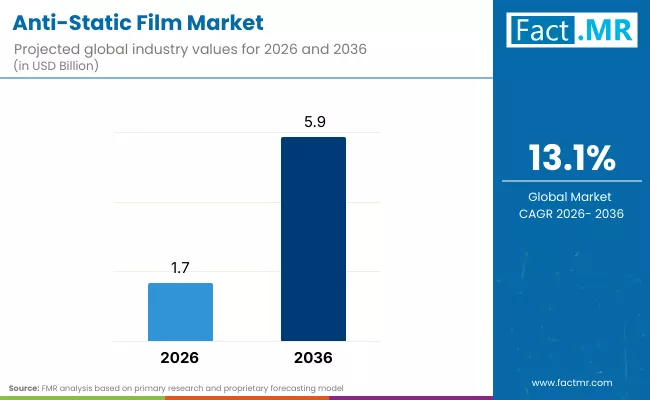
Anti Static Film Market By Industry | Source: Fact.MR
As noted by Michael Richardson, Director of Advanced Materials at TechProtect Solutions, the exponential growth in semiconductor complexity and miniaturization has made electrostatic discharge protection not just a best practice but an absolute necessity. We are witnessing a paradigm shift where anti-static films have evolved from basic protective layers to sophisticated engineered materials with precisely controlled surface resistivity, permanent static dissipation, and contamination-free performance. Companies successfully integrating advanced coating technologies, sustainable material systems, and automated quality control approaches will capture disproportionate market share in the coming years. By combining engineering innovations, circular economy principles, and supply chain optimization initiatives, leading brands align with contemporary manufacturing culture. This momentum is reinforced by strong growth in permanent anti-static formulations, reflecting industry demand for reliability, cleanroom compatibility, and reduced contamination risk.
Anti-Static Film Market
| Metric | Value |
|---|---|
| Estimated Value in (2026) | USD 1.7 billion |
| Forecast Value in (2036) | USD 5.9 billion |
| Forecast CAGR (2026 to 2036) | 13.1 % |
Source: Fact.MR analysis. Updated Feb 6, 2026
Category
| Category | Segments |
|---|---|
| Application | Electronics Packaging, Automotive Electronics, Industrial Electronics, Consumer Electronics |
| Coating Type | Conductive Coatings, Electrostatic Coatings, Organic Coatings, Carbon-Black Coatings |
| Base Film | PET Films, PP Films, PE Films, PVC Films |
| Region | North America; Europe; Asia Pacific; Latin America; Middle East & Africa |
Source: Fact.MR analysis. Updated Feb 6, 2026
Segmental Analysis
How is electronics packaging establishing dominance as the preferred application in the anti-static film market?
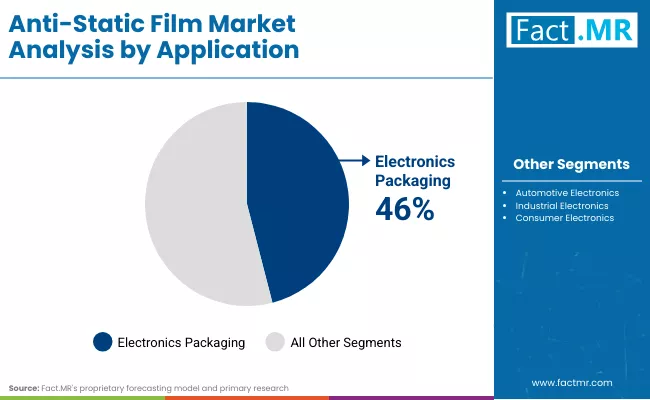
Anti Static Film Market By Application | Source: Fact.MR
Electronics packaging accounts for 46% of the anti-static film market because it provides reliable protection against electrostatic discharge. Semiconductor components are extremely sensitive to static electricity. Even minor discharge events can cause hidden defects or long-term reliability issues. Manufacturers prefer advanced anti-static films that protect components while supporting high-volume production. Permanent anti-static formulations offer consistent surface resistivity and do not rely on migratory additives. This allows safe handling across multiple process stages. These films also perform well in cleanroom environments and work with a wide range of packaging formats. As a result, they reduce defect rates without adding complex handling steps.
Why do conductive coatings maintain a leadership position in coating preferences?
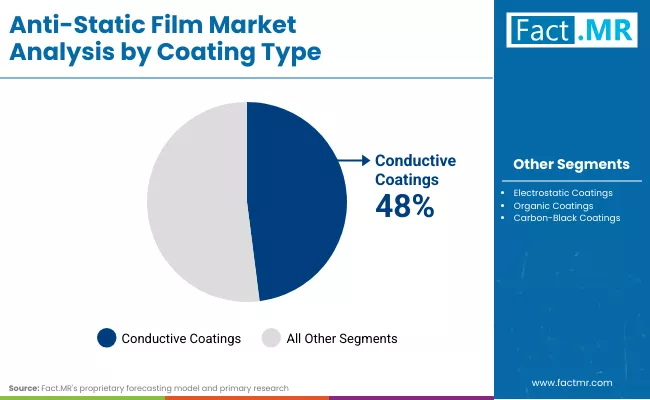
Anti Static Film Market By Coating Type | Source: Fact.MR
Conductive coatings hold 48% market share because they deliver predictable and fast static dissipation. They use carbon-based materials or metallic particles to move electrical charge away from sensitive components.
These coatings consistently maintain surface resistance between 10⁴ and 10⁶ ohms per square. This range is ideal for protecting electronics during handling and transport. Improvements in nano-particle dispersion and polymer formulation have solved earlier durability and clarity issues. Today’s conductive coatings combine long-term performance with transparency, allowing visual inspection while meeting strict cleanroom standards.
Anti-Static Film Market-Drivers, Restraints & Trends
- Drivers: Growth in semiconductor manufacturing is a major driver. New fabrication facilities are moving to advanced process nodes that demand zero-defect packaging. Leading foundries producing at three-nanometer nodes adopted permanent anti-static films in 2025 to meet tighter quality standards. Electronics are also becoming smaller and more complex. This increases the need for thin, high-performance anti-static films that protect components without adding bulk. These requirements are shaping packaging choices across global supply chains.
- Restraints: Adoption is limited in some environments. High humidity can reduce anti-static performance, especially in tropical regions where moisture barriers are also required. Cost is another challenge. Permanent anti-static additives are more expensive than standard polyethylene films. This limits adoption in price-sensitive applications. Compatibility issues with older automated packaging equipment also slow deployment in facilities using legacy systems.
- Trend 1: Sustainable anti-static solutions Sustainability is becoming a priority. Manufacturers are developing anti-static films using bio-based additives and recyclable polymers. European producers are leading this shift. Mono-material PET films with built-in anti-static properties support circular economy goals while meeting performance requirements.
- Trend 2: Smart anti-static monitoring Smart anti-static films are emerging. These films include sensors that monitor surface resistivity in real time. Japanese manufacturers are piloting this technology. It allows continuous verification of static protection throughout the supply chain. This adds value by improving quality control, traceability, and confidence beyond traditional passive packaging solutions.
Anti-Static Film Market Analysis by Key Country
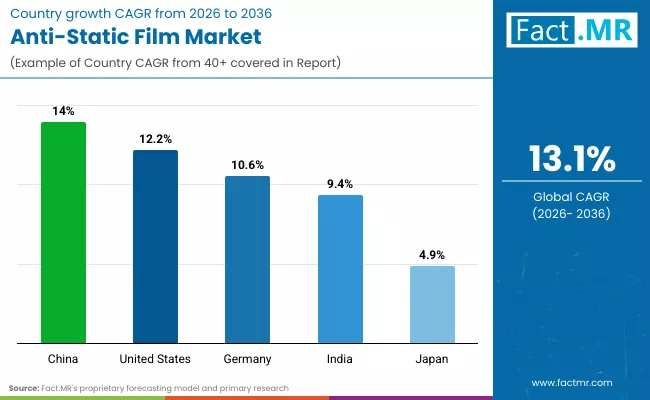
Anti Static Film Market By Country | Source: Fact.MR
| Country | CAGR (2026-2036) |
|---|---|
| China | 14.0% |
| United States | 12.2% |
| Germany | 10.6% |
| India | 9.4% |
| Japan | 4.9% |
Source: Fact.MR analysis. Updated Feb 6, 2026
What factors position China to lead global growth in anti-static film adoption?
China is the fastest-growing market, expanding at 14.0% CAGR. Growth is driven by new energy vehicle production, semiconductor localization, and export-focused electronics manufacturing. Government mandates require up to 80% localization of high-end power electronics by 2025-2026. This has increased demand for permanent anti-static packaging that supports zero-defect assembly in automotive and electronics applications. The expansion of domestic chip fabrication facilities further accelerates adoption. Companies such as Achilles Corporation are expanding electrostatic discharge film production to serve China’s EV export corridor. Policy support under Made in China 2025 continues to promote packaging optimization across electronics supply chains.
How does CHIPS Act enforcement influence United States market expansion?
The United States market grows at 12.2% CAGR, driven by Phase II enforcement of the CHIPS Act in 2026. Federal funding requirements now mandate ultra-clean electrostatic discharge packaging for wafer transport and cleanroom handling. These rules have reshaped packaging specifications. Manufacturers are rapidly adopting dissipative PET films that meet strict contamination and static control standards. Toray Plastics introduced advanced permanent anti-static films designed for precision chip fabrication. Growth reflects the strategic importance of domestic semiconductor capacity tied to national security objectives.
What role do packaging circularity regulations play in Germany’s market development?
Germany’s market expands at 10.6% CAGR, driven by enforcement of the EU Packaging and Packaging Waste Regulation starting in August 2026. Circularity requirements favor mono-material, recyclable packaging. These rules accelerate the shift toward all-polyethylene anti-static films with built-in dissipative properties. Multi-layer composite films are being phased out. Klockner Pentaplast launched recyclable anti-static films for medical and electronics packaging. Germany’s advanced recycling infrastructure continues to influence packaging decisions across Europe.
How does electronics manufacturing growth influence India’s market trajectory?
India’s anti-static film market grows at 9.4% CAGR, supported by government initiatives such as PLASTINDIA 2026 and electronics manufacturing incentive programs. The focus is on upgrading packaging readiness for advanced electronics. Manufacturers are integrating smart anti-static monitoring into production lines. Meech Shavotech India deployed real-time electrostatic monitoring systems in Pune facilities. Growth is reinforced by rising domestic electronics assembly and increased protection needs for imported semiconductors.
How do Industry 5.0 initiatives influence Japan’s market development?
Japan’s market grows at 4.9% CAGR, driven by Industry 5.0 initiatives emphasizing continuous, human-centric manufacturing. These environments require contamination-free, long-life packaging solutions. Permanent anti-static films with non-migratory additives are preferred for extended cleanroom use. Toyobo introduced hybrid films combining antiviral and anti-static functions. Growth reflects Japan’s focus on quality, reliability, and long-term performance rather than rapid volume expansion.
Competitive Landscape of the Anti-Static Film Market
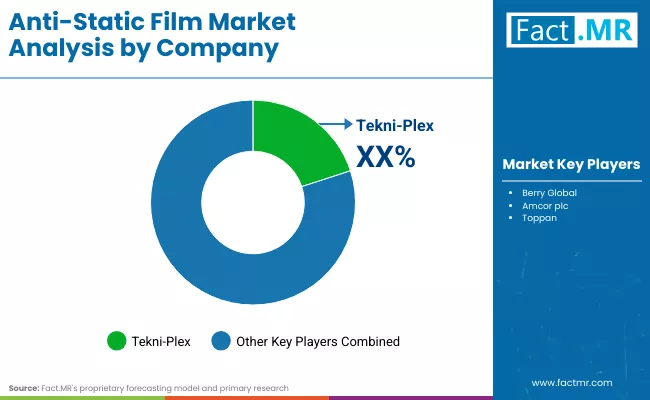
Anti Static Film Market By Company | Source: Fact.MR
Competition in the anti-static film market is increasingly shaped by specialization and scale. A small group of global specialty film manufacturers competes alongside regional coating experts, each targeting high-growth applications in semiconductors and electric vehicle electronics. As electronics become more sensitive and manufacturing tolerances tighten, demand has shifted toward films that deliver consistent electrostatic discharge protection while meeting strict contamination and reliability standards.
Companies such as Tekni-Plex have strengthened their position through advanced polymer platforms and precision co-extrusion technologies. These capabilities allow tight control over surface resistivity and film uniformity, which are critical in cleanroom environments. Berry Global benefits from its global manufacturing footprint and vertical integration, enabling it to supply customized anti-static solutions at scale for automotive electronics and industrial packaging customers. Meanwhile, Amcor differentiates through recyclable, mono-material anti-static films designed to meet evolving European sustainability and circularity regulations.
Competition now extends well beyond the film itself. Customers increasingly value application engineering support, cleanroom compatibility testing, and help integrating packaging into automated production lines. These services reduce risk and simplify implementation. As a result, switching suppliers becomes more difficult, and long-term partnerships are formed with manufacturers that can deliver performance, compliance, and sustainability as a complete solution rather than a standalone material.
Recent Development
- In December 2025, Cortec Corporation launched its EcoSonic VpCI-125 HP permanent ESD stretch film, designed to provide long-lasting electrostatic discharge protection along with corrosion inhibition for packaged goods. The new film meets static decay standards under MIL-STD-3010, Method 4046 both before and after stretch, helping maintain static dissipation throughout application and addressing concerns about limited effectiveness in traditional static-dissipative wraps.
- In November 2024–2025 (carried into 2025 market insights), EcoCortec also expanded its biodegradable and compostable static dissipative Eco-Corr Film ESD offerings, targeting sustainable anti-static packaging for electronics and automotive applications.
Key Players in Anti-Static Film Market
- Tekni-Plex
- Berry Global
- Amcor plc
- Toppan
Bibliography
- Toray Plastics Americas. 2026. Next-generation dissipative PET films for semiconductor applications. Official company press releases and technical documentation.
- Toyobo Co. Ltd. 2026. Virusweeper Hybrid antiviral anti-static film product launch. Corporate innovation announcements and SIAA Japan certification documentation.
- Achilles Corporation. 2026. NCAP PDLC and ESD film line expansion for NEV applications. Company investor relations materials and manufacturing facility announcements.
- SEMI. 2026. Semiconductor manufacturing packaging requirements and ESD protection standards. Industry association technical publications and member resources.
- Meech International. 2026. Hyperion SmartControl Touch static control system for Indian manufacturing facilities. Technical product documentation and application case studies.
- European Union. 2026. Packaging and Packaging Waste Regulation implementation guidelines. Official EU regulatory documentation and extended producer responsibility frameworks.
- Government of China. 2025. New Energy Vehicle integration policies and high-end electronics localization mandates. National Development and Reform Commission policy documentation.
- United States Congress. 2026. CHIPS and Science Act Phase II implementation requirements. Federal Register notices and Department of Commerce program guidelines.
Segmentation
Scope of Report
| Items | Values |
|---|---|
| Quantitative Units (2026) | USD 1.7 Billion |
| Application Segment | Display Protection, Automotive Glass, Mobile Devices, Optical Displays |
| Coating Technology | Matte Coatings, Nano Coatings, Light Diffusion Coatings, Anti-Reflection Coatings |
| Base Film | PET Films, Polycarbonate, Acrylic Films, PET / PC Films |
| Regions Covered | North America, Europe, Asia Pacific, Latin America, Middle East & Africa |
| Countries Covered | U.S., Canada, Germany, Italy, UK, France, Japan, Australia, and other countries |
| Key Companies Profiled | Tekni-Plex, Berry Global, Amcor plc, Toppan |
| Additional Attributes | Dollar revenue in the anti-static film market is segmented by application (electronics packaging, automotive electronics, industrial electronics, consumer electronics), coating type (conductive coatings, electrostatic coatings, organic coatings, carbon-black coatings), base film (PET films, PP films, PE films, PVC films), and region. |
Source: Fact.MR analysis. Updated Feb 6, 2026
Anti-Static Film Market by Segments
-
Application :
- Electronics Packaging
- Automotive Electronics
- Industrial Electronics
- Consumer Electronics
-
Coating Type :
- Conductive Coatings
- Electrostatic Coatings
- Organic Coatings
- Carbon-Black Coatings
-
Base Film :
- PET Films
- PP Films
- PE Films
- PVC Films
-
Region :
- Asia Pacific
- China
- India
- Japan
- South Korea
- Australia
- Rest of Asia Pacific
- North America
- United States
- Canada
- Mexico
- Europe
- Germany
- France
- UK
- Italy
- Spain
- Rest of Europe
- Latin America
- Brazil
- Mexico
- Argentina
- Rest of Latin America
- Asia Pacific
Frequently Asked Questions
How big is the global anti-static film market in 2026?
What will be the size of the anti-static film market in 2036?
How fast will the anti-static film market grow between 2026 and 2036?
Which application dominates the anti-static film market?
Which coating type holds the largest share in anti-static film?
Who worked on this report


Preview the report firsthand - request a free sample
Free SampleGet the brochure for pricing and purchase details
Download PDF