Automated Feeding System Market
Automated Feeding System Market Size and Share Forecast Outlook 2025 to 2035
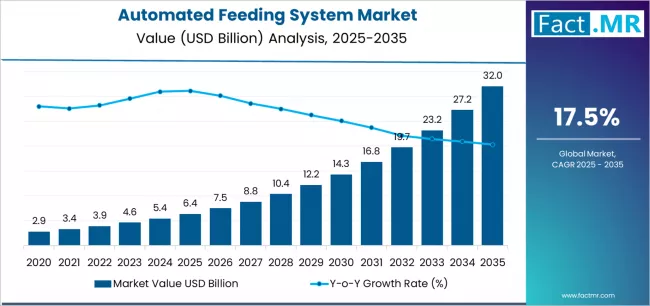
Automated feeding system market is projected to grow from USD 6.4 billion in 2025 to USD 32.0 billion by 2035, at a CAGR of 17.5%. Hardware will dominate with a 61.6% market share, while conveyor feeding system will lead the system segment with a 49.0% share.
Automated Feeding System Market Forecast and Outlook 2025 to 2035
The global automated feeding system market is projected to reach USD 32.0 billion by 2035, recording an absolute increase of USD 25.6 billion over the forecast period. The market is valued at USD 6.4 billion in 2025 and is set to rise at a CAGR of 17.5% during the assessment period.
The market is expected to grow by 5.0 times during the same period, supported by increasing demand from commercial livestock operations and expanding applications in precision farming technologies across both developed and emerging agricultural markets. Additionally, growing application diversity in dairy farm automation, poultry production system, and swine management operations creates expanding opportunities for automated feeding equipment innovation and specialized solution development.
Quick Stats for Automated Feeding System Market
- Automated Feeding System Market Value (2025): USD 6.4 billion
- Automated Feeding System Market Forecast Value (2035): USD 32.0 billion
- Automated Feeding System Market Forecast CAGR: 17.5%
- Leading Component in Automated Feeding System Market: Hardware (61.6%)
- Key Growth Regions in Automated Feeding System Market: North America, Europe, and Asia Pacific
- Top Players in Automated Feeding System Market: DeLaval, GEA Group, Lely, BouMatic, DAIRYMASTER, Trioliet, Schauer Agrotronic, Fullwood JOZ, Rovibec Agrisolutions, HETWIN Fütterungstechnik

Rising labor costs and workforce availability constraints in major agricultural nations, coupled with expanding livestock production capacity through modern farm facilities and advanced animal management infrastructure, further accelerate market penetration across diverse agricultural segments. The growing global demand for efficient livestock management, particularly in dairy and poultry applications, generates sustained requirements for automated feeding system and intelligent farm management platforms.
Technical advancements in IoT-enabled feeding technologies demonstrating measurable improvements in feed conversion efficiency, reduced labor requirements, and animal welfare optimization reinforce farmer confidence in automated feeding system economics, while sustainability sector trends toward resource-efficient farming practices expand addressable market opportunities beyond traditional livestock operations into precision agriculture supply chains.
Livestock producers and commercial farming enterprises increasingly incorporate automated feeding solutions into dairy operations, poultry houses, and swine facilities, creating mainstream adoption channels that extend beyond specialty agricultural applications into conventional farming environments.
High initial capital investment requirements for automated feeding infrastructure and technical complexity during system integration may pose challenges to market expansion. Limited technical expertise among farmers in certain regions and infrastructure constraints for power supply and connectivity also influence adoption rates, requiring manufacturers to develop accessible installation support and comprehensive training programs catering to specific operational requirements across different geographical markets.
Supply chain complexity during component procurement and the technical requirements for sensor integration, software configuration, and system maintenance operations may limit accessibility among smaller producers in developing regions with limited infrastructure for advanced livestock automation and digital farm management system.
Automated Feeding System Market Year-over-Year Forecast 2025 to 2035
Between 2025 and 2030, the automated feeding system market is projected to expand from USD 6.4 billion to USD 14.0 billion, resulting in a value increase of USD 7.6 billion, which represents 29.7% of the total forecast growth for the decade. This phase of development will be shaped by rising demand for labor-saving agricultural technologies and precision livestock management solutions, product innovation in sensor-integrated feeding platforms and AI-driven feed optimization system, as well as expanding integration with dairy farm automation initiatives and smart farming platforms. Companies are establishing competitive positions through investment in IoT-enabled feeding technology development, advanced animal monitoring capabilities, and strategic market expansion across dairy farming operations, poultry production segments, and commercial livestock applications.
From 2030 to 2035, the market is forecast to grow from USD 14.0 billion to USD 32.0 billion, adding another USD 18.0 billion, which constitutes 70.3% of the overall ten-year expansion. This period is expected to be characterized by the expansion of specialized feeding automation solutions, including targeted system configurations and customized platform integrations tailored for specific livestock applications, strategic collaborations between equipment manufacturers and farm management software providers, and an enhanced focus on sustainable feeding practices and resource efficiency optimization. The growing emphasis on animal welfare standards and climate-smart agriculture will drive demand for high-performance automated feeding solutions across diverse agricultural applications.
Automated Feeding System Market Key Takeaways
| Metric | Value |
|---|---|
| Market Value (2025) | USD 6.4 billion |
| Market Forecast Value (2035) | USD 32.0 billion |
| Forecast CAGR (2025-2035) | 17.5% |
Why is the Automated Feeding System Market Experiencing Rapid Growth?
The automated feeding system market grows by enabling livestock producers, dairy farmers, and poultry operations to access efficient feeding technologies that support animal productivity while meeting agricultural demand for consistent nutrition delivery and labor optimization.
Commercial farming enterprises and livestock management operations face mounting pressure to develop efficient production system with proven animal welfare outcomes and operational efficiency characteristics, with automated feeding platforms typically providing precise feed delivery and real-time monitoring capabilities essential for optimal animal performance and feed conversion efficiency, making these solutions essential for competitive positioning in dairy, poultry, and swine production categories.
The agricultural industry's need for reliable labor alternatives and consistent feeding protocols creates demand for diverse automation system that can provide superior feeding accuracy, maintain predictable performance across different livestock operations, and ensure animal welfare compliance without compromising production economics or operational reliability.
Government initiatives promoting sustainable agricultural practices and efficient resource utilization drive adoption in dairy production facilities, poultry operations, and commercial livestock farms, where automated feeding system implementation has a direct impact on production efficiency outcomes and animal welfare standards.
The agricultural industry's growing focus on labor shortage mitigation and operational efficiency improvements further expands market opportunities, with farming research demonstrating measurable performance advantages from automated feeding technologies, including enhanced feed conversion ratios and improved animal health monitoring.
Supply chain complexity during system component sourcing and the technical requirements for installation, integration, and maintenance operations may limit accessibility among smaller producers and developing regions with limited infrastructure for advanced livestock automation and technical support system.
Segmental Analysis
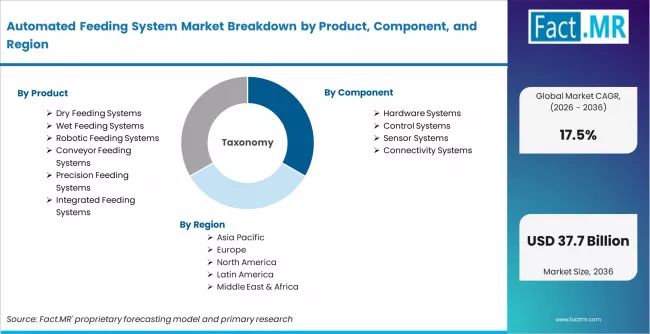
The market is segmented by component, system, livestock, and region. By component, the market is divided into hardware, software, and services. By system, the market includes conveyor feeding system, rail-guided feeding system, and self-propelled feeding system.
By livestock, the market covers ruminants, poultry, swine, and others. Regionally, the market is divided into North America, Europe, Asia Pacific, Latin America, and Middle East & Africa.
By Component, Which Category Dominates in the Automated Feeding System Market?

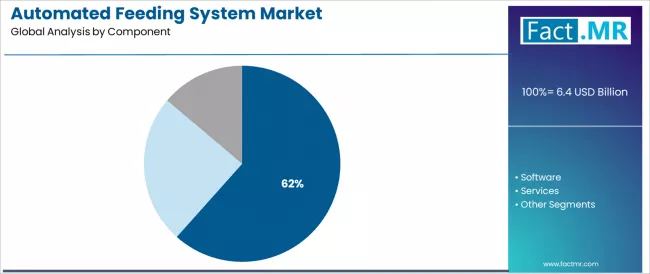
Automated feed system hardware represents the dominant force, capturing 61.6% of the total market share in 2025. This established component category encompasses solutions featuring critical physical infrastructure for feed delivery, storage, and distribution, including conveyor system, feeding stations, sensors, and control units that enable automated nutrition delivery and animal monitoring across all livestock production applications.
The hardware segment's market leadership stems from its essential role in system functionality, with hardware components capable of meeting diverse operational requirements while maintaining cost-effective installation and operational reliability across all farming environments. Within the hardware segment, feeding equipment and delivery mechanisms account for the largest investment share, driven by the fundamental infrastructure requirements for automated feeding operations across global livestock production facilities.
The software segment maintains a substantial 25.0% market share, serving farm operators who require intelligent management platforms for feed optimization, animal monitoring, and production analytics applications.
Software applications offer sophisticated farm management solutions for nutrition planning, inventory management, and performance tracking while providing sufficient system flexibility to meet operational demands and data integration requirements.
The services segment accounts for the remaining market share, serving maintenance, installation, and technical support applications requiring ongoing system optimization and farmer training for automated feeding operations.
Key advantages driving the hardware segment include:
- Established infrastructure requirements with integrated feeding equipment that reduces implementation complexity and ensures consistent feed delivery performance
- Critical functional components allowing comprehensive feeding automation across different livestock species without significant operational disruptions
- Proven durability and reliability, delivering dependable performance while maintaining competitiveness against manual feeding alternatives
- Broad agricultural acceptance enabling straightforward system specification and quality standards across multiple farming operations
Which System Configuration Leads in the Automated Feeding System Market?

The conveyor feeding system segment captures 49.0% of the market share, driven by widespread adoption in dairy operations and large-scale livestock facilities requiring continuous feed delivery capabilities. These systems offer established technology with proven reliability across various farm configurations, enabling efficient feed distribution through fixed infrastructure that minimizes labor requirements while maintaining consistent feeding schedules. Conveyor system demonstrate strength in dairy farming applications where multiple feeding stations and regular feeding intervals create compelling operational advantages.
Rail-guided feeding system maintains a 32.0% market share, serving operations that require flexible feed distribution across larger facility footprints. These mobile feeding solutions provide versatility for farms with dispersed animal housing or varied feeding locations, offering programmable routes and customizable delivery schedules that accommodate different operational layouts. The self-propelled feeding system segment accounts for the remaining market share, serving specialized applications requiring maximum flexibility and independent operation capabilities across diverse farm configurations.
Which Livestock Category Account for the Highest Proportion of Automated Feeding System Usage?

The ruminants segment dominates with a 46.0% market share, reflecting the substantial global dairy and beef cattle populations requiring automated feeding solutions. Dairy operations particularly drive this segment, with automated feeding system delivering measurable improvements in milk production efficiency and herd management capabilities. The segment benefits from established dairy industry infrastructure and increasing farm consolidation trends that favor automation investments for improved operational efficiency and animal welfare outcomes.
The poultry segment captures approximately 28.0% market share, driven by intensive production system and high stocking densities in commercial poultry operations. Automated feeding solutions in poultry applications enable precise feed delivery, reduced waste, and improved bird performance across broiler and layer operations. The swine and others segments account for the remaining market share, serving pig farming operations and alternative livestock species requiring specialized feeding automation tailored to specific nutritional requirements and production system.
What are the Drivers, Restraints, and Key Trends of the Automated Feeding System Market?
The market is driven by three concrete demand factors tied to agricultural transformation and technological advancement. First, increasing labor costs and workforce availability constraints create growing demand for automated feeding solutions, with agricultural labor shortages affecting 60-70% of commercial livestock operations in developed markets worldwide, requiring comprehensive automation infrastructure. Second, expanding precision livestock farming adoption and smart agriculture initiatives drives increased implementation of sensor-enabled feeding system, with many farm operators implementing digital transformation programs for livestock management by 2030. Third, technological advancements in IoT connectivity, artificial intelligence, and data analytics enable more effective and efficient feeding optimization that reduces feed waste while improving animal performance and production efficiency capabilities.
Market restraints include high upfront capital investment requirements for automated feeding infrastructure that can deter smaller farming operations from adopting advanced automation technologies, particularly in regions where agricultural financing mechanisms face accessibility constraints or risk assessment limitations. Technical complexity and integration challenges pose another significant barrier, as automated feeding system require proper installation, calibration, and ongoing maintenance support, potentially causing increased implementation costs and operational disruption during adoption phases. Infrastructure limitations including power supply reliability and internet connectivity across rural farming regions create additional market challenges for technology deployment, demanding ongoing investment in rural infrastructure development and connectivity improvement initiatives.
Key trends indicate accelerated adoption in North American and European markets, particularly USA and Germany, where labor market conditions and regulatory frameworks drive comprehensive automated feeding system implementation. Technology integration trends toward cloud-based farm management platforms with remote monitoring capabilities, predictive analytics functionalities, and automated alert system enable optimized feeding approaches that reduce operational oversight requirements and maximize production efficiency. However, the market thesis could face disruption if significant advances in alternative livestock management technologies or major shifts in agricultural production economics reduce reliance on capital-intensive automation investments.
Analysis of the Automated Feeding System Market by Key Countries

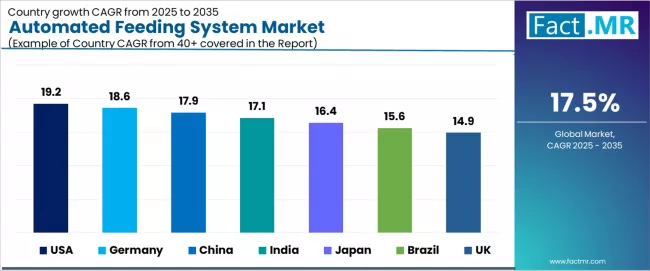
| Country | CAGR (2025 to 2035) |
|---|---|
| USA | 19.2% |
| Germany | 18.6% |
| China | 17.9% |
| India | 17.1% |
| Japan | 16.4% |
| Brazil | 15.6% |
| UK | 14.9% |
The automated feeding system market is expanding rapidly, with USA leading at a 19.2% CAGR through 2035, driven by strong adoption of AI-driven livestock automation solutions and high labor costs motivating efficiency investments. Germany follows at 18.6%, supported by precision livestock farming leadership, comprehensive sustainability regulations, and advanced agricultural technology infrastructure.
China records 17.9%, reflecting rapid farm industrialization, government funding support, and accelerated modernization of commercial livestock operations. India posts 17.1%, anchored by expanding dairy sector growth and rising protein consumption driving farm mechanization.
Japan grows at 16.4%, with severe labor shortages compelling automation adoption and advanced technology integration capabilities. Brazil advances at 15.6%, emphasizing commercial poultry and beef production growth with increasing farm scale and efficiency requirements, while UK grows steadily at 14.9%, focusing on modernization initiatives and climate-resilient livestock management strategies.
USA Leads Global Market Expansion

USA demonstrates the strongest growth potential in the automated feeding system market with a CAGR of 19.2% through 2035. The country's leadership position stems from severe agricultural labor shortages, advanced technology adoption culture, and increasing commercial farm consolidation enabling mainstream automated feeding implementation.
Growth is concentrated in major dairy regions, including Wisconsin, California, New York, and Pennsylvania, where large-scale operations and established agricultural infrastructure are implementing automated feeding technologies for enhanced production efficiency and labor optimization.
Distribution channels through agricultural equipment dealers, direct manufacturer relationships, and farm technology integrators expand deployment across dairy farms and livestock operations. The country's established agricultural sector provides comprehensive support infrastructure for technology adoption, including financing programs for capital equipment investments.
Key market factors:
- Agricultural demand concentrated in dairy farming operations and large-scale livestock facilities with comprehensive automation requirements
- Infrastructure development through rural broadband expansion and power grid improvements supporting technology deployment
- Comprehensive agricultural ecosystem, including established equipment distribution networks with proven technical support capabilities
- Technology integration featuring advanced AI-driven platforms, cloud-based management system, and real-time monitoring technologies
Germany Emerges as Precision Farming Leader
In major agricultural regions including Bavaria, Lower Saxony, North Rhine-Westphalia, and Baden-Württemberg, the adoption of automated feeding system is accelerating across dairy operations and livestock management facilities, driven by sustainability regulations and precision farming initiatives.
The market demonstrates strong growth momentum with a CAGR of 18.6% through 2035, linked to government agricultural modernization policies, stringent animal welfare standards, and sustained demand for efficient livestock production system. German farmers are implementing advanced automated feeding technologies and sensor-integrated platforms to enhance operational efficiency while meeting rigorous environmental compliance and animal welfare requirements.
The country's sustainable agriculture initiatives create persistent demand for efficient feeding technologies, while increasing emphasis on carbon footprint reduction drives adoption of resource-optimized feeding automation system.
Key development areas:
- Dairy and livestock operations leading automated feeding adoption with comprehensive precision farming programs
- Integrated farm management platforms providing efficient data utilization with extensive analytics infrastructure
- Technology partnerships between equipment manufacturers and agricultural software providers are expanding system capabilities
- Integration of sustainability monitoring system and comprehensive environmental performance tracking protocols
China Shows Rapid Industrialization Momentum
China's market expansion is driven by agricultural modernization policies, including large-scale dairy and livestock facility development in Heilongjiang, Inner Mongolia, Shandong, and Henan provinces, and expanding commercial farming operations across multiple agricultural regions.
The country demonstrates promising growth potential with a CAGR of 17.9% through 2035, supported by government agricultural transformation initiatives, increasing farm scale operations, and growing integration with food security strategies. Chinese producers face implementation challenges related to technical expertise development and service infrastructure establishment, requiring investment in training programs and support from international technology providers.
However, growing livestock production volumes and government policy support create compelling business cases for automated feeding adoption, particularly in regions where commercial farming operations have a direct impact on national food security objectives.
Key market characteristics:
- Commercial dairy and intensive livestock operations showing fastest growth with substantial increase in automation requirements
- Regional expansion trends focused on major agricultural provinces in northern and northeastern regions
- Future projections indicate the need for expanded technical support infrastructure and farmer training program development
- Growing emphasis on food safety standards and production efficiency optimization in commercial operations
India Demonstrates Dairy Sector Expansion
The Indian market leads in emerging agricultural automation based on integration with expanding dairy sector operations and increasing commercial livestock production for enhanced productivity outcomes. The country shows significant potential with a CAGR of 17.1% through 2035, driven by world's largest dairy industry presence, growing protein consumption patterns, and the expansion of cooperative dairy networks in major production centers, including Gujarat, Uttar Pradesh, Punjab, and Rajasthan.
Indian dairy operators are adopting automated feeding system for productivity optimization and quality improvement applications, particularly in regions with progressive farming practices and access to agricultural financing programs. Technology deployment channels through cooperative societies and agricultural development agencies expand coverage across commercial dairy farms and livestock producers.
Leading market segments:
- Dairy cooperative networks and commercial milk production facilities implementing comprehensive automation programs
- Strategic partnerships with agricultural equipment suppliers, achieving accessible financing options and technical support services
- Collaborative initiatives between government agricultural departments and private sector technology providers are expanding adoption capabilities
- Focus on productivity enhancement and operational efficiency improvements through technology adoption
Japan Emphasizes Labor Shortage Solutions

In major agricultural regions including Hokkaido, Iwate, Tochigi, and Kumamoto, dairy producers and livestock operators are implementing comprehensive automated feeding strategies to address severe labor shortage challenges and maintain production viability, with documented case studies showing significant operational efficiency improvements through advanced automation technologies and robotic feeding system.
The market shows steady growth potential with a CAGR of 16.4% through 2035, linked to critical agricultural workforce constraints, aging farmer demographics, and ongoing technology innovation in precision livestock management system. Japanese producers are adopting sophisticated automated feeding platforms and intelligent management system to enhance farm sustainability while addressing labor availability challenges demanded by shrinking agricultural workforce populations. The country's advanced technology infrastructure creates persistent demand for high-quality automation solutions and comprehensive technical support that integrate with existing farm operations.
Market development factors:
- Dairy producers and livestock operators leading automated feeding adoption across Japan
- Government agricultural policies and rural development initiatives providing support for farm mechanization investments
- Strategic relationships between Japanese farmers and international technology suppliers are expanding automation accessibility
- Emphasis on operational efficiency and production sustainability across aging farming operations
Brazil Shows Commercial Agriculture Growth
Brazil's automated feeding system market demonstrates competitive positioning focused on commercial poultry and beef production operations, with documented adoption of automated feeding technologies achieving improved production efficiency and feed conversion performance in large-scale operations across Paraná, Santa Catarina, and Goiás.
The country maintains steady growth momentum with a CAGR of 15.6% through 2035, driven by expanding commercial livestock sector, increasing export market requirements, and strategic investments in agricultural modernization. Major production regions, including southern and central-western states, showcase advanced deployment of automated feeding operations where scale economics support investment justification and comprehensive production optimization programs.
Key market characteristics:
- Commercial poultry and beef production operations driving automated feeding adoption with emphasis on efficiency and scale advantages
- Export market requirements enabling quality standardization demands with comprehensive production management programs
- Technology collaboration between Brazilian agricultural companies and international equipment manufacturers is expanding market capabilities
- Emphasis on production efficiency and international competitiveness improvement methodologies
UK Emphasizes Modernization Initiatives
UK's automated feeding system market demonstrates focused and efficiency-driven landscape, characterized by strategic integration of automation technologies with existing livestock operations across modernization initiatives in England, Scotland, Wales, and Northern Ireland. The country shows steady growth momentum with a CAGR of 14.9% through 2035, driven by agricultural productivity improvement programs, climate-resilient farming strategies, and post-Brexit agricultural policy frameworks supporting domestic food production capabilities.
The emphasis on sustainable farming practices and animal welfare excellence creates requirements for advanced automated feeding solutions that support comprehensive farm management initiatives and stringent regulatory compliance in livestock operations. The market benefits from strong partnerships between domestic farmers and agricultural technology providers, creating comprehensive support ecosystem that prioritize operational efficiency and environmental sustainability.
Key market characteristics:
- Dairy and livestock producers driving automation requirements with emphasis on sustainability and welfare standards
- Agricultural policy frameworks enabling farm modernization support with comprehensive grant programs
- Technology collaboration between UK farmers and equipment suppliers is expanding adoption capabilities
- Emphasis on climate-smart agriculture and production resilience optimization methodologies
Europe Market Split by Country

The automated feeding system market in Europe is projected to grow from USD 1.5 billion in 2025 to USD 7.2 billion by 2035, registering a CAGR of 17.0% over the forecast period. Germany is expected to maintain its leadership position with a 29.4% market share in 2025, supported by its advanced dairy farming infrastructure, comprehensive precision agriculture programs, and strong livestock industry presence across major agricultural regions.
France follows with a 22.1% share in 2025, driven by established dairy production operations and integrated livestock management system. Netherlands holds a 18.7% share in 2025 through its intensive dairy farming practices and technology-forward agricultural sector. UK commands a 15.3% share, while Rest of Europe accounts for 14.5% in 2025.
By 2035, Germany is projected to hold 28.9% share, France 22.4%, Netherlands 19.1%, UK 15.0%, and Rest of Europe 14.6%, reflecting sustained growth momentum across all major European markets and increasing automated feeding system adoption in diversified livestock operations implementing advanced farm management programs.
Competitive Landscape of the Automated Feeding System Market

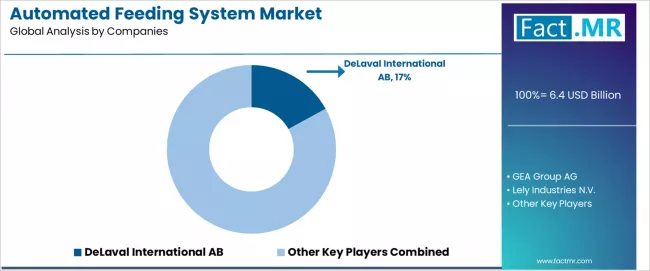
The automated feeding system market features approximately 20-25 meaningful players with moderate concentration, where the top three companies control roughly 40-50% of global market share through established manufacturing capabilities and extensive distribution networks across agricultural equipment sectors.
Market leaders include DeLaval International AB, GEA Group, and Lely, which maintain competitive advantages through comprehensive automated feeding portfolios, global service networks, and deep expertise in the livestock automation and precision farming sectors, creating strong customer relationships among dairy producers and commercial livestock operators.
These companies leverage established brand recognition and ongoing product innovation initiatives to defend market positions while expanding into adjacent farm automation applications and digital agriculture platforms. DeLaval commands a 17.0% market share through integrated dairy management solutions and strategic positioning in developed agricultural markets.
Challengers encompass BouMatic, Dairymaster, and Trioliet, which compete through specialized product offerings and strong regional presence in key dairy farming markets. Specialty manufacturers, including Schauer Agrotronic, Fullwood JOZ, and Rovibec Agrisolutions, focus on specific livestock segments or technology niches, offering differentiated capabilities in system customization, technical innovation, and application-specific solutions.
Regional players and emerging manufacturers create competitive pressure through localized service capabilities and cost-competitive product offerings, particularly in high-growth markets including China and India, where local presence provides advantages in after-sales support and farmer relationship management.
Market dynamics favor companies that combine proven feeding technology with comprehensive service infrastructure that addresses the complete value chain from system design through installation, maintenance, and ongoing technical support. Strategic investments in IoT integration capabilities and digital platform development enable enhanced farm management functionality and data-driven optimization across feeding operations.
Global Automated Feeding System Market - Stakeholder Contribution Framework
Automated feeding system represents a critical agricultural technology that enables livestock producers, dairy farmers, and commercial operations to enhance production efficiency and animal welfare without substantial operational disruption, typically providing essential labor optimization and feed management capabilities while supporting diverse farming applications.
With the market projected to grow from USD 6.4 billion in 2025 to USD 32.0 billion by 2035 at a 17.5% CAGR, these solutions offer compelling advantages - consistent feeding accuracy, significant labor savings, and improved animal performance outcomes - making them essential for dairy operations (largest livestock segment), poultry production (expanding adoption), and diverse agricultural applications seeking proven efficiency technologies. Scaling adoption and market development requires coordinated action across agricultural policy, industry associations, equipment manufacturers, technology providers, and research institutions.
How Governments Could Spur Local Adoption and Infrastructure?
- Agricultural Modernization Programs: Include automated feeding system in national farming development strategies, providing targeted subsidies for livestock automation investments in priority agricultural regions and supporting farmer adoption through accessible financing mechanisms and technical assistance programs.
- Rural Infrastructure Development: Implement comprehensive broadband connectivity expansion for rural farming areas, provide reliable power grid infrastructure for automated equipment operations, and establish technical support networks that enable technology deployment across dispersed agricultural regions.
- Policy Incentives & Financial Support: Create favorable loan programs for farm mechanization investments, establish tax incentives for agricultural technology adoption, and develop risk-sharing mechanisms that facilitate automation investments among small and medium-scale farming operations.
- Skills Development & Training: Fund technical education programs for farm equipment operators, maintenance technicians, and agricultural technology specialists. Invest in knowledge transfer initiatives that bridge equipment manufacturers with farming communities and extension service networks.
How Industry Bodies Could Support Market Development?
- Standards & Certification Programs: Define standardized performance specifications for automated feeding system across dairy, poultry, and livestock applications, establish universal safety protocols and quality metrics, and create certification frameworks for equipment reliability that farmers can trust.
- Market Education & Best Practices: Lead communication initiatives that demonstrate automated feeding benefits, emphasizing proven productivity improvements, labor cost savings, and animal welfare advantages compared to manual feeding methods and traditional farm management approaches.
- Sustainability Guidelines: Develop environmental performance benchmarks for livestock feeding operations, comprehensive resource efficiency methodologies, and animal welfare best practices, ensuring responsible farming across different production system and operational scales.
How Manufacturers and Technology Players Could Strengthen the Ecosystem?
- Product Innovation & Development: Develop next-generation feeding automation platforms with enhanced sensor integration capabilities, improved AI-driven optimization algorithms, and application-specific features that enhance feeding precision while improving farm management economics and animal performance outcomes.
- Technical Support Infrastructure: Provide comprehensive installation services that integrate equipment setup, system calibration, operator training, and ongoing maintenance support, enabling farmers to maximize technology benefits and operational efficiency.
- Financing Solutions & Partnerships: Offer flexible payment arrangements for dairy producers and livestock operators, including leasing programs, performance-based contracts, and equipment financing pathways that keep automated feeding system accessible for farming operations across different economic scales.
Key Players in the Automated Feeding System Market
- DeLaval International AB
- GEA Group AG
- Lely Industries N.V.
- BouMatic LLC
- Dairymaster
- Trioliet B.V.
- Schauer Agrotronic GmbH
- Fullwood JOZ B.V.
- Rovibec Agrisolutions Inc.
- HETWIN Fütterungstechnik GmbH
Scope of the Report
| Items | Values |
|---|---|
| Quantitative Units | USD 6.4 Billion |
| Component | Hardware, Software, Services |
| System | Conveyor Feeding System, Rail-Guided Feeding System, Self-Propelled Feeding System |
| Livestock | Ruminants, Poultry, Swine, Others |
| Regions Covered | North America, Europe, Asia Pacific, Latin America, Middle East & Africa |
| Country Covered | USA, Germany, China, India, Japan, Brazil, UK, and 40+ countries |
| Key Companies Profiled | DeLaval, GEA Group, Lely, BouMatic, DAIRYMASTER, Trioliet, Schauer Agrotronic, Fullwood JOZ, Rovibec Agrisolutions, HETWIN Fütterungstechnik |
| Additional Attributes | Dollar sales by component categories, system configurations, and livestock segments, regional adoption trends across North America, Europe, and Asia Pacific, competitive landscape with equipment manufacturers and technology providers, technical specifications and performance requirements, integration with farm management platforms and precision agriculture system. |
Automated Feeding System Market by Segments
-
Component :
- Hardware
- Software
- Services
-
System :
- Conveyor Feeding System
- Rail-Guided Feeding System
- Self-Propelled Feeding System
-
Livestock :
- Ruminants
- Poultry
- Swine
- Others
-
Region :
- North America
- USA
- Canada
- Mexico
- Europe
- Germany
- France
- UK
- Netherlands
- Rest of Europe
- Asia Pacific
- China
- India
- Japan
- Australia & New Zealand
- Rest of Asia Pacific
- Latin America
- Brazil
- Rest of Latin America
- Middle East & Africa
- Kingdom of Saudi Arabia
- Other GCC Countries
- Turkey
- South Africa
- Rest of Middle East & Africa
- North America
Table of Content
- Executive Summary
- Global Market Outlook
- Demand to side Trends
- Supply to side Trends
- Technology Roadmap Analysis
- Analysis and Recommendations
- Market Overview
- Market Coverage / Taxonomy
- Market Definition / Scope / Limitations
- Market Background
- Market Dynamics
- Drivers
- Restraints
- Opportunity
- Trends
- Scenario Forecast
- Demand in Optimistic Scenario
- Demand in Likely Scenario
- Demand in Conservative Scenario
- Opportunity Map Analysis
- Product Life Cycle Analysis
- Supply Chain Analysis
- Investment Feasibility Matrix
- Value Chain Analysis
- PESTLE and Porter’s Analysis
- Regulatory Landscape
- Regional Parent Market Outlook
- Production and Consumption Statistics
- Import and Export Statistics
- Market Dynamics
- Global Market Analysis 2020 to 2024 and Forecast, 2025 to 2035
- Historical Market Size Value (USD Million) Analysis, 2020 to 2024
- Current and Future Market Size Value (USD Million) Projections, 2025 to 2035
- Y to o to Y Growth Trend Analysis
- Absolute $ Opportunity Analysis
- Global Market Pricing Analysis 2020 to 2024 and Forecast 2025 to 2035
- Global Market Analysis 2020 to 2024 and Forecast 2025 to 2035, By Component
- Introduction / Key Findings
- Historical Market Size Value (USD Million) Analysis By Component, 2020 to 2024
- Current and Future Market Size Value (USD Million) Analysis and Forecast By Component, 2025 to 2035
- Hardware
- Software
- Services
- Y to o to Y Growth Trend Analysis By Component, 2020 to 2024
- Absolute $ Opportunity Analysis By Component, 2025 to 2035
- Global Market Analysis 2020 to 2024 and Forecast 2025 to 2035, By System
- Introduction / Key Findings
- Historical Market Size Value (USD Million) Analysis By System, 2020 to 2024
- Current and Future Market Size Value (USD Million) Analysis and Forecast By System, 2025 to 2035
- Conveyor Feeding System
- Rail-Guided Feeding System
- Self-Propelled Feeding System
- Y to o to Y Growth Trend Analysis By System, 2020 to 2024
- Absolute $ Opportunity Analysis By System, 2025 to 2035
- Global Market Analysis 2020 to 2024 and Forecast 2025 to 2035, By Livestock
- Introduction / Key Findings
- Historical Market Size Value (USD Million) Analysis By Livestock, 2020 to 2024
- Current and Future Market Size Value (USD Million) Analysis and Forecast By Livestock, 2025 to 2035
- Ruminants
- Poultry
- Swine
- Others
- Y to o to Y Growth Trend Analysis By Livestock, 2020 to 2024
- Absolute $ Opportunity Analysis By Livestock, 2025 to 2035
- Global Market Analysis 2020 to 2024 and Forecast 2025 to 2035, By Region
- Introduction
- Historical Market Size Value (USD Million) Analysis By Region, 2020 to 2024
- Current Market Size Value (USD Million) Analysis and Forecast By Region, 2025 to 2035
- North America
- Latin America
- Western Europe
- Eastern Europe
- East Asia
- South Asia and Pacific
- Middle East & Africa
- Market Attractiveness Analysis By Region
- North America Market Analysis 2020 to 2024 and Forecast 2025 to 2035, By Country
- Historical Market Size Value (USD Million) Trend Analysis By Market Taxonomy, 2020 to 2024
- Market Size Value (USD Million) Forecast By Market Taxonomy, 2025 to 2035
- By Country
- USA
- Canada
- Mexico
- By Component
- By System
- By Livestock
- By Country
- Market Attractiveness Analysis
- By Country
- By Component
- By System
- By Livestock
- Key Takeaways
- Latin America Market Analysis 2020 to 2024 and Forecast 2025 to 2035, By Country
- Historical Market Size Value (USD Million) Trend Analysis By Market Taxonomy, 2020 to 2024
- Market Size Value (USD Million) Forecast By Market Taxonomy, 2025 to 2035
- By Country
- Brazil
- Chile
- Rest of Latin America
- By Component
- By System
- By Livestock
- By Country
- Market Attractiveness Analysis
- By Country
- By Component
- By System
- By Livestock
- Key Takeaways
- Western Europe Market Analysis 2020 to 2024 and Forecast 2025 to 2035, By Country
- Historical Market Size Value (USD Million) Trend Analysis By Market Taxonomy, 2020 to 2024
- Market Size Value (USD Million) Forecast By Market Taxonomy, 2025 to 2035
- By Country
- Germany
- UK
- Italy
- Spain
- France
- Nordic
- BENELUX
- Rest of Western Europe
- By Component
- By System
- By Livestock
- By Country
- Market Attractiveness Analysis
- By Country
- By Component
- By System
- By Livestock
- Key Takeaways
- Eastern Europe Market Analysis 2020 to 2024 and Forecast 2025 to 2035, By Country
- Historical Market Size Value (USD Million) Trend Analysis By Market Taxonomy, 2020 to 2024
- Market Size Value (USD Million) Forecast By Market Taxonomy, 2025 to 2035
- By Country
- Russia
- Poland
- Hungary
- Balkan & Baltic
- Rest of Eastern Europe
- By Component
- By System
- By Livestock
- By Country
- Market Attractiveness Analysis
- By Country
- By Component
- By System
- By Livestock
- Key Takeaways
- East Asia Market Analysis 2020 to 2024 and Forecast 2025 to 2035, By Country
- Historical Market Size Value (USD Million) Trend Analysis By Market Taxonomy, 2020 to 2024
- Market Size Value (USD Million) Forecast By Market Taxonomy, 2025 to 2035
- By Country
- China
- Japan
- South Korea
- By Component
- By System
- By Livestock
- By Country
- Market Attractiveness Analysis
- By Country
- By Component
- By System
- By Livestock
- Key Takeaways
- South Asia and Pacific Market Analysis 2020 to 2024 and Forecast 2025 to 2035, By Country
- Historical Market Size Value (USD Million) Trend Analysis By Market Taxonomy, 2020 to 2024
- Market Size Value (USD Million) Forecast By Market Taxonomy, 2025 to 2035
- By Country
- India
- ASEAN
- Australia & New Zealand
- Rest of South Asia and Pacific
- By Component
- By System
- By Livestock
- By Country
- Market Attractiveness Analysis
- By Country
- By Component
- By System
- By Livestock
- Key Takeaways
- Middle East & Africa Market Analysis 2020 to 2024 and Forecast 2025 to 2035, By Country
- Historical Market Size Value (USD Million) Trend Analysis By Market Taxonomy, 2020 to 2024
- Market Size Value (USD Million) Forecast By Market Taxonomy, 2025 to 2035
- By Country
- Kingdom of Saudi Arabia
- Other GCC Countries
- Turkiye
- South Africa
- Other African Union
- Rest of Middle East & Africa
- By Component
- By System
- By Livestock
- By Country
- Market Attractiveness Analysis
- By Country
- By Component
- By System
- By Livestock
- Key Takeaways
- Key Countries Market Analysis
- USA
- Pricing Analysis
- Market Share Analysis, 2024
- By Component
- By System
- By Livestock
- Canada
- Pricing Analysis
- Market Share Analysis, 2024
- By Component
- By System
- By Livestock
- Mexico
- Pricing Analysis
- Market Share Analysis, 2024
- By Component
- By System
- By Livestock
- Brazil
- Pricing Analysis
- Market Share Analysis, 2024
- By Component
- By System
- By Livestock
- Chile
- Pricing Analysis
- Market Share Analysis, 2024
- By Component
- By System
- By Livestock
- Germany
- Pricing Analysis
- Market Share Analysis, 2024
- By Component
- By System
- By Livestock
- UK
- Pricing Analysis
- Market Share Analysis, 2024
- By Component
- By System
- By Livestock
- Italy
- Pricing Analysis
- Market Share Analysis, 2024
- By Component
- By System
- By Livestock
- Spain
- Pricing Analysis
- Market Share Analysis, 2024
- By Component
- By System
- By Livestock
- France
- Pricing Analysis
- Market Share Analysis, 2024
- By Component
- By System
- By Livestock
- India
- Pricing Analysis
- Market Share Analysis, 2024
- By Component
- By System
- By Livestock
- ASEAN
- Pricing Analysis
- Market Share Analysis, 2024
- By Component
- By System
- By Livestock
- Australia & New Zealand
- Pricing Analysis
- Market Share Analysis, 2024
- By Component
- By System
- By Livestock
- China
- Pricing Analysis
- Market Share Analysis, 2024
- By Component
- By System
- By Livestock
- Japan
- Pricing Analysis
- Market Share Analysis, 2024
- By Component
- By System
- By Livestock
- South Korea
- Pricing Analysis
- Market Share Analysis, 2024
- By Component
- By System
- By Livestock
- Russia
- Pricing Analysis
- Market Share Analysis, 2024
- By Component
- By System
- By Livestock
- Poland
- Pricing Analysis
- Market Share Analysis, 2024
- By Component
- By System
- By Livestock
- Hungary
- Pricing Analysis
- Market Share Analysis, 2024
- By Component
- By System
- By Livestock
- Kingdom of Saudi Arabia
- Pricing Analysis
- Market Share Analysis, 2024
- By Component
- By System
- By Livestock
- Turkiye
- Pricing Analysis
- Market Share Analysis, 2024
- By Component
- By System
- By Livestock
- South Africa
- Pricing Analysis
- Market Share Analysis, 2024
- By Component
- By System
- By Livestock
- USA
- Market Structure Analysis
- Competition Dashboard
- Competition Benchmarking
- Market Share Analysis of Top Players
- By Regional
- By Component
- By System
- By Livestock
- Competition Analysis
- Competition Deep Dive
- DeLaval International AB
- Overview
- Product Portfolio
- Profitability by Market Segments (Product/Age /Sales Channel/Region)
- Sales Footprint
- Strategy Overview
- Marketing Strategy
- Product Strategy
- Channel Strategy
- GEA Group AG
- Lely Industries N.V.
- BouMatic LLC
- Dairymaster
- Trioliet B.V.
- Schauer Agrotronic GmbH
- Fullwood JOZ B.V.
- Rovibec Agrisolutions Inc.
- HETWIN Fütterungstechnik GmbH
- DeLaval International AB
- Competition Deep Dive
- Assumptions & Acronyms Used
- Research Methodology
List Of Table
- Table 1: Global Market Value (USD Million) Forecast by Region, 2020 to 2035
- Table 2: Global Market Value (USD Million) Forecast by Component, 2020 to 2035
- Table 3: Global Market Value (USD Million) Forecast by System, 2020 to 2035
- Table 4: Global Market Value (USD Million) Forecast by Livestock, 2020 to 2035
- Table 5: North America Market Value (USD Million) Forecast by Country, 2020 to 2035
- Table 6: North America Market Value (USD Million) Forecast by Component, 2020 to 2035
- Table 7: North America Market Value (USD Million) Forecast by System, 2020 to 2035
- Table 8: North America Market Value (USD Million) Forecast by Livestock, 2020 to 2035
- Table 9: Latin America Market Value (USD Million) Forecast by Country, 2020 to 2035
- Table 10: Latin America Market Value (USD Million) Forecast by Component, 2020 to 2035
- Table 11: Latin America Market Value (USD Million) Forecast by System, 2020 to 2035
- Table 12: Latin America Market Value (USD Million) Forecast by Livestock, 2020 to 2035
- Table 13: Western Europe Market Value (USD Million) Forecast by Country, 2020 to 2035
- Table 14: Western Europe Market Value (USD Million) Forecast by Component, 2020 to 2035
- Table 15: Western Europe Market Value (USD Million) Forecast by System, 2020 to 2035
- Table 16: Western Europe Market Value (USD Million) Forecast by Livestock, 2020 to 2035
- Table 17: Eastern Europe Market Value (USD Million) Forecast by Country, 2020 to 2035
- Table 18: Eastern Europe Market Value (USD Million) Forecast by Component, 2020 to 2035
- Table 19: Eastern Europe Market Value (USD Million) Forecast by System, 2020 to 2035
- Table 20: Eastern Europe Market Value (USD Million) Forecast by Livestock, 2020 to 2035
- Table 21: East Asia Market Value (USD Million) Forecast by Country, 2020 to 2035
- Table 22: East Asia Market Value (USD Million) Forecast by Component, 2020 to 2035
- Table 23: East Asia Market Value (USD Million) Forecast by System, 2020 to 2035
- Table 24: East Asia Market Value (USD Million) Forecast by Livestock, 2020 to 2035
- Table 25: South Asia and Pacific Market Value (USD Million) Forecast by Country, 2020 to 2035
- Table 26: South Asia and Pacific Market Value (USD Million) Forecast by Component, 2020 to 2035
- Table 27: South Asia and Pacific Market Value (USD Million) Forecast by System, 2020 to 2035
- Table 28: South Asia and Pacific Market Value (USD Million) Forecast by Livestock, 2020 to 2035
- Table 29: Middle East & Africa Market Value (USD Million) Forecast by Country, 2020 to 2035
- Table 30: Middle East & Africa Market Value (USD Million) Forecast by Component, 2020 to 2035
- Table 31: Middle East & Africa Market Value (USD Million) Forecast by System, 2020 to 2035
- Table 32: Middle East & Africa Market Value (USD Million) Forecast by Livestock, 2020 to 2035
List Of Figures
- Figure 1: Global Market Pricing Analysis
- Figure 2: Global Market Value (USD Million) Forecast 2020 to 2035
- Figure 3: Global Market Value Share and BPS Analysis by Component, 2025 and 2035
- Figure 4: Global Market Y to o to Y Growth Comparison by Component, 2025 to 2035
- Figure 5: Global Market Attractiveness Analysis by Component
- Figure 6: Global Market Value Share and BPS Analysis by System, 2025 and 2035
- Figure 7: Global Market Y to o to Y Growth Comparison by System, 2025 to 2035
- Figure 8: Global Market Attractiveness Analysis by System
- Figure 9: Global Market Value Share and BPS Analysis by Livestock, 2025 and 2035
- Figure 10: Global Market Y to o to Y Growth Comparison by Livestock, 2025 to 2035
- Figure 11: Global Market Attractiveness Analysis by Livestock
- Figure 12: Global Market Value (USD Million) Share and BPS Analysis by Region, 2025 and 2035
- Figure 13: Global Market Y to o to Y Growth Comparison by Region, 2025 to 2035
- Figure 14: Global Market Attractiveness Analysis by Region
- Figure 15: North America Market Incremental Dollar Opportunity, 2025 to 2035
- Figure 16: Latin America Market Incremental Dollar Opportunity, 2025 to 2035
- Figure 17: Western Europe Market Incremental Dollar Opportunity, 2025 to 2035
- Figure 18: Eastern Europe Market Incremental Dollar Opportunity, 2025 to 2035
- Figure 19: East Asia Market Incremental Dollar Opportunity, 2025 to 2035
- Figure 20: South Asia and Pacific Market Incremental Dollar Opportunity, 2025 to 2035
- Figure 21: Middle East & Africa Market Incremental Dollar Opportunity, 2025 to 2035
- Figure 22: North America Market Value Share and BPS Analysis by Country, 2025 and 2035
- Figure 23: North America Market Value Share and BPS Analysis by Component, 2025 and 2035
- Figure 24: North America Market Y to o to Y Growth Comparison by Component, 2025 to 2035
- Figure 25: North America Market Attractiveness Analysis by Component
- Figure 26: North America Market Value Share and BPS Analysis by System, 2025 and 2035
- Figure 27: North America Market Y to o to Y Growth Comparison by System, 2025 to 2035
- Figure 28: North America Market Attractiveness Analysis by System
- Figure 29: North America Market Value Share and BPS Analysis by Livestock, 2025 and 2035
- Figure 30: North America Market Y to o to Y Growth Comparison by Livestock, 2025 to 2035
- Figure 31: North America Market Attractiveness Analysis by Livestock
- Figure 32: Latin America Market Value Share and BPS Analysis by Country, 2025 and 2035
- Figure 33: Latin America Market Value Share and BPS Analysis by Component, 2025 and 2035
- Figure 34: Latin America Market Y to o to Y Growth Comparison by Component, 2025 to 2035
- Figure 35: Latin America Market Attractiveness Analysis by Component
- Figure 36: Latin America Market Value Share and BPS Analysis by System, 2025 and 2035
- Figure 37: Latin America Market Y to o to Y Growth Comparison by System, 2025 to 2035
- Figure 38: Latin America Market Attractiveness Analysis by System
- Figure 39: Latin America Market Value Share and BPS Analysis by Livestock, 2025 and 2035
- Figure 40: Latin America Market Y to o to Y Growth Comparison by Livestock, 2025 to 2035
- Figure 41: Latin America Market Attractiveness Analysis by Livestock
- Figure 42: Western Europe Market Value Share and BPS Analysis by Country, 2025 and 2035
- Figure 43: Western Europe Market Value Share and BPS Analysis by Component, 2025 and 2035
- Figure 44: Western Europe Market Y to o to Y Growth Comparison by Component, 2025 to 2035
- Figure 45: Western Europe Market Attractiveness Analysis by Component
- Figure 46: Western Europe Market Value Share and BPS Analysis by System, 2025 and 2035
- Figure 47: Western Europe Market Y to o to Y Growth Comparison by System, 2025 to 2035
- Figure 48: Western Europe Market Attractiveness Analysis by System
- Figure 49: Western Europe Market Value Share and BPS Analysis by Livestock, 2025 and 2035
- Figure 50: Western Europe Market Y to o to Y Growth Comparison by Livestock, 2025 to 2035
- Figure 51: Western Europe Market Attractiveness Analysis by Livestock
- Figure 52: Eastern Europe Market Value Share and BPS Analysis by Country, 2025 and 2035
- Figure 53: Eastern Europe Market Value Share and BPS Analysis by Component, 2025 and 2035
- Figure 54: Eastern Europe Market Y to o to Y Growth Comparison by Component, 2025 to 2035
- Figure 55: Eastern Europe Market Attractiveness Analysis by Component
- Figure 56: Eastern Europe Market Value Share and BPS Analysis by System, 2025 and 2035
- Figure 57: Eastern Europe Market Y to o to Y Growth Comparison by System, 2025 to 2035
- Figure 58: Eastern Europe Market Attractiveness Analysis by System
- Figure 59: Eastern Europe Market Value Share and BPS Analysis by Livestock, 2025 and 2035
- Figure 60: Eastern Europe Market Y to o to Y Growth Comparison by Livestock, 2025 to 2035
- Figure 61: Eastern Europe Market Attractiveness Analysis by Livestock
- Figure 62: East Asia Market Value Share and BPS Analysis by Country, 2025 and 2035
- Figure 63: East Asia Market Value Share and BPS Analysis by Component, 2025 and 2035
- Figure 64: East Asia Market Y to o to Y Growth Comparison by Component, 2025 to 2035
- Figure 65: East Asia Market Attractiveness Analysis by Component
- Figure 66: East Asia Market Value Share and BPS Analysis by System, 2025 and 2035
- Figure 67: East Asia Market Y to o to Y Growth Comparison by System, 2025 to 2035
- Figure 68: East Asia Market Attractiveness Analysis by System
- Figure 69: East Asia Market Value Share and BPS Analysis by Livestock, 2025 and 2035
- Figure 70: East Asia Market Y to o to Y Growth Comparison by Livestock, 2025 to 2035
- Figure 71: East Asia Market Attractiveness Analysis by Livestock
- Figure 72: South Asia and Pacific Market Value Share and BPS Analysis by Country, 2025 and 2035
- Figure 73: South Asia and Pacific Market Value Share and BPS Analysis by Component, 2025 and 2035
- Figure 74: South Asia and Pacific Market Y to o to Y Growth Comparison by Component, 2025 to 2035
- Figure 75: South Asia and Pacific Market Attractiveness Analysis by Component
- Figure 76: South Asia and Pacific Market Value Share and BPS Analysis by System, 2025 and 2035
- Figure 77: South Asia and Pacific Market Y to o to Y Growth Comparison by System, 2025 to 2035
- Figure 78: South Asia and Pacific Market Attractiveness Analysis by System
- Figure 79: South Asia and Pacific Market Value Share and BPS Analysis by Livestock, 2025 and 2035
- Figure 80: South Asia and Pacific Market Y to o to Y Growth Comparison by Livestock, 2025 to 2035
- Figure 81: South Asia and Pacific Market Attractiveness Analysis by Livestock
- Figure 82: Middle East & Africa Market Value Share and BPS Analysis by Country, 2025 and 2035
- Figure 83: Middle East & Africa Market Value Share and BPS Analysis by Component, 2025 and 2035
- Figure 84: Middle East & Africa Market Y to o to Y Growth Comparison by Component, 2025 to 2035
- Figure 85: Middle East & Africa Market Attractiveness Analysis by Component
- Figure 86: Middle East & Africa Market Value Share and BPS Analysis by System, 2025 and 2035
- Figure 87: Middle East & Africa Market Y to o to Y Growth Comparison by System, 2025 to 2035
- Figure 88: Middle East & Africa Market Attractiveness Analysis by System
- Figure 89: Middle East & Africa Market Value Share and BPS Analysis by Livestock, 2025 and 2035
- Figure 90: Middle East & Africa Market Y to o to Y Growth Comparison by Livestock, 2025 to 2035
- Figure 91: Middle East & Africa Market Attractiveness Analysis by Livestock
- Figure 92: Global Market - Tier Structure Analysis
- Figure 93: Global Market - Company Share Analysis
- FAQs -
How big is the automated feeding system market in 2025?
The global automated feeding system market is estimated to be valued at USD 6.4 billion in 2025.
What will be the size of automated feeding system market in 2035?
The market size for the automated feeding system market is projected to reach USD 32.0 billion by 2035.
How much will be the automated feeding system market growth between 2025 and 2035?
The automated feeding system market is expected to grow at a 17.5% CAGR between 2025 and 2035.
What are the key product types in the automated feeding system market?
The key product types in automated feeding system market are hardware, software and services.
Which system segment to contribute significant share in the automated feeding system market in 2025?
In terms of system, conveyor feeding system segment to command 49.0% share in the automated feeding system market in 2025.