Biosensor Spoilage Labels Market
Biosensor Spoilage Labels Market Size and Share Forecast Outlook 2026 to 2036
The biosensor spoilage labels market is projected to grow from USD 110.0 million in 2026 to USD 355.0 million by 2036, at a CAGR of 12.4%. Cold-chain perishable foods will dominate with a 50.0% market share, while peel-and-stick sensor labels will lead the packaging format/type segment with a 55.0% share.
Biosensor Spoilage Labels Market Forecast and Outlook (2026-2036)
The global biosensor spoilage labels market is valued at USD 110.0 million in 2026 and is set to reach USD 355.0 million by 2036, recording a compound annual growth rate (CAGR) of 12.4% between 2026 and 2036. In 2026, the cold-chain perishable foods application segment is projected to hold a 50% share, while peel-and-stick sensor labels account for 55% by packaging format.
Key Takeaways from the Biosensor Spoilage Labels Market Report
- Market Value of the Biosensor Spoilage Labels Market (2026): USD 110.0 Million
- Market Forecast Value of the Biosensor Spoilage Labels Market (2036): USD 355.0 Million
- Forecast CAGR of the Biosensor Spoilage Labels Market (2026-2036): 12.4%
- Leading Application Segment of the Biosensor Spoilage Labels Market: Cold-chain Perishable Foods (50%)
- Leading Packaging Format of the Biosensor Spoilage Labels Market: Peel-and-Stick Sensor Labels (55%)
- Key Growth Regions of the Biosensor Spoilage Labels Market: North America, Europe, Asia Pacific, Latin America, MEA
- Key Players in the Biosensor Spoilage Labels Market: Berlinger/Timestrip, Toppan, Schreiner, UFlex
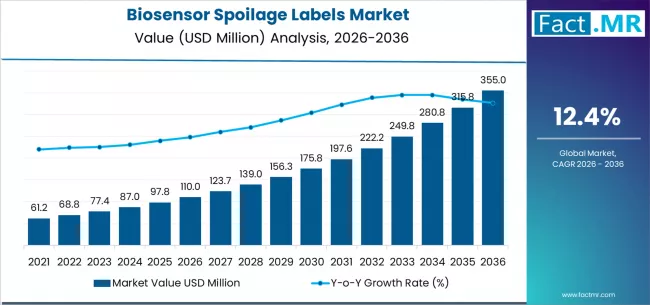
Market expansion is fueled by the critical global imperative to reduce food waste and enhance supply chain transparency. These smart labels provide real-time, visual indicators of product freshness, moving beyond static "best before" dates to dynamic, condition-based monitoring. This shift empowers retailers and consumers to make informed decisions, improving food safety and optimizing inventory management across complex logistics networks.
Growth from 2026 to 2036 will be defined by technological miniaturization and integration. Advances in bio-ink formulations and microfluidic designs are enhancing sensor sensitivity, stability, and cost-effectiveness, enabling broader deployment beyond high-value products. Concurrently, the rise of blockchain and IoT platforms is creating demand for labels that can provide digitizable spoilage data, linking physical product condition directly to digital supply chain records for unparalleled traceability.
Biosensor Spoilage Labels Market
| Metric | Value |
|---|---|
| Estimated Value in (2026E) | USD 110.0 Million |
| Forecast Value in (2036F) | USD 355.0 Million |
| Forecast CAGR (2026 to 2036) | 12.4% |
Category
| Category | Segments |
|---|---|
| End-use/Application | Cold-chain Perishable Foods, Seafood & Sushi Monitoring, Retail & Grocery, E-commerce Perishables, Others |
| Packaging Format/Type | Peel-and-Stick Sensor Labels, Sleeve Sensors, Tag Labels, Integratable Stickers, Others |
| Material | PET / Biopolymer Films, Synthetic Paper, PET + Coating, Polymer Films, Others |
| Technology | Enzyme-based Bio-sensors, Microfluidic Bio-sensors, Optical Enzyme Indicators, Colorimetric Bio-reaction, Others |
| Region | North America, Europe, Asia Pacific, Latin America, MEA |
Segmental Analysis
Why is Cold-chain Perishable Foods the Dominant Application Category?
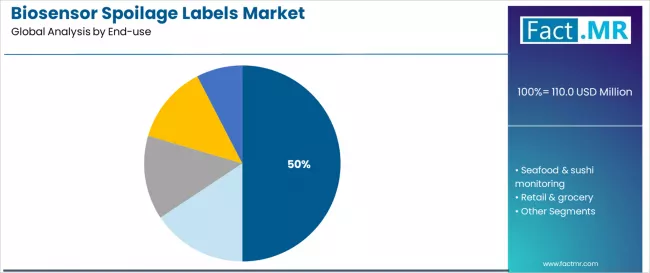
The cold-chain perishable foods segment commands a 50% market share in 2026, reflecting its role as the primary testing ground for spoilage sensing technology. The financial stakes of spoilage are highest for meats, dairy, and fresh produce, where temperature abuse can lead to significant waste and safety risks.
Biosensor labels directly address this vulnerability by providing a clear, irreversible visual signal of cumulative temperature exposure or microbial growth, offering a more reliable safety indicator than printed dates. This application is critical for building trust in extended supply chains, from farm to overseas retail. The data from these labels helps logistics providers validate cold-chain integrity and enables retailers to prioritize stock rotation dynamically, reducing shrink and protecting brand reputation.
- Stringent food safety regulations and retailer demands for proof of cold-chain compliance are mandating the adoption of advanced monitoring solutions.
- The segment drives innovation in sensor speed and specificity, requiring labels that react accurately to spoilage biomarkers specific to different food types.
What renders Peel-and-Stick Sensor Labels as the Preferred Packaging Format?
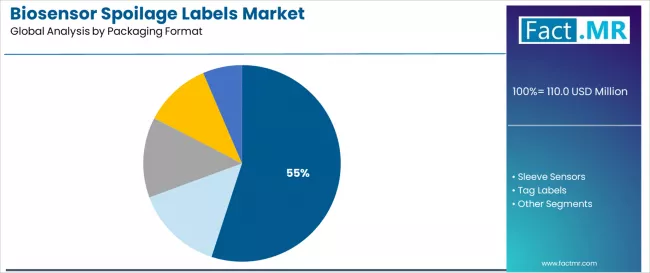
Peel-and-stick sensor labels are projected to hold a 55% share by format in 2026. Their dominance is rooted in unparalleled application flexibility and integration ease. These labels can be applied to almost any packaging surface, such as rigid trays, flexible films, or glass jars, at the final packaging stage, without disrupting existing production lines. This allows for rapid deployment across diverse product portfolios.
For end-users, the format offers clear, localized spoilage indication directly on the package, requiring no additional scanning equipment. The adhesive and substrate can be engineered for specific environmental conditions, such as freezer storage or high humidity, ensuring label performance matches the product’s journey.
- The format enables small-batch or pilot testing of biosensor technology, lowering the barrier to entry for food producers.
- Advances in adhesive technology ensure labels remain securely affixed throughout the supply chain while still allowing for clean removal if required for recycling streams.
What are the Drivers, Restraints, and Trends in the Biosensor Spoilage Labels Market?
The market is propelled by escalating global food waste reduction targets and increasing regulatory focus on food authenticity and safety. Consumer demand for transparency and distrust of arbitrary date labels create a strong pull for smarter packaging solutions. A primary restraint is the higher unit cost compared to traditional labels, necessitating a clear demonstration of reduced waste and liability to justify investment.
The market is trending towards multi-parameter sensors that can indicate both spoilage and tampering, and the integration of QR codes with color-changing biosensors to bridge physical indicators with digital product passports and consumer education.
Analysis of the Biosensor Spoilage Labels Market by Key Countries
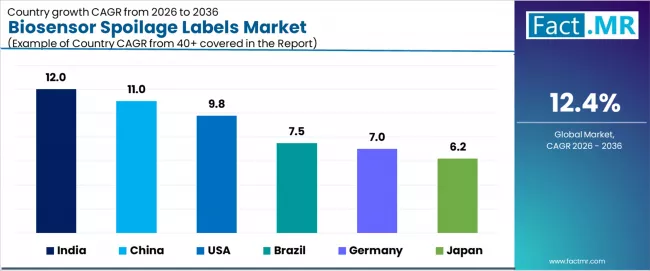
| Country | CAGR (2026-2036) |
|---|---|
| India | 12.0% |
| China | 11.0% |
| USA | 9.8% |
| Brazil | 7.5% |
| Germany | 7.0% |
| Japan | 6.2% |
How are Expanding Cold Chains and Food Safety Concerns Driving India's Growth?
Demand for biosensor spoilage labels in India is projected to grow at a leading CAGR of 12.0% through 2036. This is driven by the rapid formalization and geographical expansion of the cold chain for dairy, meat, and processed foods. Growing consumer awareness of foodborne illnesses and significant post-harvest losses create a powerful dual demand for waste reduction and safety assurance technologies.
- Government initiatives to modernize food storage infrastructure and reduce waste are creating a conducive environment for smart label adoption.
- The burgeoning e-commerce sector for perishable groceries requires reliable freshness indicators to manage last-mile delivery trust and reduce returns.
What Role does Seafood Export Quality and Tech Integration Play in China's Market?
The market for biosensor spoilage labels in China is forecast to grow at a CAGR of 11.0%. As a major global seafood exporter, Chinese producers adopt these labels to meet stringent international quality standards and guarantee product freshness upon arrival. Domestically, the integration of spoilage indicators with WeChat scan-and-verify functions is emerging, allowing consumers to access a digital freshness certificate and detailed origin data.
- Investment in domestic biosensor R&D aims to lower production costs and cater to the vast domestic market for packaged fresh foods.
- Major retail chains are piloting the technology on high-value items like imported meats and prepared meals to differentiate their quality promise.
How do Regulatory Pressures and Retailer Initiatives Shape the Market in USA?
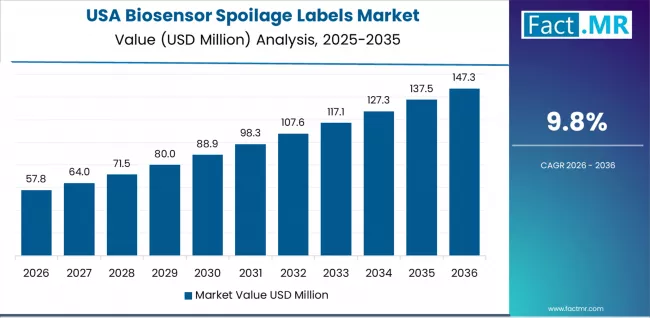
Deployment of biosensor spoilage labels in the USA is set to grow at a CAGR of 9.8%. Growth is driven by FDA focus on reducing foodborne illness and major retailer commitments to halve food waste in their operations. These labels are increasingly seen as a tool to validate vendor compliance with cold-chain protocols and to dynamically discount products approaching spoilage, maximizing sell-through.
- The strong focus on liability and brand protection in the food industry makes objective spoilage detection a valuable risk-mitigation tool.
- Partnerships between biosensor firms and major food distributors are key to scaling technology adoption across complex national supply networks.
How are Increasing Meat Exports Influencing Biosensor Spoilage Labels Adoption in Brazil?
The biosensor spoilage labels market in Brazil is projected to grow at a CAGR of 7.5%. As a leading global meat exporter, Brazilian producers utilize biosensor labels to provide tangible proof of cold-chain integrity to distant buyers in Asia and Europe. This enhances product value and competitiveness. Domestically, the technology is gaining traction in premium supermarket chains for high-quality fresh cuts.
- The need to maintain Brazil's reputation as a reliable, quality-focused meat supplier is a powerful driver for investment in traceability and freshness technologies.
- Local development focuses on robust labels capable of withstanding long-haul maritime transport conditions.
How do Precision and Quality Assurance define Biosensor Spoilage Labels Demand in Germany?
Demand for biosensor spoilage labels in Germany is expected to grow at a CAGR of 7.0%. The market is characterized by a demand for precision engineering and verifiable quality assurance, aligning with Germany’s high standards in food production. Biosensor labels are used not just for spoilage but as part of comprehensive quality management systems, providing auditable evidence of proper handling for premium products like cheese, sausages, and ready-to-eat meals.
- Adoption is driven by a strong cultural emphasis on product quality, resource efficiency (reducing waste), and meeting stringent EU food safety regulations.
- Integration focuses on creating seamless data links between the physical label indicator and digital quality management platforms.
What drives Adoption in Japan's High-Value Seafood and Prepared Food Sectors?
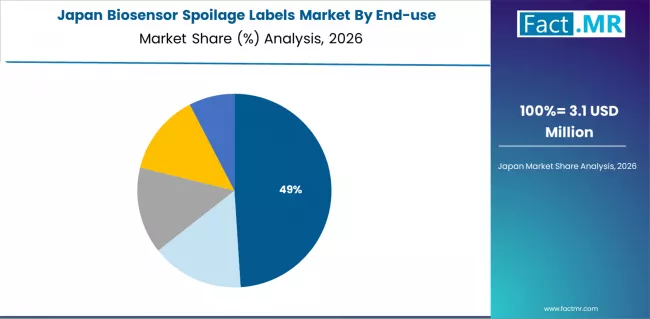
The biosensor spoilage labels market in Japan is projected to grow at a CAGR of 6.2%. Adoption is concentrated in the ultra-fresh seafood supply chain, particularly for sushi-grade fish, and in the premium prepared meal sector. Consumers exhibit a very low tolerance for quality deviation, and retailers use the labels as a premium trust signal. The technology also supports the management of complex convenience store supply chains, where frequent, small deliveries are the norm.
- High value placed on freshness and presentation in Japanese food culture creates a ready market for unambiguous quality indicators.
- Miniaturization and aesthetic integration of sensors are critical for adoption, as labels must not detract from the product's visual appeal.
Competitive Landscape of the Biosensor Spoilage Labels Market
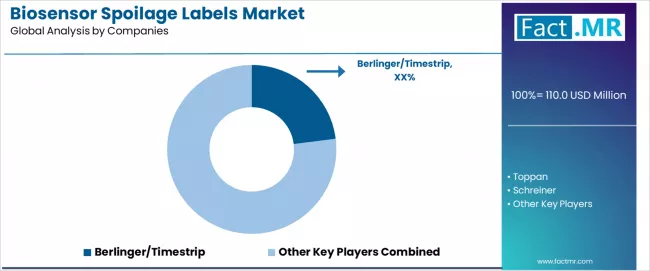
The competitive landscape features specialized smart packaging firms, sensor technology developers, and established label manufacturers forming strategic alliances. Companies compete on sensor accuracy, response time, shelf-life stability, and the ability to integrate labels into high-speed packaging lines.
Key players are investing heavily in R&D to develop more cost-effective bio-inks and scalable printing techniques like flexography. A significant competitive front is the creation of proprietary indicator chemistries for specific food types (e.g., fish vs. chicken). Success depends on securing partnerships with large food producers and retail consortiums to move from pilot projects to volume deployment.
Key Players in the Biosensor Spoilage Labels Market
- Berlinger
- Toppan
- Schreiner
- UFlex
Scope of the Report
| Items | Values |
|---|---|
| Quantitative Units (2026) | USD 110.0 Million |
| End-use/Application | Cold-chain Perishable Foods, Seafood & Sushi Monitoring, Retail & Grocery, E-commerce Perishables, Others |
| Packaging Format/Type | Peel-and-Stick Sensor Labels, Sleeve Sensors, Tag Labels, Integratable Stickers, Others |
| Material | PET / Biopolymer Films, Synthetic Paper, PET + Coating, Polymer Films, Others |
| Technology | Enzyme-based Bio-sensors, Microfluidic Bio-sensors, Optical Enzyme Indicators, Colorimetric Bio-reaction, Others |
| Regions Covered | North America, Europe, Asia Pacific, Latin America, MEA |
| Key Companies Profiled | Berlinger/Timestrip, Toppan, Schreiner, UFlex, and other leading biosensor label manufacturers |
| Additional Attributes | Market share analysis, case studies on waste reduction ROI, regulatory landscape analysis, insights into R&D in bio-ink formulations and integration with IoT platforms. |
Biosensor Spoilage Labels Market by Segments
-
By End-use/Application :
- Cold-chain Perishable Foods
- Seafood & Sushi Monitoring
- Retail & Grocery
- E-commerce Perishables
- Others
-
By Packaging Format/Type :
- Peel-and-Stick Sensor Labels
- Sleeve Sensors
- Tag Labels
- Integratable Stickers
- Others
-
By Material :
- PET/Biopolymer Films
- Synthetic Paper
- PET + Coating
- Polymer Films
- Others
-
By Technology :
- Enzyme-based Bio-sensors
- Microfluidic Bio-sensors
- Optical Enzyme Indicators
- Colorimetric Bio-reaction
- Others
-
By Region :
-
North America
- USA
- Canada
- Mexico
-
Europe
- Germany
- UK
- France
- Italy
- Spain
- Nordic Countries
- BENELUX
- Rest of Europe
-
Asia Pacific
- China
- India
- Japan
- South Korea
- Australia
- Rest of Asia Pacific
-
Latin America
- Brazil
- Argentina
- Rest of Latin America
-
MEA
- Saudi Arabia
- UAE
- South Africa
- Rest of MEA
-
Table of Content
- Executive Summary
- Global Market Outlook
- Demand to side Trends
- Supply to side Trends
- Technology Roadmap Analysis
- Analysis and Recommendations
- Market Overview
- Market Coverage / Taxonomy
- Market Definition / Scope / Limitations
- Market Background
- Market Dynamics
- Drivers
- Restraints
- Opportunity
- Trends
- Scenario Forecast
- Demand in Optimistic Scenario
- Demand in Likely Scenario
- Demand in Conservative Scenario
- Opportunity Map Analysis
- Product Life Cycle Analysis
- Supply Chain Analysis
- Investment Feasibility Matrix
- Value Chain Analysis
- PESTLE and Porter’s Analysis
- Regulatory Landscape
- Regional Parent Market Outlook
- Production and Consumption Statistics
- Import and Export Statistics
- Market Dynamics
- Global Market Analysis 2021 to 2025 and Forecast, 2026 to 2036
- Historical Market Size Value (USD Million) Analysis, 2021 to 2025
- Current and Future Market Size Value (USD Million) Projections, 2026 to 2036
- Y to o to Y Growth Trend Analysis
- Absolute $ Opportunity Analysis
- Global Market Pricing Analysis 2021 to 2025 and Forecast 2026 to 2036
- Global Market Analysis 2021 to 2025 and Forecast 2026 to 2036, By End-use/Application
- Introduction / Key Findings
- Historical Market Size Value (USD Million) Analysis By End-use/Application, 2021 to 2025
- Current and Future Market Size Value (USD Million) Analysis and Forecast By End-use/Application, 2026 to 2036
- Cold-chain perishable foods
- Seafood & sushi monitoring
- Retail & grocery
- E-commerce perishables
- Others
- Y to o to Y Growth Trend Analysis By End-use/Application, 2021 to 2025
- Absolute $ Opportunity Analysis By End-use/Application, 2026 to 2036
- Global Market Analysis 2021 to 2025 and Forecast 2026 to 2036, By Packaging Format/Type
- Introduction / Key Findings
- Historical Market Size Value (USD Million) Analysis By Packaging Format/Type, 2021 to 2025
- Current and Future Market Size Value (USD Million) Analysis and Forecast By Packaging Format/Type, 2026 to 2036
- Peel-and-stick Sensor Labels
- Sleeve Sensors
- Tag Labels
- Integratable Stickers
- Others
- Y to o to Y Growth Trend Analysis By Packaging Format/Type, 2021 to 2025
- Absolute $ Opportunity Analysis By Packaging Format/Type, 2026 to 2036
- Global Market Analysis 2021 to 2025 and Forecast 2026 to 2036, By Material
- Introduction / Key Findings
- Historical Market Size Value (USD Million) Analysis By Material, 2021 to 2025
- Current and Future Market Size Value (USD Million) Analysis and Forecast By Material, 2026 to 2036
- PET / Biopolymer Films
- Synthetic Paper
- PET + Coating
- Polymer Films
- Others
- Y to o to Y Growth Trend Analysis By Material, 2021 to 2025
- Absolute $ Opportunity Analysis By Material, 2026 to 2036
- Global Market Analysis 2021 to 2025 and Forecast 2026 to 2036, By Technology
- Introduction / Key Findings
- Historical Market Size Value (USD Million) Analysis By Technology, 2021 to 2025
- Current and Future Market Size Value (USD Million) Analysis and Forecast By Technology, 2026 to 2036
- Enzyme-based Bio-sensors
- Microfluidic Bio-sensors
- Optical Enzyme Indicators
- Colorimetric Bio-reaction
- Others
- Y to o to Y Growth Trend Analysis By Technology, 2021 to 2025
- Absolute $ Opportunity Analysis By Technology, 2026 to 2036
- Global Market Analysis 2021 to 2025 and Forecast 2026 to 2036, By Region
- Introduction
- Historical Market Size Value (USD Million) Analysis By Region, 2021 to 2025
- Current Market Size Value (USD Million) Analysis and Forecast By Region, 2026 to 2036
- North America
- Latin America
- Western Europe
- Eastern Europe
- East Asia
- South Asia and Pacific
- Middle East & Africa
- Market Attractiveness Analysis By Region
- North America Market Analysis 2021 to 2025 and Forecast 2026 to 2036, By Country
- Historical Market Size Value (USD Million) Trend Analysis By Market Taxonomy, 2021 to 2025
- Market Size Value (USD Million) Forecast By Market Taxonomy, 2026 to 2036
- By Country
- USA
- Canada
- Mexico
- By End-use/Application
- By Packaging Format/Type
- By Material
- By Technology
- By Country
- Market Attractiveness Analysis
- By Country
- By End-use/Application
- By Packaging Format/Type
- By Material
- By Technology
- Key Takeaways
- Latin America Market Analysis 2021 to 2025 and Forecast 2026 to 2036, By Country
- Historical Market Size Value (USD Million) Trend Analysis By Market Taxonomy, 2021 to 2025
- Market Size Value (USD Million) Forecast By Market Taxonomy, 2026 to 2036
- By Country
- Brazil
- Chile
- Rest of Latin America
- By End-use/Application
- By Packaging Format/Type
- By Material
- By Technology
- By Country
- Market Attractiveness Analysis
- By Country
- By End-use/Application
- By Packaging Format/Type
- By Material
- By Technology
- Key Takeaways
- Western Europe Market Analysis 2021 to 2025 and Forecast 2026 to 2036, By Country
- Historical Market Size Value (USD Million) Trend Analysis By Market Taxonomy, 2021 to 2025
- Market Size Value (USD Million) Forecast By Market Taxonomy, 2026 to 2036
- By Country
- Germany
- UK
- Italy
- Spain
- France
- Nordic
- BENELUX
- Rest of Western Europe
- By End-use/Application
- By Packaging Format/Type
- By Material
- By Technology
- By Country
- Market Attractiveness Analysis
- By Country
- By End-use/Application
- By Packaging Format/Type
- By Material
- By Technology
- Key Takeaways
- Eastern Europe Market Analysis 2021 to 2025 and Forecast 2026 to 2036, By Country
- Historical Market Size Value (USD Million) Trend Analysis By Market Taxonomy, 2021 to 2025
- Market Size Value (USD Million) Forecast By Market Taxonomy, 2026 to 2036
- By Country
- Russia
- Poland
- Hungary
- Balkan & Baltic
- Rest of Eastern Europe
- By End-use/Application
- By Packaging Format/Type
- By Material
- By Technology
- By Country
- Market Attractiveness Analysis
- By Country
- By End-use/Application
- By Packaging Format/Type
- By Material
- By Technology
- Key Takeaways
- East Asia Market Analysis 2021 to 2025 and Forecast 2026 to 2036, By Country
- Historical Market Size Value (USD Million) Trend Analysis By Market Taxonomy, 2021 to 2025
- Market Size Value (USD Million) Forecast By Market Taxonomy, 2026 to 2036
- By Country
- China
- Japan
- South Korea
- By End-use/Application
- By Packaging Format/Type
- By Material
- By Technology
- By Country
- Market Attractiveness Analysis
- By Country
- By End-use/Application
- By Packaging Format/Type
- By Material
- By Technology
- Key Takeaways
- South Asia and Pacific Market Analysis 2021 to 2025 and Forecast 2026 to 2036, By Country
- Historical Market Size Value (USD Million) Trend Analysis By Market Taxonomy, 2021 to 2025
- Market Size Value (USD Million) Forecast By Market Taxonomy, 2026 to 2036
- By Country
- India
- ASEAN
- Australia & New Zealand
- Rest of South Asia and Pacific
- By End-use/Application
- By Packaging Format/Type
- By Material
- By Technology
- By Country
- Market Attractiveness Analysis
- By Country
- By End-use/Application
- By Packaging Format/Type
- By Material
- By Technology
- Key Takeaways
- Middle East & Africa Market Analysis 2021 to 2025 and Forecast 2026 to 2036, By Country
- Historical Market Size Value (USD Million) Trend Analysis By Market Taxonomy, 2021 to 2025
- Market Size Value (USD Million) Forecast By Market Taxonomy, 2026 to 2036
- By Country
- Kingdom of Saudi Arabia
- Other GCC Countries
- Turkiye
- South Africa
- Other African Union
- Rest of Middle East & Africa
- By End-use/Application
- By Packaging Format/Type
- By Material
- By Technology
- By Country
- Market Attractiveness Analysis
- By Country
- By End-use/Application
- By Packaging Format/Type
- By Material
- By Technology
- Key Takeaways
- Key Countries Market Analysis
- USA
- Pricing Analysis
- Market Share Analysis, 2025
- By End-use/Application
- By Packaging Format/Type
- By Material
- By Technology
- Canada
- Pricing Analysis
- Market Share Analysis, 2025
- By End-use/Application
- By Packaging Format/Type
- By Material
- By Technology
- Mexico
- Pricing Analysis
- Market Share Analysis, 2025
- By End-use/Application
- By Packaging Format/Type
- By Material
- By Technology
- Brazil
- Pricing Analysis
- Market Share Analysis, 2025
- By End-use/Application
- By Packaging Format/Type
- By Material
- By Technology
- Chile
- Pricing Analysis
- Market Share Analysis, 2025
- By End-use/Application
- By Packaging Format/Type
- By Material
- By Technology
- Germany
- Pricing Analysis
- Market Share Analysis, 2025
- By End-use/Application
- By Packaging Format/Type
- By Material
- By Technology
- UK
- Pricing Analysis
- Market Share Analysis, 2025
- By End-use/Application
- By Packaging Format/Type
- By Material
- By Technology
- Italy
- Pricing Analysis
- Market Share Analysis, 2025
- By End-use/Application
- By Packaging Format/Type
- By Material
- By Technology
- Spain
- Pricing Analysis
- Market Share Analysis, 2025
- By End-use/Application
- By Packaging Format/Type
- By Material
- By Technology
- France
- Pricing Analysis
- Market Share Analysis, 2025
- By End-use/Application
- By Packaging Format/Type
- By Material
- By Technology
- India
- Pricing Analysis
- Market Share Analysis, 2025
- By End-use/Application
- By Packaging Format/Type
- By Material
- By Technology
- ASEAN
- Pricing Analysis
- Market Share Analysis, 2025
- By End-use/Application
- By Packaging Format/Type
- By Material
- By Technology
- Australia & New Zealand
- Pricing Analysis
- Market Share Analysis, 2025
- By End-use/Application
- By Packaging Format/Type
- By Material
- By Technology
- China
- Pricing Analysis
- Market Share Analysis, 2025
- By End-use/Application
- By Packaging Format/Type
- By Material
- By Technology
- Japan
- Pricing Analysis
- Market Share Analysis, 2025
- By End-use/Application
- By Packaging Format/Type
- By Material
- By Technology
- South Korea
- Pricing Analysis
- Market Share Analysis, 2025
- By End-use/Application
- By Packaging Format/Type
- By Material
- By Technology
- Russia
- Pricing Analysis
- Market Share Analysis, 2025
- By End-use/Application
- By Packaging Format/Type
- By Material
- By Technology
- Poland
- Pricing Analysis
- Market Share Analysis, 2025
- By End-use/Application
- By Packaging Format/Type
- By Material
- By Technology
- Hungary
- Pricing Analysis
- Market Share Analysis, 2025
- By End-use/Application
- By Packaging Format/Type
- By Material
- By Technology
- Kingdom of Saudi Arabia
- Pricing Analysis
- Market Share Analysis, 2025
- By End-use/Application
- By Packaging Format/Type
- By Material
- By Technology
- Turkiye
- Pricing Analysis
- Market Share Analysis, 2025
- By End-use/Application
- By Packaging Format/Type
- By Material
- By Technology
- South Africa
- Pricing Analysis
- Market Share Analysis, 2025
- By End-use/Application
- By Packaging Format/Type
- By Material
- By Technology
- USA
- Market Structure Analysis
- Competition Dashboard
- Competition Benchmarking
- Market Share Analysis of Top Players
- By Regional
- By End-use/Application
- By Packaging Format/Type
- By Material
- By Technology
- Competition Analysis
- Competition Deep Dive
- Berlinger/Timestrip
- Overview
- Product Portfolio
- Profitability by Market Segments (Product/Age /Sales Channel/Region)
- Sales Footprint
- Strategy Overview
- Marketing Strategy
- Product Strategy
- Channel Strategy
- Toppan
- Schreiner
- UFlex
- Others
- Berlinger/Timestrip
- Competition Deep Dive
- Assumptions & Acronyms Used
- Research Methodology
List Of Table
- Table 1: Global Market Value (USD Million) Forecast by Region, 2021 to 2036
- Table 2: Global Market Value (USD Million) Forecast by End-use/Application, 2021 to 2036
- Table 3: Global Market Value (USD Million) Forecast by Packaging Format/Type, 2021 to 2036
- Table 4: Global Market Value (USD Million) Forecast by Material, 2021 to 2036
- Table 5: Global Market Value (USD Million) Forecast by Technology, 2021 to 2036
- Table 6: North America Market Value (USD Million) Forecast by Country, 2021 to 2036
- Table 7: North America Market Value (USD Million) Forecast by End-use/Application, 2021 to 2036
- Table 8: North America Market Value (USD Million) Forecast by Packaging Format/Type, 2021 to 2036
- Table 9: North America Market Value (USD Million) Forecast by Material, 2021 to 2036
- Table 10: North America Market Value (USD Million) Forecast by Technology, 2021 to 2036
- Table 11: Latin America Market Value (USD Million) Forecast by Country, 2021 to 2036
- Table 12: Latin America Market Value (USD Million) Forecast by End-use/Application, 2021 to 2036
- Table 13: Latin America Market Value (USD Million) Forecast by Packaging Format/Type, 2021 to 2036
- Table 14: Latin America Market Value (USD Million) Forecast by Material, 2021 to 2036
- Table 15: Latin America Market Value (USD Million) Forecast by Technology, 2021 to 2036
- Table 16: Western Europe Market Value (USD Million) Forecast by Country, 2021 to 2036
- Table 17: Western Europe Market Value (USD Million) Forecast by End-use/Application, 2021 to 2036
- Table 18: Western Europe Market Value (USD Million) Forecast by Packaging Format/Type, 2021 to 2036
- Table 19: Western Europe Market Value (USD Million) Forecast by Material, 2021 to 2036
- Table 20: Western Europe Market Value (USD Million) Forecast by Technology, 2021 to 2036
- Table 21: Eastern Europe Market Value (USD Million) Forecast by Country, 2021 to 2036
- Table 22: Eastern Europe Market Value (USD Million) Forecast by End-use/Application, 2021 to 2036
- Table 23: Eastern Europe Market Value (USD Million) Forecast by Packaging Format/Type, 2021 to 2036
- Table 24: Eastern Europe Market Value (USD Million) Forecast by Material, 2021 to 2036
- Table 25: Eastern Europe Market Value (USD Million) Forecast by Technology, 2021 to 2036
- Table 26: East Asia Market Value (USD Million) Forecast by Country, 2021 to 2036
- Table 27: East Asia Market Value (USD Million) Forecast by End-use/Application, 2021 to 2036
- Table 28: East Asia Market Value (USD Million) Forecast by Packaging Format/Type, 2021 to 2036
- Table 29: East Asia Market Value (USD Million) Forecast by Material, 2021 to 2036
- Table 30: East Asia Market Value (USD Million) Forecast by Technology, 2021 to 2036
- Table 31: South Asia and Pacific Market Value (USD Million) Forecast by Country, 2021 to 2036
- Table 32: South Asia and Pacific Market Value (USD Million) Forecast by End-use/Application, 2021 to 2036
- Table 33: South Asia and Pacific Market Value (USD Million) Forecast by Packaging Format/Type, 2021 to 2036
- Table 34: South Asia and Pacific Market Value (USD Million) Forecast by Material, 2021 to 2036
- Table 35: South Asia and Pacific Market Value (USD Million) Forecast by Technology, 2021 to 2036
- Table 36: Middle East & Africa Market Value (USD Million) Forecast by Country, 2021 to 2036
- Table 37: Middle East & Africa Market Value (USD Million) Forecast by End-use/Application, 2021 to 2036
- Table 38: Middle East & Africa Market Value (USD Million) Forecast by Packaging Format/Type, 2021 to 2036
- Table 39: Middle East & Africa Market Value (USD Million) Forecast by Material, 2021 to 2036
- Table 40: Middle East & Africa Market Value (USD Million) Forecast by Technology, 2021 to 2036
List Of Figures
- Figure 1: Global Market Pricing Analysis
- Figure 2: Global Market Value (USD Million) Forecast 2021 to 2036
- Figure 3: Global Market Value Share and BPS Analysis by End-use/Application, 2026 and 2036
- Figure 4: Global Market Y to o to Y Growth Comparison by End-use/Application, 2026 to 2036
- Figure 5: Global Market Attractiveness Analysis by End-use/Application
- Figure 6: Global Market Value Share and BPS Analysis by Packaging Format/Type, 2026 and 2036
- Figure 7: Global Market Y to o to Y Growth Comparison by Packaging Format/Type, 2026 to 2036
- Figure 8: Global Market Attractiveness Analysis by Packaging Format/Type
- Figure 9: Global Market Value Share and BPS Analysis by Material, 2026 and 2036
- Figure 10: Global Market Y to o to Y Growth Comparison by Material, 2026 to 2036
- Figure 11: Global Market Attractiveness Analysis by Material
- Figure 12: Global Market Value Share and BPS Analysis by Technology, 2026 and 2036
- Figure 13: Global Market Y to o to Y Growth Comparison by Technology, 2026 to 2036
- Figure 14: Global Market Attractiveness Analysis by Technology
- Figure 15: Global Market Value (USD Million) Share and BPS Analysis by Region, 2026 and 2036
- Figure 16: Global Market Y to o to Y Growth Comparison by Region, 2026 to 2036
- Figure 17: Global Market Attractiveness Analysis by Region
- Figure 18: North America Market Incremental Dollar Opportunity, 2026 to 2036
- Figure 19: Latin America Market Incremental Dollar Opportunity, 2026 to 2036
- Figure 20: Western Europe Market Incremental Dollar Opportunity, 2026 to 2036
- Figure 21: Eastern Europe Market Incremental Dollar Opportunity, 2026 to 2036
- Figure 22: East Asia Market Incremental Dollar Opportunity, 2026 to 2036
- Figure 23: South Asia and Pacific Market Incremental Dollar Opportunity, 2026 to 2036
- Figure 24: Middle East & Africa Market Incremental Dollar Opportunity, 2026 to 2036
- Figure 25: North America Market Value Share and BPS Analysis by Country, 2026 and 2036
- Figure 26: North America Market Value Share and BPS Analysis by End-use/Application, 2026 and 2036
- Figure 27: North America Market Y to o to Y Growth Comparison by End-use/Application, 2026 to 2036
- Figure 28: North America Market Attractiveness Analysis by End-use/Application
- Figure 29: North America Market Value Share and BPS Analysis by Packaging Format/Type, 2026 and 2036
- Figure 30: North America Market Y to o to Y Growth Comparison by Packaging Format/Type, 2026 to 2036
- Figure 31: North America Market Attractiveness Analysis by Packaging Format/Type
- Figure 32: North America Market Value Share and BPS Analysis by Material, 2026 and 2036
- Figure 33: North America Market Y to o to Y Growth Comparison by Material, 2026 to 2036
- Figure 34: North America Market Attractiveness Analysis by Material
- Figure 35: North America Market Value Share and BPS Analysis by Technology, 2026 and 2036
- Figure 36: North America Market Y to o to Y Growth Comparison by Technology, 2026 to 2036
- Figure 37: North America Market Attractiveness Analysis by Technology
- Figure 38: Latin America Market Value Share and BPS Analysis by Country, 2026 and 2036
- Figure 39: Latin America Market Value Share and BPS Analysis by End-use/Application, 2026 and 2036
- Figure 40: Latin America Market Y to o to Y Growth Comparison by End-use/Application, 2026 to 2036
- Figure 41: Latin America Market Attractiveness Analysis by End-use/Application
- Figure 42: Latin America Market Value Share and BPS Analysis by Packaging Format/Type, 2026 and 2036
- Figure 43: Latin America Market Y to o to Y Growth Comparison by Packaging Format/Type, 2026 to 2036
- Figure 44: Latin America Market Attractiveness Analysis by Packaging Format/Type
- Figure 45: Latin America Market Value Share and BPS Analysis by Material, 2026 and 2036
- Figure 46: Latin America Market Y to o to Y Growth Comparison by Material, 2026 to 2036
- Figure 47: Latin America Market Attractiveness Analysis by Material
- Figure 48: Latin America Market Value Share and BPS Analysis by Technology, 2026 and 2036
- Figure 49: Latin America Market Y to o to Y Growth Comparison by Technology, 2026 to 2036
- Figure 50: Latin America Market Attractiveness Analysis by Technology
- Figure 51: Western Europe Market Value Share and BPS Analysis by Country, 2026 and 2036
- Figure 52: Western Europe Market Value Share and BPS Analysis by End-use/Application, 2026 and 2036
- Figure 53: Western Europe Market Y to o to Y Growth Comparison by End-use/Application, 2026 to 2036
- Figure 54: Western Europe Market Attractiveness Analysis by End-use/Application
- Figure 55: Western Europe Market Value Share and BPS Analysis by Packaging Format/Type, 2026 and 2036
- Figure 56: Western Europe Market Y to o to Y Growth Comparison by Packaging Format/Type, 2026 to 2036
- Figure 57: Western Europe Market Attractiveness Analysis by Packaging Format/Type
- Figure 58: Western Europe Market Value Share and BPS Analysis by Material, 2026 and 2036
- Figure 59: Western Europe Market Y to o to Y Growth Comparison by Material, 2026 to 2036
- Figure 60: Western Europe Market Attractiveness Analysis by Material
- Figure 61: Western Europe Market Value Share and BPS Analysis by Technology, 2026 and 2036
- Figure 62: Western Europe Market Y to o to Y Growth Comparison by Technology, 2026 to 2036
- Figure 63: Western Europe Market Attractiveness Analysis by Technology
- Figure 64: Eastern Europe Market Value Share and BPS Analysis by Country, 2026 and 2036
- Figure 65: Eastern Europe Market Value Share and BPS Analysis by End-use/Application, 2026 and 2036
- Figure 66: Eastern Europe Market Y to o to Y Growth Comparison by End-use/Application, 2026 to 2036
- Figure 67: Eastern Europe Market Attractiveness Analysis by End-use/Application
- Figure 68: Eastern Europe Market Value Share and BPS Analysis by Packaging Format/Type, 2026 and 2036
- Figure 69: Eastern Europe Market Y to o to Y Growth Comparison by Packaging Format/Type, 2026 to 2036
- Figure 70: Eastern Europe Market Attractiveness Analysis by Packaging Format/Type
- Figure 71: Eastern Europe Market Value Share and BPS Analysis by Material, 2026 and 2036
- Figure 72: Eastern Europe Market Y to o to Y Growth Comparison by Material, 2026 to 2036
- Figure 73: Eastern Europe Market Attractiveness Analysis by Material
- Figure 74: Eastern Europe Market Value Share and BPS Analysis by Technology, 2026 and 2036
- Figure 75: Eastern Europe Market Y to o to Y Growth Comparison by Technology, 2026 to 2036
- Figure 76: Eastern Europe Market Attractiveness Analysis by Technology
- Figure 77: East Asia Market Value Share and BPS Analysis by Country, 2026 and 2036
- Figure 78: East Asia Market Value Share and BPS Analysis by End-use/Application, 2026 and 2036
- Figure 79: East Asia Market Y to o to Y Growth Comparison by End-use/Application, 2026 to 2036
- Figure 80: East Asia Market Attractiveness Analysis by End-use/Application
- Figure 81: East Asia Market Value Share and BPS Analysis by Packaging Format/Type, 2026 and 2036
- Figure 82: East Asia Market Y to o to Y Growth Comparison by Packaging Format/Type, 2026 to 2036
- Figure 83: East Asia Market Attractiveness Analysis by Packaging Format/Type
- Figure 84: East Asia Market Value Share and BPS Analysis by Material, 2026 and 2036
- Figure 85: East Asia Market Y to o to Y Growth Comparison by Material, 2026 to 2036
- Figure 86: East Asia Market Attractiveness Analysis by Material
- Figure 87: East Asia Market Value Share and BPS Analysis by Technology, 2026 and 2036
- Figure 88: East Asia Market Y to o to Y Growth Comparison by Technology, 2026 to 2036
- Figure 89: East Asia Market Attractiveness Analysis by Technology
- Figure 90: South Asia and Pacific Market Value Share and BPS Analysis by Country, 2026 and 2036
- Figure 91: South Asia and Pacific Market Value Share and BPS Analysis by End-use/Application, 2026 and 2036
- Figure 92: South Asia and Pacific Market Y to o to Y Growth Comparison by End-use/Application, 2026 to 2036
- Figure 93: South Asia and Pacific Market Attractiveness Analysis by End-use/Application
- Figure 94: South Asia and Pacific Market Value Share and BPS Analysis by Packaging Format/Type, 2026 and 2036
- Figure 95: South Asia and Pacific Market Y to o to Y Growth Comparison by Packaging Format/Type, 2026 to 2036
- Figure 96: South Asia and Pacific Market Attractiveness Analysis by Packaging Format/Type
- Figure 97: South Asia and Pacific Market Value Share and BPS Analysis by Material, 2026 and 2036
- Figure 98: South Asia and Pacific Market Y to o to Y Growth Comparison by Material, 2026 to 2036
- Figure 99: South Asia and Pacific Market Attractiveness Analysis by Material
- Figure 100: South Asia and Pacific Market Value Share and BPS Analysis by Technology, 2026 and 2036
- Figure 101: South Asia and Pacific Market Y to o to Y Growth Comparison by Technology, 2026 to 2036
- Figure 102: South Asia and Pacific Market Attractiveness Analysis by Technology
- Figure 103: Middle East & Africa Market Value Share and BPS Analysis by Country, 2026 and 2036
- Figure 104: Middle East & Africa Market Value Share and BPS Analysis by End-use/Application, 2026 and 2036
- Figure 105: Middle East & Africa Market Y to o to Y Growth Comparison by End-use/Application, 2026 to 2036
- Figure 106: Middle East & Africa Market Attractiveness Analysis by End-use/Application
- Figure 107: Middle East & Africa Market Value Share and BPS Analysis by Packaging Format/Type, 2026 and 2036
- Figure 108: Middle East & Africa Market Y to o to Y Growth Comparison by Packaging Format/Type, 2026 to 2036
- Figure 109: Middle East & Africa Market Attractiveness Analysis by Packaging Format/Type
- Figure 110: Middle East & Africa Market Value Share and BPS Analysis by Material, 2026 and 2036
- Figure 111: Middle East & Africa Market Y to o to Y Growth Comparison by Material, 2026 to 2036
- Figure 112: Middle East & Africa Market Attractiveness Analysis by Material
- Figure 113: Middle East & Africa Market Value Share and BPS Analysis by Technology, 2026 and 2036
- Figure 114: Middle East & Africa Market Y to o to Y Growth Comparison by Technology, 2026 to 2036
- Figure 115: Middle East & Africa Market Attractiveness Analysis by Technology
- Figure 116: Global Market - Tier Structure Analysis
- Figure 117: Global Market - Company Share Analysis
- FAQs -
How big is the biosensor spoilage labels market in 2026?
The global biosensor spoilage labels market is estimated to be valued at USD 110.0 million in 2026.
What will be the size of biosensor spoilage labels market in 2036?
The market size for the biosensor spoilage labels market is projected to reach USD 355.0 million by 2036.
How much will be the biosensor spoilage labels market growth between 2026 and 2036?
The biosensor spoilage labels market is expected to grow at a 12.4% CAGR between 2026 and 2036.
What are the key product types in the biosensor spoilage labels market?
The key product types in biosensor spoilage labels market are cold-chain perishable foods, seafood & sushi monitoring, retail & grocery, e-commerce perishables and others.
Which packaging format/type segment to contribute significant share in the biosensor spoilage labels market in 2026?
In terms of packaging format/type, peel-and-stick sensor labels segment to command 55.0% share in the biosensor spoilage labels market in 2026.