- Market Value (2025): USD 210.0 Mn
- Estimated Value (2026): USD 228.9 Mn
- Forecast Value (2036): USD 541.9 Mn
- CAGR (2026-2036): 9.0%
What is the Bio-Based Sleeve Materials Market forecast to be worth by 2036?
USD 228.9 million in 2026 and USD 541.9 million by 2036, reflecting a 9.0% CAGR.
- The market reached USD 210.0 million in 2025 as brands expanded fiber-based secondary packaging programs.
- Bio-based sleeve materials demand is anticipated to rise from USD 228.9 million in 2026 to USD 541.9 million by 2036.
- Revenue is forecast to record a 9.0% CAGR by 2036 since qualified sleeves combine material reduction with dependable pack performance.
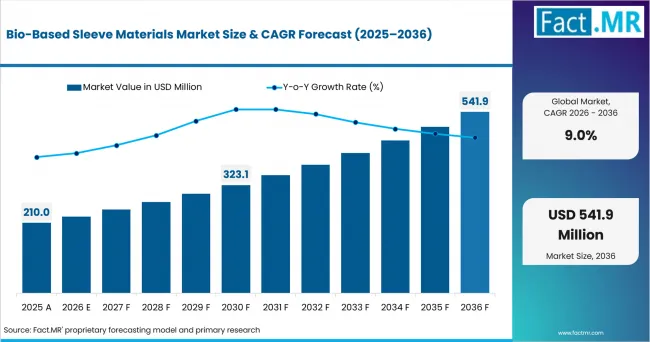
Bio Based Sleeve Materials Market Value Analysis | Source: Fact.MR
What are the defining numbers behind Bio-Based Sleeve Materials Market growth?
USD 313.0 million absolute opportunity by 2036 is led by Agri-Fiber - Bagasse and Multipack Sleeves alongside Flexographic printing.
- Demand Drivers in the Market
- Beverage brands need fiber-rich secondary packs that preserve bundle integrity throughout filling and retail handling.
- Foodservice operators need insulating sleeves that retain clear material identification throughout commercial service and disposal.
- Packaging converters require fiber structures that crease cleanly without slowing commercial printing and die-cutting lines.
- Brand owners require defensible recovery claims across national rules and widely different municipal collection systems.
- Key Segments Analyzed
- By feedstock: Agri-fiber - bagasse is expected to account for 38.0% share in 2026 due to available residue.
- By product type: Multipack sleeves are projected to hold 34.0% share in 2026 owing to combined bundling functions.
- By printing: Flexographic is anticipated to capture 40.0% share in 2026 due to repeatable commercial output.
- By application: Beverage multipacks are estimated to represent 38.0% share in 2026 attributable to production volume.
- By end use: Food & beverage is forecast to garner 68.0% share in 2026 driven by recurring orders.
- By sales channel: Direct - brand OEM is expected to record 47.0% share in 2026 reinforced by coordinated qualification.
- Analyst Opinion at Fact.MR
- Principal Consultant Shambhu Nath Jha at Fact.MR states, “Commercial adoption is driven by market-specific expectations for print clarity, durability, and packaging line compatibility. As these requirements vary by destination, suppliers must tailor material offerings accordingly.”
- Strategic Implications
- Converters should test basis weight and crease performance on customer lines before presenting material reduction commercially.
- Brand packaging teams should align coating chemistry with local recovery rules during multi-country sleeve approval.
- Material producers should provide moisture and printability data reflecting actual beverage and foodservice distribution conditions.
- Direct account teams should coordinate material declarations and artwork changes before reserving high-volume production capacity.
Paper multipacks become commercially credible after performing across production and retail handling under repeated high-volume conditions. Smurfit Westrock reported in July 2026 that its Coca-Cola designs supported retail and e-commerce programs across several manufacturing sites.
India is expected to record 11.4% CAGR through 2036 while China is projected at 10.4% CAGR as paper-based packaging programs expand. The United Kingdom is anticipated at 9.4% CAGR owing to recyclable packaging requirements while Germany is estimated at 8.7% CAGR under established sorting. Brazil is forecast at 8.6% CAGR as reverse-logistics rules increase accountability across commercial coated-sleeve programs worldwide.
How does the Bio-Based Sleeve Materials Market break down by segment?
Agri-fiber - bagasse is projected at 38.0% while multipack sleeves are expected to account for 34.0% share in 2026.
Which Feedstock dominates?
Agri-Fiber - Bagasse accounts for 38.0% share in 2026, supported by residue access and useful sleeve stiffness.
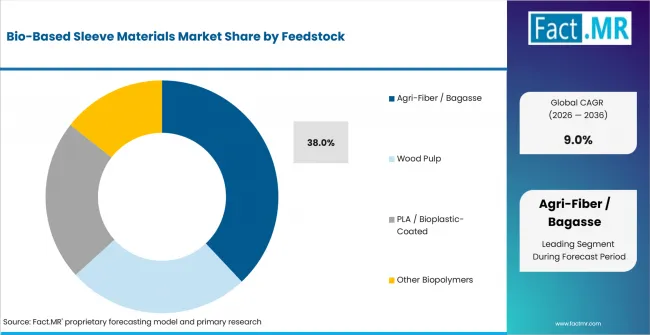
Bio Based Sleeve Materials Market Analysis By Feedstock | Source: Fact.MR
Based on feedstock, agri-fiber - bagasse is projected to account for 38.0% in 2026 due to residue access. Regional sugarcane bagasse fibre supply reduces freight exposure, and this same agricultural residue base is further strengthened in India, where the May 2025 Sugar Order improves visibility for tracked bagasse by-products.
Why do Multipack Sleeves lead the Product Type segment?
Multipack Sleeves hold 34.0% share in 2026, owing to combined bundling and communication functions.
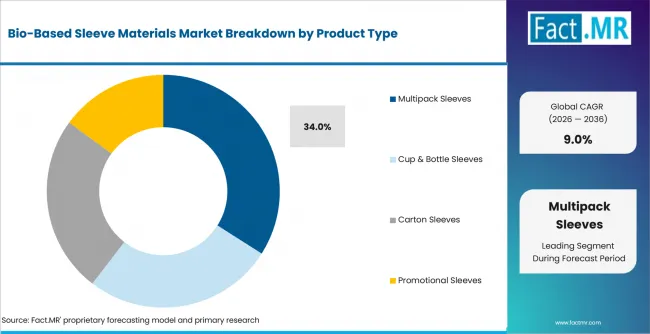
Bio Based Sleeve Materials Market Analysis By Product Type | Source: Fact.MR
In 2026, multipack sleeves are expected to lead product type with 34.0% share because one structure bundles units. High-volume folding carton packaging programs require reliable locking, and this design consistency is increasingly aligned with Graphic Packaging’s September 2025 systems, which target shrink-film replacement on existing production lines.
How does Flexographic printing retain the Printing position?
Flexographic printing captures 40.0% share in 2026, driven by repeat output across long packaging runs.
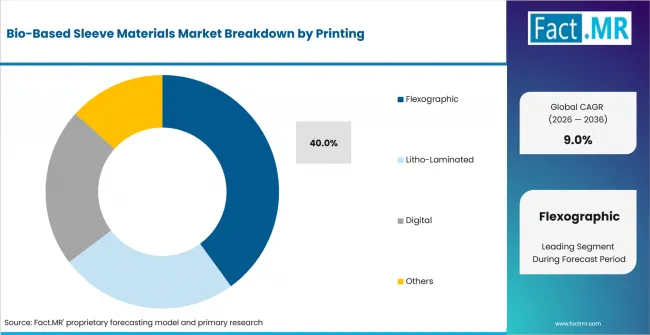
Bio Based Sleeve Materials Market Analysis By Printing | Source: Fact.MR
By printing, flexographic is forecast to represent 40.0% in 2026 driven by repeat orders and registration control. Commercial flexographic printing technology supports efficient finishing, and this efficiency is reinforced by BOBST’s December 2025 update, highlighting Sacchital’s dedicated paper-packaging department for higher-throughput workflows.
What supports Beverage Multipacks within Application?
Beverage Multipacks represent 38.0% share in 2026, attributable to high volumes and secondary-plastic reduction programs.
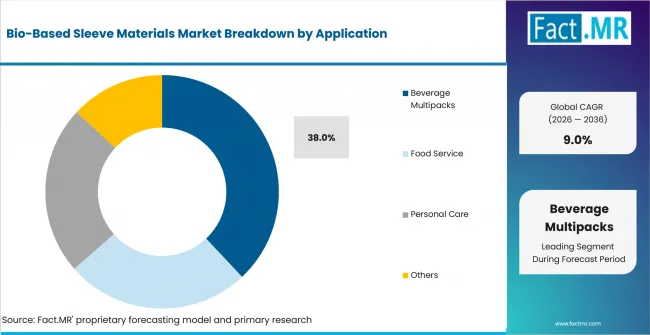
Bio Based Sleeve Materials Market Analysis By Application | Source: Fact.MR
Beverage multipacks are projected to hold 38.0% share in 2026 owing to scale and plastic reduction. Large ready-to-drink packaging programs require chilled strength, and this requirement is reflected in Graphic Packaging’s September 2025 Leffe multipack, which was designed to run on existing machinery without reinforced handles.
Why does Food & Beverage lead the End Use segment?
Food & Beverage garners 68.0% share in 2026, driven by recurring demand across several sleeve formats.
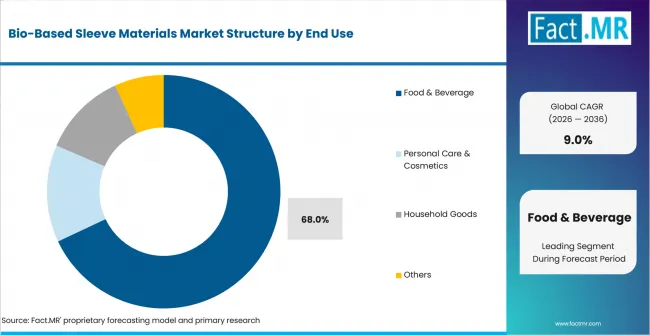
Bio Based Sleeve Materials Market Analysis By End Use | Source: Fact.MR
Food & beverage is set to lead end use with 68.0% share in 2026. Recurring foodservice packaging orders reward dependable insulation, and this demand pattern is evident in Sabert’s May 2026 portfolio, which spans coffee sleeves and drink carriers across varied print runs.
What leads the Sales Channel segment?
Direct - Brand OEM records 47.0% share in 2026, reinforced by technical qualification and artwork control.
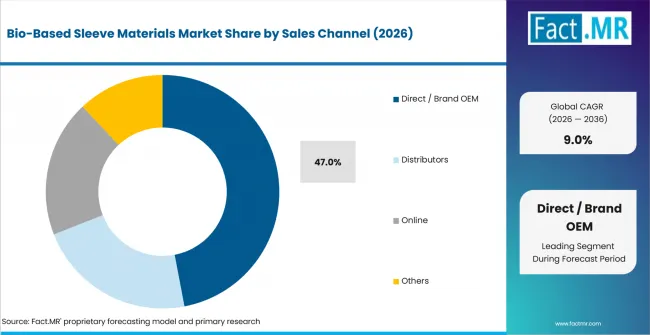
Bio Based Sleeve Materials Market Analysis By Sales Channel | Source: Fact.MR
Direct - brand OEM is forecast to hold 47.0% share in 2026 due to coordinated specifications. Direct teams manage custom packaging specifications and artwork centrally, ensuring faster qualification cycles, while distributors continue to support standard sleeve replenishment across routine supply requirements.
What is accelerating Bio-Based Sleeve Materials Market adoption, and what is holding it back?
Producer-responsibility rules are anticipated to drive adoption while recovery uncertainty and qualification costs constrain wider commercial conversion.
Drivers Impact Analysis
| DRIVER | (~) % IMPACT ON CAGR | GEOGRAPHIC RELEVANCE | IMPACT TIMELINE |
|---|---|---|---|
| Producer responsibility rules | +1.1% | North America and Europe | Short term (<= 2 years) |
| Fiber recovery infrastructure | +0.8% | Europe and selected Asian markets | Medium term (2-4 years) |
| Multipack redesign | +0.7% | North America and Asia Pacific | Medium term (2-4 years) |
| Direct brand qualification | +0.5% | Global branded packaging programs | Medium term (2-4 years) |
| Regional agri-fiber access | +0.4% | India and Brazil | Long term (>= 4 years) |
Source: Fact.MR analysis. Updated Jul 31, 2026
- Producer responsibility rules: European brand teams now treat sleeve composition as a measurable reporting and recovery decision across recurring packaging programs.
- Fiber recovery infrastructure: Established paper collection supports qualification when coatings preserve repulpability and moisture protection.
- Beverage redesign programs: Large production runs make material savings measurable while trials confirm bundle stability and pallet performance.
- Direct brand qualification: Coordinated specifications and artwork control reduce repeated testing across related sleeve programs.
Opportunity Impact Analysis
| OPPORTUNITY | (~) % IMPACT ON CAGR | GEOGRAPHIC RELEVANCE | IMPACT TIMELINE |
|---|---|---|---|
| Low-polymer fiber barriers | +0.7% | Europe and North America | Medium term (2-4 years) |
| Localized fiber converting | +0.6% | India and Brazil | Long term (>= 4 years) |
| Beverage multipack redesign | +0.5% | North America and Asia Pacific | Medium term (2-4 years) |
| Coordinated foodservice formats | +0.4% | United Kingdom and Australia | Short term (<= 2 years) |
Source: Fact.MR analysis. Updated Jul 31, 2026
- Low-polymer barriers: Coating developers gain qualification work by preserving moisture resistance within accepted paper recovery routes.
- Localized converting: Regional plants improve technical response when seasonal feedstock changes affect commercial surface quality.
- Beverage redesign: Converters secure larger programs by linking structural changes with verified line speed and chilled performance.
- Coordinated foodservice formats: Compatible cups and sleeves simplify material guidance across printing and replenishment programs.
Restraints Impact Analysis
| RESTRAINT | (~) % IMPACT ON CAGR | GEOGRAPHIC RELEVANCE | IMPACT TIMELINE |
|---|---|---|---|
| Composite classification | -0.8% | Europe and United Kingdom | Short term (<= 2 years) |
| Bio-based price premium | -0.6% | Global price-sensitive programs | Medium term (2-4 years) |
| Fiber variability | -0.5% | India and Brazil | Medium term (2-4 years) |
| Limited recovery access | -0.4% | North America and Asia Pacific | Long term (>= 4 years) |
Source: Fact.MR analysis. Updated Jul 31, 2026
- Composite classification: Coatings improve moisture resistance but slow approval when finished sleeves conflict with local sorting rules.
- Price premium: Brand teams compare packed cost and distribution risk before approving higher-priced bio-based structures.
- Fiber variability: Seasonal residue changes affect surface smoothness and crease behavior during commercial printing qualification.
- Recovery access: Coated sleeves expand more slowly when disposal guidance cannot be verified across sales geographies.
Which countries are scaling Bio-Based Sleeve Materials Market fastest?
India records 11.4%, China records 10.4%, the United Kingdom records 9.4%, Germany records 8.7%, Brazil records 8.6% CAGR through 2036.
Regional analysis covers North America, Latin America, Western Europe, Eastern Europe, East Asia, South Asia and Pacific, and the Middle East and Africa.
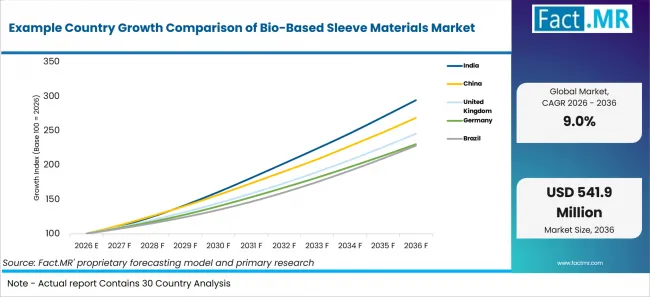
Example Country Growth Comparison Of Bio Based Sleeve Materials Market | Source: Fact.MR
| COUNTRY | CAGR |
|---|---|
| India | 11.4% |
| China | 10.4% |
| United Kingdom | 9.4% |
| Germany | 8.7% |
| Brazil | 8.6% |
Source: Fact.MR analysis. Updated Jul 31, 2026
How is India scaling Bio-Based Sleeve Materials demand?
11.4% CAGR supported by bagasse access and packaging substitution requirements.
Bagasse availability gives Indian converters a regional fiber source, and this feedstock advantage is reinforced by fragmented collection systems that still weaken recovery claims across national brand programs. Recyclable sleeve demand is expected to expand at an 11.4% CAGR through 2036, supported by foodservice conversion trends even as strict unit-cost limits persist
What underpins China’s growth through 2036?
China posts a 10.4% CAGR from 2026 to 2036 supported by converting scale and standardized packaging systems.
High-volume Chinese converting networks reward stable specifications and disciplined pricing, and this structure is further shaped by the June 2025 coated-paper standard that tightens material consistency across beverage packaging orders. Demand is projected to post a 10.4% CAGR by 2036, although premium-material cost pressure continues to limit broader adoption.
Why is the United Kingdom advancing?
9.4% CAGR owing to producer reporting and established paper recovery.
Producer reporting exposes sleeve weight and material classification, and this transparency is reinforced by established paper recovery systems that support national packaging compliance frameworks. Demand is anticipated to advance at a 9.4% CAGR by 2036, while limited composting infrastructure continues to restrict coated-format expansion.
What supports Germany’s outlook?
8.7% CAGR supported by established sorting and strict recyclability expectations.
Germany gives sleeve converters mature collection routes and demanding design requirements for recurring commercial packaging orders. Sector is estimated to register an 8.7% CAGR through 2036 as 5.5 million tonnes recycled during 2024 support paper routes while missed composite targets increase coating scrutiny.
How is Brazil developing Bio-Based Sleeve Materials demand?
8.6% CAGR supported by fiber access and reverse-logistics requirements.
Regional sugarcane residues support Brazilian sleeve production, and this feedstock base is closely tied to reverse-logistics expansion under Decree 12,688, which strengthens collection accountability across states. Industry is forecast to expand at an 8.6% CAGR during the forecast period, although long service distances and composite exclusions continue to expose recovery gaps.
Who leads the Bio-Based Sleeve Materials Market?
Graphic Packaging International and Smurfit Westrock anchor high-volume multipacks while Novolex and Sabert support foodservice sleeve programs.
Competition separates integrated paperboard converters from foodservice specialists serving custom sleeves across varied order volumes. Graphic Packaging International and Smurfit Westrock combine structural design with machinery support while Novolex and Sabert compete through availability.
BioPak and PacknWood serve custom cup-sleeve orders while Hotpack supports regional distribution and smaller replenishment programs.
Which companies are the key providers?
The provider set includes Graphic Packaging International, Smurfit Westrock, Novolex, Sabert Corporation, BioPak, PacknWood, and Hotpack Packaging LLC.
- Graphic Packaging International
- Smurfit Westrock
- Novolex
- Sabert Corporation
- BioPak, PacknWood
- Hotpack Packaging LLC
Bibliography
- BOBST. (2025, December 17). Sacchital to open new flexo plant after investing in the BOBST VISION CI. BOBST.
- Department for Environment, Food & Rural Affairs. (2025, July 23). UK statistics on waste. GOV.UK.
- German Environment Agency and Central Agency Packaging Register. (2026, January 27). Facts against myths: Packaging waste recycling in Germany is working. German Environment Agency.
- Government of Brazil. (2025, October 21). Decreto nº 12.688, de 21 de outubro de 2025. Presidência da República.
- Graphic Packaging International. (2025, September 10). Graphic Packaging Debuts Duo of Beverage Multipack Innovations at drinktec 2025. Graphic Packaging International.
- Graphic Packaging International. (2025, September 19). Leffe Beer Multipack Triumphs with Innovation Award at Europe’s Leading Carton Competition. Graphic Packaging International.
- Sabert Corporation. (2026, May 19). Sabert to Showcase Multi-Substrate Sustainable Food Packaging Portfolio at IDDBA 2026. Sabert Corporation.
- Ministry of Consumer Affairs, Food & Public Distribution. (2025, May 1). To streamline regulatory framework governing Sugar Sector, Centre formulates Sugar (Control) Order, 2025. Press Information Bureau, Government of India.
- Smurfit Westrock. (2026, July 7). Smurfit Westrock partners with Coca-Cola on World Cup packaging to capture spike in consumer demand. Smurfit Westrock.
This Report Addresses
- Report coverage tracks feedstock choices and product type design requirements in Bio-Based Sleeve Materials.
- The segment review evaluates Printing applications alongside Application demand patterns.
- The country outlook examines India, China, United Kingdom, Germany, and Brazil in comparable commercial settings.
- Provider comparison reviews manufacturing readiness and customer qualification expectations in bio-based sleeve materials.
- End Use demand signals inform the practical route to market.
- Published data and primary checks support the Bio-Based Sleeve Materials forecast assumptions.
What does the Bio-Based Sleeve Materials Market cover?
Fiber-rich and coated sleeves bundle products or insulate containers while carrying graphics across commercial applications.
The market covers materials and structures that perform a defined sleeve function during distribution or use.
Primary containers and unrelated cartons remain excluded unless the purchased component performs a defined sleeve role.
What is included in the scope?
Included formats cover commercial sleeves used across beverage and foodservice programs alongside personal-care packaging applications.
Coverage includes agri-fiber and wood-pulp structures alongside coated formats used in multipack and cup sleeves through flexographic or digital printing.
What is excluded from the scope?
Primary containers and general paperboard products without a defined sleeve function remain outside the boundary.
The scope excludes containers sold without separate sleeves and general cartons lacking the defined sleeve function.
How Was the Analysis Built?
The analysis draws on 120+ sources, 35+ company portfolios, 25+ countries, and more than 20 industry interviews.
- Primary Research: Primary research includes discussions with manufacturers, service providers, technology developers, distributors, end users, procurement teams, and subject-matter experts. These conversations examine purchasing priorities, product adoption, operational challenges, approval requirements, competitive positioning, and the factors that influence wider market acceptance.
- Desk Research: Desk research covers government statistics, regulatory publications, company filings, trade data, technical studies, industry associations, standards, public policy, and other authoritative sources. Every source used in the analysis is documented in the bibliography.
- Market Sizing and Forecasting: Market estimates combine historical performance, demand indicators, pricing and volume trends, segment shares, company participation, country-level growth, adoption patterns, investment activity, and barriers to market expansion.
- Data Validation and Update Cycle: Findings are validated by comparing primary interviews with public data, company activity, regulatory changes, trade patterns, and industry developments. Regular updates review new product launches, capacity changes, partnerships, approvals, procurement trends, and shifts in commercial adoption.
Segmentation
What is the report’s scope and coverage?
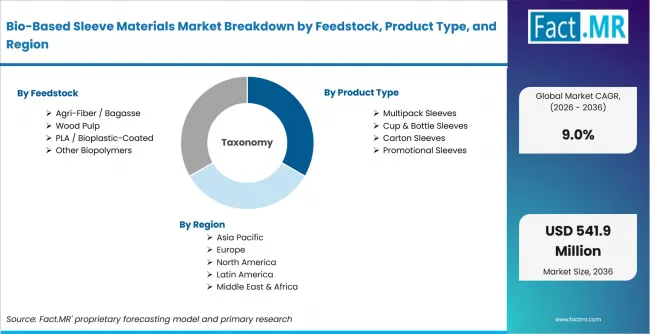
Bio Based Sleeve Materials Market Breakdown By Feedstock, Product Type, And Region | Source: Fact.MR
| Coverage field | Report scope |
|---|---|
| Quantitative Units | USD Million |
| Market Definition | Fiber-rich or coated sleeve materials and converted structures used for bundling, insulation, protection, or communication. |
| Feedstock | Agri-Fiber - Bagasse, Wood Pulp, PLA - Bioplastic-Coated, Other Biopolymers |
| Product Type | Multipack Sleeves, Cup & Bottle Sleeves, Carton Sleeves, Promotional Sleeves |
| Printing | Flexographic, Litho-Laminated, Digital, Others |
| Application | Beverage Multipacks, Food Service, Personal Care, Others |
| End Use | Food & Beverage, Personal Care & Cosmetics, Household Goods, Others |
| Sales Channel | Direct - Brand OEM, Distributors, Online, Others |
| Regions Covered | North America, Latin America, Western Europe, Eastern Europe, East Asia, South Asia and Pacific, Middle East and Africa |
| Countries Covered | India, China, United Kingdom, Germany, Brazil, United States, Canada, Mexico, France, Italy, Spain, Japan, South Korea, Australia, GCC countries, South Africa, Türkiye, Israel |
| Key Companies Profiled | Graphic Packaging International, Smurfit Westrock, Novolex, Sabert Corporation, BioPak, First Pack LLC through PacknWood, Hotpack Packaging LLC |
| Forecast Period | 2026 to 2036 |
| Approach | Hybrid top-down and bottom-up modelling using packaging output, sleeve attachment rates, material mix, redesign cycles, regulations, and converter participation. |
Source: Fact.MR analysis. Updated Jul 31, 2026
How is the market segmented?
-
By Feedstock:
- Agri-Fiber - Bagasse
- Wood Pulp
- PLA - Bioplastic-Coated
- Other Biopolymers
-
By Product Type:
- Multipack Sleeves
- Cup & Bottle Sleeves
- Carton Sleeves
- Promotional Sleeves
-
By Printing:
- Flexographic
- Litho-Laminated
- Digital
- Others
-
By Application:
- Beverage Multipacks
- Food Service
- Personal Care
- Others
-
By End Use:
- Food & Beverage
- Personal Care & Cosmetics
- Household Goods
- Others
-
By Sales Channel:
- Direct - Brand OEM
- Distributors
- Online
- Others
-
By Region:
- North America
- United States
- Canada
- Latin America
- Brazil
- Mexico
- Argentina
- Chile
- Western Europe
- Germany
- France
- United Kingdom
- Italy
- Spain
- Benelux
- Nordics
- Eastern Europe
- Poland
- Czech Republic
- Romania
- Hungary
- East Asia
- China
- Japan
- South Korea
- South Asia and Pacific
- India
- ASEAN
- Australia and New Zealand
- Middle East and Africa
- GCC Countries
- South Africa
- Türkiye
- Israel
- North America
Frequently Asked Questions
Which Feedstock accounts for the primary 2026 share?
Which Product Type holds the primary 2026 position?
Which Printing process captures the greatest 2026 share?
Which Application represents the main 2026 share?
Which End Use garners the primary 2026 share?
Which Sales Channel records the primary 2026 share?
Which country records the primary CAGR position in this market?
How does China perform during the forecast period?
What growth rate is anticipated for the United Kingdom?
How is Germany expected to develop through 2036?
What outlook is forecast for Brazil?
What is the primary demand driver?
Who worked on this report


Preview the report firsthand - request a free sample
Free SampleGet the brochure for pricing and purchase details
Download PDF