- Base Value(2025): 320.0 Mn
- Estimated Value(2026): 368.0 Mn
- Forecast Value (2036): 2420.0 Mn
- CAGR (2026 - 2036): 20.8%
Biogenic Carbon Accounting Software for Chemicals Market Forecast and Outlook By Fact.MR
In 2025, the biogenic carbon accounting software for chemicals market was valued at USD 320.0 million. Based on Fact MR analysis, demand for biogenic carbon accounting software for chemical production tracking is estimated to grow to USD 368.0 million in 2026 and USD 2,435.1 million by 2036. FMR projects a CAGR of 20.8% during the forecast period.
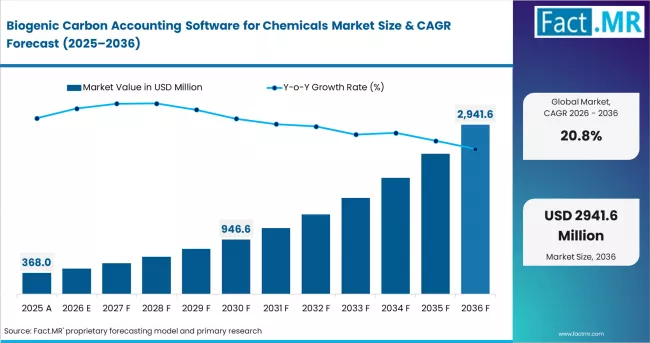
Biogenic Carbon Accounting Software For Chemicals Market Market Value Analysis | Source: Fact.MR
Biogenic Carbon Accounting Software for Chemicals Market
| Metric | Details |
|---|---|
| Industry Size (2026E) | USD 368.0 million |
| Industry Value (2036F) | USD 2,420.0 million |
| CAGR (2026 to 2036) | 20.8% |
Source: Fact.MR analysis. Updated Apr 22, 2026
Summary of the Biogenic Carbon Accounting Software for Chemicals Market
- Market Definition
- The market comprises digital platforms designed to quantify, track, and report carbon originating from biological feedstocks across chemical production value chains, supporting lifecycle emissions accounting, Scope 3 disclosure, product carbon footprint calculation, and differentiation between fossil-derived and bio-based carbon inputs.
- Demand Drivers
- Increasing adoption of bio-based feedstocks requiring differentiated carbon accounting methodologies across chemical manufacturing workflows.
- Rising regulatory requirements for lifecycle emissions disclosure across chemical supply chains.
- Growing need for Scope 3 emissions transparency across multi-tier supplier networks.
- Expansion of lifecycle assessment frameworks supporting calculation of product-level carbon intensity metrics.
- Increasing integration of environmental data platforms with enterprise resource planning systems.
- Rising requirement for standardized methodologies supporting verification of biogenic carbon flows.
- Key Segments Analyzed
- Component: Software platforms lead with 52% share supported by need for lifecycle carbon calculation functionality.
- Deployment: Cloud adoption supported by centralized management of emissions datasets across distributed production facilities.
- Application Role: Lifecycle assessment and product carbon footprint tracking represent core use cases.
- Technology Function: Carbon accounting platforms enable differentiation between fossil carbon emissions and biomass-derived carbon flows.
- Geography: Asia Pacific, Europe, and North America demonstrate adoption aligned with environmental disclosure frameworks.
- Analyst Opinion at Fact MR
- Shambhu Nath Jha, Principal Consultant, Fact MR, opines, 'In this updated edition of the Biogenic Carbon Accounting Software for Chemicals Market report, lifecycle carbon traceability is increasingly embedded within chemical value chain reporting systems supporting transparency of bio-based material utilization through 2036.'
- Strategic Implications or Executive Takeaways
- Invest in lifecycle assessment software capability supporting calculation of carbon intensity across bio-based chemical production processes.
- Strengthen data integration capability supporting compatibility with enterprise resource planning and supply chain reporting platforms.
- Expand Scope 3 accounting functionality supporting supplier-level emissions transparency across chemical value chains.
- Improve data standardization capability supporting consistent application of carbon accounting methodologies.
- Focus on cloud-based environmental data platforms supporting centralized emissions reporting workflows.
- Enhance collaboration with chemical manufacturers supporting implementation of product carbon footprint tracking systems.
- Methodology
- Primary interviews conducted with sustainability software providers, lifecycle assessment specialists, and chemical manufacturers.
- Benchmarked against regulatory disclosure frameworks influencing adoption of environmental reporting software.
- Evaluated lifecycle carbon accounting methodologies supporting differentiation of fossil and biogenic carbon flows.
- Hybrid modeling applied combining top down sustainability reporting demand assessment with bottom up software deployment benchmarking.
- Validation conducted using supplier level environmental data platform adoption indicators across chemical production environments.
- Peer review applied using Fact MR analytical frameworks linking lifecycle emissions reporting requirements with enterprise carbon accounting software demand.
An increase of USD 2,052.0 million indicates transformational expansion driven by demand for verified carbon intensity tracking across chemical value chains. Growth is supported by emissions reporting requirements and lifecycle assessment integration, while constraints persist from data standardization challenges, verification costs, and interoperability complexity across enterprise resource planning systems.
India leads with a projected CAGR of 22.6%, supported by increasing implementation of carbon traceability tools across bio-based chemical manufacturing processes. China follows with a CAGR of 22.1%, driven by expanding adoption of emissions accounting platforms across industrial chemical production networks. The United Kingdom records a CAGR of 21.7%, reflecting steady deployment of digital carbon balance tracking systems across specialty chemical formulation operations. Germany shows a CAGR of 21.3%, supported by consistent integration of lifecycle carbon accounting software across regulated chemical production environments. The United States records the slowest growth at 20.8%, reflecting an emerging compliance software ecosystem tied to gradual adoption cycles within established environmental reporting frameworks.
Segmental Analysis
Biogenic Carbon Accounting Software for Chemicals Market Analysis by Component
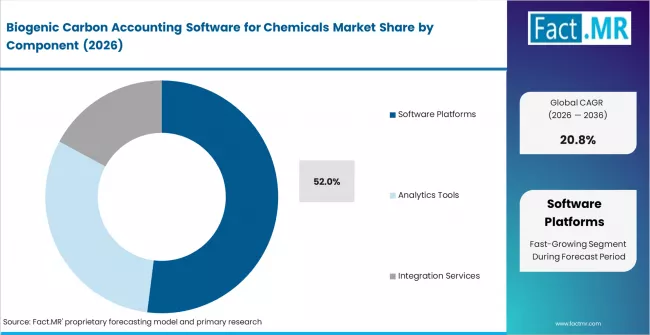
Biogenic Carbon Accounting Software For Chemicals Market Analysis By Component | Source: Fact.MR
-
Market Overview: Based on Fact MR assessment, software platforms are projected to account for 52% share of the biogenic carbon accounting software for chemicals market in 2026. Carbon accounting platforms enable calculation of biogenic carbon content across chemical value chains requiring structured data capture from feedstock sourcing, production processes, and product lifecycle stages. Software architecture supports allocation methodologies enabling differentiation between fossil derived carbon and biomass based carbon inputs across chemical manufacturing workflows. Data modeling frameworks enable traceability of carbon flow across supply chain networks requiring consistent documentation of emission factors and material balance relationships across industrial chemical production environments.
- Demand Drivers:
- Carbon Traceability Requirements: Software platforms support tracking of carbon origin across feedstock conversion processes requiring structured data mapping frameworks.
- Lifecycle Calculation Parameters: Accounting systems enable evaluation of carbon balance across production and distribution stages supporting standardized reporting methodologies.
- Data Integration Needs: Software platforms support aggregation of process data enabling calculation of carbon intensity metrics across chemical manufacturing operations.
Biogenic Carbon Accounting Software for Chemicals Market Analysis by Deployment
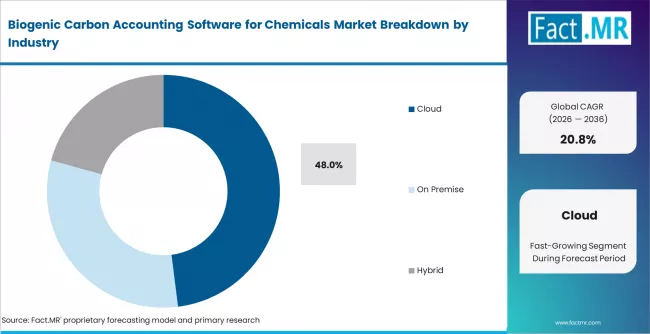
Biogenic Carbon Accounting Software For Chemicals Market Analysis By Deployment | Source: Fact.MR
- Market Overview: Cloud deployment is estimated to hold 48% share of the biogenic carbon accounting software for chemicals market in 2026, supported by requirement for centralized data processing enabling consolidation of emission related information across distributed production facilities. Cloud based infrastructure supports storage of lifecycle inventory datasets enabling scalable calculation of carbon footprint parameters across complex chemical supply chains. Deployment architecture supports accessibility of reporting tools enabling coordination of carbon accounting processes across multiple operational sites requiring standardized data processing workflows aligned with environmental reporting frameworks.
- Demand Drivers:
- Data Centralization Requirements: Cloud deployment supports aggregation of carbon accounting datasets enabling unified reporting across distributed chemical production networks.
- Computational Scalability Parameters: Cloud infrastructure supports processing of lifecycle emission data requiring flexible analytical capacity.
- Multi Site Accessibility Needs: Cloud platforms enable access to carbon accounting tools across geographically distributed operational environments supporting consistent calculation methodologies.
Key Dynamics
Biogenic Carbon Accounting Software for Chemicals Market Drivers, Restraints, and Opportunities
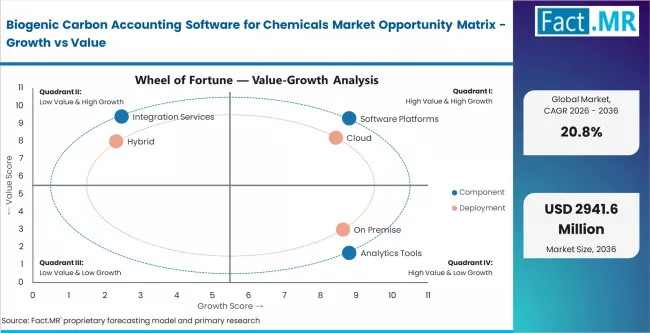
Biogenic Carbon Accounting Software For Chemicals Market Opportunity Matrix Growth Vs Value | Source: Fact.MR
FMR analysts observe that historical carbon accounting in the chemical industry has been structurally based on fossil carbon lifecycle models where emissions reporting frameworks focused primarily on scope-based greenhouse gas measurement rather than material-level carbon origin differentiation. The current market size reflects a transition toward software platforms capable of distinguishing fossil carbon from biogenic carbon flows within bio-based chemicals, polymers, and intermediates used in packaging, coatings, and specialty materials. Structural reality indicates a growth-phase environmental data infrastructure market because chemical producers increasingly incorporate biomass-derived feedstocks, requiring lifecycle accounting tools capable of quantifying carbon uptake, storage duration, and end-of-life emissions across complex value chains. Biogenic carbon refers to carbon originating from biological sources such as biomass and forms part of the short-term global carbon cycle.
The present structural shift reflects declining reliance on simplified carbon footprint models that treat all CO₂ emissions equivalently, while advanced lifecycle assessment software distinguishes temporary carbon storage effects associated with bio-based materials. Software costs increase due to integration of lifecycle inventory databases, supply chain traceability inputs, and emissions factor modeling, yet improved compliance readiness and product-level carbon disclosure capabilities support adoption across specialty chemicals and polymer producers. Value growth is driven by regulatory disclosure requirements rather than direct production volume expansion.
- Bio-feedstock Traceability: Lifecycle assessment software quantifies carbon uptake and release timing across biomass-derived intermediates, improving transparency of bio-based chemical climate impact calculations.
- Carbon Accounting Standards: ISO 14040, ISO 14044, ISO 14067, and GHG Protocol Product Standards influence methodological requirements for lifecycle-based carbon footprint reporting across chemical value chains.
- Europe Policy Adoption: Germany, Netherlands, and Nordic countries drive adoption due to strong bio-based chemical development ecosystems and regulatory emphasis on lifecycle emissions transparency.
Regional Analysis
The Biogenic Carbon Accounting Software for Chemicals Market is assessed across North America, Europe, and Asia Pacific, segmented by country-level demand in lifecycle emission tracking, product carbon footprint measurement, Scope 3 accounting systems, and chemical value chain sustainability reporting platforms. Regional demand reflects regulatory disclosure requirements and adoption of digital carbon accounting tools in chemical manufacturing. The full report offers market attractiveness analysis.
.webp "Top Country Growth Comparison Biogenic Carbon Accounting Software For Chemicals Market Cagr (2026 2036)")
Top Country Growth Comparison Biogenic Carbon Accounting Software For Chemicals Market Cagr (2026 2036) | Source: Fact.MR
CAGR Table
| Country | CAGR (2026–2036) |
|---|---|
| India | 22.6% |
| China | 22.1% |
| United Kingdom | 21.7% |
| Germany | 21.3% |
| United States | 20.8% |
Source: Fact.MR analysis. Updated Apr 22, 2026
Source: Fact MR analysis, based on proprietary forecasting model and primary research
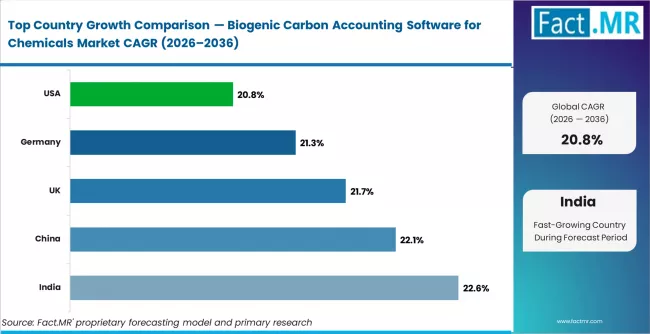
Biogenic Carbon Accounting Software For Chemicals Market Cagr Analysis By Country | Source: Fact.MR
Asia Pacific
Asia Pacific functions as the digital carbon tracking adoption hub, supported by expansion of environmental disclosure frameworks and increasing need for lifecycle emission measurement tools in chemical production. Sphera Solutions Inc. strengthens lifecycle assessment software capability. SAP SE expands sustainability data management platforms. Ecochain Technologies B.V. supports product carbon footprint modelling solutions.
- India: India is projected to record 22.6% CAGR in biogenic carbon accounting software for chemicals through 2036. National Green Hydrogen Mission lifecycle emission tracking framework update (Ministry of New and Renewable Energy, March 2024) supports carbon accounting software adoption. Tata Consultancy Services Limited expanded sustainability analytics software capability (June 2023).
- China: Adoption of biogenic carbon accounting software for chemicals in China is forecast to grow at 22.1% CAGR through 2036. National carbon market reporting guideline update (Ministry of Ecology and Environment, January 2024) supports lifecycle emission tracking integration in chemical production. SAP SE expanded sustainability data platform deployment capability (May 2023).
Europe
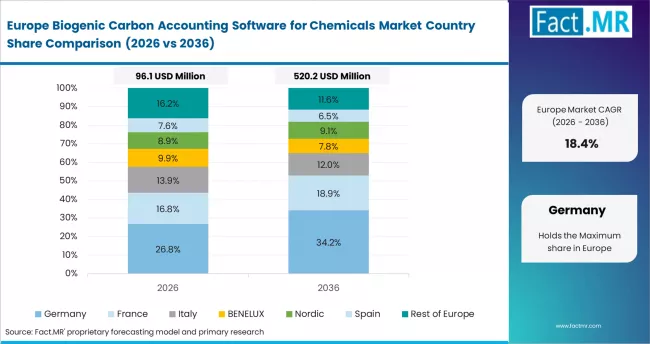
Biogenic Carbon Accounting Software For Chemicals Market Europe Country Market Share Analysis, 2026 & 2036 | Source: Fact.MR
Europe operates as the chemical lifecycle emission compliance benchmark, supported by structured carbon disclosure requirements and adoption of digital product footprint reporting systems. Sphera Solutions Inc. strengthens lifecycle emission analytics capability. Ecochain Technologies B.V. expands Scope 3 accounting software platforms. Dassault Systèmes SE supports sustainability data modelling integration.
- United Kingdom: Deployment of biogenic carbon accounting software for chemicals in United Kingdom is expected to expand at 21.7% CAGR through 2036. UK Emissions Trading Scheme reporting framework update (Department for Energy Security, February 2024) supports carbon accounting platform adoption. Ecochain Technologies B.V. expanded lifecycle impact assessment software capability (July 2023).
- Germany: Germany is anticipated to observe 21.3% CAGR in biogenic carbon accounting software for chemicals through 2036. EU Corporate Sustainability Reporting Directive implementation update (Federal Ministry for Economic Affairs, October 2023) supports product carbon footprint data reporting systems. Sphera Solutions Inc. expanded lifecycle emission analytics capability (April 2023).
North America
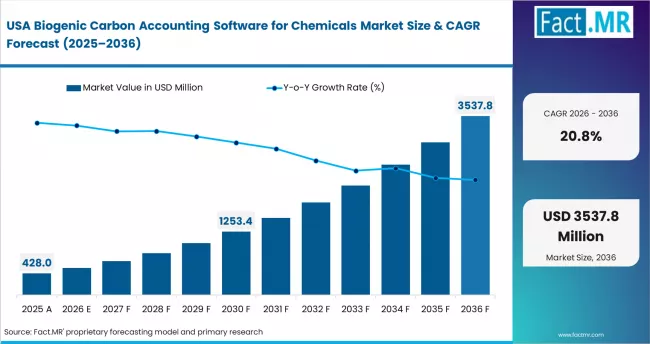
Biogenic Carbon Accounting Software For Chemicals Market Country Value Analysis | Source: Fact.MR
North America represents the enterprise sustainability reporting software commercialization environment, supported by increasing regulatory focus on emissions disclosure and adoption of Scope 3 carbon accounting tools in chemical supply chains. IBM Corporation strengthens sustainability data analytics capability. Persefoni AI Inc. expands enterprise carbon accounting platforms. Microsoft Corporation supports cloud-based emission reporting integration.
- United States: The United States is forecast to witness 20.8% CAGR in biogenic carbon accounting software for chemicals through 2036. SEC climate disclosure proposal update (March 2024) supports lifecycle carbon reporting software deployment. Persefoni AI Inc. expanded enterprise carbon accounting analytics capability (August 2023).
Fact MR's analysis of biogenic carbon accounting software for chemicals market in global regions consists of country-wise assessment that includes India, China, United Kingdom, Germany, and United States. Readers can find lifecycle emission tracking trends, Scope 3 reporting developments, regulatory disclosure signals, and competitive positioning across key markets.
Competitive Landscape
Competitive Structure and Buyer Dynamics in the Biogenic Carbon Accounting Software for Chemicals Market
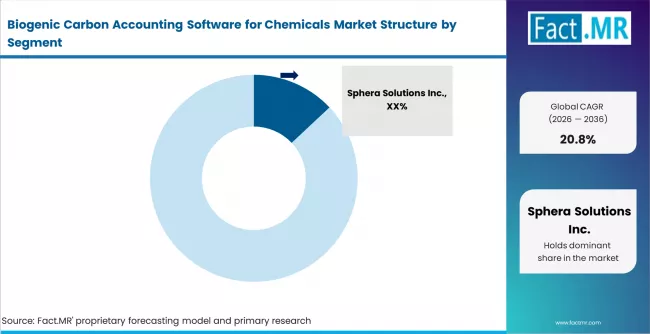
Biogenic Carbon Accounting Software For Chemicals Market Analysis By Company | Source: Fact.MR
The competitive structure of the Biogenic Carbon Accounting Software for Chemicals Market is moderately fragmented, with sustainability software providers and enterprise analytics companies competing across lifecycle emissions tracking platforms. Companies such as Sphera Solutions Inc., SAP SE, Dassault Systemes SE, IBM Corporation, Microsoft Corporation, Ecochain Technologies B.V., Persefoni AI Inc., Normative.io, Greenly SAS, and SINAI Technologies Inc. maintain notable positions through carbon accounting software platforms integrated with enterprise resource planning and supply chain data systems. Competition is primarily influenced by lifecycle assessment accuracy, emissions factor database coverage, audit readiness capability, and interoperability with corporate reporting systems used in chemical manufacturing environments.
Several companies maintain structural advantages through established enterprise software ecosystems and strong expertise in environmental performance analytics. Firms such as SAP SE, IBM Corporation, and Microsoft Corporation benefit from integration capabilities across enterprise data environments supporting large scale emissions monitoring. Sphera Solutions Inc. and Ecochain Technologies B.V. maintain advantages through specialized lifecycle assessment databases tailored for chemical value chains. Chemical manufacturers typically evaluate multiple software providers to reduce dependence on a single carbon accounting platform and maintain flexibility in reporting frameworks. Procurement decisions assess suppliers based on calculation transparency, regulatory alignment capability, and long term scalability, moderating supplier pricing leverage across emissions accounting software deployments.
Key Players of the Biogenic Carbon Accounting Software for Chemicals Market
- Sphera Solutions Inc.
- Ecochain Technologies B.V.
- SAP SE
- Dassault Systemes SE
- Persefoni AI Inc.
- Normative.io
- IBM Corporation
- Microsoft Corporation
- Greenly SAS
- SINAI Technologies Inc.
Bibliographies
- [1] Federal Ministry for Economic Affairs and Climate Action. (2023, October). EU corporate sustainability reporting directive implementation update. Government of Germany.
- [2] Ministry of Ecology and Environment. (2024, January). National carbon market reporting guideline update. Government of China.
- [3] Ministry of New and Renewable Energy. (2024, March). National green hydrogen mission lifecycle emission tracking framework update. Government of India.
- [4] Department for Energy Security and Net Zero. (2024, February). UK emissions trading scheme reporting framework update. UK Government.
- [5] U.S. Securities and Exchange Commission. (2024, March). SEC climate disclosure proposal update. U.S. Securities and Exchange Commission.
- [6] SAP SE. (2023, May). Sustainability data platform deployment capability expansion. SAP SE.
- [7] Sphera Solutions Inc. (2023, April). Lifecycle emission analytics capability expansion. Sphera Solutions Inc.
- [8] Tata Consultancy Services Limited. (2023, June). Sustainability analytics software capability expansion. Tata Consultancy Services Limited.
- [9] Ecochain Technologies B.V. (2023, July). Lifecycle impact assessment software capability expansion. Ecochain Technologies B.V.
This Report Addresses
- Market size forecasts for 2026 to 2036 based on adoption of digital platforms supporting traceability of biogenic carbon across chemical production value chains.
- Opportunity mapping across lifecycle assessment software, Scope 3 tracking tools, product carbon footprint analytics, and supply chain emissions reporting platforms supporting bio-based material accounting.
- Segment and regional forecasts covering software platforms, analytics modules, and integration services enabling differentiation of fossil-derived and biomass-derived carbon streams.
- Competition benchmarking based on lifecycle calculation accuracy, emissions factor database coverage, audit readiness capability, and interoperability with enterprise resource planning systems used in chemical manufacturing environments.
- Standards assessment covering ISO 14040, ISO 14044, ISO 14067, and GHG Protocol Product Standards influencing methodology frameworks for lifecycle carbon accounting across bio-based chemical production.
- Report delivery in PDF, Excel, PPT, and dashboard formats supporting chemical manufacturers, sustainability analytics providers, environmental consultants, and enterprise software developers.
- Technology risk evaluation covering variability in lifecycle inventory data quality, verification cost structures, integration complexity across supply chain reporting systems, and evolving regulatory disclosure requirements for bio-based material carbon accounting.
Biogenic Carbon Accounting Software for Chemicals Market Definition
The biogenic carbon accounting software for chemicals market includes digital platforms that measure, track, and report carbon originating from biological feedstocks such as biomass, bio based intermediates, and renewable raw materials across chemical production processes, supporting life cycle assessment, emissions reporting, and verification of fossil versus bio derived carbon content in chemical value chains.
Biogenic Carbon Accounting Software for Chemicals Market Inclusions
The report includes global and regional market size estimates, forecast analysis, and segmentation by software type, accounting methodology, deployment architecture, application area, end use industry, pricing structure, and integration with life cycle assessment tools, sustainability reporting systems, and enterprise resource planning platforms used in chemical manufacturing.
Biogenic Carbon Accounting Software for Chemicals Market Exclusions
The scope excludes general carbon footprint management software not designed to differentiate fossil and biogenic carbon streams, laboratory carbon testing services without digital accounting platforms, emissions monitoring hardware, and sustainability software not specifically configured for chemical material level carbon tracking.
Biogenic Carbon Accounting Software for Chemicals Market Research Methodology
- Primary Research: Interviews were conducted with sustainability software providers, chemical manufacturers, regulatory specialists, and life cycle assessment professionals.
- Desk Research: Public sources included carbon accounting standards documentation, sustainability reporting frameworks, company technical materials, and research publications on biogenic carbon measurement approaches.
- Market-Sizing and Forecasting: A hybrid model combining top-down evaluation of sustainability software demand in chemical industries and bottom-up analysis of biogenic carbon tracking platform adoption was applied.
- Data Validation and Update Cycle: Outputs were validated through cross comparison of regulatory developments, expert consultation, and periodic monitoring of reporting requirements related to bio based material accounting.
Segmentation
Report Scope
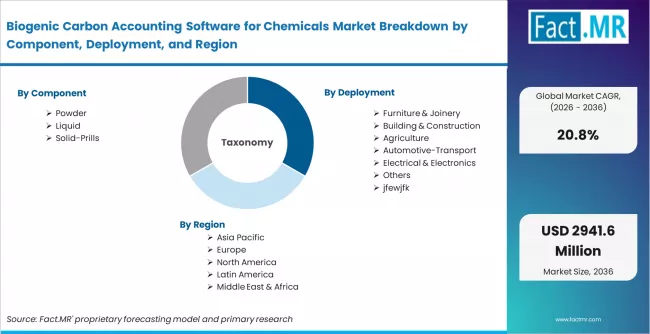
Biogenic Carbon Accounting Software For Chemicals Market Breakdown By Component, Deployment, And Region | Source: Fact.MR
| Metric | Value |
|---|---|
| Quantitative Units | USD 368.0 million (2026) to USD 2,420.0 million (2036), at a CAGR of 20.8% |
| Market Definition | The biogenic carbon accounting software for chemicals market includes digital platforms designed to measure, track, and report carbon flows derived from biological feedstocks across chemical production value chains, supporting lifecycle emissions accounting, regulatory compliance, and supply chain transparency. |
| Component Segmentation | Software platforms, Analytics tools, Integration services |
| Application Segmentation | Lifecycle assessment, Scope 3 tracking, Product carbon footprint, Supply chain reporting |
| Deployment Segmentation | Cloud, On premise, Hybrid |
| Regions Covered | North America, Latin America, Europe, East Asia, South Asia, Oceania, Middle East and Africa |
| Countries Covered | United States, Canada, Germany, France, United Kingdom, Netherlands, Sweden, Switzerland, China, Japan, South Korea, India, Singapore, Australia, Brazil, Mexico, United Arab Emirates, South Africa, and 40+ countries |
| Key Companies Profiled | Sphera Solutions Inc., Ecochain Technologies B.V., SAP SE, Dassault Systemes SE, Persefoni AI Inc., Normative.io, IBM Corporation, Microsoft Corporation, Greenly SAS, SINAI Technologies Inc. |
| Forecast Period | 2026 to 2036 |
| Approach | Hybrid top-down and bottom-up market estimation based on lifecycle emissions accounting adoption trends in chemical manufacturing, carbon disclosure regulatory benchmarking, enterprise sustainability software deployment rates, supply chain emissions tracking demand patterns, and validation through primary interviews with enterprise software providers, chemical manufacturers, and environmental data platform developers. |
Source: Fact.MR analysis. Updated Apr 22, 2026
Biogenic Carbon Accounting Software for Chemicals Market Key Segments
-
Component:
- Software Platforms
- Analytics Tools
- Integration Services
-
Application:
- Lifecycle Assessment
- Scope 3 Tracking
- Product Carbon Footprint
- Supply Chain Reporting
-
Deployment:
- Cloud
- On Premise
- Hybrid
-
Region:
- North America
- USA
- Canada
- Mexico
- Europe
- Germany
- UK
- France
- Italy
- Spain
- Nordic Countries
- BENELUX
- Rest of Europe
- Asia Pacific
- China
- Japan
- South Korea
- India
- Australia
- Rest of Asia Pacific
- Latin America
- Brazil
- Argentina
- Rest of Latin America
- Middle East and Africa
- Kingdom of Saudi Arabia
- United Arab Emirates
- South Africa
- Rest of Middle East and Africa
- Other Regions
- Oceania
- Central Asia
- Other Markets
- North America
Frequently Asked Questions
How large is the demand for Biogenic Carbon Accounting Software for Chemicals in the global market in 2026?
What will be the market size of Biogenic Carbon Accounting Software for Chemicals in the global market by 2036?
What is the expected demand growth for Biogenic Carbon Accounting Software for Chemicals in the global market between 2026 and 2036?
Which company is identified as a leading provider in the Biogenic Carbon Accounting Software for Chemicals market?
Which component segment is projected to dominate biogenic carbon accounting software adoption by 2026?
Why are software platforms widely used in biogenic carbon accounting applications?
What is driving demand for biogenic carbon accounting software in India?
What is the growth outlook for the Biogenic Carbon Accounting Software for Chemicals market in India?
Why is China an important market for carbon accounting platforms in chemical production environments?
What is the growth outlook for the Biogenic Carbon Accounting Software for Chemicals market in China?
How is demand for carbon accounting software evolving in the United Kingdom chemicals sector?
What is the growth outlook for the Biogenic Carbon Accounting Software for Chemicals market in the United Kingdom?
What is the growth outlook for the Biogenic Carbon Accounting Software for Chemicals market in Germany?
How is the United States positioned in the Biogenic Carbon Accounting Software for Chemicals market?
What is the growth outlook for the Biogenic Carbon Accounting Software for Chemicals market in the United States?
What is biogenic carbon accounting software for chemicals and what is it mainly used for?
What does the Biogenic Carbon Accounting Software for Chemicals market include in this report?
What applications are included in the scope of the Biogenic Carbon Accounting Software for Chemicals market?
What is excluded from the scope of the Biogenic Carbon Accounting Software for Chemicals market report?
What does market forecast mean in the Biogenic Carbon Accounting Software for Chemicals market report?
How is the Biogenic Carbon Accounting Software for Chemicals market forecast developed in this report?
What does primary validation indicate in the Biogenic Carbon Accounting Software for Chemicals market analysis?
Who worked on this report


Preview the report firsthand - request a free sample
Free SampleGet the brochure for pricing and purchase details
Download PDF