- Base Value(2025): 1.4 Bn
- Estimated Value(2026): 1.5 Bn
- Forecast Value (2036): 2.7 Bn
- CAGR (2026 - 2036): 6.0%
Chicory Root Oligo fructose for Low-Sugar Dairy Market Forecast and Outlook By Fact.MR
In 2025, the chicory root oligo fructose for low-sugar dairy market was valued at USD 1.4 billion. Based on Fact.MR analysis, demand for chicory root oligo fructose in low-sugar dairy applications is estimated to grow to USD 1.5 billion in 2026 and USD 2.7 billion by 2036. FACT.MR projects a CAGR of 6.0% during the forecast period.
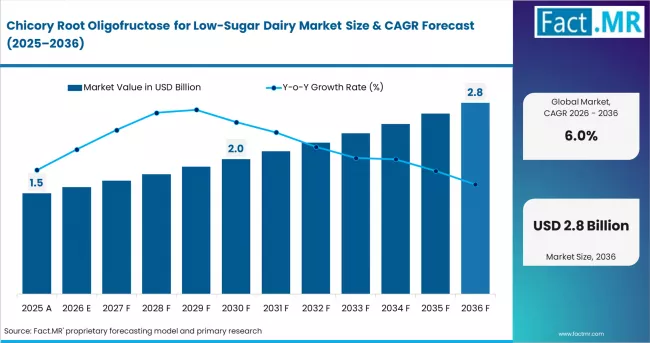
Chicory Root Oligofructose For Low Sugar Dairy Market Market Value Analysis | Source: Fact.MR
| Metric | Value |
|---|---|
| Estimated Value in 2026 | USD 1.5 billion |
| Forecast Value in 2036 | USD 2.7 billion |
| Forecast CAGR (2026 to 2036) | 6.0% |
Source: Fact.MR analysis. Updated Apr 13, 2026
Summary of the Chicory Root Oligofructose for Low-Sugar Dairy Market
- Market Definition
- Covers chicory-derived oligofructose and inulin in powder and liquid forms used as sugar-reducing and prebiotic ingredients in low-sugar dairy.
- Demand Drivers
- Growth of low-sugar dairy in Europe and North America drives reformulation demand.
- EU sugar targets and U.S. labelling rules push sugar replacement with prebiotic fibres.
- China dairy innovation and infant nutrition demand increase oligofructose use.
- Key Segments Analyzed
- By Form: Powder leads 70% share, 2026 due to compatibility with dairy processing.
- By Application: Food & beverages lead 62% share, driven by dairy and functional foods.
- By Geography: China leads growth 7.9% CAGR due to dairy expansion and infant nutrition demand.
- Analyst Opinion at FACT.MR
- Shambhu Nath Jha Principal consultant at Fact.MR highlights high-DP validation, EFSA alignment, and certification as key to securing dairy contracts.
- Strategic Implications
- Focus on EFSA-compliant health claims and EU sugar reduction alignment.
- Invest in high-DP oligofructose with proven sweetness and functionality.
- Build local technical support for China and Japan dairy applications.
- Methodology
- Based on revenue, volume, and pricing data (2024–2025).
- Uses EFSA, USDA, FOSHU, and EU regulatory inputs.
- Forecasts include dairy growth, prebiotic trends, and processing capacity insights.
Between 2026 and 2036, the market is expected to create USD 1.2 billion in new opportunity. Growth remains steady and structurally anchored. Demand is driven by dairy manufacturer reformulation away from added sugar and artificial sweeteners toward prebiotic fibre systems delivering sweetness modulation, gut health credentials, and clean-label ingredient declarations. Raw chicory root price volatility driven by European harvest conditions and processing capacity concentration in Belgium, France, and the Netherlands creates input cost pressure for smaller formulators.
Country growth reflects sugar reduction regulation stringency, functional dairy innovation depth, chicory processing infrastructure maturity, and organized retail clean-label dairy shelf expansion. China leads at 7.9% CAGR through rapid dairy innovation investment and infant nutrition demand for prebiotic fibre ingredients. The United States follows at 7.7% as the fastest-growing consumption market through retailer low-sugar dairy mandates and nutrition label reform driving added sugar reduction. Japan records 7.0% through advanced functional dairy market infrastructure and FOSHU-labelled prebiotic dairy product development. Germany records 6.4% through strong chicory processing capacity and the largest European low-sugar dairy market share. France records 6.0% through deep chicory production heritage and established clean-label dairy reformulation. Structural constraints across mature European markets include established inulin overcapacity limiting premium pricing recovery for standard-grade oligofructose and lengthy dairy manufacturer qualification cycles for new functional fibre suppliers.
Segmental Analysis
Chicory Root Oligofructose for Low-Sugar Dairy Market Analysis by Form
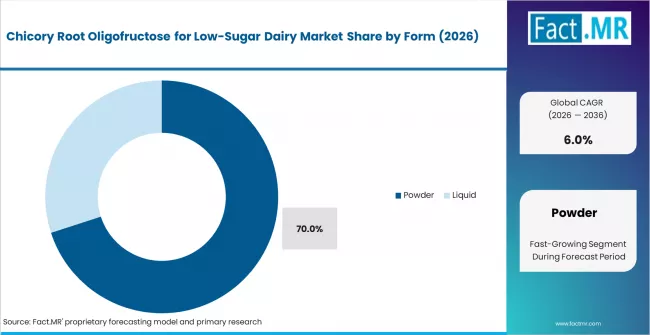
Chicory Root Oligofructose For Low Sugar Dairy Market Analysis By Form | Source: Fact.MR
Powder form holds 70% share in 2026 due to versatility across dry yoghurt culture blending, dairy powder fortification, and shelf-stable dairy dessert manufacturing. Strong compatibility with industrial dairy processing lines and cost-efficient transport and storage versus liquid format support its position as the volume anchor globally.
- BENEO Capacity Investment: BENEO expanded its Orafti HP inulin and oligofructose powder production capacity at its Tienen, Belgium facility in 2024, targeting European and export low-sugar dairy manufacturer demand for high-purity prebiotic fibre systems. [1]
- Cosucra Liquid Launch: Cosucra Groupe Warcoing introduced a new liquid oligofructose format in 2024 with improved heat stability and dosing consistency for continuous dairy processing lines, targeting yoghurt and flavoured milk manufacturers in France and Germany. [2]
- Powder Procurement Trend: European dairy ingredient powder imports for prebiotic fortification grew 16% in 2024, driven by low-sugar dairy product launch acceleration across German and Dutch supermarket private label ranges. [3]
Chicory Root Oligofructose for Low-Sugar Dairy Market Analysis by Application
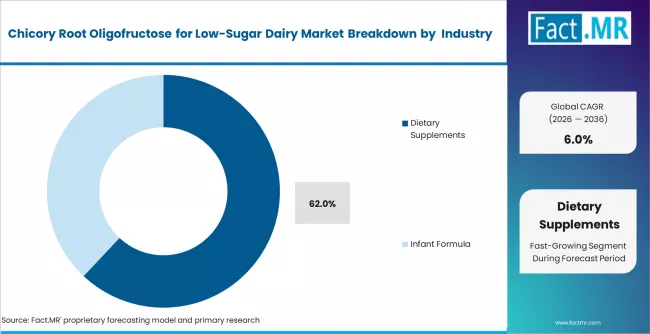
Chicory Root Oligofructose For Low Sugar Dairy Market Analysis By Application | Source: Fact.MR
Based on FACT.MR's chicory root oligofructose for low-sugar dairy market report, Food and Beverages is estimated to hold 62% share in 2026. Food and beverages dominate as chicory oligofructose provides critical sugar reduction, prebiotic fibre addition, and texture enhancement functions in low-sugar yoghurt, ice cream, and flavoured milk manufacturing where regulatory and retailer reformulation mandates are creating the largest and fastest-growing ingredient substitution demand globally.
- Sensus Supply Investment: Sensus (Royal Cosun) expanded chicory oligofructose supply agreements with major Dutch and German dairy cooperative manufacturers in 2024, targeting low-sugar yoghurt and dairy dessert product reformulation driven by EU sugar reduction targets. [4]
- Ingredion Functional Development: Ingredion Incorporated launched a chicory root inulin and oligofructose blend system in 2025 specifically engineered for no-added-sugar ice cream and frozen dairy applications, maintaining creaminess and structure without added sugar. [5]
- Infant Formula Trend: Global infant formula launches incorporating chicory-derived prebiotic GOS and FOS blends grew 21% in 2024, driven by EU infant formula regulatory framework updates mandating prebiotic fibre inclusion in follow-on formula products. [6]
Drivers, Restraints, and Opportunities
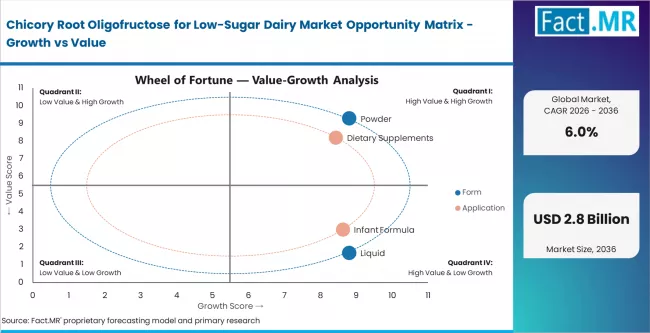
Chicory Root Oligofructose For Low Sugar Dairy Market Opportunity Matrix Growth Vs Value | Source: Fact.MR
FACT.MR notes the market has evolved from a niche prebiotic ingredient to a mainstream low-sugar dairy solution. Growth is driven by sugar reduction policies, clean-label demand, and dairy reformulation across retail channels.
A clear split is visible. Standard inulin faces pricing pressure due to European oversupply and bulk procurement. High-DP oligo fructose and FOS blends with proven prebiotic benefits command 25–45% premiums. These certified formats are gaining long-term supply contracts and supporting revenue growth.
- EU Sugar Reduction Regulation: EU Farm to Fork strategy and 2024 national targets in Germany and France are driving dairy reformulation. Chicory oligofructose is used as a sugar reduction system with EFSA-backed claims. [7]
- China Dairy Innovation Expansion: China’s 2025 dairy plan promotes low-sugar and functional products. Companies like Mengniu and Yili are increasing oligofructose use in yoghurt and dairy lines. [8]
- U.S. Nutrition Label Reform: FDA added sugar disclosure rules (fully enforced 2024) are pushing brands like Chobani and Danone North America toward prebiotic fibre-based reformulation. [9]
Regional Analysis
The chicory root oligofructose for low-sugar dairy market is analysed across North America, Europe, Asia Pacific, Latin America, and Middle East and Africa, covering 40+ key countries with distinct demand profiles shaped by sugar reduction regulatory frameworks, dairy innovation ecosystem depth, chicory processing infrastructure maturity, and organised retail low-sugar dairy shelf expansion. The full report offers market attractiveness analysis across regulatory compliance intensity, prebiotic sourcing infrastructure, and application-specific demand trajectories.
.webp "Top Country Growth Comparison Chicory Root Oligofructose For Low Sugar Dairy Market Cagr (2026 2036)")
Top Country Growth Comparison Chicory Root Oligofructose For Low Sugar Dairy Market Cagr (2026 2036) | Source: Fact.MR
| Country | CAGR (2026 to 2036) |
|---|---|
| China | 7.9% |
| United States | 7.7% |
| Japan | 7.0% |
| Germany | 6.4% |
| France | 6.0% |
Source: Fact.MR analysis. Updated Apr 13, 2026
Source: Fact.MR (FACT.MR) analysis, based on proprietary forecasting model and primary research
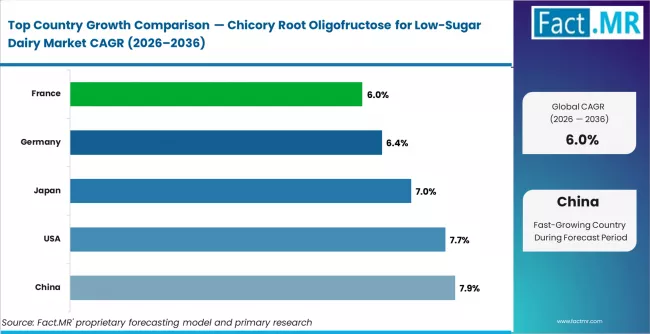
Chicory Root Oligofructose For Low Sugar Dairy Market Cagr Analysis By Country | Source: Fact.MR
Asia Pacific Chicory Root Oligofructose for Low-Sugar Dairy Market
Chicory Root Oligofructose For Low Sugar Dairy Market Japan Market Share Analysis By Form | Source: Fact.MR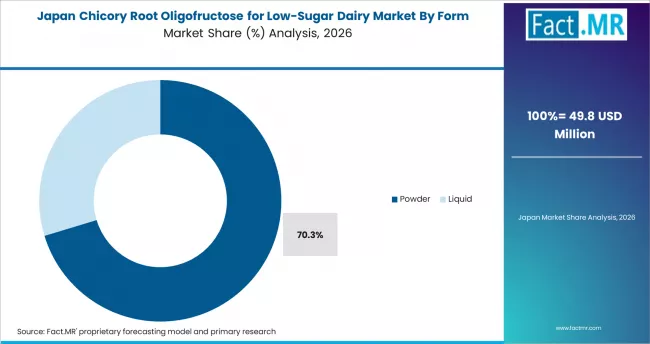
Asia Pacific shows the highest growth. Driven by China’s dairy expansion, Japan’s functional ecosystem, and rising infant formula demand. BENEO, Ingredion, and regional distributors lead supply.
- China: Strong dairy innovation drives ~7.9% CAGR through 2036. The 2025 Dairy Plan promotes low-sugar and functional products. Mengniu and Yili are expanding oligofructose use in yoghurt and desserts. The 2024 GB 25192 update mandates prebiotics in infant formula. Growth is led by innovation and nutrition demand.
- Japan: Mature functional dairy supports ~7.0% CAGR through 2036. FOSHU approval continues to support chicory FOS use. Companies like Meiji and Morinaga use it in gut-health yoghurt. Demand is driven by regulatory compliance and precise health claims.
FACT.MR covers China, Japan, South Korea, India, ASEAN, and ANZ. Includes dairy innovation, regulation trends, and retail benchmarks.
Europe Chicory Root Oligofructose for Low-Sugar Dairy Market
Chicory Root Oligofructose For Low Sugar Dairy Market Europe Country Market Share Analysis, 2026 & 2036 | Source: Fact.MR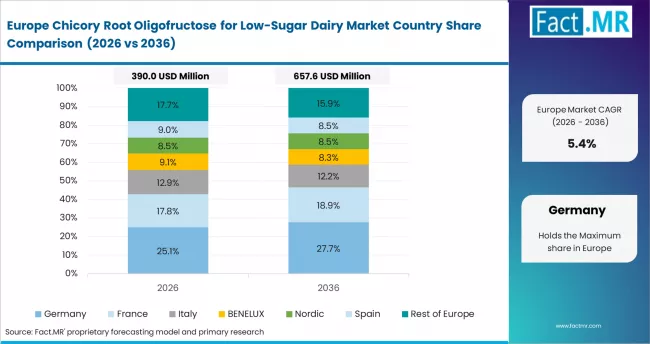
Europe leads in production and regulation. EU sugar targets and EFSA guidance shape demand. BENEO, Cosucra, and Sensus dominate supply.
- Germany: Retail reformulation drives ~6.4% CAGR through 2036. EU sugar targets and 2024 updates push private labels to adopt oligofructose. Edeka and REWE expanded low-sugar yoghurt lines. BENEO increased supply from Tienen. Growth is compliance-driven.
- France: Innovation and supply strength support ~6.0% CAGR through 2036. Cosucra launched improved liquid oligofructose in 2024. Targets Lactalis and Danone reformulation. France 2030 funds prebiotic R&D. Growth is driven by production and innovation.
FACT.MR covers Germany, France, UK, Netherlands, Belgium, and others. Includes EU regulation data and procurement trends.
North America Chicory Root Oligofructose for Low-Sugar Dairy Market
Chicory Root Oligofructose For Low Sugar Dairy Market Country Value Analysis | Source: Fact.MR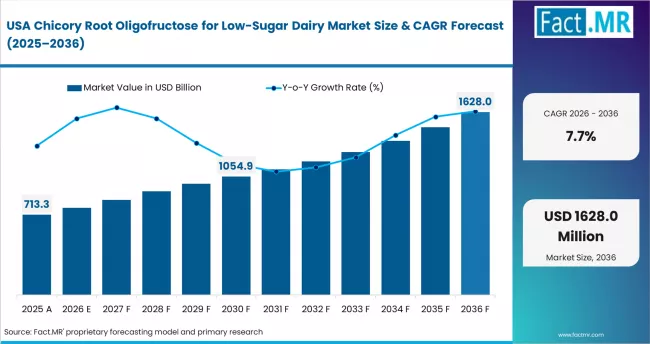
North America is a premium market. Growth is driven by FDA rules and retailer mandates. Cargill, Kerry, and Ingredion lead supply.
- United States: Regulatory push drives 7.7% CAGR through 2036. FDA sugar labelling rules (2024) force reformulation. Chobani expanded low-sugar yoghurt using chicory fibre. Kerry supplies ingredient systems. Ingredion launched no-added-sugar ice cream blends in 2025. Growth is regulation and retail driven.
FACT.MR covers the U.S., Canada, and Mexico. Includes FDA data, retail mandates, and dairy reformulation trends.
Competitive Aligners for Market Players
Competitive Structure and Buyer Dynamics in the Chicory Root Oligofructose for Low-Sugar Dairy Market
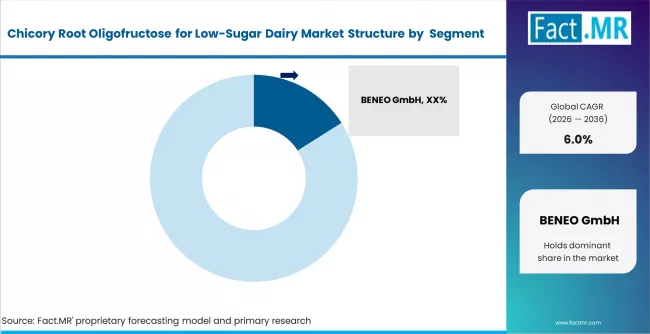
Chicory Root Oligofructose For Low Sugar Dairy Market Analysis By Company | Source: Fact.MR
Competitive alignment in the chicory root oligofructose for low-sugar dairy market is increasingly defined by the ability to combine functional performance validation, regulatory compliance, and application-specific technical support. Market leaders are positioning themselves not just as ingredient suppliers, but as formulation partners capable of enabling sugar reduction without compromising taste, texture, or digestive benefits.
Producers such as BENEO, Cosucra Groupe Warcoing, and Sensus are aligning their strategies around high-purity oligofructose and inulin systems with documented prebiotic efficacy. These companies invest in EFSA-compliant health claim substantiation and clinical validation to secure long-term supply agreements with European dairy manufacturers operating under strict sugar reduction mandates.
In North America, players such as Ingredion Incorporated and Kerry Group are focusing on application-driven innovation. Their strategies include developing customised oligofructose blends tailored for yoghurt, ice cream, and flavoured milk reformulation. Strong relationships with dairy brands, along with technical support services, allow them to integrate directly into product development pipelines.
Another key alignment factor is supply chain positioning. European producers benefit from proximity to chicory cultivation and established processing infrastructure, ensuring consistency and traceability. Meanwhile, global suppliers are expanding regional application labs and technical service teams, particularly in Asia Pacific, to support fast-growing dairy innovation markets such as China and Japan. Certification remains a central competitive lever. Non-GMO, organic, and clean-label credentials are essential for accessing premium retail-driven dairy reformulation programmes.
Key Players
- BENEO GmbH
- Cosucra Groupe Warcoing SA
- Sensus (Royal Cosun)
- Ingredion Incorporated
- Cargill Incorporated
- Kerry Group plc
- Roquette Freres
- FrieslandCampina Ingredients
- Tereos
- NutriLeads B.V.
Bibliography
- [1] BENEO GmbH. (2024). Production Capacity Expansion Announcement: Orafti HP Inulin and Oligofructose Powder Capacity Expansion at Tienen Belgium Facility Targeting European and Export Low-Sugar Dairy Manufacturer Prebiotic Fibre System Supply. 2024. beneo.com/newsroom
- [2] Cosucra Groupe Warcoing SA. (2024). Product Launch: Liquid Oligofructose Format with Improved Heat Stability and Dosing Consistency for Continuous Dairy Processing Lines Targeting Yoghurt and Flavoured Milk Manufacturers in France and Germany. October 2024. cosucra.com/news
- [3] European Dairy Association. (2024). Dairy Ingredient Procurement Survey 2024: Prebiotic Fibre Powder Import Growth Data Including Chicory Oligofructose Adoption in German and Dutch Supermarket Private Label Low-Sugar Dairy Product Reformulation. December 2024. euromilk.org
- [4] Sensus (Royal Cosun). (2024). Supply Agreement Expansion: Chicory Oligofructose Supply Agreements with Dutch and German Dairy Cooperative Manufacturers for Low-Sugar Yoghurt and Dairy Dessert Product Reformulation Under EU Sugar Reduction Targets. 2024. sensus.nl/news
- [5] Ingredion Incorporated. (2025). Product Launch: Chicory Root Inulin and Oligofructose Blend System for No-Added-Sugar Ice Cream and Frozen Dairy Applications Maintaining Creaminess and Structure Without Added Sugar. January 2025. ingredion.com/newsroom
- [6] European Commission. (2024). Delegated Regulation (EU) 2016/127 Update: Prebiotic Fibre Inclusion Requirements for Follow-On Infant Formula Including Chicory-Derived Fructooligosaccharides in EU Infant Formula Regulatory Framework. 2024. ec. europa.eu/food/safety
- [7] European Commission. (2024). Farm to Fork Strategy Sugar Reduction Framework: Updated Voluntary Reformulation Targets for Dairy Products Including Yoghurt and Flavoured Milk Under National Sugar Reduction Pledges in Germany and France. 2024. ec. europa.eu/food/farm2fork
- [8] Ministry of Agriculture and Rural Affairs, China. (2024). National Dairy Industry Development Plan 2025: Functional and Low-Sugar Dairy Product Development Investment Priority Including Prebiotic Fibre Ingredient Procurement Support for Mengniu Dairy and Yili Group. 2024. moa.gov.cn
- [9] U.S. Food and Drug Administration. (2024). Nutrition Facts Label: Added Sugar Declaration Enforcement Update for All Food Manufacturers Including Dairy Product Category Implementation Data and Reformulation Programme Progress. 2024. fda.gov/food/nutrition-facts-label
This Report Addresses
- Strategic intelligence on chicory oligofructose demand across low-sugar dairy reformulation, EU sugar reduction compliance, U.S. FDA added sugar disclosure procurement, China functional dairy innovation investment, and Japan FOSHU-labelled prebiotic dairy product development globally.
- Market forecast from USD 1.5 billion in 2026 to USD 2.7 billion by 2036 at a CAGR of 6.0%.
- Growth opportunity mapping across high-DP oligofructose for premium low-sugar yoghurt, FOS blends for infant formula prebiotic fortification, liquid oligofructose for continuous dairy processing, and pharmaceutical-grade prebiotic dietary supplement applications.
- Segment-wise analysis by form (powder, liquid), application (food and beverages including dairy, dietary supplements, infant formula, pharmaceuticals), and type (inulin, oligofructose, FOS blends).
- Regional outlook covering Asia Pacific China-dairy-innovation-led growth, North America FDA-compliance-and-retailer-mandate-driven reformulation demand, and Europe EU-sugar-reduction-and-chicory-production-led certified ingredient adoption trends.
- Competitive landscape of BENEO, Cosucra, Sensus, Ingredion, Cargill, Kerry Group, Roquette, FrieslandCampina Ingredients, Tereos, and NutriLeads covering vertical integration depth, EFSA health claim documentation capability, and low-sugar dairy supply contract positioning.
- Regulatory impact analysis covering EU Farm to Fork sugar reduction targets, EFSA prebiotic health claim guidance, FDA Nutrition Facts Panel added sugar disclosure enforcement, Japan FOSHU approved ingredient list maintenance, and China GB 25192 infant formula prebiotic fibre standards.
- Report delivery in PDF, Excel datasets, and presentation formats supported by primary interviews, regulatory databases, producer revenue disclosures, dairy manufacturer procurement data, and prebiotic trade association statistics.
Chicory Root Oligofructose for Low-Sugar Dairy Market Definition
Chicory Root Oligofructose for Low-Sugar Dairy Market Definition
The chicory root oligofructose for low-sugar dairy market includes prebiotic ingredients from chicory root used as sugar replacers in yoghurt, milk, ice cream, and dairy desserts.
Chicory Root Oligofructose for Low-Sugar Dairy Market Inclusions
Covers global forecasts (2026–2036) by form, type, and application. Includes powder and liquid formats across food & beverages, supplements, infant formula, and pharma. Covers all major regions.
Chicory Root Oligofructose for Low-Sugar Dairy Market Exclusions
Excludes inulin used only as fat replacer, finished dairy products, synthetic sweeteners, and non-chicory FOS sources. Focus is on chicory-derived oligo fructose supply.
Chicory Root Oligofructose for Low-Sugar Dairy Market Research Methodology
- Primary Research: Interviews with producers, dairy buyers, technologists, and distributors across key regions.
- Desk Research: Uses EFSA data, EU sugar policies, USDA certification, Japan FOSHU lists, and company reports (2024–2025).
- Market-Sizing and Forecasting: Hybrid model using producer revenue and application-level volume estimates by type and form.
- Data Validation and Update Cycle: Validated via producer data, dairy procurement inputs, and regulatory databases. Updated regularly.
Segmentation
Scope of Report
| Attribute | Details |
|---|---|
| Quantitative Units | USD 1.5 billion (2026) to USD 2.7 billion (2036), at a CAGR of 6.0% |
| Market Definition | Chicory root-derived prebiotic oligofructose and inulin in powder and liquid forms supplied as functional sugar-reducing and gut health ingredients to low-sugar yoghurt, flavoured milk, ice cream, infant formula, and dairy dessert manufacturers globally. |
| Form Segmentation | Powder, Liquid |
| Application Segmentation | Food and Beverages (Dairy, Yoghurt, Flavoured Milk, Ice Cream), Dietary Supplements, Infant Formula, Pharmaceuticals |
| Type Segmentation | Inulin, Oligofructose (FOS), Fructooligosaccharides Blends |
| Regions Covered | North America, Europe, Asia Pacific, Latin America, Middle East and Africa |
| Countries Covered | USA, Canada, Mexico, Germany, UK, France, Italy, Spain, Nordic, BENELUX, China, Japan, South Korea, India, ASEAN, Australia and New Zealand, Brazil, Argentina, Chile, Saudi Arabia, GCC, Turkey, South Africa, Rest of MEA |
| Key Companies Profiled | BENEO GmbH, Cosucra Groupe Warcoing, Sensus (Royal Cosun), Ingredion, Cargill, Kerry Group, Roquette Freres, FrieslandCampina Ingredients, Tereos, NutriLeads B.V. |
| Forecast Period | 2026 to 2036 |
| Approach | Hybrid top-down and bottom-up model using application-level volume estimates, average ingredient prices by oligofructose type and purity grade, EFSA health claim data, dairy manufacturer reformulation programme records, and primary interviews with chicory processors and dairy product development managers. |
Source: Fact.MR analysis. Updated Apr 13, 2026
Chicory Root Oligofructose for Low-Sugar Dairy Market by Segments
-
By Form:
- Powder
- Liquid
-
By Application:
- Food and Beverages
- Dairy (Yoghurt, Flavoured Milk, Ice Cream, Low-Sugar Dairy)
- Dietary Supplements
- Infant Formula
- Pharmaceuticals
- Food and Beverages
-
By Type:
- Inulin
- Oligofructose (FOS)
- Fructooligosaccharides Blends
-
By Region:
-
North America
- United States
- Canada
- Mexico
-
Latin America
- Brazil
- Mexico
- Argentina
- Chile
- Rest of Latin America
-
Western Europe
- Germany
- United Kingdom
- France
- Italy
- Spain
- Nordic Countries
- BENELUX
- Rest of Western Europe
-
Eastern Europe
- Russia
- Poland
- Hungary
- Balkan and Baltic
- Rest of Eastern Europe
-
East Asia
- China
- Japan
- South Korea
- South Asia and Pacific
- India
- ASEAN
- Australia and New Zealand
- Rest of South Asia and Pacific
- Middle East and Africa
- Kingdom of Saudi Arabia
- Other GCC Countries
- Turkey
- South Africa
- Rest of Middle East and Africa
-
Frequently Asked Questions
How large is the chicory root oligofructose for low-sugar dairy market in 2025?
What will the market size be by 2036?
What is the expected CAGR for the market from 2026 to 2036?
Which form segment is poised to lead the market?
Which application segment is expected to dominate?
How significant is Asia Pacific in the global market?
What is chicory root oligofructose used for?
Why is demand increasing for oligofructose in dairy?
Which region leads market growth?
What gives premium pricing to oligofructose?
Who are the key players in this market?
What applications dominate usage?
What is the main challenge in this market?
Who worked on this report


Preview the report firsthand - request a free sample
Free SampleGet the brochure for pricing and purchase details
Download PDF