- Market Value (2025): USD 10.3 Bn
- Estimated Value (2026): USD 12.8 Bn
- Forecast Value (2036): USD 117.3 Bn
- CAGR (2026-2036): 24.8%
What is the Cloud Robotics Market forecast to be worth by 2036?
USD 12.8 billion in 2026 to USD 117.3 billion by 2036, at 24.8% CAGR.
- The cloud robotics market crossed a valuation of USD 10.3 billion in 2025 while manufacturers connected robot data with engineering workflows.
- Demand is projected to increase from USD 12.8 billion in 2026 to USD 117.3 billion by 2036.
- The market is forecast to record a 24.8% CAGR from 2026 to 2036 because manufacturers and logistics operators need shared robot operations software.
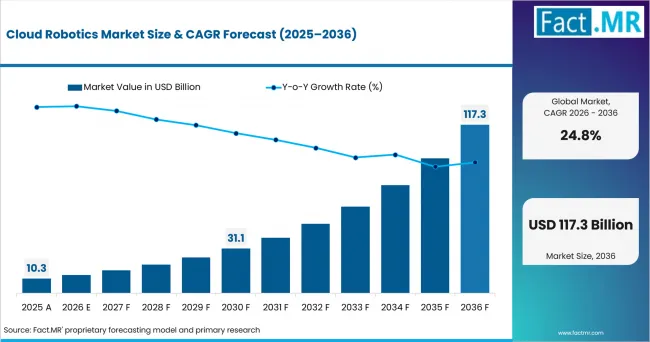
Cloud Robotics Market Market Value Analysis | Source: Fact.MR
What are the defining numbers behind Cloud Robotics Market growth?
USD 104.5 billion absolute opportunity by 2036, led by Software & Platforms and Public Cloud alongside Manufacturing demand.
- Demand Drivers in the Market
- Plant engineering teams need remote programming access because one qualified specialist often supports several robot cells across more than one site.
- Maintenance teams need centralized telemetry so recurring motor and controller faults are compared across fleets before planned service windows.
- Quality managers need synchronized machine data supported by cloud analytics that connect inspection results with robot motion and process settings.
- Fleet operators need vendor-neutral orchestration shaped by mixed deployments where mobile robots and fixed arms exchange tasks across one workflow.
- Key Segments Analyzed
- By Component: Software & Platforms is expected to account for 44% share in 2026, supported by fleet orchestration and remote programming requirements across distributed robot operations.
- By Deployment: Public Cloud is projected to account for 49% share in 2026, owing to centralized fleet analytics and remote engineering access across multiple operating sites.
- By Application: Industrial Automation is anticipated to capture 31% share in 2026, shaped by connected production cells and shared robot programming workflows across factories.
- By End Use: Manufacturing is estimated to represent 34% share in 2026, attributable to large installed robot bases and recurring multi-site production changes.
- Analyst Opinion at Fact.MR
- Shambhu Nath Jha, Senior Analyst at Fact.MR, states, “Cloud robotics is becoming an integration problem before it becomes a computing problem across mixed controller estates. Adoption is expected to favor platforms that keep safety-critical execution local while sharing fleet intelligence across distributed factories. Suppliers should combine secure controller connectors with simulation workflows and field teams that understand production changeovers.”
- Strategic Implications
- Robot manufacturers should expose secure controller interfaces that support remote diagnostics without opening safety-critical motion commands to public networks.
- Plant operators should map tasks by latency sensitivity before deciding which functions remain local and which analytics belong in shared cloud services.
- Robotics software teams should maintain connectors for older controllers because installed fleets rarely standardize on one robot brand or software generation.
- System integrators should test failover behavior during weak connectivity so plant technicians know which functions remain available during network disruption.
Growing demand for remote engineering and digital commissioning is driving investment in cloud-based robotics software platforms. ABB Robotics introduced the RobotStudio AI Assistant in September 2025 to give step-by-step programming guidance inside its cloud-supported simulation environment. The move fits the wider shift toward shared engineering software where teams review programs remotely and reuse robot knowledge across geographically separated plants and production networks before onsite commissioning begins.
India is expected to record 26.6% CAGR between 2026 and 2036, driven by automotive robot expansion and national work on a robotics strategy. China is projected to post 25.9% CAGR during the forecast period, supported by dense factory automation and rising industrial robot output. Australia is anticipated to advance at 24.6% CAGR over the assessment period, owing to public robotics investment and remote-industry automation requirements. The United Kingdom is estimated to record 24.3% CAGR across the 2026 to 2036 period, shaped by robotics adoption programs and established cloud procurement. The United States is forecast to post 24.1% CAGR over the forecast horizon, attributable to its installed robot base and connected manufacturing upgrades. Germany is estimated to register 23.8% CAGR during the forecast period, supported by extensive industrial automation and connected manufacturing networks. Japan is projected to record 23.5% CAGR over the assessment period, owing to deep robot deployment across automotive and electronics production.
How does the Cloud Robotics Market break down by segment?
Software & Platforms accounts for 44% share in 2026, Public Cloud garners 49% share in 2026
Which component is projected to account for the largest share?
Software & Platforms accounts for 44% share in 2026.
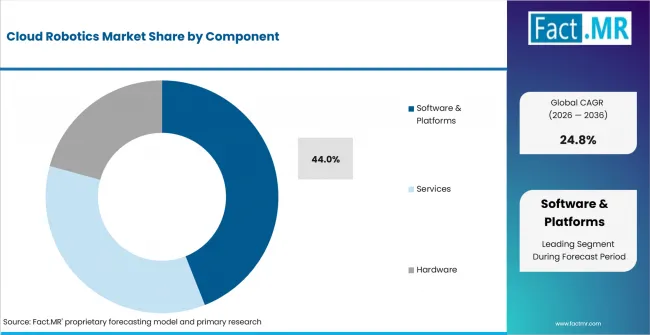
Cloud Robotics Market Analysis By Component | Source: Fact.MR
Software & Platforms is expected to represent 44% share in 2026, supported by centralized fleet coordination and remote programming across distributed robot operations. Services remain important where integrators connect proprietary controllers and maintain cloud deployments across mixed fleets. Hardware supports gateways and controller interfaces that move operational data between robotic equipment and shared software layers. In September 2025 IFR reported 542,000 industrial robot installations across global factories during the 2024 calendar year. That annual volume expands the endpoint base requiring secure connectivity and common operations software across manufacturing networks.
Which deployment is projected to account for the largest share?
Public Cloud is projected to garner 49% share in 2026.
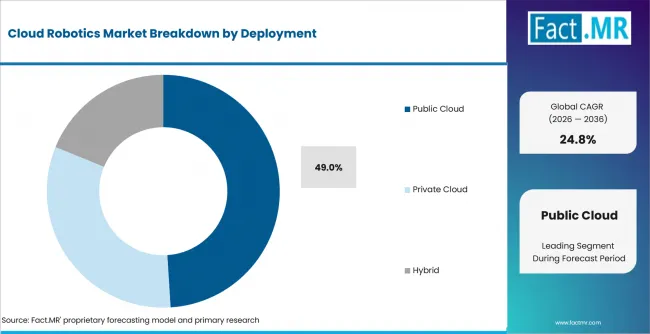
Cloud Robotics Market Analysis By Deployment | Source: Fact.MR
Public Cloud is estimated to account for 49% share in 2026, supported by centralized analytics and remote engineering access across distributed robot fleets. Private Cloud serves operators that need dedicated infrastructure and tighter control over robotic data flows. Hybrid deployments combine shared software services with local execution for latency-sensitive or security-sensitive functions. In March 2025 ONS reported that 69% of UK firms used cloud systems during 2023. That software base lowers organizational barriers to remote engineering tools and shared fleet operations.
How does Application shape demand?
Industrial Automation records 31% share in 2026.
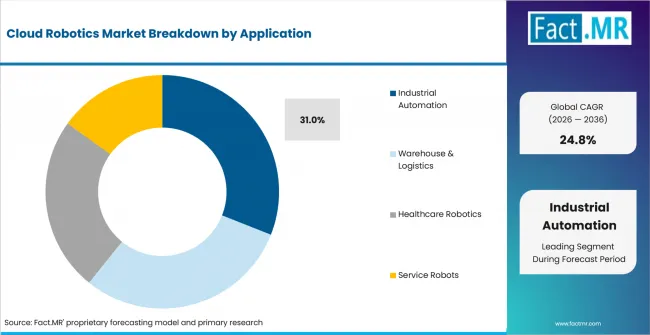
Cloud Robotics Market Analysis By Application | Source: Fact.MR
Industrial Automation is anticipated to capture 31% share in 2026, supported by centralized robot programming and fleet coordination across connected factories. Warehouse & Logistics demand centers on mission assignment and traffic management across mobile robot fleets. Healthcare Robotics uses remote monitoring and controlled software updates across distributed clinical equipment. Service Robots depend on shared software layers for fleet status and task allocation across dispersed operating environments. FANUC highlighted Zero Down Time software in April 2025 through its Automate 2025 portfolio for robot monitoring and maintenance programs. The portfolio shows how connected operations software supports industrial robot availability across production sites.
What supports Manufacturing within End Use?
Manufacturing represents 34% share in 2026.
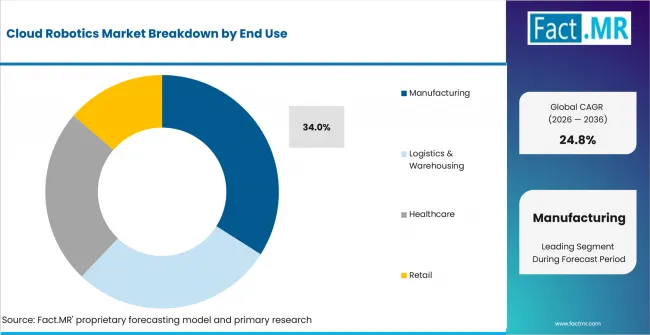
Cloud Robotics Market Analysis By End Use | Source: Fact.MR
Manufacturing is estimated to represent 34% share in 2026, supported by large installed robot bases and recurring production changes across multi-site operations. Logistics & Warehousing uses cloud platforms to coordinate missions and balance workloads across mobile robot fleets. Healthcare demand centers on remote diagnostics and controlled software updates across distributed robotic equipment. Retail uses connected service robots and fulfillment automation where fleet status must remain visible across multiple locations. IFR reported 4,070 automotive robot installations across India during 2024 in its September 2025 release. That installation depth supports demand for remote commissioning and shared maintenance analytics across manufacturing groups.
What is accelerating Cloud Robotics Market adoption, and what is holding it back?
Fleet orchestration drives adoption while cybersecurity exposure restrains connected multi-site robot operations and remote service workflows.
Drivers Impact Analysis
| DRIVER | (~) % IMPACT ON CAGR | GEOGRAPHIC RELEVANCE | IMPACT TIMELINE |
|---|---|---|---|
| Fleet orchestration across sites | +4.5% | North America and Asia Pacific | Medium term (2-4 years) |
| Edge-cloud workload split | +3.8% | Global manufacturing hubs | Short term (<= 2 years) |
| Remote programming and simulation | +3.1% | Europe and North America | Medium term (2-4 years) |
| Predictive maintenance from telemetry | +2.6% | Automotive and electronics clusters | Medium term (2-4 years) |
| Labor constraints and RaaS models | +2.0% | Asia Pacific and Europe | Long term (>= 4 years) |
Source: Fact.MR analysis. Updated Jul 9, 2026
- Fleet orchestration across sites: Manufacturers are connecting more robot cells to shared fleet records so one operations team compares uptime and task performance across facilities. IFR reported in September 2025 that Asia accounted for 74% of new industrial robot deployments during 2024. Adoption is expected to favor platforms that normalize data from different controller generations without interrupting production.
- Edge-cloud workload split: Robot motion and safety checks stay near the cell while shared analytics move to cloud services for learning across sites. NIST warned in February 2025 that connected devices and cloud services expand cybersecurity exposure inside digitized manufacturing environments. Deployments are projected to favor architectures that preserve local fail-safe behavior and tightly govern outbound data paths.
- Remote programming and simulation: Remote engineering environments reduce travel because configuration review and simulation occur before technicians reach the production line. ONS reported in March 2025 that 91% of UK firms using AI also used cloud systems during 2023. Demand is anticipated to expand for tools that connect simulation changes with controlled deployment workflows.
- Predictive maintenance from telemetry: Robot telemetry gives maintenance teams a common history for motor temperatures and fault codes across equipment families at different sites. FANUC highlighted Zero Down Time software in April 2025 through its Automate 2025 portfolio for robot monitoring and maintenance programs. Adoption is estimated to broaden where maintenance savings cover integration effort on installed controllers across sufficiently large robot estates.
- Labor constraints and RaaS models: Subscription models reduce the capital hurdle for operators that need flexibility during seasonal expansion or uncertain production ramps. IFR reported in October 2025 that the Robot-as-a-Service fleet grew 31% during 2024 across service robotics markets worldwide. Demand is forecast to widen for cloud operations layers that support metering and service-level reporting across rented machines.
Opportunity Impact Analysis
| OPPORTUNITY | (~) % IMPACT ON CAGR | GEOGRAPHIC RELEVANCE | IMPACT TIMELINE |
|---|---|---|---|
| Multi-vendor robot orchestration | +2.7% | Global robot fleets | Medium term (2-4 years) |
| Simulation-to-real pipelines | +2.2% | North America and Europe | Short term (<= 2 years) |
| SME cloud onboarding | +1.8% | United Kingdom and India | Medium term (2-4 years) |
| Cloud quality inspection | +1.4% | Electronics production clusters | Long term (>= 4 years) |
Source: Fact.MR analysis. Updated Jul 9, 2026
- Multi-vendor robot orchestration: Heterogeneous fleets create room for orchestration layers that connect robot tasking with enterprise planning systems and warehouse software. InOrbit.AI announced an expanded product suite in March 2026 for enterprise orchestration and robot operations. Enterprise deployments are expected to expand where software teams coordinate workflows without replacing functional robot hardware.
- Simulation-to-real pipelines: Robot developers need repeatable paths from virtual factory models into deployed machine behavior across multiple controller brands. Wandelbots published a March 2026 workflow linking NOVA with NVIDIA Isaac Sim for simulation and real-world execution. Near-term demand is projected to concentrate on platforms that preserve validation records when applications move from test environments into production.
- SME cloud onboarding: Smaller manufacturers have fewer robotics engineers and therefore benefit from managed software environments that reduce local tooling and maintenance burden. ONS reported in March 2025 that robotics adoption reached 16% among UK firms with at least 250 employees. Subscription demand is anticipated to grow where platforms package monitoring and deployment support for smaller engineering teams.
- Cloud quality inspection: Quality workflows produce image and process data that improve when model updates are governed across several production lines. In October 2025 NVIDIA described FieldAI using Isaac Lab and Isaac Sim for monitoring and inspection workflows across construction and energy sites. Commercial uptake is estimated to expand where providers combine model governance with traceable deployment controls for industrial operations.
Restraints Impact Analysis
| RESTRAINT | (~) % IMPACT ON CAGR | GEOGRAPHIC RELEVANCE | IMPACT TIMELINE |
|---|---|---|---|
| Cybersecurity and plant network risk | -2.8% | Global connected factories | Short term (<= 2 years) |
| Legacy controller integration debt | -2.2% | Global installed robot base | Medium term (2-4 years) |
| Latency and connectivity limits | -1.7% | Remote industrial sites | Medium term (2-4 years) |
| Skills and governance gaps | -1.3% | Emerging adoption markets | Long term (>= 4 years) |
Source: Fact.MR analysis. Updated Jul 9, 2026
- Cybersecurity and plant network risk: Remote access increases the attack surface around production assets when identity controls and network boundaries are weak. In February 2025 ISO published ISO 10218-2:2025 covering safety requirements for industrial robot applications and integrated robot cells. Connection decisions are expected to remain selective where security review delays production-controller access to external services.
- Legacy controller integration debt: Robot fleets accumulate proprietary interfaces and older controllers that expose different data models across one plant. Integration teams often write adapters before monitoring or orchestration becomes usable across installed assets at meaningful multi-cell operating scale. Platform adoption is projected to stay selective where connector development costs exceed the value of centralized analytics for smaller fleets.
- Latency and connectivity limits: Edge execution limits risk but remote sites still depend on stable links for synchronization and remote engineering. Australia published its National Robotics Strategy in May 2024 to coordinate capability across a geographically dispersed industrial economy. Architectures are anticipated to favor store-and-forward designs that preserve local operation during outages and synchronize records after connectivity returns.
- Skills and governance gaps: Cloud robotics combines controls engineering with software operations and cybersecurity responsibilities that many plant teams still divide across departments. ABS reported in June 2026 that 12% of Australian businesses used AI during the 2024-25 financial year. Rollouts are estimated to slow when organizations lack clear owners for model updates and robot-data access.
Which countries are scaling Cloud Robotics Market fastest?
Regional analysis covers North America and Europe together with the major Cloud Robotics markets assessed across both regions. Coverage also includes Asia Pacific and Latin America alongside the Middle East & Africa across the overall regional assessment.
| COUNTRY | CAGR |
|---|---|
| India | 26.6% |
| China | 25.9% |
| Australia | 24.6% |
| United Kingdom | 24.3% |
| United States | 24.1% |
| Germany | 23.8% |
| Japan | 23.5% |
Source: Fact.MR analysis. Updated Jul 9, 2026
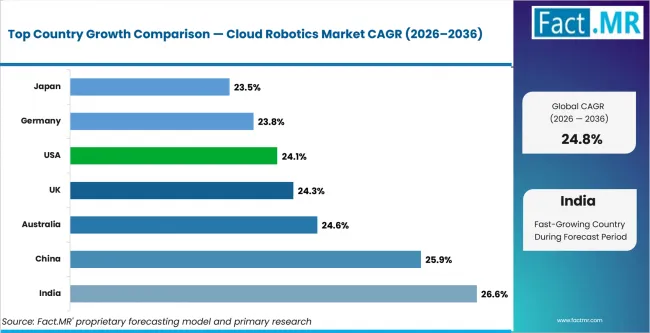
Cloud Robotics Market Cagr Analysis By Country | Source: Fact.MR
Why is India moving faster toward cloud-connected robotics?
26.6% CAGR, driven by automotive automation and national robotics planning across factory modernization programs.
India is moving beyond isolated automation projects as manufacturing clusters connect robot deployment with centralized engineering support. In February 2026, the Government of India’s Technology Advisory Group discussed a strategic roadmap for domestic robotics capability. In September 2025, IFR reported 9,120 industrial robot installations across India during the 2024 calendar year. The market is expected to record a 26.6% CAGR during the forecast period as automation programs create demand for remote monitoring and software-led fleet coordination. Cloud robotics providers gain a practical route where multi-site manufacturers need common visibility without expanding engineering staff at every plant.
What gives China a stronger scaling path for Cloud Robotics?
25.9% CAGR, supported by factory automation scale and rising robot output across major industrial production clusters.
Factory scale gives China a distinct growth path because expanding robot fleets create continuous data flows across production and maintenance systems. In August 2025, the National Bureau of Statistics reported that industrial robot output increased 24.0% year over year during July. The market is projected to post a 25.9% CAGR between 2026 and 2036 as connected factories require broader coordination across controllers and analytics platforms. Vendors gain relevance when fleet software supports centralized diagnostics across automotive and electronics plants with different operating schedules.
Where is Australia creating practical Cloud Robotics opportunities?
24.6% CAGR, owing to remote-industry automation and broader robotics deployment across dispersed operating sites.
Distance between operating sites and engineering teams makes remote robot oversight commercially important across Australian mining and industrial operations. In March 2026, the Department of Industry reported that robotics and automation support would cover 27 new industry projects. Australia is anticipated to advance at a 24.6% CAGR over the assessment period as dispersed operators seek centralized diagnostics and maintenance visibility. Providers can strengthen adoption by combining fleet analytics with remote engineering workflows suited to sites that cannot maintain specialist teams locally.
Why are robotics skills becoming central to the United Kingdom outlook?
24.3% CAGR, shaped by robotics adoption programs and growing implementation capacity across connected manufacturing operations.
Skills capacity is becoming a critical adoption factor as manufacturers move from robot trials toward connected operating environments. In September 2025, IFR reported 2,500 industrial robot installations across the United Kingdom during 2024. The market is estimated to record a 24.3% CAGR between 2026 and 2036 as manufacturers require stronger integration capability across robotics and cloud systems. Cloud robotics vendors gain traction when implementation support helps plant teams connect equipment data with maintenance workflows and remote specialist input.
How does installed robot stock support United States demand?
24.1% CAGR, attributable to extensive installed robot stock and connected manufacturing upgrades across multi-site production networks.
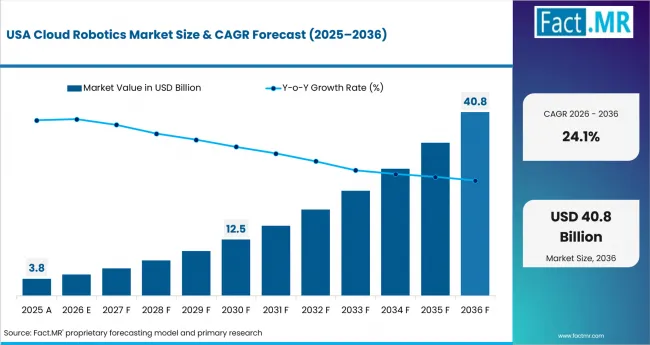
Cloud Robotics Market Country Value Analysis | Source: Fact.MR
A large installed robot base creates recurring demand for lifecycle analytics across factories that operate different equipment generations. In September 2025, IFR reported 393,700 industrial robots operating in United States factories during 2024. The market is forecast to post a 24.1% CAGR during the forecast period as manufacturers connect maintenance and production data across plant networks. Providers improve account access when software integrates legacy controllers with secure cloud services and predictive maintenance workflows.
What keeps Germany’s Cloud Robotics opportunity structurally strong?
23.8% CAGR, supported by extensive industrial automation and interconnected manufacturing networks.
Germany’s dense manufacturing networks make shared robot visibility valuable across specialist suppliers and multi-plant production groups. In September 2025, IFR reported 26,982 industrial robot installations in Germany during 2024. Industry is estimated to record a 23.8% CAGR over the forecast horizon as manufacturers coordinate production support across connected facilities. Suppliers gain a stronger position when remote diagnostics reduce specialist travel and help engineering teams compare equipment performance across sites.
Why is Japan’s automotive base supporting Cloud Robotics adoption?
23.5% CAGR over the assessment period, owing to deep robot deployment across automotive and electronics production.
Automotive production renewal is reinforcing Japan’s need for coordinated robot management across established manufacturing networks. In July 2025, IFR reported approximately 13,000 industrial robot installations in Japan’s automotive industry during 2024. The market is projected to register a 23.5% CAGR between 2026 and 2036 as production teams require remote monitoring across increasingly connected equipment fleets. Cloud platforms gain relevance when manufacturers need common maintenance visibility while preserving the disciplined operating controls used across long-running production programs.
Who are the key providers in the Cloud Robotics Market?
Players such as ABB, FANUC Corporation and KUKA AG are focusing on connected robot monitoring and fleet software.
ABB combines RobotStudio Cloud and Connected Services with controller-level access for remote engineering and robot monitoring. FANUC Corporation adds Zero Down Time connectivity for predictive maintenance across installed robot fleets. KUKA AG provides AMR fleet software for central management of mobile robot operations. Yaskawa Electric connects production equipment data with Yaskawa Cockpit for monitoring and analysis across automated manufacturing systems.
Amazon Robotics combines centralized planning software with cloud infrastructure across a large fulfillment robot fleet. Zebra Technologies provides the Symmetry Cloud Robotics Platform for AMR control and workflow orchestration in distribution operations. Teradyne combines Universal Robots and Mobile Industrial Robots within its robotics portfolio. Competition during the forecast period is expected to center on secure fleet software and deployment depth across manufacturing and logistics operations.
Which companies are the key providers?
ABB, FANUC Corporation, KUKA AG, Yaskawa Electric, Amazon Robotics, Zebra Technologies, Teradyne
- ABB
- FANUC Corporation
- KUKA AG
- Yaskawa Electric
- Amazon Robotics
- Zebra Technologies
- Teradyne
Bibliography
- ABB Robotics. (2025, September 25). ABB Robotics adds generative AI assistant to RobotStudio®. ABB.
- Amazon. (2025, June 30). Amazon launches a new AI foundation model to power its robotic fleet and deploys its 1 millionth robot. Amazon.
- Australian Bureau of Statistics. (2026, June 25). Characteristics of Australian Business, 2024–25 financial year. Australian Bureau of Statistics.
- Department of Industry, Science and Resources. (2024, May 28). National Robotics Strategy. Australian Government.
- FANUC America Corporation. (2025, April 28). Innovating Tomorrow: FANUC to showcase cutting-edge robotics and automation solutions at Automate 2025. FANUC America.
- International Federation of Robotics. (2025, July 15). Japan’s car industry has highest robot installations in five years. International Federation of Robotics.
- Intrinsic. (2026, March 2). AI for Industry Challenge. Intrinsic.
- InOrbit.AI. (2026, March 30). Announcing the evolution of InOrbit’s product suite. InOrbit.AI.
- KUKA. (2026). AMR fleet management: AI as a driver of efficiency. KUKA.
- National Bureau of Statistics of China. (2025, August 15). National economy maintained a steady development momentum with progress in July. National Bureau of Statistics of China.
- National Institute of Standards and Technology. (2025, February 20). What’s coming for US manufacturing in 2025. NIST.
- Office for National Statistics. (2025, March 24). Management practices and the adoption of technology and artificial intelligence in UK firms: 2023. Office for National Statistics.
- Press Information Bureau. (2026, February 3). Technology Advisory Group of Empowered Technology Group meets to discuss Strategic Roadmap for Robotics in India. Government of India.
- Teradyne, Inc. (2025, January 22). Teradyne Robotics and Analog Devices enter strategic partnership to accelerate the adoption of AI and advanced robotics-driven collaborative automation in manufacturing. Teradyne.
- Teradyne Robotics. (2026). Robotics. Teradyne.
- UK Research and Innovation. (2026, February 3). Robotics Adoption Programme skills development. UKRI.
- Wandelbots. (2026, March 19). Bringing embodied AI to life: Simplifying robotics development with Wandelbots NOVA and NVIDIA Isaac. Wandelbots.
- Yaskawa Motoman. (2026). Yaskawa Cockpit. Yaskawa Motoman.
- Zebra Technologies. (2025, January 30). Zebra Technologies expands Symmetry Fulfillment solution to increase productivity with 30% fewer robots. Zebra Technologies.
This Report Addresses
- The report provides strategic intelligence on Cloud Robotics across Component and Deployment choices that shape connected robot operations across manufacturing and service environments.
- Regional outlook compares India and China with Australia and the United Kingdom. The review also covers the United States alongside Germany and Japan.
- Competitive analysis profiles ABB and FANUC Corporation alongside KUKA AG and Yaskawa Electric. Amazon Robotics joins Zebra Technologies and Teradyne in the provider comparison.
- End Use assessment covers Manufacturing and Logistics & Warehousing alongside Healthcare and Retail across connected robot operations.
- Application assessment covers Industrial Automation and Warehouse & Logistics alongside Healthcare Robotics and Service Robots.
What does the Cloud Robotics Market cover?
Software platforms and services connect robotic systems with cloud deployments. Supporting hardware enables industrial and service applications across distributed operations.
The Cloud Robotics Market covers software platforms and services that connect robots with remote programming environments and shared fleet operations. Coverage includes supporting hardware and cloud deployment used for industrial automation or warehouse logistics across distributed robot fleets.
The market differs from general industrial robotics because commercial value comes from connectivity layers and remote operations software around physical machines. Standalone robot hardware remains outside the boundary unless it is sold with cloud connectivity or a managed software service that supports deployed robots.
What is included in the scope?
Cloud robotics systems used across connected factories and distributed robot fleets for remote programming and coordinated fleet operations.
The scope includes Software & Platforms together with Services and Hardware that connect robotic equipment with shared operations software. Deployment coverage includes Public Cloud and Private Cloud alongside Hybrid architectures for robot fleet coordination. Application coverage includes Industrial Automation and Warehouse & Logistics across connected robot operations. Healthcare Robotics and Service Robots remain included across distributed equipment fleets. Manufacturing and Logistics & Warehousing are evaluated alongside Healthcare and Retail end-use demand.
What is excluded from the scope?
Standalone automation hardware and unrelated cloud analytics are outside the scope when they do not support deployed robotic equipment.
The scope excludes industrial robots sold without remote connectivity and generic cloud infrastructure that does not manage or support robotic equipment. Warehouse software is excluded unless it directly dispatches robot missions or exchanges operating data with connected robot fleets. General robot software platforms remain adjacent unless they manage deployment or operations for physical robot fleets covered by this analysis. Pure simulation tools remain outside the boundary when they do not support deployment or management of physical robotic systems.
How was the analysis built?
120+ sources, 40+ company portfolios, 25+ countries, 20+ interviews.
- Primary Research
- Primary research includes interviews with cloud robotics platform providers, robotics software developers, automation engineers and enterprise technology decision-makers. It also includes input from robotics system integrators, cloud infrastructure providers, industrial automation specialists and end users deploying cloud-connected robotic systems across manufacturing, logistics and service applications.
- Desk Research
- Desk research reviews robotics industry statistics, cloud computing adoption trends, industrial automation reports, company product portfolios and technology provider announcements. Technical publications, developer resources, cloud robotics frameworks and industry case studies are also assessed to evaluate market trends and competitive positioning.
- Market-Sizing and Forecasting
- Forecasting uses robotics deployment activity, cloud infrastructure adoption, enterprise automation investments, connected device growth and software platform demand across major regions. Models consider robot-as-a-service adoption, edge-to-cloud integration, fleet management requirements, AI-enabled robotics applications and digital transformation initiatives influencing market growth.
- Data Validation and Update Cycle
- Forecasts are validated through provider checks and industry interviews that test assumptions on cloud robotics adoption, deployment patterns and enterprise investment priorities. Portfolio mapping, end-user assessment and stakeholder feedback help confirm market direction, while ongoing reviews of technology developments, product launches and automation investments support forecast updates.
Segmentation
What is the report’s scope and coverage?
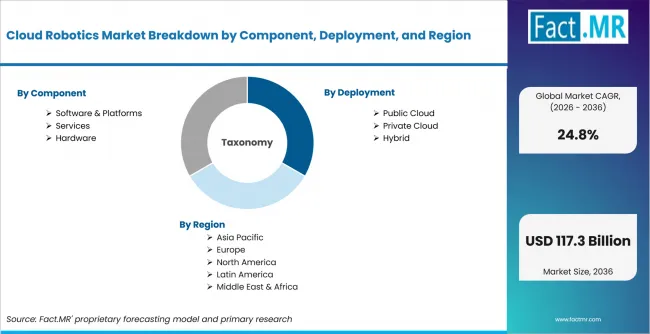
Cloud Robotics Market Breakdown By Component, Deployment, And Region | Source: Fact.MR
| Attribute | Details |
|---|---|
| Quantitative Units | USD Billion |
| Market Definition | Connected robotics systems that combine robot hardware gateways and software services with remote programming, fleet coordination, cloud analytics, and edge execution across distributed robot fleets |
| Component | Software & Platforms; Services; Hardware |
| Deployment | Public Cloud; Private Cloud; Hybrid |
| Application | Industrial Automation; Warehouse & Logistics; Healthcare Robotics; Service Robots |
| End Use | Manufacturing; Logistics & Warehousing; Healthcare; Retail |
| Regions Covered | North America; Europe; Asia Pacific; Latin America; Middle East & Africa |
| Countries Covered | India; China; Australia; United Kingdom; United States; Germany; Japan |
| Key Companies Profiled | ABB; FANUC Corporation; KUKA AG; Yaskawa Electric; Amazon Robotics; Zebra Technologies; Teradyne |
| Forecast Period | 2026 to 2036 |
| Approach | Hybrid top-down and bottom-up approach using installed robot bases; robot installation activity; cloud adoption; controller connectivity; deployment architecture; application demand; end-use adoption; and provider portfolio validation |
Source: Fact.MR analysis. Updated Jul 9, 2026
How is the market segmented?
-
By Component
- Software & Platforms
- Services
- Hardware
-
By Deployment
- Public Cloud
- Private Cloud
- Hybrid
-
By Application
- Industrial Automation
- Warehouse & Logistics
- Healthcare Robotics
- Service Robots
-
By End Use
- Manufacturing
- Logistics & Warehousing
- Healthcare
- Retail
-
By Region
- North America
- United States
- Canada
- Europe
- Germany
- United Kingdom
- France
- Italy
- Spain
- Asia Pacific
- China
- Japan
- South Korea
- Taiwan
- Singapore
- Latin America
- Brazil
- Mexico
- Argentina
- Middle East & Africa
- GCC Countries
- South Africa
- Israel
- North America
Frequently Asked Questions
How is Software & Platforms positioned within the Cloud Robotics Market?
What role does Public Cloud play in the Cloud Robotics Market?
Which application area contributes a significant portion of Cloud Robotics Market demand?
How prominent is Manufacturing within the Cloud Robotics Market?
Which country shows notable growth potential in the Cloud Robotics Market?
How is the Cloud Robotics Market expected to evolve in China?
What outlook is anticipated for Australia in the Cloud Robotics Market?
How is demand projected to develop in the United Kingdom?
What trend characterizes the United States Cloud Robotics Market?
How does Germany perform in the Cloud Robotics Market?
What growth pattern is expected in Japan?
What factor primarily supports expansion in the Cloud Robotics Market?
Which challenge continues to influence Cloud Robotics adoption?
Why does Public Cloud remain important in the Cloud Robotics Market?
What supports Manufacturing's contribution to Cloud Robotics Market demand?
Who worked on this report


Preview the report firsthand - request a free sample
Free SampleGet the brochure for pricing and purchase details
Download PDF