- Market Value (2025): USD 635.5 Mn
- Estimated Value (2026): USD 760 Mn
- Forecast Value (2036): USD 4551 Mn
- CAGR (2026-2036): 19.6%
What is the CNC Digital Twin Software Market forecast to be worth by 2036?
USD 760 million in 2026 to USD 4,551 million by 2036 at 19.6% CAGR.
- The CNC digital twin software market reached USD 635.5 million in 2025 as virtual prove-out expanded across precision machining.
- Demand is projected to increase from USD 760 million in 2026 to USD 4551 million by 2036.
- The market is forecast to record 19.6% CAGR from 2026 to 2036 owing to Cloud/SaaS deployment and machining simulation.
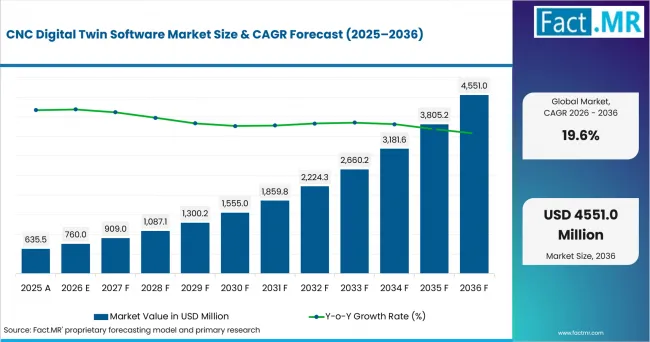
Cnc Digital Twin Software Market Value Analysis | Source: Fact.MR
What are the defining numbers behind CNC Digital Twin Software Market growth?
USD 3.79 billion absolute opportunity by 2036, led by Cloud/SaaS and machining simulation alongside aerospace users.
- Demand Drivers in the Market
- CNC programmers need machine-level simulation where setup errors damage spindles, fixtures and high-value workpieces.
- Aerospace machining teams require virtual prove-out where costly alloys make first-part scrap harder to absorb.
- Siemens Digital Industries Software said in July 2025 that CNC users apply digital twins to validate toolpaths and detect collisions before machining.
- Key Segments Analyzed
- By Deployment: Cloud/SaaS is expected to hold 57.0% share in 2026 due to shared machine libraries and easier access.
- By Capability: Machining simulation is projected to account for 32.0% share in 2026 since it is the first validation step.
- By End-Use Industry: Aerospace is anticipated to capture 28.0% share in 2026 owing to tight-tolerance work.
- By Machine Type: Milling centres are estimated to represent 41.0% share in 2026 due to broad machining coverage.
- Analyst Opinion at Fact.MR
- Shambhu Nath Jha, Principal Consultant at Fact.MR, states, “CNC digital twin software is bought when a shop needs trusted machine motion and controller behavior in one review loop. Supplier selection is expected to depend on machine-library depth and proof that the virtual result matches the production program.”
- Strategic Implications
- Software vendors should document controller coverage before positioning platforms for high-value CNC cells. This requirement aligns with virtual commissioning use where machine behavior must be proven before launch.
- Machine-tool builders should package digital models with installed equipment to shorten customer acceptance testing.
- Job-shop owners should track scrap avoidance and setup hours when comparing SaaS and on-premise tools.
- Investors should separate CNC-specific twins from broad plant visualization since machine kinematics decide adoption.
South Korea leads at 21.6% CAGR through smart-manufacturing programs, electronics production and virtual machining checks. The United States follows at 21.1% as durable-goods activity and aerospace machining support digital prove-out. The United Kingdom reaches 20.3% through manufacturing digitalization and SME support. France records 19.9% through aerospace activity and robotics programs. Germany posts 19.2% through machine-tool depth and process discipline, while Japan reaches 18.9% through machinery demand and rigorous CNC qualification.
How does the CNC Digital Twin Software Market break down by segment?
Cloud/SaaS leads Deployment at 57.0%; machining simulation leads Capability at 32.0%.
Which deployment dominates?
Cloud/SaaS is projected to account for 57.0% share in 2026.
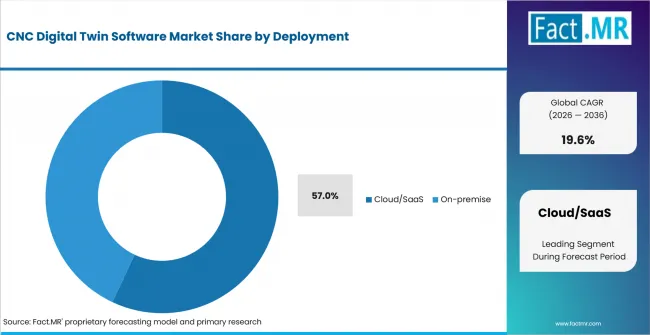
Cnc Digital Twin Software Market Analysis By Deployment | Source: Fact.MR
Cloud/SaaS leads the Deployment segment because CNC teams benefit from shared model libraries, easier access and centralized simulation workflows. Hosted platforms support collaboration across engineering locations and reduce local infrastructure needs, making them attractive where manufacturers want consistent digital-twin access without maintaining separate software environments for every machine group.
What leads the Capability segment?
Machining simulation is expected to hold 32.0% share in 2026.
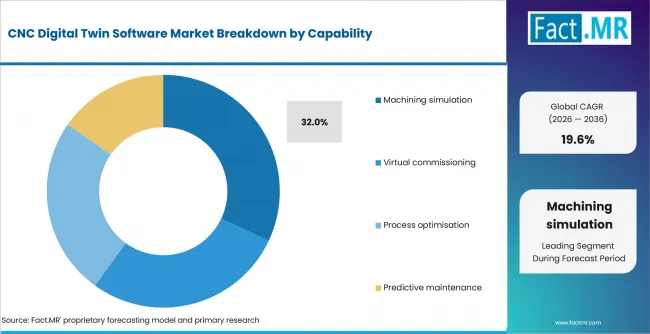
Cnc Digital Twin Software Market Analysis By Capability | Source: Fact.MR
Machining simulation leads the Capability segment because shops validate toolpaths, machine motion and setup logic before production begins. This reduces reliance on physical prove-out and helps teams identify programming issues earlier. Autodesk Support described machine-tool simulation workflows in Fusion CAM in February 2026, providing further evidence of the use of simulation for pre-manufacturing validation.
How does End-Use Industry shape demand?
Aerospace is anticipated to lead with 28.0% share in 2026.
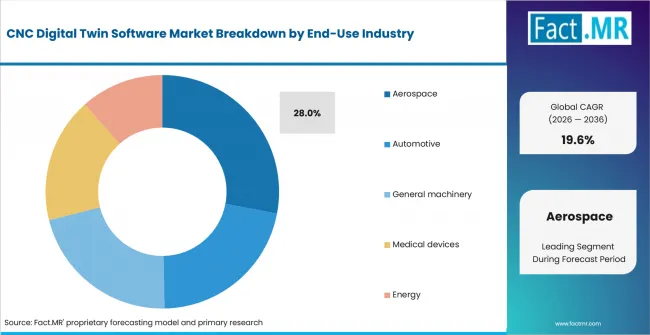
Cnc Digital Twin Software Market Analysis By End Use Industry | Source: Fact.MR
Aerospace leads the End-Use Industry segment because complex parts, expensive materials and tight tolerances increase the value of virtual prove-out. Digital twins help engineering teams review machine motion and machining sequences before production, supporting more controlled validation where programming errors can create costly scrap or rework on high-value components.
What supports Milling centres within Machine Type?
Milling centres are estimated to represent 41.0% share in 2026.
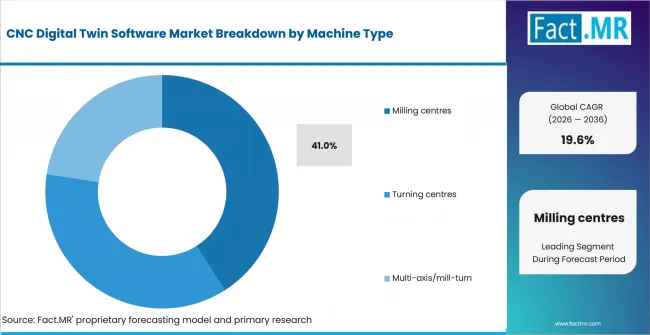
Cnc Digital Twin Software Market Analysis By Machine Type | Source: Fact.MR
Milling centres lead the Machine Type segment because they serve a broad mix of aerospace, automotive and job-shop programs. Their varied cutting paths, fixtures and motion requirements increase the value of machine-level simulation, especially where engineers need to verify tool movement and process behavior before committing production time.
What is accelerating CNC Digital Twin Software Market adoption, and what is holding it back?
Machine simulation drives it; model accuracy restrains it.
| DRIVER | (~) % IMPACT ON CAGR | GEOGRAPHIC RELEVANCE | IMPACT TIMELINE |
|---|---|---|---|
| Cloud machine libraries | +4.5% | USA, UK, Germany | Short term (<= 2 years) |
| G-code verification | +4.0% | USA, Japan, South Korea | Short term (<= 2 years) |
| Aerospace prove-out | +3.4% | USA, UK, France | Medium term (2-4 years) |
| Virtual commissioning | +2.5% | Germany, France, South Korea | Medium term (2-4 years) |
| Controller-aware training | +1.8% | Japan and mixed-machine shops | Long term (>= 4 years) |
Source: Fact.MR analysis. Updated Aug 18, 2026
- G-code verification: CNC teams are anticipated to rely on digital twins when NC code must match real machine motion. Hexagon introduced ESPRIT EDGE capabilities in April 2026 for complex CNC programming.
- Aerospace prove-out: Virtual checks to gain value where high-value workpieces raise scrap exposure. Siemens described a September 2025 collaboration with HELLER in which an NX CAM program was tested and optimized virtually using the digital twin of HELLER’s HF 3501 machine before the physical part was machined on five-axis equipment.
- Virtual commissioning: Factory teams to test production systems virtually before launch. Dassault Systèmes and NVIDIA announced a February 2026 partnership combining virtual-twin technologies with NVIDIA AI infrastructure, including a Virtual Twins for Every Factory initiative.
| OPPORTUNITY | (~) % IMPACT ON CAGR | GEOGRAPHIC RELEVANCE | IMPACT TIMELINE |
|---|---|---|---|
| SaaS for job shops | +2.2% | USA and UK | Short term (<= 2 years) |
| AI-assisted programming | +1.8% | South Korea, USA, Germany | Medium term (2-4 years) |
| Multi-axis library depth | +1.5% | Japan, Germany, France | Medium term (2-4 years) |
| Training simulation | +1.1% | Global mixed-machine users | Long term (>= 4 years) |
Source: Fact.MR analysis. Updated Aug 18, 2026
- SaaS for job shops: Smaller machining companies are expected to adopt hosted tools when license cost and IT maintenance stay predictable.
- Multi-axis library depth: Software providers are anticipated to win accounts when they support exact machine kinematics and controller versions.
- Training simulation: Virtual cells are forecast to widen adoption where experienced CNC programmers are scarce and live setup time is expensive.
- Model-library gaps: Older CNC machines often need custom model work before simulation results are trusted.
- Sensitive production data: Hosted deployments are constrained when NC programs contain defense drawings or customer-owned geometry.
- Training burden: Skilled programmers must learn how to maintain virtual models before software replaces physical prove-out.
| RESTRAINT | (~) % IMPACT ON CAGR | GEOGRAPHIC RELEVANCE | IMPACT TIMELINE |
|---|---|---|---|
| Model-library gaps | -2.0% | Older machine fleets | Short term (<= 2 years) |
| Sensitive production data | -1.5% | Aerospace and defense users | Short term (<= 2 years) |
| Controller variation | -1.2% | Japan, Germany, USA | Medium term (2-4 years) |
| Training burden | -0.8% | SMEs and job shops | Medium term (2-4 years) |
Source: Fact.MR analysis. Updated Aug 18, 2026
- Model-library gaps: Older CNC machines often need custom model work before simulation results are trusted.
- Sensitive production data: Hosted deployments are constrained when NC programs contain defense drawings or customer-owned geometry.
- Training burden: Skilled programmers must learn how to maintain virtual models before software replaces physical prove-out.
Which countries are scaling CNC Digital Twin Software Market fastest?
- The country comparison spans 2.70 percentage points and forms three practical growth bands across the forecast period.
- South Korea remains 0.50 percentage point above the United States through smart-manufacturing programs, electronics production and virtual machining checks.
- The United States remains 0.77 percentage point above the United Kingdom through durable-goods activity, aerospace machining and shared Cloud/SaaS machine libraries.
- The United Kingdom remains 0.37 percentage point above France through manufacturing digitalization, SME support and simulation-led production validation.
- France remains 0.76 percentage point above Germany through aerospace activity, robotics programs and virtual prove-out requirements.
- Germany remains 0.30 percentage point above Japan through machine-tool depth, process discipline and virtual commissioning needs.
- Japan closes the displayed range through machinery demand, controller-aware virtual models and rigorous CNC qualification.
Comparable CAGRs can create different entry conditions due to machine-tool depth, controller variation, digital-adoption maturity and qualification requirements. Full report coverage includes North America, Latin America, Europe, East Asia, South Asia and Pacific, Middle East and Africa.
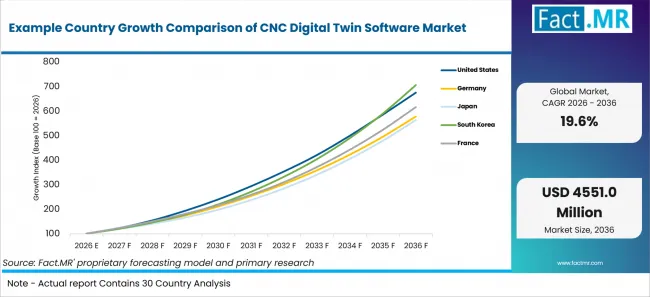
Example Country Growth Comparison Of Cnc Digital Twin Software Market | Source: Fact.MR
| Country | CAGR (2026-2036) |
|---|---|
| South Korea | 21.6% |
| United States | 21.1% |
| United Kingdom | 20.3% |
| France | 19.9% |
| Germany | 19.2% |
| Japan | 18.9% |
Source: Fact.MR analysis. Updated Aug 18, 2026
What supports South Korea adoption?
21.6% CAGR, supported by smart-manufacturing investment and electronics production.
South Korea’s momentum comes from smart-factory programs and electronics manufacturing. The Ministry of SMEs and Startups said around 450 projects would receive support under the 2026 Smart Manufacturing Innovation Support Program. Korea’s Ministry of Data and Statistics reported that manufacturing production rose 7.2% year over year in January 2026, while MOTIR reported that manufacturing FDI investment notifications fell 28.4% to USD 3.8 billion in H1 2026.
How is the United States scaling demand?
21.1% CAGR, driven by durable-goods activity and aerospace machining.
The United States benefits from a broad industrial base and demand for virtual prove-out in high-value machining. The U.S. Census Bureau reported that new orders for computers and electronic products rose 3.1% to USD 31.1 billion in June 2026. BEA reported that real value added for private goods-producing industries increased 4.5% in Q1 2026, while Federal Reserve data showed manufacturing capacity utilization at 75.7% in June. Separately, machine-specific NC code and postprocessor requirements can add complexity when standardizing CNC workflows across different machines or production sites.
What supports United Kingdom growth?
20.3% CAGR, backed by manufacturing digitalization and SME support.
The United Kingdom is advancing through manufacturing digitization and support for smaller producers. ONS reported manufacturing output increased 1.6% in the three months to May 2026, while GBP 116 million through Made Smarter is available to support 5,500 SMEs. Manufacturers’ product sales nevertheless fell 1.8% to GBP 452.0 billion in 2025. Programming skill gaps and legacy equipment encourage staged CNC digital-twin deployment.
How is France developing demand?
19.9% CAGR, supported by aerospace activity and robotics programs.
France’s expansion is tied to aerospace, regulated manufacturing and robotics investment. Manufacturing production increased 0.1% in Q2 2026 after 0.5% growth in Q1, while the France 2030 robotics research acceleration program was endowed with EUR 30 million. Manufacturing output fell 1.0% in May 2026. Lengthy controller validation and training requirements can delay adoption among smaller subcontractors replacing physical trial cuts.
What underpins Germany’s outlook?
19.2% CAGR, led by machine-tool depth and process discipline.
Germany’s outlook draws on its machine-tool base and demand for detailed process validation. Destatis revised May 2026 real manufacturing orders to a 0.3% month-over-month increase, while VDW expects machine-tool production to grow 1% to EUR 13.7 billion in 2026. Production had fallen 8% in 2025. Customized CNC cells, modelling requirements and on-premise engineering-file policies can extend implementation cycles.
How does Japan perform?
18.9% CAGR, backed by machinery demand and rigorous process qualification.
Japan’s development reflects its CNC engineering depth and preference for careful production qualification. The Cabinet Office reported that machinery orders received by 280 manufacturers rose 9.5% month over month in May 2026, while private-sector machinery orders excluding ships and electric power companies fell 12.4%. METI reported that the industrial production index reached 103.0 in May, up 0.5% from April.
Who leads the CNC Digital Twin Software Market?
This report profiles Siemens and Hexagon for direct CNC digital-twin and machine-simulation offerings, while Dassault Systèmes and CGTECH (VERICUT) are profiled for adjacent virtual-twin, design and manufacturing capabilities.
Siemens supports CNC digital twin work through NX CAM and machine-level simulation. Hexagon provides ESPRIT EDGE and NCSIMUL for CNC programming, G-code verification and machine simulation.
CGTECH (VERICUT), Autodesk and Synopsys (Ansys) add design, simulation and manufacturing workflow depth. Autodesk provides Fusion CAM machine simulation guidance for machine-tool setup. Competitive positioning is expected to depend on controller coverage, model-library accuracy and proof that digital checks reduce rework. Adjacent metal cutting machines coverage helps frame the hardware base that feeds software demand.
Which companies are the key providers?
The company set profiled in this report comprises Siemens, Hexagon, Dassault Systèmes, CGTECH (VERICUT), Autodesk and Synopsys (Ansys).
- Siemens
- Dassault Systèmes
- CGTECH (VERICUT)
- Hexagon
- Autodesk
- Synopsys (Ansys)
Bibliography
- Autodesk. (2026, February 17). How to setup machine tool simulation in Fusion CAM.
- Economic and Social Research Institute, Cabinet Office, Government of Japan. (2026, July 15). Machinery orders in May, 2026.
- Dassault Systèmes. (2026, February 3). Dassault Systèmes and NVIDIA partner to build industrial AI platform powering virtual twins.
- Federal Statistical Office (Destatis). (2026, August 6). New orders in manufacturing in June 2026: +3.1% on the previous month.
- Board of Governors of the Federal Reserve System. (2026, July 17). Industrial production and capacity utilization – G.17.
- Hexagon. (2026, April 1). Hexagon introduces new ESPRIT EDGE capabilities to reduce CNC programming effort and support high complexity machining.
- Hexagon. (2026, May 19). Hexagon helps manufacturers verify and optimise NC programs faster with NCSIMUL.
- Ministry of SMEs and Startups. (2025, October 31). 2026 Smart Manufacturing Innovation Support Program.
- Ministry of Trade, Industry and Resources. (2026, July 3). Korea’s FDI notifications rise 9.1% to $14.3 billion in first half of 2026.
- Office for National Statistics. (2026, July 16). GDP monthly estimate, UK: May 2026.
- Office for National Statistics. (2026, July 24). UK manufacturers' sales by product: 2025.
- U.S. Bureau of Economic Analysis. (2026, June 25). GDP (third estimate), industries, corporate profits, state GDP, and state personal income, 1st quarter 2026.
- U.S. Census Bureau. (2026, July 27). Monthly advance report on durable goods manufacturers' shipments inventories and orders.
This Report Answers
- The report provides strategic intelligence on CNC Digital Twin Software Market across Deployment and Capability choices that shape CNC validation programs.
- Segment analysis covers Cloud/SaaS and machining simulation as the share leaders within the 2026 market.
- Country outlook evaluates South Korea and the United States alongside the United Kingdom, France, Germany and Japan.
- Competitive analysis profiles Siemens and Hexagon alongside Dassault Systèmes and CGTECH (VERICUT). Autodesk and Synopsys (Ansys) complete the provider set.
- Technology assessment covers machining simulation and virtual commissioning. Process optimisation and predictive maintenance complete the capability view.
- Plant-level coverage links CNC digital twins with robot control systems where machine motion and control behavior need coordinated validation.
What does the CNC Digital Twin Software Market cover?
Cloud/SaaS, on-premise, machining simulation and virtual commissioning software used for CNC process validation.
The CNC Digital Twin Software Market covers platforms that model CNC machines, fixtures and machining programs. The scope includes simulation, verification, virtual commissioning, process optimisation and predictive maintenance tied to CNC equipment behavior.
The market differs from broad plant digital twin software since CNC use depends on machine kinematics, controller behavior and postprocessor accuracy. Basic CAM and standalone visualization tools are included only when they provide CNC machine-level simulation.
What is included in the scope?
CNC digital twin software used on machining centres, turning centres and mill-turn equipment.
The scope includes Cloud/SaaS and on-premise deployment. Coverage spans machining simulation, virtual commissioning, process optimisation and predictive maintenance. End-use coverage includes aerospace, automotive, general machinery, medical devices and energy machining. Machine-type coverage includes milling centres, turning centres and multi-axis or mill-turn equipment.
What is excluded from the scope?
Standalone CAD/CAM tools and general plant visualization platforms are outside the scope.
Standalone CAD tools are excluded when they do not simulate CNC machine motion. Basic CAM, ERP, MES and generic asset-monitoring platforms are excluded unless CNC process validation is part of the deployed module. The scope also separates CNC digital twins from digital readout equipment used only for measurement support.
How Was the Analysis Built?
The analysis draws on 120+ sources, 35+ company portfolios, 25+ countries, and more than 20 industry interviews.
- Primary Research: Primary research includes discussions with manufacturers, service providers, technology developers, distributors, end users, procurement teams, and subject-matter experts. These conversations examine purchasing priorities, product adoption, operational challenges, approval requirements, competitive positioning, and the factors that influence wider market acceptance.
- Desk Research: Desk research covers government statistics, regulatory publications, company filings, trade data, technical studies, industry associations, standards, public policy, and other authoritative sources. Every source used in the analysis is documented in the bibliography.
- Market Sizing and Forecasting: Market estimates combine historical performance, demand indicators, pricing and volume trends, segment shares, company participation, country-level growth, adoption patterns, investment activity, and barriers to market expansion.
- Data Validation and Update Cycle: Findings are validated by comparing primary interviews with public data, company activity, regulatory changes, trade patterns, and industry developments. Regular updates review new product launches, capacity changes, partnerships, approvals, procurement trends, and shifts in commercial adoption.
Segmentation
What is the report’s scope and coverage?
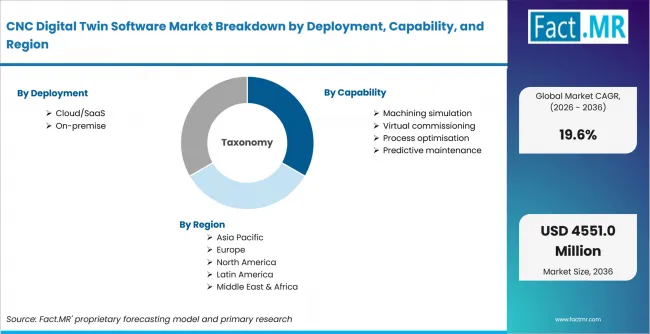
Cnc Digital Twin Software Market Breakdown By Deployment, Capability, And Region | Source: Fact.MR
| Attribute | Details |
|---|---|
| Quantitative Units | USD million |
| Market Definition | Software that builds virtual CNC machine, controller, tool and process models for simulation, verification, optimization and training |
| Deployment | Cloud/SaaS; On-premise |
| Capability | Machining simulation; Virtual commissioning; Process optimisation; Predictive maintenance |
| End-Use Industry | Aerospace; Automotive; General machinery; Medical devices; Energy |
| Machine Type | Milling centres; Turning centres; Multi-axis/mill-turn |
| Regions Covered | North America; Latin America; Europe; East Asia; South Asia and Pacific; Middle East and Africa |
| Countries Covered | South Korea; United States; United Kingdom; France; Germany; Japan |
| Selected Country Shares | United States; Germany; Japan |
| Key Companies Profiled | Siemens; Dassault Systèmes; CGTECH (VERICUT); Hexagon; Autodesk; Synopsys (Ansys) |
| Forecast Period | 2026 to 2036 |
| Approach | Hybrid top-down and bottom-up approach using CNC software deployment; machine simulation usage; end-use machining demand; country adoption patterns; company portfolio review |
Source: Fact.MR analysis. Updated Aug 18, 2026
How is the market segmented?
-
By Deployment
- Cloud/SaaS
- On-premise
-
By Capability
- Machining simulation
- Virtual commissioning
- Process optimisation
- Predictive maintenance
-
By End-Use Industry
- Aerospace
- Automotive
- General machinery
- Medical devices
- Energy
-
By Machine Type
- Milling centres
- Turning centres
- Multi-axis/mill-turn
-
By Region
- North America
- Latin America
- Europe
- East Asia
- South Asia and Oceania
- Middle East and Africa
Frequently Asked Questions
How big is the CNC digital twin software market in 2026?
What is the CAGR of the CNC digital twin software market from 2026 to 2036?
Which deployment type leads the CNC digital twin software market?
Which capability leads the CNC digital twin software market?
Who are the leading companies in the CNC digital twin software market?
Who worked on this report


Preview the report firsthand - request a free sample
Free SampleGet the brochure for pricing and purchase details
Download PDF