- Base Value(2025): 1.7 Bn
- Estimated Value(2026): 1.8 Bn
- Forecast Value (2036): 3.6 Bn
- CAGR (2026 - 2036): 7.3%
Cold-Chain Friendly Post-Harvest Sanitizing Mist Market Forecast and Outlook By FACT.MR
In 2025, the cold-chain friendly post-harvest sanitizing mist market was valued at USD 1.7 billion. Based on Fact.MR analysis, demand for post-harvest sanitizing mists is estimated to grow to USD 1.8 billion in 2026 and USD 3.6 billion by 2036. FACT.MR projects a CAGR of 7.3% during the forecast period.
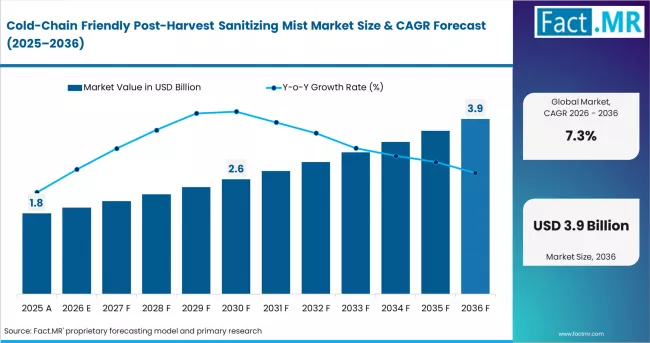
Cold Chain Friendly Post Harvest Sanitizing Mist Market Value Analysis | Source: Fact.MR
Summary of Cold-Chain Friendly Post-Harvest Sanitizing Mist Market
- Market Definition
- Market covers cold-compatible fogging mists, liquid washes, and antimicrobial coatings applied during post-harvest cold storage and packhouse operations globally.
- Demand Drivers
- India's national cold-chain expansion programme is increasing packhouse and cold storage procurement of certified sanitizing mist systems for export-grade produce.
- U.S. FDA FSMA produce safety rule enforcement is requiring documented microbial intervention at cold storage and food processing facilities across domestic supply chains.
- Brazil's export-driven tropical fruit and protein sector is adopting cold-compatible mist formulations to meet EU and U.S. import residue and food safety standards.
- Key Segments Analyzed
- By Product Type: Sanitizing mists and fogging sprays lead with approximately 45% share in 2026, owing to uniform surface coverage, minimal residue, and cold-chain temperature compatibility.
- By Application: Fruits and vegetables lead with approximately 48% share in 2026, driven by high spoilage risk, large cold-chain volumes, and export certification requirements.
- By End Use: Cold storage facilities lead with approximately 50% share in 2026, reflecting direct integration with cold-chain logistics and continuous sanitization cycle requirements.
- Analyst Opinion at FACT.MR
- Shambhu Nath Jha, Principal Consultant at Fact.MR, opines, ‘CXOs will observe that residue-free, cold-compatible mist formulations are becoming the key procurement criterion. Certification under FDA FSMA and EU biocide regulations is now essential. Formulators lacking validated cold-chain efficacy data risk losing contracts with packhouses and export-focused operators through 2036.’
- Strategic Implications
- Invest in cold-temperature-stable mist formulations certified under FDA FSMA and EU biocide product regulations to capture packhouse and export operator procurement.
- Expand direct supply relationships with Indian and Brazilian export packhouses to support compliance documentation and gain multi-season procurement agreements.
- Develop residue-free, organic-certified sanitizing mist variants targeting premium fresh produce exporters supplying European retail and foodservice chains.
- Methodology
- Market sizing based on formulator revenues and application-level volumes, validated with 2024-2025 cold storage procurement and food export certification data.
- Uses U.S. FDA FSMA compliance records, EU biocide regulation assessments, India APEDA export data, and company filings from BASF, AgroFresh, and Syngenta.
- Forecasts incorporate cold-chain infrastructure expansion rates, food export volume trends, and expert inputs from post-harvest food safety specialists.
| Metric | Value |
|---|---|
| Estimated Value in 2026 | USD 1.8 billion |
| Forecast Value in 2036 | USD 3.6 billion |
| Forecast CAGR (2026 to 2036) | 7.3% |
Source: Fact.MR analysis. Updated Apr 23, 2026
The market is expected to create an absolute opportunity of USD 1.8 billion between 2026 and 2036. Growth remains steady and widely distributed across regions. Demand is supported by rising pressure to reduce food waste, increasing global trade in fresh produce, and the modernization of HoReCa-linked supply chains. However, expansion is partially constrained by uneven cold-chain infrastructure in secondary markets and the high cost of meeting residue-free formulation standards and certifications.
Procurement trends are becoming more structured and compliance-focused. Cold storage operators and packhouses are prioritising sanitizing mist solutions that are cold-compatible and supported by validated microbial efficacy data. Export-oriented processors, particularly in India and Brazil, are aligning procurement with EU and U.S. FDA import requirements. This is creating consistent demand for certified treatment protocols. Companies such as BASF and AgroFresh maintain strong positioning due to their regulatory expertise and formulation capabilities. At the same time, large operators are adopting multi-supplier sourcing strategies to minimise risk and ensure supply continuity.
From a regional perspective, growth momentum is strongest in emerging export economies. India is expected to lead with a CAGR of 9.2%, supported by cold-chain infrastructure expansion and policy-driven export certification. China and Brazil follow closely, benefiting from logistics modernisation and strong agricultural export flows. In developed markets, the United States and Germany show stable growth driven by strict regulatory enforcement and established cold-chain systems. Other Western European markets, including France and the Netherlands, remain largely replacement-driven, with demand tied to compliance upgrades rather than volume expansion.
Segmental Analysis
Cold-Chain Friendly Post-Harvest Sanitizing Mist Market Analysis by Product Type
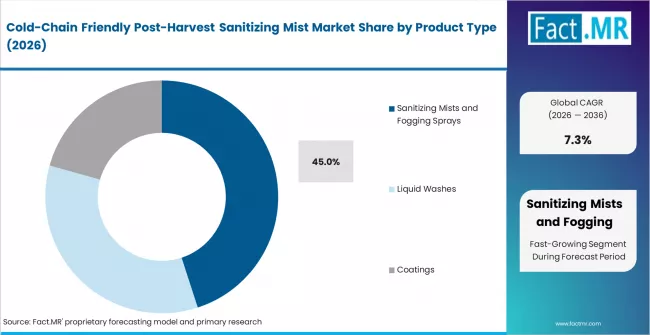
Cold Chain Friendly Post Harvest Sanitizing Mist Market Analysis By Product Type | Source: Fact.MR
Based on FACT.MR's report, sanitizing mists and fogging sprays are estimated to hold 45% share in 2026. This format dominates due to uniform coverage. Ultrafine mist particles reach irregular surfaces effectively. There is no pooling or temperature disruption. Cold compatibility and low residue make this the preferred solution for packhouses.
- AgroFresh Technology Launch: AgroFresh launched Harvista Mist protocol in Q3 2024. It is validated for 0–4°C cold storage. The solution targets apple and pear packhouses in the U.S. and Chile. [4]
- BASF Formulation Development: BASF introduced a cold-stable peracetic acid mist in Q1 2025. It is validated at 2–8°C. The product meets EU PT8 approval requirements. It targets European cold storage operators. [2]
- Fogging Adoption Trend: Fogging system procurement increased 23% in Maharashtra in FY2024–25. Growth is driven by export compliance requirements. APEDA certification mandates sanitation logs for produce exports. [3]
Cold-Chain Friendly Post-Harvest Sanitizing Mist Market Analysis by Application
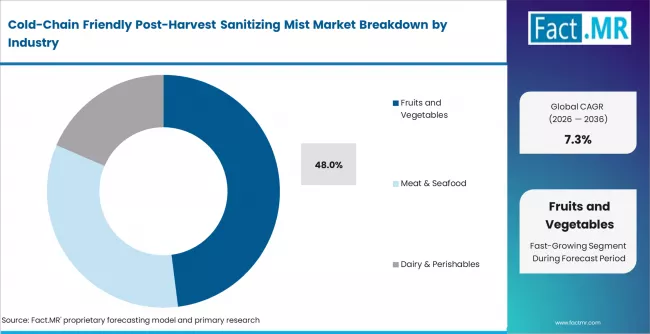
Cold Chain Friendly Post Harvest Sanitizing Mist Market Analysis By Application | Source: Fact.MR
Based on FACT.MR's report, fruits and vegetables are estimated to hold 48% share in 2026. This segment leads due to high spoilage rates. Export compliance requirements are strict for fresh produce. This drives strong demand for validated misting systems.
- Syngenta Investment: Syngenta expanded Filan mist compatibility testing in Q2 2024. Focus is on citrus and stone fruits. Target markets include Latin America and South Africa. The program integrates with cold-chain fogging systems. [5]
- Citrosol Product Development: Citrosol launched Citrox mist line in Q4 2024. It is designed for 4–8°C environments. The product meets EU regulatory standards. It targets citrus export packhouses. [6]
- Meat and Seafood Trend: USDA FSIS updated antimicrobial guidance in January 2025. Post-harvest misting is now included for poultry processing. Adoption is expanding beyond produce. Demand is increasing in chilled meat and seafood processing. [7]
Drivers, Restraints, and Opportunities
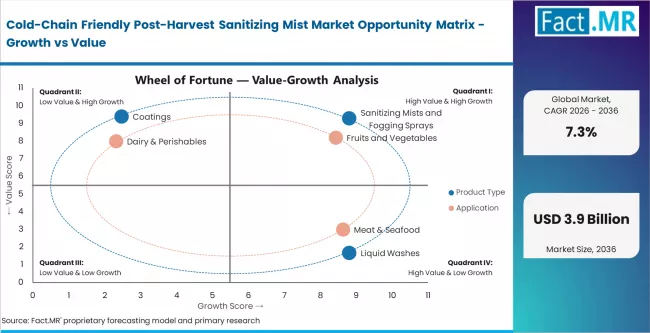
Cold Chain Friendly Post Harvest Sanitizing Mist Market Opportunity Matrix Growth Vs Value | Source: Fact.MR
Fact.MR analysis indicates that the post-harvest sanitizing mist market is steadily expanding. Growth is driven by tightening global food safety regulations. Cold-chain infrastructure investment in emerging markets is accelerating adoption. The market has evolved from basic chlorine-based wash systems. Demand is shifting toward certified fogging and misting formats. These are compatible with refrigerated supply chains.
Conventional liquid wash treatments are facing substitution pressure. Cold-compatible fogging systems offer more uniform microbial reduction. They also use lower active ingredient concentrations. Residue-free mist formulations command 20–35% price premiums.
- FSMA Enforcement: U.S. FDA expanded FSMA produce safety enforcement in 2024. Mid-size packhouses must now maintain sanitation documentation. This is increasing adoption of validated misting systems. AgroFresh expanded SmartFresh-compatible mist protocols in Q4 2024. [1]
- EU Biocide Regulation: European Chemicals Agency updated PT8 approvals in 2024. Active substance requirements were tightened. This is driving formulation changes across Europe. BASF submitted updated efficacy dossiers in early 2025.
- India Cold-Chain Expansion: India allocated INR 10,900 crore under PM GatiShakti in FY2024–25. This supports cold-chain infrastructure growth. APEDA export certification requires sanitation logs. Demand for mist systems is increasing across key export states.
Regional Analysis
The cold-chain friendly post-harvest sanitizing mist market is assessed across Asia Pacific, North America, Europe, Latin America, and Middle East and Africa, covering 40+ countries with distinct demand profiles shaped by cold-chain infrastructure maturity, food export compliance requirements, and post-harvest biocide regulatory frameworks. The full report offers market attractiveness analysis by region and country.
.webp "Top Country Growth Comparison Cold Chain Friendly Post Harvest Sanitizing Mist Market Cagr (2026 2036)")
Top Country Growth Comparison Cold Chain Friendly Post Harvest Sanitizing Mist Market Cagr (2026 2036) | Source: Fact.MR
| Country | CAGR (2026 to 2036) |
|---|---|
| India | 9.2% |
| China | 8.8% |
| Brazil | 8.5% |
| United States | 7.8% |
| Germany | 7.4% |
Source: Fact.MR analysis. Updated Apr 23, 2026
Source: Fact.MR (FACT.MR) analysis, based on proprietary forecasting model and primary research
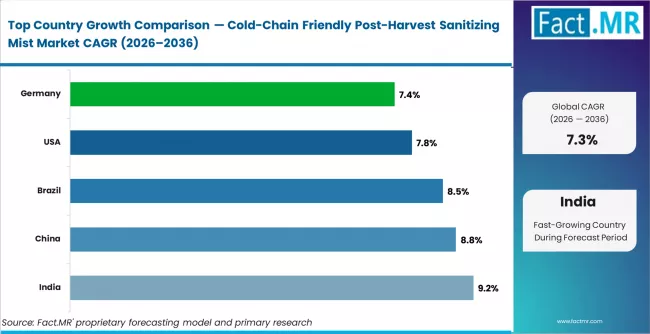
Cold Chain Friendly Post Harvest Sanitizing Mist Market Cagr Analysis By Country | Source: Fact.MR
Asia Pacific Cold-Chain Friendly Post-Harvest Sanitizing Mist Market Analysis
Asia Pacific is the highest-growth region, driven by rapid cold-chain infrastructure investment and food export compliance pressures across India and China. The region combines the largest fresh produce volumes with the fastest-expanding packhouse certification programmes.
- India: Cold-chain expansion and export compliance support 9.2% CAGR through 2036. It is the fastest-growing market. PM GatiShakti programme allocated INR 10,900 crore in FY2024–25. This expanded cold storage and packhouse infrastructure. APEDA updated grape export certification in November 2024. Sanitation logs are now mandatory for EU-bound shipments. Export hubs in Nashik and Sangli increased mist system procurement. Growth is driven by policy support, export compliance, and infrastructure expansion.
- China: Logistics modernisation and export compliance support 8.8% CAGR through 2036. MOFCOM updated cold-chain facility standards in 2024. Sanitization protocols are now mandatory for certified hubs. Export shipments to Japan, South Korea, and the EU require microbial compliance records. Domestic producers in Shandong and Zhejiang expanded food-grade mist production. Cold storage operators are increasing adoption. Growth is driven by regulation, domestic manufacturing, and export alignment.
FACT.MR's analysis of post-harvest sanitizing mist market in Asia Pacific covers India, China, Japan, South Korea, ASEAN, and Australia and New Zealand. Readers can find cold-chain infrastructure investment trends, food export compliance benchmarks, and packhouse procurement analysis.
Latin America Cold-Chain Friendly Post-Harvest Sanitizing Mist Market Analysis
Latin America is the fastest-growing export-driven market, anchored by Brazil and Chile as the primary fresh produce and protein exporters. The region is characterised by large-scale tropical and subtropical produce cold chains where post-harvest loss reduction is a critical commercial priority. Syngenta and Citrosol lead supply with export-certified product lines.
- Brazil: Export-driven agriculture and hygiene mandates support 8.5% CAGR through 2036. MAPA updated export hygiene standards in Q2 2024. Packhouses must implement antimicrobial interventions. Syngenta expanded mist compatibility programmes in H2 2024. Focus remains on mango, papaya, and citrus exports. Cold storage networks are expanding across Sao Paulo and Minas Gerais. Growth is driven by export volumes, compliance, and tropical produce preservation needs.
FACT.MR's analysis of post-harvest sanitizing mist market in Latin America covers Brazil, Argentina, Chile, and Rest of Latin America. Readers can find export-driven cold-chain investment data, MAPA and SENASA compliance trends, and tropical produce packhouse procurement benchmarks.
North America Cold-Chain Friendly Post-Harvest Sanitizing Mist Market Analysis
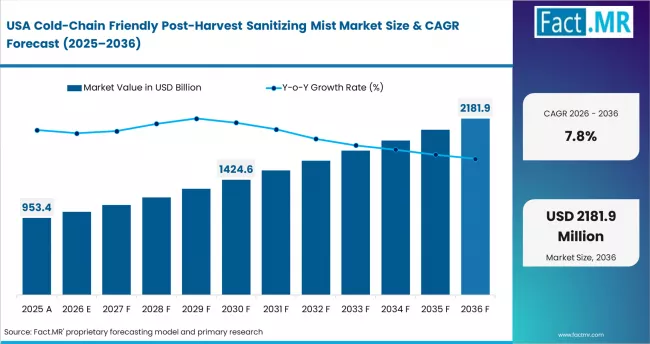
Cold Chain Friendly Post Harvest Sanitizing Mist Market Country Value Analysis | Source: Fact.MR
North America is the most compliance-mature market, driven by U.S. FDA FSMA enforcement and the largest established cold-chain infrastructure base. AgroFresh and Hazel Technologies hold strong institutional positions through validated misting protocols and co-marketing with cold storage technology providers.
- United States: Regulatory enforcement and advanced cold-chain systems support 7.8% CAGR through 2036. FDA expanded FSMA enforcement in 2024. Packhouses must implement validated sanitation systems. AgroFresh strengthened SmartFresh protocol deployment in Q4 2024. USDA FSIS updated antimicrobial guidance in January 2025. Adoption expanded into poultry processing. Growth is driven by compliance, institutional demand, and technology integration.
FACT.MR's analysis of post-harvest sanitizing mist market in North America covers the United States, Canada, and Mexico. Readers can find FSMA enforcement impact data, packhouse procurement benchmarks, and cold storage sanitization technology adoption trends.
Europe Cold-Chain Friendly Post-Harvest Sanitizing Mist Market Analysis
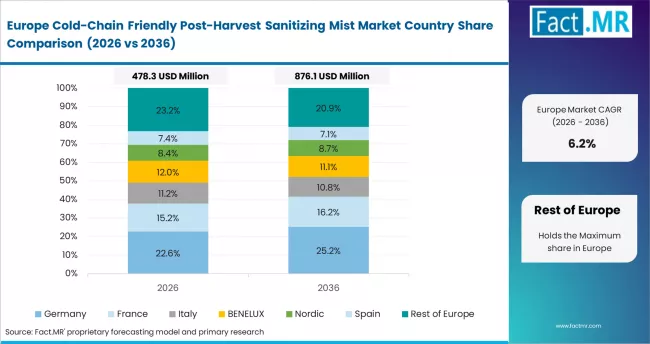
Cold Chain Friendly Post Harvest Sanitizing Mist Market Europe Country Market Share Analysis, 2026 & 2036 | Source: Fact.MR
Europe is a regulation-intensive market defined by EU Biocide Product Regulation and strict food contact surface hygiene standards. Demand is concentrated in high-value horticulture, fresh dairy, and export-grade produce sectors. BASF and Citrosol are the primary certified formulation suppliers operating within EU-approved active substance frameworks.
- Germany: Regulatory tightening and retail-driven standards support 7.4% CAGR through 2036. BVL updated sanitizer approval criteria under EU BPR 528/2012 in Q1 2025. Certification timelines have become stricter. BASF submitted updated cold-compatible formulations in early 2025. Retail chains such as Edeka and Rewe strengthened supplier hygiene requirements. Cold storage operators are aligning procurement with EU standards. Growth is driven by compliance, retail pressure, and premium supply chain requirements.
FACT.MR's analysis of post-harvest sanitizing mist market in Europe covers Germany, France, the UK, Italy, Spain, and Rest of Europe. Readers can find EU BPR compliance trends, cold storage hygiene procurement data, and post-harvest biocide approval timelines.
Competitive Aligners for Market Players
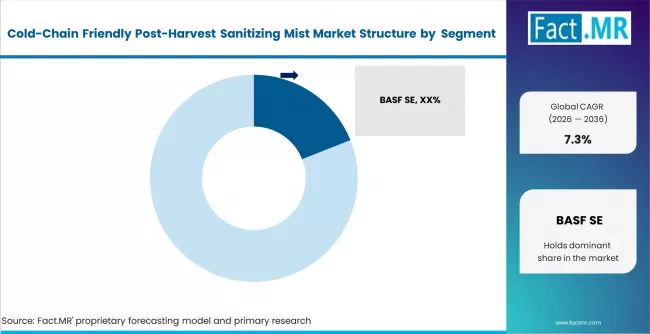
Cold Chain Friendly Post Harvest Sanitizing Mist Market Analysis By Company | Source: Fact.MR
The cold-chain friendly post-harvest sanitizing mist market has a moderately fragmented structure, but competition is not evenly distributed. A few global players dominate the high-value segment, especially where regulatory approvals and validated efficacy are required. Companies such as BASF, AgroFresh, and Syngenta hold strong positions due to their ability to meet strict food safety standards and maintain long-term relationships with large packhouses and cold storage operators.
Their advantage is not just scale, but compliance depth. These companies invest heavily in regulatory approvals across FDA, EU Biocide Product Regulation, and national frameworks. This creates high entry barriers. New players often struggle to match the documentation and validation required for export-grade applications. AgroFresh also benefits from its integrated offering, combining ethylene control with sanitization. This allows it to cross-sell solutions within existing cold storage networks. Meanwhile, Hazel Technologies takes a different approach by embedding misting solutions into broader storage technology systems rather than selling standalone products.
Buyer behavior varies across regions. Export-focused packhouses in India and Brazil are highly selective. They prioritise certified solutions that meet EU and U.S. import standards, even at premium prices. In contrast, smaller domestic operators in developing markets remain price-sensitive and often rely on local suppliers. Once a misting protocol is approved and integrated into export certification processes, switching suppliers becomes difficult. This gives established player’s strong customer retention and pricing stability.
Key Players
- BASF SE
- Bayer AG
- Syngenta AG
- AgroFresh Solutions
- Nufarm Limited
- Citrosol S.A.
- Hazel Technologies
Scope of Report
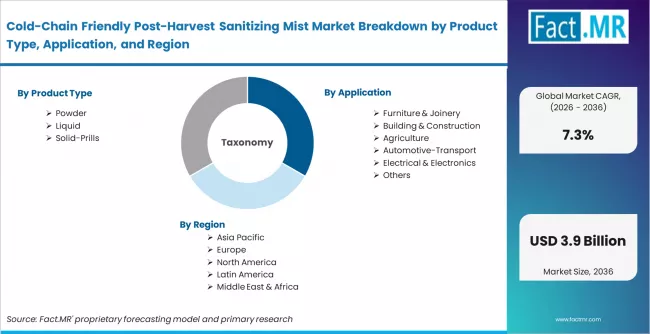
Cold Chain Friendly Post Harvest Sanitizing Mist Market Breakdown By Product Type, Application, And Region | Source: Fact.MR
| Attribute | Details |
|---|---|
| Quantitative Units | USD 1.8 billion (2026) to USD 3.6 billion (2036), at a CAGR of 7.3% |
| Market Definition | Cold-compatible fogging mist, liquid wash, and antimicrobial coating formulations applied post-harvest in cold storage, packhouse, and food processing operations across fresh produce, protein, and dairy supply chains globally. |
| Product Type Segmentation | Sanitizing Mists/Fogging Sprays, Liquid Washes, Coatings |
| Application Segmentation | Fruits & Vegetables, Meat & Seafood, Dairy & Perishables |
| End Use Segmentation | Packhouses, Cold Storage Facilities, Food Processing Units |
| Application Coverage | Fresh produce post-harvest microbial reduction, refrigerated protein and seafood surface sanitation, dairy cold storage hygiene, export-grade packhouse certification compliance, and food processing unit sanitation. |
| Regions Covered | North America, Europe, Asia Pacific, Latin America, Middle East and Africa |
| Countries Covered | USA, Canada, Mexico, Germany, UK, France, Italy, Spain, Nordic, BENELUX, China, Japan, South Korea, India, ASEAN, Australia and New Zealand, Brazil, Argentina, Chile, Saudi Arabia, UAE, Turkey, South Africa, Rest of MEA |
| Key Companies Profiled | BASF SE, Bayer AG, Syngenta AG, AgroFresh Solutions, Nufarm Limited, Citrosol S.A., Hazel Technologies |
| Forecast Period | 2026 to 2036 |
| Approach | Hybrid top-down and bottom-up model using formulator revenues, application-level volume estimates by end use, average selling prices by product type and certification tier, packhouse procurement benchmarks, and primary interviews with cold storage operators and food safety specialists. |
Source: Fact.MR analysis. Updated Apr 23, 2026
Cold-Chain Friendly Post-Harvest Sanitizing Mist Market by Segments
-
By Product Type:
- Sanitizing Mists / Fogging Sprays
- Liquid Washes
- Coatings
-
By Application:
- Fruits & Vegetables
- Meat & Seafood
- Dairy & Perishables
-
By End Use:
- Packhouses
- Cold Storage Facilities
- Food Processing Units
-
By Region:
- North America
- United States
- Canada
- Mexico
- Latin America
- Brazil
- Argentina
- Chile
- Rest of Latin America
- Western Europe
- Germany
- United Kingdom
- France
- Italy
- Spain
- Nordic Countries
- BENELUX
- Rest of Western Europe
- Eastern Europe
- Russia
- Poland
- Hungary
- Balkan and Baltic
- Rest of Eastern Europe
- East Asia
- China
- Japan
- South Korea
- South Asia and Pacific
- India
- ASEAN
- Australia and New Zealand
- Rest of South Asia and Pacific
- Middle East and Africa
- Kingdom of Saudi Arabia
- UAE
- Other GCC Countries
- Turkey
- South Africa
- Rest of Middle East and Africa
- North America
Bibliography
- [1] AgroFresh Solutions Inc. (Q4 2024). Product and Compliance Update: SmartFresh Misting Protocol FSMA Documentation Expansion for Apple and Cherry Cold Storage Post-Harvest Sanitation in Washington State. agrofresh.com/news
- [2] BASF SE. (Q1 2025). Regulatory Filing Update: Peracetic Acid Cold-Compatible Sanitizing Mist Concentrate Efficacy Dossier Submission under EU Biocide Product Regulation PT8 for European Cold Storage Operator Procurement. basf.com/agriculture
- [3] Ministry of Food Processing Industries, India. (2024). PM GatiShakti Cold-Chain Infrastructure Scheme FY2024-25: INR 10,900 Crore Allocation for Packhouse and Cold Storage Development and APEDA Fresh Produce Export Certification Protocol Update. mofpi.gov.in
- [4] AgroFresh Solutions Inc. (Q3 2024). Product Launch: Harvista Mist Cold Storage Compatible Application Protocol Validated for 0-4 Degrees Celsius for Apple and Pear Packhouses in the United States and Chile. agrofresh.com/news
- [5] Syngenta AG. (Q2 2024). Programme Update: Filan Post-Harvest Fungicide Mist Compatibility Testing for Citrus and Stone Fruit Export Packhouses in Latin America and South Africa Integrated with Cold-Chain Fogging Equipment. syngenta.com/en/news
- [6] Citrosol S.A. (Q4 2024). Product Launch: Citrox Cold-Chain Compatible Sanitizing Mist Line for Citrus Packhouses Certified at 4-8 Degrees Celsius under EU Post-Harvest Biocide Regulation Targeting Spanish and Moroccan Export Operations. citrosol.com
- [7] U.S. Department of Agriculture Food Safety and Inspection Service. (January 2025). Antimicrobial Intervention Guidance Update: Approved Post-Harvest Misting Interventions for Poultry Processing Chilled and Refrigerated Lines Under FSIS Performance Standards. fsis.usda.gov
This Report Addresses
- Strategic intelligence on cold-chain post-harvest sanitizing mist demand across fogging sprays, liquid washes, and coatings for fresh produce, protein, and dairy cold-chain applications globally.
- Market forecast from USD 1.8 billion in 2026 to USD 3.6 billion by 2036, at a CAGR of 7.3%.
- Growth opportunity mapping across India PM GatiShakti cold-chain expansion, Brazil export-driven packhouse growth, China logistics modernisation, U.S. FSMA enforcement, and Germany EU BPR compliance demand.
- Segment analysis by product type (sanitizing mists, liquid washes, coatings), application (fruits and vegetables, meat and seafood, dairy), and end use (packhouses, cold storage, food processing units) across global and regional markets.
- Regional outlook covering Asia Pacific cold-chain investment, Latin America export compliance, North America FSMA enforcement, and Europe EU biocide regulation-driven procurement.
- Competitive landscape of BASF, Bayer, Syngenta, AgroFresh, Nufarm, Citrosol, and Hazel Technologies covering regulatory approval depth, packhouse supply relationships, and certification programme positioning.
- Regulatory impact analysis covering U.S. FDA FSMA produce safety rules, EU Biocide Product Regulation PT8 approvals, India APEDA export certification mandates, and Brazil MAPA post-harvest hygiene standards.
- Report delivered in PDF, Excel datasets, and presentation formats, supported by primary interviews, formulator filings, and food export certification data.
Cold-Chain Friendly Post-Harvest Sanitizing Mist Market Definition
The cold-chain friendly post-harvest sanitizing mist market includes aqueous fogging and misting formulations. These are applied to harvested produce, meat, seafood, and dairy products. Applications occur during cold storage, packhouse handling, and food processing operations.
Cold-Chain Friendly Post-Harvest Sanitizing Mist MarketInclusions
Covers global and regional forecasts from 2026 to 2036 by product type, application, and end use. Includes sanitizing mist and fogging spray formulations, liquid wash systems, and antimicrobial coatings. Applications span fruits and vegetables, meat and seafood, and dairy and perishables. End uses cover packhouses, cold storage facilities, and food processing units.
Cold-Chain Friendly Post-Harvest Sanitizing Mist Market Exclusions
Excludes post-harvest wax coatings applied for cosmetic purposes unless combined with certified antimicrobial actives. Omits standalone fogging equipment hardware and refrigeration systems. Also excludes agricultural field-use pesticides and pre-harvest crop protection chemicals.
Cold-Chain Friendly Post-Harvest Sanitizing Mist Market Research Methodology
- Primary Research
- Interviews with cold storage operators, packhouse procurement managers, food export certification bodies, and post-harvest chemical formulators across India, the United States, Brazil, Germany, and China.
- Desk Research
- Analysis of regulatory filings from BASF, AgroFresh, and Syngenta, alongside U.S. FDA FSMA compliance data, EU biocide product regulation assessments, and India APEDA export certification records (2024-2025).
- Market-Sizing and Forecasting
- Hybrid model using formulator revenues, application-level volume estimates by end use, and average selling prices across packhouse, cold storage, and food processing segments.
- Data Validation and Update Cycle
- Validated through cold storage operator procurement records, food export certification data, and expert interviews with post-harvest food safety specialists. Updated annually.
Frequently Asked Questions
How large is the global cold-chain friendly post-harvest sanitizing mist market in 2025?
What will the market size be in 2026?
What is the projected market size by 2036?
What is the expected CAGR from 2026 to 2036?
Which product type segment is poised to lead the market?
Which application segment holds the largest share?
Which end use segment dominates the market?
Which country shows the fastest growth?
What drives demand in this market?
Who are the key players in the market?
Who worked on this report


Preview the report firsthand - request a free sample
Free SampleGet the brochure for pricing and purchase details
Download PDF