Cover-Crop Friendly Selective Herbicide Co-Pack Market
Cover-Crop Friendly Selective Herbicide Co-Pack Market Size and Share Forecast Outlook 2026 to 2036
Cover-crop friendly selective herbicide co-pack market is projected to grow from USD 0.5 billion in 2026 to USD 1.9 billion by 2036, at a CAGR of 15.1%. Selective Herbicide + Safener Blends will dominate with a 37.0% market share, while early-season selective suppression will lead the weed control strategy segment with a 35.0% share.
Cover-Crop Friendly Selective Herbicide Co-Pack Market Forecast and Outlook 2026 to 2036
The global cover-crop friendly selective herbicide co-pack market is projected to reach USD 1.89 billion by 2036. The market is valued at USD 0.46 billion in 2026 and is set to rise at a CAGR of 15.1% during the assessment period. By co-pack composition type, selective herbicide + safener blends hold a leading 37% share. The early-season selective suppression weed control strategy represents a dominant 35% segment.
Key Takeaways from the Cover-Crop Friendly Selective Herbicide Co-Pack Market
- Market Value for 2026: USD 0.46 Billion
- Market Value for 2036: USD 1.89 Billion
- Forecast CAGR (2026-2036): 15.1%
- Leading Co-Pack Composition Type Share (2026): Selective Herbicide + Safener Blends (37%)
- Leading Weed Control Strategy Share (2026): Early-Season Selective Suppression (35%)
- Key Players in the Market: UPL Sustainable Ag Solutions, Albaugh Specialty Crop Programs, Rotam CropSciences, RedEagle International, Nichino America
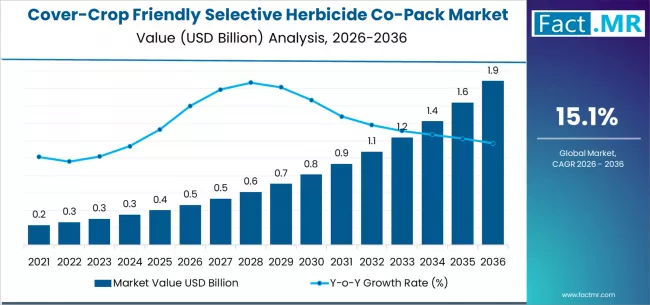
A defining market trend is the shift from broad-spectrum burndown chemicals to precisely formulated multi-component packs that protect cash crop seedlings while allowing cover crops to continue growing or decompose without herbicide injury. Innovation focuses on expanding the window of selectivity and creating sequential application kits that manage weed flushes throughout the cover crop phase. Integration of these co-packs into whole-farm system plans is becoming critical for achieving both weed control and soil health objectives.
Regulatory and certification frameworks are strong market enablers. Policies promoting integrated pest management and soil conservation create a favorable environment for these targeted solutions. Certification programs for regenerative or sustainable agriculture often mandate practices that these co-packs facilitate, directly linking product use to market access and premium incentives for growers.
Cover-Crop Friendly Selective Herbicide Co-Pack Market
| Metric | Value |
|---|---|
| Market Value (2026) | USD 0.46 Billion |
| Market Forecast Value (2036) | USD 1.89 Billion |
| Forecast CAGR (2026-2036) | 15.1% |
Category
| Category | Segments |
|---|---|
| Co-Pack Composition Type | Selective Herbicide + Safener Blends, Herbicide + Residue-Friendly Adjuvant Packs, Low-Dose Sequential Herbicide Kits, Cover-Crop Termination-Safe Formulations, Others |
| Weed Control Strategy | Early-Season Selective Suppression, Inter-Crop Weed Management, Cover-Crop Preservation Programs, Precision & Spot-Spray Programs, Others |
| Region | North America, Latin America, Western Europe, Eastern Europe, East Asia, South Asia & Pacific, MEA |
Segmental Analysis
By Co-Pack Composition, Which System Most Effectively Expands the Selectivity Window?
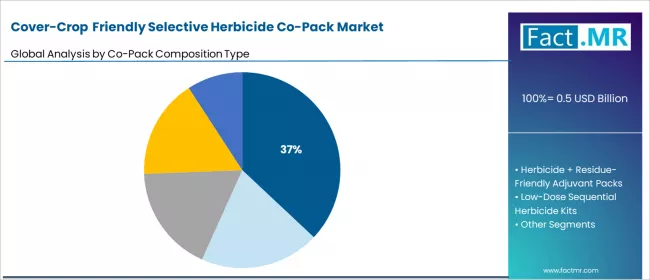
Selective herbicide + safener blends lead the segment with a 37% share. This dominance is based on the critical need to protect the cash crop seedling from herbicide injury in a cover-crop system. Safeners selectively enhance the cash crop's ability to metabolize the herbicide, providing a crucial safety margin. This technology unlocks the use of effective post-emergent chemistries that would otherwise be too risky, allowing growers to control weeds without harming their primary crop or terminating their living cover prematurely.
By Weed Control Strategy, Which Timing is Most Critical for System Success?
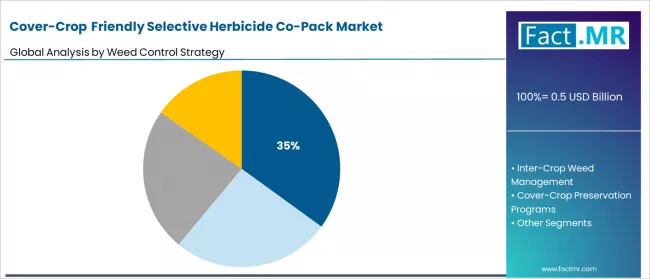
Early-season selective suppression holds the largest strategic share at 35%. The initial weeks after cash crop planting are decisive. Weeds must be controlled before they outcompete the young crop, yet the cover crop biomass should remain to provide soil benefits. Co-packs enabling this strategy allow farmers to manage that narrow agronomic window perfectly, suppressing weeds while preserving the cover crop's protective residue or continued growth for as long as possible.
What are the Drivers, Restraints, and Key Trends of the Cover-Crop Friendly Selective Herbicide Co-Pack Market?
Market expansion is driven by the rapid adoption of cover cropping and the agronomic challenge of managing weeds within these complex systems without tillage. The economic value of soil health and carbon sequestration provides a new incentive to solve this weed control puzzle. Regulatory and consumer pressure to reduce herbicide load and environmental impact favors these precise, system-compatible solutions over conventional broad-spectrum programs.
A significant restraint is the high level of agronomic knowledge required to correctly match a co-pack to specific cover crop and cash crop species. The cost premium over standard herbicides can be a barrier. Performance can be sensitive to weather conditions and cover crop growth stage, requiring precise timing and potentially limiting the application window.
Key trends include the development of multi-season, multi-herbicide kits for managing weeds across both cover and cash crop phases. Formulations are increasingly incorporating bio-based safeners and adjuvants. Digital tools are emerging to help farmers select the correct co-pack based on their specific cover crop mixture, soil type, and cash crop rotation.
Analysis of the Cover-Crop Friendly Selective Herbicide Co-Pack Market by Key Countries
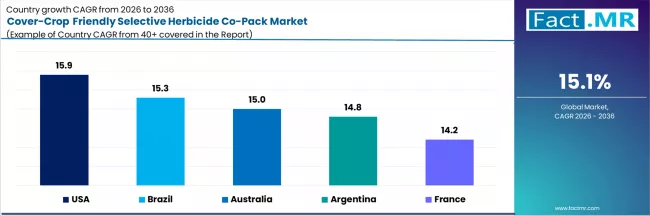
| Country | CAGR (2026-2036) |
|---|---|
| USA | 15.90% |
| Brazil | 15.30% |
| Australia | 15.00% |
| Argentina | 14.80% |
| France | 14.20% |
How does the USA's Leadership in Regenerative Agriculture Fuel Market Growth?
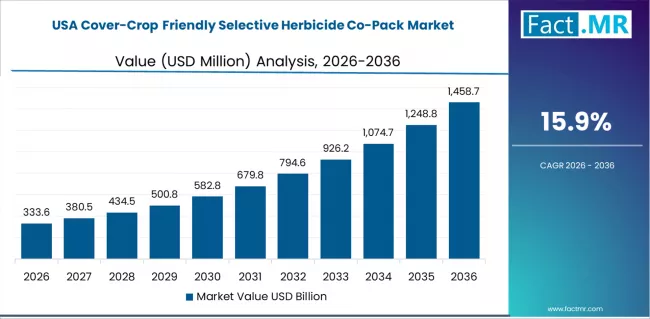
The USA exhibits a 15.90% CAGR, driven by its central role in the regenerative agriculture movement. American farmers, particularly in the Midwest and Plains, are intensively integrating cover crops into corn and soybean systems. They demand chemical tools that make this integration workable. Co-packs are seen as essential enabling technology, allowing them to achieve weed control goals without sacrificing soil health benefits, a trade-off they are increasingly unwilling to make.
Why is Brazil's No-Till Imperative Creating Demand for Selective Solutions?
Brazil's 15.30% growth stems from its absolute reliance on no-till and the growing use of cover crops to improve soil. The challenge of controlling weeds in a living or recently terminated cover crop without harming the main soybean or cotton crop is widespread. Brazilian growers seek co-packs that offer clear selectivity, often favoring those with robust safener technology to protect their high-value cash crop investments in these intensive systems.
What drives Adoption in Australia's Climate-Adaptive Cropping Systems?
Australia's 15.00% CAGR is linked to the use of cover crops for moisture retention and weed suppression in its variable climate. Australian farmers need to manage weeds during the cover crop phase without compromising its soil protection role. Co-packs that allow for selective weed removal or suppression within a standing cover are highly valued for preserving ground cover through dry periods, making them a strategic risk management tool.
How do Argentina's Mixed Cropping Systems Benefit from Inter-Crop Management?
Argentina's 14.80% growth occurs in systems where cover crops are often intersown with cereals or used in complex rotations. The need to manage weeds in the overlap period between cash crop harvest and cover crop establishment, or within the cover crop itself, is acute. Co-packs designed for inter-crop weed management provide the necessary flexibility, allowing farmers to maintain clean fields without disrupting their soil-building practices.
What Factors Underpin France's Focus on Cover-Crop Preservation?
France's 14.20% growth aligns with strict EU agroecological targets that incentivize maintaining green cover. French farmers are adopters of co-packs designed for "cover-crop preservation programs," where the goal is to suppress weeds while keeping the cover crop alive and functional for as long as possible. This approach satisfies regulatory cross-compliance requirements for soil coverage while providing effective weed control, a balance that drives product innovation and adoption.
Competitive Landscape of the Cover-Crop Friendly Selective Herbicide Co-Pack Market
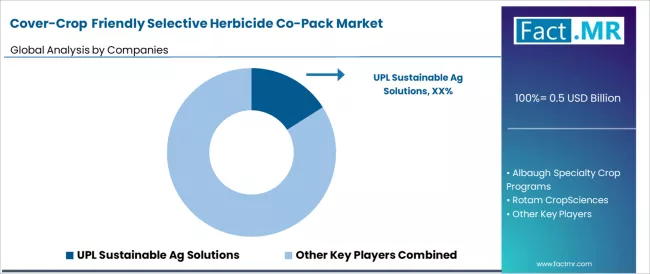
The market is moderately fragmented, featuring competition between global agrochemical firms with broad portfolios and regional specialists with deep system knowledge. Companies like UPL and Rotam CropSciences compete by developing and registering novel safener and herbicide combinations specifically for these niche use cases. Their strength lies in regulatory expertise and the ability to generate robust selectivity data for multiple crop combinations.
Regional specialists like Albaugh Specialty Crop Programs, RedEagle International, and Nichino America often compete by tailoring existing herbicide chemistries into co-packs for local cover-crop and cash-crop rotations. Their advantage is agility and close relationships with distributors and farmers practicing regenerative agriculture. Success hinges on providing clear, practical application guidance and demonstrating reliable crop safety in the complex environment of a cover-crop system.
Key Players in the Cover-Crop Friendly Selective Herbicide Co-Pack Market
- UPL Sustainable Ag Solutions
- Albaugh Specialty Crop Programs
- Rotam CropSciences
- RedEagle International
- Nichino America
Scope of Report
| Items | Values |
|---|---|
| Quantitative Units | USD Billion |
| Co-Pack Composition Type | Selective Herbicide + Safener Blends, Herbicide + Residue-Friendly Adjuvant Packs, Low-Dose Sequential Herbicide Kits, Cover-Crop Termination-Safe Formulations, Others |
| Weed Control Strategy | Early-Season Selective Suppression, Inter-Crop Weed Management, Cover-Crop Preservation Programs, Precision & Spot-Spray Programs, Others |
| Key Countries | USA, Brazil, Australia, Argentina, France |
| Key Companies | UPL Sustainable Ag Solutions, Albaugh Specialty Crop Programs, Rotam CropSciences, RedEagle International, Nichino America |
| Additional Analysis | Analysis of crop safety (safener) mechanisms, rotational crop restrictions, integration with cover crop termination timing, economic analysis of weed control within soil health management systems. |
Cover-Crop Friendly Selective Herbicide Co-Pack Market by Segments
-
Co-Pack Composition Type :
- Selective Herbicide + Safener Blends
- Herbicide + Residue-Friendly Adjuvant Packs
- Low-Dose Sequential Herbicide Kits
- Cover-Crop Termination-Safe Formulations
- Others
-
Weed Control Strategy :
- Early-Season Selective Suppression
- Inter-Crop Weed Management
- Cover-Crop Preservation Programs
- Precision & Spot-Spray Programs
- Others
-
Region :
-
North America
- USA
- Canada
-
Latin America
- Brazil
- Mexico
- Argentina
- Rest of Latin America
-
Western Europe
- Germany
- UK
- France
- Spain
- Italy
- BENELUX
- Rest of Western Europe
-
Eastern Europe
- Czech Republic
- Poland
- Russia
- Rest of Eastern Europe
-
East Asia
- China
- Japan
- South Korea
- Rest of East Asia
-
South Asia & Pacific
- India
- Indonesia
- Australia
- Rest of South Asia & Pacific
-
MEA
- GCC Countries
- Turkiye
- Saudi Arabia
- Rest of MEA
-
Table of Content
- Executive Summary
- Global Market Outlook
- Demand to side Trends
- Supply to side Trends
- Technology Roadmap Analysis
- Analysis and Recommendations
- Market Overview
- Market Coverage / Taxonomy
- Market Definition / Scope / Limitations
- Market Background
- Market Dynamics
- Drivers
- Restraints
- Opportunity
- Trends
- Scenario Forecast
- Demand in Optimistic Scenario
- Demand in Likely Scenario
- Demand in Conservative Scenario
- Opportunity Map Analysis
- Product Life Cycle Analysis
- Supply Chain Analysis
- Investment Feasibility Matrix
- Value Chain Analysis
- PESTLE and Porter’s Analysis
- Regulatory Landscape
- Regional Parent Market Outlook
- Production and Consumption Statistics
- Import and Export Statistics
- Market Dynamics
- Global Market Analysis 2021 to 2025 and Forecast, 2026 to 2036
- Historical Market Size Value (USD Million) Analysis, 2021 to 2025
- Current and Future Market Size Value (USD Million) Projections, 2026 to 2036
- Y to o to Y Growth Trend Analysis
- Absolute $ Opportunity Analysis
- Global Market Pricing Analysis 2021 to 2025 and Forecast 2026 to 2036
- Global Market Analysis 2021 to 2025 and Forecast 2026 to 2036, By Co-Pack Composition Type
- Introduction / Key Findings
- Historical Market Size Value (USD Million) Analysis By Co-Pack Composition Type, 2021 to 2025
- Current and Future Market Size Value (USD Million) Analysis and Forecast By Co-Pack Composition Type, 2026 to 2036
- Selective Herbicide + Safener Blends
- Herbicide + Residue-Friendly Adjuvant Packs
- Low-Dose Sequential Herbicide Kits
- Cover-Crop Termination-Safe Formulations
- Others
- Selective Herbicide + Safener Blends
- Y to o to Y Growth Trend Analysis By Co-Pack Composition Type, 2021 to 2025
- Absolute $ Opportunity Analysis By Co-Pack Composition Type, 2026 to 2036
- Global Market Analysis 2021 to 2025 and Forecast 2026 to 2036, By Weed Control Strategy
- Introduction / Key Findings
- Historical Market Size Value (USD Million) Analysis By Weed Control Strategy, 2021 to 2025
- Current and Future Market Size Value (USD Million) Analysis and Forecast By Weed Control Strategy, 2026 to 2036
- Early-Season Selective Suppression
- Inter-Crop Weed Management
- Cover-Crop Preservation Programs
- Precision & Spot-Spray Programs
- Early-Season Selective Suppression
- Y to o to Y Growth Trend Analysis By Weed Control Strategy, 2021 to 2025
- Absolute $ Opportunity Analysis By Weed Control Strategy, 2026 to 2036
- Global Market Analysis 2021 to 2025 and Forecast 2026 to 2036, By Region
- Introduction
- Historical Market Size Value (USD Million) Analysis By Region, 2021 to 2025
- Current Market Size Value (USD Million) Analysis and Forecast By Region, 2026 to 2036
- North America
- Latin America
- Western Europe
- Eastern Europe
- East Asia
- South Asia and Pacific
- Middle East & Africa
- Market Attractiveness Analysis By Region
- North America Market Analysis 2021 to 2025 and Forecast 2026 to 2036, By Country
- Historical Market Size Value (USD Million) Trend Analysis By Market Taxonomy, 2021 to 2025
- Market Size Value (USD Million) Forecast By Market Taxonomy, 2026 to 2036
- By Country
- USA
- Canada
- Mexico
- By Co-Pack Composition Type
- By Weed Control Strategy
- By Country
- Market Attractiveness Analysis
- By Country
- By Co-Pack Composition Type
- By Weed Control Strategy
- Key Takeaways
- Latin America Market Analysis 2021 to 2025 and Forecast 2026 to 2036, By Country
- Historical Market Size Value (USD Million) Trend Analysis By Market Taxonomy, 2021 to 2025
- Market Size Value (USD Million) Forecast By Market Taxonomy, 2026 to 2036
- By Country
- Brazil
- Chile
- Rest of Latin America
- By Co-Pack Composition Type
- By Weed Control Strategy
- By Country
- Market Attractiveness Analysis
- By Country
- By Co-Pack Composition Type
- By Weed Control Strategy
- Key Takeaways
- Western Europe Market Analysis 2021 to 2025 and Forecast 2026 to 2036, By Country
- Historical Market Size Value (USD Million) Trend Analysis By Market Taxonomy, 2021 to 2025
- Market Size Value (USD Million) Forecast By Market Taxonomy, 2026 to 2036
- By Country
- Germany
- UK
- Italy
- Spain
- France
- Nordic
- BENELUX
- Rest of Western Europe
- By Co-Pack Composition Type
- By Weed Control Strategy
- By Country
- Market Attractiveness Analysis
- By Country
- By Co-Pack Composition Type
- By Weed Control Strategy
- Key Takeaways
- Eastern Europe Market Analysis 2021 to 2025 and Forecast 2026 to 2036, By Country
- Historical Market Size Value (USD Million) Trend Analysis By Market Taxonomy, 2021 to 2025
- Market Size Value (USD Million) Forecast By Market Taxonomy, 2026 to 2036
- By Country
- Russia
- Poland
- Hungary
- Balkan & Baltic
- Rest of Eastern Europe
- By Co-Pack Composition Type
- By Weed Control Strategy
- By Country
- Market Attractiveness Analysis
- By Country
- By Co-Pack Composition Type
- By Weed Control Strategy
- Key Takeaways
- East Asia Market Analysis 2021 to 2025 and Forecast 2026 to 2036, By Country
- Historical Market Size Value (USD Million) Trend Analysis By Market Taxonomy, 2021 to 2025
- Market Size Value (USD Million) Forecast By Market Taxonomy, 2026 to 2036
- By Country
- China
- Japan
- South Korea
- By Co-Pack Composition Type
- By Weed Control Strategy
- By Country
- Market Attractiveness Analysis
- By Country
- By Co-Pack Composition Type
- By Weed Control Strategy
- Key Takeaways
- South Asia and Pacific Market Analysis 2021 to 2025 and Forecast 2026 to 2036, By Country
- Historical Market Size Value (USD Million) Trend Analysis By Market Taxonomy, 2021 to 2025
- Market Size Value (USD Million) Forecast By Market Taxonomy, 2026 to 2036
- By Country
- India
- ASEAN
- Australia & New Zealand
- Rest of South Asia and Pacific
- By Co-Pack Composition Type
- By Weed Control Strategy
- By Country
- Market Attractiveness Analysis
- By Country
- By Co-Pack Composition Type
- By Weed Control Strategy
- Key Takeaways
- Middle East & Africa Market Analysis 2021 to 2025 and Forecast 2026 to 2036, By Country
- Historical Market Size Value (USD Million) Trend Analysis By Market Taxonomy, 2021 to 2025
- Market Size Value (USD Million) Forecast By Market Taxonomy, 2026 to 2036
- By Country
- Kingdom of Saudi Arabia
- Other GCC Countries
- Turkiye
- South Africa
- Other African Union
- Rest of Middle East & Africa
- By Co-Pack Composition Type
- By Weed Control Strategy
- By Country
- Market Attractiveness Analysis
- By Country
- By Co-Pack Composition Type
- By Weed Control Strategy
- Key Takeaways
- Key Countries Market Analysis
- USA
- Pricing Analysis
- Market Share Analysis, 2025
- By Co-Pack Composition Type
- By Weed Control Strategy
- Canada
- Pricing Analysis
- Market Share Analysis, 2025
- By Co-Pack Composition Type
- By Weed Control Strategy
- Mexico
- Pricing Analysis
- Market Share Analysis, 2025
- By Co-Pack Composition Type
- By Weed Control Strategy
- Brazil
- Pricing Analysis
- Market Share Analysis, 2025
- By Co-Pack Composition Type
- By Weed Control Strategy
- Chile
- Pricing Analysis
- Market Share Analysis, 2025
- By Co-Pack Composition Type
- By Weed Control Strategy
- Germany
- Pricing Analysis
- Market Share Analysis, 2025
- By Co-Pack Composition Type
- By Weed Control Strategy
- UK
- Pricing Analysis
- Market Share Analysis, 2025
- By Co-Pack Composition Type
- By Weed Control Strategy
- Italy
- Pricing Analysis
- Market Share Analysis, 2025
- By Co-Pack Composition Type
- By Weed Control Strategy
- Spain
- Pricing Analysis
- Market Share Analysis, 2025
- By Co-Pack Composition Type
- By Weed Control Strategy
- France
- Pricing Analysis
- Market Share Analysis, 2025
- By Co-Pack Composition Type
- By Weed Control Strategy
- India
- Pricing Analysis
- Market Share Analysis, 2025
- By Co-Pack Composition Type
- By Weed Control Strategy
- ASEAN
- Pricing Analysis
- Market Share Analysis, 2025
- By Co-Pack Composition Type
- By Weed Control Strategy
- Australia & New Zealand
- Pricing Analysis
- Market Share Analysis, 2025
- By Co-Pack Composition Type
- By Weed Control Strategy
- China
- Pricing Analysis
- Market Share Analysis, 2025
- By Co-Pack Composition Type
- By Weed Control Strategy
- Japan
- Pricing Analysis
- Market Share Analysis, 2025
- By Co-Pack Composition Type
- By Weed Control Strategy
- South Korea
- Pricing Analysis
- Market Share Analysis, 2025
- By Co-Pack Composition Type
- By Weed Control Strategy
- Russia
- Pricing Analysis
- Market Share Analysis, 2025
- By Co-Pack Composition Type
- By Weed Control Strategy
- Poland
- Pricing Analysis
- Market Share Analysis, 2025
- By Co-Pack Composition Type
- By Weed Control Strategy
- Hungary
- Pricing Analysis
- Market Share Analysis, 2025
- By Co-Pack Composition Type
- By Weed Control Strategy
- Kingdom of Saudi Arabia
- Pricing Analysis
- Market Share Analysis, 2025
- By Co-Pack Composition Type
- By Weed Control Strategy
- Turkiye
- Pricing Analysis
- Market Share Analysis, 2025
- By Co-Pack Composition Type
- By Weed Control Strategy
- South Africa
- Pricing Analysis
- Market Share Analysis, 2025
- By Co-Pack Composition Type
- By Weed Control Strategy
- USA
- Market Structure Analysis
- Competition Dashboard
- Competition Benchmarking
- Market Share Analysis of Top Players
- By Regional
- By Co-Pack Composition Type
- By Weed Control Strategy
- Competition Analysis
- Competition Deep Dive
- UPL Sustainable Ag Solutions
- Overview
- Product Portfolio
- Profitability by Market Segments (Product/Age /Sales Channel/Region)
- Sales Footprint
- Strategy Overview
- Marketing Strategy
- Product Strategy
- Channel Strategy
- Albaugh Specialty Crop Programs
- Rotam CropSciences
- RedEagle International
- Nichino America
- Others
- UPL Sustainable Ag Solutions
- Competition Deep Dive
- Assumptions & Acronyms Used
- Research Methodology
List Of Table
- Table 1: Global Market Value (USD Million) Forecast by Region, 2021 to 2036
- Table 2: Global Market Value (USD Million) Forecast by Co-Pack Composition Type, 2021 to 2036
- Table 3: Global Market Value (USD Million) Forecast by Weed Control Strategy, 2021 to 2036
- Table 4: North America Market Value (USD Million) Forecast by Country, 2021 to 2036
- Table 5: North America Market Value (USD Million) Forecast by Co-Pack Composition Type, 2021 to 2036
- Table 6: North America Market Value (USD Million) Forecast by Weed Control Strategy, 2021 to 2036
- Table 7: Latin America Market Value (USD Million) Forecast by Country, 2021 to 2036
- Table 8: Latin America Market Value (USD Million) Forecast by Co-Pack Composition Type, 2021 to 2036
- Table 9: Latin America Market Value (USD Million) Forecast by Weed Control Strategy, 2021 to 2036
- Table 10: Western Europe Market Value (USD Million) Forecast by Country, 2021 to 2036
- Table 11: Western Europe Market Value (USD Million) Forecast by Co-Pack Composition Type, 2021 to 2036
- Table 12: Western Europe Market Value (USD Million) Forecast by Weed Control Strategy, 2021 to 2036
- Table 13: Eastern Europe Market Value (USD Million) Forecast by Country, 2021 to 2036
- Table 14: Eastern Europe Market Value (USD Million) Forecast by Co-Pack Composition Type, 2021 to 2036
- Table 15: Eastern Europe Market Value (USD Million) Forecast by Weed Control Strategy, 2021 to 2036
- Table 16: East Asia Market Value (USD Million) Forecast by Country, 2021 to 2036
- Table 17: East Asia Market Value (USD Million) Forecast by Co-Pack Composition Type, 2021 to 2036
- Table 18: East Asia Market Value (USD Million) Forecast by Weed Control Strategy, 2021 to 2036
- Table 19: South Asia and Pacific Market Value (USD Million) Forecast by Country, 2021 to 2036
- Table 20: South Asia and Pacific Market Value (USD Million) Forecast by Co-Pack Composition Type, 2021 to 2036
- Table 21: South Asia and Pacific Market Value (USD Million) Forecast by Weed Control Strategy, 2021 to 2036
- Table 22: Middle East & Africa Market Value (USD Million) Forecast by Country, 2021 to 2036
- Table 23: Middle East & Africa Market Value (USD Million) Forecast by Co-Pack Composition Type, 2021 to 2036
- Table 24: Middle East & Africa Market Value (USD Million) Forecast by Weed Control Strategy, 2021 to 2036
List Of Figures
- Figure 1: Global Market Pricing Analysis
- Figure 2: Global Market Value (USD Million) Forecast 2021 to 2036
- Figure 3: Global Market Value Share and BPS Analysis by Co-Pack Composition Type, 2026 and 2036
- Figure 4: Global Market Y to o to Y Growth Comparison by Co-Pack Composition Type, 2026 to 2036
- Figure 5: Global Market Attractiveness Analysis by Co-Pack Composition Type
- Figure 6: Global Market Value Share and BPS Analysis by Weed Control Strategy, 2026 and 2036
- Figure 7: Global Market Y to o to Y Growth Comparison by Weed Control Strategy, 2026 to 2036
- Figure 8: Global Market Attractiveness Analysis by Weed Control Strategy
- Figure 9: Global Market Value (USD Million) Share and BPS Analysis by Region, 2026 and 2036
- Figure 10: Global Market Y to o to Y Growth Comparison by Region, 2026 to 2036
- Figure 11: Global Market Attractiveness Analysis by Region
- Figure 12: North America Market Incremental Dollar Opportunity, 2026 to 2036
- Figure 13: Latin America Market Incremental Dollar Opportunity, 2026 to 2036
- Figure 14: Western Europe Market Incremental Dollar Opportunity, 2026 to 2036
- Figure 15: Eastern Europe Market Incremental Dollar Opportunity, 2026 to 2036
- Figure 16: East Asia Market Incremental Dollar Opportunity, 2026 to 2036
- Figure 17: South Asia and Pacific Market Incremental Dollar Opportunity, 2026 to 2036
- Figure 18: Middle East & Africa Market Incremental Dollar Opportunity, 2026 to 2036
- Figure 19: North America Market Value Share and BPS Analysis by Country, 2026 and 2036
- Figure 20: North America Market Value Share and BPS Analysis by Co-Pack Composition Type, 2026 and 2036
- Figure 21: North America Market Y to o to Y Growth Comparison by Co-Pack Composition Type, 2026 to 2036
- Figure 22: North America Market Attractiveness Analysis by Co-Pack Composition Type
- Figure 23: North America Market Value Share and BPS Analysis by Weed Control Strategy, 2026 and 2036
- Figure 24: North America Market Y to o to Y Growth Comparison by Weed Control Strategy, 2026 to 2036
- Figure 25: North America Market Attractiveness Analysis by Weed Control Strategy
- Figure 26: Latin America Market Value Share and BPS Analysis by Country, 2026 and 2036
- Figure 27: Latin America Market Value Share and BPS Analysis by Co-Pack Composition Type, 2026 and 2036
- Figure 28: Latin America Market Y to o to Y Growth Comparison by Co-Pack Composition Type, 2026 to 2036
- Figure 29: Latin America Market Attractiveness Analysis by Co-Pack Composition Type
- Figure 30: Latin America Market Value Share and BPS Analysis by Weed Control Strategy, 2026 and 2036
- Figure 31: Latin America Market Y to o to Y Growth Comparison by Weed Control Strategy, 2026 to 2036
- Figure 32: Latin America Market Attractiveness Analysis by Weed Control Strategy
- Figure 33: Western Europe Market Value Share and BPS Analysis by Country, 2026 and 2036
- Figure 34: Western Europe Market Value Share and BPS Analysis by Co-Pack Composition Type, 2026 and 2036
- Figure 35: Western Europe Market Y to o to Y Growth Comparison by Co-Pack Composition Type, 2026 to 2036
- Figure 36: Western Europe Market Attractiveness Analysis by Co-Pack Composition Type
- Figure 37: Western Europe Market Value Share and BPS Analysis by Weed Control Strategy, 2026 and 2036
- Figure 38: Western Europe Market Y to o to Y Growth Comparison by Weed Control Strategy, 2026 to 2036
- Figure 39: Western Europe Market Attractiveness Analysis by Weed Control Strategy
- Figure 40: Eastern Europe Market Value Share and BPS Analysis by Country, 2026 and 2036
- Figure 41: Eastern Europe Market Value Share and BPS Analysis by Co-Pack Composition Type, 2026 and 2036
- Figure 42: Eastern Europe Market Y to o to Y Growth Comparison by Co-Pack Composition Type, 2026 to 2036
- Figure 43: Eastern Europe Market Attractiveness Analysis by Co-Pack Composition Type
- Figure 44: Eastern Europe Market Value Share and BPS Analysis by Weed Control Strategy, 2026 and 2036
- Figure 45: Eastern Europe Market Y to o to Y Growth Comparison by Weed Control Strategy, 2026 to 2036
- Figure 46: Eastern Europe Market Attractiveness Analysis by Weed Control Strategy
- Figure 47: East Asia Market Value Share and BPS Analysis by Country, 2026 and 2036
- Figure 48: East Asia Market Value Share and BPS Analysis by Co-Pack Composition Type, 2026 and 2036
- Figure 49: East Asia Market Y to o to Y Growth Comparison by Co-Pack Composition Type, 2026 to 2036
- Figure 50: East Asia Market Attractiveness Analysis by Co-Pack Composition Type
- Figure 51: East Asia Market Value Share and BPS Analysis by Weed Control Strategy, 2026 and 2036
- Figure 52: East Asia Market Y to o to Y Growth Comparison by Weed Control Strategy, 2026 to 2036
- Figure 53: East Asia Market Attractiveness Analysis by Weed Control Strategy
- Figure 54: South Asia and Pacific Market Value Share and BPS Analysis by Country, 2026 and 2036
- Figure 55: South Asia and Pacific Market Value Share and BPS Analysis by Co-Pack Composition Type, 2026 and 2036
- Figure 56: South Asia and Pacific Market Y to o to Y Growth Comparison by Co-Pack Composition Type, 2026 to 2036
- Figure 57: South Asia and Pacific Market Attractiveness Analysis by Co-Pack Composition Type
- Figure 58: South Asia and Pacific Market Value Share and BPS Analysis by Weed Control Strategy, 2026 and 2036
- Figure 59: South Asia and Pacific Market Y to o to Y Growth Comparison by Weed Control Strategy, 2026 to 2036
- Figure 60: South Asia and Pacific Market Attractiveness Analysis by Weed Control Strategy
- Figure 61: Middle East & Africa Market Value Share and BPS Analysis by Country, 2026 and 2036
- Figure 62: Middle East & Africa Market Value Share and BPS Analysis by Co-Pack Composition Type, 2026 and 2036
- Figure 63: Middle East & Africa Market Y to o to Y Growth Comparison by Co-Pack Composition Type, 2026 to 2036
- Figure 64: Middle East & Africa Market Attractiveness Analysis by Co-Pack Composition Type
- Figure 65: Middle East & Africa Market Value Share and BPS Analysis by Weed Control Strategy, 2026 and 2036
- Figure 66: Middle East & Africa Market Y to o to Y Growth Comparison by Weed Control Strategy, 2026 to 2036
- Figure 67: Middle East & Africa Market Attractiveness Analysis by Weed Control Strategy
- Figure 68: Global Market - Tier Structure Analysis
- Figure 69: Global Market - Company Share Analysis
- FAQs -
How big is the cover-crop friendly selective herbicide co-pack market in 2026?
The global cover-crop friendly selective herbicide co-pack market is estimated to be valued at USD 0.5 billion in 2026.
What will be the size of cover-crop friendly selective herbicide co-pack market in 2036?
The market size for the cover-crop friendly selective herbicide co-pack market is projected to reach USD 1.9 billion by 2036.
How much will be the cover-crop friendly selective herbicide co-pack market growth between 2026 and 2036?
The cover-crop friendly selective herbicide co-pack market is expected to grow at a 15.1% CAGR between 2026 and 2036.
What are the key product types in the cover-crop friendly selective herbicide co-pack market?
The key product types in cover-crop friendly selective herbicide co-pack market are selective herbicide + safener blends, herbicide + residue-friendly adjuvant packs, low-dose sequential herbicide kits, cover-crop termination-safe formulations and others.
Which weed control strategy segment to contribute significant share in the cover-crop friendly selective herbicide co-pack market in 2026?
In terms of weed control strategy, early-season selective suppression segment to command 35.0% share in the cover-crop friendly selective herbicide co-pack market in 2026.