- Market Value (2025): USD 164.8 Mn
- Estimated Value (2026): USD 180 Mn
- Forecast Value (2036): USD 434 Mn
- CAGR (2026-2036): 9.2%
What is the Collagen-Fortified Food Spreads Market forecast to be worth by 2036?
USD 180 million in 2026 and USD 434 million by 2036 at 9.2% CAGR.
- The collagen-fortified food spreads market was valued at USD 164.8 million in 2025.
- Demand is projected to increase from USD 180 million in 2026 to USD 434 million by 2036.
- The market is forecast to record 9.2% CAGR from 2026 to 2036 as formulators, DTC brands and specialty retailers build collagen into familiar spread bases.
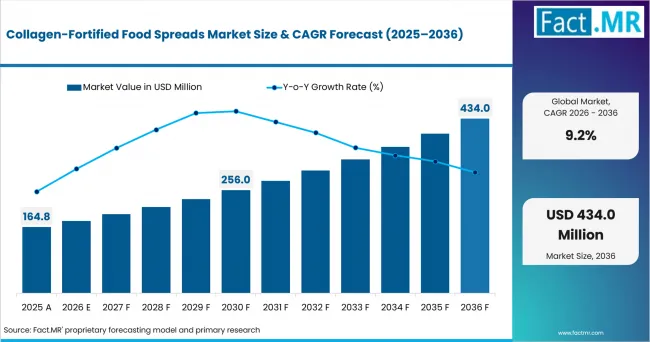
Collagen Fortified Food Spreads Market Value Analysis | Source: Fact.MR
What are the defining numbers behind Collagen-Fortified Food Spreads Market growth?
USD 254 million absolute opportunity by 2036, led by Hydrolysed peptides, Nut & seed spreads and Online/DTC distribution.
- Demand Drivers in the Market
- Wellness food brands need collagen formats that fit normal meals. USDA ERS reported in June 2026 that inflation-adjusted U.S. food expenditures reached USD 2.51 trillion in 2025, expressed in 2025 dollars.
- Product-development teams to favor hydrolysed peptides where formulation trials confirm acceptable dissolution, taste and texture.
- Specialty retailers benefit from clear source and serving information when collagen content is easy to compare on pack.
- DTC operators are expected to prioritize repeatable subscription packs where flavor variety and visible collagen dosage support replenishment.
- Key Segments Analyzed
- By Collagen Type: Hydrolysed peptides are expected to hold 44.0% share in 2026.
- By Spread Base: Nut & seed spreads are projected to account for 34.0% share in 2026 owing to a base that already carries protein and premium wellness cues.
- By Distribution: Online/DTC is anticipated to capture 41.0% share in 2026.
- Analyst Opinion at Fact.MR
- Shambhu Nath Jha, Principal Consultant at Fact.MR, states, “Collagen-fortified spreads occupy the space between everyday food and benefit-led nutrition. Adoption is expected to depend on taste, collagen dose visibility and how naturally the format fits breakfast or snack routines. Suppliers that combine smooth texture, credible source documentation and simple benefit language are expected to earn better brand trials.”
- Strategic Implications
- Food brands should keep the collagen claim close to serving size so shoppers understand the benefit before comparing flavor options.
- Ingredient suppliers should provide dispersion guidance for nut oils and cocoa systems before brands run pilot batches.
- Retail category teams should separate collagen spreads from standard jams when the product carries a clear beauty or protein cue.
- Investors should distinguish spread brands with repeat purchase data from collagen powder extensions that have not proved food-format acceptance.
Australia is estimated to record 10.7% CAGR through 2036, followed by Canada at 10.6%, the United States at 9.5%, the United Kingdom at 9.3%, Germany at 8.8% and Japan at 8.7%.
How does the Collagen-Fortified Food Spreads Market break down by segment?
Hydrolysed peptides are expected to lead Collagen Type at 44.0% share in 2026. Nut & seed spreads are projected to lead Spread Base at 34.0% share in 2026.
Which collagen type dominates?
Hydrolysed peptides are projected to account for 44.0% share in 2026.
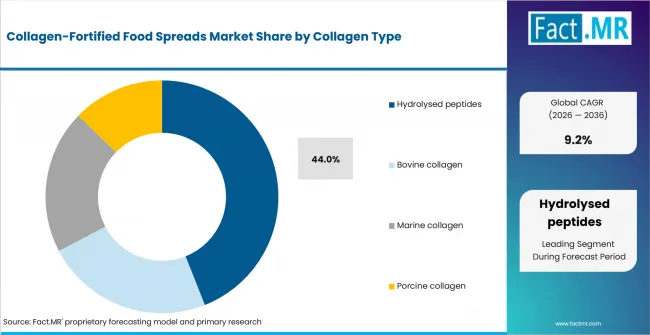
Collagen Fortified Food Spreads Market Analysis By Collagen Type | Source: Fact.MR
Hydrolysed peptides lead the Collagen Type segment because their processed form supports easier formulation across functional food and spread applications. Their 44.0% share reflects strong use where manufacturers need consistent dispersion, serving control and product integration, while maintaining collagen positioning across premium nutrition-focused products and formats.
What leads the Spread Base segment?
Nut & seed spreads are expected to hold 34.0% share in 2026.
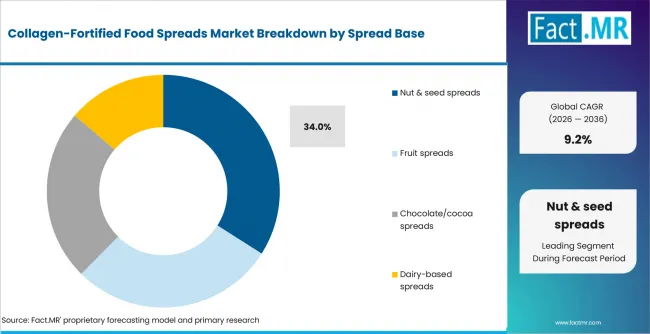
Collagen Fortified Food Spreads Market Analysis By Spread Base | Source: Fact.MR
Nut & seed spreads lead the Spread Base segment because they align with protein-rich and wellness-oriented product positioning. ABS reported in March 2025 that apparent consumption of seed and nut products increased 4.5% to 16.2 grams per capita per day in Australia in 2023-24, supporting broader category relevance.
How does Distribution shape demand?
Online/DTC is anticipated to lead with 41.0% share in 2026.
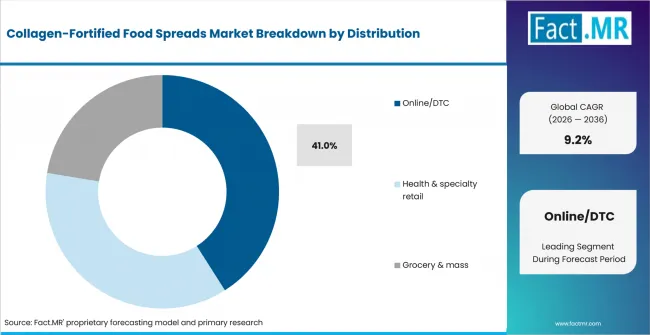
Collagen Fortified Food Spreads Market Analysis By Distribution | Source: Fact.MR
Online/DTC leads the Distribution segment because brand-owned digital channels allow companies to explain collagen source, serving size and product characteristics directly to consumers. These platforms also support targeted education, subscription models and premium positioning, strengthening adoption where buyers seek detailed product information before purchasing functional spread products.
What is accelerating Collagen-Fortified Food Spreads Market adoption, and what is holding it back?
Daily wellness food use is expected to accelerate adoption. Claim and allergen control is anticipated to limit faster scale.
Drivers Impact Analysis
| DRIVER | (~) % IMPACT ON CAGR | GEOGRAPHIC RELEVANCE | IMPACT TIMELINE |
|---|---|---|---|
| Daily collagen routines | +2.5% | USA, Australia, Canada | Short term (<= 2 years) |
| Online product education | +2.0% | USA, UK, Australia | Short term (<= 2 years) |
| Hydrolysed peptide functionality | +1.8% | Global formulation hubs | Medium term (2-4 years) |
| Nut and seed base fit | +1.5% | Australia, USA, Europe | Medium term (2-4 years) |
| Beauty and active nutrition positioning | +1.2% | Japan, Germany, USA | Long term (>= 4 years) |
Source: Fact.MR analysis. Updated Aug 18, 2026
- Daily collagen routines: Consumers are expected to use collagen spreads during breakfast or snacks when the serving size is clear. The format helps brands move collagen from scoop-based use into a normal food routine.
- Online product education: DTC stores explain collagen type and serving size without depending on a shelf tag. Subscription packs are expected to improve repeat visibility once taste and texture are accepted.
- Beauty and active nutrition positioning: Benefit-specific collagen claims are anticipated to support premium food formats. Brand teams still need careful wording so food claims do not read like supplement claims.
Opportunity Impact Analysis
| OPPORTUNITY | (~) % IMPACT ON CAGR | GEOGRAPHIC RELEVANCE | IMPACT TIMELINE |
|---|---|---|---|
| Multi-serve breakfast packs | +1.3% | USA and UK | Medium term (2-4 years) |
| Marine collagen premium lines | +1.0% | Japan and Australia | Medium term (2-4 years) |
| Specialty retail education | +0.9% | Germany and Canada | Short term (<= 2 years) |
| Hybrid protein and collagen claims | +0.7% | USA and Japan | Long term (>= 4 years) |
Source: Fact.MR analysis. Updated Aug 18, 2026
- Multi-serve breakfast packs: Larger jars are expected to fit routine household spread use. Clear serving directions keep the collagen dose visible after trial and support replenishment.
- Hybrid protein and collagen claims: Protein pairing is anticipated to help spreads speak to active nutrition users. Product teams still need a recipe that tastes like a food first.
Restraints Impact Analysis
| RESTRAINT | (~) % IMPACT ON CAGR | GEOGRAPHIC RELEVANCE | IMPACT TIMELINE |
|---|---|---|---|
| Claim substantiation burden | -1.2% | USA, Canada, UK | Short term (<= 2 years) |
| Allergen and label risk | -1.0% | Global grocery channels | Short term (<= 2 years) |
| Taste and texture tradeoff | -0.8% | All spread bases | Medium term (2-4 years) |
| Premium price sensitivity | -0.6% | Mass retail channels | Medium term (2-4 years) |
Source: Fact.MR analysis. Updated Aug 18, 2026
- Claim substantiation burden: Collagen-spread benefit claims require jurisdiction-specific review. In the United States, FDA states that structure/function claims for conventional foods focus on effects derived from nutritive value. In the EU, the EU Register lists a collagen claim concerning maintenance of skin firmness and elasticity as non-authorised.
- Allergen and label risk: Nut and dairy spread bases can contain major food allergens, and fish-derived ingredients require source-specific label review. FDA identifies milk, fish, tree nuts and peanuts among the nine major food allergens in the United States and requires the food source of a major-allergen ingredient to be declared on applicable labels.
- Taste and texture tradeoff: Formulation teams to test mouthfeel as collagen loading changes. No direct external evidence in this report establishes a repeat-purchase effect for collagen-fortified spreads.
Which countries are scaling Collagen-Fortified Food Spreads Market fastest?
- The country comparison spans 2.00 percentage points and forms three practical growth bands across the forecast period.
- Australia remains 0.11 percentage point above Canada through online food sales, wellness positioning and digital product education.
- Canada remains 1.13 percentage points above the United States through e-commerce reach and specialty food retail.
- The United States remains 0.22 percentage point above the United Kingdom through food-spending scale and established retail channels.
- The United Kingdom remains 0.45 percentage point above Germany through online spending growth and health-oriented retail access.
- Germany remains 0.09 percentage point above Japan through retail-market strength and established distribution channels.
- Japan closes the displayed range through e-commerce growth, compact wellness formats and digital product discovery.
Comparable CAGRs can create different entry conditions due to online retail penetration, wellness positioning, food-spending scale and specialty-channel depth. Full report coverage includes North America, Europe, East Asia and Oceania.
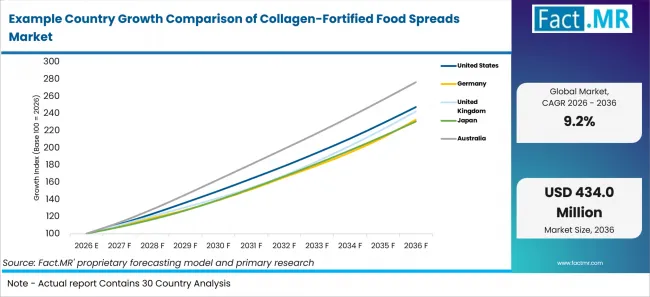
Example Country Growth Comparison Of Collagen Fortified Food Spreads Market | Source: Fact.MR
| Country | CAGR (2026-2036) |
|---|---|
| Australia | 10.7% |
| Canada | 10.6% |
| United States | 9.5% |
| United Kingdom | 9.3% |
| Germany | 8.8% |
| Japan | 8.7% |
Source: Fact.MR analysis. Updated Aug 18, 2026
What supports Australia adoption?
10.7% CAGR, supported by online product education and premium wellness positioning.
Australia’s growth is supported by digital food retail and wellness-oriented product discovery. ABS reported in July 2025 that seasonally adjusted online food sales reached AUD 1,449.9 million in June 2025. Strong online food purchasing activity supports digital product education, premium positioning and easier discovery of collagen-fortified spread formats.
How is Canada scaling demand?
10.6% CAGR, supported by e-commerce reach and specialty food retail.
Canada’s growth reflects strong digital retail access and specialty-channel availability. Statistics Canada reported in May 2026 that seasonally adjusted retail e-commerce sales reached CAD 5.1 billion in March 2026 and represented 7.1% of total retail trade. Expanding e-commerce supports product education and direct access to functional nutrition products.
What supports United States adoption?
9.5% CAGR, supported by food-spending scale and established retail channels.
The United States holds the largest country share in 2026. USDA ERS reported inflation-adjusted U.S. food-at-home expenditures of USD 1.10 trillion in 2025. High household food spending supports a large addressable market for premium spreads, although competition from established spread and collagen-supplement formats may affect commercialization.
How is the United Kingdom developing demand?
9.3% CAGR, supported by online grocery education and health-store curation.
The United Kingdom’s growth reflects expanding online spending and health-oriented retail access. ONS reported in January 2026 that online spending values in Great Britain rose by 8.4% in Quarter 4 2025 compared with Quarter 4 2024. Digital retail growth supports product discovery, health-focused merchandising and wider access to premium functional food formats.
What supports Germany adoption?
8.8% CAGR, supported by label discipline and established retail channels.
Germany’s growth reflects established retail infrastructure and strong attention to product labeling. Destatis reported on February 2, 2026 that German retail turnover in 2025 was 2.7% higher in real terms than in 2024. Improving retail activity supports shelf expansion, specialty product placement and broader consumer access to premium wellness-oriented spreads.
How does Japan perform?
8.7% CAGR, supported by compact wellness formats and online discovery.
Japan’s growth reflects digital commerce expansion and demand for compact wellness-oriented formats. METI reported in August 2025 that Japan’s domestic B-to-C e-commerce market reached JPY 26.1 trillion in 2024, up 5.1% from JPY 24.8 trillion in 2023. Expanding digital commerce supports premium product discovery, while marine collagen remains a relevant positioning route.
Which companies form the relevant provider set for the Collagen-Fortified Food Spreads Market?
American Dream Nut Butter and Nutriversum anchor the profiled provider set, while CIMA-99 Ltd. (TruBalance) and Holidermie broaden the competitive landscape for collagen-fortified food spreads.
American Dream Nut Butter and Nutriversum contribute consumer-facing relevance to the category. CIMA-99 Ltd. (TruBalance) and Holidermie add further participation across wellness-oriented product positioning. Parayil Biofarm Pvt. Ltd. (KILOWATTFIT) completes the competitive field within the identified provider set. The supplied material does not provide enough company-level product evidence to assign more specific capabilities without introducing unsupported claims.
Which companies are the key providers?
Key companies include American Dream Nut Butter, Nutriversum, CIMA-99 Ltd. (TruBalance), Holidermie, Parayil Biofarm Pvt. Ltd. (KILOWATTFIT).
- American Dream Nut Butter
- Nutriversum
- CIMA-99 Ltd. (TruBalance)
- Holidermie
- Parayil Biofarm Pvt. Ltd. (KILOWATTFIT)
Bibliography
- Australian Bureau of Statistics. (2025, March 28). Apparent consumption of selected foodstuffs, Australia, 2023–24 financial year.
- Australian Bureau of Statistics. (2025, July 31). Retail trade, Australia, June 2025.
- Statistisches Bundesamt (Destatis). (2026, February 2). Einzelhandelsumsatz im Jahr 2025 real um 2,7 % höher als im Vorjahr [Retail sales in 2025 up 2.7% in real terms on the previous year].
- Ministry of Economy, Trade and Industry. (2025, August 26). Results of FY2024 E-Commerce Market Survey compiled.
- Office for National Statistics. (2026, January 23). Retail sales, Great Britain: December 2025.
- Statistics Canada. (2026, May 22). Retail trade, March 2026.
This Report Answers
- The report provides strategic intelligence on the Collagen-Fortified Food Spreads Market across Collagen Type and Spread Base choices that shape formulation work.
- Segment analysis covers Hydrolysed peptides and Nut & seed spreads as the share leaders within the 2026 market.
- Country outlook evaluates Australia and Canada alongside the United States and United Kingdom. Germany and Japan complete the growth comparison across the profiled markets.
- Competitive analysis profiles American Dream Nut Butter and Nutriversum alongside CIMA-99 Ltd. (TruBalance) and Holidermie. Parayil Biofarm Pvt. Ltd. (KILOWATTFIT) completes the provider set.
- Distribution assessment covers Online/DTC and Health & specialty retail. Grocery & mass completes the channel view for wider packaged-food placement.
What does the Collagen-Fortified Food Spreads Market cover?
Collagen-fortified food spreads are finished foods that add collagen ingredients to a spread base and present the product as part of a daily eating routine. The market covers functional foods where collagen is built into the jar, tub or chilled pack. Coverage includes health and wellness foods when the collagen claim is part of the finished spread proposition.
The market covers nut, seed, fruit, cocoa and dairy-based spreads when collagen is present in the formulation. Adjacent sweet and savory spreads are included only when the collagen fortification is part of the consumer-facing product. The scope also includes functional snacks only where spread use is central to the product format.
What is included in the scope?
The scope includes collagen-fortified nut, seed, fruit, cocoa and dairy-based spreads sold through online, specialty and grocery channels. Products qualify when collagen source, dose and benefit positioning are tied to the finished spread. Ingredient revenues are included only when they are clearly linked to collagen used in food spread formulations.
What is excluded from the scope?
Standalone collagen powders, capsules, drinks and gummies remain outside the scope unless they are sold with a spread product. General dietary supplements are excluded when they do not function as a spread. Skin care supplements remain adjacent since they explain benefit positioning but do not represent finished food spreads.
Ordinary jams, nut butters and chocolate spreads without collagen fortification are also excluded. Company revenue without a clear link to collagen ingredients or fortified food spreads is outside the scope. Finished beverages and bars are excluded unless they are used only as supporting evidence for collagen positioning.
How Was the Analysis Built?
The analysis draws on 120+ sources, 35+ company portfolios, 25+ countries, and more than 20 industry interviews.
- Primary Research: Primary research includes discussions with manufacturers, service providers, technology developers, distributors, end users, procurement teams, and subject-matter experts. These conversations examine purchasing priorities, product adoption, operational challenges, approval requirements, competitive positioning, and the factors that influence wider market acceptance.
- Desk Research: Desk research covers government statistics, regulatory publications, company filings, trade data, technical studies, industry associations, standards, public policy, and other authoritative sources. Every source used in the analysis is documented in the bibliography.
- Market Sizing and Forecasting: Market estimates combine historical performance, demand indicators, pricing and volume trends, segment shares, company participation, country-level growth, adoption patterns, investment activity, and barriers to market expansion.
- Data Validation and Update Cycle: Findings are validated by comparing primary interviews with public data, company activity, regulatory changes, trade patterns, and industry developments. Regular updates review new product launches, capacity changes, partnerships, approvals, procurement trends, and shifts in commercial adoption.
Segmentation
What is the report’s scope and coverage?
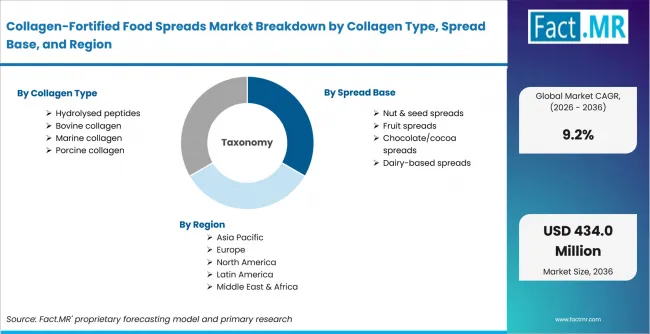
Collagen Fortified Food Spreads Market Breakdown By Collagen Type, Spread Base, And Region | Source: Fact.MR
| Attribute | Details |
|---|---|
| Quantitative Units | USD million |
| Market Definition | Finished food spreads fortified with collagen ingredients where source, dose visibility, taste and label compliance determine commercial acceptance |
| Collagen Type | Hydrolysed peptides; Bovine collagen; Marine collagen; Porcine collagen |
| Spread Base | Nut & seed spreads; Fruit spreads; Chocolate/cocoa spreads; Dairy-based spreads |
| Distribution | Online/DTC; Health & specialty retail; Grocery & mass |
| Regions Covered | North America; Europe; East Asia; Oceania |
| Countries Covered | United States; Germany; United Kingdom; Japan; Australia; Canada |
| Key Companies Profiled | American Dream Nut Butter; Nutriversum; CIMA-99 Ltd. (TruBalance); Holidermie; Parayil Biofarm Pvt. Ltd. (KILOWATTFIT) |
| Forecast Period | 2026 to 2036 |
| Approach | Hybrid top-down and bottom-up approach using food retail data; collagen ingredient relevance; spread-base adoption; channel fit; country adoption patterns; formulation limits; pricing pressure; company portfolio review and source verification |
Source: Fact.MR analysis. Updated Aug 18, 2026
How is the market segmented?
-
By Collagen Type:
- Hydrolysed peptides
- Bovine collagen
- Marine collagen
- Porcine collagen
-
By Spread Base:
- Nut & seed spreads
- Fruit spreads
- Chocolate/cocoa spreads
- Dairy-based spreads
-
By Distribution:
- Online/DTC
- Health & specialty retail
- Grocery & mass
-
By Region:
- North America
- Latin America
- Europe
- East Asia
- South Asia and Oceania
- Middle East and Africa
Frequently Asked Questions
How big is the collagen-fortified food spreads market in 2026?
What is the CAGR of the collagen-fortified food spreads market from 2026 to 2036?
Which collagen type leads the collagen-fortified food spreads market?
Which spread base leads the collagen-fortified food spreads market?
Who are the leading companies in the collagen-fortified food spreads market?
Who worked on this report


Preview the report firsthand - request a free sample
Free SampleGet the brochure for pricing and purchase details
Download PDF