- Base Value(2026): 1.2 Bn
- Estimated Value(2026): 1.2 Bn
- Forecast Value (2036): 2.7 Bn
- CAGR (2026 - 2036): 8.3%
Drought-Resistant Cotton Herbicides Market Forecast and Outlook 2026 to 2036
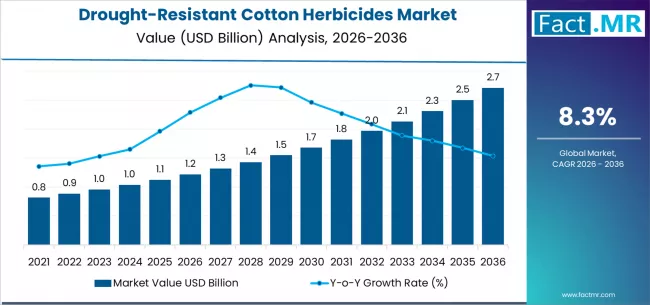
The global market for drought-resistant cotton herbicides is evolving in direct response to the escalating pressures of climate change and water scarcity, projected to expand from USD 1.22 billion in 2026 to USD 2.71 billion by 2036, advancing at an 8.3% CAGR.
Drought Resistant Cotton Herbicides Market Market Value Analysis | Source: Fact.MR
Summary of Drought-Resistant Cotton Herbicides Market
- Market Snapshot
- Global drought-resistant cotton herbicides market revenue stood at USD 1.22 billion in 2026 and is forecast to reach USD 2.71 billion by 2036.
- At aCAGRof 8.3% from 2026 to 2036, this market adds USD 1.49 billion in absolute opportunity, growing ~2.22x in value.
- Growth is underpinned by a fundamental shift in agricultural input strategy where herbicide selection is increasingly tailored to the unique agronomic conditions of water-stressed cotton cultivation.
- The market is transitioning to a precise moisture-management tool, transforming herbicide selection from a standard weed control practice into a foundationalcomponentof climate-resilient cotton production.
- Demand and Growth Drivers
- Increasing adoption of drought-tolerant cotton genetics across major producing regionsnecessitatescomplementary herbicide programs safe on these varieties under stress conditions.
- Expanding water scarcity and regulatory restrictions on irrigation are forcing systemic agronomy changes, elevating the importance of herbicides for soil moisture conservation.
- Economic imperative to protect high-input drought-tolerant cotton yields from weed competition provides strong commercial motivation for effective herbicide investment.
- Development of herbicide tolerance traits stacked with drought-tolerance genes creating integrated seed-chemical systems is a key trend driving demand.
- Precision application technologies including see-and-spray systems being adapted tooptimizeherbicide use in uneven stands of stressed cotton are broadening the precision market.
- Product and Segment View
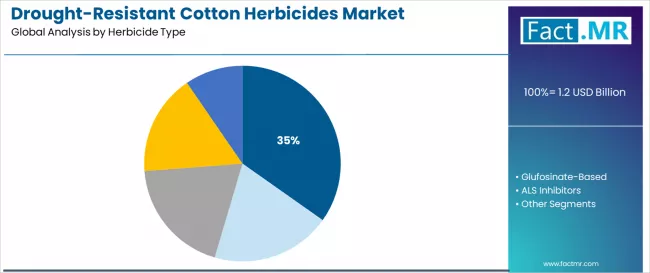
- Glyphosate-based herbicides lead the herbicide type segment with 34.8% share in 2026, sustained by entrenched use with glyphosate-tolerant drought-resistant cotton varieties and conservation tillage compatibility.
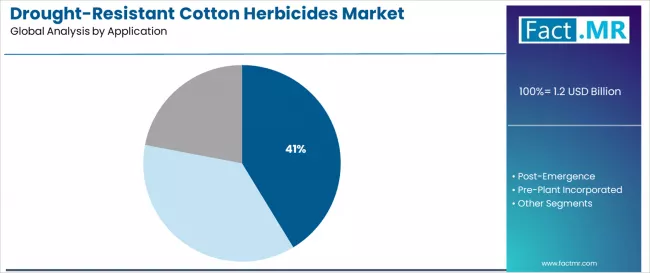
- Pre-emergence application dominates with 41.3% share in 2026, reflecting its strategic importance inestablishinga protective weed-free window during vulnerable early crop establishment.
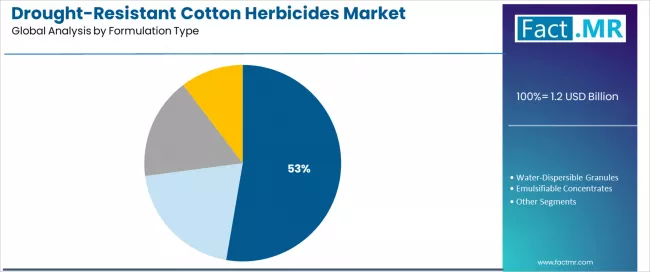
- Liquid concentrates command 52.7% of the formulation type segment in 2026,favoredfor reliability, ease of tank mixing, and consistent performance in high-temperature, low-humidity cotton-growing regions.
- Additionalherbicide types includeGlufosinate-Based, ALS Inhibitors, and PPO Inhibitors; other application timings include Post-Emergence and Pre-Plant Incorporated.
- Geography and Competitive Outlook
- Key growth regions include North America, Latin America, Western Europe, Eastern Europe, East Asia, South Asia & Pacific, and Middle East & Africa.
- India leads country-level growth at 9.4%CAGR, driven by massiverainfedcotton area, erratic monsoon-induced weed pressure, and rapid adoption of herbicide-tolerant varieties by smallholders.
- Brazil (8.9%CAGR)fueledby expanding cotton production into theCerradoregion and intensive soybean-cotton double-cropping systems requiring robustburndownand residual control.
- China (8.7%CAGR) linked to national cotton self-sufficiency strategies in Xinjiang, where large-scale mechanized farming demandshighly reliableherbicide regimens under severe water pressure.
- Australia (7.2%CAGR) characterized by extreme climate variability, demanding sophisticated resistance management strategies and premium pre-emergence chemistries for high-value irrigated crops.
- USA (7.6%CAGR) reflects a mature market focused onoptimizingestablished systems and integrating new modes of action to manage evolving resistance challenges.
- Key companies active in this market include BayerCropScience, BASF SE, Syngenta Group,CortevaAgriscience, andUPLLimited.
Drought-Resistant Cotton Herbicides Market — At a Glance
| Attribute | Details |
| Market Value 2026 | USD 1.22 Billion |
| Market Value 2036 | USD 2.71 Billion |
| Absolute Dollar Opportunity 2026–2036 | USD 1.49 Billion |
| Total Growth 2026–2036 | 122.13% |
| CAGR2026–2036 | 8.3% |
| Growth Multiple | ~2.22x |
| Key Demand Theme | Herbicide programs tailored to water-stressed drought-tolerant cotton systems, prioritizing pre-emergence soil barriers for moisture conservation and multi-mode formulations for resistance management |
| Leading Segment by Herbicide Type (2026) | Glyphosate-Based |
| Herbicide Type Segment Share (2026) | 34.8% |
| Leading Segment by Application (2026) | Pre-Emergence |
| Application Segment Share (2026) | 41.3% |
| Leading Segment by Formulation Type (2026) | Liquid Concentrates |
| Formulation Type Segment Share (2026) | 52.7% |
| Key Growth Regions | North America, Latin America, Western Europe, Eastern Europe, East Asia, South Asia & Pacific, Middle East & Africa |
| CountryCAGRs | India 9.4%, Brazil 8.9%, China 8.7%, USA 7.6%, Australia 7.2% |
| Top Companies | BayerCropScience, BASF SE, Syngenta Group,CortevaAgriscience,UPLLimited |
| Segmentation by Herbicide Type | Glyphosate-Based,Glufosinate-Based, ALS Inhibitors, PPO Inhibitors, Others |
| Segmentation by Application | Pre-Emergence, Post-Emergence, Pre-Plant Incorporated |
| Segmentation by Formulation Type | Liquid Concentrates, Water-Dispersible Granules,EmulsifiableConcentrates, Others |
| Segmentation by Region | North America, Latin America, Western Europe, Eastern Europe, East Asia, South Asia & Pacific, Middle East & Africa |
Source: Fact.MR analysis. Updated Apr 10, 2026
Growth is underpinned by a fundamental shift in agricultural input strategy, where herbicide selection is increasingly tailored to the unique agronomic and physiological conditions of water-stressed cotton cultivation. The market's trajectory is defined by the integration of herbicide programs with drought-tolerant and water-efficient cotton varieties, creating a specialized demand for chemistries that remain effective under limited moisture and higher plant stress. Key trends include the strategic prioritization of soil-applied, pre-emergence herbicides to establish a critical weed-free window during vulnerable early growth stages when irrigation is most restricted. There is a marked focus on developing and promoting herbicide-tolerant trait systems compatible with DT cotton, ensuring crop safety and weed control efficacy when plants are under physiological duress. The need to manage herbicide resistance in weeds that themselves adapt to drier conditions is driving innovation toward multi-site action formulations and robust rotational programs. This market is becoming a critical component of climate-resilient cotton production, where effective weed control directly conserves soil moisture and protects yield potential, transforming herbicide selection from a standard practice into a precise moisture-management tool.
Category
| Category | Segments |
|---|---|
| Herbicide Type | Glyphosate-Based, Glufosinate-Based, ALS Inhibitors, PPO Inhibitors, Others |
| Application | Pre-Emergence, Post-Emergence, Pre-Plant Incorporated |
| Formulation Type | Liquid Concentrates, Water-Dispersible Granules, Emulsifiable Concentrates, Others |
| Region | North America, Latin America, Western Europe, Eastern Europe, East Asia, South Asia & Pacific, MEA |
Source: Fact.MR analysis. Updated Apr 10, 2026
Segmental Analysis
By Herbicide Type, Which Segment Maintains a Foundational Role?
Drought Resistant Cotton Herbicides Market Analysis By Herbicide Type | Source: Fact.MR
Glyphosate-based herbicides hold a leading 34.8% share, sustained by their entrenched use in conjunction with glyphosate-tolerant drought-resistant cotton varieties. Their systemic, broad-spectrum activity provides reliable control of a wide weed spectrum, which is crucial for conserving soil moisture in water-limited systems.
While resistance management pressures the market, its cost-effectiveness and utility in conservation tillage systems, which themselves help retain soil moisture, cement its role as a cornerstone of many drought-area weed control programs, often used in sequenced or mixed applications with other modes of action.
By Application, Which Timing is Most Critical for Moisture Conservation?
Drought Resistant Cotton Herbicides Market Analysis By Application | Source: Fact.MR
Pre-emergence application dominates with a 41.3% share, reflecting its strategic importance in drought-prone regimes. Establishing a protective herbicide barrier at planting is vital to prevent early-season weed competition for scarce water and nutrients.
This approach maximizes the efficiency of limited rainfall or initial irrigation by directing all available moisture to the cotton crop during its critical establishment phase, directly supporting the yield-preservation goal of drought-resistant farming systems. Its leadership underscores a proactive rather than reactive approach to weed management under stress conditions.
By Formulation Type, Which Offers Practical Advantages in Arid Regions?
Drought Resistant Cotton Herbicides Market Analysis By Formulation Type | Source: Fact.MR
Liquid concentrates command a majority 52.7% share, favored for their reliability, ease of tank mixing, and consistent performance in the low-humidity, high-temperature conditions common in cotton-growing arid zones.
These formulations are less prone to drift compared to some dry forms in windy conditions and often offer superior compatibility with the residual herbicides essential for pre-emergence programs. Their widespread use is linked to practical farmer preference and established supply chains in key cotton-producing regions facing water scarcity.
What are the Drivers, Restraints, and Key Trends of the Drought-Resistant Cotton Herbicides Market?
The primary market driver is the increasing adoption of drought-tolerant cotton genetics across major producing regions, which necessitates complementary herbicide programs that are safe on these varieties under stress. Expanding water scarcity and regulatory restrictions on irrigation are forcing a systemic change in agronomy, elevating the importance of herbicides for moisture conservation. The economic imperative to protect high-input DT cotton yields from weed competition provides strong commercial motivation for effective herbicide investment.
A significant market restraint is the evolution of herbicide-resistant weeds, which is accelerated in monoculture systems and can be particularly challenging to manage when crop stress limits the window for effective post-emergence control. The high cost of developing new herbicide modes of action specifically for niche drought conditions limits innovation speed. Variable rainfall patterns can also reduce the activation and efficacy of soil-applied pre-emergence herbicides, leading to control failures and increased costs for remedial applications.
Key trends include the development of herbicide tolerance traits stacked with drought-tolerance genes, creating integrated seed-chemical systems. There is growing emphasis on soil health and moisture retention, driving interest in herbicide programs that support conservation tillage. Precision application technologies, including see-and-spray systems, are being adapted to optimize herbicide use in uneven stands of stressed cotton. Furthermore, biological herbicide alternatives and synergists are being explored for integration into programs to reduce chemical load and manage resistance.
Analysis of the Drought-Resistant Cotton Herbicides Market by Key Countries
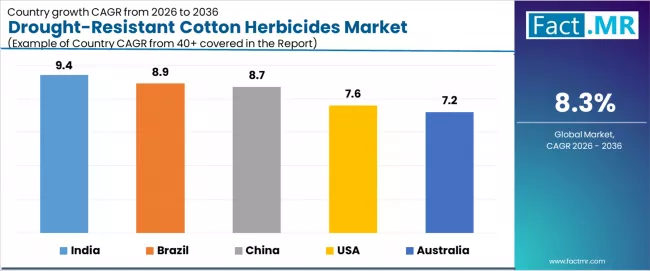
Drought Resistant Cotton Herbicides Market Cagr Analysis By Country | Source: Fact.MR
| Country | CAGR (2026-2036) |
|---|---|
| India | 9.4% |
| Brazil | 8.9% |
| China | 8.7% |
| Australia | 7.2% |
Source: Fact.MR analysis. Updated Apr 10, 2026
How is India's Vast Rainfed Cotton Area and Pest Pressure Driving Demand?
India's leading CAGR of 9.4% is driven by its massive cotton cultivation area, a significant portion of which is under rainfed and moisture-stressed conditions. Reliance on monsoon rains creates intense weed pressure during erratic wet periods, making effective pre-monsoon and early-season herbicide application critical.
The rapid adoption of herbicide-tolerant cotton varieties by Indian farmers, seeking to reduce labor costs and manage weeds with limited water, directly fuels demand for compatible glyphosate and glufosinate-based systems tailored to these challenging environments.
What is the Impact of Brazil's Expanding Agricultural Frontier and Double-Cropping Systems?
Brazil's 8.9% growth is fueled by the expansion of cotton production into the Cerrado region and its integration into intensive soybean-cotton double-cropping systems. This creates a compressed growing window with high weed pressure, where effective, rapid burndown and residual control are essential.
Drought periods within the cotton season necessitate robust herbicide programs that can perform under heat and moisture stress. Brazilian farmers are early adopters of integrated trait and chemical systems, demanding high-efficacy solutions to protect yield and fiber quality in a competitive export market.
Why is China's Focus on Yield Stability and Domestic Production Influencing the Market?
China's 8.7% CAGR is linked to national strategies for cotton self-sufficiency and yield stabilization in regions like Xinjiang, where water resources are under severe pressure. Large-scale, mechanized farming demands highly reliable herbicide regimens.
Government support for agricultural modernization and high-yielding practices encourages investment in premium chemical solutions that maximize output per unit of water. The market is characterized by demand for advanced formulation technologies that enhance efficacy and reduce environmental impact in these sensitive ecosystems.
How are Australia's Extreme Climate and High-Value Production Shaping Product Needs?
Australia's 7.2% growth occurs within a context of extreme climate variability and high-production-cost farming. Australian cotton growers, often facing severe drought, require herbicide programs with exceptional reliability and crop safety to protect their high-value, irrigated crops.
The market demands sophisticated resistance management strategies and premium pre-emergence chemistries that offer long-lasting residual control, making every irrigation event count. This environment fosters demand for the most advanced and scientifically supported products available.
What is the Role of the USA's Mature Market and Advanced Trait Systems?
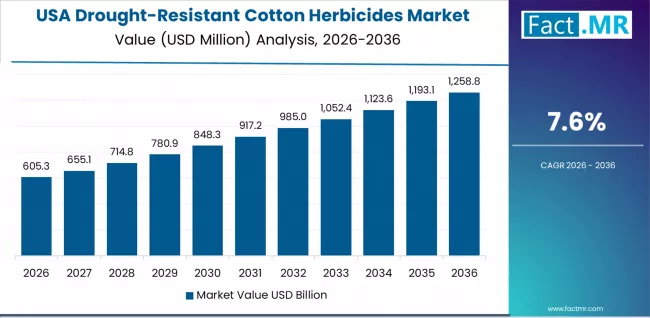
Drought Resistant Cotton Herbicides Market Country Value Analysis | Source: Fact.MR
The USA's 7.6% CAGR reflects a mature market focused on optimizing established systems. US growers leverage advanced DT cotton traits and have access to a wide herbicide portfolio. Growth is driven by the need to fine-tune herbicide programs for evolving resistance challenges and to integrate new chemistries into conservation-based production systems that build soil organic matter for better water retention. The demand is for precision, data-driven application and novel modes of action to preserve the utility of existing tools.
Competitive Landscape of the Drought-Resistant Cotton Herbicides Market
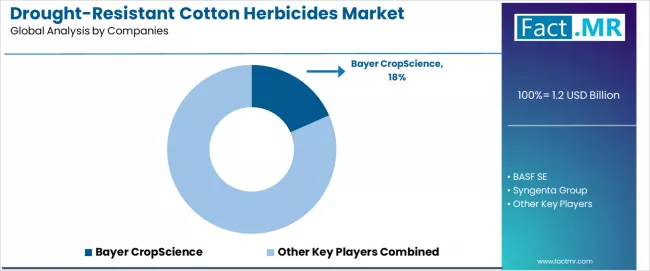
Drought Resistant Cotton Herbicides Market Analysis By Company | Source: Fact.MR
Global agrochemical giants with integrated seed and trait platforms, competing directly with large, diversified crop protection companies, dominate the competitive landscape. Competition hinges on the ability to offer complete, agronomically validated herbicide systems specifically tested and promoted for drought-tolerant cotton varieties.
Success depends on robust field trial data generated under water-stressed conditions, deep technical support for growers, and strategic pricing to secure adoption in cost-sensitive markets. Companies are also competing to develop digital agronomy tools that recommend optimized herbicide timing and mixtures based on local soil moisture forecasts and weed pressure models.
Key Players in the Drought-Resistant Cotton Herbicides Market
- Bayer CropScience
- BASF SE
- Syngenta Group
- Corteva Agriscience
- UPL Limited
References
- Berger, S. T., & Ferrell, J. A. (2023). Weed management in cotton under water-limited conditions. Weed Technology, 37(4), 345-352.
- Ganie, Z. A., & Jhala, A. J. (2024). Interaction of drought stress and herbicide efficacy: A review. Agronomy for Sustainable Development, 44(2), 25.
- Heap, I. (2024). The international survey of herbicide resistant weeds. Science Direct.
- Korres, N. E., & Norsworthy, J. K. (2023). Cotton weed management: Current status and future directions. Outlooks on Pest Management, 34(5), 195-201.
- Mohan, A., & Singh, V. P. (2024). Herbicide use patterns and resistance evolution in rainfed cotton systems of India. Crop Protection, 175, 106478.
- Reddy, K. N., & Nandula, V. K. (2023). Herbicide-resistant weeds in cotton: Mechanisms and management. In Herbicide Resistance in Weeds and Crops (pp. 155-172). IntechOpen.
- Stoller, J., & Wax, L. M. (2024). The role of soil-applied herbicides in conservation systems for moisture retention. Journal of Soil and Water Conservation, 79(1), 45-51.
- Ulber, L., & Zwerger, P. (2023). Integrated weed management in drought-sensitive crops: Principles and practices. Journal of Plant Diseases and Protection, 130(3), 541-553.
- Zhang, C., & Li, X. (2024). Efficacy of pre-emergence herbicides under different soil moisture regimes in cotton. Weed Research, 64(2), 112-123.
- Zhao, D., & Oosterhuis, D. M. (2023). Physiological responses of cotton to drought stress and implications for management. Field Crops Research, 291, 108792.
Segmentation
Scope of Report
| Items | Values |
|---|---|
| Quantitative Units | USD Billion |
| Herbicide Type | Glyphosate-Based, Glufosinate-Based, ALS Inhibitors, PPO Inhibitors, Others |
| Application | Pre-Emergence, Post-Emergence, Pre-Plant Incorporated |
| Formulation Type | Liquid Concentrates, Water-Dispersible Granules, Emulsifiable Concentrates, Others |
| Key Countries | India, Brazil, China, Australia, USA |
| Key Companies | Bayer CropScience, BASF SE, Syngenta Group, Corteva Agriscience, UPL Limited |
| Additional Analysis | Agronomic interaction between DT cotton traits and herbicide physiology; efficacy of residual herbicides under low soil moisture; resistance evolution in weeds under drought stress; economic threshold models for weed control in water-limited systems; lifecycle analysis of herbicide use in arid zone cotton production. |
Source: Fact.MR analysis. Updated Apr 10, 2026
Market by Segments
-
Herbicide Type :
- Glyphosate-Based
- Glufosinate-Based
- ALS Inhibitors
- PPO Inhibitors
- Others
-
Application :
- Pre-Emergence
- Post-Emergence
- Pre-Plant Incorporated
-
Formulation Type :
- Liquid Concentrates
- Water-Dispersible Granules
- Emulsifiable Concentrates
- Others
-
Region :
- North America
- USA
- Canada
- Latin America
- Brazil
- Mexico
- Argentina
- Rest of Latin America
- Western Europe
- Germany
- UK
- France
- Spain
- Italy
- BENELUX
- Rest of Western Europe
- Eastern Europe
- Russia
- Poland
- Czech Republic
- Rest of Eastern Europe
- East Asia
- China
- Japan
- South Korea
- Rest of East Asia
- South Asia & Pacific
- India
- ASEAN
- Australia
- Rest of South Asia & Pacific
- MEA
- Saudi Arabia
- UAE
- Turkiye
- Rest of MEA
- North America
Frequently Asked Questions
How big is the drought-resistant cotton herbicides market in 2026?
What will be the size of drought-resistant cotton herbicides market in 2036?
How much will be the drought-resistant cotton herbicides market growth between 2026 and 2036?
What are the key product types in the drought-resistant cotton herbicides market?
Which application segment to contribute significant share in the drought-resistant cotton herbicides market in 2026?
Who worked on this report


Preview the report firsthand - request a free sample
Free SampleGet the brochure for pricing and purchase details
Download PDF