Moisture-Triggered Herbicide Microgranule Market
Moisture-Triggered Herbicide Microgranule Market Size and Share Forecast Outlook 2026 to 2036
Moisture-triggered herbicide microgranule market is projected to grow from USD 0.3 billion in 2026 to USD 1.2 billion by 2036, at a CAGR of 15.3%. Moisture-Activated Polymer-Coated Granules will dominate with a 38.0% market share, while residual & pre-emergent herbicides will lead the herbicide mode of action segment with a 42.0% share.
Moisture-Triggered Herbicide Microgranule Market Forecast and Outlook 2026 to 2036
The global moisture-triggered herbicide microgranule market is projected to reach USD 1.16 billion by 2036. The market is valued at USD 0.28 billion in 2026 and is set to rise at a CAGR of 15.3% during the assessment period. By microgranule technology type, moisture-activated polymer-coated granules hold a leading 38% share. The residual & pre-emergent herbicide mode of action segment represents a dominant 42% share, while row crops account for 49% market share.
Key Takeaways from the Moisture-Triggered Herbicide Microgranule Market
- Market Value for 2026: USD 0.28 Billion
- Market Value for 2036: USD 1.16 Billion
- Forecast CAGR (2026-2036): 15.3%
- Leading Microgranule Technology Type Share (2026): Moisture-Activated Polymer-Coated Granules (38%)
- Leading Herbicide Mode of Action Share (2026): Residual & Pre-Emergent Herbicides (42%)
- Leading Crop Type Share (2026): Row Crops (49%)
- Key Players in the Market: FMC Corporation, Nufarm Limited, Albaugh LLC, Gowan Company, Sipcam Oxon
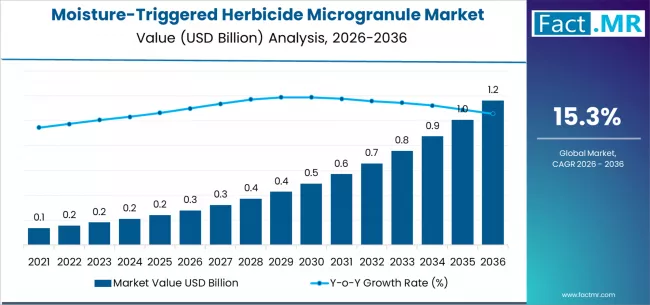
A defining trend is the optimization of microgranule dissolution profiles to match specific rainfall patterns and soil moisture conditions, ensuring herbicide activation coincides with weed seed germination. Research focuses on bio-based and fully biodegradable shell materials to eliminate environmental persistence. Integration with variable-rate application technology allows for prescription mapping of microgranules based on soil texture and weed pressure zones.
Regulatory frameworks favor these systems due to their inherent reduction in herbicide leaching and volatilization compared to liquid formulations. Policies aimed at protecting water quality and minimizing non-target drift create a positive pathway for microgranule registration. Their precise, condition-dependent release mechanism aligns with goals for reduced environmental loading and enhanced applicator safety.
Moisture-Triggered Herbicide Microgranule Market
| Metric | Value |
|---|---|
| Market Value (2026) | USD 0.28 Billion |
| Market Forecast Value (2036) | USD 1.16 Billion |
| Forecast CAGR (2026-2036) | 15.3% |
Category
| Category | Segments |
|---|---|
| Microgranule Technology Type | Moisture-Activated Polymer-Coated Granules, Clay-Matrix Swell-Release Granules, Biodegradable Starch-Based Microgranules, Wax-Encapsulated Delayed-Release Granules, Others |
| Herbicide Mode of Action | Residual & Pre-Emergent Herbicides, Cell Division Inhibitors, Photosynthesis Inhibitors, Amino Acid Synthesis Inhibitors, Others |
| Crop Type | Row Crops (Corn, Soybean, Cotton), Cereals & Grains, Plantation & Industrial Crops, Horticulture & Specialty Crops, Others |
| Region | North America, Latin America, Western Europe, Eastern Europe, East Asia, South Asia & Pacific, MEA |
Segmental Analysis
By Microgranule Technology, Which System Offers the Most Reliable Release Mechanism?
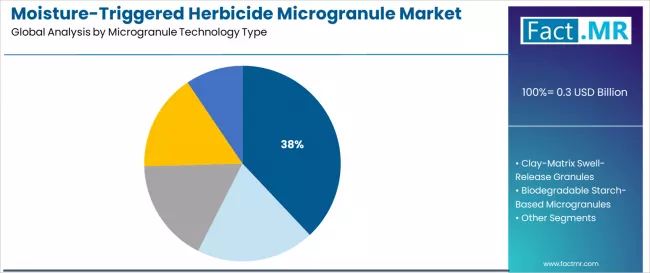
Moisture-activated polymer-coated granules lead the segment with a 38% share. This dominance is attributed to the precise engineering of polymer coatings that hydrolyze or swell at a specific moisture threshold. This technology provides a dependable, rainfast delivery system that prevents premature herbicide release from dew or light showers, ensuring the chemical remains protected until a genuine germination-triggering rainfall occurs.
By Herbicide Mode of Action, Which Chemistry Most Benefits from Timed Release?
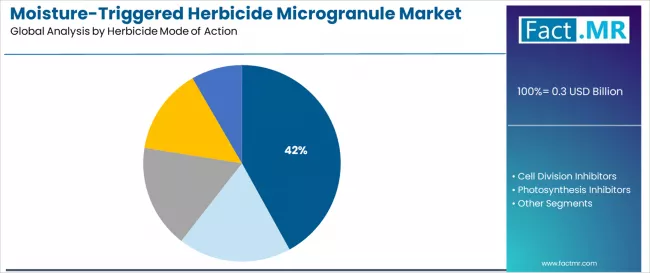
Residual and pre-emergent herbicides hold the largest share at 42%. These herbicides require precise placement and timing in the weed seed germination zone to be effective. Moisture-triggered microgranules solve a key weakness of traditional applications by preventing herbicide degradation on the soil surface and instead releasing the active ingredient directly into the soil moisture column coinciding with weed emergence.
By Crop Type, Where is the Agronomic Practice of Pre-Emergence Control Most Critical?
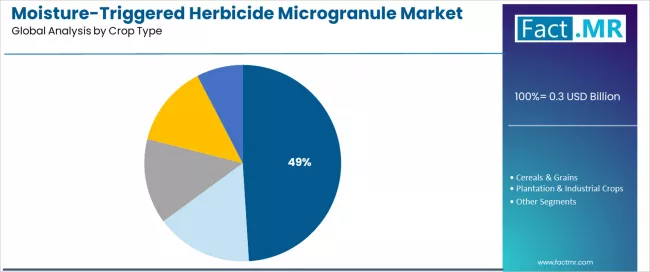
Row crops command a 49% share. The wide row spacing and high value of crops like corn, soybean, and cotton make early-season weed control absolutely essential for yield protection. The practice of applying pre-emergent herbicides at planting is standard, and microgranules offer a superior method by safeguarding the herbicide from volatility and photodegradation until activated by rain, providing longer-lasting, more reliable control.
What are the Drivers, Restraints, and Key Trends of the Moisture-Triggered Herbicide Microgranule Market?
Market growth is driven by the need to improve the reliability and longevity of pre-emergent weed control in unpredictable rainfall environments. These granules significantly reduce herbicide losses from volatility and UV degradation, enhancing efficiency and stewardship. The rise of herbicide-resistant weeds necessitates optimizing the performance of remaining effective soil-active chemistries, which these delivery systems facilitate.
A primary restraint is the higher cost per unit area compared to standard liquid or dry flowable formulations. The performance is inherently linked to adequate rainfall, which can lead to variable results in arid regions or during droughty springs. Grower familiarity with and access to specialized application equipment for granular products can also slow initial adoption.
Key trends include the coupling of herbicide microgranules with fertilizer or safener granules in multifunctional blends. Development is progressing towards region-specific formulations tuned to local average rainfall patterns. Integration with weather forecast data and smart sprayers to adjust application rates in real-time represents the next frontier in precision deployment.
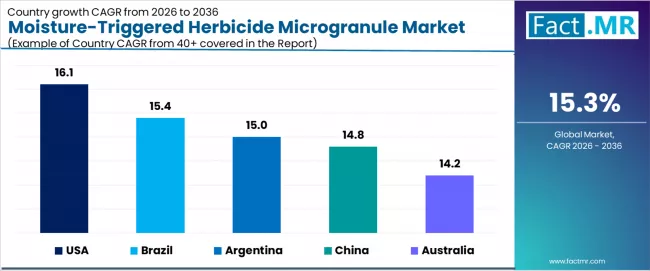
Analysis of the Moisture-Triggered Herbicide Microgranule Market by Key Countries
| Country | CAGR (2026-2036) |
|---|---|
| USA | 16.10% |
| Brazil | 15.40% |
| Argentina | 15.00% |
| China | 14.80% |
| Australia | 14.20% |
How does the USA's Reliance on Pre-Emergent Weed Control Fuel Adoption?
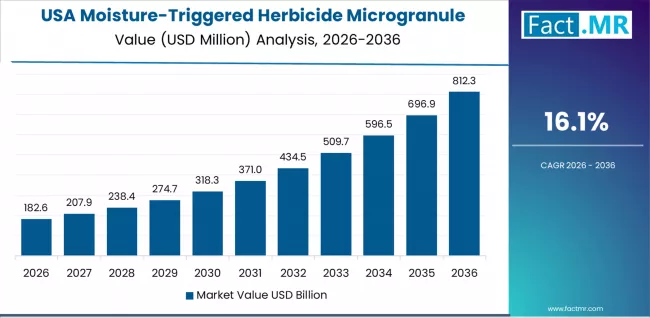
The USA leads with a 16.10% CAGR, driven by the complete dependence on residual herbicides for managing resistant weeds in corn and soybean systems. The volatility challenges of herbicides like dicamba and S-metolachlor make moisture-activated granular forms an attractive, low-volatility solution. American farmers value the extended window of control and reduced dependency on a perfect post-planting rain for activation that liquid formulations require.
Why is Brazil's Tropical Climate Ideal for Moisture-Triggered Technology?
Brazil's 15.40% growth is propelled by its predictable rainy seasons following soybean and cotton planting. This climate allows for reliable activation of the microgranules. The technology is particularly valuable for managing tough weeds in no-till systems, where granules settle better into crop residue than sprays. The scale of farming makes the efficiency gains and reduced chemical loss highly cost-effective.
What Role Does Argentina's Variable Pampas Climate Play in Market Growth?
Argentina's 15.00% CAGR is linked to the variable spring rainfall in its core cropping region. Farmers face the dilemma of applying pre-emergents that may wash away or fail to activate. Moisture-triggered granules mitigate this risk by remaining stable until sufficient soil moisture is present. This reliability is crucial for protecting yield potential in high-value crops like soybeans and corn grown for export.
How is China's Drive for Efficiency and Safety Shaping Market Development?
China's 14.80% growth aligns with national mandates to increase pesticide utilization efficiency and reduce operator exposure. Microgranules minimize drift and dermal contact during handling and application. As Chinese agriculture consolidates into larger farms, the adoption of precision granular applicators that can place these products effectively is increasing, supporting the technology's integration.
What Factors Underpin Adoption in Australia's Drought-Prone Systems?
Australia's 14.20% growth is notable given its arid climate. The driver is the need for ultra-efficient water use. In seasons with planting rains, moisture-triggered granules ensure no herbicide is wasted to evaporation. Their use is strategic in regions with sporadic summer storms, providing weed control only when conditions are right for germination, which aligns with a conservative, risk-averse approach to input use.
Competitive Landscape of the Moisture-Triggered Herbicide Microgranule Market
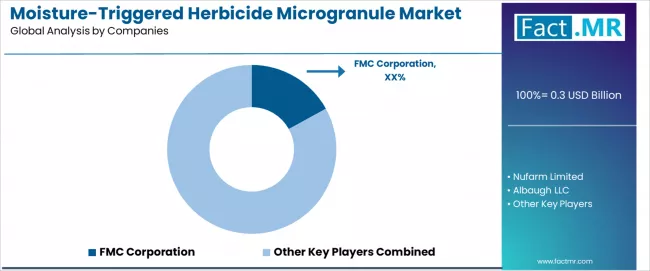
The market features competition between multinational agrochemical firms and strong regional specialists. Global players like FMC Corporation compete by developing proprietary encapsulation technologies for their herbicide portfolios, offering a differentiated, value-added formulation. Regional leaders such as Nufarm Limited, Albaugh LLC, and Gowan Company compete through deep understanding of local weed spectra, climate patterns, and grower economics, often producing tailored microgranule products.
Specialty firms like Sipcam Oxon provide niche technology and formulation expertise. Competition hinges on the reliability of the release mechanism, consistency of granule size for accurate application, and successful formulation of challenging active ingredients. Establishing a robust supply chain for granular application equipment and providing clear agronomic support for optimal use are critical for market penetration.
Key Players in the Moisture-Triggered Herbicide Microgranule Market
- FMC Corporation
- Nufarm Limited
- Albaugh LLC
- Gowan Company
- Sipcam Oxon
Scope of Report
| Items | Values |
|---|---|
| Quantitative Units | USD Billion |
| Microgranule Technology Type | Moisture-Activated Polymer-Coated Granules, Clay-Matrix Swell-Release Granules, Biodegradable Starch-Based Microgranules, Wax-Encapsulated Delayed-Release Granules, Others |
| Herbicide Mode of Action | Residual & Pre-Emergent Herbicides, Cell Division Inhibitors, Photosynthesis Inhibitors, Amino Acid Synthesis Inhibitors, Others |
| Crop Type | Row Crops (Corn, Soybean, Cotton), Cereals & Grains, Plantation & Industrial Crops, Horticulture & Specialty Crops, Others |
| Key Countries | USA, Brazil, Argentina, China, Australia |
| Key Companies | FMC Corporation, Nufarm Limited, Albaugh LLC, Gowan Company, Sipcam Oxon |
| Additional Analysis | Analysis of soil moisture release kinetics, herbicide efficacy under different rainfall scenarios, application equipment calibration data, environmental fate compared to sprayable formulations, and economic models for variable-rate application. |
Moisture-Triggered Herbicide Microgranule Market by Segments
-
Microgranule Technology Type :
- Moisture-Activated Polymer-Coated Granules
- Clay-Matrix Swell-Release Granules
- Biodegradable Starch-Based Microgranules
- Wax-Encapsulated Delayed-Release Granules
- Others
-
Herbicide Mode of Action :
- Residual & Pre-Emergent Herbicides
- Cell Division Inhibitors
- Photosynthesis Inhibitors
- Amino Acid Synthesis Inhibitors
- Others
-
Crop Type :
- Row Crops (Corn, Soybean, Cotton)
- Cereals & Grains
- Plantation & Industrial Crops
- Horticulture & Specialty Crops
- Others
-
Region :
-
North America
- USA
- Canada
-
Latin America
- Brazil
- Mexico
- Argentina
- Rest of Latin America
-
Western Europe
- Germany
- UK
- France
- Spain
- Italy
- BENELUX
- Rest of Western Europe
-
Eastern Europe
- Czech Republic
- Poland
- Russia
- Rest of Eastern Europe
-
East Asia
- China
- Japan
- South Korea
- Rest of East Asia
-
South Asia & Pacific
- India
- Indonesia
- Australia
- Rest of South Asia & Pacific
-
MEA
- GCC Countries
- Turkiye
- Saudi Arabia
- Rest of MEA
-
Table of Content
- Executive Summary
- Global Market Outlook
- Demand to side Trends
- Supply to side Trends
- Technology Roadmap Analysis
- Analysis and Recommendations
- Market Overview
- Market Coverage / Taxonomy
- Market Definition / Scope / Limitations
- Market Background
- Market Dynamics
- Drivers
- Restraints
- Opportunity
- Trends
- Scenario Forecast
- Demand in Optimistic Scenario
- Demand in Likely Scenario
- Demand in Conservative Scenario
- Opportunity Map Analysis
- Product Life Cycle Analysis
- Supply Chain Analysis
- Investment Feasibility Matrix
- Value Chain Analysis
- PESTLE and Porter’s Analysis
- Regulatory Landscape
- Regional Parent Market Outlook
- Production and Consumption Statistics
- Import and Export Statistics
- Market Dynamics
- Global Market Analysis 2021 to 2025 and Forecast, 2026 to 2036
- Historical Market Size Value (USD Million) Analysis, 2021 to 2025
- Current and Future Market Size Value (USD Million) Projections, 2026 to 2036
- Y to o to Y Growth Trend Analysis
- Absolute $ Opportunity Analysis
- Global Market Pricing Analysis 2021 to 2025 and Forecast 2026 to 2036
- Global Market Analysis 2021 to 2025 and Forecast 2026 to 2036, By Microgranule Technology Type
- Introduction / Key Findings
- Historical Market Size Value (USD Million) Analysis By Microgranule Technology Type, 2021 to 2025
- Current and Future Market Size Value (USD Million) Analysis and Forecast By Microgranule Technology Type, 2026 to 2036
- Moisture-Activated Polymer-Coated Granules
- Clay-Matrix Swell-Release Granules
- Biodegradable Starch-Based Microgranules
- Wax-Encapsulated Delayed-Release Granules
- Others
- Moisture-Activated Polymer-Coated Granules
- Y to o to Y Growth Trend Analysis By Microgranule Technology Type, 2021 to 2025
- Absolute $ Opportunity Analysis By Microgranule Technology Type, 2026 to 2036
- Global Market Analysis 2021 to 2025 and Forecast 2026 to 2036, By Herbicide Mode of Action
- Introduction / Key Findings
- Historical Market Size Value (USD Million) Analysis By Herbicide Mode of Action, 2021 to 2025
- Current and Future Market Size Value (USD Million) Analysis and Forecast By Herbicide Mode of Action, 2026 to 2036
- Residual & Pre-Emergent Herbicides
- Cell Division Inhibitors
- Photosynthesis Inhibitors
- Amino Acid Synthesis Inhibitors
- Others
- Residual & Pre-Emergent Herbicides
- Y to o to Y Growth Trend Analysis By Herbicide Mode of Action, 2021 to 2025
- Absolute $ Opportunity Analysis By Herbicide Mode of Action, 2026 to 2036
- Global Market Analysis 2021 to 2025 and Forecast 2026 to 2036, By Crop Type
- Introduction / Key Findings
- Historical Market Size Value (USD Million) Analysis By Crop Type, 2021 to 2025
- Current and Future Market Size Value (USD Million) Analysis and Forecast By Crop Type, 2026 to 2036
- Row Crops (Corn, Soybean, Cotton)
- Cereals & Grains
- Plantation & Industrial Crops
- Horticulture & Specialty Crops
- Others
- Row Crops (Corn, Soybean, Cotton)
- Y to o to Y Growth Trend Analysis By Crop Type, 2021 to 2025
- Absolute $ Opportunity Analysis By Crop Type, 2026 to 2036
- Global Market Analysis 2021 to 2025 and Forecast 2026 to 2036, By Region
- Introduction
- Historical Market Size Value (USD Million) Analysis By Region, 2021 to 2025
- Current Market Size Value (USD Million) Analysis and Forecast By Region, 2026 to 2036
- North America
- Latin America
- Western Europe
- Eastern Europe
- East Asia
- South Asia and Pacific
- Middle East & Africa
- Market Attractiveness Analysis By Region
- North America Market Analysis 2021 to 2025 and Forecast 2026 to 2036, By Country
- Historical Market Size Value (USD Million) Trend Analysis By Market Taxonomy, 2021 to 2025
- Market Size Value (USD Million) Forecast By Market Taxonomy, 2026 to 2036
- By Country
- USA
- Canada
- Mexico
- By Microgranule Technology Type
- By Herbicide Mode of Action
- By Crop Type
- By Country
- Market Attractiveness Analysis
- By Country
- By Microgranule Technology Type
- By Herbicide Mode of Action
- By Crop Type
- Key Takeaways
- Latin America Market Analysis 2021 to 2025 and Forecast 2026 to 2036, By Country
- Historical Market Size Value (USD Million) Trend Analysis By Market Taxonomy, 2021 to 2025
- Market Size Value (USD Million) Forecast By Market Taxonomy, 2026 to 2036
- By Country
- Brazil
- Chile
- Rest of Latin America
- By Microgranule Technology Type
- By Herbicide Mode of Action
- By Crop Type
- By Country
- Market Attractiveness Analysis
- By Country
- By Microgranule Technology Type
- By Herbicide Mode of Action
- By Crop Type
- Key Takeaways
- Western Europe Market Analysis 2021 to 2025 and Forecast 2026 to 2036, By Country
- Historical Market Size Value (USD Million) Trend Analysis By Market Taxonomy, 2021 to 2025
- Market Size Value (USD Million) Forecast By Market Taxonomy, 2026 to 2036
- By Country
- Germany
- UK
- Italy
- Spain
- France
- Nordic
- BENELUX
- Rest of Western Europe
- By Microgranule Technology Type
- By Herbicide Mode of Action
- By Crop Type
- By Country
- Market Attractiveness Analysis
- By Country
- By Microgranule Technology Type
- By Herbicide Mode of Action
- By Crop Type
- Key Takeaways
- Eastern Europe Market Analysis 2021 to 2025 and Forecast 2026 to 2036, By Country
- Historical Market Size Value (USD Million) Trend Analysis By Market Taxonomy, 2021 to 2025
- Market Size Value (USD Million) Forecast By Market Taxonomy, 2026 to 2036
- By Country
- Russia
- Poland
- Hungary
- Balkan & Baltic
- Rest of Eastern Europe
- By Microgranule Technology Type
- By Herbicide Mode of Action
- By Crop Type
- By Country
- Market Attractiveness Analysis
- By Country
- By Microgranule Technology Type
- By Herbicide Mode of Action
- By Crop Type
- Key Takeaways
- East Asia Market Analysis 2021 to 2025 and Forecast 2026 to 2036, By Country
- Historical Market Size Value (USD Million) Trend Analysis By Market Taxonomy, 2021 to 2025
- Market Size Value (USD Million) Forecast By Market Taxonomy, 2026 to 2036
- By Country
- China
- Japan
- South Korea
- By Microgranule Technology Type
- By Herbicide Mode of Action
- By Crop Type
- By Country
- Market Attractiveness Analysis
- By Country
- By Microgranule Technology Type
- By Herbicide Mode of Action
- By Crop Type
- Key Takeaways
- South Asia and Pacific Market Analysis 2021 to 2025 and Forecast 2026 to 2036, By Country
- Historical Market Size Value (USD Million) Trend Analysis By Market Taxonomy, 2021 to 2025
- Market Size Value (USD Million) Forecast By Market Taxonomy, 2026 to 2036
- By Country
- India
- ASEAN
- Australia & New Zealand
- Rest of South Asia and Pacific
- By Microgranule Technology Type
- By Herbicide Mode of Action
- By Crop Type
- By Country
- Market Attractiveness Analysis
- By Country
- By Microgranule Technology Type
- By Herbicide Mode of Action
- By Crop Type
- Key Takeaways
- Middle East & Africa Market Analysis 2021 to 2025 and Forecast 2026 to 2036, By Country
- Historical Market Size Value (USD Million) Trend Analysis By Market Taxonomy, 2021 to 2025
- Market Size Value (USD Million) Forecast By Market Taxonomy, 2026 to 2036
- By Country
- Kingdom of Saudi Arabia
- Other GCC Countries
- Turkiye
- South Africa
- Other African Union
- Rest of Middle East & Africa
- By Microgranule Technology Type
- By Herbicide Mode of Action
- By Crop Type
- By Country
- Market Attractiveness Analysis
- By Country
- By Microgranule Technology Type
- By Herbicide Mode of Action
- By Crop Type
- Key Takeaways
- Key Countries Market Analysis
- USA
- Pricing Analysis
- Market Share Analysis, 2025
- By Microgranule Technology Type
- By Herbicide Mode of Action
- By Crop Type
- Canada
- Pricing Analysis
- Market Share Analysis, 2025
- By Microgranule Technology Type
- By Herbicide Mode of Action
- By Crop Type
- Mexico
- Pricing Analysis
- Market Share Analysis, 2025
- By Microgranule Technology Type
- By Herbicide Mode of Action
- By Crop Type
- Brazil
- Pricing Analysis
- Market Share Analysis, 2025
- By Microgranule Technology Type
- By Herbicide Mode of Action
- By Crop Type
- Chile
- Pricing Analysis
- Market Share Analysis, 2025
- By Microgranule Technology Type
- By Herbicide Mode of Action
- By Crop Type
- Germany
- Pricing Analysis
- Market Share Analysis, 2025
- By Microgranule Technology Type
- By Herbicide Mode of Action
- By Crop Type
- UK
- Pricing Analysis
- Market Share Analysis, 2025
- By Microgranule Technology Type
- By Herbicide Mode of Action
- By Crop Type
- Italy
- Pricing Analysis
- Market Share Analysis, 2025
- By Microgranule Technology Type
- By Herbicide Mode of Action
- By Crop Type
- Spain
- Pricing Analysis
- Market Share Analysis, 2025
- By Microgranule Technology Type
- By Herbicide Mode of Action
- By Crop Type
- France
- Pricing Analysis
- Market Share Analysis, 2025
- By Microgranule Technology Type
- By Herbicide Mode of Action
- By Crop Type
- India
- Pricing Analysis
- Market Share Analysis, 2025
- By Microgranule Technology Type
- By Herbicide Mode of Action
- By Crop Type
- ASEAN
- Pricing Analysis
- Market Share Analysis, 2025
- By Microgranule Technology Type
- By Herbicide Mode of Action
- By Crop Type
- Australia & New Zealand
- Pricing Analysis
- Market Share Analysis, 2025
- By Microgranule Technology Type
- By Herbicide Mode of Action
- By Crop Type
- China
- Pricing Analysis
- Market Share Analysis, 2025
- By Microgranule Technology Type
- By Herbicide Mode of Action
- By Crop Type
- Japan
- Pricing Analysis
- Market Share Analysis, 2025
- By Microgranule Technology Type
- By Herbicide Mode of Action
- By Crop Type
- South Korea
- Pricing Analysis
- Market Share Analysis, 2025
- By Microgranule Technology Type
- By Herbicide Mode of Action
- By Crop Type
- Russia
- Pricing Analysis
- Market Share Analysis, 2025
- By Microgranule Technology Type
- By Herbicide Mode of Action
- By Crop Type
- Poland
- Pricing Analysis
- Market Share Analysis, 2025
- By Microgranule Technology Type
- By Herbicide Mode of Action
- By Crop Type
- Hungary
- Pricing Analysis
- Market Share Analysis, 2025
- By Microgranule Technology Type
- By Herbicide Mode of Action
- By Crop Type
- Kingdom of Saudi Arabia
- Pricing Analysis
- Market Share Analysis, 2025
- By Microgranule Technology Type
- By Herbicide Mode of Action
- By Crop Type
- Turkiye
- Pricing Analysis
- Market Share Analysis, 2025
- By Microgranule Technology Type
- By Herbicide Mode of Action
- By Crop Type
- South Africa
- Pricing Analysis
- Market Share Analysis, 2025
- By Microgranule Technology Type
- By Herbicide Mode of Action
- By Crop Type
- USA
- Market Structure Analysis
- Competition Dashboard
- Competition Benchmarking
- Market Share Analysis of Top Players
- By Regional
- By Microgranule Technology Type
- By Herbicide Mode of Action
- By Crop Type
- Competition Analysis
- Competition Deep Dive
- FMC Corporation
- Overview
- Product Portfolio
- Profitability by Market Segments (Product/Age /Sales Channel/Region)
- Sales Footprint
- Strategy Overview
- Marketing Strategy
- Product Strategy
- Channel Strategy
- Nufarm Limited
- Albaugh LLC
- Gowan Company
- Sipcam Oxon
- Others
- FMC Corporation
- Competition Deep Dive
- Assumptions & Acronyms Used
- Research Methodology
List Of Table
- Table 1: Global Market Value (USD Million) Forecast by Region, 2021 to 2036
- Table 2: Global Market Value (USD Million) Forecast by Microgranule Technology Type, 2021 to 2036
- Table 3: Global Market Value (USD Million) Forecast by Herbicide Mode of Action, 2021 to 2036
- Table 4: Global Market Value (USD Million) Forecast by Crop Type, 2021 to 2036
- Table 5: North America Market Value (USD Million) Forecast by Country, 2021 to 2036
- Table 6: North America Market Value (USD Million) Forecast by Microgranule Technology Type, 2021 to 2036
- Table 7: North America Market Value (USD Million) Forecast by Herbicide Mode of Action, 2021 to 2036
- Table 8: North America Market Value (USD Million) Forecast by Crop Type, 2021 to 2036
- Table 9: Latin America Market Value (USD Million) Forecast by Country, 2021 to 2036
- Table 10: Latin America Market Value (USD Million) Forecast by Microgranule Technology Type, 2021 to 2036
- Table 11: Latin America Market Value (USD Million) Forecast by Herbicide Mode of Action, 2021 to 2036
- Table 12: Latin America Market Value (USD Million) Forecast by Crop Type, 2021 to 2036
- Table 13: Western Europe Market Value (USD Million) Forecast by Country, 2021 to 2036
- Table 14: Western Europe Market Value (USD Million) Forecast by Microgranule Technology Type, 2021 to 2036
- Table 15: Western Europe Market Value (USD Million) Forecast by Herbicide Mode of Action, 2021 to 2036
- Table 16: Western Europe Market Value (USD Million) Forecast by Crop Type, 2021 to 2036
- Table 17: Eastern Europe Market Value (USD Million) Forecast by Country, 2021 to 2036
- Table 18: Eastern Europe Market Value (USD Million) Forecast by Microgranule Technology Type, 2021 to 2036
- Table 19: Eastern Europe Market Value (USD Million) Forecast by Herbicide Mode of Action, 2021 to 2036
- Table 20: Eastern Europe Market Value (USD Million) Forecast by Crop Type, 2021 to 2036
- Table 21: East Asia Market Value (USD Million) Forecast by Country, 2021 to 2036
- Table 22: East Asia Market Value (USD Million) Forecast by Microgranule Technology Type, 2021 to 2036
- Table 23: East Asia Market Value (USD Million) Forecast by Herbicide Mode of Action, 2021 to 2036
- Table 24: East Asia Market Value (USD Million) Forecast by Crop Type, 2021 to 2036
- Table 25: South Asia and Pacific Market Value (USD Million) Forecast by Country, 2021 to 2036
- Table 26: South Asia and Pacific Market Value (USD Million) Forecast by Microgranule Technology Type, 2021 to 2036
- Table 27: South Asia and Pacific Market Value (USD Million) Forecast by Herbicide Mode of Action, 2021 to 2036
- Table 28: South Asia and Pacific Market Value (USD Million) Forecast by Crop Type, 2021 to 2036
- Table 29: Middle East & Africa Market Value (USD Million) Forecast by Country, 2021 to 2036
- Table 30: Middle East & Africa Market Value (USD Million) Forecast by Microgranule Technology Type, 2021 to 2036
- Table 31: Middle East & Africa Market Value (USD Million) Forecast by Herbicide Mode of Action, 2021 to 2036
- Table 32: Middle East & Africa Market Value (USD Million) Forecast by Crop Type, 2021 to 2036
List Of Figures
- Figure 1: Global Market Pricing Analysis
- Figure 2: Global Market Value (USD Million) Forecast 2021 to 2036
- Figure 3: Global Market Value Share and BPS Analysis by Microgranule Technology Type, 2026 and 2036
- Figure 4: Global Market Y to o to Y Growth Comparison by Microgranule Technology Type, 2026 to 2036
- Figure 5: Global Market Attractiveness Analysis by Microgranule Technology Type
- Figure 6: Global Market Value Share and BPS Analysis by Herbicide Mode of Action, 2026 and 2036
- Figure 7: Global Market Y to o to Y Growth Comparison by Herbicide Mode of Action, 2026 to 2036
- Figure 8: Global Market Attractiveness Analysis by Herbicide Mode of Action
- Figure 9: Global Market Value Share and BPS Analysis by Crop Type, 2026 and 2036
- Figure 10: Global Market Y to o to Y Growth Comparison by Crop Type, 2026 to 2036
- Figure 11: Global Market Attractiveness Analysis by Crop Type
- Figure 12: Global Market Value (USD Million) Share and BPS Analysis by Region, 2026 and 2036
- Figure 13: Global Market Y to o to Y Growth Comparison by Region, 2026 to 2036
- Figure 14: Global Market Attractiveness Analysis by Region
- Figure 15: North America Market Incremental Dollar Opportunity, 2026 to 2036
- Figure 16: Latin America Market Incremental Dollar Opportunity, 2026 to 2036
- Figure 17: Western Europe Market Incremental Dollar Opportunity, 2026 to 2036
- Figure 18: Eastern Europe Market Incremental Dollar Opportunity, 2026 to 2036
- Figure 19: East Asia Market Incremental Dollar Opportunity, 2026 to 2036
- Figure 20: South Asia and Pacific Market Incremental Dollar Opportunity, 2026 to 2036
- Figure 21: Middle East & Africa Market Incremental Dollar Opportunity, 2026 to 2036
- Figure 22: North America Market Value Share and BPS Analysis by Country, 2026 and 2036
- Figure 23: North America Market Value Share and BPS Analysis by Microgranule Technology Type, 2026 and 2036
- Figure 24: North America Market Y to o to Y Growth Comparison by Microgranule Technology Type, 2026 to 2036
- Figure 25: North America Market Attractiveness Analysis by Microgranule Technology Type
- Figure 26: North America Market Value Share and BPS Analysis by Herbicide Mode of Action, 2026 and 2036
- Figure 27: North America Market Y to o to Y Growth Comparison by Herbicide Mode of Action, 2026 to 2036
- Figure 28: North America Market Attractiveness Analysis by Herbicide Mode of Action
- Figure 29: North America Market Value Share and BPS Analysis by Crop Type, 2026 and 2036
- Figure 30: North America Market Y to o to Y Growth Comparison by Crop Type, 2026 to 2036
- Figure 31: North America Market Attractiveness Analysis by Crop Type
- Figure 32: Latin America Market Value Share and BPS Analysis by Country, 2026 and 2036
- Figure 33: Latin America Market Value Share and BPS Analysis by Microgranule Technology Type, 2026 and 2036
- Figure 34: Latin America Market Y to o to Y Growth Comparison by Microgranule Technology Type, 2026 to 2036
- Figure 35: Latin America Market Attractiveness Analysis by Microgranule Technology Type
- Figure 36: Latin America Market Value Share and BPS Analysis by Herbicide Mode of Action, 2026 and 2036
- Figure 37: Latin America Market Y to o to Y Growth Comparison by Herbicide Mode of Action, 2026 to 2036
- Figure 38: Latin America Market Attractiveness Analysis by Herbicide Mode of Action
- Figure 39: Latin America Market Value Share and BPS Analysis by Crop Type, 2026 and 2036
- Figure 40: Latin America Market Y to o to Y Growth Comparison by Crop Type, 2026 to 2036
- Figure 41: Latin America Market Attractiveness Analysis by Crop Type
- Figure 42: Western Europe Market Value Share and BPS Analysis by Country, 2026 and 2036
- Figure 43: Western Europe Market Value Share and BPS Analysis by Microgranule Technology Type, 2026 and 2036
- Figure 44: Western Europe Market Y to o to Y Growth Comparison by Microgranule Technology Type, 2026 to 2036
- Figure 45: Western Europe Market Attractiveness Analysis by Microgranule Technology Type
- Figure 46: Western Europe Market Value Share and BPS Analysis by Herbicide Mode of Action, 2026 and 2036
- Figure 47: Western Europe Market Y to o to Y Growth Comparison by Herbicide Mode of Action, 2026 to 2036
- Figure 48: Western Europe Market Attractiveness Analysis by Herbicide Mode of Action
- Figure 49: Western Europe Market Value Share and BPS Analysis by Crop Type, 2026 and 2036
- Figure 50: Western Europe Market Y to o to Y Growth Comparison by Crop Type, 2026 to 2036
- Figure 51: Western Europe Market Attractiveness Analysis by Crop Type
- Figure 52: Eastern Europe Market Value Share and BPS Analysis by Country, 2026 and 2036
- Figure 53: Eastern Europe Market Value Share and BPS Analysis by Microgranule Technology Type, 2026 and 2036
- Figure 54: Eastern Europe Market Y to o to Y Growth Comparison by Microgranule Technology Type, 2026 to 2036
- Figure 55: Eastern Europe Market Attractiveness Analysis by Microgranule Technology Type
- Figure 56: Eastern Europe Market Value Share and BPS Analysis by Herbicide Mode of Action, 2026 and 2036
- Figure 57: Eastern Europe Market Y to o to Y Growth Comparison by Herbicide Mode of Action, 2026 to 2036
- Figure 58: Eastern Europe Market Attractiveness Analysis by Herbicide Mode of Action
- Figure 59: Eastern Europe Market Value Share and BPS Analysis by Crop Type, 2026 and 2036
- Figure 60: Eastern Europe Market Y to o to Y Growth Comparison by Crop Type, 2026 to 2036
- Figure 61: Eastern Europe Market Attractiveness Analysis by Crop Type
- Figure 62: East Asia Market Value Share and BPS Analysis by Country, 2026 and 2036
- Figure 63: East Asia Market Value Share and BPS Analysis by Microgranule Technology Type, 2026 and 2036
- Figure 64: East Asia Market Y to o to Y Growth Comparison by Microgranule Technology Type, 2026 to 2036
- Figure 65: East Asia Market Attractiveness Analysis by Microgranule Technology Type
- Figure 66: East Asia Market Value Share and BPS Analysis by Herbicide Mode of Action, 2026 and 2036
- Figure 67: East Asia Market Y to o to Y Growth Comparison by Herbicide Mode of Action, 2026 to 2036
- Figure 68: East Asia Market Attractiveness Analysis by Herbicide Mode of Action
- Figure 69: East Asia Market Value Share and BPS Analysis by Crop Type, 2026 and 2036
- Figure 70: East Asia Market Y to o to Y Growth Comparison by Crop Type, 2026 to 2036
- Figure 71: East Asia Market Attractiveness Analysis by Crop Type
- Figure 72: South Asia and Pacific Market Value Share and BPS Analysis by Country, 2026 and 2036
- Figure 73: South Asia and Pacific Market Value Share and BPS Analysis by Microgranule Technology Type, 2026 and 2036
- Figure 74: South Asia and Pacific Market Y to o to Y Growth Comparison by Microgranule Technology Type, 2026 to 2036
- Figure 75: South Asia and Pacific Market Attractiveness Analysis by Microgranule Technology Type
- Figure 76: South Asia and Pacific Market Value Share and BPS Analysis by Herbicide Mode of Action, 2026 and 2036
- Figure 77: South Asia and Pacific Market Y to o to Y Growth Comparison by Herbicide Mode of Action, 2026 to 2036
- Figure 78: South Asia and Pacific Market Attractiveness Analysis by Herbicide Mode of Action
- Figure 79: South Asia and Pacific Market Value Share and BPS Analysis by Crop Type, 2026 and 2036
- Figure 80: South Asia and Pacific Market Y to o to Y Growth Comparison by Crop Type, 2026 to 2036
- Figure 81: South Asia and Pacific Market Attractiveness Analysis by Crop Type
- Figure 82: Middle East & Africa Market Value Share and BPS Analysis by Country, 2026 and 2036
- Figure 83: Middle East & Africa Market Value Share and BPS Analysis by Microgranule Technology Type, 2026 and 2036
- Figure 84: Middle East & Africa Market Y to o to Y Growth Comparison by Microgranule Technology Type, 2026 to 2036
- Figure 85: Middle East & Africa Market Attractiveness Analysis by Microgranule Technology Type
- Figure 86: Middle East & Africa Market Value Share and BPS Analysis by Herbicide Mode of Action, 2026 and 2036
- Figure 87: Middle East & Africa Market Y to o to Y Growth Comparison by Herbicide Mode of Action, 2026 to 2036
- Figure 88: Middle East & Africa Market Attractiveness Analysis by Herbicide Mode of Action
- Figure 89: Middle East & Africa Market Value Share and BPS Analysis by Crop Type, 2026 and 2036
- Figure 90: Middle East & Africa Market Y to o to Y Growth Comparison by Crop Type, 2026 to 2036
- Figure 91: Middle East & Africa Market Attractiveness Analysis by Crop Type
- Figure 92: Global Market - Tier Structure Analysis
- Figure 93: Global Market - Company Share Analysis
- FAQs -
How big is the moisture-triggered herbicide microgranule market in 2026?
The global moisture-triggered herbicide microgranule market is estimated to be valued at USD 0.3 billion in 2026.
What will be the size of moisture-triggered herbicide microgranule market in 2036?
The market size for the moisture-triggered herbicide microgranule market is projected to reach USD 1.2 billion by 2036.
How much will be the moisture-triggered herbicide microgranule market growth between 2026 and 2036?
The moisture-triggered herbicide microgranule market is expected to grow at a 15.3% CAGR between 2026 and 2036.
What are the key product types in the moisture-triggered herbicide microgranule market?
The key product types in moisture-triggered herbicide microgranule market are moisture-activated polymer-coated granules, clay-matrix swell-release granules, biodegradable starch-based microgranules, wax-encapsulated delayed-release granules and others.
Which herbicide mode of action segment to contribute significant share in the moisture-triggered herbicide microgranule market in 2026?
In terms of herbicide mode of action, residual & pre-emergent herbicides segment to command 42.0% share in the moisture-triggered herbicide microgranule market in 2026.