- Market Value (2025): USD 904.9 Mn
- Estimated Value (2026): USD 980.0 Mn
- Forecast Value (2036): USD 2175.3 Mn
- CAGR (2026-2036): 8.3%
What is the Dielectric Ester Fluids Market forecast to be worth by 2036?
USD 980.0 million in 2026 to USD 2,175.3 million by 2036, at 8.3% CAGR.
- The Dielectric Ester Fluids Market was valued at 904.9 million in 2025.
- Demand is projected to increase from USD 980.0 million in 2026 to USD 2,175.3 million by 2036.
- The market is forecast to record 8.3% CAGR from 2026 to 2036 as utilities, transformer OEMs and renewable project teams specify ester fluids for safer liquid insulation.
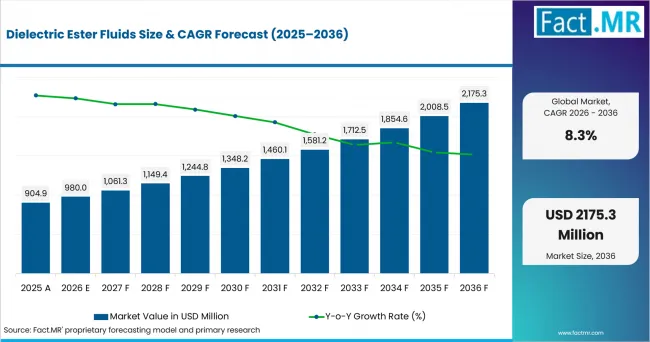
Dielectric Ester Fluids Value Analysis | Source: Fact.MR
What are the defining numbers behind Dielectric Ester Fluids Market growth?
USD 1,195.2573 million absolute opportunity by 2036, led by natural ester fluids, distribution transformers and fire safety.
- Demand Drivers in the Market
- Utility asset teams need fluids with higher fire safety performance where transformers are installed close to buildings, tunnels or public infrastructure.
- Transformer OEMs need insulating liquids that can handle moisture and extend paper-insulation life in sealed distribution transformers.
- Renewable project developers need biodegradable fluids for wind and solar substations where leak exposure can affect environmental approvals.
- Grid planners are reassessing transformer supply chains after the U.S. Department of Energy said in March 2026 that distribution-transformer demand had jumped 41% since 2019.
- Data-center operators need fire-safe transformer liquids as high-density power connections move closer to server halls and urban load centers.
- Key Segments Analyzed
- By Ester Type: Natural ester is expected to hold 46.0% share in 2026, supported by biodegradability and compatibility with distribution transformer designs.
- By Transformer and Equipment Class: Distribution transformers are projected to account for 34.0% share in 2026 owing to replacement cycles and compact substation use.
- By Voltage Class: <36 kV is anticipated to capture 30.0% share in 2026 because medium-voltage networks provide the broadest retrofit base.
- By Purchase Driver: Fire safety is estimated to represent 31.0% share in 2026, reflecting installations near buildings, rail assets and public infrastructure.
- Analyst Opinion at Fact.MR
- Shambhu Nath Jha, Principal Consultant at Fact.MR, states, “The market is shifting because ester fluids solve two approval questions at the same time: how safe the transformer is near people and how manageable the fluid is if a leak occurs. Demand is expected to widen as grid assets move closer to dense load centers. Suppliers that combine fluid qualification, OEM support and field-service guidance have a clearer route to repeat orders.”
- Strategic Implications
- Fluid producers should document fire point, biodegradation behavior and transformer compatibility in formats that utilities can compare quickly.
- Transformer OEMs should test natural and synthetic ester fluids early in design programs so approvals match insulation, gasket and thermal requirements.
- Utilities should map indoor and environmentally sensitive substations first because these assets offer the clearest economic case for ester fluids.
- Service providers should add testing and handling capacity in regions where utilities are moving from mineral-oil retrofills to ester-filled assets.
The United Kingdom is forecast to record 10.0% CAGR through 2036 as transmission investment moves transformer decisions earlier in project planning. The USA is projected to reach 8.6% CAGR through grid funding and transformer replacement pressure. Germany is anticipated to advance at 8.2% CAGR with faster power-line approvals. France is estimated to post 7.9% CAGR through regulated network investment. Brazil is forecast to reach 7.1% CAGR as transmission planning expands long-distance grid assets.
How does the Dielectric Ester Fluids Market break down by segment?
Natural ester leads Ester Type at 46.0%; Fire safety leads Purchase Driver at 31.0%.
Which Ester Type dominates?
Natural ester holds 46.0% share in 2026.
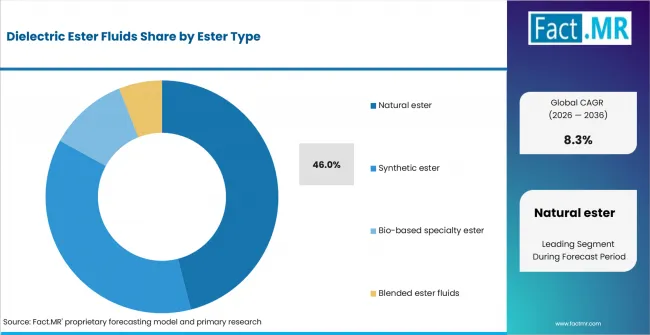
Dielectric Ester Fluids Analysis By Ester Type | Source: Fact.MR
Natural ester fluids lead because utilities value biodegradability and moisture tolerance in distribution transformers. These fluids help asset owners reduce spill exposure and manage paper-insulation aging where long service life carries a clear operating value.
Cargill FR3 illustrates the category through a natural ester dielectric fluid positioned for transformer insulation and cooling. The segment is expected to remain closely tied to utility replacement programs and renewable substation designs.
What leads the Transformer and Equipment Class segment?
Distribution transformers account for 34.0% share in 2026.
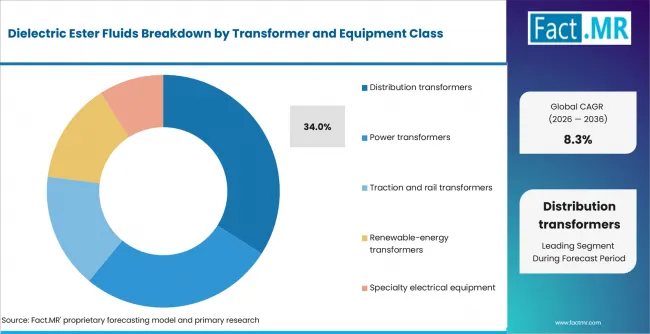
Dielectric Ester Fluids Analysis By Transformer And Equipment Class | Source: Fact.MR
Distribution transformers lead because they are numerous and often installed closer to buildings than large transmission assets. Fire-safe ester fluids fit compact pad-mounted and indoor designs where transformer placement affects permitting and maintenance access.
How does Voltage Class shape demand?
<36 kV holds 30.0% share in 2026.
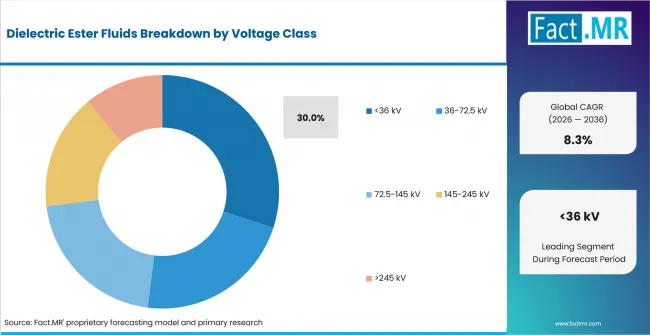
Dielectric Ester Fluids Analysis By Voltage Class | Source: Fact.MR
The <36 kV class leads because medium-voltage transformers cover broad distribution networks, renewable interconnections and site-level power systems. Fluid decisions in this voltage range often balance fire safety with maintenance familiarity and OEM qualification.
Lower-voltage ester adoption is expected to move faster where utilities standardize approved transformer designs. Repeatable equipment platforms reduce the engineering work needed to qualify gaskets, insulation paper and fill procedures.
What supports Fire safety within Purchase Driver?
Fire safety represents 31.0% share in 2026.
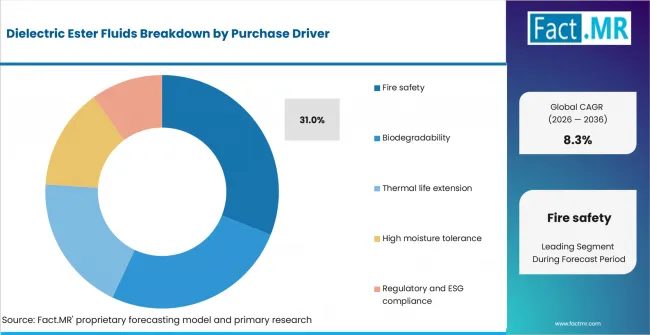
Dielectric Ester Fluids Analysis By Purchase Driver | Source: Fact.MR
Fire safety leads the purchase-driver segment because many transformer installations are closer to people, buildings and enclosed infrastructure. Ester fluids help reduce fire-clearance pressure and can lower the need for added protection systems in selected designs.
Shell states that Shell MIDEL eN 1204, a natural ester dielectric fluid, has a fire point of over 350°C and can reduce the need for fire-protection equipment. Fire behavior therefore remains a practical buying trigger for indoor substations, rail transformers and dense power-distribution assets.
What is accelerating Dielectric Ester Fluids Market adoption, and what is holding it back?
Demand is expected to rise through fire safety, biodegradability and grid replacement needs. Growth is constrained by qualification cost, fluid handling and price sensitivity.
Drivers Impact Analysis
| DRIVER | (~) % IMPACT ON CAGR | GEOGRAPHIC RELEVANCE | IMPACT TIMELINE |
|---|---|---|---|
| Fire-safe transformer placement | +1.5% | North America, Western Europe | Short term (<= 2 years) |
| Biodegradable-fluid requirements | +1.1% | Europe, Brazil | Medium term (2-4 years) |
| Distribution transformer replacement | +1.3% | USA, Western Europe | Medium term (2-4 years) |
| Renewable-grid interconnections | +0.9% | Global | Long term (>= 4 years) |
Source: Fact.MR analysis. Updated Sep 4, 2026
- Fire-safe transformer placement: Utilities place greater value on ester fluids when substation designs are near buildings, rail corridors or public assets.
- Biodegradable-fluid requirements: Environmental exposure at renewable substations and sensitive sites supports natural ester adoption during new equipment selection.
- Distribution transformer replacement: Aging equipment and longer lead times make fluid qualification part of broader replacement planning.
Opportunity Impact Analysis
| OPPORTUNITY | (~) % IMPACT ON CAGR | GEOGRAPHIC RELEVANCE | IMPACT TIMELINE |
|---|---|---|---|
| Retrofills for fire-sensitive assets | +1.0% | USA, UK, Germany | Short term (<= 2 years) |
| Renewable transformer packages | +0.8% | Brazil, France, USA | Medium term (2-4 years) |
| OEM-qualified ester designs | +0.7% | Global | Long term (>= 4 years) |
Source: Fact.MR analysis. Updated Sep 4, 2026
- Retrofills for fire-sensitive assets: Utilities can convert selected mineral-oil assets when space constraints make civil fire protection expensive.
- Renewable transformer packages: Wind and solar developers can specify ester-filled transformers where leak exposure and fire behavior shape site approvals.
- OEM-qualified ester designs: Transformer makers can improve repeat sales by pre-validating ester fluids across insulation, sealing and thermal design packages.
Restraints Impact Analysis
| RESTRAINT | (~) % IMPACT ON CAGR | GEOGRAPHIC RELEVANCE | IMPACT TIMELINE |
|---|---|---|---|
| Higher fluid cost versus mineral oil | -0.7% | Global | Short term (<= 2 years) |
| Asset-level qualification work | -0.5% | North America, Europe | Medium term (2-4 years) |
| Handling and retrofill discipline | -0.4% | Global | Long term (>= 4 years) |
Source: Fact.MR analysis. Updated Sep 4, 2026
- Higher fluid cost versus mineral oil: Ester adoption can slow when projects focus on first cost and place lower value on fire-safety savings.
- Asset-level qualification work: Utilities need compatibility checks before changing fluid types in existing transformers and long-life equipment fleets.
- Handling and retrofill discipline: Field crews need clear procedures for moisture control, oil sampling and filling practice before wider conversion.
Which countries are scaling the Dielectric Ester Fluids Market through 2036?
- The country comparison spans 2.91 percentage points across the 2026 to 2036 CAGR range.
- The United Kingdom tracks 1.36 percentage points above the USA through electricity transmission investment and clean-power connection reform.
- The USA tracks 0.41 percentage point above Germany through transformer replacement pressure and federal grid-upgrade funding.
- Germany tracks 0.38 percentage point above France through faster power-line approvals and renewable electricity flows.
- France tracks 0.76 percentage point above Brazil through regulated grid investment and renewable connection needs.
- Brazil closes the displayed range through transmission planning and renewable-grid integration across long-distance corridors.
Comparable CAGRs create different entry conditions because each country approves grid assets in a different way. Full report coverage includes North America, Latin America, Western Europe, Eastern Europe, East Asia, South Asia & Pacific, Middle East & Africa.
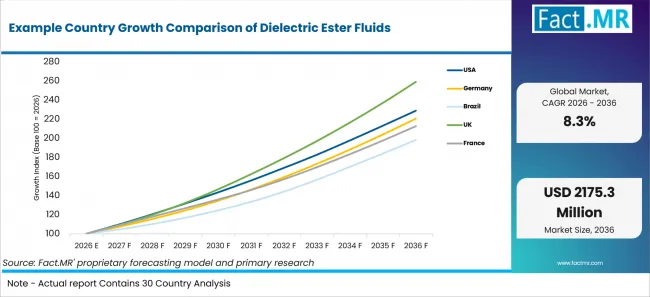
Example Country Growth Comparison Of Dielectric Ester Fluids | Source: Fact.MR
| Country | CAGR |
|---|---|
| United Kingdom | 10.0% |
| United States | 8.6% |
| Germany | 8.2% |
| France | 7.9% |
| Brazil | 7.1% |
Source: Fact.MR analysis. Updated Sep 4, 2026
What supports United Kingdom adoption?
10.0% CAGR, shaped by transmission investment and clean-power connection reform.
The United Kingdom leads the displayed country set as transmission funding and connection reform move ester-fluid decisions earlier in transformer planning. Ofgem set GBP 10.3 billion of upfront funding for electricity transmission under RIIO-ET3 in December 2025. Ester fluids fit this setting when utilities plan indoor substations, compact rail equipment and renewable-connection transformers with stronger fire behavior.
What supports USA adoption?
8.6% CAGR, supported by transformer replacement needs and grid-upgrade funding.
The USA ranks second where local-grid replacement and load growth place distribution transformers under closer specification review. The U.S. Department of Energy announced an approximately USD 1.9 billion SPARK funding opportunity for grid upgrades in March 2026. Ester fluids gain attention where utilities plan fire-safe indoor substations and distribution assets with longer insulation life.
How is Germany scaling demand?
8.2% CAGR, led by power-line approvals and renewable electricity flows.
Germany records the third country CAGR as grid expansion and renewables reshape transformer placement. The Bundesnetzagentur reported in January 2026 that it had approved roughly 2,000 km of power lines during 2025. Ester-fluid vendors have an entry path where utilities review compact substations and renewable interconnection assets under stricter fire-safety requirements.
What supports France growth?
7.9% CAGR, reinforced by regulated grid investment and renewable connection needs.
France advances through regulated network investment and a power mix that keeps transformer utilization high. CRE approved EUR 4.24 billion for RTE’s 2026 investment program through a deliberation dated February 26, 2026. Natural and synthetic ester fluids fit transformer projects where operators connect renewable assets, reinforce dense urban networks and review equipment fire behavior near public infrastructure.
How does Brazil perform?
7.1% CAGR, led by transmission expansion and renewable-integration needs.
Brazil closes the displayed country range with long-distance transmission planning that expands transformer placements across renewable corridors. MME and EPE projected about BRL 120 billion in transmission-system investment through 2035 under the PDE 2035 reference scenario in December 2025. Ester-fluid demand is expected to follow substation additions where leak control and fire behavior guide transformer-fluid selection.
Who leads the Dielectric Ester Fluids Market?
Cargill is an active provider through FR3 natural ester dielectric fluid for transformer insulation and cooling. The portfolio gives utilities a recognized option for biodegradability, moisture tolerance and distribution transformer service life.
Shell Lubricants anchors the MIDEL position following its acquisition of the MIDEL and MIVOLT businesses. On April 1, 2025, Shell launched the Shell MIDEL brand worldwide, integrating natural and synthetic ester transformer liquids into its broader transformer-liquid portfolio.
Ergon participates directly through HyVolt NE natural ester and HyVolt SE synthetic ester dielectric fluids. In July 2025, Ergon opened its first Transformer Oil Technology Center in Asia, located in Merak, Indonesia, expanding regional research, development and technical-service capabilities for dielectric-fluid customers.
Savita Oil Technologies participates directly through bioTRANSOL natural ester and TRANSOL Synth synthetic ester transformer fluids for power, distribution, traction and renewable-energy transformer applications. Competition centers on qualification depth, OEM acceptance, fire-safety performance and field-service support.
Which companies are the key providers?
Key companies include Cargill, Shell Lubricants including Shell MIDEL, Ergon, and Savita Oil Technologies.
- Cargill
- Shell Lubricants including Shell MIDEL
- Ergon
- Savita Oil Technologies
Bibliography
- U.S. Department of Energy. (2026, March 12). Energy Department announces $1.9B investment in critical grid infrastructure to reduce electricity costs.
- Ofgem. (2025, December 4). RIIO-3 Final Determinations for the Electricity Transmission, Gas Distribution and Gas Transmission sectors.
- Bundesnetzagentur. (2026, January 2). Energy transition clears crucial hurdle – significant progress in electricity grid expansion in 2025.
- Commission de régulation de l’énergie. (2026, February 26). Délibération de la CRE du 26 février 2026 portant approbation du programme d’investissements 2026 de RTE.
- Empresa de Pesquisa Energética. (2025, December 23). MME e EPE preveem investimentos de cerca de R$ 120 bilhões para o sistema de transmissão até o ano de 2035.
- Ergon, Inc. (2025, July 25). Ergon celebrates opening of Transformer Oil Technology Center in Indonesia.
- Shell. (2025, April 1). Shell enhances its transformer liquid portfolio, now includes Shell MIDEL.
- Savita Oil Technologies Limited. (2025). Annual report 2024-25.
This Report Answers
- The report explains where dielectric ester fluids are used across ester type and transformer class. It also covers voltage class and purchase driver.
- Segment analysis identifies the leading subsegments and the operational reasons utilities prioritize them.
- Country analysis examines the listed markets and the grid-investment mechanisms supporting ester-fluid adoption.
- Competitive analysis reviews current providers across natural and synthetic ester transformer fluids and technical-service support.
- Application analysis assesses how fire safety, moisture behavior and biodegradability influence purchase decisions.
What does the Dielectric Ester Fluids Market cover?
The Dielectric Ester Fluids Market covers insulating liquids used in transformers where fluid chemistry affects fire behavior, moisture handling and environmental exposure. Related analysis spans dielectric fluids and natural ester fluids where transformer specifications overlap with liquid insulation decisions.
The assessment covers natural, synthetic and blended ester fluids for distribution transformers, power transformers and renewable-energy transformer packages. Adjacent thermal-management context includes dielectric cooling fluids and single-phase dielectric immersion fluids where fluid safety and dielectric behavior shape technical selection.
What is included in the scope?
The scope includes ester-filled transformer liquids sold for new equipment, retrofills and qualified service programs. Maintenance context includes transformer oil purification units when fluid conditioning affects dielectric strength and asset life.
It includes transformer insulation decisions where ester fluids interact with paper, seals and thermal design. Related material context includes transformer insulation materials and transformer insulation pressboards when liquid and solid insulation choices are evaluated together.
What is excluded from the scope?
The scope excludes mineral-oil transformer fluids sold without ester chemistry and general lubricants used outside electrical insulation. Broader equipment categories such as electric power transmission distribution equipment are used only for grid-demand context.
Standalone switchgear gases, dry-type transformer designs, cable oils and general industrial heat-transfer fluids fall outside the scope unless the product is sold as an ester transformer insulating liquid. Pure additive packages are also outside the scope when they are sold without a finished dielectric ester fluid.
How Was the Analysis Built?
The analysis draws on 120+ sources, 35+ company portfolios, 25+ countries, and more than 20 industry interviews.
- Primary Research: Primary research includes discussions with manufacturers, service providers, technology developers, distributors, end users, and subject-matter experts. These conversations examine purchasing priorities, product adoption, operational challenges, approval requirements, competitive positioning, and the factors that influence wider market acceptance.
- Desk Research: Desk research covers government statistics, regulatory publications, company filings, trade data, technical studies, industry associations, standards, public policy, and other authoritative sources. Every source used in the analysis is documented in the bibliography.
- Market Sizing and Forecasting: Market estimates combine historical performance, demand indicators, pricing and volume trends, segment shares, company participation, country-level growth, adoption patterns, investment activity, and barriers to market expansion.
- Data Validation and Update Cycle: Findings are validated by comparing primary interviews with public data, company activity, regulatory changes, trade patterns, and industry developments. Regular updates review new product launches, capacity changes, partnerships, approvals, and shifts in commercial adoption.
Segmentation
What is the report’s scope and coverage?
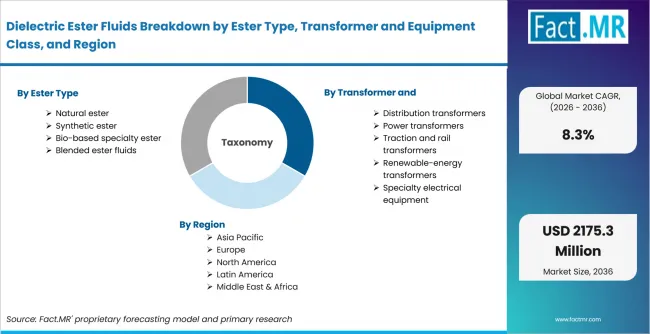
Dielectric Ester Fluids Breakdown By Ester Type, Transformer And Equipment Class, And Region | Source: Fact.MR
| Attribute | Details |
|---|---|
| Quantitative Units | USD million |
| Market Definition | Dielectric ester fluids are natural, synthetic or blended ester insulating liquids used for transformer insulation and cooling where fire safety, biodegradability and moisture tolerance influence specification. |
| Ester Type | Natural ester; Synthetic ester; Bio-based specialty ester; Blended ester fluids |
| Transformer and Equipment Class | Distribution transformers; Power transformers; Traction and rail transformers; Renewable-energy transformers; Specialty electrical equipment |
| Voltage Class | <36 kV; 36-72.5 kV; 72.5-145 kV; 145-245 kV; >245 kV |
| Purchase Driver | Fire safety; Biodegradability; Thermal life extension; High moisture tolerance; Regulatory and ESG compliance |
| Regions Covered | North America; Latin America; Western Europe; Eastern Europe; East Asia; South Asia & Pacific; Middle East & Africa |
| Countries Covered | United Kingdom; United States; Germany; France; Brazil |
| Key Companies Profiled | Cargill; Shell Lubricants including Shell MIDEL; Ergon; Savita Oil Technologies |
| Forecast Period | 2026 to 2036 |
| Approach | Hybrid top-down and bottom-up approach using transformer installations, fluid qualification patterns, grid investment, company portfolios, country-level demand indicators and buyer interviews. |
Source: Fact.MR analysis. Updated Sep 4, 2026
How is the market segmented?
-
By Ester Type:
- Natural ester
- Synthetic ester
- Bio-based specialty ester
- Blended ester fluids
-
By Transformer and Equipment Class:
- Distribution transformers
- Power transformers
- Traction and rail transformers
- Renewable-energy transformers
- Specialty electrical equipment
-
By Voltage Class:
- <36 kV
- 36-72.5 kV
- 72.5-145 kV
- 145-245 kV
- >245 kV
-
By Purchase Driver:
- Fire safety
- Biodegradability
- Thermal life extension
- High moisture tolerance
- Regulatory and ESG compliance
-
By Region:
- North America
- Latin America
- Western Europe
- Eastern Europe
- East Asia
- South Asia & Pacific
- Middle East & Africa
Frequently Asked Questions
How big is the dielectric ester fluids market in 2026?
What is the CAGR of the dielectric ester fluids market from 2026 to 2036?
Which ester type leads the dielectric ester fluids market?
Which transformer and equipment class leads the dielectric ester fluids market?
Who are the leading companies in the dielectric ester fluids market?
Who worked on this report


Preview the report firsthand - request a free sample
Free SampleGet the brochure for pricing and purchase details
Download PDF