- Market Value (2025): USD 101.7 Mn
- Estimated Value (2026): USD 120.0 Mn
- Forecast Value (2036): USD 628.0 Mn
- CAGR (2026-2036): 18.0%
What is the Dispersible Snack Films Market forecast to be worth by 2036?
USD 120.0 million in 2026 to USD 628.0 million by 2036 at an 18.0% CAGR.
- The dispersible snack films market crossed a valuation of USD 101.7 million in 2025.
- Demand is projected to increase from USD 120.0 million in 2026 to USD 628.0 million by 2036.
- The market is forecast to record an 18.0% CAGR from 2026 to 2036 as snack brands, produce packers and foodservice operators qualify lighter film formats.
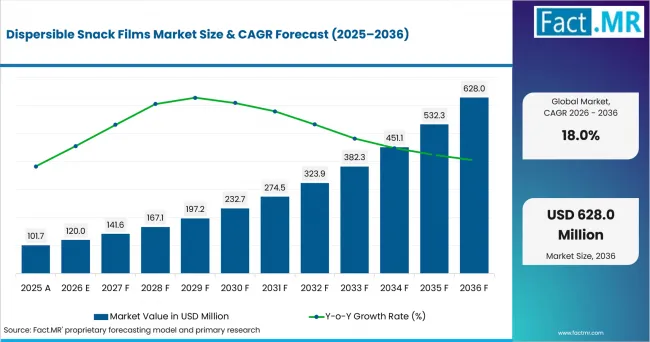
Dispersible Snack Films Market Value Analysis | Source: Fact.MR
What are the defining numbers behind Dispersible Snack Films Market growth?
USD 508.0 million absolute opportunity by 2036, led by bio-polymer blends, flexible film and produce packaging.
- Demand Drivers in the Market
- Snack brands need thinner packaging that protects texture during short retail cycles. USDA Economic Research Service updated its Food Expenditure Series in June 2026 and reported that total U.S. food spending reached USD 2.51 trillion in 2025, measured in inflation-adjusted 2025 dollars.
- Grocery retailers need visible waste-reduction options that fit mainstream chilled and ambient aisles. Defra reported in July 2026 that UK consumer expenditure on food and alcoholic drinks reached GBP 303.3 billion in 2025 in real terms, measured at constant 2023 prices.
- Foodservice operators need coated boxes and windows that preserve product visibility during take-away service. Notpla Limited introduced SeaView in May 2026 as a food-to-go range combining seaweed-based coating with a transparent seaweed-based window.
- Key Segments Analyzed
- By Material: Bio-polymer blends are expected to hold 44.0% share in 2026 because starch, cellulose and PVOH combinations allow film strength and controlled water response.
- By Format: Flexible film is projected to account for 42.0% share in 2026 as brands can trial wrappers and liners on established flexible-packaging equipment.
- By Barrier Function: Moisture is anticipated to capture 46.0% share in 2026 since snack texture and produce freshness rely on controlled vapor movement.
- By Application: Produce is estimated to represent 39.0% share in 2026 owing to small packs that need light protection and clear disposal guidance.
- Analyst Opinion at Fact.MR
- Shambhu Nath Jha, Principal Consultant at Fact.MR, states, "Dispersible snack films are drawing attention because they force packaging teams to qualify function and end-of-life behavior together. Demand is expected to favor suppliers that can document food-contact safety and moisture response before retail tests begin. The most capable providers combine film chemistry, pack-line support and disposal instructions that store teams can explain clearly."
- Strategic Implications
- Film suppliers should publish moisture-response data for each snack and produce format so brands can match dispersibility with shelf stability.
- Pack converters should design paper-film combinations for recovery tests. PackUK listed a 2025 plastic packaging base fee of GBP 423 per tonne in June 2025.
- Foodservice packaging teams should test windowed and coated formats around sandwiches, salads and wraps before moving into wider prepared-food ranges.
- Export-focused brands should prepare country-by-country disposal statements.
South Korea is projected to post 22.4% CAGR through 2036 supported by K-food exports and compact convenience channels. The UK is expected to record 20.9% CAGR owing to grocery spending and packaging-fee exposure. Germany is forecast to advance at 20.0% CAGR with food-price discipline and recycling scrutiny. Japan is anticipated to hold 18.9% CAGR reflecting premium retail formats and food-export packaging needs. The USA is estimated to reach 17.6% CAGR due to food-spending scale and regional packaging pilots.
How does the Dispersible Snack Films Market break down by segment?
Bio-polymer blends lead Material at 44.0% share in 2026; flexible film leads Format at 42.0% share.
Which Material dominates?
Bio-polymer blends are expected to hold 44.0% share in 2026.
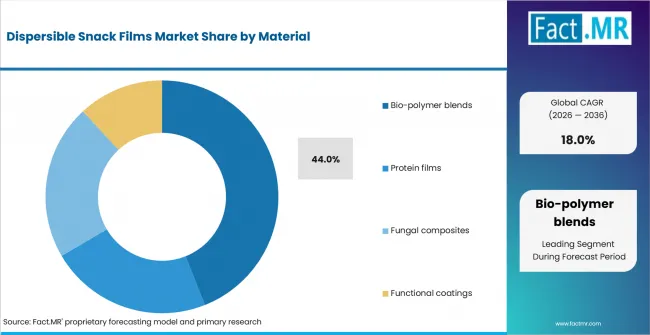
Dispersible Snack Films Market Analysis By Material | Source: Fact.MR
Bio-polymer blends lead because dispersible snack films need film strength before use and predictable breakdown after use. Blending also helps formulators balance clarity, seal behavior and moisture response across produce packs and snack liners.
Kuraray said in July 2025 that its packaging materials portfolio for K 2025 included KURARAY POVAL, EXCEVAL and PLANTIC. The same communication described PLANTIC as dispersible in water, enabling multilayer separation and easy repulping of paper packaging. These properties support its potential use in packaging structures designed to combine barrier performance with paper-repulping compatibility.
What leads the Format segment?
Flexible film is projected to account for 42.0% share in 2026.
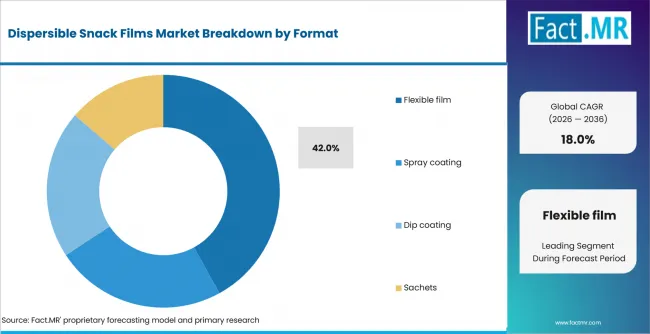
Dispersible Snack Films Market Analysis By Format | Source: Fact.MR
Flexible film leads because most snack and produce brands already buy web-fed packaging and pouch materials. A film format lowers conversion friction compared with molded packs or full coating-system changes.
Notpla Limited’s May 2026 SeaView launch illustrates how seaweed-based coatings and transparent bio-based windows can be incorporated into commercial foodservice packaging while maintaining product visibility and food-protection performance. These attributes indicate potential opportunities for flexible dispersible films in applications where buyers seek transparent packaging, functional barriers and simpler end-of-life handling.
How does Barrier Function shape demand?
Moisture is anticipated to lead with 46.0% share in 2026.
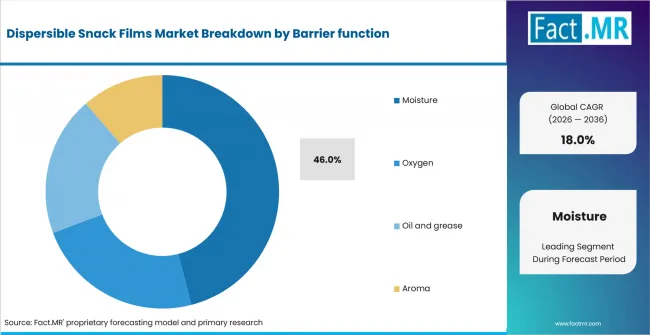
Dispersible Snack Films Market Analysis By Barrier Function | Source: Fact.MR
Moisture control leads because dispersible films must avoid early softening during storage. Snack makers need films that protect crisp texture while produce packers need controlled vapor transfer for fresh items.
Aquapak stated in July 2025 that Hydropol-coated paper provided an excellent oxygen barrier for a recyclable snack pack. The Hydropol layer was designed to dissolve during paper recycling, allowing up to 100% recovery of paper pulp. Aquapak also noted that the crisp-pack application required an additional moisture barrier, with Hydropol combined with Nissha metallised paper to achieve the required performance.
What supports Produce within Application?
Produce is estimated to represent 39.0% share in 2026.
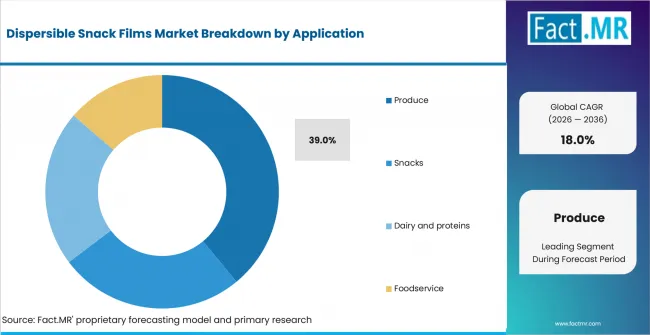
Dispersible Snack Films Market Analysis By Application | Source: Fact.MR
Produce leads because small fruit and cut-produce packs create a narrow performance window. Film makers must support appearance and handling while limiting excess packaging weight for refrigerated retail displays.
Fresh produce packers are expected to test dispersible films where berries, grapes and prepared fruit need light barrier layers. The application fits early qualification because pack sizes are small and retail feedback arrives faster than in bulk food packaging.
What is accelerating Dispersible Snack Films Market adoption, and what is holding it back?
Demand is expected to rise with food-packaging waste pressure and controlled film qualification. Growth is constrained by moisture stability, food-contact approval and disposal clarity.
Drivers Impact Analysis
| DRIVER | (~) % IMPACT ON CAGR | GEOGRAPHIC RELEVANCE | IMPACT TIMELINE |
|---|---|---|---|
| Retail pressure to reduce snack-pack material | +1.7% | North America, Western Europe, East Asia | Short term (<= 2 years) |
| Moisture-stable films for produce and snacks | +1.4% | Global | Medium term (2-4 years) |
| Foodservice trials for coated and windowed packs | +1.1% | Western Europe, North America | Short term (<= 2 years) |
| Paper-recovery compatibility for coated structures | +0.9% | Western Europe, East Asia | Long term (>= 4 years) |
Source: Fact.MR analysis. Updated Aug 26, 2026
- Retail pressure to reduce snack-pack material: Brand teams are expected to evaluate dispersible films where lighter liners and sachets lower visible plastic use without changing the food proposition.
- Moisture-stable films for produce and snacks: Functional qualification is anticipated to focus on crispness, condensation control and shelf performance before national retail launches.
- Foodservice trials for coated and windowed packs: Short-run take-away programs are expected to help film suppliers prove performance before moving into grocery multipacks.
- Paper-recovery compatibility for coated structures: Converters are projected to favor films that support repulping or clear separation during established recovery operations.
Opportunity Impact Analysis
| OPPORTUNITY | (~) % IMPACT ON CAGR | GEOGRAPHIC RELEVANCE | IMPACT TIMELINE |
|---|---|---|---|
| Produce films with controlled water response | +1.3% | North America, East Asia | Medium term (2-4 years) |
| Sachets for single-serve ingredients and snacks | +1.0% | Global | Short term (<= 2 years) |
| Export snack packs with lower material weight | +0.8% | South Korea, Japan, Western Europe | Long term (>= 4 years) |
Source: Fact.MR analysis. Updated Aug 26, 2026
- Produce films with controlled water response: Retailers are expected to qualify small protective films for high-turn produce packs where appearance and handling drive repeat purchase.
- Sachets for single-serve ingredients and snacks: Portion packs are anticipated to create a route for dispersible structures where the package contacts water during use.
- Export snack packs with lower material weight: Export brands are projected to evaluate films that reduce package weight while preserving aroma and texture during longer shipping cycles.
Restraints Impact Analysis
| RESTRAINT | (~) % IMPACT ON CAGR | GEOGRAPHIC RELEVANCE | IMPACT TIMELINE |
|---|---|---|---|
| Premature softening under humid storage | -0.6% | East Asia, Western Europe | Short term (<= 2 years) |
| Food-contact and migration documentation burden | -0.5% | Global | Medium term (2-4 years) |
| Consumer disposal confusion across local systems | -0.4% | North America, Western Europe | Long term (>= 4 years) |
Source: Fact.MR analysis. Updated Aug 26, 2026
- Premature softening under humid storage: High-moisture retail and distribution settings are expected to slow approval for films used around crisp snacks and fresh-cut produce.
- Food-contact and migration documentation burden: Brands are likely to require formulation-level evidence before dispersible films touch oily, acidic or high-moisture food surfaces.
- Consumer disposal confusion across local systems: Adoption is expected to depend on simple pack instructions that distinguish water dispersion, composting and paper recovery.
Which countries are scaling the Dispersible Snack Films Market through 2036?
- The country comparison spans 4.8 percentage points between South Korea and the USA across the forecast period.
- South Korea remains 1.5 percentage points above the UK through export snack channels and compact retail formats.
- The UK remains 0.9 percentage point above Germany because packaging fee exposure supports lighter food-pack trials.
- Germany remains 1.1 percentage points above Japan through strict packaging scrutiny and food-price awareness.
- Japan remains 1.3 percentage points above the USA owing to premium convenience formats and food-export packaging needs.
- The USA closes the displayed range while giving suppliers the widest food-spending base for commercial pilots.
Comparable CAGRs create different entry conditions due to food-channel structure, packaging rules, moisture-control requirements and converter readiness. Full report coverage includes North America, Latin America, Western Europe, Eastern Europe, East Asia, South Asia & Pacific, Middle East & Africa.
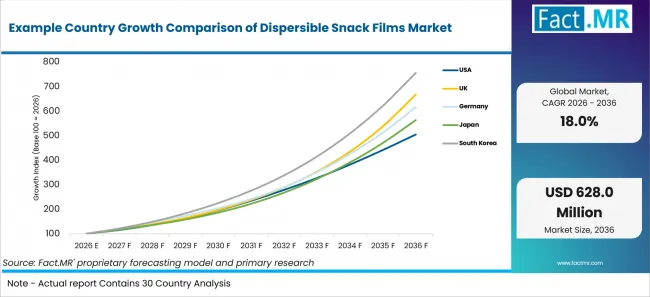
Example Country Growth Comparison Of Dispersible Snack Films Market | Source: Fact.MR
| Country | CAGR (2026-2036) |
|---|---|
| South Korea | 22.4% |
| United Kingdom | 20.9% |
| Germany | 20.0% |
| Japan | 18.9% |
| United States | 17.6% |
Source: Fact.MR analysis. Updated Aug 26, 2026
How is South Korea scaling demand?
22.4% CAGR, supported by K-food exports and compact snack channels.
South Korea gives dispersible snack film suppliers a testing base in convenience retail and export snack packaging. MAFRA announced in January 2026 that K-Food Plus exports reached USD 13.62 billion in 2025 after a 5.1% year-over-year gain. That export base raises the value of lighter pack formats that protect flavor during shipment and meet overseas disposal expectations.
What supports the United Kingdom's growth?
20.9% CAGR, backed by grocery expenditure and packaging fee pressure.
The UK market is shaped by grocery spending depth and clearer producer responsibility costs. Defra reported in July 2026 that real consumer expenditure on food and alcoholic drinks reached GBP 303.3 billion in 2025. Retailers and private-label food brands therefore have a broad test base for flexible films, produce liners and foodservice packs that use less conventional plastic.
What is supporting Germany's adoption?
20.0% CAGR, supported by food-price discipline and packaging regulation.
German food brands are expected to qualify dispersible films where material savings align with strict pack review. Destatis reported in February 2026 that consumer food prices in Germany rose 2.1% year over year in January 2026. Price discipline keeps waste reduction visible for retailers, while packaging teams require proof that film layers behave correctly during storage and recovery.
How does Japan perform?
18.9% CAGR, led by premium retail and export-oriented food channels.
Japan is expected to scale through premium convenience formats and export food packs that require careful presentation. MAFF announced in February 2026 that agricultural, forestry, fishery and food exports reached JPY 1,700.5 billion in 2025. Export-led food development supports documented films that protect aroma, resist humidity and preserve the appearance expected in small snack and produce packs.
What supports USA adoption?
17.6% CAGR, shaped by food spending scale and regional packaging trials.
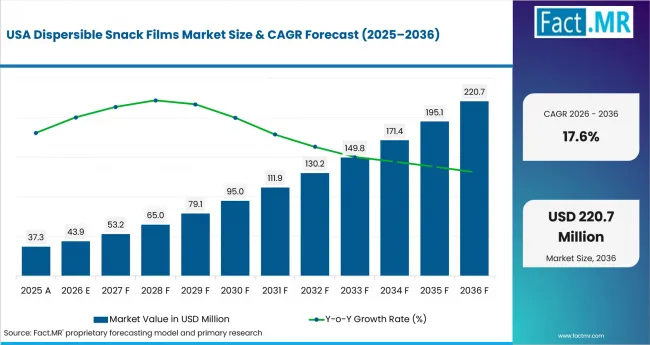
Dispersible Snack Films Market Country Value Analysis | Source: Fact.MR
The USA gives suppliers a large trial base across food retail and foodservice channels. The U.S. Census Bureau reported in August 2026 that July 2026 retail and food services sales stood at USD 763.6 billion and ran 5.0% above July 2025. Regional snack launches and produce pilots are expected to help brands test dispersible films before national rollouts.
Who leads the Dispersible Snack Films Market?
MonoSol is active in water-soluble film technology through Kuraray ownership and its PVOH film portfolio. The company's materials experience fits dispersible snack films where brands need predictable water response, seal quality and food-contact documentation before line trials.
Kuraray supports the market through PVOH-based materials and PLANTIC water-dispersible packaging technology. Its July 2025 K 2025 communication positioned water-soluble, dispersible and repulpable barrier materials within a broader portfolio for recyclable packaging and highlighted collaboration with brand owners, converters and packaging manufacturers.
Aquapak Polymers Ltd. competes through Hydropol, a PVOH-based water-soluble polymer technology used in coated-paper applications. Its July 2025 Environmental Packaging Awards announcement highlighted Hydropol in a fully recyclable paper crisp packet within the snacks and confectionery category. Notpla Limited adds seaweed-based foodservice coatings and transparent-window packaging through its SeaView range, while Loliware develops seaweed-derived bio-based materials and TIPA CORP. LTD. supplies compostable flexible films and laminates.
Which companies are the key providers?
Key companies include MonoSol; Kuraray; Notpla Limited; Loliware; Aquapak Polymers Ltd.; and TIPA CORP. LTD.
- MonoSol
- Kuraray
- Notpla Limited
- Loliware
- Aquapak Polymers Ltd.
- TIPA CORP. LTD.
Bibliography
- Aquapak Polymers Ltd. (2025, July 16). Hydropol™ wins snacks and confectionery category at Environmental Packaging Awards.
- Department for Environment, Food & Rural Affairs. (2026, July 29). Food statistics in your pocket. GOV.UK.
- Federal Statistical Office. (2026, February 17). Inflation rate at +2.1% in January 2026.
- Kuraray Co., Ltd. (2025, July 15). Kuraray pioneers sustainable packaging with innovative barrier materials: K 2025—Co-creation and innovation for future-proof, recyclable packaging.
- Ministry of Agriculture, Food and Rural Affairs. (2026, January 20). Exports of K-Food Plus reached USD 13.6 billion in 2025, up 5.1% year-over-year.
- Notpla. (2026, May 8). The future of food-to-go packaging? A plastic-free window box built for real foodservice.
- U.S. Census Bureau. (2026, August 14). Advance monthly sales for retail and food services: July 2026.
- Ministry of Climate, Energy and Environment. (2026, April 28). Breaking Free from Oil Imports: Toward a Sustainable, Plastic-Free Circular Economy.
This Report Answers
- The report explains where dispersible snack films are used across material, format, barrier function and application segments.
- Segment analysis identifies the leading subsegments and the technical reasons brands prioritize moisture behavior, line fit and disposal clarity.
- Country analysis examines the listed markets and the food-channel or packaging mechanisms supporting film qualification.
- Competitive analysis reviews current providers across water-soluble films, bio-based coatings, coated paper structures and compostable packaging routes.
- Application analysis assesses how produce, snacks and foodservice formats influence film specification and adoption timing.
What does the Dispersible Snack Films Market cover?
The Dispersible Snack Films Market covers thin films and coatings that disperse, dissolve or recover through defined disposal paths after protecting snacks and fresh food. The assessment places these formats next to edible packaging materials where direct food contact and consumer handling shape product design.
The analysis compares dispersible structures with biodegradable packaging material where end-of-life claims depend on local collection systems and material behavior. It also reviews bioplastics for packaging when bio-based input choices influence converter sourcing and food-contact documentation.
What is included in the scope?
The scope includes flexible films, sachets and coatings used around snacks, produce, dairy and foodservice items. It covers qualification links to fresh food packaging where moisture behavior and display quality influence approval.
Films with breathable or vapor-control functions are included when they are specified for snack or produce packs. Adjacent comparisons include micro perforated films where controlled airflow supports fresh food presentation.
What is excluded from the scope?
The scope excludes rigid trays, bottles, cartons and conventional flexible packaging that lack dispersible or recoverable film behavior. It also excludes broad zero waste packaging programs when the package is reusable or refillable instead of film-based.
General foodservice containers are outside the scope unless the film or coating is the value-creating component. Related benchmarks include on the go food packaging where the full pack format is the purchase driver.
How Was the Analysis Built?
The analysis draws on 120+ sources, 35+ company portfolios, 25+ countries, and more than 20 industry interviews.
- Primary Research: Primary research includes discussions with manufacturers, service providers, technology developers, distributors, end users, procurement teams, and subject-matter experts. These conversations examine purchasing priorities, product adoption, operational challenges, approval requirements, competitive positioning, and the factors that influence wider market acceptance.
- Desk Research: Desk research covers government statistics, regulatory publications, company filings, trade data, technical studies, industry associations, standards, public policy, and other authoritative sources. Every source used in the analysis is documented in the bibliography.
- Market Sizing and Forecasting: Market estimates combine historical performance, demand indicators, pricing and volume trends, segment shares, company participation, country-level growth, adoption patterns, investment activity, and barriers to market expansion.
- Data Validation and Update Cycle: Findings are validated by comparing primary interviews with public data, company activity, regulatory changes, trade patterns, and industry developments. Regular updates review new product launches, capacity changes, partnerships, approvals, procurement trends, and shifts in commercial adoption.
Segmentation
What is the report's scope and coverage?
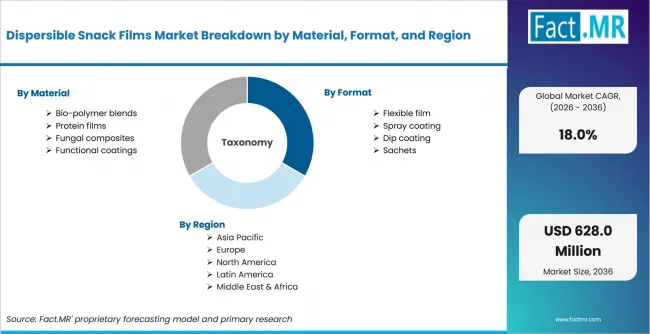
Dispersible Snack Films Market Breakdown By Material, Format, And Region | Source: Fact.MR
| Attribute | Details |
|---|---|
| Quantitative Units | USD million |
| Market Definition | Dispersible snack films are thin edible, water-dispersible or recoverable film structures used to wrap, line, coat or portion snacks, produce and foodservice items while managing moisture, oxygen, oil, grease or aroma exposure. |
| Material | Bio-polymer blends; Protein films; Fungal composites; Functional coatings |
| Format | Flexible film; Spray coating; Dip coating; Sachets |
| Barrier Function | Moisture; Oxygen; Oil and grease; Aroma |
| Application | Produce; Snacks; Dairy and proteins; Foodservice |
| Regions Covered | North America; Latin America; Western Europe; Eastern Europe; East Asia; South Asia & Pacific; Middle East & Africa |
| Countries Covered | United States; United Kingdom; Germany; Japan; South Korea |
| Key Companies Profiled | MonoSol; Kuraray; Notpla Limited; Loliware; Aquapak Polymers Ltd.; TIPA CORP. LTD. |
| Forecast Period | 2026 to 2036 |
| Approach | Hybrid top-down and bottom-up approach using snack packaging applications, material qualification patterns, food-channel adoption, country growth, company portfolio review and converter feedback. |
Source: Fact.MR analysis. Updated Aug 26, 2026
How is the market segmented?
-
By Material:
- Bio-polymer blends
- Protein films
- Fungal composites
- Functional coatings
-
By Format:
- Flexible film
- Spray coating
- Dip coating
- Sachets
-
By Barrier Function:
- Moisture
- Oxygen
- Oil and grease
- Aroma
-
By Application:
- Produce
- Snacks
- Dairy and proteins
- Foodservice
-
By Region:
- North America
- Latin America
- Western Europe
- Eastern Europe
- East Asia
- South Asia & Pacific
- Middle East & Africa
Frequently Asked Questions
How big is the dispersible snack films market in 2026?
What is the CAGR of the dispersible snack films market from 2026 to 2036?
Which material leads the dispersible snack films market?
Which format leads the dispersible snack films market?
Who are the leading companies in the dispersible snack films market?
Who worked on this report


Preview the report firsthand - request a free sample
Free SampleGet the brochure for pricing and purchase details
Download PDF