Low Methane Paddy Rice Nutrient Program Market

Low Methane Paddy Rice Nutrient Program Market Size and Share Forecast Outlook 2026 to 2036

Low methane paddy rice nutrient program market is projected to grow from USD 86.9 million in 2026 to USD 267.4 million by 2036, at a CAGR of 11.9%. Cereals will dominate with a 51.9% market share, while granular will lead the form segment with a 36.9% share.

Low Methane Paddy Rice Nutrient Program Market Forecast and Outlook 2026 to 2036

The global market for low methane paddy rice nutrient programs is projected to grow from USD 86.85 million in 2026 to USD 267.35 million by 2036, advancing at a CAGR of 11.9%. This specialized market addresses one of agriculture's most significant climate challenges: methane emissions from flooded rice paddies, which contribute substantially to global greenhouse gas inventories.

Key Takeaways from the Low Methane Paddy Rice Nutrient Program Market

  • Market Value for 2026: USD 86.85 Million
  • Market Value for 2036: USD 267.35 Million
  • Forecast CAGR (2026-2036): 11.9%
  • Leading Crop Type Segment (2026): Cereals (52%)
  • Leading Form Segment (2026): Granular (37%)
  • Leading Sales Channel Segment (2026): Ag-Retailers (48%)
  • Key Growth Countries: Vietnam (18.9% CAGR), India (18.6% CAGR), China (17.4% CAGR), Thailand (17.1% CAGR)
  • Key Players in the Market: Yara International ASA, Nutrien, ICL Group Ltd., EuroChem Group A.G., BASF SE, Syngenta AG
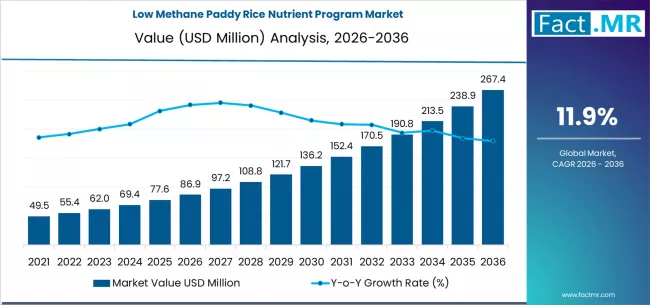
Low Methane Paddy Rice Nutrient Program Market Market Value Analysis

The market represents a critical convergence of climate-smart agriculture and precision nutrition, offering integrated fertilizer management programs specifically designed to maintain or increase yield while dramatically reducing the microbial production of methane in saturated soils.

Growth is propelled by tightening climate policy frameworks, corporate net-zero commitments across food value chains, and the availability of results-based finance such as carbon credits. These programs typically combine controlled-release or stabilized nitrogen fertilizers with micronutrients like silicon and iron, and sometimes microbial amendments.

The goal is to optimize rice root health and soil chemistry, shifting microbial processes away from methanogenesis without compromising grain productivity. This transforms nutrient management from a purely agronomic concern into a core strategy for reducing the carbon footprint of staple food production.

The market's expansion hinges on proving the dual benefit of these programs: verifiable methane reduction quantified through standardized measurement protocols, and economic gains for farmers from improved nitrogen use efficiency and potential premium markets or carbon payments. Success requires collaboration between agrochemical companies, rice research institutions, and governments to validate technologies and create enabling policy and market incentives.

Metric

Metric Value
Market Value (2026) USD 86.85 Million
Market Forecast Value (2036) USD 267.35 Million
Forecast CAGR (2026-2036) 11.9%

Category

Category Segments
Crop Type Cereals, Oilseeds, Fruits, Vegetables
Form Granular, Liquid, Powder, Suspension
Sales Channel Ag-Retailers, Direct-to-Farmer, Online Marketplaces, Cooperatives
Region North America, Latin America, Western Europe, Eastern Europe, East Asia, South Asia & Pacific, MEA

Segmental Analysis

By Crop Type, Why is Rice the Dominant Focus?
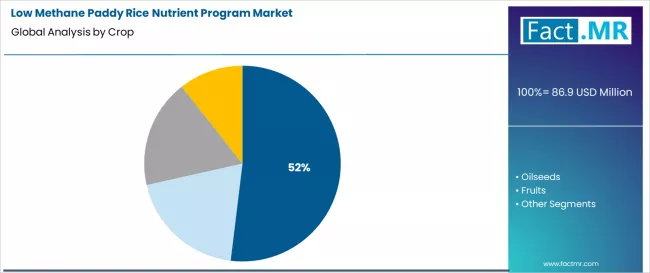
Low Methane Paddy Rice Nutrient Program Market Analysis By Crop

Cererals command a 52% share. Rice is unique among major cereals for its cultivation in flooded soils, the condition that leads to substantial methane emissions. This creates a singular and large addressable market for mitigation technologies.

Nutrient programs targeting this crop are designed to interact directly with the flooded soil environment, making them highly specific and not directly transferable to other cereal crops like wheat or maize, thus solidifying rice's lead.

By Form, Which is Best Suited for Flooded Fields?
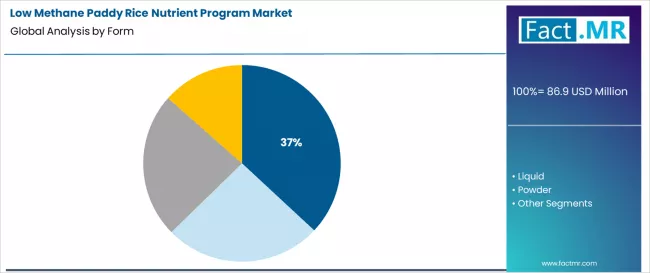
Low Methane Paddy Rice Nutrient Program Market Analysis By Form

Granular form, particularly controlled-release or deep-placement varieties, leads with a 37% share. Granular fertilizers, especially urea supergranules placed deep in the soil, reduce nitrogen loss via runoff and volatilization.

This localized nutrient availability improves root uptake efficiency and can create localized soil oxidation zones that suppress methane-producing archaea. The physical handling and application of granules also align with existing farming practices in major rice-growing regions.

By Sales Channel, How do Programs Reach Millions of Smallholders?
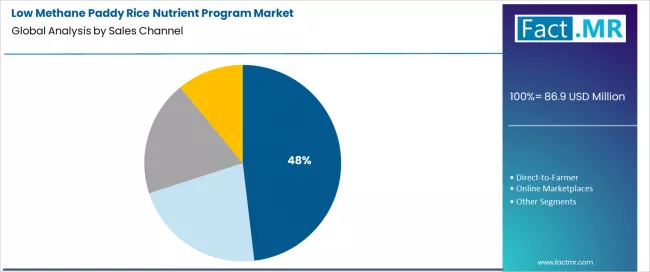
Low Methane Paddy Rice Nutrient Program Market Analysis By Sales Channel

Ag-retailers are the primary channel, holding a 48% share. In Asia's rice belts, localized retailers are the trusted source of inputs and information. For complex nutrient programs to achieve scale, they must be distributed and explained through this extensive network.

Retailers act as crucial intermediaries for educating farmers on the proper use of these specialized products to achieve both yield and emission reduction benefits, often supported by demonstration plots.

What are the Drivers, Restraints, and Key Trends of the Low Methane Paddy Rice Nutrient Program Market?

The paramount driver is the integration of agriculture into national and corporate climate action plans. Rice-producing countries face pressure to meet Nationally Determined Contributions (NDCs), while food companies seek to decarbonize supply chains. The emerging market for agricultural carbon credits provides a potential revenue stream that improves program economics. Growing scientific validation of the link between specific nutrient management practices and methane reduction also supports market development.

A key restraint is the added cost and complexity for farmers, who may be reluctant to adopt new practices without guaranteed financial return or yield benefit. Measuring, reporting, and verifying (MRV) methane reductions remains technically challenging and costly, creating a barrier to scaling carbon finance models. Furthermore, the effectiveness of nutrient programs can be highly variable depending on soil type, water management, and rice variety, requiring localized adaptation.

Key trends include the bundling of products with digital MRV tools, using simplified sensors or modeling to estimate emission reductions for carbon credit generation. There is a strong move toward integrated packages that combine fertilizers with water management advice (like alternate wetting and drying) for synergistic mitigation. Public-private partnerships are also increasing, with governments and NGOs co-investing in program roll-out to achieve climate targets, effectively de-risking adoption for the private sector and farmers.

Analysis of the Low Methane Paddy Rice Nutrient Program Market by Key Countries
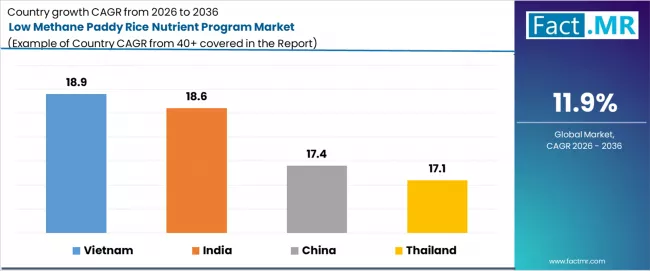
Low Methane Paddy Rice Nutrient Program Market Cagr Analysis By Country

Country CAGR (2026-2036)
Vietnam 18.9%
India 18.6%
China 17.4%
Thailand 17.1%

How is Vietnam's Delta-Centric Agriculture and Policy Driving Growth?
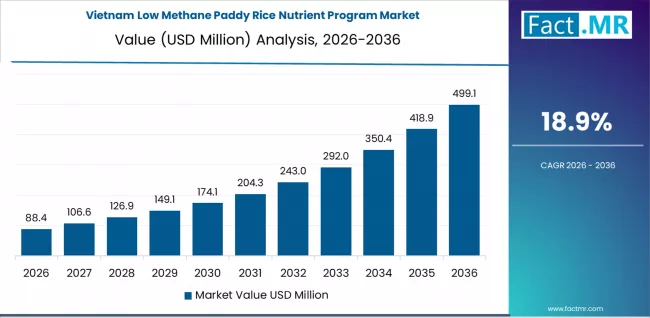
Low Methane Paddy Rice Nutrient Program Market Country Value Analysis

Vietnam’s leading CAGR of 18.9% is fueled by its high vulnerability to climate change and its strategic position as a major rice exporter. The government’s strong commitment to sustainable agriculture, outlined in policies like the Green Growth Strategy, is actively promoting low-emission rice farming.

Projects in the Mekong Delta, often supported by international climate finance, are piloting and scaling nutrient management programs integrated with water-saving techniques, creating a rapid adoption pathway.

What is the Impact of India's Scale and National Missions?

The sheer scale of its rice area and national policies like the National Mission drives India’s 18.6% growth on Sustainable Agriculture. The government’s focus on climate resilience and soil health, combined with corporate interest in sustainable sourcing from Punjab and other states, is fostering innovation. The potential to link nutrient programs to India’s carbon market framework could unlock massive scale, provided cost and MRV challenges are addressed for smallholders.

Why is China's Top-Down Approach Influencing the Market?

China’s 17.4% CAGR is underpinned by its “peak carbon” commitments and significant investment in agricultural green development. Provincial governments are tasked with reducing agricultural emissions, leading to state-supported programs that promote stabilized and controlled-release fertilizers. China’s large-scale farming operations in the north provide a conducive environment for implementing and monitoring standardized nutrient programs aimed at methane abatement.

How is Thailand's Export-Oriented Industry Shaping Adoption?

Thailand’s 17.1% growth is linked to its premium rice export market and increasing buyer demand for sustainably certified produce. The Thai Rice Department and private millers are actively promoting low-carbon rice standards.

Nutrient programs that reduce methane are a core component of these standards, allowing farmers to access better prices. This market-pull mechanism, centered on quality and branding, is a powerful driver for program adoption among Thai farmers.

Competitive Landscape of the Low Methane Paddy Rice Nutrient Program Market
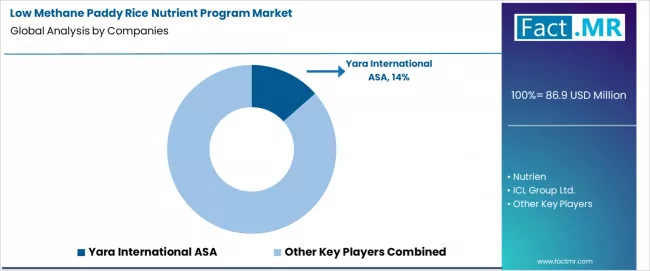
Low Methane Paddy Rice Nutrient Program Market Analysis By Company

The competitive landscape features global fertilizer and agriscience companies competing with regional specialists and sustainability project developers. Competition is based on the scientific robustness of the emission reduction claim, the development of cost-effective and farmer-friendly product formulations, and the ability to navigate the carbon credit ecosystem.

Strategic alliances are essential, often linking input suppliers with MRV technology firms, NGOs for farmer engagement, and food corporations as end-market anchors. Success depends on building a credible and scalable model that delivers tangible climate and livelihood benefits.

Key Players in the Low Methane Paddy Rice Nutrient Program Market

  • Yara International ASA
  • Nutrien
  • ICL Group Ltd.
  • EuroChem Group A.G.
  • BASF SE
  • Syngenta AG

Scope of Report

Items Values
Quantitative Units USD Million
Crop Type Cereals, Oilseeds, Fruits, Vegetables
Form Granular, Liquid, Powder, Suspension
Sales Channel Ag-Retailers, Direct-to-Farmer, Online Marketplaces, Cooperatives
Key Countries India, China, Vietnam, Thailand
Key Companies Yara International ASA, Nutrien, ICL Group Ltd., EuroChem Group A.G., BASF SE, Syngenta AG
Additional Analysis Agronomic and methane reduction efficacy of different fertilizer formulations; techno-economic analysis of carbon credit generation potential; review of MRV methodologies for paddy methane; analysis of policy frameworks and subsidies supporting adoption; supply chain models for low-carbon rice; comparative assessment of nutrient programs vs. other mitigation practices (e.g., AWD, biochar).

Market by Segments

  • Crop Type :

    • Cereals
    • Oilseeds
    • Fruits
    • Vegetables
  • Form :

    • Granular
    • Liquid
    • Powder
    • Suspension
  • Sales Channel :

    • Ag-Retailers
    • Direct-to-Farmer
    • Online Marketplaces
    • Cooperatives
  • Region :

    • North America

      • USA
      • Canada
    • Latin America

      • Brazil
      • Mexico
      • Argentina
      • Rest of Latin America
    • Western Europe

      • Germany
      • UK
      • France
      • Spain
      • Italy
      • BENELUX
      • Rest of Western Europe
    • Eastern Europe

      • Russia
      • Poland
      • Czech Republic
      • Rest of Eastern Europe
    • East Asia

      • China
      • Japan
      • South Korea
      • Rest of East Asia
    • South Asia & Pacific

      • India
      • Thailand
      • Vietnam
      • Australia
      • Rest of South Asia & Pacific
    • MEA

      • Saudi Arabia
      • UAE
      • Turkiye
      • Rest of MEA

Table of Content

  1. Executive Summary
    • Global Market Outlook
    • Demand to side Trends
    • Supply to side Trends
    • Technology Roadmap Analysis
    • Analysis and Recommendations
  2. Market Overview
    • Market Coverage / Taxonomy
    • Market Definition / Scope / Limitations
  3. Market Background
    • Market Dynamics
      • Drivers
      • Restraints
      • Opportunity
      • Trends
    • Scenario Forecast
      • Demand in Optimistic Scenario
      • Demand in Likely Scenario
      • Demand in Conservative Scenario
    • Opportunity Map Analysis
    • Product Life Cycle Analysis
    • Supply Chain Analysis
    • Investment Feasibility Matrix
    • Value Chain Analysis
    • PESTLE and Porter’s Analysis
    • Regulatory Landscape
    • Regional Parent Market Outlook
    • Production and Consumption Statistics
    • Import and Export Statistics
  4. Global Market Analysis 2021 to 2025 and Forecast, 2026 to 2036
    • Historical Market Size Value (USD Million) Analysis, 2021 to 2025
    • Current and Future Market Size Value (USD Million) Projections, 2026 to 2036
      • Y to o to Y Growth Trend Analysis
      • Absolute $ Opportunity Analysis
  5. Global Market Pricing Analysis 2021 to 2025 and Forecast 2026 to 2036
  6. Global Market Analysis 2021 to 2025 and Forecast 2026 to 2036, By Crop
    • Introduction / Key Findings
    • Historical Market Size Value (USD Million) Analysis By Crop, 2021 to 2025
    • Current and Future Market Size Value (USD Million) Analysis and Forecast By Crop, 2026 to 2036
      • Cereals
      • Oilseeds
      • Fruits
      • Vegetables
    • Y to o to Y Growth Trend Analysis By Crop, 2021 to 2025
    • Absolute $ Opportunity Analysis By Crop, 2026 to 2036
  7. Global Market Analysis 2021 to 2025 and Forecast 2026 to 2036, By Form
    • Introduction / Key Findings
    • Historical Market Size Value (USD Million) Analysis By Form, 2021 to 2025
    • Current and Future Market Size Value (USD Million) Analysis and Forecast By Form, 2026 to 2036
      • Granular
      • Liquid
      • Powder
      • Suspension
    • Y to o to Y Growth Trend Analysis By Form, 2021 to 2025
    • Absolute $ Opportunity Analysis By Form, 2026 to 2036
  8. Global Market Analysis 2021 to 2025 and Forecast 2026 to 2036, By Sales Channel
    • Introduction / Key Findings
    • Historical Market Size Value (USD Million) Analysis By Sales Channel, 2021 to 2025
    • Current and Future Market Size Value (USD Million) Analysis and Forecast By Sales Channel, 2026 to 2036
      • Ag-Retailers
      • Direct-to-Farmer
      • Online Marketplaces
      • Cooperatives
    • Y to o to Y Growth Trend Analysis By Sales Channel, 2021 to 2025
    • Absolute $ Opportunity Analysis By Sales Channel, 2026 to 2036
  9. Global Market Analysis 2021 to 2025 and Forecast 2026 to 2036, By Region
    • Introduction
    • Historical Market Size Value (USD Million) Analysis By Region, 2021 to 2025
    • Current Market Size Value (USD Million) Analysis and Forecast By Region, 2026 to 2036
      • North America
      • Latin America
      • Western Europe
      • Eastern Europe
      • East Asia
      • South Asia and Pacific
      • Middle East & Africa
    • Market Attractiveness Analysis By Region
  10. North America Market Analysis 2021 to 2025 and Forecast 2026 to 2036, By Country
    • Historical Market Size Value (USD Million) Trend Analysis By Market Taxonomy, 2021 to 2025
    • Market Size Value (USD Million) Forecast By Market Taxonomy, 2026 to 2036
      • By Country
        • USA
        • Canada
        • Mexico
      • By Crop
      • By Form
      • By Sales Channel
    • Market Attractiveness Analysis
      • By Country
      • By Crop
      • By Form
      • By Sales Channel
    • Key Takeaways
  11. Latin America Market Analysis 2021 to 2025 and Forecast 2026 to 2036, By Country
    • Historical Market Size Value (USD Million) Trend Analysis By Market Taxonomy, 2021 to 2025
    • Market Size Value (USD Million) Forecast By Market Taxonomy, 2026 to 2036
      • By Country
        • Brazil
        • Chile
        • Rest of Latin America
      • By Crop
      • By Form
      • By Sales Channel
    • Market Attractiveness Analysis
      • By Country
      • By Crop
      • By Form
      • By Sales Channel
    • Key Takeaways
  12. Western Europe Market Analysis 2021 to 2025 and Forecast 2026 to 2036, By Country
    • Historical Market Size Value (USD Million) Trend Analysis By Market Taxonomy, 2021 to 2025
    • Market Size Value (USD Million) Forecast By Market Taxonomy, 2026 to 2036
      • By Country
        • Germany
        • UK
        • Italy
        • Spain
        • France
        • Nordic
        • BENELUX
        • Rest of Western Europe
      • By Crop
      • By Form
      • By Sales Channel
    • Market Attractiveness Analysis
      • By Country
      • By Crop
      • By Form
      • By Sales Channel
    • Key Takeaways
  13. Eastern Europe Market Analysis 2021 to 2025 and Forecast 2026 to 2036, By Country
    • Historical Market Size Value (USD Million) Trend Analysis By Market Taxonomy, 2021 to 2025
    • Market Size Value (USD Million) Forecast By Market Taxonomy, 2026 to 2036
      • By Country
        • Russia
        • Poland
        • Hungary
        • Balkan & Baltic
        • Rest of Eastern Europe
      • By Crop
      • By Form
      • By Sales Channel
    • Market Attractiveness Analysis
      • By Country
      • By Crop
      • By Form
      • By Sales Channel
    • Key Takeaways
  14. East Asia Market Analysis 2021 to 2025 and Forecast 2026 to 2036, By Country
    • Historical Market Size Value (USD Million) Trend Analysis By Market Taxonomy, 2021 to 2025
    • Market Size Value (USD Million) Forecast By Market Taxonomy, 2026 to 2036
      • By Country
        • China
        • Japan
        • South Korea
      • By Crop
      • By Form
      • By Sales Channel
    • Market Attractiveness Analysis
      • By Country
      • By Crop
      • By Form
      • By Sales Channel
    • Key Takeaways
  15. South Asia and Pacific Market Analysis 2021 to 2025 and Forecast 2026 to 2036, By Country
    • Historical Market Size Value (USD Million) Trend Analysis By Market Taxonomy, 2021 to 2025
    • Market Size Value (USD Million) Forecast By Market Taxonomy, 2026 to 2036
      • By Country
        • India
        • ASEAN
        • Australia & New Zealand
        • Rest of South Asia and Pacific
      • By Crop
      • By Form
      • By Sales Channel
    • Market Attractiveness Analysis
      • By Country
      • By Crop
      • By Form
      • By Sales Channel
    • Key Takeaways
  16. Middle East & Africa Market Analysis 2021 to 2025 and Forecast 2026 to 2036, By Country
    • Historical Market Size Value (USD Million) Trend Analysis By Market Taxonomy, 2021 to 2025
    • Market Size Value (USD Million) Forecast By Market Taxonomy, 2026 to 2036
      • By Country
        • Kingdom of Saudi Arabia
        • Other GCC Countries
        • Turkiye
        • South Africa
        • Other African Union
        • Rest of Middle East & Africa
      • By Crop
      • By Form
      • By Sales Channel
    • Market Attractiveness Analysis
      • By Country
      • By Crop
      • By Form
      • By Sales Channel
    • Key Takeaways
  17. Key Countries Market Analysis
    • USA
      • Pricing Analysis
      • Market Share Analysis, 2025
        • By Crop
        • By Form
        • By Sales Channel
    • Canada
      • Pricing Analysis
      • Market Share Analysis, 2025
        • By Crop
        • By Form
        • By Sales Channel
    • Mexico
      • Pricing Analysis
      • Market Share Analysis, 2025
        • By Crop
        • By Form
        • By Sales Channel
    • Brazil
      • Pricing Analysis
      • Market Share Analysis, 2025
        • By Crop
        • By Form
        • By Sales Channel
    • Chile
      • Pricing Analysis
      • Market Share Analysis, 2025
        • By Crop
        • By Form
        • By Sales Channel
    • Germany
      • Pricing Analysis
      • Market Share Analysis, 2025
        • By Crop
        • By Form
        • By Sales Channel
    • UK
      • Pricing Analysis
      • Market Share Analysis, 2025
        • By Crop
        • By Form
        • By Sales Channel
    • Italy
      • Pricing Analysis
      • Market Share Analysis, 2025
        • By Crop
        • By Form
        • By Sales Channel
    • Spain
      • Pricing Analysis
      • Market Share Analysis, 2025
        • By Crop
        • By Form
        • By Sales Channel
    • France
      • Pricing Analysis
      • Market Share Analysis, 2025
        • By Crop
        • By Form
        • By Sales Channel
    • India
      • Pricing Analysis
      • Market Share Analysis, 2025
        • By Crop
        • By Form
        • By Sales Channel
    • ASEAN
      • Pricing Analysis
      • Market Share Analysis, 2025
        • By Crop
        • By Form
        • By Sales Channel
    • Australia & New Zealand
      • Pricing Analysis
      • Market Share Analysis, 2025
        • By Crop
        • By Form
        • By Sales Channel
    • China
      • Pricing Analysis
      • Market Share Analysis, 2025
        • By Crop
        • By Form
        • By Sales Channel
    • Japan
      • Pricing Analysis
      • Market Share Analysis, 2025
        • By Crop
        • By Form
        • By Sales Channel
    • South Korea
      • Pricing Analysis
      • Market Share Analysis, 2025
        • By Crop
        • By Form
        • By Sales Channel
    • Russia
      • Pricing Analysis
      • Market Share Analysis, 2025
        • By Crop
        • By Form
        • By Sales Channel
    • Poland
      • Pricing Analysis
      • Market Share Analysis, 2025
        • By Crop
        • By Form
        • By Sales Channel
    • Hungary
      • Pricing Analysis
      • Market Share Analysis, 2025
        • By Crop
        • By Form
        • By Sales Channel
    • Kingdom of Saudi Arabia
      • Pricing Analysis
      • Market Share Analysis, 2025
        • By Crop
        • By Form
        • By Sales Channel
    • Turkiye
      • Pricing Analysis
      • Market Share Analysis, 2025
        • By Crop
        • By Form
        • By Sales Channel
    • South Africa
      • Pricing Analysis
      • Market Share Analysis, 2025
        • By Crop
        • By Form
        • By Sales Channel
  18. Market Structure Analysis
    • Competition Dashboard
    • Competition Benchmarking
    • Market Share Analysis of Top Players
      • By Regional
      • By Crop
      • By Form
      • By Sales Channel
  19. Competition Analysis
    • Competition Deep Dive
      • Yara International ASA
        • Overview
        • Product Portfolio
        • Profitability by Market Segments (Product/Age /Sales Channel/Region)
        • Sales Footprint
        • Strategy Overview
          • Marketing Strategy
          • Product Strategy
          • Channel Strategy
      • Nutrien
      • ICL Group Ltd.
      • EuroChem Group A.G.
      • BASF SE
      • Syngenta AG
  20. Assumptions & Acronyms Used
  21. Research Methodology

List Of Table

  • Table 1: Global Market Value (USD Million) Forecast by Region, 2021 to 2036
  • Table 2: Global Market Value (USD Million) Forecast by Crop, 2021 to 2036
  • Table 3: Global Market Value (USD Million) Forecast by Form, 2021 to 2036
  • Table 4: Global Market Value (USD Million) Forecast by Sales Channel, 2021 to 2036
  • Table 5: North America Market Value (USD Million) Forecast by Country, 2021 to 2036
  • Table 6: North America Market Value (USD Million) Forecast by Crop, 2021 to 2036
  • Table 7: North America Market Value (USD Million) Forecast by Form, 2021 to 2036
  • Table 8: North America Market Value (USD Million) Forecast by Sales Channel, 2021 to 2036
  • Table 9: Latin America Market Value (USD Million) Forecast by Country, 2021 to 2036
  • Table 10: Latin America Market Value (USD Million) Forecast by Crop, 2021 to 2036
  • Table 11: Latin America Market Value (USD Million) Forecast by Form, 2021 to 2036
  • Table 12: Latin America Market Value (USD Million) Forecast by Sales Channel, 2021 to 2036
  • Table 13: Western Europe Market Value (USD Million) Forecast by Country, 2021 to 2036
  • Table 14: Western Europe Market Value (USD Million) Forecast by Crop, 2021 to 2036
  • Table 15: Western Europe Market Value (USD Million) Forecast by Form, 2021 to 2036
  • Table 16: Western Europe Market Value (USD Million) Forecast by Sales Channel, 2021 to 2036
  • Table 17: Eastern Europe Market Value (USD Million) Forecast by Country, 2021 to 2036
  • Table 18: Eastern Europe Market Value (USD Million) Forecast by Crop, 2021 to 2036
  • Table 19: Eastern Europe Market Value (USD Million) Forecast by Form, 2021 to 2036
  • Table 20: Eastern Europe Market Value (USD Million) Forecast by Sales Channel, 2021 to 2036
  • Table 21: East Asia Market Value (USD Million) Forecast by Country, 2021 to 2036
  • Table 22: East Asia Market Value (USD Million) Forecast by Crop, 2021 to 2036
  • Table 23: East Asia Market Value (USD Million) Forecast by Form, 2021 to 2036
  • Table 24: East Asia Market Value (USD Million) Forecast by Sales Channel, 2021 to 2036
  • Table 25: South Asia and Pacific Market Value (USD Million) Forecast by Country, 2021 to 2036
  • Table 26: South Asia and Pacific Market Value (USD Million) Forecast by Crop, 2021 to 2036
  • Table 27: South Asia and Pacific Market Value (USD Million) Forecast by Form, 2021 to 2036
  • Table 28: South Asia and Pacific Market Value (USD Million) Forecast by Sales Channel, 2021 to 2036
  • Table 29: Middle East & Africa Market Value (USD Million) Forecast by Country, 2021 to 2036
  • Table 30: Middle East & Africa Market Value (USD Million) Forecast by Crop, 2021 to 2036
  • Table 31: Middle East & Africa Market Value (USD Million) Forecast by Form, 2021 to 2036
  • Table 32: Middle East & Africa Market Value (USD Million) Forecast by Sales Channel, 2021 to 2036

List Of Figures

  • Figure 1: Global Market Pricing Analysis
  • Figure 2: Global Market Value (USD Million) Forecast 2021 to 2036
  • Figure 3: Global Market Value Share and BPS Analysis by Crop, 2026 and 2036
  • Figure 4: Global Market Y to o to Y Growth Comparison by Crop, 2026 to 2036
  • Figure 5: Global Market Attractiveness Analysis by Crop
  • Figure 6: Global Market Value Share and BPS Analysis by Form, 2026 and 2036
  • Figure 7: Global Market Y to o to Y Growth Comparison by Form, 2026 to 2036
  • Figure 8: Global Market Attractiveness Analysis by Form
  • Figure 9: Global Market Value Share and BPS Analysis by Sales Channel, 2026 and 2036
  • Figure 10: Global Market Y to o to Y Growth Comparison by Sales Channel, 2026 to 2036
  • Figure 11: Global Market Attractiveness Analysis by Sales Channel
  • Figure 12: Global Market Value (USD Million) Share and BPS Analysis by Region, 2026 and 2036
  • Figure 13: Global Market Y to o to Y Growth Comparison by Region, 2026 to 2036
  • Figure 14: Global Market Attractiveness Analysis by Region
  • Figure 15: North America Market Incremental Dollar Opportunity, 2026 to 2036
  • Figure 16: Latin America Market Incremental Dollar Opportunity, 2026 to 2036
  • Figure 17: Western Europe Market Incremental Dollar Opportunity, 2026 to 2036
  • Figure 18: Eastern Europe Market Incremental Dollar Opportunity, 2026 to 2036
  • Figure 19: East Asia Market Incremental Dollar Opportunity, 2026 to 2036
  • Figure 20: South Asia and Pacific Market Incremental Dollar Opportunity, 2026 to 2036
  • Figure 21: Middle East & Africa Market Incremental Dollar Opportunity, 2026 to 2036
  • Figure 22: North America Market Value Share and BPS Analysis by Country, 2026 and 2036
  • Figure 23: North America Market Value Share and BPS Analysis by Crop, 2026 and 2036
  • Figure 24: North America Market Y to o to Y Growth Comparison by Crop, 2026 to 2036
  • Figure 25: North America Market Attractiveness Analysis by Crop
  • Figure 26: North America Market Value Share and BPS Analysis by Form, 2026 and 2036
  • Figure 27: North America Market Y to o to Y Growth Comparison by Form, 2026 to 2036
  • Figure 28: North America Market Attractiveness Analysis by Form
  • Figure 29: North America Market Value Share and BPS Analysis by Sales Channel, 2026 and 2036
  • Figure 30: North America Market Y to o to Y Growth Comparison by Sales Channel, 2026 to 2036
  • Figure 31: North America Market Attractiveness Analysis by Sales Channel
  • Figure 32: Latin America Market Value Share and BPS Analysis by Country, 2026 and 2036
  • Figure 33: Latin America Market Value Share and BPS Analysis by Crop, 2026 and 2036
  • Figure 34: Latin America Market Y to o to Y Growth Comparison by Crop, 2026 to 2036
  • Figure 35: Latin America Market Attractiveness Analysis by Crop
  • Figure 36: Latin America Market Value Share and BPS Analysis by Form, 2026 and 2036
  • Figure 37: Latin America Market Y to o to Y Growth Comparison by Form, 2026 to 2036
  • Figure 38: Latin America Market Attractiveness Analysis by Form
  • Figure 39: Latin America Market Value Share and BPS Analysis by Sales Channel, 2026 and 2036
  • Figure 40: Latin America Market Y to o to Y Growth Comparison by Sales Channel, 2026 to 2036
  • Figure 41: Latin America Market Attractiveness Analysis by Sales Channel
  • Figure 42: Western Europe Market Value Share and BPS Analysis by Country, 2026 and 2036
  • Figure 43: Western Europe Market Value Share and BPS Analysis by Crop, 2026 and 2036
  • Figure 44: Western Europe Market Y to o to Y Growth Comparison by Crop, 2026 to 2036
  • Figure 45: Western Europe Market Attractiveness Analysis by Crop
  • Figure 46: Western Europe Market Value Share and BPS Analysis by Form, 2026 and 2036
  • Figure 47: Western Europe Market Y to o to Y Growth Comparison by Form, 2026 to 2036
  • Figure 48: Western Europe Market Attractiveness Analysis by Form
  • Figure 49: Western Europe Market Value Share and BPS Analysis by Sales Channel, 2026 and 2036
  • Figure 50: Western Europe Market Y to o to Y Growth Comparison by Sales Channel, 2026 to 2036
  • Figure 51: Western Europe Market Attractiveness Analysis by Sales Channel
  • Figure 52: Eastern Europe Market Value Share and BPS Analysis by Country, 2026 and 2036
  • Figure 53: Eastern Europe Market Value Share and BPS Analysis by Crop, 2026 and 2036
  • Figure 54: Eastern Europe Market Y to o to Y Growth Comparison by Crop, 2026 to 2036
  • Figure 55: Eastern Europe Market Attractiveness Analysis by Crop
  • Figure 56: Eastern Europe Market Value Share and BPS Analysis by Form, 2026 and 2036
  • Figure 57: Eastern Europe Market Y to o to Y Growth Comparison by Form, 2026 to 2036
  • Figure 58: Eastern Europe Market Attractiveness Analysis by Form
  • Figure 59: Eastern Europe Market Value Share and BPS Analysis by Sales Channel, 2026 and 2036
  • Figure 60: Eastern Europe Market Y to o to Y Growth Comparison by Sales Channel, 2026 to 2036
  • Figure 61: Eastern Europe Market Attractiveness Analysis by Sales Channel
  • Figure 62: East Asia Market Value Share and BPS Analysis by Country, 2026 and 2036
  • Figure 63: East Asia Market Value Share and BPS Analysis by Crop, 2026 and 2036
  • Figure 64: East Asia Market Y to o to Y Growth Comparison by Crop, 2026 to 2036
  • Figure 65: East Asia Market Attractiveness Analysis by Crop
  • Figure 66: East Asia Market Value Share and BPS Analysis by Form, 2026 and 2036
  • Figure 67: East Asia Market Y to o to Y Growth Comparison by Form, 2026 to 2036
  • Figure 68: East Asia Market Attractiveness Analysis by Form
  • Figure 69: East Asia Market Value Share and BPS Analysis by Sales Channel, 2026 and 2036
  • Figure 70: East Asia Market Y to o to Y Growth Comparison by Sales Channel, 2026 to 2036
  • Figure 71: East Asia Market Attractiveness Analysis by Sales Channel
  • Figure 72: South Asia and Pacific Market Value Share and BPS Analysis by Country, 2026 and 2036
  • Figure 73: South Asia and Pacific Market Value Share and BPS Analysis by Crop, 2026 and 2036
  • Figure 74: South Asia and Pacific Market Y to o to Y Growth Comparison by Crop, 2026 to 2036
  • Figure 75: South Asia and Pacific Market Attractiveness Analysis by Crop
  • Figure 76: South Asia and Pacific Market Value Share and BPS Analysis by Form, 2026 and 2036
  • Figure 77: South Asia and Pacific Market Y to o to Y Growth Comparison by Form, 2026 to 2036
  • Figure 78: South Asia and Pacific Market Attractiveness Analysis by Form
  • Figure 79: South Asia and Pacific Market Value Share and BPS Analysis by Sales Channel, 2026 and 2036
  • Figure 80: South Asia and Pacific Market Y to o to Y Growth Comparison by Sales Channel, 2026 to 2036
  • Figure 81: South Asia and Pacific Market Attractiveness Analysis by Sales Channel
  • Figure 82: Middle East & Africa Market Value Share and BPS Analysis by Country, 2026 and 2036
  • Figure 83: Middle East & Africa Market Value Share and BPS Analysis by Crop, 2026 and 2036
  • Figure 84: Middle East & Africa Market Y to o to Y Growth Comparison by Crop, 2026 to 2036
  • Figure 85: Middle East & Africa Market Attractiveness Analysis by Crop
  • Figure 86: Middle East & Africa Market Value Share and BPS Analysis by Form, 2026 and 2036
  • Figure 87: Middle East & Africa Market Y to o to Y Growth Comparison by Form, 2026 to 2036
  • Figure 88: Middle East & Africa Market Attractiveness Analysis by Form
  • Figure 89: Middle East & Africa Market Value Share and BPS Analysis by Sales Channel, 2026 and 2036
  • Figure 90: Middle East & Africa Market Y to o to Y Growth Comparison by Sales Channel, 2026 to 2036
  • Figure 91: Middle East & Africa Market Attractiveness Analysis by Sales Channel
  • Figure 92: Global Market - Tier Structure Analysis
  • Figure 93: Global Market - Company Share Analysis

- FAQs -

How big is the low methane paddy rice nutrient program market in 2026?

The global low methane paddy rice nutrient program market is estimated to be valued at USD 86.9 million in 2026.

What will be the size of low methane paddy rice nutrient program market in 2036?

The market size for the low methane paddy rice nutrient program market is projected to reach USD 267.4 million by 2036.

How much will be the low methane paddy rice nutrient program market growth between 2026 and 2036?

The low methane paddy rice nutrient program market is expected to grow at a 11.9% CAGR between 2026 and 2036.

What are the key product types in the low methane paddy rice nutrient program market?

The key product types in low methane paddy rice nutrient program market are cereals, oilseeds, fruits and vegetables.

Which form segment to contribute significant share in the low methane paddy rice nutrient program market in 2026?

In terms of form, granular segment to command 36.9% share in the low methane paddy rice nutrient program market in 2026.

Low Methane Paddy Rice Nutrient Program Market