- Market Value (2025): USD 2.6 Bn
- Estimated Value (2026): USD 3.0 Bn
- Forecast Value (2036): USD 11.4 Bn
- CAGR (2026-2036): 14.2%
What is the Fast-Degrade Packaging Resins Market forecast to be worth by 2036?
USD 3.0 billion in 2026 to USD 11.4 billion by 2036, at 14.2% CAGR.
- The Fast-Degrade Packaging Resins Market reached USD 2.6 billion in 2025.
- Demand is projected to increase from USD 3.0 billion in 2026 to USD 11.4 billion by 2036.
- The market is forecast to record 14.2% CAGR from 2026 to 2036 as converters qualify PHA, PBAT blends and PLA blends for defined disposal routes.
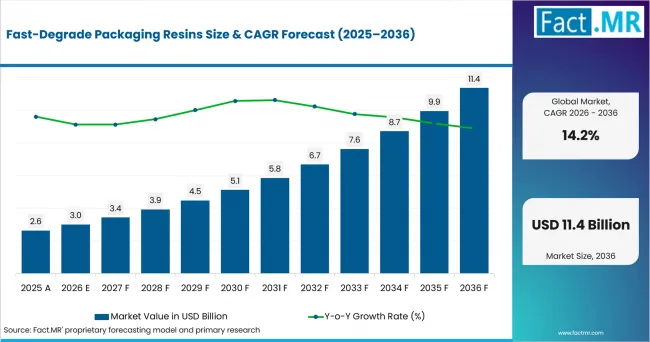
Fast Degrade Packaging Resins Value Analysis | Source: Fact.MR
What are the defining numbers behind Fast-Degrade Packaging Resins Market growth?
USD 8.3 billion absolute opportunity by 2036, led by PHA, industrial compost and flexible films.
- Demand Drivers in the Market
- Packaging converters need resin grades that run on familiar film, coating and lamination equipment while meeting a clear end-of-life claim.
- Foodservice brands need certified materials for cups, lids, wrappers and liners that often carry grease or food residue after use.
- Retailers need lighter flexible films and bags that support disposal instructions while retaining sealing behavior during storage and delivery.
- Material developers need stronger evidence on barrier retention since faster breakdown must work with shelf-life and product-safety needs.
- Key Segments Analyzed
- By Resin Platform: PHA is projected to hold 28.0% share in 2026 due to its biological production route and fit with compostable packaging claims.
- By Degradation Environment: Industrial compost is estimated to account for 31.0% share in 2026 owing to clearer certification paths and controlled processing conditions.
- By Packaging Format: Flexible films are anticipated to capture 35.0% share in 2026 because wrappers and liners use low material weight per pack.
- By Performance Trade-off: Fast biodegradation is forecast to represent 27.0% share in 2026, reinforced by buyer interest in verified breakdown after short use.
- Analyst Opinion at Fact.MR
- Shambhu Nath Jha, Principal Consultant at Fact.MR, states, “The commercial test is moving from whether a resin sounds compostable to whether the pack has a practical disposal route. Brands are expected to ask where the pack is collected and how its barrier performance behaves before disposal. Suppliers that combine certification evidence, converter support and application-level test data are better placed to win repeat programs.”
- Strategic Implications
- Resin producers should publish degradation, food-contact and conversion data by application so brand teams approve materials with fewer trial cycles.
- Film converters should align resin selection with the disposal instruction printed on the pack before committing to wider launch volumes.
- Foodservice operators should pair compostable formats with collection partners because end-of-life claims lose value when recovery access is weak.
- Retail packaging teams should compare resin price with pack weight, EPR exposure and returned-goods risk before choosing a degradation target.
Japan is forecast to record 17.1% CAGR through 2036, led by bio-based plastic policy targets and disciplined packaging recovery. The USA is projected to post 16.5% CAGR as online retail volume pushes brands to review short-use films and liners. Germany is estimated to reach 15.8% CAGR due to EU packaging rules and mature recovery systems. The UK is anticipated to advance at 11.4% CAGR because EPR fee design raises packaging-material scrutiny. Italy is expected to record 11.1% CAGR through compostable bag use and municipal organics links.
How does the Fast-Degrade Packaging Resins Market break down by segment?
PHA leads Resin Platform at 28.0%; flexible films lead Packaging Format at 35.0%.
Which Resin Platform dominates?
PHA holds 28.0% share in 2026.
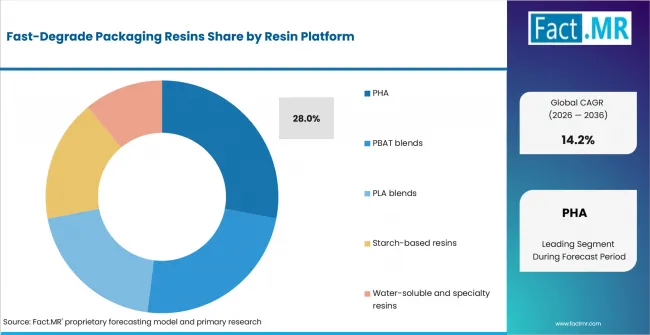
Fast Degrade Packaging Resins Analysis By Resin Platform | Source: Fact.MR
PHA leads the resin platform mix due to its biological production route and credible degradation behavior. It fits formats where a short service life needs a defined end-of-life route. CJ Biomaterials introduced a new PHA platform in October 2025 for extrusion coating on paper and board used in foodservice and food packaging applications.
The platform combines amorphous and semi-crystalline PHA grades for adhesion, sealing and grease resistance on paper and board. That material design supports coated paper packs where converters want compostability while protecting cup, tray and wrap performance.
What leads the Degradation Environment segment?
Industrial compost holds 31.0% share in 2026.
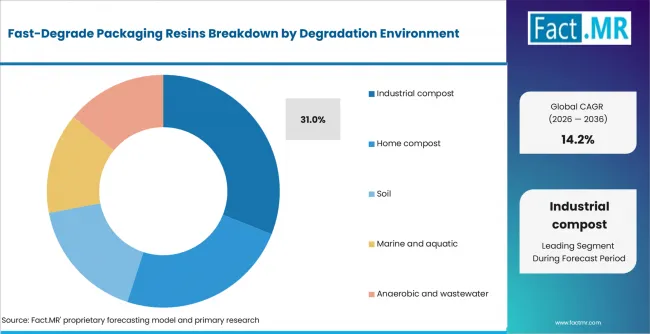
Fast Degrade Packaging Resins Analysis By Degradation Environment | Source: Fact.MR
Industrial compost leads the degradation environment segment since facility conditions are more controlled than backyard disposal or open soil exposure. Time, heat and microbial activity are easier to specify, making certification easier to use in packaging approval reviews.
European Bioplastics reported in December 2025 that packaging represented 41.3% of global bioplastics production capacity in 2025, equal to 0.95 million tonnes. A large packaging base gives industrial compost grades a practical route into bags, liners and food-contact films.
How does Packaging Format shape demand?
Flexible films account for 35.0% share in 2026.
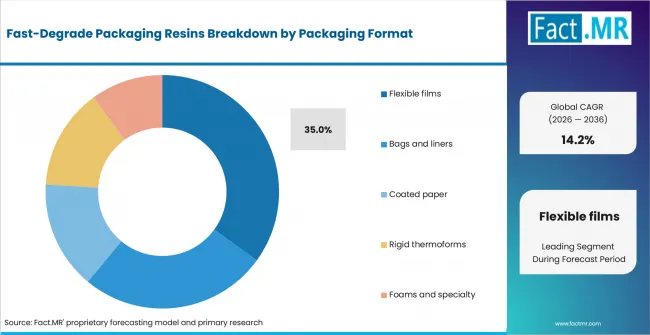
Fast Degrade Packaging Resins Analysis By Packaging Format | Source: Fact.MR
Flexible films account for the leading format share owing to their use in many short-use packaging jobs with low material weight. Sachets, wrap films and liners give brand teams a lower-risk way to test faster-degrading resins before moving into rigid formats.
NatureWorks introduced Ingeo Extend in March 2025 for BOPLA films. The first grade supports transverse-direction stretch up to 7x and faster biodegradation compared with unmodified Ingeo PLA, depending on how much is added to the blend.
What supports Fast biodegradation within Performance Trade-off?
Fast biodegradation represents 27.0% share in 2026.
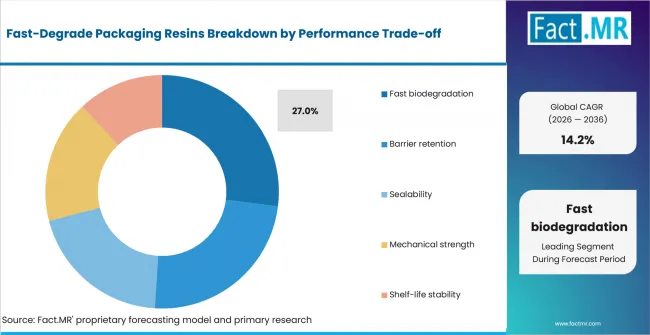
Fast Degrade Packaging Resins Analysis By Performance Trade Off | Source: Fact.MR
Fast biodegradation leads the performance trade-off mix due to shorter breakdown timelines after use. Packaging developers still need sealability and shelf-life stability, so resin approval depends on a careful balance between disposal speed and pack function.
Eurostat reported in October 2025 that the EU generated 35.3 kg of plastic packaging waste per person in 2023. The figure gives brands and regulators a direct reason to examine materials that lower persistent short-use packaging burdens.
What is accelerating Fast-Degrade Packaging Resins Market adoption, and what is holding it back?
Demand is expected to rise through compostability rules, short-use packaging redesign and verified disposal claims.
Drivers Impact Analysis
| DRIVER | (~) % IMPACT ON CAGR | GEOGRAPHIC RELEVANCE | IMPACT TIMELINE |
|---|---|---|---|
| Short-use packaging redesign | +1.6% | Global | Short term (<= 2 years) |
| Industrial compost certification | +1.3% | Europe, North America | Medium term (2-4 years) |
| Foodservice residue management | +1.0% | USA, Japan, Italy | Medium term (2-4 years) |
| PHA and PLA format innovation | +0.8% | Global | Long term (>= 4 years) |
Source: Fact.MR analysis. Updated Sep 7, 2026
- Short-use packaging redesign: Brand owners are testing resins where films, bags and liners create disposal pressure after brief use.
- Industrial compost certification: Controlled facilities make claims easier to specify than unmanaged outdoor environments.
- Foodservice residue management: Compostable packs gain value when food residue limits paper recovery or conventional plastic sorting.
- PHA and PLA format innovation: New coating and film grades help converters test fast-degrade materials in familiar formats.
Opportunity Impact Analysis
| OPPORTUNITY | (~) % IMPACT ON CAGR | GEOGRAPHIC RELEVANCE | IMPACT TIMELINE |
|---|---|---|---|
| Coated paper substitution | +1.2% | Europe, Japan | Medium term (2-4 years) |
| Home-compostable flexible packaging | +0.9% | USA, Germany, UK | Medium term (2-4 years) |
| Foodservice takeout formats | +0.7% | USA, Italy, Japan | Short term (<= 2 years) |
Source: Fact.MR analysis. Updated Sep 7, 2026
- Coated paper substitution: PHA and PBAT blend coatings are expected to replace plastic barriers where paper packs need compostability.
- Home-compostable flexible packaging: BASF, Novamont and CJ Biomaterials are building portfolios around clearer end-of-life options.
- Foodservice takeout formats: Bowls, lids and liners offer repeat applications for grease-resistant degradable resins.
Restraints Impact Analysis
| RESTRAINT | (~) % IMPACT ON CAGR | GEOGRAPHIC RELEVANCE | IMPACT TIMELINE |
|---|---|---|---|
| Compost access gaps | -0.7% | Global | Short term (<= 2 years) |
| Barrier and seal trade-offs | -0.5% | Global | Medium term (2-4 years) |
| Resin cost pressure | -0.4% | North America, Europe | Short term (<= 2 years) |
Source: Fact.MR analysis. Updated Sep 7, 2026
- Compost access gaps: Fast degradation claims are harder to monetize where consumers have limited access to suitable treatment routes.
- Barrier and seal trade-offs: Faster breakdown is likely to narrow the design window for oily, wet or oxygen-sensitive products.
- Resin cost pressure: Material substitution has to compete with conventional plastic grades that remain familiar to converters.
Which countries are scaling the Fast-Degrade Packaging Resins Market through 2036?
- The country comparison spans 5.99 percentage points and forms three practical growth bands across the forecast period.
- Japan remains 0.55 percentage point above the USA on the back of bio-based plastic policy targets and packaging recovery discipline.
- The USA remains 0.71 percentage point above Germany as online retail sales widen trials for lightweight films and liners.
- Germany remains 4.39 percentage points above the UK because EU packaging rules and recycling systems sharpen material approval.
- The UK remains 0.34 percentage point above Italy as EPR fees and retailer packaging reviews influence resin choices.
- Italy closes the displayed range through compostable bag experience and municipal collection links.
Comparable CAGRs create different entry conditions due to disposal rules, compost access and retail packaging habits. Full report coverage includes North America, Latin America, Western Europe, Eastern Europe, East Asia, South Asia & Pacific, Middle East & Africa.
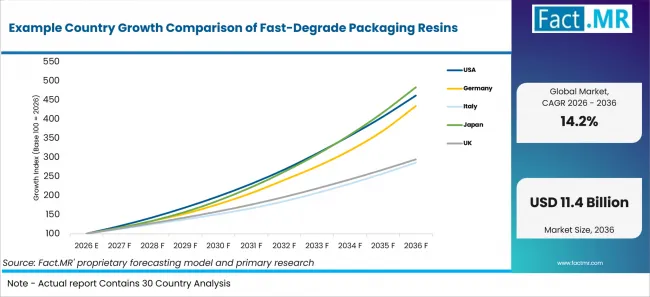
Example Country Growth Comparison Of Fast Degrade Packaging Resins | Source: Fact.MR
| Country | CAGR (2026-2036) |
|---|---|
| Japan | 17.1% |
| USA | 16.5% |
| Germany | 15.8% |
| UK | 11.4% |
| Italy | 11.1% |
Source: Fact.MR analysis. Updated Sep 7, 2026
What supports Japan adoption?
17.1% CAGR, led by bio-based plastic policy and packaging recovery discipline.
Japan's packaging buyers evaluate fast-degrade resins against national plastic milestones and foodservice disposal habits. OECD's 2025 review states that Japan's 2019 Resource Circulation Strategy for Plastics targets a 25% total reduction in single-use plastics by 2030. Japan is forecast to record 17.1% CAGR through 2036 as PHA and PLA formats align with coated paper, takeout packs and controlled degradation claims.
What supports USA adoption?
16.5% CAGR, supported by online retail volume and compostable format trials.
The U.S. Census Bureau reported seasonally adjusted retail e-commerce sales of USD 340.2 billion in Q2 2026. The USA to expand at 16.5% CAGR through 2036 and identifies flexible films, bags and liners as potential entry formats for resin substitution.
What supports Germany adoption?
15.8% CAGR, supported by EU packaging rules and recovery discipline.
Germany operates within established packaging-recycling systems and the EU Packaging and Packaging Waste Regulation. UBA and ZSVR reported in January 2026 that around 5.5 million tonnes of packaging waste collected by Germany’s dual systems were recovered in 2024. German market to expand at 15.8% CAGR through 2036.
What supports UK growth?
11.4% CAGR, shaped by EPR fees and retailer packaging reviews.
UK packaging producers operate under extended producer responsibility disposal fees. PackUK set the 2025-2026 base fee for plastic packaging at GBP 423 per tonne and is introducing fee modulation based on recyclability from 2026-2027. The UK market to expand at 11.4% CAGR through 2036.
What supports Italy adoption?
11.1% CAGR, supported by compostable bag use and municipal collection links.
CONAI reports that 47,511 tonnes of biodegradable and compostable plastic packaging were recycled through the organic-recycling stream in Italy in 2024, up from 43,496 tonnes in 2023.
Who leads the Fast-Degrade Packaging Resins Market?
BASF participates through ecovio®, including certified compostable grades for flexible barrier packaging. Novamont competes through MATER-BI®, a family of biodegradable and compostable bioplastics used in bags, food packaging, foodservice and agriculture. Its January 2026 MATER-BI visual-identity release also highlighted a verified carbon footprint supported by Novamont’s ISO 14067 certification.
Teknor Apex acquired Danimer Scientific in June 2025, adding Danimer’s biodegradable-material and biopolymer capabilities to its broader sustainable-materials portfolio. CJ Biomaterials participates through PHA coating platforms, including its PHACT™ extrusion-coating system for paper and board foodservice and food-packaging applications, while NatureWorks competes through Ingeo™ PLA technologies for BOPLA films. TotalEnergies Corbion supplies Luminy® PLA for rigid packaging, foodserviceware and flexible-packaging applications.
Which companies are the key providers?
Key companies include BASF; Novamont; Teknor Apex (Danimer Scientific); CJ Biomaterials; NatureWorks; and TotalEnergies Corbion.
- BASF
- Novamont
- Teknor Apex (Danimer Scientific)
- CJ Biomaterials
- NatureWorks
- TotalEnergies Corbion
Bibliography
- BASF. (2026, April 29). New ecovio® portfolio for flexible packaging: Multiple barrier options combined with organic or paper recycling.
- CJ Biomaterials. (2025, October 1). CJ Biomaterials launches new PHA platform for extrusion coatings.
- CONAI. (2025). Sustainability report 2025.
- European Bioplastics. (2025, December 2). EUBP presents the results of the 2025 market data report.
- Eurostat. (2025, October 22). Plastic packaging waste in the EU: 35.3 kg per person.
- European Parliament, & Council of the European Union. (2025, January 22). Regulation (EU) 2025/40 of the European Parliament and of the Council of 19 December 2024 on packaging and packaging waste, amending Regulation (EU) 2019/1020 and Directive (EU) 2019/904, and repealing Directive 94/62/EC.
- NatureWorks. (2025, March 18). Ingeo™ Extend: An exceptional solution offering unprecedented manufacturing efficiency and faster biodegradability of BOPLA films.
- Novamont. (2026, January 15). Mater-Bi takes on a new look: Novamont unveils its rebranding and communication campaign.
- OECD. (2025, July 30). Regional plastics outlook for Southeast and East Asia. OECD Publishing.
- PackUK. (2025, June 30). Extended Producer Responsibility for Packaging: 2025 base fees.
- Teknor Apex. (2025, June 10). Teknor Apex acquires Danimer Scientific to further diversify sustainable materials portfolio.
- U.S. Census Bureau. (2026, August 18). Quarterly retail e-commerce sales.
- German Environment Agency, & Central Agency Packaging Register. (2026, January 27). Facts against myths: Packaging waste recycling in Germany is working.
This Report Answers
- The report explains where fast-degrade packaging resins are used across resin platforms and degradation environments.
- Segment analysis identifies the leading subsegments and the technical reasons converters prioritize them.
- Country analysis examines the listed markets and the policy or infrastructure mechanisms supporting resin substitution.
- Competitive analysis reviews active providers across PHA, PBAT blends, PLA and compostable coating systems.
- Application analysis assesses how degradation speed, barrier retention and sealability influence material selection.
What does the Fast-Degrade Packaging Resins Market cover?
The Fast-Degrade Packaging Resins Market covers resins used in packaging formats that need defined breakdown behavior after use. It includes PHA, PBAT blends, PLA blends, starch-based resins and specialty materials used in flexible films, bags, liners, coated paper and selected rigid formats.
Adjacent material categories include biodegradable packaging materials, where resin behavior is evaluated against pack function and disposal route. The boundary also touches bioplastics for packaging when brand teams compare PLA, PHA and starch-based systems.
What is included in the scope?
The scope includes commercial resin grades, blends and compounds sold for packaging where biodegradation or compostability is a claimed feature. It covers extrusion coating, film extrusion, lamination, thermoforming and foamed structures when the material is sold for packaging use.
Packaging applications overlap with sustainable plastic packaging when resin selection balances reduced persistent waste with pack protection. Biodegradable wrap systems are included as a downstream format reference for food wrapping and produce packaging use cases.
What is excluded from the scope?
The scope excludes conventional fossil packaging resins sold without a degradation claim. Paper-only packaging, ordinary recycled plastic packaging, agricultural mulch films outside packaging, equipment and waste-management services are outside the market boundary.
Waste bioplastics resins are treated as an adjacent recovery topic when the discussion moves from packaging resin selection into post-use resin handling. Zero waste packaging is a broader downstream packaging theme that extends beyond resin chemistry into reuse systems and other design choices.
How Was the Analysis Built?
The analysis draws on 120+ sources, 35+ company portfolios, 25+ countries, and more than 20 industry interviews.
- Primary Research: Primary research includes discussions with manufacturers, service providers, technology developers, distributors, end users, and subject-matter experts. These conversations examine purchasing priorities, product adoption, operational challenges, approval requirements, competitive positioning, and the factors that influence wider market acceptance.
- Desk Research: Desk research covers government statistics, regulatory publications, company filings, trade data, technical studies, industry associations, standards, public policy, and other authoritative sources. Every source used in the analysis is documented in the bibliography.
- Market Sizing and Forecasting: Market estimates combine historical performance, demand indicators, pricing and volume trends, segment shares, company participation, country-level growth, adoption patterns, investment activity, and barriers to market expansion.
- Data Validation and Update Cycle: Findings are validated by comparing primary interviews with public data, company activity, regulatory changes, trade patterns, and industry developments. Regular updates review new product launches, capacity changes, partnerships, approvals, and shifts in commercial adoption.
Segmentation
What is the report’s scope and coverage?
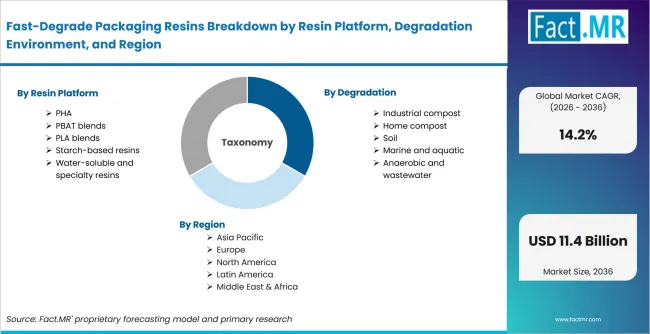
Fast Degrade Packaging Resins Breakdown By Resin Platform, Degradation Environment, And Region | Source: Fact.MR
| Attribute | Details |
|---|---|
| Quantitative Units | USD billion |
| Market Definition | Packaging resins designed for controlled degradation, compostability or related end-of-life performance in packaging applications. |
| Resin Platform | PHA; PBAT blends; PLA blends; Starch-based resins; Water-soluble and specialty resins |
| Degradation Environment | Industrial compost; Home compost; Soil; Marine and aquatic; Anaerobic and wastewater |
| Packaging Format | Flexible films; Bags and liners; Coated paper; Rigid thermoforms; Foams and specialty |
| Performance Trade-off | Fast biodegradation; Barrier retention; Sealability; Mechanical strength; Shelf-life stability |
| Regions Covered | North America; Latin America; Western Europe; Eastern Europe; East Asia; South Asia & Pacific; Middle East & Africa |
| Countries Covered | USA; Germany; Italy; Japan; UK |
| Key Companies Profiled | BASF; Novamont; Teknor Apex (Danimer Scientific); CJ Biomaterials; NatureWorks; TotalEnergies Corbion |
| Forecast Period | 2026 to 2036 |
| Approach | Hybrid top-down and bottom-up approach using resin platform review; packaging application demand; degradation environment mapping; country policy assessment; and provider portfolio validation. |
Source: Fact.MR analysis. Updated Sep 7, 2026
How is the market segmented?
-
By Resin Platform
- PHA
- PBAT blends
- PLA blends
- Starch-based resins
- Water-soluble and specialty resins
-
By Degradation Environment
- Industrial compost
- Home compost
- Soil
- Marine and aquatic
- Anaerobic and wastewater
-
By Packaging Format
- Flexible films
- Bags and liners
- Coated paper
- Rigid thermoforms
- Foams and specialty
-
By Performance Trade-off
- Fast biodegradation
- Barrier retention
- Sealability
- Mechanical strength
- Shelf-life stability
-
By Region
- North America
- Latin America
- Western Europe
- Eastern Europe
- East Asia
- South Asia & Pacific
- Middle East & Africa
Frequently Asked Questions
How big is the Fast-Degrade Packaging Resins Market in 2026?
What is the CAGR of the Fast-Degrade Packaging Resins Market from 2026 to 2036?
Which degradation environment leads the Fast-Degrade Packaging Resins Market?
Which packaging format leads the Fast-Degrade Packaging Resins Market?
Who are the leading companies in the Fast-Degrade Packaging Resins Market?
Who worked on this report


Preview the report firsthand - request a free sample
Free SampleGet the brochure for pricing and purchase details
Download PDF