- Base Value(2025): 7.8 Bn
- Estimated Value(2026): 8.0 Bn
- Forecast Value (2036): 11.2 Bn
- CAGR (2026 - 2036): 3.5%
Gasoline Direct Injection Market Forecast and Outlook By Fact.MR
The Gasoline Direct Injection Market was valued at USD 7.8 billion in 2025. The analysis has shown that the size of the global market will be over USD 8.0 billion in 2026 and reach USD 11.2 billion in 2036, and the rate of growth will be 3.5 CAGR. It is expected to increase in terms of dollars by the forecast period by almost USD 3.3 billion. Besides this, the market will grow in the next decade in a likely scenario, due to a higher adoption of fuel-saving powertrain technologies, emission control standards, and turbocharging in gasoline engines.
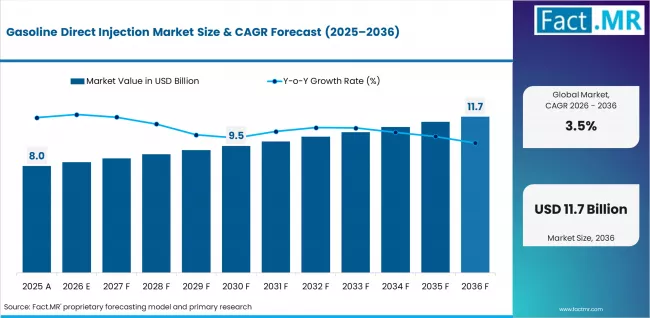
Gasoline Direct Injection Market Cagr Forecast 2025 To 2036 | Source: Fact.MR
Summary of Gasoline Direct Injection Market
- Market Snapshot
- Global gasoline direct injection market revenue stood at approximately USD 8.0 billion in 2026 and is forecast to reach around USD 11.2 billion by 2036.
- The market was valued at nearly USD 7.8 billion in 2025, reflecting consistent year-on-year growth momentum.
- At a CAGR of 3.5% from 2026 to 2036, the market is projected to expand 1.4x in value, creating an absolute opportunity of about USD 3.3 billion.
- Growth is primarily supported by rising demand for fuel-efficient and high-performance engines, alongside tightening emission norms across key automotive markets.
- Gasoline direct injection systems remain integral to modern powertrain architectures, enabling improved combustion efficiency, reduced fuel consumption, and enhanced engine downsizing strategies.
- Demand and Growth Drivers
- Increasing demand for fuel-efficient and low-emission vehicles is accelerating the adoption of gasoline direct injection systems across global automotive markets.
- Stringent emission regulations in regions such as Europe, North America, and Asia are pushing automakers to integrate advanced fuel injection technologies to meet compliance standards.
- Rising penetration of turbocharged and downsized engines is strengthening the need for precise fuel delivery systems, where GDI plays a critical role.
- Growth in passenger vehicle production, particularly in emerging economies, is supporting sustained demand for gasoline direct injection components.
- Continuous advancements in injector design, pressure capabilities, and electronic control systems are enhancing combustion efficiency and expanding application across vehicle segments.
- Product and Segment View
- Gasoline direct injection systems are widely integrated across passenger cars and light commercial vehicles, supporting broad-based demand across automotive applications.
- Demand is influenced by key performance parameters such as fuel pressure, injection precision, and combustion efficiency, which determine system effectiveness and vehicle performance.
- Component variants include high-pressure fuel injectors, pumps, and electronic control systems, each engineered to meet specific engine requirements and emission standards.
- Geography and Competitive Outlook
- Growth is globally distributed, with strong momentum in regions characterized by high automotive production and tightening emission regulations.
- Market expansion is closely linked to vehicle production trends, powertrain technology shifts, and regulatory frameworks governing fuel efficiency and emissions.
- Increasing demand in emerging economies is driven by rising vehicle ownership, urbanization, and the growing preference for fuel-efficient gasoline vehicles.
- Key companies operating in this market include Bosch, Denso Corporation, Continental AG, Delphi Technologies, Hitachi Astemo, and Magneti Marelli.
Gasoline Direct Injection Market — At a Glance
| Attribute | Details |
| Market Value 2025 | USD 7.8 billion |
| Market Value 2026 | USD 8.0 billion |
| Market Value 2036 | USD 11.2 billion |
| Absolute Dollar Opportunity 2026–2036 | USD 3.3 billion |
| Total Growth 2026–2036 | 4.2% (CAGR basis) |
| CAGR 2026–2036 | 3.5% |
| Growth Multiple | 1.4x |
| Key Demand Theme | Rising demand for fuel-efficient, low-emission, and high-performance gasoline engines |
| Top Companies | Bosch, Denso Corporation, Continental AG, Delphi Technologies, Hitachi Astemo, Magneti Marelli |
| Segmentation by Component | Fuel Injectors, High-Pressure Pumps, Electronic Control Units, Sensors, Others |
| Segmentation by Vehicle Type | Passenger Cars, Commercial Vehicle |
| Segmentation by Engine Type | Naturally Aspirated, Turbocharged, Hybrid |
| Segmentation by Region | North America, Europe, Asia Pacific, Latin America, Middle East & Africa |
Among the major countries, China is expected to expand at a CAGR of 4.2%, supported by high vehicle production volumes, strong domestic demand, and continued advancements in engine technologies. India follows with a CAGR of 4.6%, driven by rising passenger vehicle ownership, stricter emission norms, and increasing adoption of fuel-efficient technologies. Japan grows at 3.2%, backed by technological innovation and a strong presence of leading automotive OEMs. Meanwhile, mature markets such as the United States (2.8%) and Germany (2.4%) are largely driven by replacement demand and incremental efficiency improvements, reflecting market maturity and the gradual transition toward electrified mobility.
Where is the real growth coming from?
According to market analysis by Fact.MR, the growth of the gasoline direct injection market is not merely volume-driven at a global level, but increasingly shaped by specific technology transitions and regional automotive dynamics. While the market is projected to expand at a steady CAGR of 3.5% from 2026 to 2036, the most notable growth is concentrated in the widespread adoption of turbocharged and downsized gasoline engines, particularly across passenger vehicles.
A significant share of this growth is emerging from Asia Pacific, led by China and India, where rising vehicle production, tightening emission standards, and increasing consumer preference for fuel-efficient vehicles are accelerating GDI penetration. Additionally, regulatory push in Europe and North America is sustaining demand through continuous upgrades in fuel injection systems to meet stricter emission norms. As a result, growth is being driven less by overall vehicle volume expansion and more by the increasing integration of advanced fuel injection technologies across both new and existing vehicle platforms.
The Technology Premium: Why Gasoline Direct Injection Systems Are Sustaining Value Amid Automotive Transition
The global gasoline direct injection (GDI) market is navigating a phase of structural transition rather than decline. As the automotive industry gradually shifts toward electrification, GDI systems continue to exhibit a “technology premium” stability. While overall internal combustion engine (ICE) vehicle growth is moderating, the value per vehicle is increasing due to the rising integration of advanced fuel injection systems. This has created a stable-to-firm pricing environment for high-precision components such as injectors and high-pressure pumps, even as broader automotive volumes fluctuate.
This resilience is being driven by multiple structural factors shaping the global automotive and supply chain landscape:
- Tightening emission norms across Europe, China, and India are compelling OEMs to adopt more sophisticated GDI systems with higher injection pressures and precision control, increasing system complexity and cost per unit.
- The growing adoption of turbocharged and downsized engines has elevated the importance of GDI technology, as it enables better combustion efficiency and power output—supporting a premium positioning despite slower ICE volume growth.
- Semiconductor dependencies, specialized materials, and precision manufacturing requirements for injectors and control units have introduced supply-side rigidity, preventing significant price softening.
- The rise of hybrid vehicles is extending the lifecycle of gasoline engines rather than replacing them outright, with GDI systems remaining a core component in hybrid powertrains, thereby sustaining long-term demand.
- In response to supply uncertainties, automakers are increasingly moving from cost-optimized sourcing to reliability-focused procurement, securing long-term supplier agreements for critical GDI components and reinforcing price stability.
How to differentiate beyond price?
The latest insights from Fact.MR highlight that differentiation in the gasoline direct injection (GDI) market is increasingly shifting beyond pricing toward technology depth and system-level capabilities. With major players such as Bosch, Denso, and Continental offering comparable core components, competitive advantage is now being built through advanced engineering, calibration expertise, and integrated system solutions.
The 2026 analysis by Fact.MR indicates that a significant share of automotive OEMs are prioritizing suppliers that can deliver consistent combustion performance, emission compliance, and long-term reliability under varying driving conditions. This places greater emphasis on precision engineering, software integration, and real-world validation rather than just component cost. Additionally, suppliers offering end-to-end support—including engine calibration, system integration, and faster prototyping—are witnessing stronger client retention. Fact.MR further notes that companies positioning themselves as full-system solution providers, rather than standalone component manufacturers, are gaining higher pricing power and deeper OEM partnerships.
How to improve margins in a commoditizing market?
According to Fact.MR, while baseline GDI components are gradually facing pricing pressure due to standardization, margin expansion is increasingly linked to innovation and value-added offerings. The market is witnessing a shift where profitability is driven less by volume and more by technological sophistication.
Manufacturers are focusing on next-generation high-pressure injection systems, advanced multi-hole injectors, and electronically controlled solutions that support stricter emission norms and higher engine efficiency. These premium configurations command better margins compared to conventional systems. Furthermore, integrating software, sensors, and control strategies into bundled offerings allows suppliers to move up the value chain.
Fact.MR also highlights that companies providing modular GDI systems, pre-calibrated solutions, and application-specific designs particularly for turbocharged and hybrid engines can achieve margin improvements in the range of 8% to 15% compared to standalone component sales. In a market gradually moving toward commoditization, the ability to deliver performance-driven, integrated solutions is becoming the key lever for sustaining profitability.
Why are Gasoline Direct Injection Systems So Widely Adopted?
GDI Systems Enhancing Engine Efficiency and Performance in Modern Vehicles
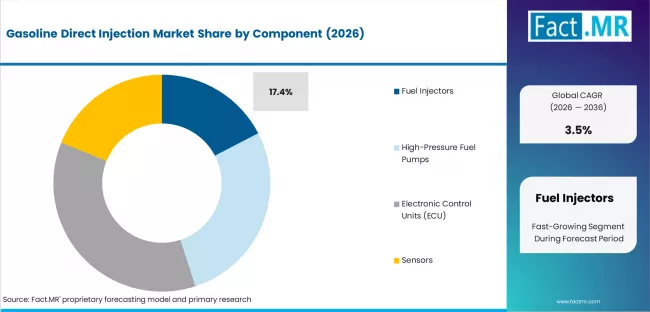
Gasoline Direct Injection Market By Component | Source: Fact.MR
Automotive OEMs are increasingly focused on improving fuel efficiency while maintaining performance, especially under tightening global emission norms. Gasoline direct injection (GDI) systems enable precise fuel delivery directly into the combustion chamber, resulting in better atomization, improved combustion control, and higher thermal efficiency.
With growing emphasis on engine downsizing and turbocharging, GDI has become a critical enabler, allowing smaller engines to deliver higher power output without compromising fuel economy. This has significantly accelerated its adoption across passenger vehicles and light commercial vehicles.
Advanced GDI components are now widely used in turbocharged gasoline engines, hybrid powertrains, and next-generation mobility platforms. Applications span across compact cars, SUVs, and performance vehicles, where optimized combustion translates into reduced emissions, improved mileage, and enhanced driving dynamics.
What is the right product & portfolio strategy?
To build a competitive portfolio in the gasoline direct injection market, manufacturers need to balance standardized high-volume components with advanced, high-value system solutions. While conventional injectors and pumps continue to dominate in terms of volume, the real margin expansion lies in next-generation high-pressure systems and electronically controlled injection technologies.
From a demand standpoint, passenger vehicles prioritize fuel efficiency and emission compliance, while performance and premium segments focus more on power output and responsiveness. As a result, leading players are increasingly tailoring their offerings based on engine architecture, vehicle class, and regional regulatory requirements rather than relying on one-size-fits-all solutions.
Automakers Driving Demand Through Advanced Gasoline Engine Platforms
The increasing demand for fuel-efficient and performance-oriented vehicles is pushing automakers to adopt advanced gasoline engine technologies powered by GDI systems. Continuous stress on engines due to higher power density and operating pressures necessitates precise and reliable fuel delivery mechanisms.
GDI systems help extend engine life, improve combustion stability, and reduce component wear under high-load conditions. Additionally, as consumers demand better mileage and lower operating costs, automakers are prioritizing technologies that enhance engine efficiency without significantly increasing vehicle cost.
This shift is particularly visible in emerging markets, where rising vehicle ownership and stricter emission standards are accelerating the adoption of GDI-equipped vehicles, further reinforcing long-term market demand.
What is the optimal go-to-market model?
Fact.MR indicate that the go-to-market approach in the gasoline direct injection (GDI) market is evolving from traditional component supply toward a more integrated, partnership-led model.
While Tier-1 suppliers and distributors continue to play a role in supporting volume-driven sales—especially in aftermarket and smaller OEM segments—the real strategic shift is toward direct engagement with automotive OEMs. Early collaboration with automakers during engine development and platform design enables suppliers to secure long-term contracts and embed their systems at the specification stage, significantly improving demand visibility and lifecycle revenues.
Fact.MR also highlights the growing importance of co-development and solution selling, where GDI manufacturers work closely with OEM engineering teams on fuel system design, calibration, and performance optimization. This approach enhances value realization, reduces pricing pressure, and strengthens long-term partnerships.
How producers are exposed to raw material volatility?
According to insights from Fact.MR, manufacturers in the gasoline direct injection (GDI) market face notable exposure to fluctuations in key input materials and electronic components. Critical inputs such as specialty steels, precision alloys, semiconductors, and electronic sub-systems directly influence production costs, particularly for high-pressure injectors and control units.
The analysis suggests that raw materials and electronic components can account for nearly 50% to 65% of total system costs, making margins highly sensitive to price swings. Volatility in semiconductor supply, rare earth materials, and precision machining inputs can disrupt production schedules and increase procurement costs. Additionally, geopolitical tensions and supply chain disruptions especially in electronics and automotive components further intensify cost uncertainty.
What is the long-term strategic positioning?
The long-term trajectory of the gasoline direct injection market is increasingly centered on transitioning from component manufacturing to technology-driven system solutions. While overall market growth remains moderate, value creation is shifting toward innovation, integration, and application expertise rather than volume expansion.
Leading players are already repositioning themselves as full-system providers offering integrated fuel injection systems, advanced control software, and calibration capabilities tailored to specific engine platforms. According to Fact.MR, companies that invest in high-pressure injection technologies, hybrid-compatible systems, and next-generation combustion optimization will be better placed to capture future value.
Regional Analysis
The report on the global gasoline direct injection market categorizes key regions into South Asia & Pacific, Middle East & Africa, North America, Latin America, Western Europe, and Eastern Europe. The market demonstrates strong regional variation, driven by differences in automotive production volumes, emission regulations, fuel efficiency standards, and technology adoption levels.
The report also provides a comprehensive assessment of market attractiveness at a regional level over the forecast period, based on parameters such as growth potential, vehicle production, technology adoption, supply chain maturity, and penetration of advanced fuel injection systems. Regional demand patterns are influenced by varying levels of automotive manufacturing, emission regulations, fuel efficiency standards, and the pace of transition toward hybrid and advanced gasoline powertrains, which collectively shape the overall growth trajectory of the global gasoline direct injection market. Gasoline Direct Injection Market Top Countries | Source: Fact.MR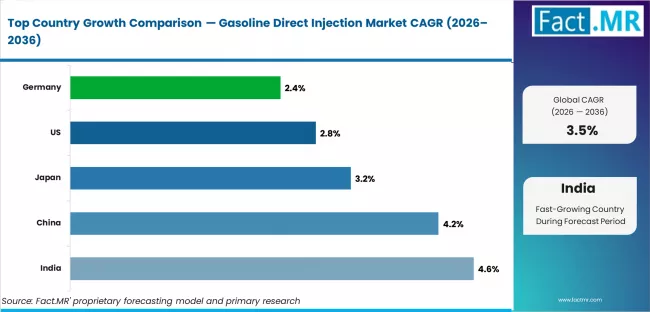
| Country | CAGR (%) |
|---|---|
| Canada | 3.2% |
| India | 4.6% |
| China | 4.2% |
| Japan | 3.2% |
| U.S. | 2.8% |
| Germany | 2.4% |
Source: Fact MR (FMR) analysis, based on proprietary forecasting model and primary research.
South Asia & Pacific
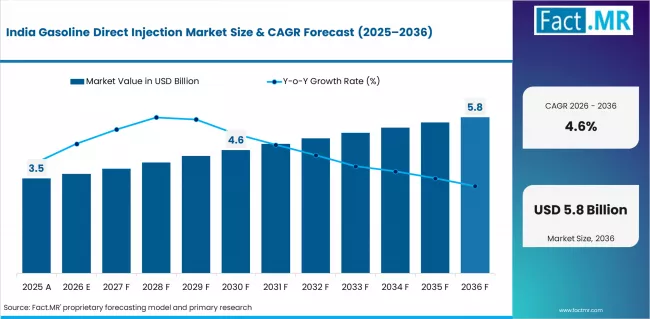
India Gasoline Direct Injection Market 2025 To 2036 | Source: Fact.MR
South Asia & Pacific is emerging as a high-growth region for the gasoline direct injection market, supported by rising vehicle production, tightening emission norms, and increasing adoption of fuel-efficient gasoline technologies.
- India: Demand is projected to grow at a CAGR of 4.6% through 2036, fueled by rising passenger vehicle ownership, BS-VI emission norms, and increasing penetration of turbocharged gasoline engines.
- Japan: Market growth is projected at a CAGR of 3.2%, driven by advanced automotive engineering, strong hybrid vehicle adoption, and continuous innovation in fuel injection technologies.
Middle East & Africa
The Middle East & Africa represents a developing market, where gradual automotive sector expansion and improving regulatory frameworks are supporting demand for gasoline direct injection systems.
- Growth is supported by rising vehicle imports, increasing urbanization, and a gradual shift toward fuel-efficient gasoline vehicles, though from a relatively smaller base.
North America
North America remains a mature yet stable market, supported by strong automotive OEM presence and continued demand for performance-oriented gasoline vehicles.
- United States: Demand is projected to grow at a CAGR of 2.8%, driven by steady adoption of turbocharged engines, regulatory compliance requirements, and replacement demand.
- Canada: Growth is supported by stable automotive production and increasing integration of fuel-efficient engine technologies.
Latin America
Latin America represents a developing growth market, where demand for gasoline direct injection systems is increasing due to rising vehicle ownership and gradual regulatory alignment.
- Growth is supported by expanding automotive production in countries such as Brazil and Mexico, along with increasing consumer preference for fuel-efficient vehicles.
Western Europe
Western Europe remains a mature and regulation-driven market, characterized by stringent emission standards and high penetration of advanced engine technologies.
- Germany: Projected CAGR of 2.4%, driven by strong automotive manufacturing, technological advancements, and focus on emission reduction, though growth remains moderate due to electrification trends.
- France: Growth is supported by regulatory push for fuel efficiency and increasing adoption of hybrid gasoline vehicles.
Eastern Europe
Eastern Europe is witnessing gradual expansion, supported by automotive manufacturing growth, increasing exports, and rising adoption of advanced fuel injection systems.
- Growth is driven by expanding production bases and cost-competitive manufacturing, along with gradual technological upgrades in vehicle platforms.
Fact.MR’s analysis of the gasoline direct injection market across South Asia & Pacific, Middle East & Africa, North America, Latin America, Western Europe, and Eastern Europe includes country-level insights covering India, China, Japan, the United States, Germany, and other key markets. The report evaluates automotive production trends, emission regulations, technology adoption, and supply chain dynamics, along with advancements in high-pressure injection systems and electronic controls, which collectively shape long-term growth across these key regions.
Competitive Landscape
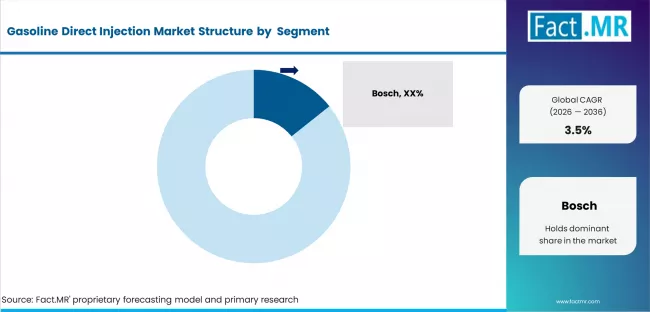
Gasoline Direct Injection Market By Company | Source: Fact.MR
How Are Key Players Competing in the Gasoline Direct Injection Market?
The gasoline direct injection (GDI) market is led by prominent Tier-1 automotive suppliers such as Bosch, Denso Corporation, Continental AG, Delphi Technologies, Hitachi Astemo, and Magneti Marelli, among other global powertrain technology providers. These companies are focused on advancing high-pressure injection systems, improving fuel atomization precision, and enhancing electronic control capabilities to meet evolving emission and performance requirements.
Key Players of the Gasoline Direct Injection Market
- Bosch
- Denso Corporation
- Continental AG
- Hitachi Astemo Ltd.
- Marelli Holdings Co., Ltd.
- BorgWarner Inc.
- Stanadyne LLC
- Infineon Technologies AG
- Renesas Electronics Corporation
- Sensata Technologies
Research Methodology
The analysis of the gasoline direct injection market is based on a combination of primary research, validation of secondary sources, and quantitative modeling to ensure accuracy and reliability. Secondary research forms the foundation of the study, with data sourced from credible organizations such as the International Energy Agency, International Organization of Motor Vehicle Manufacturers, and World Bank, particularly for automotive production, fuel consumption trends, and regulatory frameworks.
Primary research includes interactions with key industry stakeholders such as automotive OEMs, Tier-1 suppliers, and component manufacturers. These discussions provide insights into demand trends, technology adoption, pricing dynamics, and future outlook across gasoline and hybrid powertrain systems.
Market sizing is conducted using a bottom-up approach, aggregating data across vehicle segments and regions. Historical trends are analyzed to derive forecasts, supported by triangulation methods that reconcile supply-side inputs (production, component supply) with demand-side indicators (vehicle sales, emission regulations).
- Data Validation: Outputs are cross-verified through supply chain analysis, expert interviews, and alignment with trends in semiconductor availability, material costs, and evolving emission standards.
- Analyst Opinion: The gasoline direct injection market is in a stable growth phase, driven by the increasing need for fuel-efficient and low-emission gasoline engines. As emission regulations become more stringent and automakers continue to adopt engine downsizing and turbocharging strategies, GDI systems are becoming a critical component of modern powertrains.
The market is also benefiting from the rise of hybrid vehicles, where gasoline engines continue to play a key role alongside electrification. High-pressure injection systems and advanced electronic controls are enabling better combustion efficiency, reduced emissions, and improved engine performance. As a result, GDI technology is expected to remain relevant in the medium to long term, particularly in regions where full electrification adoption is gradual.
Strategic Insights
- Advancement in High-Pressure Injection Technologies: Leading players are focusing on developing next-generation GDI systems with higher injection pressures (350+ bar), improved spray patterns, and enhanced combustion control to meet stringent emission norms.
- Strong Demand from Automotive Production Hubs: Asia Pacific, North America, and Europe remain key production and consumption centers, driven by high vehicle manufacturing volumes and increasing adoption of fuel-efficient gasoline and hybrid vehicles.
- Supply Chain Optimization and Localization: Manufacturers are increasingly focusing on localized production, supplier diversification, and strategic sourcing of electronic and precision components to enhance supply reliability and cost efficiency.
Bibliographies
- Bosch highlights advanced fuel injection and mobility solutions at ACT Expo 2025, reinforcing the role of gasoline direct injection in improving fuel efficiency and reducing emissions. [1]
- Bosch continues to expand its gasoline direct injection portfolio with high-pressure systems enabling improved combustion efficiency and reduced emissions in modern engines. [2]
- Hitachi Astemo advances powertrain technologies, including fuel injection systems, to support next-generation hybrid and fuel-efficient gasoline engines. [3]
- Continental AG develops advanced fuel supply and injection systems to enhance engine performance and meet stringent emission standards globally. [4]
Gasoline Direct Injection Market Definition
The Gasoline Direct Injection (GDI) Market comprises advanced fuel delivery systems designed to inject gasoline directly into the combustion chamber of internal combustion engines, enabling higher precision, improved fuel efficiency, and reduced emissions across modern automotive applications. Unlike conventional port fuel injection systems, GDI technology allows for better control over air-fuel mixture formation, resulting in optimized combustion and enhanced engine performance.
Gasoline direct injection systems consist of key components such as high-pressure fuel injectors, fuel pumps, electronic control units (ECUs), and sensors, all working in coordination to deliver fuel at high pressures directly into the cylinder. These systems are engineered using precision manufacturing and advanced electronics to ensure accurate fuel atomization, timing, and combustion control under varying operating conditions.
GDI technology is widely adopted across passenger vehicles and light commercial vehicles, particularly in turbocharged and downsized engines, where efficiency and power output must be balanced. Typical applications include compact cars, sedans, SUVs, and hybrid vehicles, where improved fuel economy and compliance with stringent emission norms are critical. The technology is also increasingly integrated into next-generation gasoline-hybrid powertrains, extending the relevance of internal combustion engines.
Gasoline Direct Injection Market Inclusions
The report covers global and regional market size estimates and forecasts for the Gasoline Direct Injection Market from 2025 to 2036, including:
- Segment analysis by Component (Fuel Injectors, High-Pressure Fuel Pumps, Electronic Control Units, Sensors, Others), Vehicle Type (Passenger Cars, Light Commercial Vehicles, Heavy Commercial Vehicles), Engine Type (Inline, V-type, Others), and Region (North America, Latin America, East Asia, South Asia & Pacific, Western Europe, Eastern Europe, Middle East & Africa).
- Regional performance comparison across North America, Latin America, Western Europe, Eastern Europe, East Asia, South Asia & Pacific, and Middle East & Africa, highlighting demand variations driven by vehicle production trends, emission regulations, and adoption of advanced powertrain technologies.
- Pricing trend evaluation, raw material and component cost analysis (precision alloys, semiconductors, electronic systems), supply chain structure, and manufacturing dynamics for gasoline direct injection systems.
- Technology and product outlook, including advancements in high-pressure injection systems, multi-hole injector design, electronic control integration, and combustion optimization technologies enhancing fuel efficiency and emission performance.
- Analysis of demand shifts driven by increasing adoption of turbocharged and downsized engines, rising hybrid vehicle penetration, tightening emission norms, and the growing need for fuel-efficient and high-performance gasoline vehicles.
Gasoline Direct Injection Market Exclusions
The scope excludes:
- Conventional fuel injection systems such as port fuel injection (PFI) and carburetor-based systems that do not involve direct in-cylinder fuel delivery.
- Complete engine assemblies and fully integrated powertrain systems, including gasoline engines, hybrid systems, and electric drivetrains (only gasoline direct injection components and systems are considered).
- Downstream automotive components unrelated to fuel injection, such as exhaust after-treatment systems, turbochargers, and transmission systems.
- Alternative fuel injection technologies designed for diesel, hydrogen, or compressed natural gas (CNG) engines, as the focus remains strictly on gasoline-based direct injection systems.
- Pure battery electric vehicle (BEV) components and systems where internal combustion engines are not present, as GDI technology is not applicable in fully electric architectures.
Segmentation
Report Scope
| Metric | Value |
|---|---|
| Quantitative Units | USD 7.8 billion (2025) to USD 11.2 billion (2036), at a CAGR of 3.5% |
| Market Definition | The Gasoline Direct Injection Market includes advanced fuel delivery systems that inject gasoline directly into the combustion chamber to enhance fuel efficiency, engine performance, and emission control. These systems (injectors, high-pressure pumps, ECUs, sensors) are engineered using precision manufacturing and electronic control technologies to deliver optimized combustion, reduced fuel consumption, and improved power output across gasoline and hybrid vehicles. |
| By Component | Fuel Injectors, High-Pressure Fuel Pumps, Electronic Control Units (ECU), Sensors, Others |
| By Engine Type | Naturally Aspirated Engines, Turbocharged Engines, Hybrid Powertrains |
| Regions Covered | North America, Latin America, Western Europe, Eastern Europe, East Asia, South Asia & Pacific, Middle East & Africa |
| Countries Covered | United States, Canada, Germany, France, China, Japan, India, Brazil, South Korea, other key automotive markets |
| Key Companies Profiled | Bosch, Denso Corporation, Continental AG, Hitachi Astemo Ltd., Marelli Holdings Co., Ltd., BorgWarner Inc., Stanadyne LLC |
| Forecast Period | 2026 to 2036 |
| Approach | Hybrid top-down and bottom-up modeling validated through primary interviews with automotive OEMs, Tier-1 suppliers, and component manufacturers, supported by analysis of vehicle production trends, emission regulations, fuel efficiency standards, semiconductor supply, and evolving powertrain technologies. |
Gasoline Direct Injection Market Key Segments
-
By Component:
- Fuel Injectors
- High-Pressure Fuel Pumps
- Electronic Control Units (ECU)
- Sensors
- Others
-
By Vehicle Type:
- Passenger Cars
- Compact / Mini (Up to 3m)
- Mid-Size (3.1 to 4m)
- Luxury (4.1 to 5m)
- Sedan / Executive (5.1 to 5.5 m)
- SUVs / MPV
- Commercial Vehicle
- Light Commercial Vehicles
- Heavy Commercial Vehicles
- Passenger Cars
-
By Engine Type:
- Naturally Aspirated
- Turbocharged
- Hybrid
-
By Powertrain Integration:
- Pure ICE (Gasoline)
- Hybrid Electric Vehicles (HEV)
- Plug-in Hybrid Vehicles (PHEV)
-
By Injection Architecture:
- Solenoid-Based Systems
- Piezoelectric Systems
- High-Pressure Systems
-
By Sales Channel:
- OEM Supply
- Aftermarket
-
By Region:
- North America
- United States
- Canada
- Europe
- Germany
- UK
- France
- Rest of Europe
- Asia Pacific
- China
- India
- Japan
- ASEAN
- Latin America
- Middle East & Africa
- North America
Frequently Asked Questions
What is the current size of the global Gasoline Direct Injection Market?
How large will the market be by 2036?
What is the expected growth rate of the market?
Which segment is leading the market by component?
Who are the major industry participants?
Which region is expected to show the highest growth rate in the market?
How strong is the growth outlook for China?
What is the growth outlook for the United States in this market?
What is the growth forecast for Japan in this market?
Which European market is highlighted in this analysis?
Who worked on this report


Preview the report firsthand - request a free sample
Free SampleGet the brochure for pricing and purchase details
Download PDF