- Base Value(2025): 3.2 Bn
- Estimated Value(2026): 3.6 Bn
- Forecast Value (2036): 11.5 Bn
- CAGR (2026 - 2036): 10.8%
Touch Slider and Gesture-Based Control Interfaces Market Forecast and OutlookBy Fact.MR
- In 2025, the touch slider and gesture-based control interfaces market was valued at USD 3.2 billion.
- Based on Fact.MR analysis, demand for touch slider and gesture-based control interfaces is estimated to grow to USD 3.6 billion in 2026 and USD 11.5 billion by 2036.
- FACT.MR projects a CAGR of 10.8% during the forecast period.
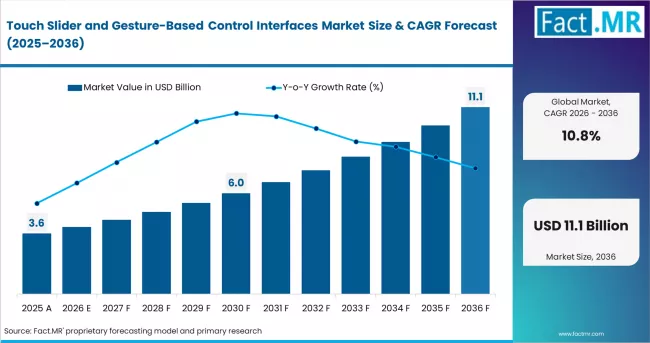
Touch Slider And Gesture Based Control Interfaces Market Market Value Analysis | Source: Fact.MR
| Metric | Value |
|---|---|
| Estimated Value in 2026 | USD 3.6 billion |
| Forecast Value in 2036 | USD 11.5 billion |
| Forecast CAGR (2026 to 2036) | 10.8% |
Source: Fact.MR analysis. Updated May 14, 2026
Summary of Touch Slider and Gesture-Based Control Interfaces Market
- Market Definition
- The market covers touch slider capacitive strip controls, gesture-based air and 3D sensing interfaces, and hybrid systems deployed in automotive cockpits, consumer electronics, and industrial HMI applications globally.
- Demand Drivers
- EV cockpit digitisation programmes by Chinese OEMs and global automakers are accelerating capacitive and gesture interface content per vehicle across premium and mid-range platforms.
- ADAS integration mandates in North America and Europe require driver monitoring and contactless HMI validation, driving radar and vision-based gesture system adoption by Tier 1 suppliers.
- Smartphone-native touch interface familiarity among Indian and South Korean consumers is raising HMI quality expectations in mid-range automotive and consumer electronics segments.
- Key Segments Analyzed
- By Interface Type: Touch sliders lead approximately 45% in 2026, driven by cost efficiency, OEM design familiarity, and established capacitive controller supply chains for automotive and consumer electronics platforms.
- By Technology: Capacitive sensing interfaces dominate approximately 60% in 2026, supported by mature supply chains, low integration cost, and broad OEM qualification across vehicle classes.
- By Geography: China leads at approximately 14.5% CAGR, driven by EV cockpit digitisation and domestic OEM investment in premium HMI platforms.
- Analyst Opinion at FACT.MR
- Shambhu Nath Jha, Principal Consultant at Fact.MR, opines, CXOs will find that radar- and vision-based gesture systems are expanding at a faster CAGR than capacitive touch interfaces. However, capacitive solutions continue to hold the majority of installed volume due to cost efficiency and established adoption. This creates a dual-structure market. Advanced sensing technologies drive growth, while capacitive interfaces anchor scale.
- Strategic Implications
- Invest in automotive-grade radar and IR gesture sensing development to qualify for EV cockpit and ADAS platform design win cycles at Chinese, German, and South Korean OEMs through 2026 to 2028.
- Develop dual-mode touch and gesture interface modules targeting mid-range vehicle platforms in India and Southeast Asia where cost-to-feature ratio determines HMI tier adoption.
- Secure long-term capacitive controller IC supply agreements to protect design win economics as automotive-grade chip lead times extend across Tier 1 supplier programmes.
- Methodology
- Market sizing uses Tier 1 supplier revenues and OEM design win volume data, validated with 2024-2025 automotive HMI content value benchmarks from IHS Markit.
- Analysis includes SAE HMI integration standards, EU ADAS regulation updates, and China NEV cockpit digitisation policy data from MIIT and CAAM sources.
- Forecasts incorporate EV platform content value growth trends, sensor cost reduction roadmaps, and expert interviews with automotive HMI procurement and engineering specialists.
Between 2026 and 2036, the market is projected to generate USD 8.3 billion in absolute opportunity. Growth is driven by EV cockpit digitisation, rising ADAS penetration, and premium HMI adoption by global OEMs. Expansion is tempered by high radar sensor integration costs, supply chain dependencies for capacitive controller ICs, and slower gesture system adoption in mid-range vehicle segments.
China leads at approximately 14.5% CAGR through 2036, driven by rapid electric vehicle cockpit digitisation and domestic OEM platform investment. India follows at 14.1%, supported by smartphone interface familiarity and fast-growing mid-range automotive HMI adoption. The United States records 13.7%, driven by ADAS integration requirements and premium HMI demand from Tier 1 OEM programmes. Germany posts 12.5%, anchored by luxury OEM innovation pipelines at BMW, Mercedes-Benz, and Volkswagen. South Korea records 12.1%, supported by display and sensor leadership from Samsung and LG Electronics.
Segmental Analysis
Touch Slider and Gesture-Based Control Interfaces Market Analysis by Interface Type
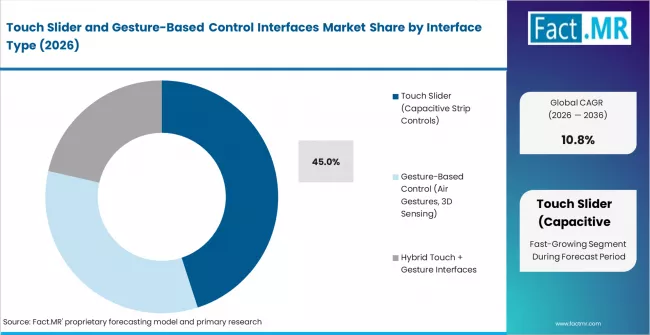
Touch Slider And Gesture Based Control Interfaces Market Analysis By Interface Type | Source: Fact.MR
Touch sliders hold approximately 45% share in 2026. They lead due to cost efficiency, established OEM qualification, and broad capacitive controller availability. Gesture-based control systems are gaining design wins in premium automotive and smart home segments driven by contactless and 3D sensing requirements.
- Continental AG Cockpit HMI Expansion: Continental AG announced expansion of its touch and gesture HMI portfolio for EV cockpit platforms in Q2 2024, including capacitive strip and radar gesture modules targeting Chinese and European OEM programmes. [5]
- Qualcomm Snapdragon Cockpit Platform Integration: Qualcomm's Snapdragon Ride Cockpit Platform, updated in 2024, integrates gesture recognition processing for automotive HMI, enabling OEMs to deploy vision-based gesture systems on shared compute architecture. [6]
- Hybrid Interface Adoption Trend: ABI Research noted in 2024 that hybrid touch plus gesture interface modules are gaining traction in premium vehicle segments, with OEM content value per cockpit increasing as multi-modal sensing replaces single-modality touch strip designs. [7]
Touch Slider and Gesture-Based Control Interfaces Market Analysis by Technology
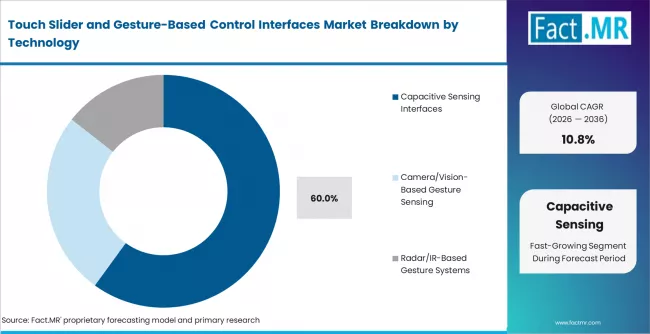
Touch Slider And Gesture Based Control Interfaces Market Analysis By Technology | Source: Fact.MR
Capacitive sensing interfaces dominate approximately 60% share in 2026. Dominance is supported by low per-unit cost, mature IC supply chains, and established automotive grade qualification. Camera and vision-based gesture sensing is gaining ground in premium segments. Radar and IR systems represent the fastest-growing technology sub-segment by revenue.
- Synaptics Automotive Capacitive Controller Platform: Synaptics launched the Poly Touch automotive capacitive sensing platform in 2024, targeting EV cockpit and automotive HMI applications with enhanced noise immunity and multi-zone detection for Tier 1 supplier programmes. [8]
- Sony IMX Radar Vision Sensor Development: Sony Corporation disclosed expansion of its IMX series automotive image sensor roadmap in 2025 to support in-cabin gesture recognition and driver monitoring applications in collaboration with Tier 1 HMI system integrators. [9]
- STMicroelectronics Radar Gesture IC Launch: STMicroelectronics launched the VD5050 radar gesture sensor IC in early 2025 targeting automotive cockpit gesture detection, consumer appliances, and smart home control interfaces, with ADAS-compatible functional safety ratings. [10]
Drivers, Restraints, and Opportunities
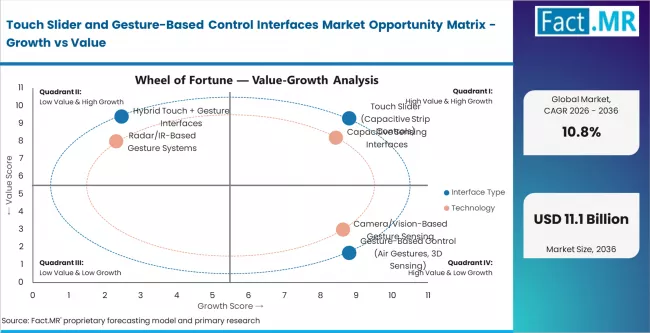
Touch Slider And Gesture Based Control Interfaces Market Opportunity Matrix Growth Vs Value | Source: Fact.MR
FACT.MR analysts observe the touch slider and gesture-based control interfaces market is a structurally scaling segment driven by automotive cockpit digitisation and consumer electronics HMI premiumisation.
The market shows clear technology bifurcation. Capacitive touch sliders retain volume dominance due to low cost and broad qualification. Gesture systems face higher integration complexity and cost.
- EV Cockpit Digitalisation Mandate: China's Ministry of Industry and Information Technology NEV technology roadmap requires advanced HMI integration in EV platforms by 2025 to 2027. This is accelerating touch and gesture interface design wins at BYD, SAIC, and Nio. Continental AG and Bosch expanded China HMI engineering centres in 2024 to support local OEM design cycles. [2]
- ADAS Integration and Driver Monitoring Regulation: EU General Safety Regulation (GSR) 2022, effective from 2024, mandates driver monitoring systems in new vehicle approvals. This is driving in-cabin gesture and proximity sensing adoption across European OEM platforms. Valeo and Aptiv secured driver monitoring interface contracts with European automakers in 2024. [3]
- Consumer Electronics Premium HMI Shift: Samsung Electronics and Sony Corporation expanded capacitive and gesture interface integration in 2025 smart home and premium audio product lines. Synaptics reported increased design win volume for automotive-grade touch controllers in Q3 2024 investor disclosures, reflecting OEM demand consolidation. [4]
Regional Analysis
The touch slider and gesture-based control interfaces market is assessed across Asia Pacific, Europe, North America, Latin America, and Middle East and Africa, covering 40+ countries. The full report offers market attractiveness analysis by region and country.
.webp "Top Country Growth Comparison Touch Slider And Gesture Based Control Interfaces Market Cagr (2026 2036)")
Top Country Growth Comparison Touch Slider And Gesture Based Control Interfaces Market Cagr (2026 2036) | Source: Fact.MR
| Country | CAGR (2026 to 2036) |
|---|---|
| China | 14.5% |
| India | 14.1% |
| USA | 13.7% |
| Germany | 12.5% |
| South Korea | 12.1% |
Source: Fact.MR analysis. Updated May 14, 2026
Source: Fact.MR (FACT.MR) analysis, based on proprietary forecasting model and primary research
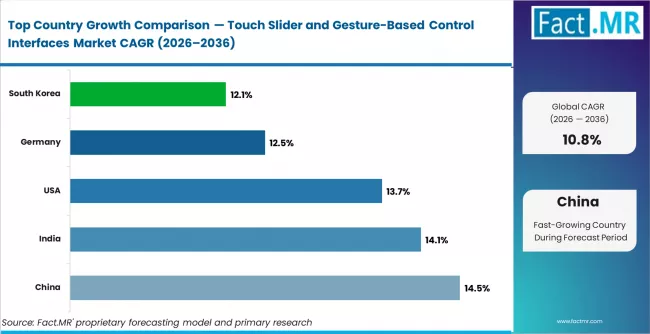
Touch Slider And Gesture Based Control Interfaces Market Cagr Analysis By Country | Source: Fact.MR
Asia Pacific Touch Slider and Gesture-Based Control Interfaces Market Analysis
Asia Pacific is the growth epicentre, led by China EV cockpit programmes and India mid-range HMI adoption. Regional dynamics differ between state-supported EV digitisation in China and consumer-driven interface premiumisation in India..
- China: EV cockpit digitalisation mandates are accelerating adoption. Demand is projected to rise at 14.5% CAGR through 2036. MIIT policy is pushing advanced HMI integration in NEVs. BYD and SAIC Motor are standardising touch and gesture modules across new platforms. Continental AG is expanding local HMI engineering capability. OEM design cycles are increasingly China-centric.
- India: Demand for touch slider and gesture-based control interfaces in India is projected to rise at 14.1% CAGR through 2036. India's Automotive Mission Plan 2026 prioritises connected vehicle HMI development, increasing OEM procurement interest in cost-optimised touch interface modules for mid-range vehicles. Maruti Suzuki and Tata Motors introduced capacitive HMI controls in sub-compact and compact EV models launched in 2024 to 2025.
- South Korea: Electronics and display ecosystem strength is enabling rapid adoption. The market is expected to grow at 12.1% CAGR through 2036. Samsung Electronics and LG Electronics are integrating gesture sensing in cockpit modules. Hyundai Motor Group is deploying multi-modal interfaces in EV platforms. Domestic innovation programmes are supporting sensor development.
FACT.MR's analysis of the touch slider and gesture-based control interfaces market in Asia Pacific consists of country-wise assessment covering China, India, Japan, South Korea, ASEAN, and Australia and New Zealand. Readers can find EV cockpit HMI adoption data, OEM design win volumes, and technology tier penetration forecasts.
Europe Touch Slider and Gesture-Based Control Interfaces Market Analysis
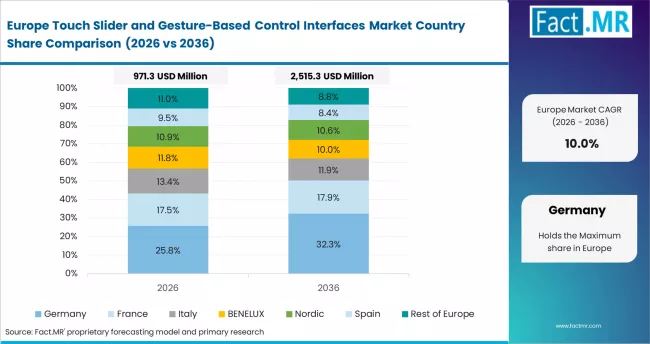
Touch Slider And Gesture Based Control Interfaces Market Europe Country Market Share Analysis, 2026 & 2036 | Source: Fact.MR
Europe acts as the regulatory and technology innovation benchmark for gesture and touch HMI integration, shaped by EU GSR driver monitoring mandates and luxury OEM innovation cycles. Valeo and Continental maintain strong positions across the region's premium automotive supply chain.
- Germany: Growth for touch slider and gesture-based control interfaces in Germany is projected to rise at 12.5% CAGR through 2036. BMW and Mercedes-Benz embedded multi-modal touch and gesture HMI systems in 2024 to 2025 model-year flagship and near-premium platforms, specifying radar and vision-based gesture sensing alongside capacitive controls.
FACT.MR's analysis of the touch slider and gesture-based control interfaces market in Europe consists of country-wise assessment covering Germany, France, the UK, Italy, Spain, Nordic countries, BENELUX, and Rest of Europe. Readers can find EU GSR compliance benchmarks, luxury OEM HMI content value data, and gesture system design win tracking.
North America Touch Slider and Gesture-Based Control Interfaces Market Analysis
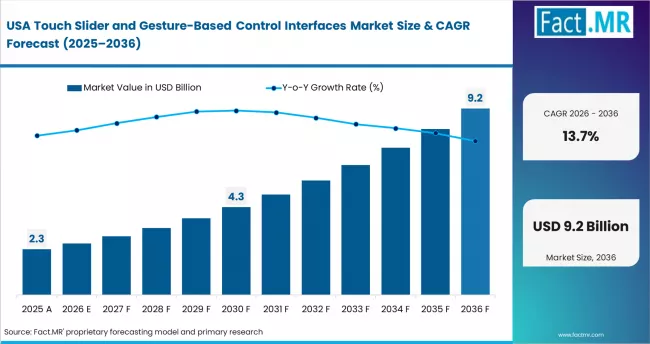
Touch Slider And Gesture Based Control Interfaces Market Country Value Analysis | Source: Fact.MR
North America reflects an ADAS-led and premium HMI-driven environment anchored by Detroit OEM and Silicon Valley technology integration. Aptiv and Qualcomm lead supplier positioning across touch and gesture interface supply chains. Demand is shaped by NHTSA distracted driving policy and EV platform cockpit premiumisation.
- USA: ADAS-driven HMI upgrades are accelerating adoption. Demand is projected to rise at 13.7% CAGR through 2036. General Motors and Ford Motor Company are integrating gesture-enabled cockpit platforms. Qualcomm is enabling gesture recognition through cockpit systems. Aptiv PLC is securing multi-year supply agreements. OEM content value per vehicle is increasing.
FACT.MR's analysis of the touch slider and gesture-based control interfaces market in North America consists of country-wise assessment covering the USA, Canada, and Mexico. Readers can find ADAS integration mandates, OEM cockpit content value data, and Tier 1 supplier programme benchmarks.
Competitive Aligners for Market Players
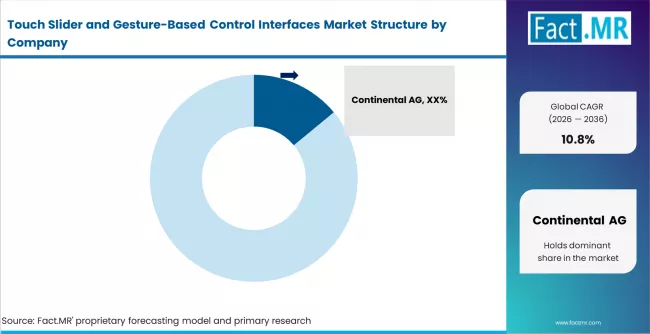
Touch Slider And Gesture Based Control Interfaces Market Analysis By Company | Source: Fact.MR
The touch slider and gesture-based control interfaces market is evolving into a clear two-tier competitive structure. On one side are established automotive Tier-1 suppliers such as Continental AG, Robert Bosch GmbH, and Valeo SA. These players compete through strong OEM relationships, proven automotive-grade reliability, and large-scale production capabilities.
On the other side are semiconductor and sensor specialists like Synaptics Incorporated, NXP Semiconductors, and STMicroelectronics, who focus on innovation, chip-level performance, and cross-platform compatibility. A key factor shaping competition is the ability to secure and retain design wins across multiple vehicle generations.
Tier-1 suppliers hold a strong advantage because they offer integrated systems rather than standalone components. Their long-standing partnerships with OEMs and experience in delivering complete cockpit and ADAS solutions make it difficult for competitors to replace them once selected. For example, companies like Continental and Bosch embed touch and gesture technologies within broader vehicle architectures, increasing switching costs for automakers. OEM buying strategies are becoming more consolidated. Automakers are moving toward platform-level sourcing decisions, relying on a limited number of trusted suppliers for system integration while using dual sourcing for chips. This approach ensures reliability and scalability but also raises barriers for new entrants, who must meet strict automotive standards and prove system-level capability to compete effectively.
Key Players
- Continental AG
- Robert Bosch GmbH
- Denso Corporation
- Valeo SA
- Aptiv PLC
- Synaptics Incorporated
- NXP Semiconductors
- STMicroelectronics
- Sony Corporation
- Qualcomm Incorporated
Bibliography
- [1] Hella GmbH & Co. KGaA. (2024). Annual Report 2024: Automotive Cockpit HMI Strategy and Touch Interface Content Value Growth Programme. hella.com/investor-relations
- [2] Ministry of Industry and Information Technology, People's Republic of China. (2024). New Energy Vehicle Industry Development Plan Update 2024: Advanced Cockpit HMI Integration Requirements for NEV Platform Procurement Eligibility and Smart Cabin Digitisation Standards. miit.gov.cn
- [3] European Commission. (2022, updated 2024). EU General Safety Regulation (GSR) 2022/2019: Driver Monitoring System Mandatory Integration Requirements for Type Approval of New Passenger Vehicles Effective July 2024 for New Platform Approvals. ec.europa.eu/transport/road_safety
- [4] Synaptics Incorporated. (2024). Q3 2024 Investor Earnings Disclosure: Automotive-Grade Capacitive Touch Controller Design Win Volume Growth and Tier 1 Supplier Programme Expansion in Automotive and Consumer Electronics HMI Applications. synaptics.com/investor-relations
- [5] Continental AG. (2024). Press Release Q2 2024: Radar-Based Gesture Sensing HMI Module for EV Cockpit Platforms with ASIL-B Functional Safety Certification for European and Chinese OEM Programme Qualification. continental.com/press
- [6] Qualcomm Incorporated. (2024). Snapdragon Ride Cockpit Platform Update 2024: Integrated Gesture Recognition Processing for Automotive HMI Applications Supporting OEM AI-Enabled Contactless Control Interface Deployment. qualcomm.com/products/automotive
This Report Addresses
- Strategic intelligence on touch slider and gesture-based control interface demand across EV cockpit digitisation, ADAS driver monitoring integration, consumer electronics HMI premiumisation, and industrial control panel gesture adoption.
- Market forecast from USD 3.6 billion in 2026 to USD 11.5 billion by 2036, at 10.8% CAGR.
- Opportunity mapping across China NEV cockpit platform investment, India mid-range automotive HMI adoption, EU GSR-driven gesture sensing mandates, and North American ADAS integration requirements.
- Segment analysis by interface type and technology. Covers touch sliders, gesture and hybrid interfaces, and capacitive, vision, and radar sensing technologies across automotive, consumer electronics, and industrial end uses.
- Regional outlook covering Asia Pacific EV-driven growth, Europe EU GSR compliance-led procurement, and North American ADAS and premium HMI design win activity.
- Competitive landscape of Continental AG, Robert Bosch GmbH, Valeo SA, Aptiv PLC, Synaptics, NXP Semiconductors, STMicroelectronics, Sony, and Qualcomm covering design win strategy, automotive qualification, and technology portfolio positioning.
- Regulatory analysis covering EU General Safety Regulation driver monitoring mandates, China MIIT NEV HMI integration requirements, NHTSA 2024 distracted driving system guidelines, and automotive functional safety certification standards.
- Report delivery in PDF, Excel, and presentation formats supported by validated Tier 1 supplier data, OEM design win benchmarks, and automotive HMI engineering expert inputs.
Touch Slider and Gesture-Based Control Interfaces Market Definition
The touch slider and gesture-based control interfaces market includes capacitive touch strip controls, air gesture detection systems, and hybrid touch-gesture interface modules used in automotive, consumer electronics, and industrial HMI applications.
Touch Slider and Gesture-Based Control Interfaces Market Inclusions
Covers global and regional forecasts from 2026 to 2036 by interface type and technology. Includes capacitive touch sliders, camera-based gesture systems, and radar and IR gesture units across automotive, consumer electronics, and industrial end uses. Includes OEM design win data, sensor integration benchmarks, and pricing by technology tier.
Touch Slider and Gesture-Based Control Interfaces Market Exclusions
Excludes standalone touchscreen displays, force-feedback haptic systems, and voice-only control interfaces. Finished infotainment systems and complete cockpit modules incorporating these interfaces as embedded components are not included. Focus remains on the interface sensing and detection hardware supplied to OEM and Tier 1 integrators.
Touch Slider and Gesture-Based Control Interfaces Market Research Methodology
- Primary Research:Interviews with automotive Tier 1 suppliers, HMI system integrators, consumer electronics OEM procurement teams, and sensor technology specialists across China, Germany, the United States, South Korea, and India.
- Desk Research:Uses data from Continental AG, Robert Bosch, Synaptics, and Qualcomm investor disclosures, SAE HMI standards updates, and 2024-2025 automotive sensor trade data from IHS Markit and ABI Research.
- Market-Sizing and Forecasting:Applies a hybrid model using Tier 1 supplier revenues by interface technology, OEM design win volumes by vehicle segment, and average selling price benchmarks by sensing modality and automotive grade.
- Data Validation and Update Cycle:Validated using Tier 1 supplier revenue data, OEM cockpit content value benchmarks, and automotive sensor procurement volumes. Supported by expert interviews with HMI engineers and procurement specialists.
Segmentation
Scope of Report
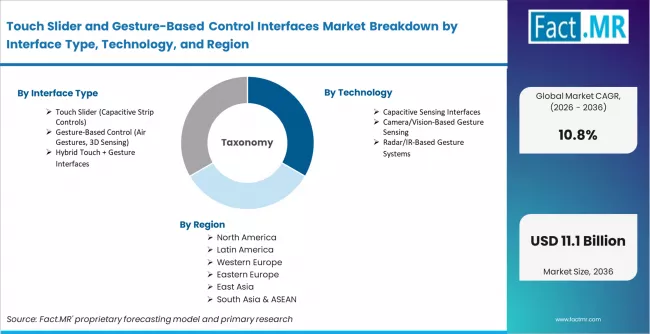
Touch Slider And Gesture Based Control Interfaces Market Breakdown By Interface Type, Technology, And Region | Source: Fact.MR
| Attribute | Details |
|---|---|
| Quantitative Units | USD 3.6 billion (2026) to USD 11.5 billion (2036), at a CAGR of 10.8% |
| Market Definition | Touch slider capacitive strip controls, gesture-based air and 3D sensing interfaces, and hybrid touch-gesture modules supplied to automotive OEMs, consumer electronics manufacturers, and industrial HMI integrators globally. |
| Interface Type Segmentation | Touch Slider (Capacitive Strip Controls), Gesture-Based Control (Air Gestures, 3D Sensing), Hybrid Touch + Gesture Interfaces |
| Technology Segmentation | Capacitive Sensing Interfaces, Camera/Vision-Based Gesture Sensing, Radar/IR-Based Gesture Systems |
| Application Coverage | Automotive cockpit HMI and ADAS driver monitoring, consumer electronics smart home and premium audio control, and industrial panel and appliance gesture interface integration. |
| Regions Covered | North America, Europe, Asia Pacific, Latin America, Middle East and Africa |
| Countries Covered | USA, Canada, Mexico, Germany, UK, France, Italy, Spain, Nordic, BENELUX, China, Japan, South Korea, India, ASEAN, Australia and New Zealand, Brazil, Argentina, Saudi Arabia, GCC, Turkey, South Africa, Rest of MEA |
| Key Companies Profiled | Continental AG, Robert Bosch GmbH, Denso Corporation, Valeo SA, Aptiv PLC, Synaptics Incorporated, NXP Semiconductors, STMicroelectronics, Sony Corporation, Qualcomm Incorporated |
| Forecast Period | 2026 to 2036 |
| Approach | Hybrid top-down and bottom-up model using Tier 1 supplier revenues, OEM design win volumes by vehicle and device segment, average selling prices by interface technology and automotive grade, and primary interviews with HMI engineers and automotive procurement specialists. |
Source: Fact.MR analysis. Updated May 14, 2026
Touch Slider and Gesture-Based Control Interfaces Market by Segments
-
By Interface Type:
- Touch Slider (Capacitive Strip Controls)
- Gesture-Based Control (Air Gestures, 3D Sensing)
- Hybrid Touch + Gesture Interfaces
-
By Technology:
- Capacitive Sensing Interfaces
- Camera/Vision-Based Gesture Sensing
- Radar/IR-Based Gesture Systems
-
By Region:
- North America
- United States
- Canada
- Mexico
- Latin America
- Brazil
- Mexico
- Argentina
- Rest of Latin America
- Western Europe
- Germany
- United Kingdom
- France
- Italy
- Spain
- Nordic Countries
- BENELUX
- Rest of Western Europe
- Eastern Europe
- Russia
- Poland
- Hungary
- Rest of Eastern Europe
- East Asia
- China
- Japan
- South Korea
- South Asia and Pacific
- India
- ASEAN
- Australia and New Zealand
- Rest of South Asia and Pacific
- Middle East and Africa
- Kingdom of Saudi Arabia
- Other GCC Countries
- Turkey
- South Africa
- Rest of Middle East and Africa
- North America
Frequently Asked Questions
How large is the global touch slider and gesture-based control interfaces market in 2025?
What will the market size be in 2026?
What is the projected market size by 2036?
What is the expected CAGR from 2026 to 2036?
Which interface type segment is poised to lead the market?
Which technology segment holds the largest share?
Which country shows the fastest growth?
What are touch slider and gesture-based control interfaces used for?
What drives demand in this market?
Who are the key players in the market?
Who worked on this report


Preview the report firsthand - request a free sample
Free SampleGet the brochure for pricing and purchase details
Download PDF