- Market Value (2025): USD 37.8 Bn
- Estimated Value (2026): USD 42.8 Bn
- Forecast Value (2036): USD 149.2 Bn
- CAGR (2026-2036): 13.3%
What is the Graphics Processing Unit GPU Server Market forecast to be worth by 2036?
USD 42.8 billion in 2026 to USD 149.2 billion by 2036 at 13.3% CAGR.
- The graphics processing unit GPU server market reached USD 37.8 billion in 2025 as AI infrastructure buyers moved toward GPU-dense compute nodes.
- Demand is projected to increase from USD 42.8 billion in 2026 to USD 149.2 billion by 2036.
- The market is forecast to record 13.3% CAGR from 2026 to 2036.
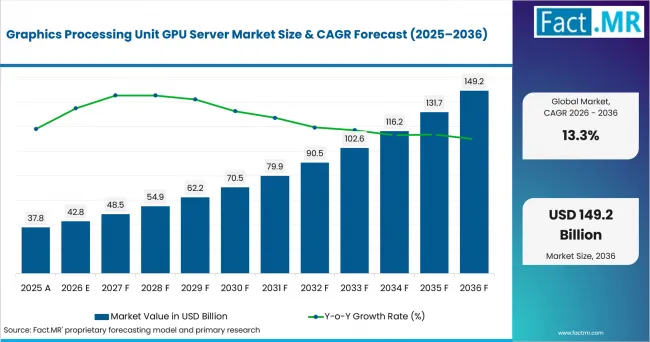
Graphics Processing Unit Gpu Server Market Value Analysis | Source: Fact.MR
What are the defining numbers behind Graphics Processing Unit GPU Server Market growth?
USD 105.8 billion absolute opportunity by 2036.
- Demand Drivers in the Market
- AI training and inference workloads are expected to lift demand for AI server chassis built around high memory bandwidth and stable accelerator use.
- Chiplet processors and 3D semiconductor packaging are anticipated to raise server design complexity where GPU modules depend on high-bandwidth memory and dense interconnects.
- Data center accelerator demand is projected to support repeat GPU server purchases as cloud providers add capacity for enterprise AI and high-performance computing.
- Thermal design pressure is expected to push customers toward direct-to-chip cold plates when dense accelerator racks move beyond air-cooling limits.
- Key Segments Analyzed
- By Server Configuration: AI GPU Servers are expected to hold 47.0% share in 2026 because training clusters need high accelerator density and reliable interconnects.
- By Primary Workload: Artificial Intelligence Training is projected to account for 39.0% share in 2026 as large model training remains the most hardware-intensive workload.
- By End-use Industry: Cloud Service Providers are anticipated to capture 42.0% share in 2026 since public cloud buyers purchase GPU capacity in large repeat cycles.
- By Deployment Model: On-premises Deployment is estimated to represent 45.0% share in 2026 due to data-control needs and predictable internal workload demand.
- By GPU Architecture: NVIDIA Hopper Architecture is forecast to hold 51.0% share in 2026 as qualification work and installed software stacks keep it widely used.
- Analyst Opinion at Fact.MR
- Shambhu Nath Jha, Senior Consultant at Fact.MR, states, “GPU server purchases are moving from single-system checks to cluster planning. Buyers are expected to judge suppliers on power design and cooling readiness. Memory bandwidth, software qualification and service support matter more than accelerator count alone.”
- Strategic Implications
- Server vendors should design platforms around cooling and power delivery. Service access should be set before quoting dense GPU configurations.
- Cloud providers can reduce upgrade risk by matching GPU server roadmaps with accelerator and networking availability.
- Component suppliers should coordinate package validation and high-bandwidth memory testing so server shipments are not delayed by subsystem limits.
The USA leads at 14.5% CAGR through CHIPS Act investments. China follows at 14.1% through domestic self-sufficiency. South Korea records 13.6% through memory depth. Japan posts 13.0% through materials strength. Germany reaches 12.5% through industrial AI demand. Canada follows at 11.9% through research depth. Singapore reaches 11.3% through packaging.
How does the Graphics Processing Unit GPU Server Market break down by segment?
AI GPU Servers lead Server Configuration with 47.0% share in 2026. Artificial Intelligence Training holds 39.0% share.
Why do AI GPU Servers lead Server Configuration?
AI GPU Servers are projected to account for 47.0% share in 2026.
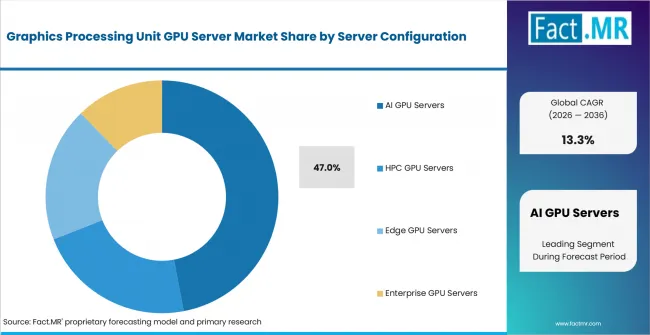
Graphics Processing Unit Gpu Server Market Analysis By Server Configuration | Source: Fact.MR
AI GPU Servers hold the largest position because training clusters need more than accelerator cards. Buyers need tested chassis, power paths and firmware support that keep dense systems stable during long workloads. Demand around high-density AI racks is expected to reinforce this purchase pattern as facilities plan rack-level capacity before server orders.
Why does Artificial Intelligence Training lead Primary Workload?
Artificial Intelligence Training holds 39.0% share in 2026.
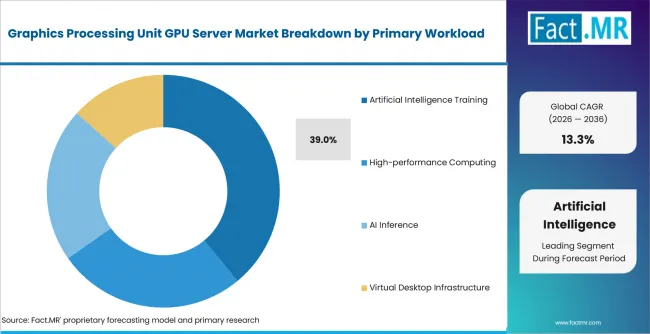
Graphics Processing Unit Gpu Server Market Analysis By Primary Workload | Source: Fact.MR
Large model training places the heaviest load on GPU memory and server interconnects. Training jobs run for long periods and lose value when nodes fail. Buyers therefore prioritize reliability for training systems.
Why do Cloud Service Providers lead End-use Industry?
Cloud Service Providers lead with 42.0% share in 2026.
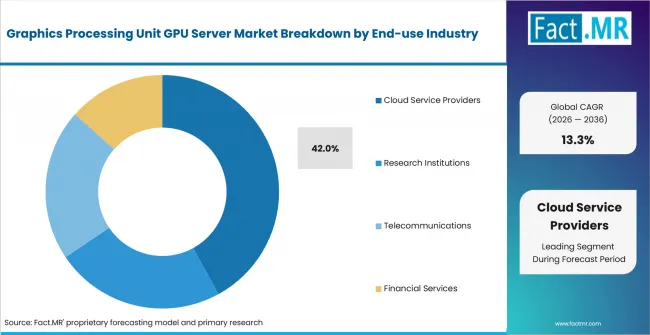
Graphics Processing Unit Gpu Server Market Analysis By End Use Industry | Source: Fact.MR
Cloud Service Providers lead because they aggregate demand from enterprises that need AI capacity without building every cluster themselves. Their buying cycles favor standard platforms that can be monitored across facilities. GPU servers become part of a broader plan that includes networking, storage and data center CPUs.
Why does On-premises Deployment lead Deployment Model?
On-premises Deployment is projected to account for 45.0% share in 2026.
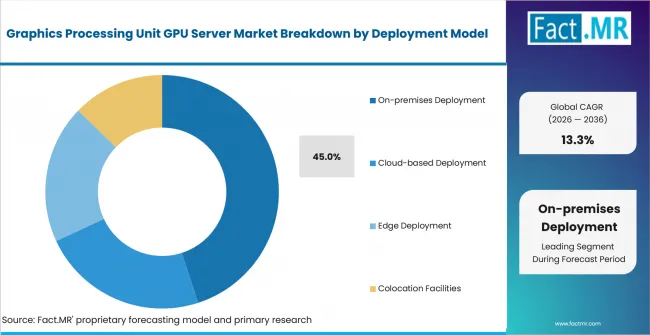
Graphics Processing Unit Gpu Server Market Analysis By Deployment Model | Source: Fact.MR
On-premises Deployment leads where buyers need direct control over data location and recurring workload cost. Local GPU systems remain useful for sensitive training jobs and predictable inference. Demand for modular ai racks is expected to support sites that want phased capacity additions.
Why does NVIDIA Hopper Architecture lead GPU Architecture?
NVIDIA Hopper Architecture leads with 51.0% share in 2026.
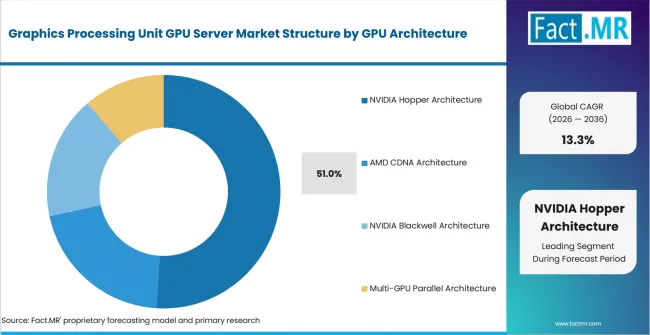
Graphics Processing Unit Gpu Server Market Analysis By Gpu Architecture | Source: Fact.MR
NVIDIA Hopper Architecture leads because many cloud, enterprise and research systems already run qualified Hopper software stacks. Blackwell platforms are entering roadmaps, but Hopper remains important where availability and operational familiarity guide procurement.
What is accelerating Graphics Processing Unit GPU Server Market adoption, and what is holding it back?
Demand is expected to rise through AI infrastructure spending and higher accelerator density. Growth may be limited by high budgets and facility readiness.
Drivers Impact Analysis
| DRIVER | (~) % IMPACT ON CAGR | GEOGRAPHIC RELEVANCE | IMPACT TIMELINE |
|---|---|---|---|
| Technology Innovation & R&D | High | Global | 2026-2036 |
| Regulatory & Policy Drivers | Medium-High | North America, Europe | 2026-2032 |
| End-User Industry Expansion | High | Asia Pacific, MEA | 2026-2036 |
| Operational & Cost Efficiency | Medium | Global | 2026-2036 |
Source: Fact.MR analysis. Updated Aug 8, 2026
- Technology Innovation & R&D: New accelerator generations are expected to raise system value when suppliers combine memory bandwidth with stable cluster software.
- Regulatory & Policy Drivers: Semiconductor sovereignty programs are anticipated to influence sourcing reviews and server assembly choices.
- End-User Industry Expansion: Cloud, automotive and research buyers are expected to widen demand for validated GPU systems.
Opportunity Impact Analysis
| OPPORTUNITY | (~) % IMPACT ON CAGR | GEOGRAPHIC RELEVANCE | IMPACT TIMELINE |
|---|---|---|---|
| Cluster-level reference designs | Medium-High | USA, China, South Korea | 2026-2032 |
| Liquid-cooled GPU platforms | Medium | North America, Europe, East Asia | 2026-2036 |
| Enterprise AI inference nodes | Medium | USA, Germany, Canada | 2026-2036 |
| Packaging and memory validation | Medium | South Korea, Japan, Singapore | 2026-2032 |
Source: Fact.MR analysis. Updated Aug 8, 2026
- Cluster-level reference designs: Suppliers that validate servers as part of full racks are expected to reduce engineering work for buyers.
- Liquid-cooled GPU platforms: Higher thermal loads are anticipated to create demand for systems that fit high-density power envelopes.
- Enterprise AI inference nodes: HBM stack inspection can become more useful as buyers check memory reliability before accepting AI systems.
Restraints Impact Analysis
| RESTRAINT | (~) % IMPACT ON CAGR | GEOGRAPHIC RELEVANCE | IMPACT TIMELINE |
|---|---|---|---|
| Capital Intensity & Investment | Medium | Developing Markets | 2026-2030 |
| Supply Chain & Raw Material | Medium | Global | 2026-2028 |
| Workforce & Capability Gaps | Low-Medium | Africa, Latin America | 2026-2036 |
| Power and Cooling Limits | Medium | High-density data centers | 2026-2036 |
Source: Fact.MR analysis. Updated Aug 8, 2026
- Capital Intensity & Investment: GPU servers require large upfront budgets for accelerators and networking. Power, cooling and support contracts can extend payback periods.
- Supply Chain & Raw Material: Accelerator allocation and memory availability are expected to influence delivery schedules for high-end GPU server orders.
- Power and Cooling Limits: Dense clusters can delay installation when facilities lack enough electrical capacity or liquid-cooling readiness.
Which countries are scaling the Graphics Processing Unit GPU Server Market fastest?
- The country comparison spans 3.2 percentage points and forms three practical growth bands across the forecast period.
- The USA remains 0.4 percentage points above China through CHIPS Act investments and AI infrastructure buildout.
- China remains 0.5 percentage points above South Korea as domestic semiconductor self-sufficiency supports local supply planning.
- South Korea remains 0.6 percentage points above Japan with memory manufacturing depth and HBM supply capability.
- Japan remains 0.5 percentage points above Germany through materials strength and semiconductor equipment supply.
- Germany remains 0.6 percentage points above Canada because automotive semiconductor demand supports industrial AI infrastructure.
- Canada remains 0.6 percentage points above Singapore where AI research capacity supports advanced manufacturing use.
Comparable CAGRs can create different entry conditions because scale and component access vary by country. Coverage spans North America, Latin America, Europe, East Asia, South Asia and Pacific, Middle East and Africa.
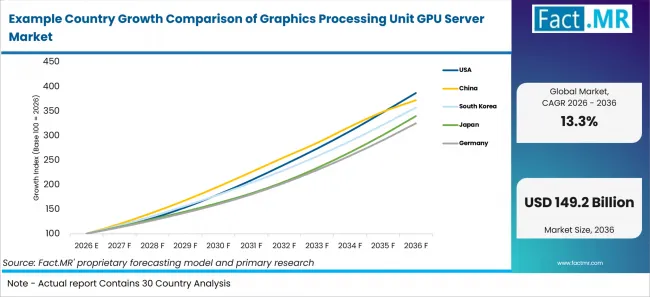
Example Country Growth Comparison Of Graphics Processing Unit Gpu Server Market | Source: Fact.MR
| Country | CAGR (2026-2036) |
|---|---|
| USA | 14.5% |
| South Korea | 13.6% |
| Japan | 13.0% |
| Germany | 12.5% |
| Canada | 11.9% |
| Singapore | 11.3% |
Source: Fact.MR analysis. Updated Aug 8, 2026
What supports USA adoption?
14.5% CAGR, supported by CHIPS Act investments and AI infrastructure buildout.
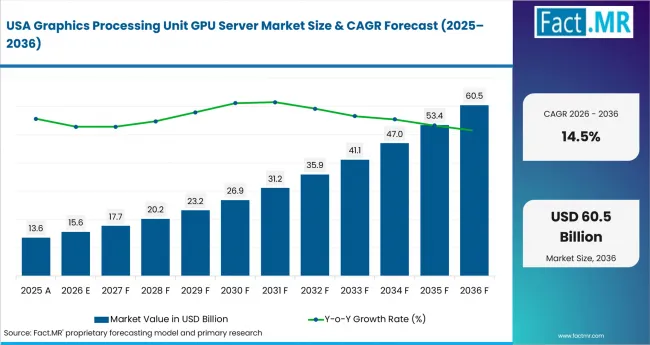
Graphics Processing Unit Gpu Server Market Country Value Analysis | Source: Fact.MR
In the USA, adoption is tied to the need for reliable power planning before GPU clusters expand. Server makers and cloud providers gain stronger planning confidence as domestic semiconductor programs improve local infrastructure support and supply visibility.
How is China scaling demand?
14.1% CAGR, driven by domestic semiconductor self-sufficiency initiatives.
China’s growth path reflects local AI infrastructure expansion and closer attention to component availability. When imported accelerator access becomes uncertain, buyers place higher value on domestic engineering support and server platforms that fit local deployment needs.
How is South Korea developing demand?
13.6% CAGR, supported by its leadership in memory manufacturing.
South Korea benefits from its strong high-bandwidth memory base, which is central to AI accelerator performance. This memory depth helps server suppliers validate GPU systems more closely with package, bandwidth and component-level requirements.
How does Japan perform?
13.0% CAGR, backed by advanced materials and equipment supply chain.
Japan’s position is shaped by materials expertise, engineering support and research computing demand. Buyers are likely to favor GPU server platforms that can support simulation, advanced manufacturing workloads and long-term technical reliability.
What is driving Germany’s growth from 2026 to 2036?
12.5% CAGR, led by automotive semiconductor and industrial IoT demand.
Germany’s demand comes from industrial automation, automotive engineering and enterprise AI use cases. Before installing large GPU clusters, buyers often review energy use, facility readiness and workload consistency, making deployment discipline a key part of adoption.
What supports Canada’s growth?
11.9% CAGR, backed by AI research and advanced manufacturing.
Canada’s market is supported by research institutions and advanced manufacturing users that need repeatable compute access. Some buyers may rely on cloud GPUs for flexible capacity, while others keep on-premises servers for recurring workloads and controlled data use.
How is Singapore positioned?
11.3% CAGR, supported by advanced packaging and regional distribution.
Singapore’s role reflects its compact electronics base, data center presence and regional supply-chain position. Space and power limitations create demand for dense, efficiently cooled GPU server systems that can support specialized AI and infrastructure workloads.
Who leads the Graphics Processing Unit GPU Server Market?
NVIDIA shows the strongest relevance in GPU servers through accelerator architecture and AI infrastructure pull, while Dell Technologies and Super Micro Computer add direct server-platform depth.
Hewlett Packard Enterprise and Lenovo strengthen enterprise and cloud deployment choices. Inspur, GIGABYTE and ASUSTeK broaden the field through GPU-dense hardware portfolios and system assembly. Cisco and Fujitsu extend the competitive base through networking, sovereign AI servers and infrastructure support, as buyers compare cooling readiness, memory bandwidth and cluster-level serviceability.
Which companies are the key providers?
Key companies profiled NVIDIA Corporation, Dell Technologies Inc., Super Micro Computer, Inc., Hewlett Packard Enterprise Company, Lenovo Group Limited, Inspur Electronic Information Industry Co., Ltd., GIGABYTE Technology Co., Ltd., ASUSTeK Computer Inc., Cisco Systems, Inc., and Fujitsu Limited.
- NVIDIA Corporation
- Dell Technologies Inc.
- Super Micro Computer, Inc.
- Hewlett Packard Enterprise Company
- Lenovo Group Limited
- Inspur Electronic Information Industry Co., Ltd.
- GIGABYTE Technology Co., Ltd.
- ASUSTeK Computer Inc.
- Cisco Systems, Inc.
- Fujitsu Limited
Bibliography
- Cisco Systems, Inc. (2024, October 29). Cisco Unveils Plug-and-Play AI Solutions, Accelerating AI Adoption for the Enterprise.
- Dell Technologies Inc. (2025, May 19). Dell Technologies Unveils Next Generation Enterprise AI Solutions with NVIDIA.
- Fujitsu Limited. (2026, February 12). Fujitsu Group starts manufacturing sovereign AI servers in Japan to enhance digital sovereignty.
- GIGABYTE Technology Co., Ltd. (2025, September 5). Giga Computing Expands NVIDIA RTX PRO Server Portfolio.
- Hewlett Packard Enterprise Company. (2025, May 19). Hewlett Packard Enterprise deepens integration with NVIDIA on AI Factory portfolio.
This Report Answers
- The report provides strategic intelligence on GPU server configurations and workload types that guide AI infrastructure buying.
- Segment analysis covers AI GPU Servers and Artificial Intelligence Training as the share leaders within the 2026 market.
- Country outlook evaluates the USA and China alongside South Korea and Japan. Germany, Canada and Singapore complete the listed growth comparison.
- Competitive analysis profiles NVIDIA Corporation and Dell Technologies Inc. alongside Super Micro Computer, Inc. and Hewlett Packard Enterprise Company.
- Adoption assessment covers AI training and cloud buying. On-premises deployment and NVIDIA Hopper Architecture shape the operating view.
What does the Graphics Processing Unit GPU Server Market cover?
GPU server systems are used for workloads where conventional CPU-only servers cannot provide enough parallel compute capacity.
The Graphics Processing Unit GPU Server Market covers finished server platforms used for artificial intelligence training and inference. Visualization, simulation and high-performance computing workloads remain included.
What is included in the scope?
GPU server systems are used by cloud service providers and enterprises. Research institutes, automotive users and government or defense buyers remain included.
The scope covers Server Configuration, Primary Workload and End-use Industry. Deployment Model and GPU Architecture complete the segment view.
What is excluded from the scope?
General-purpose servers without a server-grade GPU acceleration role remain outside the scope of this market.
The scope excludes standalone graphics cards sold for consumer PCs and workstation upgrades unless they are part of a server system. Software-only AI tools are outside the scope.
How Was the Analysis Built?
The analysis draws on 120+ sources and 35+ company portfolios. It reviews 25+ countries and 20+ industry interviews.
- Primary Research: Primary research includes discussions with manufacturers, technology developers and buyers. These conversations examine purchasing priorities and approval requirements.
- Desk Research: Desk research covers government statistics, regulatory publications and company filings. Trade data and public policy are reviewed.
- Market Sizing and Forecasting: Market estimates combine historical performance, demand indicators and pricing trends. Segment shares and expansion barriers are reviewed together.
- Data Validation and Update Cycle: Findings are checked against public data and company activity. Product updates are reviewed during each cycle.
Segmentation
What is the report’s scope and coverage?
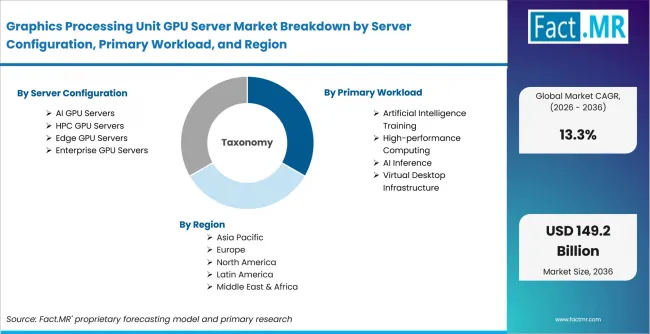
Graphics Processing Unit Gpu Server Market Breakdown By Server Configuration, Primary Workload, And Region | Source: Fact.MR
| Attribute | Details |
|---|---|
| Quantitative Units | USD billion in 2026 to USD billion by 2036 at CAGR |
| Market Definition | Server systems that use server-grade graphics processors for artificial intelligence, simulation, visualization, high-performance computing and other compute-heavy workloads |
| Server Configuration | AI GPU Servers; HPC GPU Servers; Edge GPU Servers; Workstation GPU Servers; Hybrid CPU-GPU Servers |
| Primary Workload | Artificial Intelligence Training; AI Inference; High-Performance Computing; Rendering and Visualization; Simulation and Digital Twin Workloads |
| End-use Industry | Cloud Service Providers; Enterprises; Research and Academic Institutes; Automotive and Mobility; Government and Defense |
| Deployment Model | On-premises Deployment; Cloud Deployment; Hybrid Deployment; Colocation Deployment; Managed GPU Infrastructure |
| GPU Architecture | NVIDIA Hopper Architecture; NVIDIA Blackwell Architecture; AMD Instinct Architecture; Intel Data Center GPU Architecture; Other Accelerator Architectures |
| Regions Covered | North America; Latin America; Europe; East Asia; South Asia and Pacific; Middle East and Africa |
| Countries Covered | USA; China; South Korea; Japan; Germany; Canada; Singapore |
| Key Companies Profiled | NVIDIA Corporation; Dell Technologies Inc.; Super Micro Computer, Inc.; Hewlett Packard Enterprise Company; Lenovo Group Limited; Inspur Electronic Information Industry Co., Ltd.; GIGABYTE Technology Co., Ltd.; ASUSTeK Computer Inc.; Cisco Systems, Inc.; Fujitsu Limited |
| Forecast Period | 2026 to 2036 |
| Approach | Hybrid top-down and bottom-up approach using AI workload demand; cloud capacity additions; GPU server configuration shifts; segment shares; company portfolio review; country adoption patterns; thermal design requirements; supply availability and primary interviews |
Source: Fact.MR analysis. Updated Aug 8, 2026
How is the market segmented?
-
By Server Configuration
- AI GPU Servers
- Training GPU Servers
- Inference GPU Servers
- HPC GPU Servers
- Multi-node HPC Servers
- Dense Rack-scale Servers
- Edge GPU Servers
- Compact Edge Servers
- Rugged Edge Servers
- Enterprise GPU Servers
- Virtualization Servers
- Remote Workstation Servers
- AI GPU Servers
-
By Primary Workload
- Artificial Intelligence Training
- Large Language Model Training
- Deep Learning Training
- High-performance Computing
- Scientific Simulation
- Engineering Analysis
- AI Inference
- Computer Vision
- Video Analytics
- Virtual Desktop Infrastructure
- Desktop Virtualization
- Remote Engineering Workloads
- Artificial Intelligence Training
-
By End-use Industry
- Cloud Service Providers
- Hyperscale Data Centers
- Enterprise Data Centers
- Research Institutions
- Government Laboratories
- Universities
- Telecommunications
- 5G Network Operators
- Smart Manufacturing
- Financial Services
- Banking & Financial Institutions
- Media & Entertainment
- Cloud Service Providers
-
By Deployment Model
- On-premises Deployment
- Private Data Centers
- Hybrid Infrastructure
- Cloud-based Deployment
- Public Cloud
- Edge-enabled Infrastructure
- Edge Deployment
- Distributed Edge Computing
- Remote Edge Sites
- Colocation Facilities
- Managed Hosting
- Service Provider Infrastructure
- On-premises Deployment
-
By GPU Architecture
- NVIDIA Hopper Architecture
- H100 GPU Platform
- H200 GPU Platform
- AMD CDNA Architecture
- Instinct MI300 Platform
- CDNA Accelerator Platform
- NVIDIA Blackwell Architecture
- B200 GPU Platform
- Blackwell Ultra Platform
- Multi-GPU Parallel Architecture
- GPU Virtualization Technology
- Multi-instance GPU Technology
- NVIDIA Hopper Architecture
-
By Region
- North America
- Latin America
- Western Europe
- Eastern Europe
- East Asia
- South Asia and Pacific
- Middle East & Africa
Frequently Asked Questions
How big is the graphics processing unit GPU server market in 2026?
What is the CAGR of the graphics processing unit GPU server market from 2026 to 2036?
Which server configuration leads the graphics processing unit GPU server market?
Which primary workload leads the graphics processing unit GPU server market?
Who are the leading companies in the graphics processing unit GPU server market?
Who worked on this report


Preview the report firsthand - request a free sample
Free SampleGet the brochure for pricing and purchase details
Download PDF