- Base Value(2026): 1.4 Bn
- Forecast Value (2036): 8.0 Bn
- CAGR (2036): 18.9%
Grid-Interactive Water Heater Aggregation Software Market Forecast and Outlook By Fact.MR
The grid-interactive water heater aggregation software market reached USD 1.2 billion in 2025. Fact MR estimates the market will expand to USD 1.4 billion in 2026 and attain USD 8.0 billion by 2036. The market is forecast to register a CAGR of 18.9% across the assessment period.
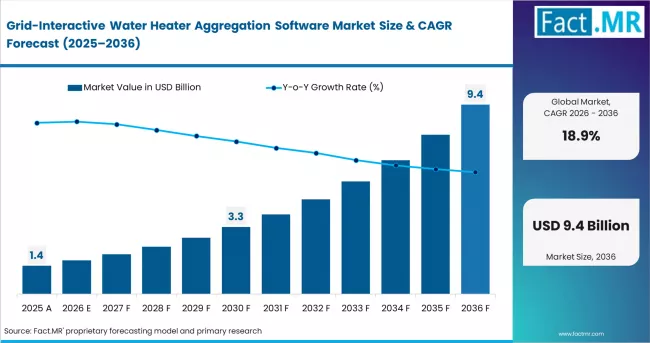
Grid Interactive Water Heater Aggregation Software Market Market Value Analysis | Source: Fact.MR
Grid-Interactive Water Heater Aggregation Software Market
| Metric | Details |
|---|---|
| Industry Size (2026E) | USD 1.4 billion |
| Industry Value (2036F) | USD 8.0 billion |
| CAGR (2026 to 2036) | 18.9% |
Source: Fact.MR analysis. Updated Apr 20, 2026
Summary of Grid-Interactive Water Heater Aggregation Software Market
- Market Definition
- The market comprises software platforms that aggregate and coordinate distributed electric water heaters as flexible energy resources, enabling utilities and aggregators to manage demand response, load shifting, virtual power plant participation, and peak load optimization through real time communication with grid management systems.
- Demand Drivers
- Increasing integration of distributed energy resource management platforms supporting coordination of flexible thermal loads.
- Rising utility demand for demand response capability enabling reduction of peak electricity consumption levels.
- Growing deployment of smart grid communication standards enabling interoperability between connected water heating assets and grid control systems.
- Expansion of renewable energy generation requiring flexible load balancing resources supporting grid stability.
- Increasing use of virtual power plant architectures enabling aggregation of distributed thermal storage capacity.
- Rising requirement for real time load orchestration software supporting optimization of electricity consumption patterns.
- Key Segments Analyzed
- Deployment: Cloud platforms lead supported by requirement for scalable coordination of distributed heating assets.
- Application: Demand response and load shifting represent primary use cases enabling flexible electricity consumption adjustment.
- End User: Utilities demonstrate strong adoption driven by requirement for distributed load balancing capability.
- Technology Role: Aggregation platforms enable coordinated scheduling of heating cycles aligned with grid frequency conditions.
- Geography: Asia Pacific, Europe, and North America demonstrate adoption supported by expansion of smart grid infrastructure.
- Analyst Opinion at Fact MR
- Shambhu Nath Jha, Principal Consultant, Fact MR, opines, 'In this updated edition of the Grid-Interactive Water Heater Aggregation Software Market report, distributed thermal flexibility is increasingly utilized as a grid balancing resource supporting integration of renewable energy capacity through 2036.'
- Strategic Implications or Executive Takeaways
- Invest in scalable aggregation platforms supporting coordination of distributed electric water heater loads across demand response environments.
- Strengthen interoperability capability supporting compatibility with distributed energy resource management communication standards.
- Expand forecasting functionality supporting optimization of load shifting strategies across variable electricity demand cycles.
- Improve integration capability supporting connection with utility grid control infrastructure and virtual power plant systems.
- Focus on cloud-based orchestration frameworks supporting centralized control of distributed thermal storage assets.
- Enhance collaboration with utilities supporting deployment of grid-interactive appliance ecosystems enabling flexible energy consumption coordination.
- Methodology
- Primary interviews conducted with utilities, distributed energy software providers, and demand response aggregators.
- Benchmarked against smart grid deployment indicators influencing adoption of distributed load orchestration software.
- Evaluated communication protocol integration supporting connectivity between aggregation platforms and connected devices.
- Hybrid modeling applied combining top down demand response participation assessment with bottom up aggregation software deployment benchmarking.
- Validation conducted using supplier level distributed energy management software adoption indicators.
- Peer review applied using Fact MR analytical frameworks linking smart grid flexibility requirements with distributed thermal load orchestration technology demand.
A CAGR of 18.9% indicates transformational expansion as utilities integrate distributed thermal storage for demand response optimization. Growth is supported by grid balancing requirements and peak load management benefits, while constraints persist from interoperability standards, regulatory approval processes, and integration complexity with legacy energy management systems.
China leads with a projected CAGR of 20.3%, supported by expansion of demand response platforms integrating distributed electric water heating assets. India follows with a CAGR of 19.8%, driven by increasing deployment of grid-responsive thermal load management software across utility optimization programs. The United Kingdom records a CAGR of 19.5%, reflecting steady adoption of distributed energy orchestration tools across residential demand balancing applications. Germany shows a CAGR of 19.2%, supported by consistent implementation of software-based load flexibility aggregation systems across smart grid environments. The United States records the slowest growth at 18.9%, reflecting an emerging digital energy management ecosystem tied to incremental adoption cycles within utility demand response infrastructure.
Segmental Analysis
Grid-Interactive Water Heater Aggregation Software Market Analysis by Deployment
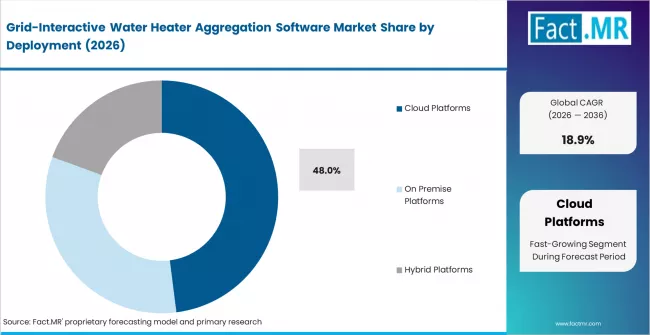
Grid Interactive Water Heater Aggregation Software Market Analysis By Deployment | Source: Fact.MR
- Market Overview: Based on Fact MR assessment, cloud platforms are projected to account for 48% share of the grid interactive water heater aggregation software market in 2026. Cloud based orchestration software aggregates distributed electric water heaters enabling coordinated control of heating cycles across demand response programs. Software platforms process real time load data enabling adjustment of energy consumption patterns aligned with grid balancing requirements across peak demand intervals. Aggregation architecture supports communication between connected devices and utility control systems enabling dynamic modification of heating schedules supporting load shifting performance across distributed residential and commercial water heating infrastructure.
- Demand Drivers:
- Demand Response Coordination Requirements: Cloud platforms support aggregation of water heater load enabling adjustment of electricity consumption patterns across grid balancing operations.
- Data Processing Parameters: Centralized software systems enable analysis of load behavior supporting optimization of heating cycles across connected devices.
- Scalability Needs: Cloud deployment supports expansion of aggregated device networks requiring flexible computational capacity across distributed energy resource management environments.
Grid-Interactive Water Heater Aggregation Software Market Analysis by End User
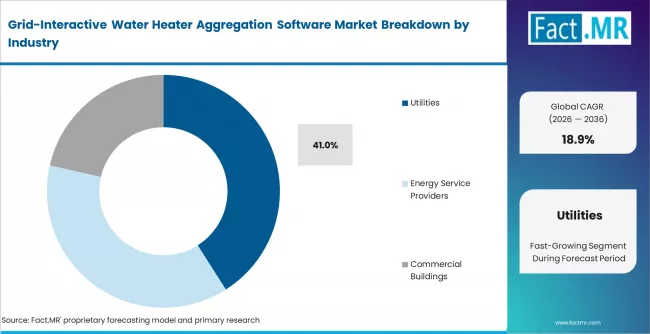
Grid Interactive Water Heater Aggregation Software Market Analysis By End User | Source: Fact.MR
- Market Overview: Utilities are estimated to hold 41% share of the grid interactive water heater aggregation software market in 2026, supported by requirement for distributed load management tools enabling coordination of residential water heating demand across electricity networks. Utility operators deploy aggregation platforms enabling remote control of connected heating units supporting peak load reduction and grid frequency stabilization performance. Software integration supports communication between grid management systems and distributed heating assets enabling controlled response to variable electricity demand patterns requiring stable load orchestration across energy distribution infrastructure.
- Demand Drivers:
- Load Management Requirements: Utilities utilize aggregation software enabling control of distributed water heating devices supporting adjustment of electricity consumption patterns.
- Grid Stability Parameters: Coordinated operation of connected heaters supports stabilization of power demand variability across electricity distribution networks.
- Operational Visibility Needs: Aggregation platforms enable monitoring of distributed heating assets supporting evaluation of demand response program performance across utility infrastructure.
Key Dynamics
Grid-Interactive Water Heater Aggregation Software Market Drivers, Restraints, and Opportunities
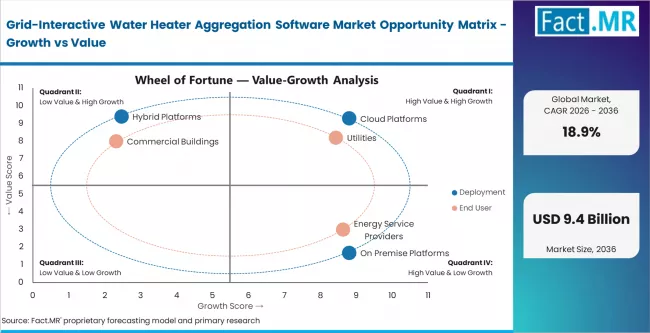
Grid Interactive Water Heater Aggregation Software Market Opportunity Matrix Growth Vs Value | Source: Fact.MR
FMR analysts observe that historical demand for grid-interactive water heater aggregation software originates from utility demand response programs that leveraged controllable residential loads to stabilize peak electricity demand. The present market size reflects a transition from isolated appliance-level control toward aggregated distributed energy resource orchestration platforms capable of coordinating thousands of electric resistance water heaters as virtual thermal storage assets. Structural reality indicates a growth-phase energy software market because electric water heaters represent one of the largest flexible loads in residential buildings, enabling utilities to shift electricity consumption without materially affecting consumer comfort. Aggregation platforms create economic value by converting decentralized thermal storage capacity into dispatchable grid balancing resources.
The current structural shift reflects declining reliance on centralized peak generation assets as utilities integrate distributed flexibility resources to manage renewable intermittency. Software orchestration costs increase due to device connectivity integration and real-time load forecasting requirements, yet avoided peak generation costs and improved grid stability support favorable economics despite modest per-device revenue contribution. Market expansion aligns with deployment of grid-interactive efficient buildings capable of responding dynamically to price signals and grid frequency conditions.
- Demand Response Scaling: Aggregation software converts distributed electric water heaters into dispatchable grid assets capable of shifting load during peak demand events without affecting user hot water availability.
- Interoperability Standards: OpenADR, IEEE 2030.5, and CTA-2045 protocols enable communication between utilities, aggregators, and connected appliances participating in grid services programs.
- North America Policy Push: Washington HB 1444 and Oregon HB 2062 mandate CTA-2045 communication ports on new water heaters, accelerating adoption of grid-interactive appliance ecosystems.
Regional Analysis
The grid-interactive water heater aggregation software market is assessed across North America, Europe, and Asia Pacific, segmented by country-level demand in demand response platforms, distributed energy resource orchestration, load flexibility optimization software, and residential energy management integration systems. Regional demand reflects expansion of smart grid infrastructure and adoption of software-enabled demand-side energy balancing tools. The full report offers market attractiveness analysis.
.webp "Top Country Growth Comparison Grid Interactive Water Heater Aggregation Software Market Cagr (2026 2036)")
Top Country Growth Comparison Grid Interactive Water Heater Aggregation Software Market Cagr (2026 2036) | Source: Fact.MR
CAGR Table
| Country | CAGR (2026–2036) |
|---|---|
| China | 20.3% |
| India | 19.8% |
| United Kingdom | 19.5% |
| Germany | 19.2% |
| United States | 18.9% |
Source: Fact.MR analysis. Updated Apr 20, 2026
Source: Fact MR analysis, based on proprietary forecasting model and primary research
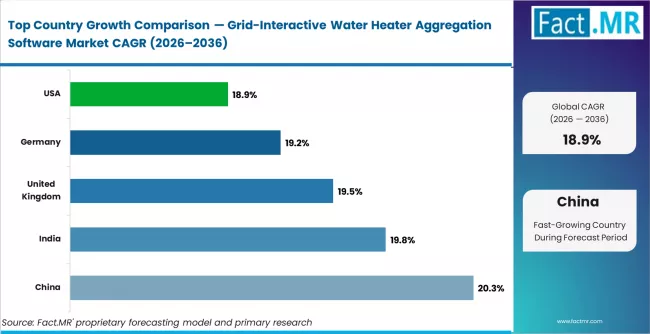
Grid Interactive Water Heater Aggregation Software Market Cagr Analysis By Country | Source: Fact.MR
Asia Pacific
Asia Pacific functions as the distributed energy orchestration deployment hub, supported by expansion of smart grid infrastructure and increasing integration of demand response management software platforms. Schneider Electric SE strengthens distributed energy optimization capability. Siemens AG expands grid-edge software analytics platforms. AutoGrid Systems Inc. supports load flexibility aggregation technologies.
- China: China is projected to record 20.3% CAGR in grid-interactive water heater aggregation software through 2036. Smart Grid development action plan update (National Energy Administration, March 2024) supports demand response software integration across distributed energy assets. Schneider Electric SE expanded grid-edge orchestration software capability (June 2023).
- India: Adoption of grid-interactive water heater aggregation software in India is forecast to grow at 19.8% CAGR through 2036. National Smart Grid Mission digital demand response framework update (Ministry of Power, January 2024) supports residential load flexibility aggregation deployment. Tata Power expanded demand response software platform capability (May 2023).
Europe
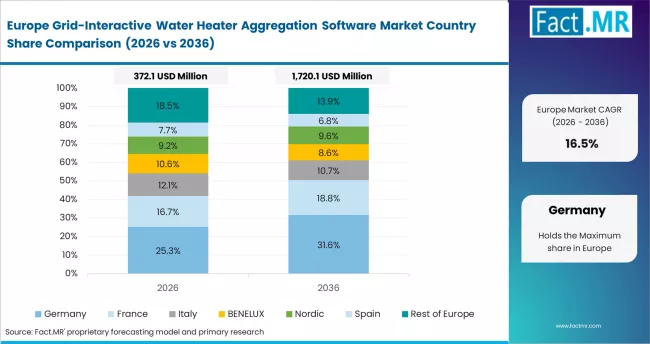
Grid Interactive Water Heater Aggregation Software Market Europe Country Market Share Analysis, 2026 & 2036 | Source: Fact.MR
Europe operates as the demand-side energy flexibility compliance center, supported by structured grid balancing frameworks and adoption of distributed energy management software solutions. Siemens AG strengthens grid orchestration analytics capability. Enel X S.r.l. expands virtual power plant software platforms. Schneider Electric SE supports demand response integration technologies.
- United Kingdom: Deployment of grid-interactive water heater aggregation software in United Kingdom is expected to expand at 19.5% CAGR through 2036. UK Smart Systems and Flexibility Plan update (Department for Energy Security, February 2024) supports residential demand response platform adoption. Enel X S.r.l. expanded distributed energy aggregation software capability (July 2023).
- Germany: Germany is anticipated to observe 19.2% CAGR in grid-interactive water heater aggregation software through 2036. Energiewende grid flexibility initiative update (Federal Ministry for Economic Affairs, October 2023) supports virtual power plant orchestration platform deployment. Siemens AG expanded grid-edge analytics integration capability (April 2023).
North America
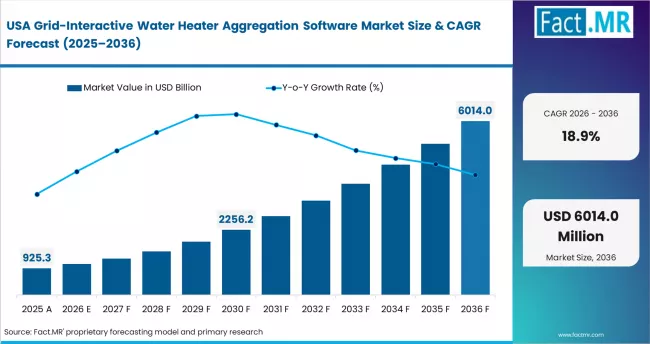
Grid Interactive Water Heater Aggregation Software Market Country Value Analysis | Source: Fact.MR
North America represents the residential demand response software commercialization environment, supported by expansion of distributed energy resource platforms and integration of load management technologies within smart grid ecosystems. Oracle Corporation strengthens utility analytics capability. AutoGrid Systems Inc. expands virtual power plant orchestration software. Honeywell International Inc. supports residential energy optimization platforms.
- United States: The United States is forecast to witness 18.9% CAGR in grid-interactive water heater aggregation software through 2036. Department of Energy demand flexibility programme update (April 2024) supports distributed load orchestration technology deployment. AutoGrid Systems Inc. expanded demand response aggregation software capability (August 2023).
Fact MR's analysis of grid-interactive water heater aggregation software market in global regions consists of country-wise assessment that includes China, India, United Kingdom, Germany, and United States. Readers can find demand response software trends, distributed energy orchestration developments, grid flexibility signals, and competitive positioning across key markets.
Competitive Landscape
Competitive Structure and Buyer Dynamics in the Grid-Interactive Water Heater Aggregation Software Market
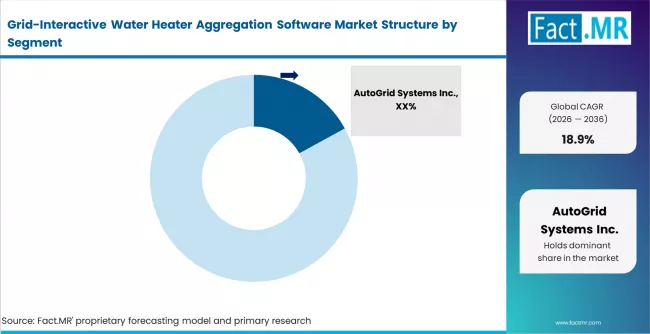
Grid Interactive Water Heater Aggregation Software Market Analysis By Company | Source: Fact.MR
The competitive structure of the Grid-Interactive Water Heater Aggregation Software Market is moderately fragmented, with energy software providers and grid optimization platform developers competing across demand response orchestration solutions. Companies such as AutoGrid Systems Inc., Uplight Inc., Oracle Corporation, Siemens AG, Schneider Electric SE, EnergyHub Inc., Bidgely Inc., Enel X S.r.l., Johnson Controls International plc, and Itron Inc. maintain strong positions through distributed energy resource management platforms and utility focused analytics software. Competition is primarily influenced by forecasting accuracy, scalability of aggregation algorithms, interoperability with utility infrastructure, and ability to manage demand flexibility across residential water heating systems.
Several companies maintain structural advantages through established relationships with electric utilities and expertise in demand response software architecture. Firms such as Siemens AG, Schneider Electric SE, and Oracle Corporation benefit from integration capabilities with grid management platforms supporting real time energy load balancing. AutoGrid Systems Inc. and EnergyHub Inc. maintain advantages through specialized distributed energy resource optimization technologies. Utilities typically adopt multi vendor software strategies to reduce dependence on a single demand response platform and maintain operational flexibility. Procurement decisions evaluate suppliers based on data integration capability, forecasting precision, and long term platform scalability, moderating supplier pricing leverage across grid interactive energy management deployments.
Key Players of the Grid-Interactive Water Heater Aggregation Software Market
- AutoGrid Systems Inc.
- Uplight Inc.
- Oracle Corporation
- Siemens AG
- Schneider Electric SE
- EnergyHub Inc.
- Bidgely Inc.
- Enel X S.r.l.
- Johnson Controls International plc
- Itron Inc.
Bibliographies
- [1] Federal Ministry for Economic Affairs and Climate Action. (2023, October). Energiewende grid flexibility initiative update. Government of Germany.
- [2] Ministry of Power. (2024, January). National smart grid mission digital demand response framework update. Government of India.
- [3] National Energy Administration. (2024, March). Smart grid development action plan update. Government of China.
- [4] U.S. Department of Energy. (2024, April). Demand flexibility programme update. U.S. Department of Energy.
- [5] Department for Energy Security and Net Zero. (2024, February). UK smart systems and flexibility plan update. UK Government.
- [6] AutoGrid Systems Inc. (2023, August). Demand response aggregation software capability expansion. AutoGrid Systems Inc.
- [7] Schneider Electric SE. (2023, June). Grid edge orchestration software capability expansion. Schneider Electric SE.
- [8] Siemens AG. (2023, April). Grid edge analytics integration capability expansion. Siemens AG.
- [9] Tata Power. (2023, May). Demand response software platform capability expansion. Tata Power.
This Report Addresses
- Market size forecasts for 2026 to 2036 based on adoption of distributed thermal load orchestration platforms supporting demand response and grid balancing operations.
- Opportunity mapping across cloud, on premise, and hybrid deployment architectures enabling aggregation of electric water heater loads across distributed energy resource environments.
- Segment and regional forecasts covering demand response, load shifting, virtual power plant participation, and peak demand management applications across grid-interactive infrastructure.
- Competition benchmarking based on forecasting accuracy capability, interoperability with distributed energy resource management systems, scalability of aggregation algorithms, and compatibility with utility communication protocols.
- Standards assessment covering OpenADR, IEEE 2030.5, and CTA-2045 communication frameworks influencing integration of distributed thermal loads within smart grid ecosystems.
- Report delivery in PDF, Excel, PPT, and dashboard formats supporting utilities, energy service providers, distributed energy aggregators, and grid optimization software developers.
- Technology risk evaluation covering interoperability constraints with legacy grid infrastructure, regulatory approval variability, data latency sensitivity, and integration complexity across distributed demand-side energy management platforms.
Grid-Interactive Water Heater Aggregation Software Market Definition
The grid-interactive water heater aggregation software market includes digital platforms that connect and coordinate multiple electric water heaters to act as flexible energy resources, enabling utilities and energy aggregators to shift electricity demand, store thermal energy, and provide grid balancing services through demand response and distributed energy resource management.
Grid-Interactive Water Heater Aggregation Software Market Inclusions
The report includes global and regional market size estimates, forecast analysis, and segmentation by software architecture, aggregation capability, communication protocol, application area, end use sector, pricing structure, and integration with demand response platforms and distributed energy resource management systems.
Grid-Interactive Water Heater Aggregation Software Market Exclusions
The scope excludes standalone water heater hardware without aggregation software, battery storage management platforms not designed for thermal load coordination, smart home energy applications without grid participation functionality, and utility infrastructure software not directly managing distributed water heater assets.
Grid-Interactive Water Heater Aggregation Software Market Research Methodology
- Primary Research: Interviews were conducted with energy software providers, utilities, demand response aggregators, water heater manufacturers, and grid technology specialists.
- Desk Research: Public sources included grid digitalization studies, demand response standards documentation, company technical literature, and research publications on distributed energy resource aggregation.
- Market-Sizing and Forecasting: A hybrid model combining top-down smart grid flexibility demand evaluation and bottom-up analysis of aggregated water heater control platform deployment was applied.
- Data Validation and Update Cycle: Outputs were validated through cross comparison of energy management deployment data, expert consultation, and periodic monitoring of demand response participation trends.
Segmentation
Report Scope
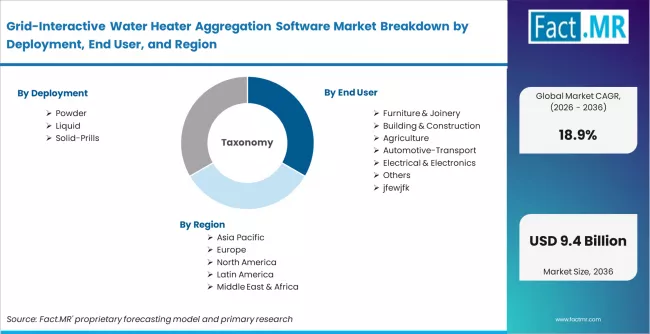
Grid Interactive Water Heater Aggregation Software Market Breakdown By Deployment, End User, And Region | Source: Fact.MR
| Metric | Value |
|---|---|
| Quantitative Units | USD 1.4 billion (2026) to USD 8.0 billion (2036), at a CAGR of 18.9% |
| Market Definition | The grid-interactive water heater aggregation software market includes software platforms that connect and coordinate distributed electric water heaters to enable flexible demand response, load balancing, and participation in virtual power plant programs supporting grid stability and energy efficiency optimization. |
| Deployment Segmentation | Cloud platforms, On premise platforms, Hybrid platforms |
| Application Segmentation | Demand response, Load shifting, Virtual power plants, Peak management |
| End User Segmentation | Utilities, Energy service providers, Commercial buildings, Residential aggregators |
| Regions Covered | North America, Latin America, Europe, East Asia, South Asia, Oceania, Middle East and Africa |
| Countries Covered | United States, Canada, Germany, France, United Kingdom, Netherlands, Sweden, China, Japan, South Korea, India, Australia, Brazil, Mexico, United Arab Emirates, Saudi Arabia, South Africa, Singapore, and 40+ countries |
| Key Companies Profiled | AutoGrid Systems Inc., Uplight Inc., Oracle Corporation, Siemens AG, Schneider Electric SE, EnergyHub Inc., Bidgely Inc., Enel X S.r.l., Johnson Controls International plc, Itron Inc. |
| Forecast Period | 2026 to 2036 |
| Approach | Hybrid top-down and bottom-up market estimation based on distributed energy resource management adoption trends, demand response program participation benchmarking, virtual power plant deployment rates, grid flexibility technology demand patterns, and validation through primary interviews with utilities, energy software providers, and grid technology integrators. |
Source: Fact.MR analysis. Updated Apr 20, 2026
Grid Interactive Water Heater Aggregation Software Market Key Segments
-
Deployment:
- Cloud Platforms
- On Premise Platforms
- Hybrid Platforms
-
Application:
- Demand Response
- Load Shifting
- Virtual Power Plants
- Peak Management
-
End User:
- Utilities
- Energy Service Providers
- Commercial Buildings
- Residential Aggregators
-
Region:
- North America
- USA
- Canada
- Mexico
- Europe
- Germany
- UK
- France
- Italy
- Spain
- Nordic Countries
- BENELUX
- Rest of Europe
- Asia Pacific
- China
- Japan
- South Korea
- India
- Australia
- Rest of Asia Pacific
- Latin America
- Brazil
- Argentina
- Rest of Latin America
- Middle East and Africa
- Kingdom of Saudi Arabia
- United Arab Emirates
- South Africa
- Rest of Middle East and Africa
- Other Regions
- Oceania
- Central Asia
- Other Markets
- North America
Frequently Asked Questions
How large is the demand for Grid-Interactive Water Heater Aggregation Software in the global market in 2026?
What will be the market size of Grid-Interactive Water Heater Aggregation Software in the global market by 2036?
What is the expected demand growth for Grid-Interactive Water Heater Aggregation Software in the global market between 2026 and 2036?
Which company is identified as a leading provider in the Grid-Interactive Water Heater Aggregation Software market?
Which deployment segment is projected to dominate aggregation software adoption by 2026?
Why are cloud-based aggregation platforms widely used in grid-interactive water heater management systems?
What is driving demand for grid-interactive water heater aggregation software in China?
What is the growth outlook for the Grid-Interactive Water Heater Aggregation Software market in China?
Why is India an important market for distributed energy aggregation technologies?
What is the growth outlook for the Grid-Interactive Water Heater Aggregation Software market in India?
How is demand for grid-interactive aggregation software evolving in the United Kingdom energy sector?
What is the growth outlook for the Grid-Interactive Water Heater Aggregation Software market in the United Kingdom?
What is the growth outlook for the Grid-Interactive Water Heater Aggregation Software market in Germany?
How is the United States positioned in the Grid-Interactive Water Heater Aggregation Software market?
What is the growth outlook for the Grid-Interactive Water Heater Aggregation Software market in the United States?
What is grid-interactive water heater aggregation software and what is it mainly used for?
What does the Grid-Interactive Water Heater Aggregation Software market include in this report?
What applications are included in the scope of the Grid-Interactive Water Heater Aggregation Software market?
What is excluded from the scope of the Grid-Interactive Water Heater Aggregation Software market report?
What does market forecast mean in the Grid-Interactive Water Heater Aggregation Software market report?
How is the Grid-Interactive Water Heater Aggregation Software market forecast developed in this report?
What does primary validation indicate in the Grid-Interactive Water Heater Aggregation Software market analysis?
Who worked on this report


Preview the report firsthand - request a free sample
Free SampleGet the brochure for pricing and purchase details
Download PDF