- Market Value (2025): USD 1.1 Bn
- Estimated Value (2026): USD 1.1 Bn
- Forecast Value (2036): USD 2.3 Bn
- CAGR (2026-2036): 7.4%
What is the Ground Beef Preservation Blends Market forecast to be worth by 2036?
USD 1.1 billion in 2026 to USD 2.3 billion by 2036 at a 7.4% CAGR.
- The Ground Beef Preservation Blends Market crossed a valuation of USD 1.1 billion in 2025.
- Demand is projected to increase from USD 1.1 billion in 2026 to USD 2.3 billion by 2036.
- The market is forecast to record 7.4% CAGR from 2026 to 2036.
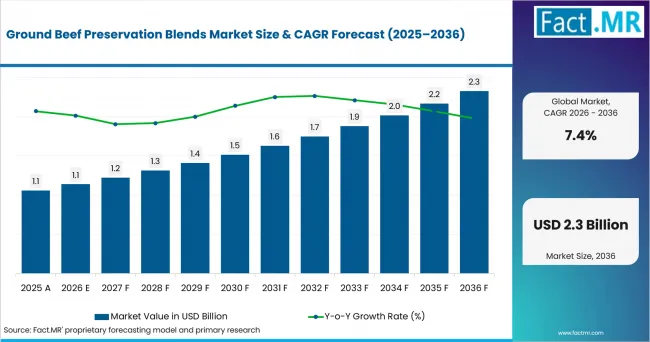
Ground Beef Preservation Blends Market Value Analysis | Source: Fact.MR
What are the defining numbers behind Ground Beef Preservation Blends Market growth?
An absolute opportunity of USD 1.2 billion is expected between 2026 and 2036.
- Demand Drivers in the Market
- Retail meat teams need longer display life in fresh ground beef. USDA ERS reported in July 2026 that beef and veal prices were 11.8% higher in June 2026 than in June 2025, increasing the value of inventory exposed to retail markdowns.
- Processors need cultured dextrose and sugar systems that combine a familiar label with organic-acid activity. These blends fit fresh retail ground beef where microbial shelf-life control is evaluated before flavor and color acceptance.
- Case-ready packers need vinegar and acetate systems that work beside MAP formats. Shelf-life performance is expected to influence blend trials where centralized grinding sends product into wider retail networks.
- Foodservice patty suppliers need antioxidant and flavor-protection systems for chilled and frozen distribution. Rosemary-based antioxidant systems are anticipated to support ground beef and patty formulas where oxidation and reheated flavor are checked closely.
- Key Segments Analyzed
- By Preservative Platform: Cultured dextrose and sugar is expected to hold 31.00% share in 2026 due to fermentate use and familiar ingredient wording.
- By Preservation Target: Microbial shelf life is projected to account for 36.00% share in 2026, supported by raw beef safety needs.
- By Beef Product: Fresh retail ground beef is anticipated to capture 42.00% share in 2026 owing to short display windows.
- By Label Position: Clean-label and natural is estimated to represent 47.00% share in 2026, shaped by retailer label standards.
- Analyst Opinion at Fact.MR
- Shambhu Nath Jha, Principal Consultant at Fact.MR, states, “Ground beef preservation has become a blend-design problem. The market is expected to reward suppliers that balance microbial control and color stability in one formula. Strong suppliers combine fermentate consistency, botanical skill and proof that taste holds at plant-scale dosage.”
- Strategic Implications
- Ingredient suppliers should document antimicrobial performance by beef fat level and packaging format so processors can qualify blends faster.
- Meat processors should test cultured sugar and vinegar blends against purge, color loss and off-note risk in the same trial.
- Retail meat teams should link shelf-life targets to markdown data so blend costs are weighed against avoidable shrink.
- Foodservice distributors should qualify low-sodium systems for patties that travel across mixed chilled and frozen channels.
The USA is expected to record 8.4% CAGR through 2036, supported by a large cattle inventory and retail shrink control. Germany is projected to post 7.9% CAGR, supported by meat processing scale and chilled retail standards. France is anticipated to advance at 7.0% CAGR, led by clean-label retail positioning and chilled-beef formulation needs. Brazil is estimated to hold 6.7% CAGR, shaped by cattle slaughter scale and export-linked quality needs. The UK is forecast to reach 5.9% CAGR, reinforced by beef value and retail mince quality pressure.
How does the Ground Beef Preservation Blends Market break down by segment?
Fresh retail ground beef is projected to lead Beef Product at 42.0% share in 2026; clean-label and natural leads Label Position at 47.0% share.
Which Preservative Platform dominates?
Cultured dextrose and sugar is expected to hold 31.0% share in 2026.
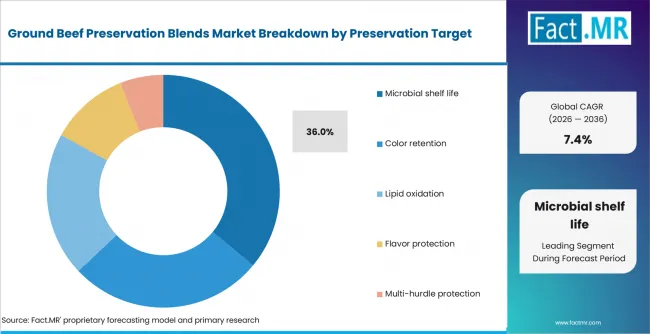
Ground Beef Preservation Blends Market Analysis By Preservation Target | Source: Fact.MR
Cultured dextrose and sugar is expected to hold 31.0% share in 2026 because meat processors value fermentate systems with familiar wording. Vinegar and acetate blends follow where organic-acid action is the first test. Rosemary antioxidant blends serve higher-fat ground beef and patty formulas. Wenda Ingredients’ SafePlate antimicrobial line includes cultured onion as an alternative to cultured dextrose for meat applications.
What leads the Preservation Target segment?
Microbial shelf life is projected to account for 36.0% share in 2026.
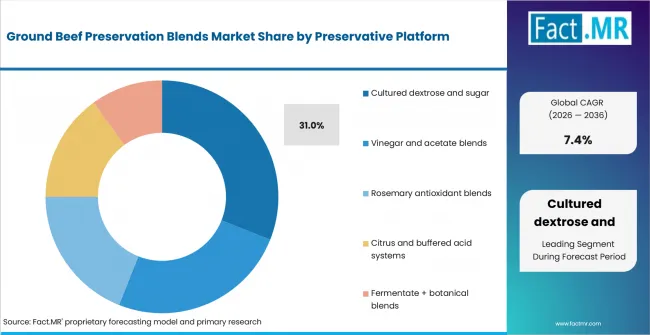
Ground Beef Preservation Blends Market Analysis By Preservative Platform | Source: Fact.MR
Microbial shelf life is projected to account for 36.0% share in 2026, supported by the risk profile of refrigerated raw ground beef. Color retention stays close to the purchase decision because shoppers judge mince before cooking. USDA FSIS lists IFF’s BIOVIA CL635, a blend of cultured dextrose, dried vinegar, maltodextrin and rosemary extract, for antimicrobial use in raw ground and whole-cut meat and poultry products.
How does Beef Product shape demand?
Fresh retail ground beef is anticipated to capture 42.0% share in 2026.
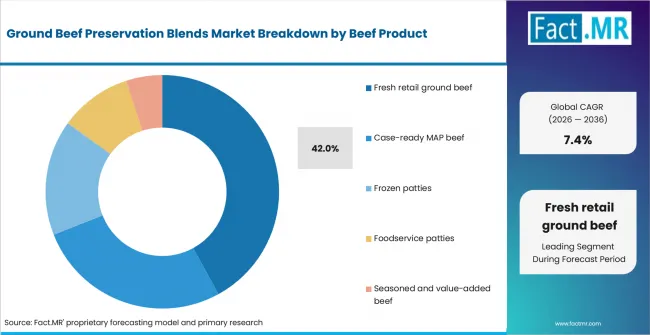
Ground Beef Preservation Blends Market Analysis By Beef Product | Source: Fact.MR
Fresh retail ground beef is anticipated to capture 42.0% share in 2026 owing to direct visibility in refrigerated meat cases. Case-ready MAP beef needs blend performance that aligns with oxygen-managed packaging. Frozen patties require oxidation control after storage and reheating.
What supports clean-label and natural within Label Position?
Clean-label and natural is estimated to represent 47.0% share in 2026.
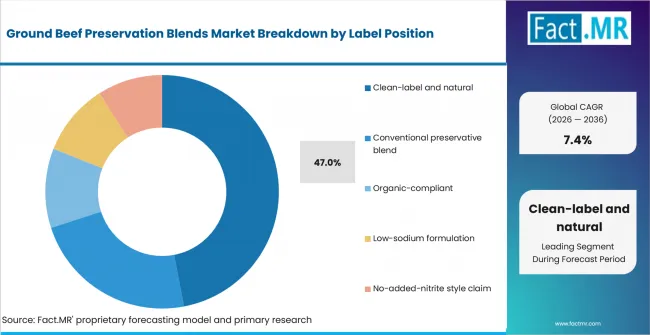
Ground Beef Preservation Blends Market Analysis By Label Position | Source: Fact.MR
Clean-label and natural is estimated to represent 47.0% share in 2026, shaped by private-label standards and consumer-facing ingredient language. Conventional preservative blends remain used where cost takes priority. Low-sodium formulation is expected to gain attention where acetate systems need careful flavor balancing.
What is accelerating Ground Beef Preservation Blends Market adoption, and what is holding it back?
Shelf-life control drives it; flavor impact restrains it.
Drivers Impact Analysis
| DRIVER | (~) % IMPACT ON CAGR | GEOGRAPHIC RELEVANCE | IMPACT TIMELINE |
|---|---|---|---|
| Shelf-life control in fresh retail ground beef | +1.4% | North America, Europe | Short term (<= 2 years) |
| Clean-label organic-acid reformulation | +1.1% | North America, Western Europe | Short term (<= 2 years) |
| Beef price pressure and shrink reduction | +0.9% | USA, UK, Germany | Medium term (2-4 years) |
| Case-ready and foodservice patty use | +0.8% | Global | Medium term (2-4 years) |
Source: Fact.MR analysis. Updated Sep 4, 2026
- Shelf-life control in fresh retail ground beef: Ground beef can lose retail value when color or odor changes appear early. Preservation blends help processors maintain product quality for longer display periods, supporting lower markdown exposure and more consistent shelf-life performance across fresh meat programs.
- Clean-label organic-acid reformulation: Vinegar, acetate, and fermentate systems give processors options for simplifying ingredient declarations while supporting preservation. Their use depends on balancing antimicrobial performance with flavor, particularly in mild beef formulations where acidic notes may become noticeable.
- Beef price pressure and shrink reduction: Higher raw-material costs increase the financial impact of unsold or downgraded beef products. Preservation systems that help extend usable shelf life and reduce product loss can therefore become more valuable to processors and retailers managing fresh meat inventories.
- Case-ready and foodservice patty use: Case-ready modified-atmosphere-packaged beef and formed patties require predictable preservation performance after grinding and forming. Blend suppliers can strengthen adoption by validating preservation systems together with the final formulation, packaging format, and expected distribution conditions.
Opportunity Impact Analysis
| OPPORTUNITY | (~) % IMPACT ON CAGR | GEOGRAPHIC RELEVANCE | IMPACT TIMELINE |
|---|---|---|---|
| Low-sodium vinegar and acetate blends | +0.8% | USA, Europe | Short term (<= 2 years) |
| Fermentate and botanical combinations | +0.7% | Global | Medium term (2-4 years) |
| Organic-compliant antioxidant systems | +0.5% | North America, Western Europe | Medium term (2-4 years) |
Source: Fact.MR analysis. Updated Sep 4, 2026
- Low-sodium vinegar and acetate blends: Meat processors are seeking antimicrobial systems that support sodium reduction without compromising preservation performance. Potassium-buffered vinegar and acetate blends create reformulation opportunities, with suppliers competing on taste neutrality, effectiveness, and compatibility with beef formulations.
- Fermentate and botanical combinations: Blends combining cultured ingredients, vinegar-derived components, and botanical extracts can support preservation and oxidation control in raw ground and whole-cut meat products. These multi-functional systems are particularly relevant for processors developing beef products with multiple formulation and label requirements.
- Organic-compliant antioxidant systems: Rosemary- and acerola-based systems can support color stability and oxidation control in beef products. Their use in organic formulations depends on ingredient composition, processing conditions, and applicable certification requirements, making formulation-specific documentation important for commercial adoption.
Restraints Impact Analysis
| RESTRAINT | (~) % IMPACT ON CAGR | GEOGRAPHIC RELEVANCE | IMPACT TIMELINE |
|---|---|---|---|
| Flavor impact at effective dosage | -0.5% | Global | Short term (<= 2 years) |
| Cost volatility for natural acids and botanicals | -0.4% | North America, Europe | Medium term (2-4 years) |
| Label-rule and regional compliance variation | -0.3% | Europe, North America | Medium term (2-4 years) |
Source: Fact.MR analysis. Updated Sep 4, 2026
- Flavor impact at effective dosage: Preservation blends require application-specific sensory validation because flavor effects can vary with dosage, formulation, packaging, and product characteristics. Suppliers can improve adoption by providing clear use-level guidance and demonstrating acceptable sensory performance under realistic processing conditions.
- Cost volatility for natural acids and botanicals: Natural preservation systems depend on specialty acids, fermentates, and botanical inputs that can vary in cost and availability. Concentrated blends, optimized dosing, and formulation support can help processors manage ingredient costs while maintaining preservation performance.
- Label-rule and regional compliance variation: Meat ingredient requirements differ across countries, product categories, and retailer programs. Suppliers therefore need clear regulatory documentation covering intended technical effects, permitted use conditions, labeling treatment, and market-specific compliance requirements to support commercial qualification.
Which countries are scaling the Ground Beef Preservation Blends Market through 2036?
- The country comparison spans 2.50 percentage points and forms three practical growth bands across the forecast period.
- The USA remains 0.44 percentage point above Germany due to high cattle throughput and fresh retail ground beef movement.
- Germany remains 0.89 percentage point above France as chilled meat standards support blend qualification.
- France remains 0.37 percentage point above Brazil owing to clean-label retail expectations and import-linked handling needs.
- Brazil remains 0.80 percentage point above the UK because large beef-processing runs support preservation at scale.
- The UK closes the displayed range as higher beef value keeps shelf-life protection relevant in chilled retail mince.
Comparable CAGRs create different entry conditions due to cattle supply, chilled distribution, retailer standards and validation needs. Full report coverage includes North America, Latin America, Western Europe, Eastern Europe, East Asia, South Asia & Pacific, and Middle East & Africa.
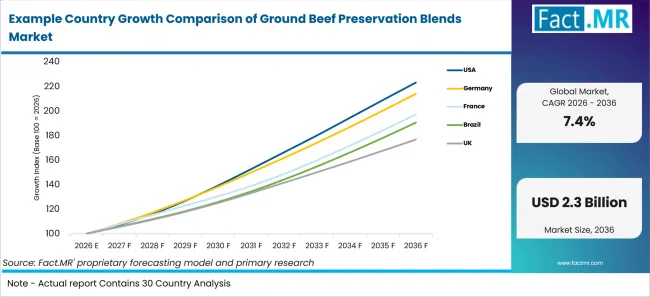
Example Country Growth Comparison Of Ground Beef Preservation Blends Market | Source: Fact.MR
| Country | CAGR (2026-2036) |
|---|---|
| United States | 8.4% |
| Germany | 7.9% |
| France | 7.0% |
| Brazil | 6.7% |
| United Kingdom | 5.9% |
Source: Fact.MR analysis. Updated Sep 4, 2026
What supports USA adoption?
8.4% CAGR through 2036, supported by a large cattle inventory and refrigerated mince demand.
Retail grinders and case-ready packers are expected to use preservation blends across large processing systems. USDA NASS reported in January 2026 that U.S. farms held 86.2 million cattle and calves as of January 1, 2026. This inventory provides an upstream scale indicator for U.S. beef-processing activity.
How is Germany scaling demand?
7.9% CAGR through 2036, driven by meat processing scale and chilled retail standards.
German meat companies are anticipated to qualify cultured and acetate blends for mince where display windows are short. Destatis reported in August 2026 that commercial slaughterhouses produced nearly 3.4 million tonnes of meat in the first half of 2026. The 7.9% CAGR reflects volume scale and private-label quality controls across discount and supermarket meat cases.
What supports France’s outlook?
7.0% CAGR through 2036, led by clean-label retail positioning and chilled-beef formulation needs.
French retailers are projected to favor preservation systems that fit simpler ingredient statements in fresh beef packs. FranceAgriMer reported in July 2026 that total meat consumption increased 1.3% in 2025, while bovine and ovine meat consumption decreased. The 7.0% CAGR is therefore tied to chilled mince, value-added beef and preservative scrutiny rather than broad meat-consumption growth.
What underpins Brazil’s growth?
6.7% CAGR through 2036, shaped by cattle slaughter scale and export-linked quality needs.
Brazilian beef processors are expected to apply antioxidant and microbial-control blends across patties and ground beef bound for long logistics chains. IBGE reported in March 2026 that Brazil slaughtered 42.94 million cattle in 2025 under sanitary inspection. The 6.7% CAGR reflects large processing runs and the need for consistent quality across frozen and chilled routes.
How does the UK perform?
5.9% CAGR through 2036, reinforced by high beef value and retail mince quality pressure.
UK processors are forecast to focus on preserving higher-value beef packs in chilled retail channels. Defra reported in July 2026 that beef and veal production value rose 23% to GBP 5.1 billion in 2025. The 5.9% CAGR is linked to margin protection and sensory approval for low-sodium beef formulations.
Who leads the Ground Beef Preservation Blends Market?
Corbion and Kerry Group offer meat-preservation solutions, while Kemin Industries and Kalsec offer antioxidant solutions for meat and poultry.
Corbion is active in fermentation-based food preservation, including cultured and fermented ingredient solutions for meat applications. Kerry Group reported in February 2026 that APMEA volumes rose 4.2% in 2025; growth was led by Bakery, Meat and Meals, while Meat performance was led by innovations using taste and texture systems as well as smoke and grill technologies.
Kemin Industries and Kalsec offer antioxidant systems for meat and poultry. USDA FSIS lists IFF’s BIOVIA CL635, a blend of cultured dextrose, dried vinegar, maltodextrin and rosemary extract, for antimicrobial use in raw ground and whole-cut meat and poultry products. Wenda Ingredients’ SafePlate antimicrobial portfolio includes cultured onion as an antimicrobial alternative to cultured dextrose for meat and poultry applications.
Which companies are the key providers?
Key companies include Corbion, Kerry Group, Kemin Industries, Kalsec, IFF, and Wenda Ingredients.
- Corbion
- Kerry Group
- Kemin Industries
- Kalsec
- IFF
- Wenda Ingredients
Bibliography
- U.S. Department of Agriculture, National Agricultural Statistics Service. (2026, January 30). United States cattle inventory down slightly.
- U.S. Department of Agriculture, Economic Research Service. (2026, July 24). Food Price Outlook - Summary Findings.
- U.S. Department of Agriculture, Food Safety and Inspection Service. (2026, February 11). CS Beef Packers, LLC recalls ground beef products that may be contaminated with E. coli O145.
- U.S. Department of Agriculture, Food Safety and Inspection Service. (2026, April 3). askFSIS public Q&A: Safe & suitable ingredient use.
- Statistisches Bundesamt (Destatis). (2026, August 7). Fleischproduktion im 1. Halbjahr 2026 um 0,7 % gesunken.
- Élevage - FranceAgriMer. (2026, July 8). La consommation de viandes en France.
- Instituto Brasileiro de Geografia e Estatística. (2026, March 18). Em 2025, Brasil registra a maior produção de leite, couro e ovos da história; abate de bovinos, frangos e suínos também é recorde.
- Department for Environment, Food & Rural Affairs. (2026, July 29). Chapter 8: Livestock. GOV.UK.
- Corbion. (2026, March 17). Corbion releases its 2025 Annual Report: Preserving what matters.
- Kerry Group plc. (2026, February 17). Kerry Group Preliminary Statement of Results for the year ended 31 December 2025.
- U.S. Department of Agriculture, Food Safety and Inspection Service. (2024, August 14). New technology information table.
- Skattebo, C. (2026, April 2). Why maintaining meat and poultry color and flavor is important for manufacturers. Kemin Industries.
This Report Answers
- The report explains where ground beef preservation blends fit within clean-label preservatives used by meat processors.
- Segment analysis identifies how cultured sugar systems and microbial shelf-life blends compare with broader food preservatives.
- Country analysis covers the United States, Germany, France, Brazil and the United Kingdom.
- Competitive analysis reviews Corbion, Kerry Group, Kemin Industries, Kalsec, IFF and Wenda Ingredients.
- Packaging adjacency is considered where ingredient blends interact with fresh meat packaging and chilled display requirements.
What does the Ground Beef Preservation Blends Market cover?
Cultured sugar, vinegar, acetate and rosemary blends used for ground beef shelf-life protection.
The Ground Beef Preservation Blends Market covers ingredient combinations used by meat processors to slow spoilage, control oxidation and protect ground beef color. It includes dry and liquid blend systems for fresh retail packs where fresh food packaging sets the visible shelf environment.
The market differs from packaging fields because the core value comes from the ingredient blend inside the beef formula. It connects with processed meat packaging only when performance is assessed alongside case-ready or patty packaging.
What is included in the scope?
Ground beef preservation blend systems used in retail, case-ready and foodservice beef applications.
The scope includes cultured dextrose and sugar, vinegar and acetate blends, rosemary antioxidant blends, citrus systems and fermentate-botanical combinations. It covers microbial shelf life, color retention, lipid oxidation and flavor protection for ground beef. Adjacent natural food preservatives are included only when formulated for beef processors.
Retail and foodservice coverage includes chilled mince, frozen patties and seasoned beef. Broader red meat value chains are considered only where ground beef formulas use preservative blends. Cold storage links are reviewed where food cold chain conditions influence shelf-life performance.
What is excluded from the scope?
Raw packaging materials and general plant sanitation products are outside the scope.
The scope excludes standalone modified-atmosphere equipment, tray materials, sanitation chemicals and logistics services sold apart from ingredient blends. Broader natural preservative systems are outside the scope when they lack meat-use qualification.
Color additives, flavor systems and spice blends are excluded when preservation is a secondary claim. Adjacent color retention agents are included only when sold as part of a ground beef preservation blend.
How Was the Analysis Built?
The analysis draws on 120+ sources, 35+ company portfolios, 25+ countries, and more than 20 industry interviews.
- Primary Research: Primary research includes discussions with manufacturers, service providers, technology developers, distributors, end users, and subject-matter experts. These conversations examine purchasing priorities, product adoption, operational challenges, approval requirements, competitive positioning, and the factors that influence wider market acceptance.
- Desk Research: Desk research covers government statistics, regulatory publications, company filings, trade data, technical studies, industry associations, standards, public policy, and other authoritative sources. Every source used in the analysis is documented in the bibliography.
- Market Sizing and Forecasting: Market estimates combine historical performance, demand indicators, pricing and volume trends, segment shares, company participation, country-level growth, adoption patterns, investment activity, and barriers to market expansion.
- Data Validation and Update Cycle: Findings are validated by comparing primary interviews with public data, company activity, regulatory changes, trade patterns, and industry developments. Regular updates review new product launches, capacity changes, partnerships, approvals, and shifts in commercial adoption.
Segmentation
What is the report’s scope and coverage?
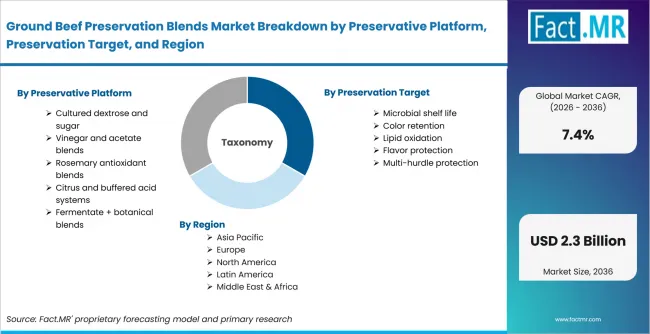
Ground Beef Preservation Blends Market Breakdown By Preservative Platform, Preservation Target, And Region | Source: Fact.MR
| Attribute | Details |
|---|---|
| Quantitative Units | USD Billion |
| Market Definition | Ingredient blends used to preserve ground beef by controlling microbial shelf life, oxidation, flavor quality and color stability in fresh, case-ready, frozen and foodservice formats. |
| Preservative Platform | Cultured dextrose and sugar; Vinegar and acetate blends; Rosemary antioxidant blends; Citrus and buffered acid systems; Fermentate and botanical blends |
| Preservation Target | Microbial shelf life; Color retention; Lipid oxidation; Flavor protection; Multi-hurdle protection |
| Beef Product | Fresh retail ground beef; Case-ready MAP beef; Frozen patties; Foodservice patties; Seasoned and value-added beef |
| Label Position | Clean-label and natural; Conventional preservative blend; Organic-compliant; Low-sodium formulation; No-added-nitrite style claim |
| Regions Covered | North America; Latin America; Western Europe; Eastern Europe; East Asia; South Asia & Pacific; Middle East & Africa |
| Countries Covered | United States; Germany; France; Brazil; United Kingdom |
| Key Companies Profiled | Corbion; Kerry Group; Kemin Industries; Kalsec; IFF; Wenda Ingredients |
| Forecast Period | 2026 to 2036 |
| Approach | Hybrid top-down and bottom-up approach using beef-processing applications, ingredient-platform mapping, country-level beef indicators, supplier portfolios and interview feedback. |
Source: Fact.MR analysis. Updated Sep 4, 2026
How is the market segmented?
-
By Preservative Platform
- Cultured dextrose and sugar
- Vinegar and acetate blends
- Rosemary antioxidant blends
- Citrus and buffered acid systems
- Fermentate and botanical blends
-
By Preservation Target
- Microbial shelf life
- Color retention
- Lipid oxidation
- Flavor protection
- Multi-hurdle protection
-
By Beef Product
- Fresh retail ground beef
- Case-ready MAP beef
- Frozen patties
- Foodservice patties
- Seasoned and value-added beef
-
By Label Position
- Clean-label and natural
- Conventional preservative blend
- Organic-compliant
- Low-sodium formulation
- No-added-nitrite style claim
-
By Region
- North America
- Latin America
- Western Europe
- Eastern Europe
- East Asia
- South Asia & Pacific
- Middle East & Africa
Frequently Asked Questions
How big is the ground beef preservation blends market in 2026?
What is the CAGR of the ground beef preservation blends market from 2026 to 2036?
Which Preservative Platform leads the Ground Beef Preservation Blends Market?
Which Preservation Target leads the Ground Beef Preservation Blends Market?
Which companies are profiled in the Ground Beef Preservation Blends Market?
Who worked on this report


Preview the report firsthand - request a free sample
Free SampleGet the brochure for pricing and purchase details
Download PDF