- Market Value (2025): USD 994.1 Mn
- Estimated Value (2026): USD 1180.0 Mn
- Forecast Value (2036): USD 6552.2 Mn
- CAGR (2026-2036): 18.7%
What is the High-Voltage ECPD Units Market forecast to be worth by 2036?
USD 1,180.0 million in 2026 to USD 6,552.2 million by 2036 at a 18.7% CAGR.
- The High-Voltage ECPD Units Market reached USD 994.1 million in 2025.
- Demand is projected to increase from USD 1,180.0 million in 2026 to USD 6,552.2 million by 2036.
- The market is forecast to record 18.7% CAGR from 2026 to 2036 as industrial power users, renewable developers, data-center operators, rail integrators, utilities and power-electronics OEMs expand qualified purchasing and deployment.
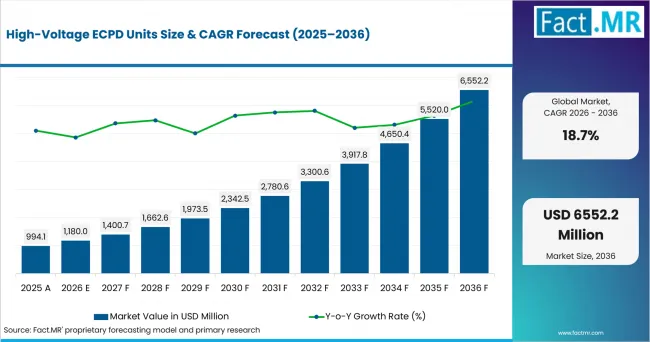
High Voltage Ecpd Units Value Analysis | Source: Fact.MR
What are the defining numbers behind High-Voltage ECPD Units Market growth?
The 2026 to 2036 value gain is expected to reach USD 5,372.2 million.
- Demand Drivers in the Market
- Medium-voltage DC systems and converter-rich networks need interruption speeds that limit fault energy before sensitive power electronics are damaged.
- SiC power devices support high-voltage and high-frequency switching; when incorporated into solid-state or hybrid protection architectures, these characteristics can enable faster electronic fault interruption and current limiting.
- Converter-rich systems with multiple sources and loads require coordinated protection and rapid fault isolation, particularly where bidirectional AC/DC power flow is used.
- Key Segments Analyzed
- By Protection Topology: Solid-state electronic breaker is expected to hold 35.0% share in 2026 because a fully electronic current path can detect and interrupt faults rapidly without waiting for mechanical contact movement.
- By Voltage Class: 3.3-10 kV is projected to account for 28.0% share in 2026, reflecting its relevance across medium-voltage protection applications that require fast fault interruption and compact electronic protection architectures.
- By Semiconductor: SiC MOSFET is anticipated to capture 39.0% share in 2026 because it combines high blocking voltage with fast switching performance, supporting compact current-limiting protection designs.
- By Application: Industrial MV distribution is estimated to represent 28.0% share in 2026 because medium-voltage industrial networks contain critical motors and converters where fault energy, equipment downtime and restart time can carry significant operating costs.
- Analyst Opinion at Fact.MR
- Shambhu Nath Jha, Principal Consultant, Fact.MR, states, "High-voltage electronic protection earns its premium when faster interruption prevents wider converter damage. Suppliers must prove thermal performance, fault energy control and coordination across mixed electronic and mechanical devices."
- Strategic Implications
- Qualification programs should prioritize fault-interruption performance, thermal management, voltage withstand and coordination with existing protection.
- MVDC and HVDC designs should document how the electronic protection architecture isolates and stabilizes faulted sections.
- Semiconductor selection should be evaluated together with conduction losses, cooling requirements and switching performance.
- Applicable high-voltage switchgear testing requirements should be mapped explicitly to the intended AC or DC application.
- Cybersecurity and control interfaces should be evaluated where protection functions are integrated into digital power-electronic systems.
How does the High-Voltage ECPD Units Market break down by segment?
The High-Voltage ECPD Units Market is analyzed by Protection Topology, Voltage Class, Semiconductor, and Application.
Why does Solid-state electronic breaker lead Protection Topology?
The Solid-state electronic breaker category holds 35.0% share of Protection Topology in 2026.
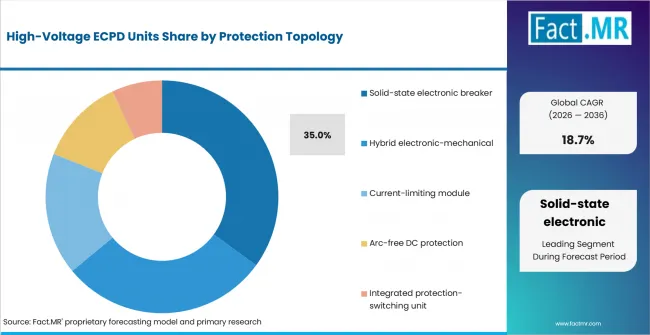
High Voltage Ecpd Units Analysis By Protection Topology | Source: Fact.MR
A fully electronic current path can detect and interrupt faults rapidly without waiting for mechanical contact travel. Hybrid electronic-mechanical remains technically credible, but buyer evaluation of fault-energy control in power-electronic medium-voltage systems maps more closely to Solid-state electronic breaker.
The route from specification to volume is shaped by MVDC protection modules, not by headline share alone. Buyers will still test Solid-state electronic breaker against conduction loss and cooling and the economics of fault-energy control in power-electronic medium-voltage systems.
Why does 3.3-10 kV lead Voltage Class?
The 3.3-10 kV category holds 28.0% share of Voltage Class in 2026.
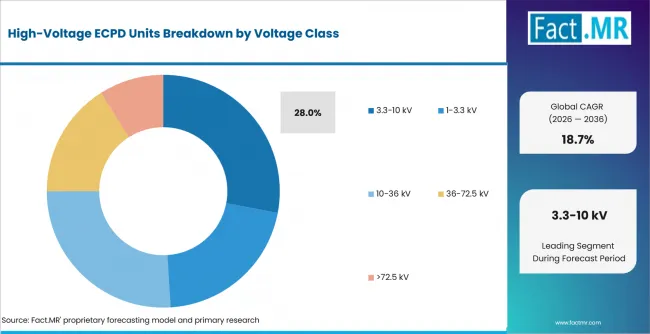
High Voltage Ecpd Units Analysis By Voltage Class | Source: Fact.MR
The 3.3 to 10 kV range covers industrial distribution and emerging medium-voltage DC applications where converter protection is valuable. Compared with 1-3.3 kV, its specification is more directly tied to fault-energy control in power-electronic medium-voltage systems.
The commercial test for 3.3-10 kV is whether data-center DC distribution can be documented without allowing semiconductor cost to erode the buyer case. That is especially relevant to industrial power users, renewable developers, data-center operators, rail integrators, utilities and power-electronics OEMs.
Why does SiC MOSFET lead Semiconductor?
The SiC MOSFET category holds 39.0% share of Semiconductor in 2026.
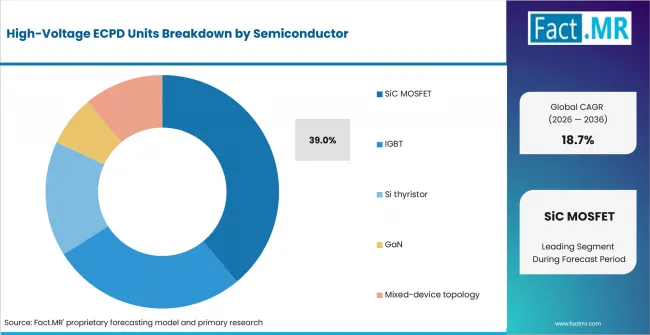
High Voltage Ecpd Units Analysis By Semiconductor | Source: Fact.MR
SiC MOSFETs combine high blocking voltage with fast switching and can support compact current-limiting protection designs. Specifications built around IGBT address narrower cases, while the purchasing logic for SiC MOSFET reaches further across semiconductor decisions.
The lead held by SiC MOSFET can persist when vendors connect the category with rail traction protection. Commercial momentum weakens where type-testing requirements transfer excessive risk to the customer.
Why does Industrial MV distribution lead Application?
The Industrial MV distribution category holds 28.0% share of Application in 2026.
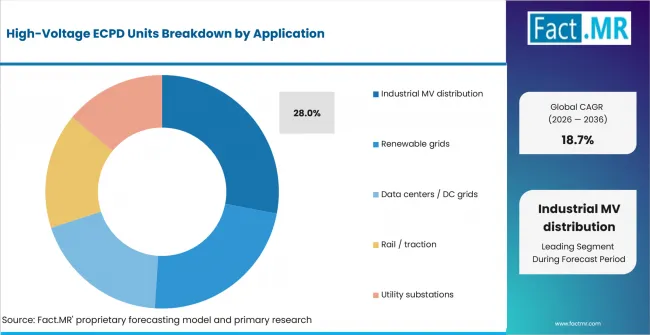
High Voltage Ecpd Units Analysis By Application | Source: Fact.MR
Industrial medium-voltage networks contain critical motors and converters for which fault energy and restart time carry high costs. The alternative, Renewable grids, serves selected designs; the closer fit with fault-energy control in power-electronic medium-voltage systems is Industrial MV distribution.
For Industrial MV distribution, supplier differentiation sits outside the label: service teams must make breaker-converter integration usable in the field and contain coordination with conventional protection. This converts technical preference into recurring orders.
What is accelerating High-Voltage ECPD Units Market adoption, and what is holding it back?
Adoption is supported by demand for faster fault interruption in converter-rich MVDC systems, advances in high-voltage SiC power electronics, and growth in power-electronics-intensive applications. Expansion can be constrained by conduction losses and thermal management, semiconductor cost, type-testing requirements, and coordination with conventional protection.
Drivers Impact Analysis
| DRIVER | (~) % IMPACT ON CAGR | GEOGRAPHIC RELEVANCE | IMPACT TIMELINE |
|---|---|---|---|
| Medium-voltage DC systems and converter-rich networks need interruption speeds that | +3.4% | Global | Short term (<= 2 years) |
| SiC power devices support high-voltage and high-frequency switching | +2.6% | USA and Germany | Medium term (2-4 years) |
| Renewable plants | +2.1% | Germany and Japan | Long term (>= 4 years) |
Source: Fact.MR analysis. Updated Sep 10, 2026
Opportunity Impact Analysis
| OPPORTUNITY | (~) % IMPACT ON CAGR | GEOGRAPHIC RELEVANCE | IMPACT TIMELINE |
|---|---|---|---|
| MVDC protection modules | +2.2% | Global | Medium term (2-4 years) |
| Data-center DC distribution | +1.9% | USA and Germany | Short term (<= 2 years) |
| Rail traction protection | +1.5% | Germany and Japan | Long term (>= 4 years) |
| Breaker-converter integration | +1.1% | Global | Medium term (2-4 years) |
Source: Fact.MR analysis. Updated Sep 10, 2026
Restraints Impact Analysis
| RESTRAINT | (~) % IMPACT ON CAGR | GEOGRAPHIC RELEVANCE | IMPACT TIMELINE |
|---|---|---|---|
| Conduction loss and cooling | -1.7% | Global | Short term (<= 2 years) |
| Semiconductor cost | -1.3% | USA and Germany | Medium term (2-4 years) |
| Type-testing requirements | -1.0% | Global | Long term (>= 4 years) |
| Coordination with conventional protection | -0.7% | Japan and South Korea | Medium term (2-4 years) |
Source: Fact.MR analysis. Updated Sep 10, 2026
Which countries are scaling the High-Voltage ECPD Units Market through 2036?
- USA: The 18.5% trajectory is application-led. Buyers are expected to use Solid-state electronic breaker as a reference while assessing MVDC protection modules.
- Germany: The 17.8% outlook is tied to data-center DC distribution, with 3.3-10 kV gaining attention where semiconductor cost can be contained.
- Japan: The 18.1% growth path points to selective expansion, led by rail traction protection rather than undifferentiated replacement.
- South Korea: A projected 19.2% CAGR brings breaker-converter integration into sharper procurement focus, particularly for Industrial MV distribution.
- UK: At 13.9% through 2036, the commercial focus falls on Solid-state electronic breaker and the rollout of MVDC protection modules.
Coverage reaches North America, Latin America, Western Europe, Eastern Europe, East Asia, South Asia & Pacific, and Middle East & Africa. These pathways frame the High-Voltage ECPD Units Market outlook.
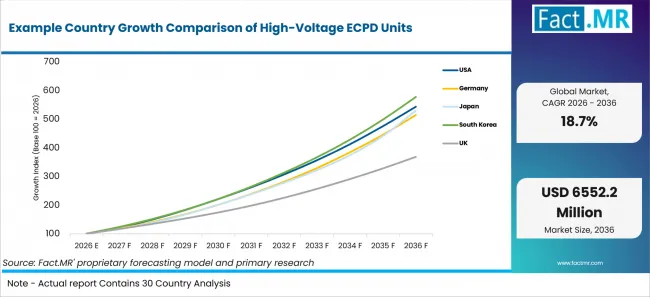
Example Country Growth Comparison Of High Voltage Ecpd Units | Source: Fact.MR
| Country | CAGR (2026-2036) |
|---|---|
| USA | 18.5% |
| Germany | 17.8% |
| Japan | 18.1% |
| South Korea | 19.2% |
| UK | 13.9% |
Source: Fact.MR analysis. Updated Sep 10, 2026
What is driving USA's growth through 2036?
The ten-year forecast for USA is 18.5% CAGR, with fault-energy control in power-electronic medium-voltage systems setting the direction.
The U.S. Department of Energy's Solid State Power Substation Technology Roadmap identifies high-voltage power electronics, system protection and thermal management as important development areas and notes the value of rapidly isolating and stabilizing faulted parts of a system.
The purchasing case is strongest for industrial power users, renewable developers, data-center operators, rail integrators, utilities and power-electronics OEMs that can quantify fault-energy control in power-electronic medium-voltage systems. Other Solid-state electronic breaker users may wait until references, standards or service coverage reduce the impact of conduction loss and cooling.
What is driving Germany's growth through 2036?
17.8% CAGR through 2036, shaped by fault-energy control in power-electronic medium-voltage systems.
Germany's Bundesnetzagentur confirmed the Electricity Network Development Plan 2023-2037/2045 in March 2024, including around 4,800 km of new lines, about 2,500 km of reinforcement and five new HVDC links rated at 2 GW each.
The most actionable opening is data-center DC distribution. The corresponding risk is semiconductor cost, which can alter timing even when the strategic case is sound.
What is driving Japan's growth through 2036?
The country is projected to expand at 18.1% CAGR from 2026 to 2036.
Japan's Electricity Business Act framework includes Ministry of Economy, Trade and Industry technical standards for the construction, maintenance and operation of electric facilities.
A successful local proposition will pair rail traction protection with evidence on type-testing requirements. This balance matters to industrial power users, renewable developers, data-center operators, rail integrators, utilities and power-electronics OEMs before they standardize the purchase.
What is driving South Korea's growth through 2036?
A projected CAGR of 19.2% places South Korea on a distinct ten-year adoption path.
South Korea continues to support power-semiconductor development through public programs in Busan. These initiatives include 8-inch SiC power-semiconductor production and manufacturing infrastructure, high-efficiency SiC substrate-analysis capabilities, and R&D achievements in 1.7-kV-class mobility compound semiconductors, providing a relevant technology-development backdrop.
Commercial traction should appear first around breaker-converter integration. If coordination with conventional protection persists, however, rollout can remain concentrated among technically experienced buyers.
What is driving UK's growth through 2036?
Through 2036, growth is projected at 13.9% CAGR as buyers act on fault-energy control in power-electronic medium-voltage systems.
Ofgem’s RIIO-3 Final Determinations cover electricity transmission from 1 April 2026 to 31 March 2031, providing a current Great Britain high-voltage network-investment context.
Execution remains decisive. Vendors need to make MVDC protection modules visible in tender and commissioning documents while preventing conduction loss and cooling from shifting risk back to the buyer.
Who Leads the High-Voltage ECPD Units Market?
ABB, Eaton, Siemens, and Hitachi Energy as relevant competitive participants. Public evidence is uneven across the report's strict in-scope definition, so the list should be read as competitive assessment rather than as a claim that every company currently sells a commercial high-voltage solid-state breaker in each defined voltage class.
Supplier competition centers on who can shorten approval and commissioning without diluting performance. The strongest portfolios connect product breadth with verifiable gains in fault-energy control in power-electronic medium-voltage systems. This is the competitive frame for the High-Voltage ECPD Units Market.
Local engineering and service coverage influence awards because conduction loss and cooling cannot always be solved remotely. MVDC protection modules add a second axis of differentiation.
Which companies are the key providers?
Key companies include ABB, Eaton, Siemens, and Hitachi Energy.
- ABB
- Eaton
- Siemens
- Hitachi Energy
What is the report's scope and coverage?
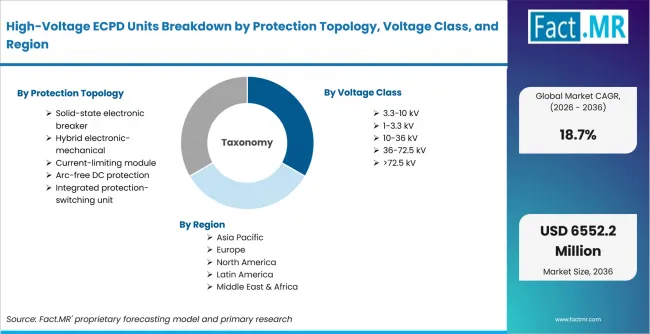
High Voltage Ecpd Units Breakdown By Protection Topology, Voltage Class, And Region | Source: Fact.MR
| Attribute | Details |
|---|---|
| Quantitative Units | USD Million |
| Market Definition | High-voltage electronic circuit protection and disconnection units using solid-state or hybrid switching to interrupt faults rapidly in medium- and high-voltage systems. |
| Protection Topology | Solid-state electronic breaker; Hybrid electronic-mechanical; Current-limiting module; Arc-free DC protection; Integrated protection-switching unit |
| Voltage Class | 3.3-10 kV; 1-3.3 kV; 10-36 kV; 36-72.5 kV; >72.5 kV |
| Semiconductor | SiC MOSFET; IGBT; Si thyristor; GaN; Mixed-device topology |
| Application | Industrial MV distribution; Renewable grids; Data centers / DC grids; Rail / traction; Utility substations |
| Regions Covered | North America; Latin America; Western Europe; Eastern Europe; East Asia; South Asia & Pacific; Middle East & Africa |
| Countries Covered | USA; Germany; Japan; South Korea; UK |
| Key Companies | ABB; Eaton; Siemens; Hitachi Energy |
| Forecast Period | 2026 to 2036 |
| Approach | Hybrid top-down and bottom-up assessment using Protection Topology, Voltage Class, Semiconductor, and Application, country deployment, replacement demand and company participation. |
Source: Fact.MR analysis. Updated Sep 10, 2026
Bibliography
- International Electrotechnical Commission. (2024). High-voltage switchgear and controlgear—Part 100: Alternating-current circuit-breakers (IEC 62271-100:2021+AMD1:2024 CSV).
- Bundesnetzagentur. (2024, March 1). Bundesnetzagentur confirms Electricity Network Development Plan 2023–2037/2045 for climate-neutral transmission network.
- Busan Metropolitan City. (2026, May 4). Busan selected for two Ministry of Trade, Industry and Energy power semiconductor projects… Secures KRW 20 billion in national funding.
- Ofgem. (2025, December 4). RIIO-3 Final Determinations for the Electricity Transmission, Gas Distribution and Gas Transmission sectors.
This Report Answers
- The report explains how the High-Voltage ECPD Units Market develops across Protection Topology and Voltage Class.
- Segment analysis identifies Solid-state electronic breaker and 3.3-10 kV as the principal 2026 reference points.
- Country analysis examines USA, Germany, Japan, South Korea, and UK.
- Competitive analysis reviews ABB, Eaton, Siemens, and Hitachi Energy.
- Opportunity analysis covers MVDC protection modules, data-center DC distribution, rail traction protection, and breaker-converter integration.
- Risk analysis evaluates conduction loss and cooling, semiconductor cost, type-testing requirements, and coordination with conventional protection.
What does the High-Voltage ECPD Units Market cover?
The High-Voltage ECPD Units Market covers solid-state breakers, hybrid electronic-mechanical units, current-limiting modules and integrated protection-switching assemblies.
Commercial coverage follows purchases made by industrial power users, renewable developers, data-center operators, rail integrators, utilities and power-electronics OEMs. Revenue is counted when the qualifying product, platform or integrated system is supplied for an in-scope application.
What is included in the scope?
The scope includes solid-state breakers, hybrid electronic-mechanical units, current-limiting modules and integrated protection-switching assemblies across Protection Topology, Voltage Class, Semiconductor, and Application.
Inclusions extend to configuration and integration elements that are inseparable from the in-scope commercial offer. The boundary is applied consistently across USA, Germany, Japan, South Korea, and UK and the seven global regions.
What is excluded from the scope?
The scope excludes conventional breakers without an electronic power path, low-voltage consumer breakers, protection relays sold alone and semiconductor dies not integrated into protection units.
Adjacent categories enter the High-Voltage ECPD Units Market only when the sold product or service performs the defining function described above. This prevents broader equipment, chemical, software or project revenue from being counted twice.
How Was the Analysis Built?
The analysis draws on 120+ sources, 35+ company portfolios, 25+ countries, and more than 20 industry interviews.
- Primary Research: Primary research includes discussions with manufacturers, service providers, technology developers, distributors, end users, and subject-matter experts. These conversations examine purchasing priorities, product adoption, operational challenges, approval requirements, competitive positioning, and the factors that influence wider market acceptance.
- Desk Research: Desk research covers government statistics, regulatory publications, company filings, trade data, technical studies, industry associations, standards, public policy, and other authoritative sources. Every source used in the analysis is documented in the bibliography.
- Market Sizing and Forecasting: Market estimates combine historical performance, demand indicators, pricing and volume trends, segment shares, company participation, country-level growth, adoption patterns, investment activity, and barriers to market expansion.
- Data Validation and Update Cycle: Findings are validated by comparing primary interviews with public data, company activity, regulatory changes, trade patterns, and industry developments. Regular updates review new product launches, capacity changes, partnerships, approvals, and shifts in commercial adoption.
Segmentation
How is the market segmented?
-
By Protection Topology
- Solid-state electronic breaker
- Hybrid electronic-mechanical
- Current-limiting module
- Arc-free DC protection
- Integrated protection-switching unit
-
By Voltage Class
- 3.3-10 kV
- 1-3.3 kV
- 10-36 kV
- 36-72.5 kV
- >72.5 kV
-
By Semiconductor
- SiC MOSFET
- IGBT
- Si thyristor
- GaN
- Mixed-device topology
-
By Application
- Industrial MV distribution
- Renewable grids
- Data centers / DC grids
- Rail / traction
- Utility substations
-
By Region
- North America
- Latin America
- Western Europe
- Eastern Europe
- East Asia
- South Asia & Pacific
- Middle East & Africa
Frequently Asked Questions
How big is the infrastructure partnership platforms market in 2026?
What is the CAGR of the infrastructure partnership platforms market from 2026 to 2036?
Which participant segment leads the infrastructure partnership platforms market?
Which deployment model leads the infrastructure partnership platforms market?
Who are the leading companies in the infrastructure partnership platforms market?
Who worked on this report


Preview the report firsthand - request a free sample
Free SampleGet the brochure for pricing and purchase details
Download PDF