- Forecast Value (2036): 1.5 Bn
- CAGR (2036): 9.7%
What is the home coagulation strips market forecast to be worth by 2036?
USD 0.6 billion in 2026 to USD 1.5 billion by 2036, at 9.7% CAGR.
- The home coagulation strips market crossed a valuation of USD 0.5 billion in 2025. Demand is expected to increase from USD 0.6 billion in 2026 to USD 1.5 billion by 2036. The market is forecast to record 9.7% CAGR from 2026 to 2036 as chronic anticoagulation patients use home INR monitoring programs and connected reporting services.
- Home coagulation strips are disposable PT/INR test strips used with portable coagulation meters. The category connects with home diagnostics because users can test outside a clinic after training and provider approval. The strongest adoption case comes from long-term warfarin monitoring.
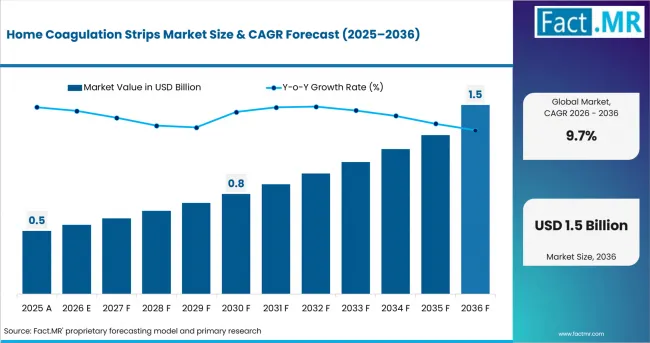
Home Coagulation Strips Market Value Analysis | Source: Fact.MR
What are the defining numbers behind home coagulation strips market growth?
USD 0.9 billion absolute opportunity by 2036, led by the United States and Germany.
- Demand Drivers in the Market
- Warfarin users need recurring INR testing across long treatment periods.
- Anticoagulation clinics need remote results for dose management.
- Home monitoring programs need reliable strip replenishment for enrolled users.
- Older patients need fingerstick testing that reduces clinic visits.
- Key Segments Analyzed
- By Strip Type: PT/INR Test Strips are expected to hold 72.0% share in 2026 because warfarin monitoring dominates home coagulation testing.
- By Technology: Dry-Reagent Electrochemical Strips lead because they support compact meters and rapid INR results. The share is projected at 46.0% in 2026.
- By Therapy Use: Warfarin Therapy Monitoring is likely to account for 63.0% share in 2026 because VKA users require routine INR checks.
- By Distribution Channel: Provider-Managed Home Monitoring Programs lead with 39.0% share in 2026 because reporting support is important for safe use.
- By Service Integration: Remote Monitoring Linked Replenishment is expected to hold 34.0% share in 2026 because connected programs automate strip supply.
- By Geography: The United States is projected to record 11.5% CAGR through 2036 as home INR services scale.
- Analyst Opinion at Fact.MR
- Shambhu Nath Jha, Senior Analyst at Fact.MR, states, “Home coagulation strips are a recurring consumable inside anticoagulation care. We see demand moving toward monitored self-testing models where the strip, meter and reporting service work together. Suppliers that combine strip reliability with patient support will gain stronger access to home INR programs.”
- Strategic Implications
The American Heart Association stated in 2024 that INR monitoring is needed at least once a month and sometimes as often as twice weekly for warfarin users. This supports repeat strip consumption because anticoagulation therapy requires ongoing measurement.
The United States is projected to record 11.5% CAGR through 2036 as home INR monitoring programs expand. Germany is expected to post 10.8% CAGR through 2036 as VKA users and anticoagulation clinics support self-testing. The United Kingdom is likely to record 10.2% CAGR as patient self-testing pathways increase. Japan is forecast to advance at 9.6% CAGR as aging patients need convenient anticoagulation monitoring. India is set to record 9.2% CAGR as private cardiac care networks adopt portable PT/INR testing.
How does the home coagulation strips market break down by segment?
PT/INR Test Strips lead at 72.0%; Warfarin Therapy Monitoring leads at 63.0%.
Which strip type dominates?
PT/INR Test Strips hold 72.0% share in 2026.
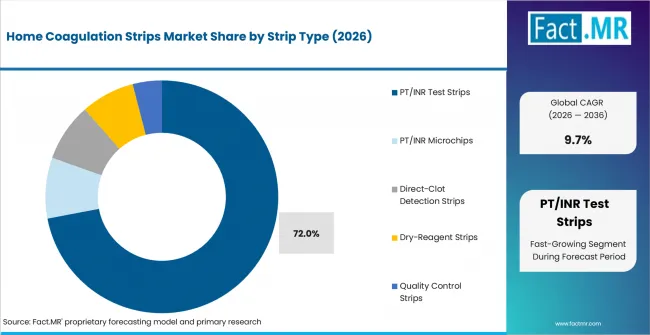
Home Coagulation Strips Market Analysis By Strip Type | Source: Fact.MR
PT/INR Test Strips are expected to hold 72.0% share in 2026 because most home coagulation testing supports warfarin dose management. These strips measure prothrombin time and report INR through a portable meter. Repeat testing creates steady consumable demand. The segment connects with anticoagulants because VKA therapy needs INR monitoring.
Which technology dominates?
Dry-Reagent Electrochemical Strips account for 46.0% share in 2026.
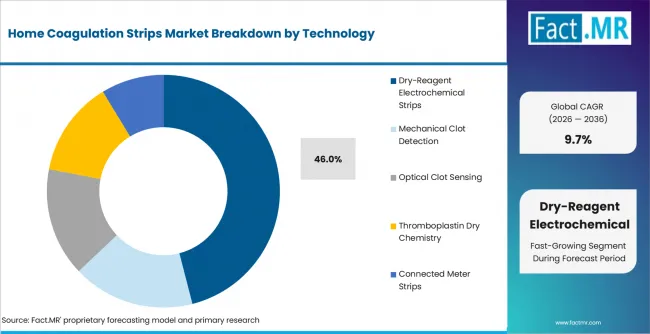
Home Coagulation Strips Market Analysis By Technology | Source: Fact.MR
Dry-Reagent Electrochemical Strips lead because they fit compact home meters and are easy to store. The technology is projected to capture 46.0% share in 2026. qLabs PT-INR dry test strips are positioned for patients taking oral anticoagulants who need clotting time monitoring. This supports demand for dry-reagent formats that reduce preparation steps.
Which therapy use dominates?
Warfarin Therapy Monitoring holds 63.0% share in 2026.
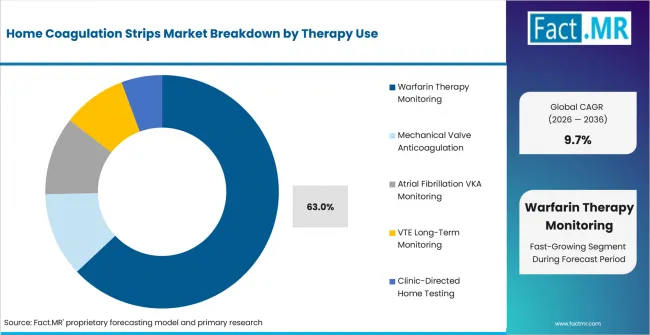
Home Coagulation Strips Market Analysis By Therapy Use | Source: Fact.MR
Warfarin Therapy Monitoring leads because home PT/INR strips are mainly used by patients on vitamin K antagonists. The therapy use is likely to account for 63.0% share in 2026. INR must stay within a physician-defined therapeutic range. Home testing helps users avoid repeated clinic visits.
Which distribution channel dominates?
Provider-Managed Home Monitoring Programs lead with 39.0% share in 2026.
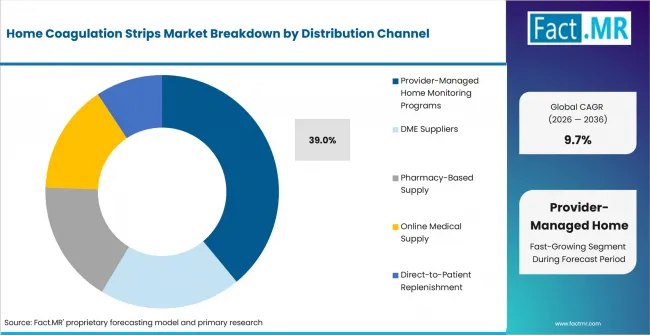
Home Coagulation Strips Market Analysis By Distribution Channel | Source: Fact.MR
Provider-Managed Home Monitoring Programs lead because home INR testing needs training and result oversight. The distribution channel is expected to hold 39.0% share in 2026. Abbott’s Acelis Connected Health program shows how remote INR monitoring can combine testing and reporting. This structure supports recurring strip delivery and clinician review.
Which service integration dominates?
Remote Monitoring Linked Replenishment holds 34.0% share in 2026.
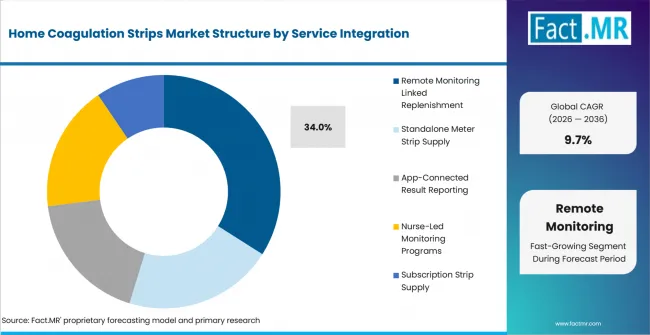
Home Coagulation Strips Market Analysis By Service Integration | Source: Fact.MR
Remote Monitoring Linked Replenishment leads because strip use is predictable once a patient is enrolled. The service integration is expected to hold 34.0% share in 2026. Monitoring programs can align shipments with testing frequency. This reduces the risk of users running out of strips. The in-vitro diagnostics test kit layer is relevant because strips function as recurring IVD consumables.
What is accelerating home coagulation strip demand, and what is holding it back?
Remote anticoagulation care drives demand; training burden restrains adoption.
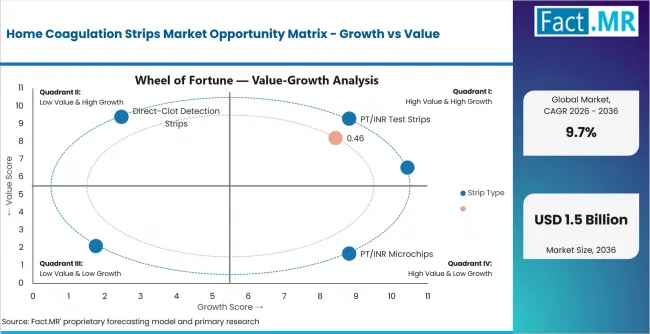
Home Coagulation Strips Market Opportunity Matrix Growth Vs Value | Source: Fact.MR
Remote anticoagulation care is the main driver. Patients on long-term VKA therapy need periodic INR checks. Home testing reduces travel and can support faster dose review when results are shared with care teams. Roche states that CoaguChek INRange and CoaguChek XS can support patient INR self-testing. This reinforces demand for strips tied to widely used home meters.
CoaguSense guidance emphasizes correct handling and single-use strips. This supports the need for patient training before self-testing expands. The main restraint is training burden. Home users must apply the blood sample correctly and follow meter prompts. Incorrect sampling or strip handling can create unreliable results.
Where do the biggest home coagulation strip opportunities sit?
Connected INR programs, mechanical valve monitoring and aging patients.
- Connected INR Programs: Service providers can combine strips with remote reporting and clinician review.
- Mechanical Valve Monitoring: Long-term VKA users need repeat INR checks across extended therapy.
- Aging Patients: Home testing can reduce routine clinic visits for stable users.
Which countries are scaling home coagulation strips fastest?
United States 11.5%, Germany 10.8%, United Kingdom 10.2%, Japan 9.6%, India 9.2%.
Based on regional analysis, the home coagulation strips market covers North America and Western Europe. Asia Pacific is also included. Latin America and Middle East and Africa complete the regional scope.
.webp "Top Country Growth Comparison Home Coagulation Strips Market Cagr (2026 2036)")
Top Country Growth Comparison Home Coagulation Strips Market Cagr (2026 2036) | Source: Fact.MR
| Country | CAGR |
|---|---|
| United States | 11.5% |
| Germany | 10.8% |
| United Kingdom | 10.2% |
| Japan | 9.6% |
| India | 9.2% |
Source: Fact.MR analysis. Updated Jun 26, 2026
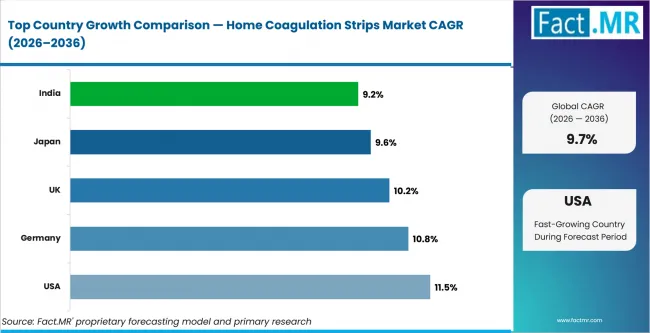
Home Coagulation Strips Market Cagr Analysis By Country | Source: Fact.MR
What is powering the United States lead?
11.5% CAGR, driven by Abbott Acelis and home INR monitoring programs.
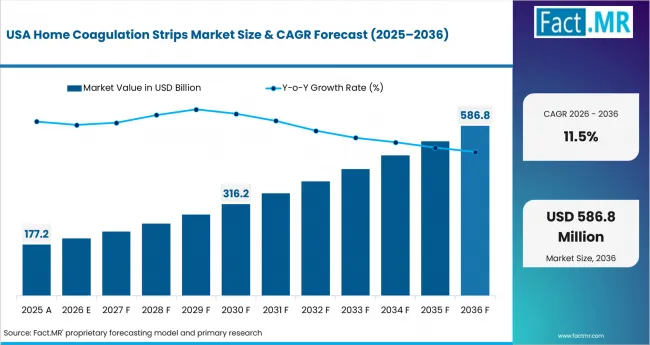
Home Coagulation Strips Market Country Value Analysis | Source: Fact.MR
The United States is projected to record 11.5% CAGR by 2036 as home INR monitoring services expand. Abbott Acelis supports remote INR self-testing and reporting. Roche and CoaguSense also support home PT/INR monitoring workflows. Growth will favor covered programs with structured patient training.
How is Germany scaling home coagulation strip demand?
10.8% CAGR, supported by Roche Diagnostics and VKA self-testing behavior.
Germany is expected to post 10.8% CAGR through 2036 as VKA users and care teams maintain self-testing pathways. Roche supports CoaguChek self-testing through a broad European presence. Patients with stable therapy need convenient recurring INR checks. Growth will favor strip supply models tied to clinician oversight.
What supports the United Kingdom outlook?
10.2% CAGR, driven by iLine Microsystems distribution and anticoagulation care pathways.
The United Kingdom is likely to record 10.2% CAGR from 2026 to 2036 as patient self-testing options increase. Una Health announced a 2024 distribution agreement with iLine Microsystems for PT/INR monitoring solutions. Anticoagulation services need tools that reduce visit burden. Growth will favor systems with clear user training.
How is Japan scaling home coagulation strip adoption?
9.6% CAGR, backed by aging patients and portable INR testing.
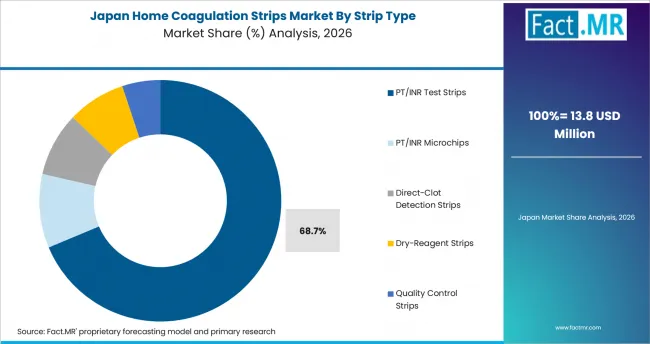
Home Coagulation Strips Market Japan Market Share Analysis By Strip Type | Source: Fact.MR
Japan is forecast to advance at 9.6% CAGR through 2036 as aging patients need convenient anticoagulation monitoring. Portable PT/INR meters can support stable users outside clinics. Physicians still need reliable result review. Growth will favor compact systems with simple strip handling.
What underpins India’s growth?
9.2% CAGR, driven by private cardiac care and strip-based INR access.
India is set to record 9.2% CAGR by 2036 as private cardiac care networks adopt portable PT/INR testing. qLabs and Xprecia Prime platforms support strip-based coagulation testing. Patient self-testing remains early, but urban adoption is rising. Growth will favor affordable strips and accessible service support.
Who leads the home coagulation strips market?
Roche Diagnostics and Abbott Acelis lead through home INR monitoring scale.
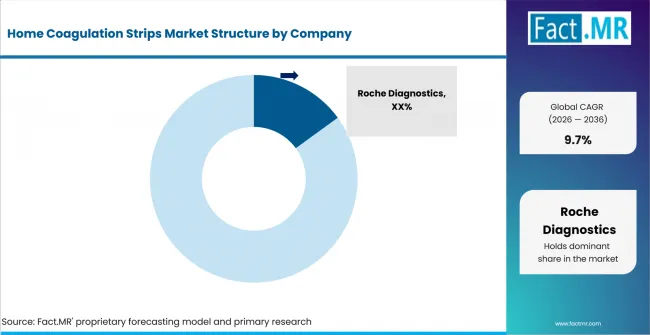
Home Coagulation Strips Market Analysis By Company | Source: Fact.MR
Home coagulation strips are supplied by diagnostics companies and specialized PT/INR platform makers. Roche Diagnostics leads through CoaguChek systems and PT test strips.
CoaguSense competes through Coag-Sense PT/INR systems and direct clot-detection strip technology. iLine Microsystems supports microINR chips for patient self-testing and point-of-care use. Micropoint Bioscience supports qLabs PT-INR dry test strips. Universal Biosensors and STAT Technologies support Xprecia Prime PT/INR strip-based testing.
Competition through 2036 will depend on strip reliability and program support. Providers need stable consumables and clear self-testing education. Coagulation testing remains important in acute settings, but this report should focus on home PT/INR strip use. Poor INR control can increase bleeding-management needs, but avoid bringing reversal drugs into the competitive discussion unless the section needs a clinical context note.
Which companies are the key providers?
Roche Diagnostics and Abbott Acelis are key providers. CoaguSense and iLine Microsystems are also profiled. Micropoint Bioscience and Universal Biosensors complete the company set.
- Roche Diagnostics
- CoaguSense
- iLine Microsystems
- Micropoint Bioscience
- Universal Biosensors
Bibliography
- [1] American Heart Association. (2024, October 24). A patient’s guide to taking warfarin. American Heart Association.
- [2] Roche Diagnostics. (2026). CoaguChek® INRange: For confident control of Vitamin K antagonist therapy. Roche Diagnostics.
- [3] CoaguSense. (2024, January 11). Do’s and don’ts for a successful PT/INR test. CoaguSense.
- [4] Una Health. (2024, April 10). Anticoagulation monitoring made easy: Una Health announces distribution agreement with iLine Microsystems. Una Health.
- [5] Micropoint Bioscience. (2026). qLabs® PT-INR Owren Test Strips. Micropoint Bioscience.
- [6] Universal Biosensors. (2026). Xprecia Prime™ PT/INR Test Strips. Universal Biosensors.
This Report Addresses
- Strategic intelligence on home coagulation strips across strip type and therapy use.
- Segment analysis covering PT/INR Test Strips and Dry-Reagent Electrochemical Strips.
- Regional outlook covering the United States, Germany, the United Kingdom, Japan, and India.
- Competitive analysis of Roche Diagnostics, Abbott Acelis, CoaguSense, iLine Microsystems, Micropoint Bioscience and Universal Biosensors.
- Technology assessment covering electrochemical strips, direct clot detection and connected INR reporting.
- Use case assessment covering warfarin therapy, mechanical valve monitoring and remote anticoagulation care.
- Primary interviews, provider checks and official source review support the forecast.
What does the home coagulation strips market cover?
Disposable PT/INR strips used for at-home anticoagulation monitoring.
The home coagulation strips market covers strips and strip-like microchips used with portable PT/INR meters. It includes electrochemical strips, mechanical clot-detection strips and dry-reagent strip formats. The scope connects with point-of-care diagnostics because home testing uses compact devices and fingerstick blood.
The market differs from central laboratory coagulation testing because patients or caregivers perform the test outside the laboratory. The strip must deliver a result that clinicians can use for therapy review. Training, quality control and result reporting are central to adoption.
What is included in the scope?
PT/INR strips, microchips and replenishment supplies for home meters.
The scope includes CoaguChek strips, Coag-Sense strips, microINR chips and comparable PT/INR strip formats. It covers dry-reagent strips used for warfarin monitoring. The scope connects with blood testing devices because recurring consumables drive long-term device use.
The scope includes strips sold through home monitoring programs, medical suppliers, pharmacies and online channels. It includes strip replenishment tied to connected INR services. It also covers control strips when supplied for patient self-testing support.
What is excluded from the scope?
Hospital coagulation reagents and anticoagulant drugs.
The scope excludes central lab PT reagents and high-throughput coagulation analyzer consumables. It excludes anticoagulant medicines and anticoagulant reversal drugs. It excludes direct oral anticoagulant monitoring products unless they use a home coagulation strip format. It also excludes professional ACT strips used mainly in operating rooms or catheterization labs.
How was the analysis built?
100+ sources, 40+ company portfolios, 25+ countries, 20+ interviews.
- Primary Research: Primary research includes interviews with anticoagulation clinic managers and home monitoring service providers. It includes input from strip suppliers and cardiology practice administrators.
- Desk Research: Desk research reviews official manufacturer sources and patient self-testing guidance. It covers home INR meters, PT/INR strips and clinical diagnostics workflows tied to anticoagulation care.
- Market-Sizing and Forecasting: Forecasting uses installed home meter base and strip replenishment frequency. Remote monitoring adoption and VKA patient retention support the market assessment.
- Data Validation and Update Cycle: Forecasts are validated through supplier checks and service provider references. Policy updates and product instructions help confirm market direction.
Segmentation
What is the report’s scope and coverage?
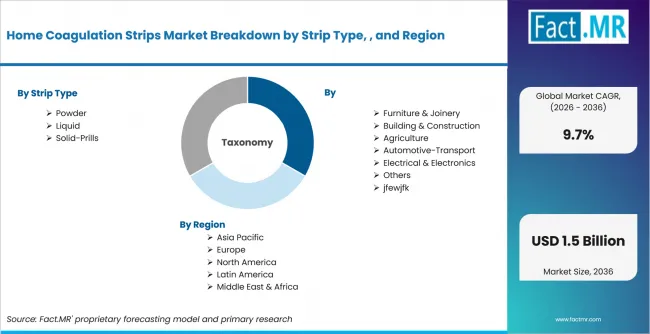
Home Coagulation Strips Market Breakdown By Strip Type, , And Region | Source: Fact.MR
| Attribute | Details |
|---|---|
| Quantitative Units | USD Billion in 2026 to USD Billion by 2036 at CAGR |
| Market Definition | Disposable PT/INR strips used with portable meters for home anticoagulation monitoring |
| Strip Type | PT/INR Test Strips; PT/INR Microchips; Direct-Clot Detection Strips; Dry-Reagent Strips; Quality Control Strips |
| Technology | Dry-Reagent Electrochemical Strips; Mechanical Clot Detection; Optical Clot Sensing; Thromboplastin Dry Chemistry; Connected Meter Strips |
| Therapy Use | Warfarin Therapy Monitoring; Mechanical Valve Anticoagulation; Atrial Fibrillation VKA Monitoring; VTE Long-Term Monitoring; Clinic-Directed Home Testing |
| Distribution Channel | Provider-Managed Home Monitoring Programs; DME Suppliers; Pharmacy-Based Supply; Online Medical Supply; Direct-to-Patient Replenishment |
| Service Integration | Remote Monitoring Linked Replenishment; Standalone Meter Strip Supply; App-Connected Result Reporting; Nurse-Led Monitoring Programs; Subscription Strip Supply |
| Regions Covered | North America; Western Europe; Asia Pacific; Latin America; Middle East and Africa |
| Countries Covered | United States; Germany; United Kingdom; Japan; India |
| Key Companies Profiled | Roche Diagnostics; CoaguSense; iLine Microsystems; Micropoint Bioscience; Universal Biosensors |
| Forecast Period | 2026 to 2036 |
| Approach | Hybrid top-down and bottom-up approach using home INR meter base, strip replenishment frequency, service enrollment and provider validation |
Source: Fact.MR analysis. Updated Jun 26, 2026
How is the market segmented?
-
By Strip Type:
- PT/INR Test Strips
- PT/INR Microchips
- Direct-Clot Detection Strips
- Dry-Reagent Strips
- Quality Control Strips
-
By Technology:
- Dry-Reagent Electrochemical Strips
- Mechanical Clot Detection
- Optical Clot Sensing
- Thromboplastin Dry Chemistry
- Connected Meter Strips
-
By Therapy Use:
- Warfarin Therapy Monitoring
- Mechanical Valve Anticoagulation
- Atrial Fibrillation VKA Monitoring
- VTE Long-Term Monitoring
- Clinic-Directed Home Testing
-
By Distribution Channel:
- Provider-Managed Home Monitoring Programs
- DME Suppliers
- Pharmacy-Based Supply
- Online Medical Supply
- Direct-to-Patient Replenishment
-
By Service Integration:
- Remote Monitoring Linked Replenishment
- Standalone Meter Strip Supply
- App-Connected Result Reporting
- Nurse-Led Monitoring Programs
- Subscription Strip Supply
-
Region:
- North America
- United States
- Canada
- Europe
- Germany
- United Kingdom
- France
- Italy
- Netherlands
- Asia Pacific
- Japan
- India
- China
- South Korea
- Australia
- Latin America
- Brazil
- Mexico
- Argentina
- Middle East & Africa
- UAE
- Saudi Arabia
- South Africa
- Israel
- North America
Frequently Asked Questions
Which strip type leads the Home Coagulation Strips Market?
Which technology leads the Home Coagulation Strips Market?
Which therapy use leads the Home Coagulation Strips Market?
Which distribution channel leads the Home Coagulation Strips Market?
Which service integration leads the Home Coagulation Strips Market?
Which country expands fastest in the Home Coagulation Strips Market?
How does Germany perform in the Home Coagulation Strips Market?
How does the United Kingdom perform in the Home Coagulation Strips Market?
How does Japan perform in the Home Coagulation Strips Market?
How does India perform in the Home Coagulation Strips Market?
What is the primary driver in the Home Coagulation Strips Market?
What is the main restraint in the Home Coagulation Strips Market?
Why are PT/INR strips important?
Why are connected INR programs gaining adoption?
Who worked on this report


Preview the report firsthand - request a free sample
Free SampleGet the brochure for pricing and purchase details
Download PDF