- Market Value (2025): USD 180 Mn
- Estimated Value (2026): USD 190 Mn
- Forecast Value (2036): USD 318 Mn
- CAGR (2026-2036): 5.3%
What is the Industrial Bulk-Bag Conditioning Systems Market forecast to be worth by 2036?
USD 190 million in 2026 to USD 318 million by 2036 at a 5.3% CAGR.
- The Industrial Bulk-Bag Conditioning Systems Market reached USD 180 million in 2025.
- Demand is projected to increase from USD 190 million in 2026 to USD 318 million by 2036.
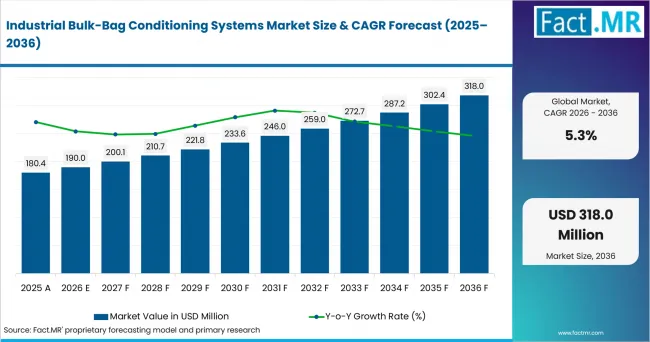
Industrial Bulk Bag Conditioning Systems Market Value Analysis | Source: Fact.MR
What are the defining numbers behind Industrial Bulk-Bag Conditioning Systems Market growth?
An absolute opportunity of USD 128 million is expected between 2026 and 2036.
- Demand Drivers in the Market
- Compaction during storage and shipment can turn a free-flowing powder into a mass that will not discharge predictably. Flexicon and National Bulk Equipment describe conditioning systems specifically for breaking up solidified or agglomerated material before unloading, creating a direct equipment need at plants where blocked bags interrupt production.
- Workplace-safety programs are reducing tolerance for repeated hammering, pushing and other force-intensive manual interventions around bulk bags. OSHA and the UK Health and Safety Executive recommend mechanical assistance or mechanization where hazardous manual handling can be reduced, supporting purchases of powered conditioning equipment.
- More receiving lines are being designed around predictable, low-touch material flow. Integrated conditioner-unloader systems allow a bag to be conditioned and discharged within one handling sequence, which is relevant to processors trying to reduce operator intervention between bag placement and downstream feeding.
- Plants handling several powders need one conditioner to work across different compaction profiles. Adjustable platen position, pressure and cycle controls allow buyers to qualify recipes by material instead of relying on one fixed conditioning action for every bag.
- Food and pharmaceutical users place added weight on clean handling and containment around the discharge point. Conditioning equipment that fits enclosed dischargers can reduce the need to open or manipulate a compacted bag outside the controlled receiving system.
- Key Segments Analyzed
- Hydraulic platen accounts for 49.0% of Conditioning Method in 2026 because opposing platens can apply controlled compression across a compacted bag and restore flow before discharge.
- Food & beverage represents 33.0% of End-Use Industry in 2026 because ingredient plants routinely receive powders in FIBCs and depend on repeatable discharge for batching and mixing.
- Standalone conditioner holds 57.0% of Integration in 2026 because one unit can serve several bag-discharge stations where conditioning demand is intermittent.
- Analyst Opinion at Fact.MR
- Shambhu Nath Jha, Principal Consultant at Fact.MR, states, "Bulk-bag conditioning is purchased to solve a receiving problem: material arrives compacted and will not feed the next process at the required rate. Hydraulic platen systems fit materials that need controlled compression, while standalone units suit plants that want one conditioner to serve several stations. Supplier selection will depend on how reliably the system restores flow, protects the operator and fits the existing discharge workflow as the market increases from USD 190 million in 2026 to USD 318 million by 2036."
- Strategic Implications
- Suppliers should qualify platen pressure, stroke and cycle sequence against specific powder behaviors so buyers can select settings by material rather than by trial and error at the receiving station.
- Integrated conditioner-discharge designs are relevant where food, chemical or pharmaceutical plants want to limit manual contact with the bag between placement and product release.
- Mobile standalone units can serve processors with several discharge points and irregular conditioning demand, reducing the need to install dedicated equipment at every station.
- Controls, guarding and service access should be treated as purchasing criteria alongside conditioning force because downtime at the receiving station can interrupt the downstream batching or conveying process.
How does the Industrial Bulk-Bag Conditioning Systems Market break down by segment?
The market is segmented by Conditioning Method, End-Use Industry and Integration.
Why does Hydraulic platen lead Conditioning Method?
Hydraulic platen leads Conditioning Method in 2026.
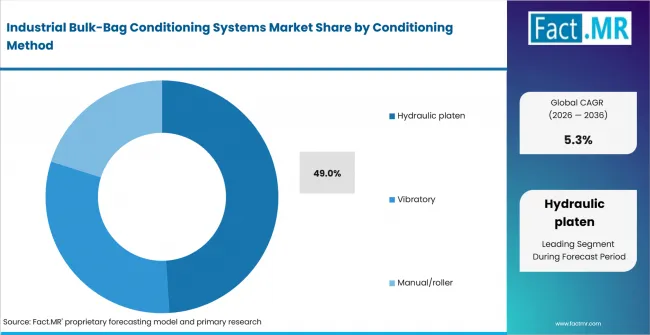
Industrial Bulk Bag Conditioning Systems Market Analysis By Conditioning Method | Source: Fact.MR
Hydraulic platen systems lead because opposing platens can apply controlled compressive force across the bag rather than relying on vibration or operator-applied force. This is useful when storage or shipment has created dense agglomeration that prevents material from falling into a discharger.
Flexicon offers hydraulic conditioners with programmable platen position and pressure, while National Bulk Equipment positions conditioning as a way to restore discharge from agglomerated bulk bags before downstream processing. Buyers therefore use hydraulic systems where repeatability and the ability to handle difficult compaction justify powered equipment.
Why does Food & beverage lead End-Use Industry?
Food & beverage leads End-Use Industry in 2026.
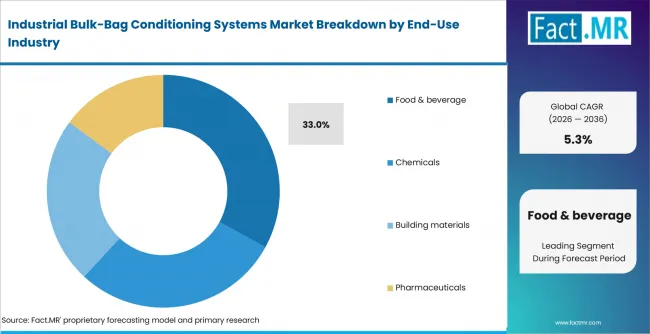
Industrial Bulk Bag Conditioning Systems Market Analysis By End Use Industry | Source: Fact.MR
Food and beverage plants receive flour and starch in bulk bags. They also handle sugar. Cocoa and dairy powders follow the same bulk-bag workflow. If those materials bridge or consolidate, discharge becomes less predictable. This can disrupt weighing and batching at the next process step or delay mixing.
Material Transfer & Storage and Palamatic Process both market bulk-bag conditioning equipment for food-related powder handling. The operational requirement is straightforward: restore flow while keeping the bag inside a controlled receiving workflow, which supports repeat equipment purchases at plants processing multiple dry ingredients.
Why does Standalone conditioner lead Integration?
Standalone conditioner leads Integration in 2026.
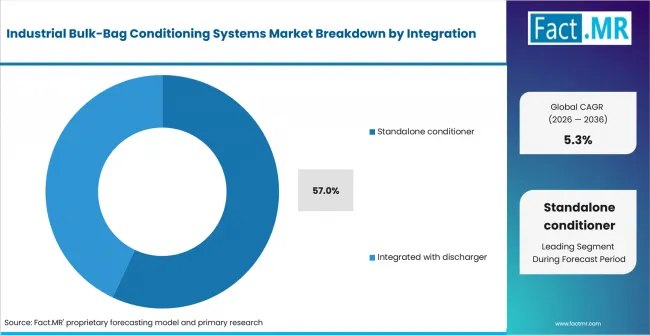
Industrial Bulk Bag Conditioning Systems Market Analysis By Integration | Source: Fact.MR
Standalone conditioners lead because the equipment can be positioned as a shared step before several bulk-bag discharge stations. This suits plants where only part of the incoming bag volume requires conditioning or where different production areas draw from the same receiving resource.
Flexicon offers conditioners as standalone equipment and as part of integrated conditioner-unloader systems. The standalone configuration lowers installation complexity for first-time buyers, while integrated systems remain relevant where conditioning and discharge need to occur in a single controlled sequence.
What is accelerating Industrial Bulk-Bag Conditioning Systems Market adoption, and what is holding it back?
Drivers Impact Analysis
| Driver | (~) % Impact on CAGR | Geographic Relevance | Impact Timeline |
|---|---|---|---|
| Growth in FIBC usage across food, chemical and building-material supply chains | +0.8% | Global | Near term |
| Occupational safety concerns driving replacement of manual bag conditioning methods | +0.6% | North America, Europe | Near term |
| Integration of conditioning frames with bulk-bag dischargers for single-operator operation | +0.5% | Europe, North America | Mid term |
| Pharmaceutical adoption of enclosed conditioning systems maintaining product containment | +0.3% | North America, Europe | Mid term |
Source: Fact.MR analysis. Updated Aug 19, 2026
The near-term effect comes from two practical triggers: more bags reaching receiving stations in a compacted state and a stronger preference for mechanical intervention when manual conditioning adds ergonomic risk or delays discharge.
Opportunity Impact Analysis
| Opportunity | (~) % Impact on CAGR | Geographic Relevance | Impact Timeline |
|---|---|---|---|
| Building-materials sector FIBC adoption for cement, mortar and aggregate packaging | +0.5% | Global | Mid term |
| Mobile standalone conditioners serving multiple discharge stations in mid-sized facilities | +0.4% | Asia-Pacific, Europe | Mid term |
| Programmable hydraulic platens with recipe-driven pressure and stroke for multi-material operations | +0.3% | North America, Europe | Long term |
Source: Fact.MR analysis. Updated Aug 19, 2026
Opportunity is concentrated in plants that need one system to handle several materials or several discharge stations. Programmable hydraulic control and mobile standalone layouts can increase equipment utilization without changing the underlying market scope.
Restraints Impact Analysis
| Restraint | (~) % Impact on CAGR | Geographic Relevance | Impact Timeline |
|---|---|---|---|
| Limited awareness of powered conditioning benefits among smaller FIBC users who rely on manual methods | -0.4% | Asia-Pacific, Latin America | Near term |
| Capital cost sensitivity among food and chemical processors with intermittent bag-conditioning needs | -0.3% | Global | Mid term |
| Commodity nature of manual and roller conditioning alternatives limiting adoption in price-sensitive segments | -0.3% | Asia-Pacific, Africa | Long term |
Source: Fact.MR analysis. Updated Aug 19, 2026
Adoption slows when conditioning is infrequent enough that buyers continue with manual methods or cannot justify a dedicated machine. The purchase case improves when blocked discharge creates measurable labor, safety or production losses.
Which countries are scaling the Industrial Bulk-Bag Conditioning Systems Market through 2036?
- United States: FIBC receiving is common in food ingredients and chemicals. It also supports other bulk materials. OSHA guidance encourages engineering controls and mechanical assistance where manual material handling creates risk. This supports powered conditioning where operators would otherwise strike or roll a compacted bag or manipulate it repeatedly.
- Germany: Process plants place a high value on controlled material handling and machinery integration. BAuA guidance treats manual handling and force exertion as physical workloads that require risk assessment, supporting mechanized conditioning in facilities seeking repeatable bulk-bag receiving.
- United Kingdom: The Health and Safety Executive advises employers to avoid hazardous manual handling where practicable and to consider automation or mechanization. That guidance makes powered conditioning relevant for sites replacing manual intervention around compacted bags.
- Italy: Food-processing and chemical plants use FIBCs for dry raw materials, while INAIL guidance addresses risk from manual load handling and force-intensive work. Conditioning equipment supports a receiving process that reduces repeated operator effort before discharge.
- Canada: Bulk-bag use across food ingredients, chemicals and minerals creates recurring conditioning requirements. CCOHS notes that mechanical aids can reduce physical effort in material handling, which supports equipment purchases where manual conditioning is repetitive.
- South Korea: Chemical, food-ingredient and pharmaceutical plants increasingly rely on automated material-handling workflows. KOSHA occupational-safety rules address heavy-material handling through unloading and transport machinery where applicable, supporting mechanized receiving practices around FIBCs.
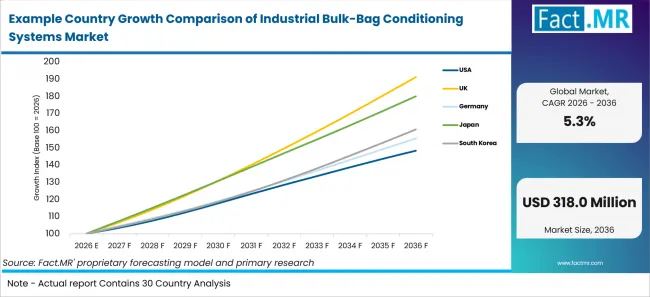
Example Country Growth Comparison Of Industrial Bulk Bag Conditioning Systems Market | Source: Fact.MR
Country CAGR (2026-2036)
| Country | CAGR (2026-2036) |
|---|---|
| United States | 5.96% |
| Germany | 4.64% |
| United Kingdom | 5.52% |
| Italy | 5.03% |
| Canada | 6.02% |
| South Korea | 7.44% |
Source: Fact.MR analysis. Updated Aug 19, 2026
What is driving growth in the United States through 2036?
The United States is forecast to expand at a 5.96% CAGR from 2026 to 2036.
Demand is tied to plants that receive dry ingredients, chemicals or bulk minerals in FIBCs and need a predictable feed into downstream conveying or batching. U.S.-based suppliers such as Flexicon, National Bulk Equipment and Material Transfer & Storage offer dedicated conditioning systems, indicating an established equipment category for this receiving problem.
OSHA guidance recommends engineering controls and mechanical assistance to reduce force-intensive manual material handling. For bulk-bag users, powered conditioning provides a direct route to reduce repeated hammering or physical manipulation while restoring discharge flow.
What is driving Germany's growth through 2036?
Germany is forecast to expand at a 4.64% CAGR from 2026 to 2036.
Germany has a process-manufacturing base where bulk-material receiving is increasingly connected with automated conveying and dosing equipment. Conditioner purchases are therefore influenced by whether the machine can deliver repeatable bag treatment and fit the discharge line without adding an extra manual step.
BAuA guidance identifies manual handling and the exertion of force as physical workload factors that should be assessed and controlled. This supports mechanized conditioning where compacted bags would otherwise require repeated physical intervention by operators.
What is driving the United Kingdom's growth through 2036?
The United Kingdom is forecast to expand at a 5.52% CAGR from 2026 to 2036.
UK demand is supported by food, chemical and contract-processing sites that receive varied powders in bulk bags. A mobile or standalone conditioner is useful where several production areas share incoming bag-handling equipment and conditioning demand varies by material.
The Health and Safety Executive advises employers to automate or mechanize hazardous manual handling where practicable and to use mechanical aids when manual handling cannot be eliminated. This strengthens the purchasing case for powered conditioners where manual bag manipulation is routine.
What is driving Italy's growth through 2036?
Italy is forecast to expand at a 5.03% CAGR from 2026 to 2036.
Italy combines food-processing demand with chemical and other powder-handling applications that use FIBCs for raw-material delivery. Buyers need conditioning equipment when compacted ingredients cannot discharge consistently into mixers, feeders or conveying systems.
INAIL guidance on manual load handling emphasizes the physical demands created by different load characteristics and handling methods. Mechanized conditioning reduces the need to apply force directly to a compacted bag and fits plants seeking more controlled receiving practices.
What is driving Canada's growth through 2036?
Canada is forecast to expand at a 6.02% CAGR from 2026 to 2036.
Canada has relevant demand across food ingredients and chemicals. Mineral handling adds another use case where powders can consolidate during storage or long-distance transport. Conditioning systems are purchased when the cost of blocked or erratic discharge becomes greater than the cost of a shared standalone unit.
CCOHS guidance states that mechanical aids reduce physical effort in manual material handling and make tasks safer. This supports powered conditioning where plants want to reduce force-intensive work around bulk bags while keeping material flow consistent.
What is driving South Korea's growth through 2036?
South Korea is forecast to expand at a 7.44% CAGR from 2026 to 2036.
South Korean demand is linked to automated food-ingredient, chemical and pharmaceutical production environments where incoming powder handling must keep pace with controlled downstream processes. Programmable conditioning is relevant when several materials require different compression cycles before discharge.
KOSHA occupational-safety rules require unloading and transport machinery or tools for heavy-material handling where applicable. In FIBC receiving, this reinforces a broader move toward mechanized handling around heavy bags and reduces reliance on repeated physical intervention before discharge.
How do suppliers compete in the Industrial Bulk-Bag Conditioning Systems Market?
Competition centers on whether a conditioner can restore flow across different bag sizes and powder behaviors without damaging the FIBC or creating an extra manual handling step. Buyers compare platen control with guarding. Bag access and mobility also matter. Compatibility with the downstream discharger remains another procurement test.
Flexicon Corporation supplies hydraulic bulk-bag conditioners as standalone units and in conditioner-unloader configurations. National Bulk Equipment, Inc. and Material Transfer & Storage also offer dedicated conditioning equipment for agglomerated or compacted bulk-bag contents, giving process plants several supplier options for hydraulic conditioning.
Akona Process Solutions now carries the Spiroflow business under its current branding and continues to serve bulk-material handling applications. Palamatic Process supplies big-bag conditioning and decompaction equipment for powder-handling lines. Cyclonaire Corporation is included for its bulk-bag unloading and pneumatic-conveying systems that operate beside conditioning equipment in receiving workflows.
Supplier selection also depends on service access and integration work. Multisite processors may prefer a common conditioner architecture that can be configured for standalone use at one plant and integrated discharge at another while retaining comparable controls and operator procedures.
Which companies are the key providers?
Key companies profiled include Flexicon Corporation; Akona Process Solutions (Spiroflow); Material Transfer & Storage; National Bulk Equipment, Inc.; Palamatic Process; and Cyclonaire Corporation.
- Flexicon Corporation
- Akona Process Solutions (Spiroflow)
- Material Transfer & Storage
- National Bulk Equipment, Inc.
- Palamatic Process
- Cyclonaire Corporation
Research Sources and Bibliography
- Flexicon Corporation. (2026). BLOCK-BUSTER Hydraulic Bulk Bag Conditioners. Flexicon Corporation.
- Flexicon Corporation. (2026). Bulk Bag Conditioner-Unloader System. Flexicon Corporation.
- Akona Process Solutions. (2026). Bulk Material Handling Solutions. Akona Process Solutions.
- Material Transfer & Storage. (2026). Bulk Bag Conditioners. Material Transfer & Storage.
- National Bulk Equipment, Inc. (2026). Bulk Bag Conditioners. National Bulk Equipment, Inc.
- Palamatic Process. (2026). Big Bag Conditioner - SmashR Conv. Palamatic Process.
- Cyclonaire Corporation. (2026). Bulk Bag Unloader. Cyclonaire Corporation.
- Flexible Intermediate Bulk Container Association. (2026). FIBC Handling Guidelines. FIBCA.
- Occupational Safety and Health Administration. (2026). Ergonomics: Solutions to Control Hazards. U.S. Department of Labor.
- Health and Safety Executive. (2025). Manual Handling at Work: Avoid Hazardous Manual Handling. UK Government.
- Federal Institute for Occupational Safety and Health. (2023). Manual Pushing and Pulling of Loads. Federal Government of Germany.
- Canadian Centre for Occupational Health and Safety. (2023). MMH - Mechanical Aids for Transporting Materials. Government of Canada.
- Istituto Nazionale per l'Assicurazione contro gli Infortuni sul Lavoro. (2025). Movimentazione Manuale dei Carichi Durante l'Attivita Lavorativa. INAIL.
- Korea Occupational Safety and Health Agency. (2014). Occupational Safety and Health Standard: Heavy Material Handling. KOSHA.
This Report Answers
The market covers purpose-built equipment used to loosen compacted, settled or solidified dry material inside flexible intermediate bulk containers before the contents are discharged. The assessment follows Conditioning Method, End-Use Industry and Integration.
What is included in the scope?
The scope includes hydraulic platen conditioners, vibratory conditioners and purpose-built manual or roller conditioning frames sold for industrial bulk-bag handling. Standalone conditioners and units integrated with a bulk-bag discharger are included.
Demand from food and beverage, chemicals, building materials and pharmaceutical users is included when the equipment is purchased specifically to restore material flow from an FIBC before or during discharge.
What is excluded from the scope?
The scope excludes improvised manual conditioning using hammers, forklift tines or other non-purpose-built methods. FIBCs themselves, bulk-bag filling equipment and standalone bulk-bag dischargers without conditioning capability are outside the market.
Aftermarket spare parts and service revenue are excluded when sold separately from the conditioning system. General pneumatic conveying equipment is outside the market unless it forms part of a conditioner-integrated discharge system included in the defined scope.
How Was the Analysis Built?
Fact.MR is of the opinion that this assessment combines primary research with a structured review of public information and industry evidence relevant to the market.
- Primary Research: Interviews with bulk-solids equipment manufacturers, process engineers, plant managers and procurement teams examine conditioner selection, bag-handling workflows, integration requirements and capital-purchase criteria.
- Desk Research: The review covers FIBC handling guidance, occupational-safety material, conditioner product literature and current supplier portfolios. External sources used in the article are recorded in the bibliography.
- Market Sizing and Forecasting: Estimates combine conditioner shipments, average equipment value, conditioning-method mix, end-use installations and standalone-versus-integrated configuration. Country projections reflect industrial bulk-material handling demand and the use of FIBC receiving systems in the listed markets.
- Data Validation and Update Cycle: Evidence is reviewed against the defined market scope, segment boundaries and forecast period. The assessment is updated when source data, technology conditions, regulation or supplier activity materially changes the outlook.
Segmentation
Research Scope and Coverage
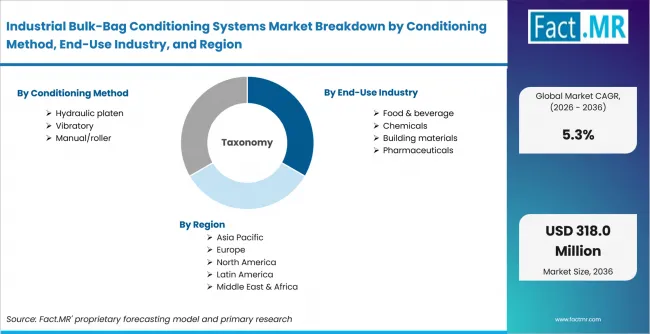
Industrial Bulk Bag Conditioning Systems Market Breakdown By Conditioning Method, End Use Industry, And Region | Source: Fact.MR
| Attribute | Details |
|---|---|
| Quantitative Units | USD million |
| Market Definition | Purpose-built equipment used to loosen compacted, settled or solidified material inside flexible intermediate bulk containers before discharge. |
| Segments Covered | Conditioning Method; End-Use Industry; Integration |
| Regions Covered | North America; Latin America; Western Europe; Eastern Europe; East Asia; South Asia & Pacific; Middle East & Africa |
| Countries Covered | United States; Germany; United Kingdom; Italy; Canada; South Korea |
| Key Companies Profiled | Flexicon Corporation; Akona Process Solutions (Spiroflow); Material Transfer & Storage; National Bulk Equipment, Inc.; Palamatic Process; Cyclonaire Corporation |
| Forecast Period | 2026 to 2036 |
| Base Year | 2025 |
| Market Value, 2026 | USD 190 million |
| Market Value, 2036 | USD 318 million |
| CAGR, 2026-2036 | 5.3% |
| Absolute Opportunity | USD 128 million |
| Approach | Hybrid top-down and bottom-up approach using system shipments, equipment value, conditioning-method mix, end-use installations, standalone-versus-integrated configuration and country demand. |
Source: Fact.MR analysis. Updated Aug 19, 2026
Market Breakdown by Segments
-
By Conditioning Method:
- Hydraulic platen
- Vibratory
- Manual/roller
-
By End-Use Industry:
- Food & beverage
- Chemicals
- Building materials
- Pharmaceuticals
-
By Integration:
- Standalone conditioner
- Integrated with discharger
-
By Region:
- North America
- Latin America
- Western Europe
- Eastern Europe
- East Asia
- South Asia & Pacific
- Middle East & Africa
Frequently Asked Questions
What is the Industrial Bulk-Bag Conditioning Systems Market value in 2026?
At what CAGR is the market projected to grow?
What is the projected market value by 2036?
Which Conditioning Method category leads the market?
Which End-Use Industry category leads the market?
Which Integration category leads the market?
What CAGR is listed for South Korea?
What is the primary driver in this market?
What is the main restraint?
Which companies are included in the market assessment?
Who worked on this report


Preview the report firsthand - request a free sample
Free SampleGet the brochure for pricing and purchase details
Download PDF