- Market Value (2025): USD 5.1 Bn
- Estimated Value (2026): USD 5.4 Bn
- Forecast Value (2036): USD 8.7 Bn
- CAGR (2026-2036): 4.9%
What is the Insulated Corrugated Boxes Market forecast to be worth by 2036?
USD 5.4 billion in 2026 to USD 8.7 billion by 2036 at a 4.9% CAGR.
- The insulated corrugated boxes market reached USD 5.1 billion in 2025.
- Demand is projected to increase from USD 5.4 billion in 2026 to USD 8.7 billion by 2036.
- The market is projected to expand at a 4.9% CAGR from 2026 to 2036.
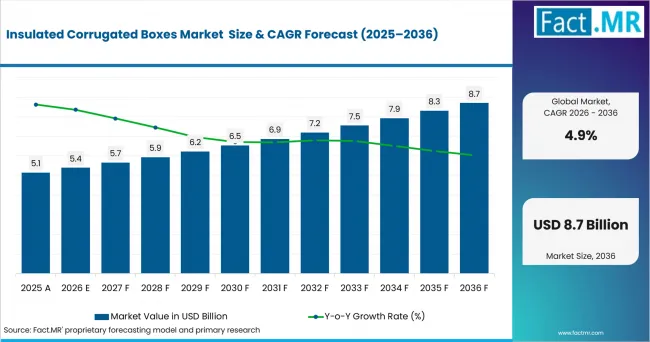
Insulated Corrugated Boxes Market Value Analysis | Source: Fact.MR
What are the defining numbers behind Insulated Corrugated Boxes Market growth?
An absolute opportunity of USD 3.3 billion is expected between 2026 and 2036.
- Demand Drivers in the Market
- Cold-chain food distribution is increasing the number of shipments that require passive thermal protection between refrigerated nodes. UNEP and FAO report that insufficient refrigeration contributes to 526 million tonnes of food loss globally, while EU food-hygiene rules require the cold chain to be maintained for foods that need temperature control. These conditions support insulated box demand for fresh, chilled and frozen product movements where a powered reefer is not practical for every parcel or secondary shipment.
- Pharmaceutical distribution adds a specification-driven demand layer. EU Good Distribution Practice requires medicinal products to be protected under appropriate storage and transport conditions, while Brazil and Japan maintain national GDP expectations for medicine distribution. This supports qualified passive shippers and pharmaceutical cold chain formats for vaccines, medical shipments and other temperature-sensitive products.
- E-commerce increases the number of smaller, individually handled shipments. USDA research found that about one in five U.S. household grocery shoppers bought groceries online in a recent month, while Germany and France also report broad online purchasing and food-delivery activity. Each parcel creates a packaging decision around thermal duration, insulation weight and disposal, expanding use of insulated boxes alongside broader insulated packaging systems.
- Packaging regulation is shifting design toward recyclable fiber structures and lower-plastic configurations. The EU Packaging and Packaging Waste Regulation applies from August 2026 and is intended to make packaging placed on the EU market recyclable in an economically viable way by 2030. This encourages corrugated outer cases combined with optimized foam content, molded fiber or reflective liners and supports innovation in fiber-based packaging.
- Corrugated converters can tailor wall construction, board grade and insulation inserts to shipment duration and load profile. This flexibility lets food processors, pharmaceutical shippers and logistics providers specify pack sizes without moving to heavier rigid containers for every lane, supporting continued use of corrugated packaging in temperature-controlled distribution.
- Key Segments Analyzed
- Single Wall Insulated Corrugated Boxes account for 42.8% of Product in 2026 because they balance board consumption, parcel weight and structural protection for common chilled and short-haul temperature-controlled shipments.
- Expanded Polystyrene accounts for 44.7% of Insulation Material in 2026 because lightweight EPS inserts provide thermal resistance, moisture tolerance and easy conversion into liners or molded box components at high shipment volumes.
- Food And Beverage represents 46.5% of Application in 2026 as fresh food, frozen food and beverage distribution creates recurring demand for boxes that protect product temperature during handoffs and last-mile delivery.
- Food And Beverage Companies account for 38.9% of End Use in 2026 because processors and brand owners specify packaging at the packing point and purchase repeat box volumes against product dimensions, shelf-life requirements and delivery lanes.
- Chilled Packaging holds 43.2% of Temperature Range in 2026 because many fresh foods, dairy products and pharmaceutical shipments require controlled cool conditions without the deep thermal load associated with frozen logistics.
- Direct Sales account for 58.4% of Distribution Channel in 2026 because large shippers frequently need custom dimensions, board grades, insulation thicknesses and contract supply arrangements directly from converters or system suppliers.
- Analyst Opinion at Fact.MR
- Shambhu Nath Jha, Principal Consultant, Fact.MR, states, "Insulated corrugated boxes sit at the intersection of thermal performance and parcel economics. Buyers need enough insulation to protect a defined transit window, but every extra layer adds material, cube and disposal cost. Suppliers that can tune wall strength, insulation type and pack-out configuration to actual route duration will be better positioned than vendors offering one generic thermal box for every shipment."
- Strategic Implications
- Converters should design box families around validated transit windows, payload size and wall-strength requirements rather than relying on one insulation thickness across food, pharmaceutical and industrial shipments.
- Food and beverage shippers can reduce material use by matching chilled and frozen pack-outs to actual lane duration, seasonal ambient conditions and the presence of refrigerated handoff points.
- Suppliers serving EU customers need product roadmaps that improve recyclability and separation of corrugated fiber from insulation components as PPWR requirements move into implementation.
- Reusable insulated formats require a reverse-logistics model that is dense enough to recover boxes economically; where recovery is weak, recyclable single-use corrugated systems may remain more practical.
How does the Insulated Corrugated Boxes Market break down by segment?
The market is segmented by Product, Insulation Material, Application, End Use, Temperature Range and Distribution Channel.
Why does Single Wall Insulated Corrugated Boxes lead Product?
Single Wall Insulated Corrugated Boxes are projected to account for a 42.8% share in 2026.
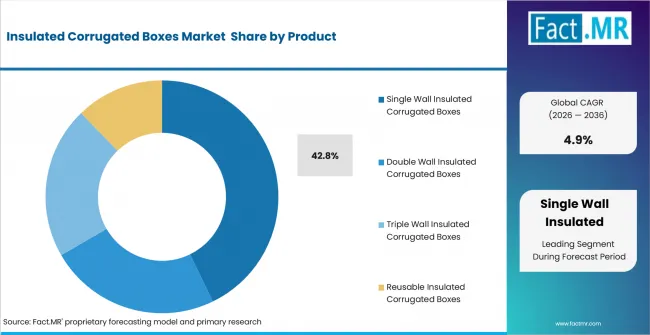
Insulated Corrugated Boxes Market Analysis By Product | Source: Fact.MR
Single-wall construction leads where shipments need an insulated outer case but do not require the compression strength of double- or triple-wall formats. It uses less board, keeps tare weight lower and can be erected and packed on standard corrugated conversion and fulfillment lines.
For food delivery, pharmaceuticals and other parcelized cold-chain lanes, the format can be paired with EPS, polyurethane, paper fiber or reflective insulation depending on transit duration. Related cold chain cartons also show why fiber-based outer structures remain attractive when shippers want thermal protection without moving to an all-plastic container.
Why does Expanded Polystyrene lead Insulation Material?
Expanded Polystyrene is projected to account for a 44.7% share in 2026.
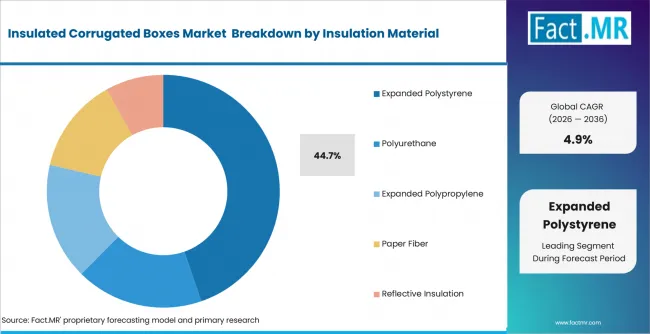
Insulated Corrugated Boxes Market Analysis By Insulation Material | Source: Fact.MR
EPS combines low density with useful thermal resistance, so a shipper can add insulation without sharply increasing parcel mass. Molded or cut EPS also protects product from impact and can be produced in repeatable insert geometries for standard box sizes.
The trade-off is end-of-life handling. EU packaging rules are raising expectations for recyclability and material separation, which is encouraging suppliers to reduce foam content where practical and develop paper-fiber or reflective alternatives. EPS remains important where thermal duration, cost and damage protection outweigh the disposal disadvantage.
Why does Food And Beverage lead Application?
Food And Beverage is projected to account for a 46.5% share in 2026.
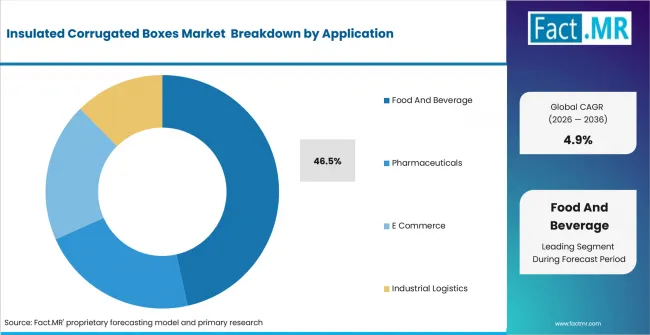
Insulated Corrugated Boxes Market Analysis By Application | Source: Fact.MR
Food and beverage shipments create recurring thermal-protection needs across fresh food, frozen food and beverage packaging. The requirement is operational rather than cosmetic: temperature excursions can reduce shelf life, accelerate microbial growth or damage product quality before delivery.
UNEP and FAO identify sustainable cold chains as a key tool for reducing food loss, while EU hygiene regulation requires temperature control and maintenance of the cold chain where food safety depends on it. These requirements sustain demand for insulated boxes between processing plants, distribution centers, retailers and consumers.
Why do Food And Beverage Companies lead End Use?
Food And Beverage Companies are projected to account for a 38.9% share in 2026.
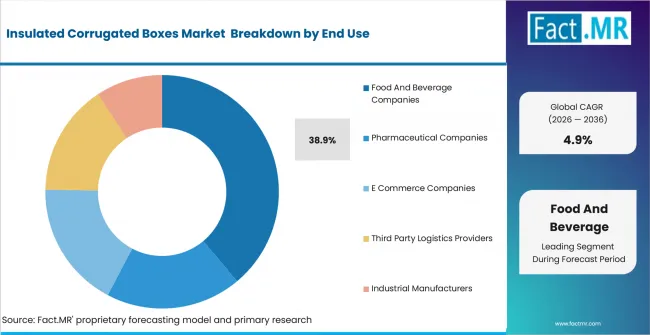
Insulated Corrugated Boxes Market Analysis By End Use | Source: Fact.MR
Food and beverage companies control the point where product dimensions, pack quantity, refrigerant mass and shipment duration are converted into a packaging specification. Repeated product runs also create predictable demand for standardized box sizes, which supports direct procurement from corrugated converters.
This buyer group also has a strong incentive to avoid overpacking. A box that is heavier or larger than necessary adds freight cube and disposal cost across every shipment, so suppliers that can reduce board and insulation while maintaining the required thermal window can become embedded in recurring packaging programs.
Why does Chilled Packaging lead Temperature Range?
Chilled Packaging is projected to account for a 43.2% share in 2026.
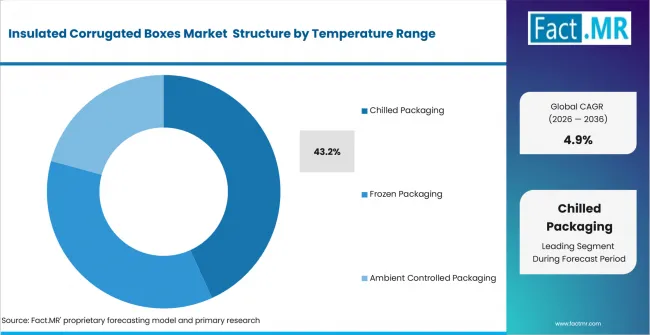
Insulated Corrugated Boxes Market Analysis By Temperature Range | Source: Fact.MR
Chilled packaging serves a broad range of fresh foods, dairy, prepared foods and temperature-sensitive healthcare products. These shipments usually require a controlled cool range rather than deep-freeze performance, allowing lower refrigerant loads and thinner insulation than many frozen applications.
French food-safety guidance states that very perishable foods are commonly kept near 0 degrees C to 4 degrees C, while EU GDP requirements keep medicinal products within manufacturer-defined transport conditions. This creates a large middle band of shipments where passive corrugated insulation is technically and economically suitable.
Why does Direct Sales lead Distribution Channel?
Direct Sales are projected to account for a 58.4% share in 2026.
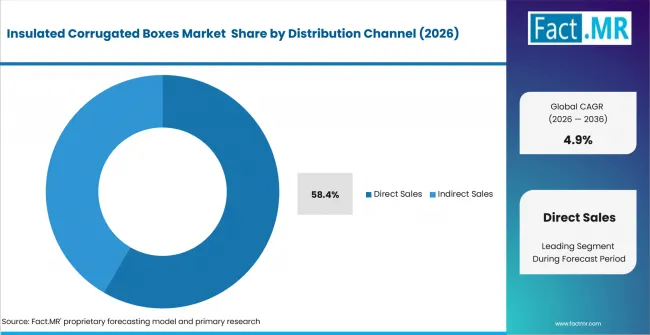
Insulated Corrugated Boxes Market Analysis By Distribution Channel | Source: Fact.MR
Direct buying fits applications where the box is part of a controlled packing process. Large food processors, pharmaceutical companies and logistics providers often need fixed dimensions, printed handling instructions, repeat insulation geometries and delivery schedules that are easier to manage through contract supply agreements.
Direct relationships also shorten the feedback loop when a shipper changes payload, transit time or refrigerant quantity. Converters can adjust board grade, insert thickness or box dimensions while preserving the rest of the pack-out, which is harder to manage through a general distributor inventory.
What is accelerating Insulated Corrugated Boxes Market adoption, and what is holding it back?
Growth is being supported by cold-chain food distribution, pharmaceutical temperature integrity, parcelized e-commerce and recyclable fiber-based packaging design. Adoption is moderated by EPS disposal pressure, corrugated moisture exposure, dimensional freight cost and the reverse-logistics burden of reusable systems.
Drivers Impact Analysis
| Factor | (~) % Impact on CAGR | Geographic Relevance | Impact Timeline |
|---|---|---|---|
| Cold-chain food shipment growth | +0.8% | Global | Short term (<= 2 years) |
| Pharmaceutical temperature-control requirements | +0.6% | USA, Brazil, Germany, Japan and France | Short term (<= 2 years) |
| Online grocery and parcel delivery | +0.5% | USA, Germany, Japan and France | Medium term (2-4 years) |
| Recyclable corrugated outer-case preference | +0.4% | Germany and France | Medium term (2-4 years) |
| Customized direct-supply programs | +0.3% | Global | Long term (>= 4 years) |
Source: Fact.MR analysis. Updated Aug 27, 2026
Opportunity Impact Analysis
| Factor | (~) % Impact on CAGR | Geographic Relevance | Impact Timeline |
|---|---|---|---|
| Molded-fiber and cellulose insulation substitution | +0.6% | Germany, France and USA | Medium term (2-4 years) |
| Reusable insulated box programs | +0.4% | USA, Japan and Germany | Long term (>= 4 years) |
| Food e-commerce and direct-to-consumer delivery | +0.3% | USA, Germany, Japan and France | Medium term (2-4 years) |
| Validated chilled pharmaceutical pack-outs | +0.2% | Brazil, USA, Germany, Japan and France | Long term (>= 4 years) |
Source: Fact.MR analysis. Updated Aug 27, 2026
Restraints Impact Analysis
| Factor | (~) % Impact on CAGR | Geographic Relevance | Impact Timeline |
|---|---|---|---|
| EPS disposal and recyclability pressure | -0.6% | Germany and France | Short term (<= 2 years) |
| Moisture and condensation exposure of corrugated board | -0.4% | Global | Short term (<= 2 years) |
| Parcel cube and dimensional freight cost | -0.3% | USA, Germany and France | Medium term (2-4 years) |
| Reverse-logistics cost for reusable boxes | -0.2% | Global | Long term (>= 4 years) |
Source: Fact.MR analysis. Updated Aug 27, 2026
Which countries are scaling the Insulated Corrugated Boxes Market through 2036?
- Brazil: Pharmaceutical transport requirements and a broad food-retail base support passive thermal packaging for medicine distribution, fresh products and regional delivery lanes where thermal boxes can bridge gaps between refrigerated facilities.
- USA: FDA sanitary-transport rules require adequate temperature control for food that depends on it for safety, while online grocery purchasing creates more parcel-level temperature-control decisions outside conventional pallet distribution.
- Germany: High online purchasing of daily goods combines with stricter packaging-recyclability rules, encouraging corrugated thermal systems that can balance cold-chain performance with fiber recovery and material separation.
- Japan: Food distribution relies on continuous temperature management across cold-chain handoffs, while pharmaceutical GDP guidance reinforces quality controls for medicines during storage and transport.
- France: Food-safety guidance keeps cold-chain integrity central to handling chilled and frozen foods, while distance selling and parcel growth increase the volume of goods moving through individually handled delivery networks.
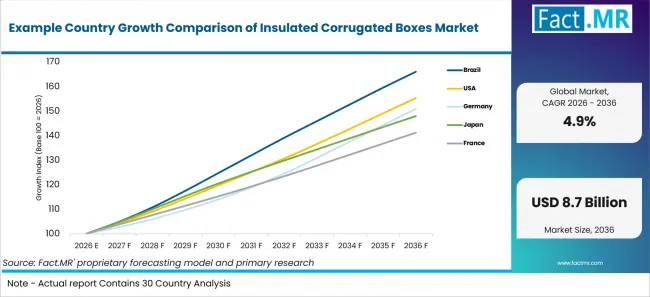
Example Country Growth Comparison Of Insulated Corrugated Boxes Market | Source: Fact.MR
Country CAGR (2026-2036)
| Country | CAGR, 2026-2036 |
|---|---|
| Brazil | 5.2% |
| USA | 4.5% |
| Germany | 4.2% |
| Japan | 4.0% |
| France | 3.5% |
Source: Fact.MR analysis. Updated Aug 27, 2026
What is driving Brazil's growth through 2036?
Brazil is forecast to expand at a 5.2% CAGR from 2026 to 2036.
Brazilian demand is supported by temperature-sensitive pharmaceutical distribution and the scale of food retail. Anvisa applies good distribution, storage and transport practices to medicines across the national supply chain, including controls for thermolabile products during receiving and dispatch. Passive insulated boxes provide a practical way to protect smaller shipments between controlled facilities and final destinations.
The food side provides recurring volume. IBGE reported continued growth in supermarket, food and beverage retail during 2025, sustaining flows of chilled and frozen products through regional distribution. Corrugated insulated formats can be produced locally, nested before use and tailored to delivery duration, which supports adoption across fragmented transport routes.
What is driving USA's growth through 2036?
The USA is forecast to expand at a 4.5% CAGR from 2026 to 2036.
The FDA Sanitary Transportation rule requires shippers and carriers to protect food from temperature abuse and to use equipment capable of maintaining temperatures necessary for safe transport. This gives food processors and logistics providers a compliance reason to specify passive thermal packaging for parcel and short-haul shipments that are not continuously inside refrigerated equipment.
Parcelization is adding another demand layer. USDA Economic Research Service found that about 19% of regular grocery shoppers bought groceries online in its 2022 survey, while U.S. Census Bureau data show retail e-commerce continued to expand in 2026. More direct-to-consumer movement means more insulated shipper decisions at the individual order level.
What is driving Germany's growth through 2036?
Germany is forecast to expand at a 4.2% CAGR from 2026 to 2036.
Germany combines mature parcel commerce with a strong paper-packaging recovery system. Destatis reported that 29% of people aged 16 to 74 bought daily-use goods such as food, beverages, drugstore goods or pet food online in 2024, increasing the number of parcel formats that may need thermal protection.
Material design is also becoming more important. Germany's Umweltbundesamt reported about 7.9 million tonnes of paper, paperboard and cardboard packaging waste in 2023 and notes that the EU PPWR applies from August 2026. This creates a strong incentive to keep corrugated fiber readily separable from insulation while improving recyclability of the complete pack.
What is driving Japan's growth through 2036?
Japan is forecast to expand at a 4.0% CAGR from 2026 to 2036.
Japan's food distribution system places high value on maintaining freshness through controlled-temperature logistics. The Ministry of Agriculture, Forestry and Fisheries has described cold-chain management as essential for keeping perishable foods at appropriate temperature through production, storage, transport, delivery and sale, while newer guidance also highlights the need to optimize cold chains for different channels including e-commerce.
Pharmaceutical logistics adds a quality-control requirement. Japan's Ministry of Health, Labour and Welfare issued GDP guidance for medicine distribution and continues to reference that framework in later delivery guidance. Corrugated insulated boxes fit smaller qualified shipments where shippers need temperature protection without using an active refrigerated container.
What is driving France's growth through 2036?
France is forecast to expand at a 3.5% CAGR from 2026 to 2036.
France's Ministry of Agriculture states that refrigerated and frozen food safety depends on keeping the cold chain intact from production through storage, transport and distribution. This sustains demand for insulated secondary packaging during handoffs, local delivery and routes where products spend time outside fixed refrigeration.
Distance selling also broadens parcel demand. Insee reported that distance selling represented 4.6% of food retail value in 2025, while Arcep reported parcel deliveries had increased 17.9% over five years by early 2026. These flows favor compact thermal boxes that can move through standard parcel networks while maintaining chilled or frozen conditions for a defined transit window.
Who Leads the Insulated Corrugated Boxes Market?
Hangzhou Qiyao New Material Co. Ltd, Shandong Green Plastic Co. Ltd, Larsen Packaging Products Inc.
Competition is shaped by the ability to combine corrugated conversion with insulation selection, dimensional optimization and repeat supply. Food and pharmaceutical buyers frequently evaluate whether a supplier can deliver consistent box compression strength, clean insulation fit, thermal duration and printed handling information across recurring production runs.
Suppliers can differentiate through a wider insulation portfolio. EPS and polyurethane remain useful where cost and thermal duration are central, while expanded polypropylene supports reusable configurations and molded fiber or cellulose options respond to recyclability goals. Direct-service capability also matters because many large buyers need custom pack-outs rather than standard distributor stock.
Geographic proximity can reduce freight on empty corrugated boxes and improve response to seasonal changes in pack configuration. This favors converters and packaging suppliers that can serve regional food, pharmaceutical and e-commerce customers with shorter lead times and stable material availability.
Which companies are the key providers?
Hangzhou Qiyao New Material Co. Ltd, Shandong Green Plastic Co. Ltd, Larsen Packaging Products Inc., Deluxe Packaging Inc., Associated Bag, Albert Paper Products, Apple Ltd., Yamakoh Co. Ltd., Rengo Co. Ltd., Oji Holdings Corporation and Shanghai DE Printed Box.
- Hangzhou Qiyao New Material Co. Ltd.
- Shandong Green Plastic Co. Ltd.
- Larsen Packaging Products Inc.
- Deluxe Packaging Inc.
- Associated Bag
- Albert Paper Products
- Apple Ltd.
- Yamakoh Co. Ltd.
- Rengo Co. Ltd.
- Oji Holdings Corporation
- Shanghai DE Printed Box
Bibliography
- UN Environment Programme and Food and Agriculture Organization of the United Nations. (2022). Sustainable Food Cold Chains: Opportunities, Challenges and the Way Forward. UNEP and FAO.
- European Parliament and Council of the European Union. (2025). Regulation (EU) 2025/40 on Packaging and Packaging Waste. Official Journal of the European Union.
- European Parliament and Council of the European Union. (2004). Regulation (EC) No 852/2004 on the Hygiene of Foodstuffs. Official Journal of the European Union.
- European Commission. (2013). Guidelines on Good Distribution Practice of Medicinal Products for Human Use. Official Journal of the European Union.
- U.S. Food and Drug Administration. (2016). FSMA Final Rule on Sanitary Transportation of Human and Animal Food. U.S. Department of Health and Human Services.
- U.S. Department of Agriculture, Economic Research Service. (2024). Who Shops for Groceries Online? USDA.
- U.S. Census Bureau. (2026). Quarterly Retail E-Commerce Sales, Second Quarter 2026. U.S. Department of Commerce.
- Agencia Nacional de Vigilancia Sanitaria. (2021). Anvisa esclarece sobre distribuicao, armazenagem e transporte de farmacos. Governo Federal do Brasil.
- Instituto Brasileiro de Geografia e Estatistica. (2026). Vendas no varejo fecham 2025 com alta de 1,6%. IBGE.
- Umweltbundesamt. (2026). Verpackungen. Federal Environment Agency, Germany.
- Statistisches Bundesamt. (2024). 83% der 16- bis 74-Jaehrigen kaufen online ein. Destatis.
- Statistisches Bundesamt. (2026). Einzelhandelsumsatz im Jahr 2025 real voraussichtlich um 2,4% hoeher als im Vorjahr. Destatis.
- Ministry of Health, Labour and Welfare, Japan. (2018). Guideline for Good Distribution Practice of Medicinal Products. Government of Japan.
- Ministry of Agriculture, Forestry and Fisheries, Japan. (2019). Food Distribution: Maintaining Quality and Freshness Through the Cold Chain. Government of Japan.
- Ministry of Agriculture and Food Sovereignty, France. (2026). Securite sanitaire des aliments: tout sur la chaine du froid. Government of France.
- Institut national de la statistique et des etudes economiques. (2026). Parts de marche du commerce de detail selon la forme de vente: donnees annuelles 2025. Insee.
- Autorite de regulation des communications electroniques, des postes et de la distribution de la presse. (2026). Parcel Delivery: Consumer Practices and Satisfaction. Arcep.
This Report Answers
- How large is the insulated corrugated boxes market in 2026 and 2036?
- Which corrugated box construction leads product demand?
- Why does expanded polystyrene remain the leading insulation material?
- How do food, pharmaceutical and e-commerce cold chains shape box specifications?
- Which temperature range creates the broadest demand for insulated corrugated boxes?
- Why do large shippers purchase many insulated box systems through direct sales?
- How are packaging-recyclability rules affecting insulation and corrugated design?
- Which country mechanisms are supporting demand through 2036?
What does the Insulated Corrugated Boxes Market cover?
The Insulated Corrugated Boxes Market covers corrugated shipping boxes supplied with thermal-insulation components for temperature-sensitive distribution. Revenue is counted when the corrugated outer box and insulation system are sold as a complete shipping solution or as an integrated pack configuration within the specified product, material, application, end-use, temperature and channel segments.
The assessment includes single-wall, double-wall, triple-wall and reusable insulated corrugated boxes used by food and beverage companies, pharmaceutical companies, e-commerce companies, third-party logistics providers and industrial manufacturers.
What is included in the scope?
The scope includes corrugated boxes using expanded polystyrene, polyurethane, expanded polypropylene, paper fiber and reflective insulation. It includes chilled, frozen and ambient-controlled packaging used for fresh and frozen food, beverages, vaccines, medical shipments, grocery delivery, specialty products, chemicals and electronics where thermal protection is part of the box system.
Direct sales include contract supply agreements and bulk procurement. Indirect sales include distributors and e-commerce platforms. Reusable formats are included when the corrugated box remains part of the commercial temperature-control solution across multiple trips.
What is excluded from the scope?
The scope excludes standard corrugated boxes sold without thermal insulation, standalone insulation sheets or liners sold for unrelated construction uses, and active refrigerated transport equipment such as reefer trucks, powered containers and cold-storage rooms.
Standalone gel packs, phase-change packs, temperature data loggers and refrigerants are excluded when sold separately from an insulated corrugated box system. Non-corrugated rigid coolers and flexible thermal bags are outside the market unless they are supplied as part of the specified insulated corrugated box configuration.
How Was the Analysis Built?
The analysis combines primary market inputs with desk research across corrugated conversion, thermal insulation, food distribution, pharmaceutical logistics, e-commerce fulfillment and third-party logistics in the specified countries.
- Primary Research: Interviews with corrugated-box converters, insulation-material suppliers, food and beverage shippers, pharmaceutical logistics teams, e-commerce fulfillment operators and third-party logistics providers examine box specifications, shipment duration, procurement routes, reuse economics and material-selection priorities.
- Desk Research: The review covers food-safety and pharmaceutical-distribution rules, packaging and recycling regulation, e-commerce and retail statistics, cold-chain guidance, public logistics information and relevant company material. External sources used in the article are recorded in the bibliography.
- Market Sizing and Forecasting: Estimates combine insulated box shipment volumes, average box-system pricing, corrugated wall mix, insulation-material mix, application demand, temperature range, replacement and reuse cycles, and country-level food, pharmaceutical and e-commerce distribution activity.
- Data Validation and Update Cycle: Findings are cross-checked against converter activity, public regulatory developments, retail and parcel statistics and buyer feedback. Updates account for changes in board and foam costs, packaging regulation, cold-chain shipment patterns, e-commerce intensity and reusable-system economics.
Segmentation
What is the report's scope and coverage?
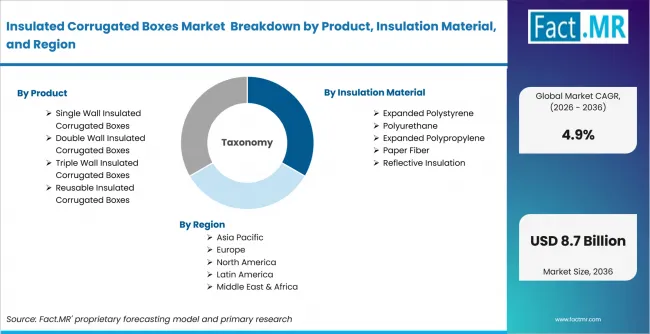
Insulated Corrugated Boxes Market Breakdown By Product, Insulation Material, And Region | Source: Fact.MR
| Attribute | Details |
|---|---|
| Quantitative Units | USD billion |
| Market Definition | Corrugated shipping boxes supplied with thermal insulation for temperature-sensitive distribution across the specified segments |
| Segments Covered | Product; Insulation Material; Application; End Use; Temperature Range; Distribution Channel |
| Regions Covered | Global analysis with country focus across Latin America, North America, Europe and East Asia |
| Countries Covered | Brazil; USA; Germany; Japan; France |
| Key Companies Profiled | Hangzhou Qiyao New Material Co. Ltd; Shandong Green Plastic Co. Ltd; Larsen Packaging Products Inc.; Deluxe Packaging Inc.; Associated Bag; Albert Paper Products; Apple Ltd.; Yamakoh Co. Ltd.; Rengo Co. Ltd.; Oji Holdings Corporation; Shanghai DE Printed Box |
| Forecast Period | 2026 to 2036 |
| Base Year | 2025 |
| Market Value, 2026 | USD 5.4 billion |
| Market Value, 2036 | USD 8.7 billion |
| CAGR, 2026-2036 | 4.9% |
| Absolute Opportunity | USD 3.3 billion |
| Approach | Demand-side and supply validation using box shipment volumes, system pricing, wall construction, insulation mix, temperature range, application demand and country distribution activity |
Source: Fact.MR analysis. Updated Aug 27, 2026
How is the market segmented?
-
By Product:
- Single Wall Insulated Corrugated Boxes
- EPS Insulated Boxes
- Polyurethane Insulated Boxes
- Paper Fiber Insulated Boxes
- Double Wall Insulated Corrugated Boxes
- EPS Double Wall Boxes
- Polyurethane Double Wall Boxes
- Triple Wall Insulated Corrugated Boxes
- Industrial Shipping Boxes
- Bulk Transport Boxes
- Reusable Insulated Corrugated Boxes
- Multi Trip Shipping Boxes
- Reusable Cold Chain Boxes
- Single Wall Insulated Corrugated Boxes
-
By Insulation Material:
- Expanded Polystyrene
- Standard Density EPS
- High Density EPS
- Polyurethane
- Rigid Foam
- High Insulation Foam
- Expanded Polypropylene
- Reusable EPP Inserts
- Impact Resistant EPP Inserts
- Paper Fiber
- Molded Fiber
- Cellulose Fiber
- Reflective Insulation
- Foil Bubble Insulation
- Reflective Thermal Liners
- Expanded Polystyrene
-
By Application:
- Food And Beverage
- Fresh Food Packaging
- Frozen Food Packaging
- Beverage Packaging
- Pharmaceuticals
- Vaccine Transportation
- Medical Shipment
- E Commerce
- Grocery Delivery
- Specialty Product Delivery
- Industrial Logistics
- Chemical Transportation
- Electronics Transportation
- Food And Beverage
-
By End Use:
- Food And Beverage Companies
- Pharmaceutical Companies
- E Commerce Companies
- Third Party Logistics Providers
- Industrial Manufacturers
- Food And Beverage Companies
-
By Temperature Range:
- Chilled Packaging
- Short Duration Transport
- Long Duration Transport
- Frozen Packaging
- Frozen Food Logistics
- Frozen Pharmaceutical Logistics
- Ambient Controlled Packaging
- Healthcare Products
- Specialty Chemicals
- Chilled Packaging
-
By Distribution Channel:
- Direct Sales
- Contract Supply Agreements
- Bulk Procurement
- Indirect Sales
- Distributors
- E Commerce Platforms
- Direct Sales
-
By Region:
- North America
- Latin America
- Western Europe
- Eastern Europe
- East Asia
- South Asia and Pacific
- Middle East & Africa
Frequently Asked Questions
What is the Insulated Corrugated Boxes Market value in 2026?
At what CAGR is the market projected to grow?
What is the projected market value by 2036?
Which Product leads the market?
Which Insulation Material leads the market?
Which Application leads the market?
Which End Use leads the market?
Which Temperature Range leads the market?
Which Distribution Channel leads the market?
What is Brazil's forecast CAGR?
What is the primary driver in this market?
What is the main restraint?
Which companies are included in the market assessment?
Who worked on this report


Preview the report firsthand - request a free sample
Free SampleGet the brochure for pricing and purchase details
Download PDF