- Market Value (2025): USD 100.4 Bn
- Estimated Value (2026): USD 112.4 Bn
- Forecast Value (2036): USD 349.1 Bn
- CAGR (2026-2036): 12.0%
What is the IoT Data Management Market forecast to be worth by 2036?
USD 112.4 billion in 2026 to USD 349.1 billion by 2036 at 12.0% CAGR.
- The IoT Data Management Market reached USD 100.4 billion in 2025 as enterprises kept funding connected data flows for manufacturing and service operations.
- Demand is projected to increase from USD 112.4 billion in 2026 to USD 349.1 billion by 2036 as connected-device data moves into governed workflows.
- The market is forecast to record 12.0% CAGR from 2026 to 2036 owing to integration needs and security review around cloud-edge deployment.
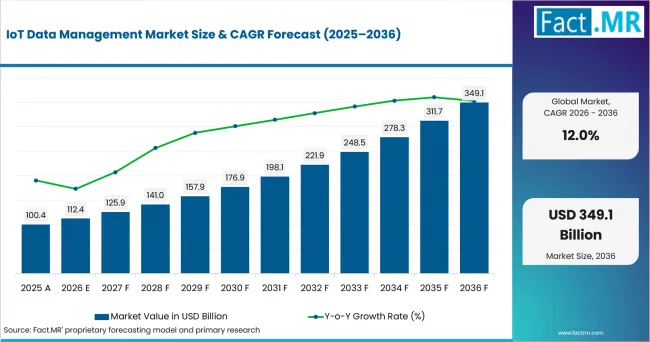
Iot Data Management Market Value Analysis | Source: Fact.MR
What are the defining numbers behind IoT Data Management Market growth?
USD 236.7 billion absolute opportunity by 2036.
- Demand Drivers in the Market
- Data integration solutions remain the first approval point because connected devices create records across incompatible systems.
- Smart factory deployments raise the value of clean operational data when production teams connect machine events with planning tools.
- Manufacturing customers need data governance since connected assets create security and lifecycle-control requirements.
- Direct sales are expected to matter where enterprise accounts require demonstrations before wider cloud or edge rollout.
- Key Segments Analyzed
- By Product Type: Data Integration Solutions are expected to hold 35.7% share in 2026 because customers first need reliable movement between device data and enterprise systems.
- By Application: Smart Manufacturing is projected to account for 28.4% share in 2026 as production teams attach connected records to monitoring workflows.
- By End Use: Manufacturing is anticipated to capture 28.8% share in 2026 since plant operators need secure handling of machine and quality records.
- By Distribution Channel: Direct Sales are estimated to represent 30.7% share in 2026 due to complex enterprise qualification and service accountability.
- By Deployment: Public Cloud is forecast to hold 44.5% share in 2026 as cloud computing economics support storage and analytics at scale.
- Analyst Opinion at Fact.MR
- Shambhu Nath Jha, Principal Consultant at Fact.MR, states, “IoT data management is becoming a purchase test around proof. Enterprise teams want to know whether data integration solutions reduce system friction, protect connected records and support repeated use after deployment.”
- Strategic Implications
- Technology companies should show how data moves from connected devices into governed applications. Cloud managed services strengthen this case when customers need support after deployment.
- Platform providers need clearer proof around identity and portability. Multi-cloud management becomes relevant when enterprise teams compare control across cloud estates.
- Investors should separate data integration exposure from broad IoT spending. Data center monitoring becomes commercially relevant when connected assets require live operational records.
South Korea is projected at 9.6% CAGR from 2026 to 2036. USA is expected to record 15.6% CAGR and Germany is projected at 13.2%. Canada is anticipated to post 10.8% CAGR. Japan is estimated at 14.4%, UK is forecast at 12.0% and Australia is projected at 8.4% during the same period.
How does the IoT Data Management Market break down by segment?
Data Integration Solutions are expected to lead Product Type at 35.7% share in 2026. Smart Manufacturing is projected to lead Application at 28.4% share in 2026.
Why does Data Integration Solutions lead Product Type?
Data Integration Solutions are projected to account for 35.7% share in 2026.
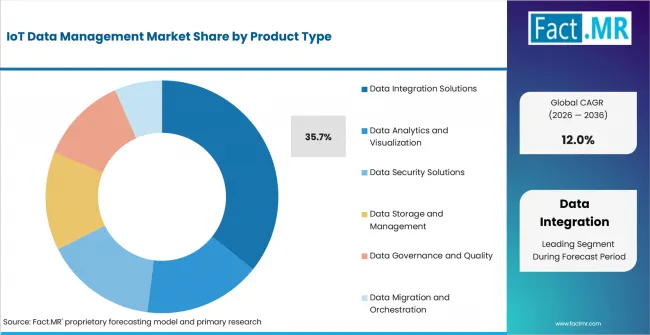
Iot Data Management Market Analysis By Product Type | Source: Fact.MR
Enterprises first need to reconcile device feeds with operational systems. Data Ingestion and Data Synchronization remain important when customers prioritize speed. Data Analytics and Visualization support users that need dashboards before broader governance work begins. Data as a service workflows reinforce the value of clean integration boundaries.
Why does Smart Manufacturing lead Application?
Smart Manufacturing is expected to hold 28.4% share in 2026.
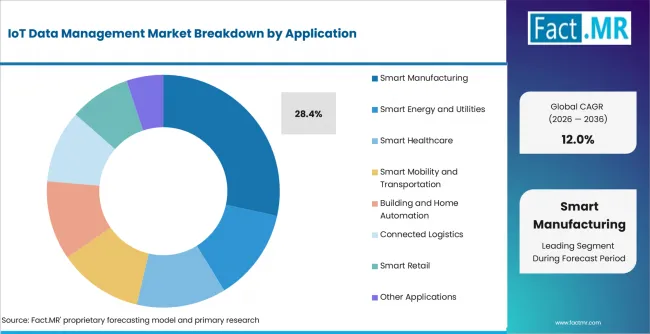
Iot Data Management Market Analysis By Application | Source: Fact.MR
Plant data has direct value in monitoring and workflow control. Predictive Maintenance becomes relevant when operators want earlier fault signals. Production Monitoring remains a practical route where managers need clear records from connected lines. Smart Energy and Utilities follow when asset-level visibility is the main need.
What supports Manufacturing within End Use?
Manufacturing is anticipated to represent 28.8% share in 2026.
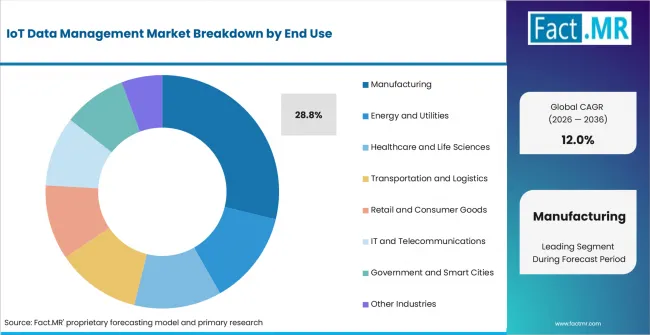
Iot Data Management Market Analysis By End Use | Source: Fact.MR
Connected equipment creates repeatable data flows that require validation before production teams act on them. Discrete Manufacturing and Process Manufacturing use different records but face similar control issues. Energy and Utilities remain relevant where connected assets require secure operational visibility.
Why does Direct Sales lead Distribution Channel?
Direct Sales are estimated to hold 30.7% share in 2026.
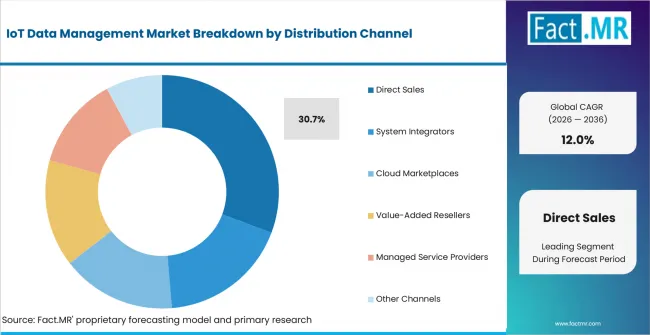
Iot Data Management Market Analysis By Distribution Channel | Source: Fact.MR
Enterprise customers often need tailored proof before approving integration platforms. Enterprise Direct Sales and Key Account Sales help large accounts test service depth. System Integrators remain important when implementation spans equipment and cloud teams.
What supports Public Cloud within Deployment?
Public Cloud is forecast to account for 44.5% share in 2026.
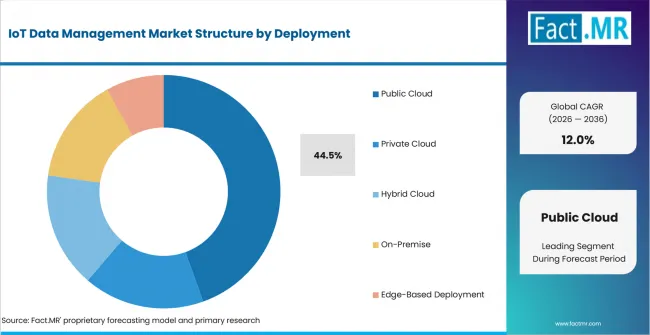
Iot Data Management Market Analysis By Deployment | Source: Fact.MR
Customers choose Public Cloud when they need flexible storage and managed analytics without owning every layer of infrastructure. Private Cloud is selected when security review limits shared environments. Cloud infrastructure planning guides the trade-off between control and scale.
What is accelerating IoT Data Management Market adoption, and what is holding it back?
Demand is expected to be driven by integration workload and manufacturing data governance. Adoption is expected to be held back by switching cost and security validation.
Drivers Impact Analysis
| DRIVER | (~) % IMPACT ON CAGR | GEOGRAPHIC RELEVANCE | IMPACT TIMELINE |
|---|---|---|---|
| Data integration solutions specification pull | +2.8% | South Korea, USA | Short term (<= 2 years) |
| Smart manufacturing integration workload | +2.4% | USA, Germany | Short term (<= 2 years) |
| Manufacturing data governance | +1.9% | South Korea, Japan | Medium term (2-4 years) |
| Public cloud deployment depth | +1.6% | Canada, UK | Medium term (2-4 years) |
| Direct sales validation support | +1.1% | Australia and large accounts | Long term (>= 4 years) |
Source: Fact.MR analysis. Updated Jul 31, 2026
- Data integration solutions specification pull: Connected systems are expected to increase the value of structured data movement between devices and applications.
- Smart manufacturing integration workload: Production teams place more weight on integration proof when cloud native technologies connect machine records to workflow automation.
- Manufacturing data governance: Data ownership and lifecycle control are expected to shape approvals where sensor records influence quality decisions.
Opportunity Impact Analysis
| OPPORTUNITY | (~) % IMPACT ON CAGR | GEOGRAPHIC RELEVANCE | IMPACT TIMELINE |
|---|---|---|---|
| Smart manufacturing deployment support | +1.4% | South Korea and USA | Medium term (2-4 years) |
| Security-led upgrades | +1.2% | USA and Germany | Medium term (2-4 years) |
| Managed-service conversion | +0.8% | Canada and UK | Long term (>= 4 years) |
| Cloud-edge deployment support | +0.6% | Japan and Australia | Long term (>= 4 years) |
Source: Fact.MR analysis. Updated Jul 31, 2026
- Smart manufacturing deployment support: Providers that package implementation help with analytics setup are expected to convert pilots into recurring accounts.
- Security-led upgrades: Edge security controls create opportunity where customers need governed device identity before sending records into cloud applications.
- Managed-service conversion: IoT managed services are expected to appeal to customers that need monitoring support after deployment.
Restraints Impact Analysis
| RESTRAINT | (~) % IMPACT ON CAGR | GEOGRAPHIC RELEVANCE | IMPACT TIMELINE |
|---|---|---|---|
| Integration complexity and switching cost | -1.6% | Global | Short term (<= 2 years) |
| Price sensitivity around smart manufacturing | -1.2% | Mid-sized accounts | Medium term (2-4 years) |
| Security validation burden | -0.8% | Regulated users | Medium term (2-4 years) |
| Slow conversion without customer-side proof | -0.6% | Developing channels | Long term (>= 4 years) |
Source: Fact.MR analysis. Updated Jul 31, 2026
- Integration complexity and switching cost: Legacy systems create mapping work before customers trust new data flows in daily operations.
- Price sensitivity around smart manufacturing: Smaller customers are expected to delay purchase when integration services raise the total project cost.
- Security validation burden: Governance checks add review time when connected data includes plant records or customer information.
Which countries are scaling IoT Data Management Market fastest?
The country comparison is defined by a narrow upper cluster and a longer step-down into lower-growth markets. South Korea leads the listed countries at 9.6% CAGR. USA remains above the global 12.0% rate. Germany and Canada form the middle group. Japan, UK and Australia follow with slower but steady adoption routes. This pattern reflects local manufacturing depth and service support more than market size alone.
- South Korea shows the highest listed CAGR because manufacturing customers move faster when integration proof aligns with local service support.
- USA remains above the global rate as enterprise accounts place more weight on documentation and security review.
- Germany and Canada form a middle group where cautious procurement slows conversion but does not remove demand.
- Japan, UK and Australia require clearer proof around service coverage and public cloud deployment before expansion.
The full report provides country-level CAGR analysis across North America; Latin America; Europe; East Asia; South Asia and Oceania; and the Middle East and Africa.
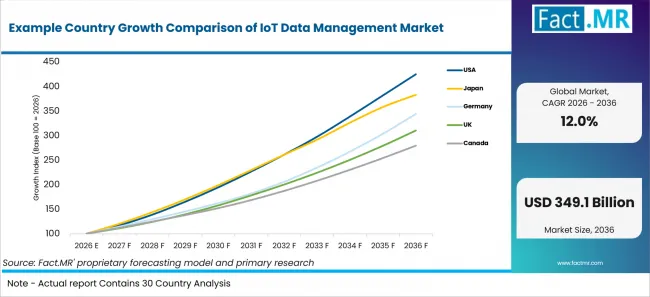
Example Country Growth Comparison Of Iot Data Management Market | Source: Fact.MR
| Country | CAGR (2026-2036) |
|---|---|
| South Korea | 9.6% |
| USA | 15.6% |
| Germany | 13.2% |
| Canada | 10.8% |
| Japan | 14.4% |
| UK | 12.0% |
| Australia | 8.4% |
Source: Fact.MR analysis. Updated Jul 31, 2026
What supports South Korea adoption?
13.4% CAGR, supported by manufacturing digitization and local cloud-integration demand.
South Korea's manufacturing customers evaluate integration proof before expansion. Local electronics accounts expect nearby support, so vendors must make machine records usable inside controlled workflow tools.
How is USA demand developing?
12.7% CAGR, led by enterprise data governance and smart manufacturing programs.
Enterprise accounts in the USA require documented proof before expansion. Smart manufacturing programs create demand for data management that connects production records with maintenance workflows and service accountability.
What is shaping Germany demand?
11.7% CAGR, supported by industrial automation depth and careful compliance review.
Germany's industrial buyers place high value on reliable plant data paths. Compliance review slows approval, so vendors must show how production records remain traceable across automation environments.
How does Canada scale adoption?
11.2% CAGR, driven by enterprise cloud use and distributed operating sites.
Canada's distributed sites need consistent data access across remote facilities. Public cloud deployment reduces infrastructure pressure, while service assurance matters because distance can raise support costs.
What supports Japan performance?
10.4% CAGR, backed by quality-led manufacturing and reliable deployment practices.
In Japan, quality-led factories prioritize stable records before wider workflow use. Public cloud adoption is expected to move carefully until security controls and local support are clear.
How is the UK market progressing?
10.2% CAGR, supported by enterprise modernization and data governance requirements.
The UK market is shaped by modernization and data governance. Customers need governed movement across applications, so providers must reduce documentation work and make lifecycle value easier to compare.
What supports Australia adoption?
9.9% CAGR, led by remote operations and cloud-based service delivery.
Australia's remote sites need reliable data access for operational visibility. Cloud deployment reduces local infrastructure burden, but connectivity limits and service cost slow the return case.
Who leads the IoT Data Management Market?
Microsoft Corporation and Google LLC are visible in the IoT Data Management Market. IBM, Cisco Systems, Inc., SAP SE, Oracle Corporation, PTC Inc. and Amazon Web Services, Inc. compete where cloud integration and connected operations overlap.
Competition from 2026 to 2036 is expected to depend on integration depth and security controls. Public cloud reach and service support are expected to decide confidence across repeat deployments.
Which companies are the key providers?
Key companies include Microsoft Corporation, Google LLC, International Business Machines Corporation (IBM), Cisco Systems, Inc., SAP SE, Oracle Corporation, PTC Inc., and Amazon Web Services, Inc.
- Microsoft Corporation
- Google LLC
- International Business Machines Corporation (IBM)
- Cisco Systems, Inc.
- SAP SE
- Oracle Corporation
- PTC Inc.
- Amazon Web Services, Inc.
Bibliography
- Eurostat. (2026, February 3). 53% of EU enterprises used paid cloud services in 2025. European Commission.
- National Institute of Standards and Technology. (2024, May). Trusted Internet of Things device network-layer onboarding and lifecycle management: Enhancing Internet Protocol-based IoT device and network security (NIST SP 1800-36, Initial Public Draft).
- National Institute of Standards and Technology. (2024, July 1). IEEE 1451.0-2024 standard published under leadership of NIST researchers.
- European Commission. (2025, June 16). State of the Digital Decade 2025 report.
This Report Answers
- The report provides intelligence on Product Type and Application choices that shape connected-device data programs.
- Segment analysis covers Data Integration Solutions and Smart Manufacturing as 2026 share leaders.
- Country outlook evaluates South Korea and USA alongside Germany, Canada, Japan, UK and Australia.
- Competitive analysis profiles Microsoft Corporation, Google LLC, IBM, Cisco Systems, Inc., SAP SE, Oracle Corporation, PTC Inc. and AWS.
- Deployment assessment covers Public Cloud, Private Cloud, Hybrid, On-Premise and Edge-Based Deployment.
What does the IoT Data Management Market cover?
IoT data management covers software and services used to control data generated by connected devices and sensors across machines and applications.
The market covers commercial activity tied to Data Integration Solutions and data ingestion. Coverage extends to synchronization and analytics. It includes security, storage, governance, migration and orchestration where connected data supports operations.
The market differs from general enterprise software because demand depends on device-level records. Unrelated corporate software spending remains outside the boundary. General cloud storage is excluded unless it directly supports IoT data handling.
What is included in the scope?
IoT data management solutions are used by manufacturers and utilities. Healthcare organizations, logistics companies, retailers, telecom providers and smart city authorities are included.
The scope includes Product Type, Application, End Use, Distribution Channel and Deployment. It covers public cloud and private cloud. Hybrid, on-premise and edge-based models are included when they support connected-device data management.
What is excluded from the scope?
Unrelated infrastructure, general corporate spending and adjacent categories outside connected-device data management remain outside the scope of this market.
The scope excludes standalone hardware, general networking equipment and device manufacturing. Enterprise applications without IoT-generated data management are outside the market boundary.
How Was the Analysis Built?
The analysis draws on 120+ sources, 35+ company portfolios and more than 20 industry interviews.
- Primary Research: Interviews cover providers, channel teams, end users and subject experts. They examine purchasing priorities, approval needs and adoption barriers.
- Desk Research: Desk research covers government statistics, company filings, technical studies and standards. Every retained source is documented in the bibliography.
- Market Sizing and Forecasting: Market estimates combine historical performance, demand indicators, segment shares, company participation, country growth and adoption barriers.
- Data Validation and Update Cycle: Findings are validated against public data, company activity, regulatory changes and commercial adoption signals. Regular updates review launches, capacity changes, partnerships and procurement trends.
Segmentation
What is the report's scope and coverage?
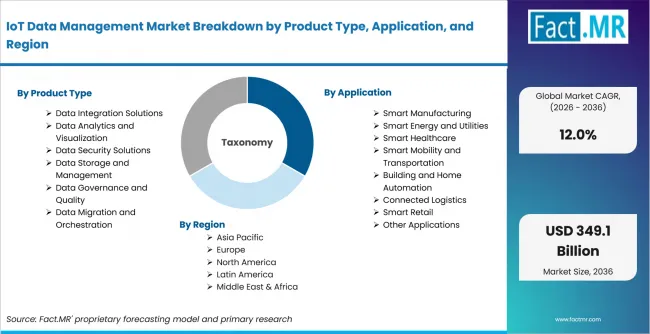
Iot Data Management Market Breakdown By Product Type, Application, And Region | Source: Fact.MR
| Attribute | Details |
|---|---|
| Quantitative Units | USD billion in 2026 to USD billion by 2036 at CAGR |
| Market Definition | Software and services used to collect connected-device records and keep them secure and usable |
| Product Type | Covers integration, ingestion, synchronization, analytics, security, storage, governance and migration functions |
| Application | Covers manufacturing, maintenance, monitoring, utilities, healthcare, mobility, automation, logistics, retail and other applications |
| End Use | Covers manufacturing, utilities, healthcare, logistics, retail, telecom, public infrastructure and other industries |
| Distribution Channel | Covers direct sales, system integrators, cloud marketplaces, resellers, managed service providers and other channels |
| Deployment | Covers public cloud, private cloud, hybrid, on-premise and edge-based deployment |
| Regions Covered | North America; Latin America; Europe; East Asia; South Asia and Pacific; Middle East and Africa |
| Countries Covered | South Korea; USA; Germany; Canada; Japan; UK; Australia |
| Key Companies Profiled | Microsoft Corporation; Google LLC; International Business Machines Corporation (IBM); Cisco Systems, Inc.; SAP SE; Oracle Corporation; PTC Inc.; Amazon Web Services, Inc. |
| Forecast Period | 2026 to 2036 |
| Approach | Hybrid top-down and bottom-up approach using connected-device data flows, enterprise cloud use, service depth, security controls and company participation |
Source: Fact.MR analysis. Updated Jul 31, 2026
How is the market segmented?
-
By Product Type
- Data Integration Solutions
- Data Ingestion
- Data Synchronization
- Data Analytics and Visualization
- Real-Time Analytics
- Visual Dashboards
- Data Security Solutions
- Data Encryption
- Identity and Access Management
- Data Storage and Management
- Cloud Data Storage
- Time-Series Data Management
- Data Governance and Quality
- Data Governance
- Data Quality Management
- Data Migration and Orchestration
- Data Migration
- Data Orchestration
- Data Integration Solutions
-
By Application
- Smart Manufacturing
- Predictive Maintenance
- Production Monitoring
- Smart Energy and Utilities
- Smart Grid Management
- Energy Consumption Monitoring
- Smart Healthcare
- Remote Patient Monitoring
- Connected Medical Devices
- Smart Mobility and Transportation
- Fleet Management
- Connected Vehicle Monitoring
- Building and Home Automation
- Smart Building Management
- Smart Home Monitoring
- Connected Logistics
- Asset Tracking
- Supply Chain Monitoring
- Smart Retail
- Inventory Management
- Connected Customer Experience
- Other Applications
- Smart Agriculture
- Smart City Infrastructure
- Smart Manufacturing
-
By End Use
- anufacturing
- Discrete Manufacturing
- Process Manufacturing
- Energy and Utilities
- Electric Utilities
- Oil and Gas
- Healthcare and Life Sciences
- Hospitals and Healthcare Providers
- Medical Device Companies
- Transportation and Logistics
- Fleet Operators
- Logistics Service Providers
- Retail and Consumer Goods
- Retail Chains
- Consumer Goods Manufacturers
- IT and Telecommunications
- Telecommunications Providers
- IT Service Providers
- Government and Smart Cities
- Public Infrastructure
- Smart City Authorities
- Other Industries
- Agriculture
- Construction
- anufacturing
-
By Distribution Channel
- Direct Sales
- Enterprise Direct Sales
- Key Account Sales
- System Integrators
- Global System Integrators
- Regional System Integrators
- Cloud Marketplaces
- Public Cloud Marketplaces
- Cloud Solution Stores
- Value-Added Resellers
- Enterprise Technology Resellers
- Specialized IoT Resellers
- Managed Service Providers
- Managed IoT Services
- Managed Data Services
- Other Channels
- Independent Software Vendors
- Industry Partnerships
- Direct Sales
-
By Deployment
- Public Cloud
- Single-Cloud Deployment
- Multi-Cloud Deployment
- Private Cloud
- Dedicated Private Cloud
- Virtual Private Cloud
- Hybrid Cloud
- Cloud-Edge Hybrid
- On-Premise-Cloud Hybrid
- On-Premise
- Dedicated Data Center
- Enterprise Server Deployment
- Edge-Based Deployment
- Edge Data Processing
- Distributed Edge Analytics
- Public Cloud
-
By Region
- North America
- Latin America
- Europe
- East Asia
- South Asia and Oceania
- Middle East and Africa
Frequently Asked Questions
Which Product Type leads the market?
Which Application leads the market?
Which End Use leads the market?
Which Distribution Channel leads the market?
Which Deployment leads the market?
Which country records the highest listed CAGR?
What is the primary driver in this market?
What is the main restraint?
Why does manufacturing lead demand?
Who worked on this report


Preview the report firsthand - request a free sample
Free SampleGet the brochure for pricing and purchase details
Download PDF