Loneliness Economy & Social Connection Services Market Size, Share, Growth and Forecast (2026 - 2036)

The Loneliness Economy & Social Connection Services Market is segmented by Service Type, User Group, Delivery Model, Revenue Model, End Use, Channel, and Region. Forecast period 2026 to 2036.

What is the loneliness economy and social connection services market forecast By Fact.MR

USD 1.5 billion in 2026 to USD 27.5 billion by 2036, at 33.8% CAGR.

  • The loneliness economy and social connection services market crossed a valuation of USD 1.12 billion in 2025.
  • Demand is expected to increase from USD 1.5 billion in 2026 to USD 27.5 billion by 2036.

What are the defining numbers behind loneliness economy and social connection services growth?

USD 26.0 billion absolute opportunity by 2036, led by South Korea and the United States.

Loneliness Economy & Social Connection Services Market Value Analysis

  • Demand Drivers in the Market
    • Health systems need social connection programs because loneliness is now measured as a risk marker in public-health guidance.
    • Cities fund outreach and local connection programs when single-person households and isolated youth become visible in official surveys.
    • Consumer platforms convert repeat users when matching and host checks reduce the stress of first contact. Payments and reminders support the same path into repeat use.
    • Health plans and families use companion care when older adults need social visits, light errands and nonclinical support at home.
  • Key Segments Analyzed
    • By Service Type: Community Events are expected to hold 32.0% share in 2026, supported by their ability to create meaningful social interactions and sustained engagement.
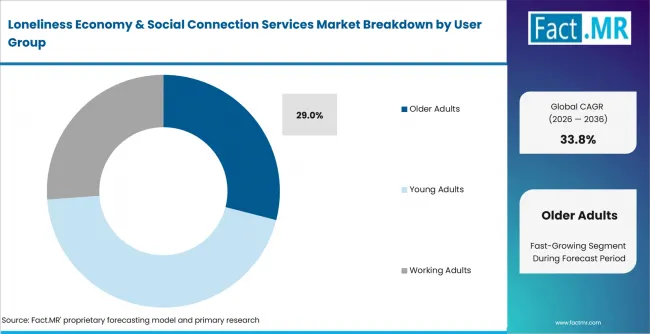
    • By User Group: Older Adults are likely to account for 29.0% share in 2026, driven by rising demand for companionship services and social support programs.
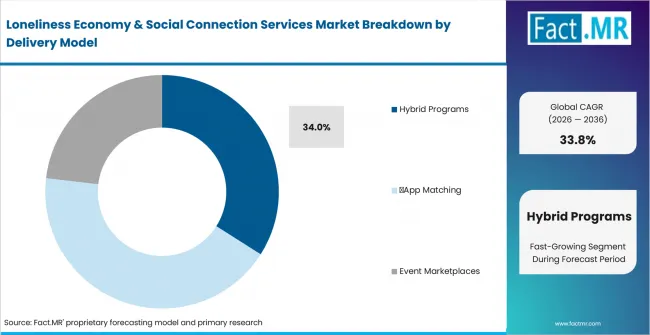
    • By Delivery Model: Hybrid Programs are projected to hold 34.0% share in 2026, reflecting the combination of digital discovery and in-person relationship building.
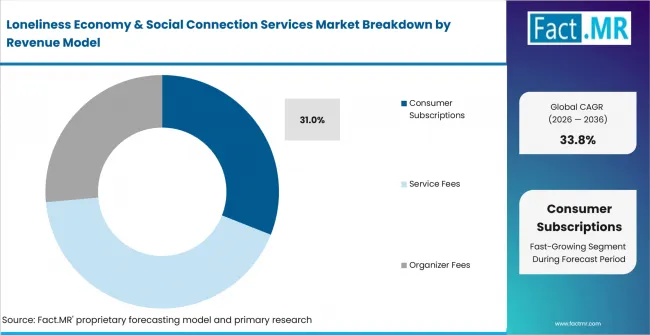
    • By Revenue Model: Consumer Subscriptions are expected to hold 31.0% share in 2026, aided by recurring participation across friendship and community engagement platforms.
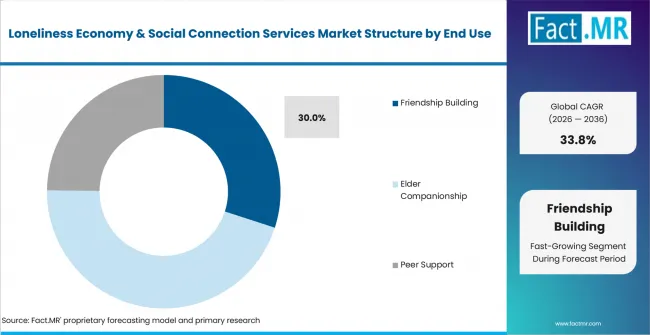
    • By End Use: Friendship Building is projected to hold 30.0% share in 2026, owing to growing demand for structured social connection services.
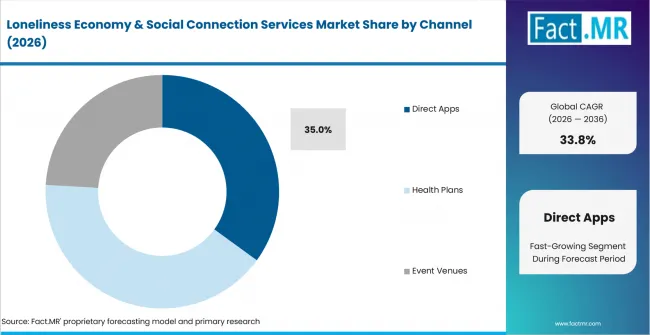
    • By Channel: Direct Apps are likely to account for 35.0% share in 2026, supported by convenient access to discovery, scheduling, and communication features.
    • By Geography: South Korea is projected to record a CAGR of 13.8% through 2036, propelled by expanding public initiatives focused on reducing social isolation among older adults.
  • Analyst Opinion at Fact.MR
    • Shambhu Nath Jha states at Fact.MR: “I see this market moving beyond the idea that loneliness is solved by another feed. Buyers are paying for safer introductions and verified groups. They also want social support that can be repeated. Providers that combine moderation with local execution are better placed than platforms that only deliver user profiles.”
  • Strategic Implications
    • Platforms should design verified group formats before expanding paid friendship features.
    • Companion care providers need outcome evidence that health plans can review during benefit design.
    • City program vendors should build referral systems that connect public outreach with local operators.
    • Event operators need host training and complaint handling because safety is part of the paid service promise.

The market is forecast to record 33.8% CAGR during 2026 to 2036. Health systems and cities now treat loneliness as a measurable risk. Employers and consumer platforms are building paid connection routes around the same need.

Paid group connection, companion care and social prescribing navigation form the core of this market. The World Health Organization reported in June 2025 that loneliness is linked to more than 871,000 deaths each year. [1] This supports funded programs that turn social connection into a service line rather than a soft community activity.

South Korea is projected to record 13.8% CAGR through 2036 as city programs and single-person household needs expand. The United States is expected to post 11.6% CAGR because app monetization and health-plan companion services are deeper. Japan is forecast at 11.2% CAGR as loneliness measurement and elder support needs rise. Canada is projected at 10.8% CAGR as public data and local services improve. The United Kingdom is expected to advance at 10.4% CAGR because loneliness measurement and social prescribing are already part of public policy. Australia is likely to record 10.1% CAGR as social isolation data supports community interventions. Germany is forecast to grow at 9.8% CAGR as youth loneliness creates room for moderated group formats.

How does the loneliness economy and social connection services market break down by segment?

Community Events lead at 32.0%; Hybrid Programs lead delivery at 34.0%.

Which service type dominates?

Community Events hold 32.0% share in 2026.

Loneliness Economy & Social Connection Services Market Analysis By Service Type

Community Events are expected to hold 32.0% share in 2026 because the user promise is visible attendance rather than a profile match. Companion care links this service category to senior care technology when families combine social visits with light support at home. Event operators gain when they reduce anxiety before the first meeting.

Which user group dominates?

Older Adults hold 29.0% share in 2026.

Loneliness Economy & Social Connection Services Market Analysis By User Group

Older Adults lead because paid companionship has clearer buyer groups. Families, health plans and community programs can fund visits when social isolation raises care risk. The segment also overlaps with personal assistance apps when users want errands, check-ins and connection through one trusted route.

Which delivery model dominates?

Hybrid Programs hold 34.0% share in 2026.

Loneliness Economy & Social Connection Services Market Analysis By Delivery Model

Hybrid Programs lead because discovery and trust formation happen in different channels. Users may find groups online. Repeat value comes from safe dinners, local meetups and moderated community activity. Providers need venue supply, host playbooks and user verification before this model scales across cities.

Which revenue model dominates?

Consumer Subscriptions hold 31.0% share in 2026.

Loneliness Economy & Social Connection Services Market Analysis By Revenue Model

Consumer Subscriptions lead because repeat access is easier to price than one-off social support. Friendship apps and premium event access sit beside mobile application monetization models. Member benefits use paid tiers, reminders and profile controls.

Which end use dominates?

Friendship Building holds 30.0% share in 2026.

Loneliness Economy & Social Connection Services Market Analysis By End Use

Friendship Building leads because the service outcome is simple to understand. Users pay when matching, moderation and group format lower the risk of awkward first contact. Mental wellbeing adjacency also connects the category with mental health apps when peer contact sits before formal therapy.

Which channel dominates?

Direct Apps hold 35.0% share in 2026.

Loneliness Economy & Social Connection Services Market Analysis By Channel

Direct Apps lead because search and payment work best in one user flow. Identity checks and scheduling sit in the same path. Health-linked services also draw from patient engagement platforms when plans refer members into social support programs. The channel has to prove safety before it can raise prices.

What is accelerating loneliness economy demand, and what is holding it back?

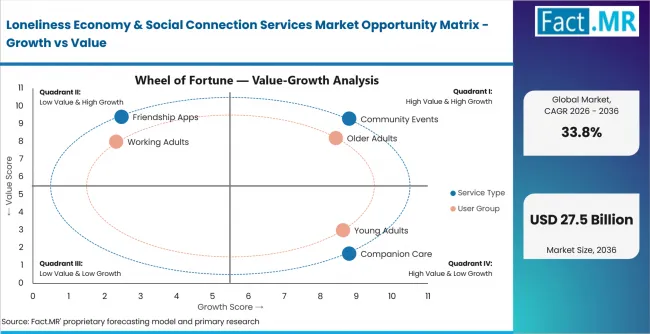
Loneliness Economy & Social Connection Services Market Opportunity Matrix Growth Vs Value

Public-health recognition and paid offline safety drive it; trust, moderation and evidence costs restrain it.

The main driver is public-health recognition of loneliness as a measurable risk. The Centers for Disease Control and Prevention reported in May 2024 that about one in three adults in the United States feel lonely and about one in four lack social and emotional support. [2] This is why health-plan pilots and mHealth services can include social support alongside care access.

The main restraint is operating cost. Services must pay for moderation and host training before users trust offline interaction. Background checks and complaint handling add further cost. Mental-health adjacent providers also face privacy and safety expectations similar to mental health software when they manage sensitive user information.

Where do the biggest loneliness economy opportunities sit?

Companion care, curated offline groups and city-funded social prescribing.

  • Companion Care: Providers can sell social visits and light support to health plans and families.
  • Curated Offline Groups: Event operators can monetize safer first meetings through host-led formats.
  • Social Prescribing: Navigation firms can connect public referrals with local classes, groups and peer communities.

Curated social formats also borrow retention tools from mental fitness apps when providers use habit reminders, small-group routines and user progress cues.

Which countries are scaling loneliness economy and social connection services fastest?

South Korea leads at 13.8%. The United States follows at 11.6%. Japan records 11.2% and Canada records 10.8%. The United Kingdom, Australia and Germany follow below these rates.

Based on regional analysis, the loneliness economy and social connection services market is segmented into North America and Europe. Asia Pacific, Latin America and Middle East and Africa are also covered.

Top Country Growth Comparison Loneliness Economy & Social Connection Services Market Cagr (2026 2036)

Country CAGR
South Korea 13.8%
United States 11.6%
Japan 11.2%
Canada 10.8%
United Kingdom 10.4%
Australia 10.1%
Germany 9.8%

Loneliness Economy & Social Connection Services Market Cagr Analysis By Country

What is powering South Korea’s lead?

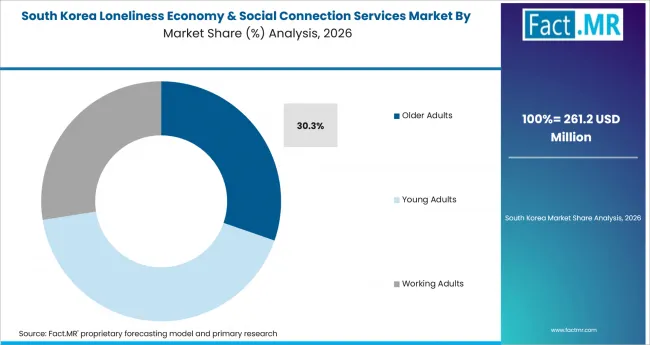
Loneliness Economy & Social Connection Services Market South Korea Market Share Analysis By User Group

13.8% CAGR, supported by city programs and single-person household concentration.

South Korea has the clearest city-level isolation policy signal. Seoul reported in March 2026 that single-person households accounted for 39.9% of all households in 2024. [9] The country is projected to record 13.8% CAGR through 2036 as municipal programs convert isolation into funded outreach. Suppliers that combine local hosts, welfare referrals and user safety workflows gain the clearest route into city programs.

What supports the USA outlook?

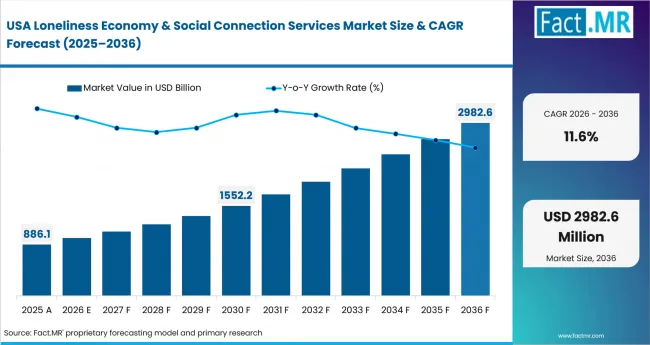
Loneliness Economy & Social Connection Services Market Country Value Analysis

11.6% CAGR, supported by app monetization and health-plan companion care.

The United States has the deepest consumer subscription and health-plan route. The Centers for Disease Control and Prevention reported that about one in three adults in the United States feel lonely. [2] The United States is expected to expand at 11.6% CAGR through 2036 as app monetization, employer benefits and companion care contracts scale. Providers need clear outcome evidence before health plans expand coverage.

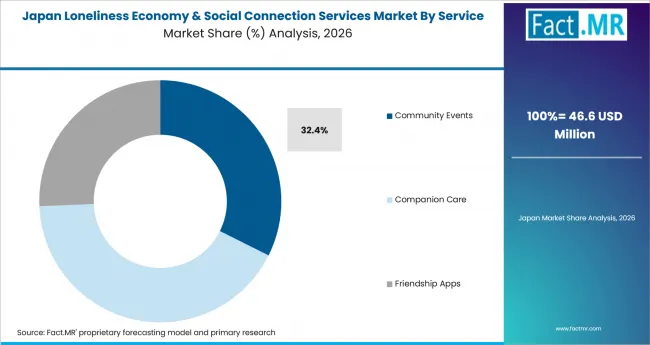
Why is Japan an important social connection market?

Loneliness Economy & Social Connection Services Market Japan Market Share Analysis By Service Type

11.2% CAGR, supported by loneliness measurement and older-adult service needs.

Japan has a national policy base for loneliness and isolation. The Cabinet Office of Japan reported in June 2025 that about 40% of respondents said they felt lonely in the 2024 survey. [6] Japan is forecast to grow at 11.2% CAGR through 2036 as older-adult companionship, community referral and city programs expand. Buyers are expected to favor providers that document safety and repeat participation.

How is Canada building social connection demand?

10.8% CAGR, supported by official loneliness measurement and local service routes.

Canada is moving from social concern into measurable service need. Statistics Canada reported in July 2024 that 13% of people aged 15 years and older always or often felt lonely in the first quarter of 2024. [5] Canada is projected to rise at 10.8% CAGR through 2036 as local operators and care organizations build programs around measured isolation. Suppliers need city partnerships and simple referral routes to reach older adults and youth.

What makes the United Kingdom relevant?

10.4% CAGR, supported by loneliness measurement and social prescribing infrastructure.

The United Kingdom has a longer policy base for loneliness measurement. The Department for Culture, Media and Sport reported in December 2025 that 9% of adults in England had high indirect loneliness during October 2024 to March 2025. [4] The United Kingdom is expected to advance at 10.4% CAGR through 2036 because social prescribing makes referral routes clearer. Providers that connect local groups with primary-care and council pathways have a stronger sales case.

Why does Australia matter in this market?

10.1% CAGR, supported by social isolation data and community health programs.

Australia has visible demand for community connection programs across older adults and younger users. The Australian Institute of Health and Welfare reported that 15% of Australians aged 15 and over were experiencing social isolation in 2024. [7] Australia is forecast at 10.1% CAGR through 2036 as community health organizations test programs for isolated users. Growth is constrained by geography because regional delivery requires local partners.

What underpins Germany’s growth?

9.8% CAGR, backed by youth loneliness and employer-oriented group programs.

Germany has a clear youth loneliness signal. Bertelsmann Stiftung reported in December 2024 that 51% of young adults in Germany were at least moderately lonely. [8] Germany is expected to post 9.8% CAGR through 2036 as employers, cities and community operators fund moderated group formats. The rate is lower than South Korea because public procurement routes are less centralized.

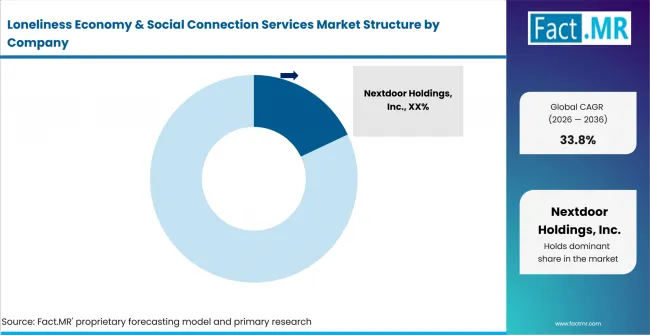
Who leads the loneliness economy and social connection services landscape?

Loneliness Economy & Social Connection Services Market Analysis By Company

Nextdoor and Bending Spoons lead through platform scale. Bumble, Papa and Timeleft add community tools and companion care depth.

Loneliness economy services are used by consumers and health plans. Employers and cities use them when they need trusted routes into repeat social contact.

Bumble Inc. expanded its friendship position by agreeing to acquire Geneva in May 2024. [11] Timeleft SAS uses curated dinners to reduce first-meeting friction. Stitch Inc. targets adults over 50 with activities, interest groups and companionship. These operators compete on matching quality, trust rules and repeat attendance rather than user volume alone.

Competition through 2036 is expected to depend on safety infrastructure and city coverage. Outcome evidence is another purchase test. App operators can learn from home fitness apps because habit formation and reminders shape repeat use.

Larger platforms need experience platforms when they manage local content, member controls and paid-service journeys across many cities.

Which companies are the key players?

Seven key players are covered below.

  • Nextdoor Holdings, Inc.
  • Bending Spoons S.p.A. (Meetup and Eventbrite)
  • Bumble Inc.
  • Papa Inc.
  • Timeleft SAS
  • Stitch Inc.
  • WeightWatchers

Bibliography

  • [1] World Health Organization. (2025, June 30). Social connection linked to improved health and reduced risk of early death. World Health Organization.
  • [2] Centers for Disease Control and Prevention. (2024, May 15). Health effects of social isolation and loneliness. U.S. Department of Health and Human Services.
  • [3] World Health Organization. (2025). Report of the WHO Commission on Social Connection. World Health Organization.
  • [4] Department for Culture, Media and Sport. (2025, December 10). Community Life Survey 2024/25: Loneliness and support networks. Government of the United Kingdom.
  • [5] Statistics Canada. (2024, July 30). You've got a friend in me. Statistics Canada. https://www.statcan.gc.ca/o1/en/plus/6735-youve-got-friend-me
  • [6] Cabinet Office of Japan. (2025, June). Japan's efforts to tackle loneliness and isolation. Cabinet Office of Japan.
  • [7] Australian Institute of Health and Welfare. (2025, December). Social isolation and loneliness. Australian Institute of Health and Welfare.
  • [8] Bertelsmann Stiftung. (2024, December 16). A comparison of youth loneliness in Europe in 2024. Bertelsmann Stiftung.
  • [9] Seoul Metropolitan Government. (2026, March 3). Seoul to build a more robust loneliness prevention and care system under the Seoul No More Loneliness initiative season 2. Seoul Metropolitan Government.
  • [10] Nextdoor Holdings, Inc. (2026, February 18). Nextdoor reports fourth quarter and full year 2025 results. Nextdoor Holdings, Inc.
  • [11] Bumble Inc. (2024, May 20). Bumble Inc. signs agreement to acquire group and community app Geneva. Bumble Inc.
  • [12] Meetup. (2024, November 8). Now exclusive to Meetup+: Unlimited DMs, priority waitlist, full access to member lists, and more. Meetup.
  • [13] Timeleft SAS. (2025, December 11). The “I'll Go If You Go” feature is finally here. Timeleft SAS. https://timeleft.com/post/1feature/
  • [14] Papa Inc. (2026). Companion care for older adults and families. Papa Inc.

This Report Address

  • Strategic intelligence on loneliness economy and social connection services across service type, user group and delivery model.
  • Segment analysis covering Community Events and Older Adults. Hybrid Programs, Consumer Subscriptions and Direct Apps are also covered.
  • Regional outlook covering South Korea and the United States. Japan, Canada, the United Kingdom, Australia and Germany are also covered.
  • Competitive analysis of Nextdoor Holdings Inc. and Bending Spoons S.p.A. Bumble Inc., Papa Inc. and Timeleft SAS are also profiled. Stitch Inc. and WeightWatchers are included.
  • Service assessment covering friendship apps and companion care. Community events, peer groups and social prescribing navigation are also assessed.
  • Primary interviews and provider checks support the forecast. Official source review and social connection data were used for validation.

What does the loneliness economy and social connection services market cover?

Paid and funded services that help people form, rebuild or maintain social connection.

The market covers services that convert social connection need into a paid service. It also covers contracted programs and funded local interventions. Included formats are friendship apps and community events. Curated dinners, companion care and social prescribing navigation are also included. The market differs from general social media because the service focus is verified interaction and repeat real-world connection.

What is included in the scope?

Paid group events and friendship matching. Companion care and social prescribing navigation are also included.

The scope includes paid group events and friendship matching. It also includes companion care and neighborhood connection platforms. Social prescribing navigation, peer support groups and connection benefits are included. Services may be delivered by apps or local operators. Care providers and community program vendors also sit inside the scope.

What is excluded from the scope?

Dating-only services and crisis helplines. Clinical therapy and open social media advertising are excluded.

The scope excludes dating-only services unless they include a separate friendship product. It excludes crisis helplines and clinical therapy. Unpaid volunteer-only activity is also excluded. General entertainment events are excluded when they do not sell a connection service model.

How was the analysis built?

120+ sources and 55+ company portfolios. The analysis covers 30+ countries and 22+ interviews.

Primary Research: Primary research includes interviews with community platform operators and elder companion providers. Health-plan benefit teams, city program managers and event organizers were also interviewed. Interviews tested pricing and user acquisition cost. Safety staffing and repeat-use behavior were reviewed separately.

Desk Research: Desk research reviews World Health Organization findings and national loneliness surveys. Company disclosures and official community life data were checked. Public program announcements were used only when the issuing body was clear. Commercial market research figures were not used for sizing.

Market-Sizing and Forecasting: Forecasting uses paid event revenue and app subscriptions. Health-plan companion contracts and social prescribing program spending were added to the model. Estimates were reconciled against company disclosures and public-health adoption signals.

Data Validation and Update Cycle: Forecasts are validated through provider checks. The model is updated when national loneliness data changes. Company launches and public funding decisions are reviewed during each update cycle.

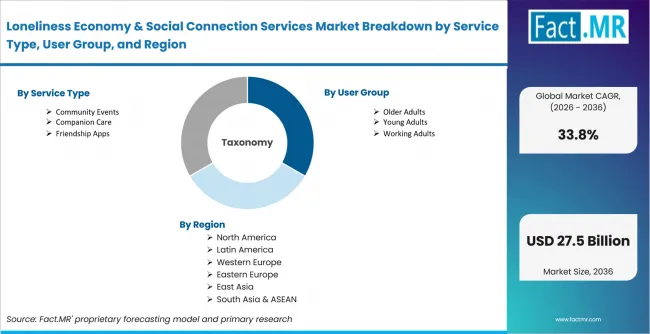
What is the report’s scope and coverage?

Loneliness Economy & Social Connection Services Market Breakdown By Service Type, User Group, And Region

Attribute Details
Quantitative Units USD Billion in 2026 to USD Billion by 2036 
Market Definition Paid and funded services that help users form, rebuild or maintain social connection
Service Type Community Events, Companion Care, Friendship Apps, Peer Communities, Social Prescribing
User Group Older Adults, Young Adults, Working Adults, Single-Person Households, Caregivers
Delivery Model Hybrid Programs, App Matching, Event Marketplaces, Health Benefits, Employer Benefits
Revenue Model Consumer Subscriptions, Service Fees, Health Contracts, Organizer Fees, Employer Contracts
End Use Friendship Building, Elder Companionship, Group Discovery, Peer Support, Community Navigation
Channel Direct Apps, Health Plans, Community Groups, Event Venues, Local Governments
Regions Covered North America, Europe, Asia Pacific, Latin America, Middle East and Africa
Countries Covered South Korea, United States, Japan, Canada, United Kingdom, Australia, Germany
Key Companies Profiled Nextdoor Holdings, Inc., Bending Spoons S.p.A., Bumble Inc., Papa Inc., Timeleft SAS, Stitch Inc. and WeightWatchers
Forecast Period 2026 to 2036
Approach Hybrid top-down and bottom-up approach using paid event revenue, app subscriptions, companion care contracts, public program spending and provider validation

How is the market segmented?

  • By Service Type:

    • Community Events
    • Companion Care
    • Friendship Apps
    • Peer Communities
    • Social Prescribing
  • By User Group:

    • Older Adults
    • Young Adults
    • Working Adults
    • Single-Person Households
    • Caregivers
  • By Delivery Model:

    • Hybrid Programs
    • App Matching
    • Event Marketplaces
    • Health Benefits
    • Employer Benefits
  • By Revenue Model:

    • Consumer Subscriptions
    • Service Fees
    • Health Contracts
    • Organizer Fees
    • Employer Contracts
  • By End Use:

    • Friendship Building
    • Elder Companionship
    • Group Discovery
    • Peer Support
    • Community Navigation
  • By Channel:

    • Direct Apps
    • Health Plans
    • Community Groups
    • Event Venues
    • Local Governments
  • By Region:

    • North America
      • United States
      • Canada
      • Mexico
    • Latin America
      • Brazil
      • Argentina
      • Rest of Latin America
    • Europe
      • United Kingdom
      • Germany
      • France
      • Italy
      • Spain
      • Rest of Europe
    • Asia Pacific
      • Japan
      • South Korea
      • China
      • India
      • Australia
      • ASEAN
    • Middle East & Africa
      • GCC Countries
      • South Africa
      • UAE
      • Rest of Middle East & Africa

- Frequently Asked Questions -

How does Japan perform in the Loneliness Economy & Social Connection Services Market?

Japan is forecast to grow at 11.2% CAGR through 2036 as loneliness measurement and older-adult services increase.

How does Canada perform in the Loneliness Economy & Social Connection Services Market?

Canada is projected to rise at 10.8% CAGR through 2036 as public data supports local service routes.

What is the primary driver in the Loneliness Economy & Social Connection Services Market?

The primary driver is public-health recognition of loneliness as a measurable risk that can be addressed through paid programs.

What is the main restraint in the Loneliness Economy & Social Connection Services Market?

The main restraint is trust and safety cost because offline interaction requires screening, moderation and complaint handling.

Why are hybrid programs important in this market?

Hybrid programs are important because users discover groups online but judge service value through in-person participation.
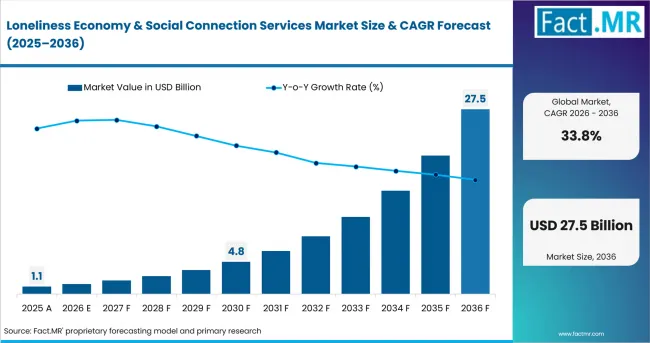
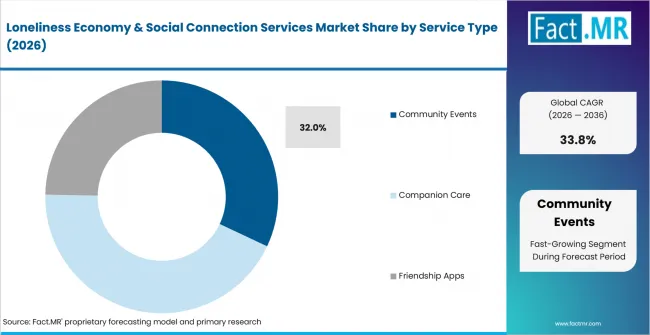
Table of Content

  1. Executive Summary
    • Global Market Outlook
    • Demand to side Trends
    • Supply to side Trends
    • Technology Roadmap Analysis
    • Analysis and Recommendations
  2. Market Overview
    • Market Coverage / Taxonomy
    • Market Definition / Scope / Limitations
  3. Research Methodology
    • Chapter Orientation
    • Analytical Lens and Working Hypotheses
      • Market Structure, Signals, and Trend Drivers
      • Benchmarking and Cross-market Comparability
      • Market Sizing, Forecasting, and Opportunity Mapping
    • Research Design and Evidence Framework
      • Desk Research Programme (Secondary Evidence)
        • Company Annual and Sustainability Reports
        • Peer-reviewed Journals and Academic Literature
        • Corporate Websites, Product Literature, and Technical Notes
        • Earnings Decks and Investor Briefings
        • Statutory Filings and Regulatory Disclosures
        • Technical White Papers and Standards Notes
        • Trade Journals, Industry Magazines, and Analyst Briefs
        • Conference Proceedings, Webinars, and Seminar Materials
        • Government Statistics Portals and Public Data Releases
        • Press Releases and Reputable Media Coverage
        • Specialist Newsletters and Curated Briefings
        • Sector Databases and Reference Repositories
        • Fact.MR Internal Proprietary Databases and Historical Market Datasets
        • Subscription Datasets and Paid Sources
        • Social Channels, Communities, and Digital Listening Inputs
        • Additional Desk Sources
      • Expert Input and Fieldwork (Primary Evidence)
        • Primary Modes
          • Qualitative Interviews and Expert Elicitation
          • Quantitative Surveys and Structured Data Capture
          • Blended Approach
        • Why Primary Evidence is Used
        • Field Techniques
          • Interviews
          • Surveys
          • Focus Groups
          • Observational and In-context Research
          • Social and Community Interactions
        • Stakeholder Universe Engaged
          • C-suite Leaders
          • Board Members
          • Presidents and Vice Presidents
          • R&D and Innovation Heads
          • Technical Specialists
          • Domain Subject-matter Experts
          • Scientists
          • Physicians and Other Healthcare Professionals
        • Governance, Ethics, and Data Stewardship
          • Research Ethics
          • Data Integrity and Handling
      • Tooling, Models, and Reference Databases
    • Data Engineering and Model Build
      • Data Acquisition and Ingestion
      • Cleaning, Normalisation, and Verification
      • Synthesis, Triangulation, and Analysis
    • Quality Assurance and Audit Trail
  4. Market Background
    • Market Dynamics
      • Drivers
      • Restraints
      • Opportunity
      • Trends
    • Scenario Forecast
      • Demand in Optimistic Scenario
      • Demand in Likely Scenario
      • Demand in Conservative Scenario
    • Opportunity Map Analysis
    • Product Life Cycle Analysis
    • Supply Chain Analysis
    • Investment Feasibility Matrix
    • Value Chain Analysis
    • PESTLE and Porter’s Analysis
    • Regulatory Landscape
    • Regional Parent Market Outlook
    • Production and Consumption Statistics
    • Import and Export Statistics
  5. Global Market Analysis 2021 to 2025 and Forecast, 2026 to 2036
    • Historical Market Size Value (USD Million) Analysis, 2021 to 2025
    • Current and Future Market Size Value (USD Million) Projections, 2026 to 2036
      • Y to o to Y Growth Trend Analysis
      • Absolute $ Opportunity Analysis
  6. Global Market Pricing Analysis 2021 to 2025 and Forecast 2026 to 2036
  7. Global Market Analysis 2021 to 2025 and Forecast 2026 to 2036, By Service Type
    • Introduction / Key Findings
    • Historical Market Size Value (USD Million) Analysis By Service Type , 2021 to 2025
    • Current and Future Market Size Value (USD Million) Analysis and Forecast By Service Type , 2026 to 2036
      • Community Events
      • Companion Care
      • Friendship Apps
    • Y to o to Y Growth Trend Analysis By Service Type , 2021 to 2025
    • Absolute $ Opportunity Analysis By Service Type , 2026 to 2036
  8. Global Market Analysis 2021 to 2025 and Forecast 2026 to 2036, By User Group
    • Introduction / Key Findings
    • Historical Market Size Value (USD Million) Analysis By User Group, 2021 to 2025
    • Current and Future Market Size Value (USD Million) Analysis and Forecast By User Group, 2026 to 2036
      • Older Adults
      • Young Adults
      • Working Adults
    • Y to o to Y Growth Trend Analysis By User Group, 2021 to 2025
    • Absolute $ Opportunity Analysis By User Group, 2026 to 2036
  9. Global Market Analysis 2021 to 2025 and Forecast 2026 to 2036, By Delivery Model
    • Introduction / Key Findings
    • Historical Market Size Value (USD Million) Analysis By Delivery Model, 2021 to 2025
    • Current and Future Market Size Value (USD Million) Analysis and Forecast By Delivery Model, 2026 to 2036
      • Hybrid Programs
      • App Matching
      • Event Marketplaces
    • Y to o to Y Growth Trend Analysis By Delivery Model, 2021 to 2025
    • Absolute $ Opportunity Analysis By Delivery Model, 2026 to 2036
  10. Global Market Analysis 2021 to 2025 and Forecast 2026 to 2036, By Revenue Model
    • Introduction / Key Findings
    • Historical Market Size Value (USD Million) Analysis By Revenue Model, 2021 to 2025
    • Current and Future Market Size Value (USD Million) Analysis and Forecast By Revenue Model, 2026 to 2036
      • Consumer Subscriptions
      • Service Fees
      • Organizer Fees
    • Y to o to Y Growth Trend Analysis By Revenue Model, 2021 to 2025
    • Absolute $ Opportunity Analysis By Revenue Model, 2026 to 2036
  11. Global Market Analysis 2021 to 2025 and Forecast 2026 to 2036, By End Use
    • Introduction / Key Findings
    • Historical Market Size Value (USD Million) Analysis By End Use, 2021 to 2025
    • Current and Future Market Size Value (USD Million) Analysis and Forecast By End Use, 2026 to 2036
      • Friendship Building
      • Elder Companionship
      • Peer Support
    • Y to o to Y Growth Trend Analysis By End Use, 2021 to 2025
    • Absolute $ Opportunity Analysis By End Use, 2026 to 2036
  12. Global Market Analysis 2021 to 2025 and Forecast 2026 to 2036, By Channel
    • Introduction / Key Findings
    • Historical Market Size Value (USD Million) Analysis By Channel, 2021 to 2025
    • Current and Future Market Size Value (USD Million) Analysis and Forecast By Channel, 2026 to 2036
      • Direct Apps
      • Health Plans
      • Event Venues
    • Y to o to Y Growth Trend Analysis By Channel, 2021 to 2025
    • Absolute $ Opportunity Analysis By Channel, 2026 to 2036
  13. Global Market Analysis 2021 to 2025 and Forecast 2026 to 2036, By Region
    • Introduction
    • Historical Market Size Value (USD Million) Analysis By Region, 2021 to 2025
    • Current Market Size Value (USD Million) Analysis and Forecast By Region, 2026 to 2036
      • North America
      • Latin America
      • Western Europe
      • Eastern Europe
      • East Asia
      • South Asia and Pacific
      • Middle East & Africa
    • Market Attractiveness Analysis By Region
  14. North America Market Analysis 2021 to 2025 and Forecast 2026 to 2036, By Country
    • Historical Market Size Value (USD Million) Trend Analysis By Market Taxonomy, 2021 to 2025
    • Market Size Value (USD Million) Forecast By Market Taxonomy, 2026 to 2036
      • By Country
        • USA
        • Canada
        • Mexico
      • By Service Type
      • By User Group
      • By Delivery Model
      • By Revenue Model
      • By End Use
      • By Channel
    • Market Attractiveness Analysis
      • By Country
      • By Service Type
      • By User Group
      • By Delivery Model
      • By Revenue Model
      • By End Use
      • By Channel
    • Key Takeaways
  15. Latin America Market Analysis 2021 to 2025 and Forecast 2026 to 2036, By Country
    • Historical Market Size Value (USD Million) Trend Analysis By Market Taxonomy, 2021 to 2025
    • Market Size Value (USD Million) Forecast By Market Taxonomy, 2026 to 2036
      • By Country
        • Brazil
        • Chile
        • Rest of Latin America
      • By Service Type
      • By User Group
      • By Delivery Model
      • By Revenue Model
      • By End Use
      • By Channel
    • Market Attractiveness Analysis
      • By Country
      • By Service Type
      • By User Group
      • By Delivery Model
      • By Revenue Model
      • By End Use
      • By Channel
    • Key Takeaways
  16. Western Europe Market Analysis 2021 to 2025 and Forecast 2026 to 2036, By Country
    • Historical Market Size Value (USD Million) Trend Analysis By Market Taxonomy, 2021 to 2025
    • Market Size Value (USD Million) Forecast By Market Taxonomy, 2026 to 2036
      • By Country
        • Germany
        • UK
        • Italy
        • Spain
        • France
        • Nordic
        • BENELUX
        • Rest of Western Europe
      • By Service Type
      • By User Group
      • By Delivery Model
      • By Revenue Model
      • By End Use
      • By Channel
    • Market Attractiveness Analysis
      • By Country
      • By Service Type
      • By User Group
      • By Delivery Model
      • By Revenue Model
      • By End Use
      • By Channel
    • Key Takeaways
  17. Eastern Europe Market Analysis 2021 to 2025 and Forecast 2026 to 2036, By Country
    • Historical Market Size Value (USD Million) Trend Analysis By Market Taxonomy, 2021 to 2025
    • Market Size Value (USD Million) Forecast By Market Taxonomy, 2026 to 2036
      • By Country
        • Russia
        • Poland
        • Hungary
        • Balkan & Baltic
        • Rest of Eastern Europe
      • By Service Type
      • By User Group
      • By Delivery Model
      • By Revenue Model
      • By End Use
      • By Channel
    • Market Attractiveness Analysis
      • By Country
      • By Service Type
      • By User Group
      • By Delivery Model
      • By Revenue Model
      • By End Use
      • By Channel
    • Key Takeaways
  18. East Asia Market Analysis 2021 to 2025 and Forecast 2026 to 2036, By Country
    • Historical Market Size Value (USD Million) Trend Analysis By Market Taxonomy, 2021 to 2025
    • Market Size Value (USD Million) Forecast By Market Taxonomy, 2026 to 2036
      • By Country
        • China
        • Japan
        • South Korea
      • By Service Type
      • By User Group
      • By Delivery Model
      • By Revenue Model
      • By End Use
      • By Channel
    • Market Attractiveness Analysis
      • By Country
      • By Service Type
      • By User Group
      • By Delivery Model
      • By Revenue Model
      • By End Use
      • By Channel
    • Key Takeaways
  19. South Asia and Pacific Market Analysis 2021 to 2025 and Forecast 2026 to 2036, By Country
    • Historical Market Size Value (USD Million) Trend Analysis By Market Taxonomy, 2021 to 2025
    • Market Size Value (USD Million) Forecast By Market Taxonomy, 2026 to 2036
      • By Country
        • India
        • ASEAN
        • Australia & New Zealand
        • Rest of South Asia and Pacific
      • By Service Type
      • By User Group
      • By Delivery Model
      • By Revenue Model
      • By End Use
      • By Channel
    • Market Attractiveness Analysis
      • By Country
      • By Service Type
      • By User Group
      • By Delivery Model
      • By Revenue Model
      • By End Use
      • By Channel
    • Key Takeaways
  20. Middle East & Africa Market Analysis 2021 to 2025 and Forecast 2026 to 2036, By Country
    • Historical Market Size Value (USD Million) Trend Analysis By Market Taxonomy, 2021 to 2025
    • Market Size Value (USD Million) Forecast By Market Taxonomy, 2026 to 2036
      • By Country
        • Kingdom of Saudi Arabia
        • Other GCC Countries
        • Turkiye
        • South Africa
        • Other African Union
        • Rest of Middle East & Africa
      • By Service Type
      • By User Group
      • By Delivery Model
      • By Revenue Model
      • By End Use
      • By Channel
    • Market Attractiveness Analysis
      • By Country
      • By Service Type
      • By User Group
      • By Delivery Model
      • By Revenue Model
      • By End Use
      • By Channel
    • Key Takeaways
  21. Key Countries Market Analysis
    • USA
      • Pricing Analysis
      • Market Share Analysis, 2025
        • By Service Type
        • By User Group
        • By Delivery Model
        • By Revenue Model
        • By End Use
        • By Channel
    • Canada
      • Pricing Analysis
      • Market Share Analysis, 2025
        • By Service Type
        • By User Group
        • By Delivery Model
        • By Revenue Model
        • By End Use
        • By Channel
    • Mexico
      • Pricing Analysis
      • Market Share Analysis, 2025
        • By Service Type
        • By User Group
        • By Delivery Model
        • By Revenue Model
        • By End Use
        • By Channel
    • Brazil
      • Pricing Analysis
      • Market Share Analysis, 2025
        • By Service Type
        • By User Group
        • By Delivery Model
        • By Revenue Model
        • By End Use
        • By Channel
    • Chile
      • Pricing Analysis
      • Market Share Analysis, 2025
        • By Service Type
        • By User Group
        • By Delivery Model
        • By Revenue Model
        • By End Use
        • By Channel
    • Germany
      • Pricing Analysis
      • Market Share Analysis, 2025
        • By Service Type
        • By User Group
        • By Delivery Model
        • By Revenue Model
        • By End Use
        • By Channel
    • UK
      • Pricing Analysis
      • Market Share Analysis, 2025
        • By Service Type
        • By User Group
        • By Delivery Model
        • By Revenue Model
        • By End Use
        • By Channel
    • Italy
      • Pricing Analysis
      • Market Share Analysis, 2025
        • By Service Type
        • By User Group
        • By Delivery Model
        • By Revenue Model
        • By End Use
        • By Channel
    • Spain
      • Pricing Analysis
      • Market Share Analysis, 2025
        • By Service Type
        • By User Group
        • By Delivery Model
        • By Revenue Model
        • By End Use
        • By Channel
    • France
      • Pricing Analysis
      • Market Share Analysis, 2025
        • By Service Type
        • By User Group
        • By Delivery Model
        • By Revenue Model
        • By End Use
        • By Channel
    • India
      • Pricing Analysis
      • Market Share Analysis, 2025
        • By Service Type
        • By User Group
        • By Delivery Model
        • By Revenue Model
        • By End Use
        • By Channel
    • ASEAN
      • Pricing Analysis
      • Market Share Analysis, 2025
        • By Service Type
        • By User Group
        • By Delivery Model
        • By Revenue Model
        • By End Use
        • By Channel
    • Australia & New Zealand
      • Pricing Analysis
      • Market Share Analysis, 2025
        • By Service Type
        • By User Group
        • By Delivery Model
        • By Revenue Model
        • By End Use
        • By Channel
    • China
      • Pricing Analysis
      • Market Share Analysis, 2025
        • By Service Type
        • By User Group
        • By Delivery Model
        • By Revenue Model
        • By End Use
        • By Channel
    • Japan
      • Pricing Analysis
      • Market Share Analysis, 2025
        • By Service Type
        • By User Group
        • By Delivery Model
        • By Revenue Model
        • By End Use
        • By Channel
    • South Korea
      • Pricing Analysis
      • Market Share Analysis, 2025
        • By Service Type
        • By User Group
        • By Delivery Model
        • By Revenue Model
        • By End Use
        • By Channel
    • Russia
      • Pricing Analysis
      • Market Share Analysis, 2025
        • By Service Type
        • By User Group
        • By Delivery Model
        • By Revenue Model
        • By End Use
        • By Channel
    • Poland
      • Pricing Analysis
      • Market Share Analysis, 2025
        • By Service Type
        • By User Group
        • By Delivery Model
        • By Revenue Model
        • By End Use
        • By Channel
    • Hungary
      • Pricing Analysis
      • Market Share Analysis, 2025
        • By Service Type
        • By User Group
        • By Delivery Model
        • By Revenue Model
        • By End Use
        • By Channel
    • Kingdom of Saudi Arabia
      • Pricing Analysis
      • Market Share Analysis, 2025
        • By Service Type
        • By User Group
        • By Delivery Model
        • By Revenue Model
        • By End Use
        • By Channel
    • Turkiye
      • Pricing Analysis
      • Market Share Analysis, 2025
        • By Service Type
        • By User Group
        • By Delivery Model
        • By Revenue Model
        • By End Use
        • By Channel
    • South Africa
      • Pricing Analysis
      • Market Share Analysis, 2025
        • By Service Type
        • By User Group
        • By Delivery Model
        • By Revenue Model
        • By End Use
        • By Channel
  22. Market Structure Analysis
    • Competition Dashboard
    • Competition Benchmarking
    • Market Share Analysis of Top Players
      • By Regional
      • By Service Type
      • By User Group
      • By Delivery Model
      • By Revenue Model
      • By End Use
      • By Channel
  23. Competition Analysis
    • Competition Deep Dive
      • Nextdoor Holdings, Inc.
        • Overview
        • Product Portfolio
        • Profitability by Market Segments (Product/Age /Sales Channel/Region)
        • Sales Footprint
        • Strategy Overview
          • Marketing Strategy
          • Product Strategy
          • Channel Strategy
      • Bending Spoons S.p.A. (Meetup and Eventbrite)
      • Bumble Inc.
      • Papa Inc.
      • Timeleft SAS
  24. Assumptions & Acronyms Used

List Of Table

  • Table 1: Global Market Value (USD Million) Forecast by Region, 2021 to 2036
  • Table 2: Global Market Value (USD Million) Forecast by Service Type, 2021 to 2036
  • Table 3: Global Market Value (USD Million) Forecast by User Group, 2021 to 2036
  • Table 4: Global Market Value (USD Million) Forecast by Delivery Model, 2021 to 2036
  • Table 5: Global Market Value (USD Million) Forecast by Revenue Model, 2021 to 2036
  • Table 6: Global Market Value (USD Million) Forecast by End Use, 2021 to 2036
  • Table 7: Global Market Value (USD Million) Forecast by Channel, 2021 to 2036
  • Table 8: North America Market Value (USD Million) Forecast by Country, 2021 to 2036
  • Table 9: North America Market Value (USD Million) Forecast by Service Type, 2021 to 2036
  • Table 10: North America Market Value (USD Million) Forecast by User Group, 2021 to 2036
  • Table 11: North America Market Value (USD Million) Forecast by Delivery Model, 2021 to 2036
  • Table 12: North America Market Value (USD Million) Forecast by Revenue Model, 2021 to 2036
  • Table 13: North America Market Value (USD Million) Forecast by End Use, 2021 to 2036
  • Table 14: North America Market Value (USD Million) Forecast by Channel, 2021 to 2036
  • Table 15: Latin America Market Value (USD Million) Forecast by Country, 2021 to 2036
  • Table 16: Latin America Market Value (USD Million) Forecast by Service Type, 2021 to 2036
  • Table 17: Latin America Market Value (USD Million) Forecast by User Group, 2021 to 2036
  • Table 18: Latin America Market Value (USD Million) Forecast by Delivery Model, 2021 to 2036
  • Table 19: Latin America Market Value (USD Million) Forecast by Revenue Model, 2021 to 2036
  • Table 20: Latin America Market Value (USD Million) Forecast by End Use, 2021 to 2036
  • Table 21: Latin America Market Value (USD Million) Forecast by Channel, 2021 to 2036
  • Table 22: Western Europe Market Value (USD Million) Forecast by Country, 2021 to 2036
  • Table 23: Western Europe Market Value (USD Million) Forecast by Service Type, 2021 to 2036
  • Table 24: Western Europe Market Value (USD Million) Forecast by User Group, 2021 to 2036
  • Table 25: Western Europe Market Value (USD Million) Forecast by Delivery Model, 2021 to 2036
  • Table 26: Western Europe Market Value (USD Million) Forecast by Revenue Model, 2021 to 2036
  • Table 27: Western Europe Market Value (USD Million) Forecast by End Use, 2021 to 2036
  • Table 28: Western Europe Market Value (USD Million) Forecast by Channel, 2021 to 2036
  • Table 29: Eastern Europe Market Value (USD Million) Forecast by Country, 2021 to 2036
  • Table 30: Eastern Europe Market Value (USD Million) Forecast by Service Type, 2021 to 2036
  • Table 31: Eastern Europe Market Value (USD Million) Forecast by User Group, 2021 to 2036
  • Table 32: Eastern Europe Market Value (USD Million) Forecast by Delivery Model, 2021 to 2036
  • Table 33: Eastern Europe Market Value (USD Million) Forecast by Revenue Model, 2021 to 2036
  • Table 34: Eastern Europe Market Value (USD Million) Forecast by End Use, 2021 to 2036
  • Table 35: Eastern Europe Market Value (USD Million) Forecast by Channel, 2021 to 2036
  • Table 36: East Asia Market Value (USD Million) Forecast by Country, 2021 to 2036
  • Table 37: East Asia Market Value (USD Million) Forecast by Service Type, 2021 to 2036
  • Table 38: East Asia Market Value (USD Million) Forecast by User Group, 2021 to 2036
  • Table 39: East Asia Market Value (USD Million) Forecast by Delivery Model, 2021 to 2036
  • Table 40: East Asia Market Value (USD Million) Forecast by Revenue Model, 2021 to 2036
  • Table 41: East Asia Market Value (USD Million) Forecast by End Use, 2021 to 2036
  • Table 42: East Asia Market Value (USD Million) Forecast by Channel, 2021 to 2036
  • Table 43: South Asia and Pacific Market Value (USD Million) Forecast by Country, 2021 to 2036
  • Table 44: South Asia and Pacific Market Value (USD Million) Forecast by Service Type, 2021 to 2036
  • Table 45: South Asia and Pacific Market Value (USD Million) Forecast by User Group, 2021 to 2036
  • Table 46: South Asia and Pacific Market Value (USD Million) Forecast by Delivery Model, 2021 to 2036
  • Table 47: South Asia and Pacific Market Value (USD Million) Forecast by Revenue Model, 2021 to 2036
  • Table 48: South Asia and Pacific Market Value (USD Million) Forecast by End Use, 2021 to 2036
  • Table 49: South Asia and Pacific Market Value (USD Million) Forecast by Channel, 2021 to 2036
  • Table 50: Middle East & Africa Market Value (USD Million) Forecast by Country, 2021 to 2036
  • Table 51: Middle East & Africa Market Value (USD Million) Forecast by Service Type, 2021 to 2036
  • Table 52: Middle East & Africa Market Value (USD Million) Forecast by User Group, 2021 to 2036
  • Table 53: Middle East & Africa Market Value (USD Million) Forecast by Delivery Model, 2021 to 2036
  • Table 54: Middle East & Africa Market Value (USD Million) Forecast by Revenue Model, 2021 to 2036
  • Table 55: Middle East & Africa Market Value (USD Million) Forecast by End Use, 2021 to 2036
  • Table 56: Middle East & Africa Market Value (USD Million) Forecast by Channel, 2021 to 2036

List Of Figures

  • Figure 1: Global Market Pricing Analysis
  • Figure 2: Global Market Value (USD Million) Forecast 2021-2036
  • Figure 3: Global Market Value Share and BPS Analysis by Service Type , 2026 and 2036
  • Figure 4: Global Market Y-o-Y Growth Comparison by Service Type , 2026 to 2036
  • Figure 5: Global Market Attractiveness Analysis by Service Type
  • Figure 6: Global Market Value Share and BPS Analysis by User Group, 2026 and 2036
  • Figure 7: Global Market Y-o-Y Growth Comparison by User Group, 2026 to 2036
  • Figure 8: Global Market Attractiveness Analysis by User Group
  • Figure 9: Global Market Value Share and BPS Analysis by Delivery Model, 2026 and 2036
  • Figure 10: Global Market Y-o-Y Growth Comparison by Delivery Model, 2026 to 2036
  • Figure 11: Global Market Attractiveness Analysis by Delivery Model
  • Figure 12: Global Market Value Share and BPS Analysis by Revenue Model, 2026 and 2036
  • Figure 13: Global Market Y-o-Y Growth Comparison by Revenue Model, 2026 to 2036
  • Figure 14: Global Market Attractiveness Analysis by Revenue Model
  • Figure 15: Global Market Value Share and BPS Analysis by End Use, 2026 and 2036
  • Figure 16: Global Market Y-o-Y Growth Comparison by End Use, 2026 to 2036
  • Figure 17: Global Market Attractiveness Analysis by End Use
  • Figure 18: Global Market Value Share and BPS Analysis by Channel, 2026 and 2036
  • Figure 19: Global Market Y-o-Y Growth Comparison by Channel, 2026 to 2036
  • Figure 20: Global Market Attractiveness Analysis by Channel
  • Figure 21: Global Market Value (USD Million) Share and BPS Analysis by Region, 2026 and 2036
  • Figure 22: Global Market Y-o-Y Growth Comparison by Region, 2026 to 2036
  • Figure 23: Global Market Attractiveness Analysis by Region
  • Figure 24: North America Market Incremental Dollar Opportunity, 2026 to 2036
  • Figure 25: Latin America Market Incremental Dollar Opportunity, 2026 to 2036
  • Figure 26: Western Europe Market Incremental Dollar Opportunity, 2026 to 2036
  • Figure 27: Eastern Europe Market Incremental Dollar Opportunity, 2026 to 2036
  • Figure 28: East Asia Market Incremental Dollar Opportunity, 2026 to 2036
  • Figure 29: South Asia and Pacific Market Incremental Dollar Opportunity, 2026 to 2036
  • Figure 30: Middle East & Africa Market Incremental Dollar Opportunity, 2026 to 2036
  • Figure 31: North America Market Value Share and BPS Analysis by Country, 2026 and 2036
  • Figure 32: North America Market Value Share and BPS Analysis by Service Type , 2026 and 2036
  • Figure 33: North America Market Y-o-Y Growth Comparison by Service Type , 2026 to 2036
  • Figure 34: North America Market Attractiveness Analysis by Service Type
  • Figure 35: North America Market Value Share and BPS Analysis by User Group, 2026 and 2036
  • Figure 36: North America Market Y-o-Y Growth Comparison by User Group, 2026 to 2036
  • Figure 37: North America Market Attractiveness Analysis by User Group
  • Figure 38: North America Market Value Share and BPS Analysis by Delivery Model, 2026 and 2036
  • Figure 39: North America Market Y-o-Y Growth Comparison by Delivery Model, 2026 to 2036
  • Figure 40: North America Market Attractiveness Analysis by Delivery Model
  • Figure 41: North America Market Value Share and BPS Analysis by Revenue Model, 2026 and 2036
  • Figure 42: North America Market Y-o-Y Growth Comparison by Revenue Model, 2026 to 2036
  • Figure 43: North America Market Attractiveness Analysis by Revenue Model
  • Figure 44: North America Market Value Share and BPS Analysis by End Use, 2026 and 2036
  • Figure 45: North America Market Y-o-Y Growth Comparison by End Use, 2026 to 2036
  • Figure 46: North America Market Attractiveness Analysis by End Use
  • Figure 47: North America Market Value Share and BPS Analysis by Channel, 2026 and 2036
  • Figure 48: North America Market Y-o-Y Growth Comparison by Channel, 2026 to 2036
  • Figure 49: North America Market Attractiveness Analysis by Channel
  • Figure 50: Latin America Market Value Share and BPS Analysis by Country, 2026 and 2036
  • Figure 51: Latin America Market Value Share and BPS Analysis by Service Type , 2026 and 2036
  • Figure 52: Latin America Market Y-o-Y Growth Comparison by Service Type , 2026 to 2036
  • Figure 53: Latin America Market Attractiveness Analysis by Service Type
  • Figure 54: Latin America Market Value Share and BPS Analysis by User Group, 2026 and 2036
  • Figure 55: Latin America Market Y-o-Y Growth Comparison by User Group, 2026 to 2036
  • Figure 56: Latin America Market Attractiveness Analysis by User Group
  • Figure 57: Latin America Market Value Share and BPS Analysis by Delivery Model, 2026 and 2036
  • Figure 58: Latin America Market Y-o-Y Growth Comparison by Delivery Model, 2026 to 2036
  • Figure 59: Latin America Market Attractiveness Analysis by Delivery Model
  • Figure 60: Latin America Market Value Share and BPS Analysis by Revenue Model, 2026 and 2036
  • Figure 61: Latin America Market Y-o-Y Growth Comparison by Revenue Model, 2026 to 2036
  • Figure 62: Latin America Market Attractiveness Analysis by Revenue Model
  • Figure 63: Latin America Market Value Share and BPS Analysis by End Use, 2026 and 2036
  • Figure 64: Latin America Market Y-o-Y Growth Comparison by End Use, 2026 to 2036
  • Figure 65: Latin America Market Attractiveness Analysis by End Use
  • Figure 66: Latin America Market Value Share and BPS Analysis by Channel, 2026 and 2036
  • Figure 67: Latin America Market Y-o-Y Growth Comparison by Channel, 2026 to 2036
  • Figure 68: Latin America Market Attractiveness Analysis by Channel
  • Figure 69: Western Europe Market Value Share and BPS Analysis by Country, 2026 and 2036
  • Figure 70: Western Europe Market Value Share and BPS Analysis by Service Type , 2026 and 2036
  • Figure 71: Western Europe Market Y-o-Y Growth Comparison by Service Type , 2026 to 2036
  • Figure 72: Western Europe Market Attractiveness Analysis by Service Type
  • Figure 73: Western Europe Market Value Share and BPS Analysis by User Group, 2026 and 2036
  • Figure 74: Western Europe Market Y-o-Y Growth Comparison by User Group, 2026 to 2036
  • Figure 75: Western Europe Market Attractiveness Analysis by User Group
  • Figure 76: Western Europe Market Value Share and BPS Analysis by Delivery Model, 2026 and 2036
  • Figure 77: Western Europe Market Y-o-Y Growth Comparison by Delivery Model, 2026 to 2036
  • Figure 78: Western Europe Market Attractiveness Analysis by Delivery Model
  • Figure 79: Western Europe Market Value Share and BPS Analysis by Revenue Model, 2026 and 2036
  • Figure 80: Western Europe Market Y-o-Y Growth Comparison by Revenue Model, 2026 to 2036
  • Figure 81: Western Europe Market Attractiveness Analysis by Revenue Model
  • Figure 82: Western Europe Market Value Share and BPS Analysis by End Use, 2026 and 2036
  • Figure 83: Western Europe Market Y-o-Y Growth Comparison by End Use, 2026 to 2036
  • Figure 84: Western Europe Market Attractiveness Analysis by End Use
  • Figure 85: Western Europe Market Value Share and BPS Analysis by Channel, 2026 and 2036
  • Figure 86: Western Europe Market Y-o-Y Growth Comparison by Channel, 2026 to 2036
  • Figure 87: Western Europe Market Attractiveness Analysis by Channel
  • Figure 88: Eastern Europe Market Value Share and BPS Analysis by Country, 2026 and 2036
  • Figure 89: Eastern Europe Market Value Share and BPS Analysis by Service Type , 2026 and 2036
  • Figure 90: Eastern Europe Market Y-o-Y Growth Comparison by Service Type , 2026 to 2036
  • Figure 91: Eastern Europe Market Attractiveness Analysis by Service Type
  • Figure 92: Eastern Europe Market Value Share and BPS Analysis by User Group, 2026 and 2036
  • Figure 93: Eastern Europe Market Y-o-Y Growth Comparison by User Group, 2026 to 2036
  • Figure 94: Eastern Europe Market Attractiveness Analysis by User Group
  • Figure 95: Eastern Europe Market Value Share and BPS Analysis by Delivery Model, 2026 and 2036
  • Figure 96: Eastern Europe Market Y-o-Y Growth Comparison by Delivery Model, 2026 to 2036
  • Figure 97: Eastern Europe Market Attractiveness Analysis by Delivery Model
  • Figure 98: Eastern Europe Market Value Share and BPS Analysis by Revenue Model, 2026 and 2036
  • Figure 99: Eastern Europe Market Y-o-Y Growth Comparison by Revenue Model, 2026 to 2036
  • Figure 100: Eastern Europe Market Attractiveness Analysis by Revenue Model
  • Figure 101: Eastern Europe Market Value Share and BPS Analysis by End Use, 2026 and 2036
  • Figure 102: Eastern Europe Market Y-o-Y Growth Comparison by End Use, 2026 to 2036
  • Figure 103: Eastern Europe Market Attractiveness Analysis by End Use
  • Figure 104: Eastern Europe Market Value Share and BPS Analysis by Channel, 2026 and 2036
  • Figure 105: Eastern Europe Market Y-o-Y Growth Comparison by Channel, 2026 to 2036
  • Figure 106: Eastern Europe Market Attractiveness Analysis by Channel
  • Figure 107: East Asia Market Value Share and BPS Analysis by Country, 2026 and 2036
  • Figure 108: East Asia Market Value Share and BPS Analysis by Service Type , 2026 and 2036
  • Figure 109: East Asia Market Y-o-Y Growth Comparison by Service Type , 2026 to 2036
  • Figure 110: East Asia Market Attractiveness Analysis by Service Type
  • Figure 111: East Asia Market Value Share and BPS Analysis by User Group, 2026 and 2036
  • Figure 112: East Asia Market Y-o-Y Growth Comparison by User Group, 2026 to 2036
  • Figure 113: East Asia Market Attractiveness Analysis by User Group
  • Figure 114: East Asia Market Value Share and BPS Analysis by Delivery Model, 2026 and 2036
  • Figure 115: East Asia Market Y-o-Y Growth Comparison by Delivery Model, 2026 to 2036
  • Figure 116: East Asia Market Attractiveness Analysis by Delivery Model
  • Figure 117: East Asia Market Value Share and BPS Analysis by Revenue Model, 2026 and 2036
  • Figure 118: East Asia Market Y-o-Y Growth Comparison by Revenue Model, 2026 to 2036
  • Figure 119: East Asia Market Attractiveness Analysis by Revenue Model
  • Figure 120: East Asia Market Value Share and BPS Analysis by End Use, 2026 and 2036
  • Figure 121: East Asia Market Y-o-Y Growth Comparison by End Use, 2026 to 2036
  • Figure 122: East Asia Market Attractiveness Analysis by End Use
  • Figure 123: East Asia Market Value Share and BPS Analysis by Channel, 2026 and 2036
  • Figure 124: East Asia Market Y-o-Y Growth Comparison by Channel, 2026 to 2036
  • Figure 125: East Asia Market Attractiveness Analysis by Channel
  • Figure 126: South Asia and Pacific Market Value Share and BPS Analysis by Country, 2026 and 2036
  • Figure 127: South Asia and Pacific Market Value Share and BPS Analysis by Service Type , 2026 and 2036
  • Figure 128: South Asia and Pacific Market Y-o-Y Growth Comparison by Service Type , 2026 to 2036
  • Figure 129: South Asia and Pacific Market Attractiveness Analysis by Service Type
  • Figure 130: South Asia and Pacific Market Value Share and BPS Analysis by User Group, 2026 and 2036
  • Figure 131: South Asia and Pacific Market Y-o-Y Growth Comparison by User Group, 2026 to 2036
  • Figure 132: South Asia and Pacific Market Attractiveness Analysis by User Group
  • Figure 133: South Asia and Pacific Market Value Share and BPS Analysis by Delivery Model, 2026 and 2036
  • Figure 134: South Asia and Pacific Market Y-o-Y Growth Comparison by Delivery Model, 2026 to 2036
  • Figure 135: South Asia and Pacific Market Attractiveness Analysis by Delivery Model
  • Figure 136: South Asia and Pacific Market Value Share and BPS Analysis by Revenue Model, 2026 and 2036
  • Figure 137: South Asia and Pacific Market Y-o-Y Growth Comparison by Revenue Model, 2026 to 2036
  • Figure 138: South Asia and Pacific Market Attractiveness Analysis by Revenue Model
  • Figure 139: South Asia and Pacific Market Value Share and BPS Analysis by End Use, 2026 and 2036
  • Figure 140: South Asia and Pacific Market Y-o-Y Growth Comparison by End Use, 2026 to 2036
  • Figure 141: South Asia and Pacific Market Attractiveness Analysis by End Use
  • Figure 142: South Asia and Pacific Market Value Share and BPS Analysis by Channel, 2026 and 2036
  • Figure 143: South Asia and Pacific Market Y-o-Y Growth Comparison by Channel, 2026 to 2036
  • Figure 144: South Asia and Pacific Market Attractiveness Analysis by Channel
  • Figure 145: Middle East & Africa Market Value Share and BPS Analysis by Country, 2026 and 2036
  • Figure 146: Middle East & Africa Market Value Share and BPS Analysis by Service Type , 2026 and 2036
  • Figure 147: Middle East & Africa Market Y-o-Y Growth Comparison by Service Type , 2026 to 2036
  • Figure 148: Middle East & Africa Market Attractiveness Analysis by Service Type
  • Figure 149: Middle East & Africa Market Value Share and BPS Analysis by User Group, 2026 and 2036
  • Figure 150: Middle East & Africa Market Y-o-Y Growth Comparison by User Group, 2026 to 2036
  • Figure 151: Middle East & Africa Market Attractiveness Analysis by User Group
  • Figure 152: Middle East & Africa Market Value Share and BPS Analysis by Delivery Model, 2026 and 2036
  • Figure 153: Middle East & Africa Market Y-o-Y Growth Comparison by Delivery Model, 2026 to 2036
  • Figure 154: Middle East & Africa Market Attractiveness Analysis by Delivery Model
  • Figure 155: Middle East & Africa Market Value Share and BPS Analysis by Revenue Model, 2026 and 2036
  • Figure 156: Middle East & Africa Market Y-o-Y Growth Comparison by Revenue Model, 2026 to 2036
  • Figure 157: Middle East & Africa Market Attractiveness Analysis by Revenue Model
  • Figure 158: Middle East & Africa Market Value Share and BPS Analysis by End Use, 2026 and 2036
  • Figure 159: Middle East & Africa Market Y-o-Y Growth Comparison by End Use, 2026 to 2036
  • Figure 160: Middle East & Africa Market Attractiveness Analysis by End Use
  • Figure 161: Middle East & Africa Market Value Share and BPS Analysis by Channel, 2026 and 2036
  • Figure 162: Middle East & Africa Market Y-o-Y Growth Comparison by Channel, 2026 to 2036
  • Figure 163: Middle East & Africa Market Attractiveness Analysis by Channel
  • Figure 164: Global Market - Tier Structure Analysis
  • Figure 165: Global Market - Company Share Analysis

Loneliness Economy & Social Connection Services Market

Buy Report Now