- Estimated Value(2026): 0.9 Bn
- Forecast Value (2036): 1.3 Bn
- CAGR (2026 - 2036): 4.0%
Manifold Absolute Pressure Sensor Market Forecast and Outlook 2026 to 2036
In 2025, the manifold absolute pressure sensor market surpassed a valuation of USD 0.8 billion. Based on Fact.MR analysis, demand for manifold absolute pressure sensors is estimated to grow to USD 0.9 billion in 2026 and USD 1.3 billion by 2036. Fact.MR projects a CAGR of 4.0% during the forecast period.
From 2026 to 2036, the market is expected to create an incremental revenue opportunity of USD 0.4 billion over the forecast period. Growth is steady rather than transformational, underpinned by the durability of ICE and hybrid vehicle production in Asia Pacific and Latin America, expanding turbocharged engine fitment raising demand for 2 Bar and 3 Bar sensors, and a large active vehicle fleet sustaining aftermarket replacement cycles. BEV substitution in mature markets constrains new-vehicle OEM volume, moderating the headline CAGR.
Stephan von Schuckmann, CEO of Sensata Technologies said, "As we look ahead to 2026 and beyond, we are now a more resilient organization... [Our strategy is to] stick to our core product technologies; pressure, temperature, and electrical protection and certain specialty sensing such as force, position, flow, and leak. [We are prioritizing] platform-driven applications where high switching costs favor incumbency and with an emphasis on regulated or mission-critical sockets."
Country growth reflects ICE and hybrid vehicle production scale, turbocharger adoption rates, and aftermarket fleet size. China leads at 5.8% CAGR, supported by the world's largest vehicle production base and expanding turbocharged engine fitment across domestic and foreign OEM programmes. India follows at 5.3%, driven by BS VI Phase 2 compliance requiring precise air-fuel management and rapid motorisation. Germany posts 4.8% as hybrid OEM production sustains MAP sensor content alongside Euro 7 engine management upgrades. Brazil registers 4.4% under PROCONVE Phase 8 emission compliance driving fuel injection precision requirements. The United States posts 4.0% anchored by a large active ICE aftermarket fleet and sustained light truck turbocharged engine production. The United Kingdom grows at 3.7%, constrained by BEV adoption pressure but sustained by hybrid fleet servicing.
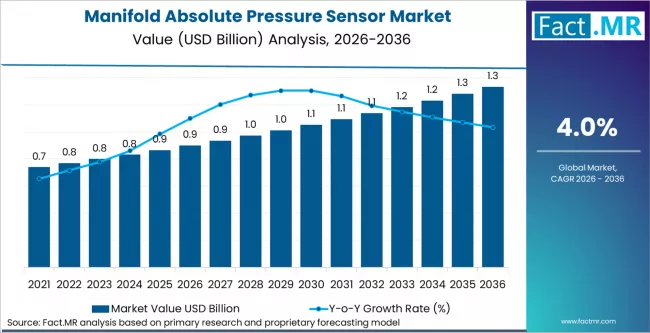
Manifold Absolute Pressure Sensor Market Market Value Analysis | Source: Fact.MR
| Metric | Value |
|---|---|
| Estimated Value in 2026 | USD 0.9 billion |
| Forecast Value in 2036 | USD 1.3 billion |
| Forecast CAGR (2026 to 2036) | 4.0% |
Source: Fact.MR analysis. Updated Mar 3, 2026
Market Definition
The manifold absolute pressure sensor market covers electronic pressure-sensing components installed in vehicle intake manifolds to measure absolute air pressure for engine control unit fuel injection and ignition timing calculations.
Market Inclusions
Global and regional revenue forecasts (2026-2036) by vehicle type and product type. Covers OEM supply and aftermarket replacement across passenger cars, LCVs, and HCVs. Includes average unit pricing by bar rating, emission standard compliance adoption timelines, turbocharger penetration analysis, and aftermarket fleet size estimates by region.
Market Exclusions
Excludes mass airflow (MAF) sensors, barometric pressure sensors used outside intake manifold applications, and boost pressure sensors serving motorsport or non-road machinery unless integrated in automotive engine management. It excludes standalone pressure sensor ICs used in industrial HVAC or aerospace applications.
Research Methodology
- Primary Research: Interviews were conducted with automotive Tier 1 sensor engineers, OEM engine management procurement specialists, aftermarket parts distributors, and emission compliance consultants across Asia Pacific, Europe, and North America.
- Desk Research: Sources included national emissions regulatory databases, BS VI and Euro 7 technical documentation, OEM annual reports, turbocharger adoption statistics from vehicle production databases, and national automotive association publications.
- Market Sizing and Forecasting: A hybrid model combined top-down vehicle production volume estimates by segment and region with bottom-up average MAP sensor unit pricing by bar rating, incorporating turbocharger adoption curves and aftermarket fleet size estimates from primary interviews.
- Data Validation and Update Cycle; Outputs were validated against OEM sensor supply disclosures, Tier 1 supplier revenue filings, emission regulation implementation records, and vehicle registration statistics. Forecasts are reviewed annually.
Summary
- Market Definition
- Manifold absolute pressure sensors are precision engine management components measuring intake air pressure to enable accurate fuel injection and ignition timing across naturally aspirated and turbocharged ICE and hybrid vehicle powertrains globally.
- Demand Drivers
- India's BS VI Phase 2 OBD enforcement from April 2024 mandates real-driving emissions compliance requiring accurate MAP sensor data for engine ECU fuel management across all new passenger car and commercial vehicle type approvals.
- Expanding turbocharged engine fitment in economy and mid-sized passenger cars across China and India is driving 2 Bar and 3 Bar MAP sensor adoption to replace legacy 1 Bar naturally aspirated configurations at higher per-unit values.
- A large and growing global active ICE vehicle fleet estimated at over 1.4 billion vehicles sustains structured aftermarket MAP sensor replacement demand as original components fail beyond 100,000-kilometre service thresholds.
- Key Segments Analyzed
- By Vehicle Type: Passenger Cars lead with 42% share, reflecting the highest global production volumes and the broadest emission compliance exposure that ties MAP sensor specification to OEM engine management certification requirements.
- By Product Type: 1 Bar sensors hold 44.2% share as the standard for naturally aspirated engine fitment across economy passenger cars, though 2 Bar and 3 Bar variants are growing fastest with turbocharger adoption in emerging markets.
- By Geography: Asia Pacific leads volume growth, with China at 5.8% and India at 5.3% CAGR, driven by the region's concentration of ICE and hybrid vehicle manufacturing and emission standard-driven sensor upgrade requirements.
- Analyst Opinion at FACT.MR
- Shambhu Nath Jha, Principal Consultant at Fact.MR, opines, 'CXOs will find this report essential for navigating the dual pressure of BEV substitution in mature OEM channels and sustained MAP sensor volume expansion in high-growth Asian and Latin American ICE markets, where turbocharger adoption is elevating per-unit sensor values even as economy-segment competition intensifies.'
- Strategic Implications
- MAP sensor manufacturers should expand 2 Bar and 3 Bar product lines targeting economy-segment turbocharged OEM programmes in China and India. Turbocharger adoption is moving down-market rapidly and premium bar-rated sensors command meaningfully higher per-unit revenue than standard 1 Bar equivalents.
- Aftermarket distributors should deepen regional coverage in Brazil, India, and Southeast Asia. Large and growing ICE vehicle fleets in these markets are generating structured replacement demand that is largely insulated from near-term BEV substitution risk through the 2036 forecast horizon.
- OEM suppliers should pursue technical co-development partnerships with hybrid platform programme teams at Toyota, Hyundai, and domestic Chinese OEMs. Hybrid powertrains retain MAP sensors with tighter performance specifications, and early design-in wins carry multi-platform lifecycle revenue.
- Methodology
- Market sizing combined vehicle production volume forecasts by segment and region with average MAP sensor unit pricing by bar rating, validated through Tier 1 supplier revenue disclosures and OEM fitment rate data.
- Turbocharger adoption curves and emission regulation implementation timelines were benchmarked against BS VI, Euro 7, PROCONVE Phase 8, and China 6b regulatory documentation published in 2024 and 2025.
- Regional forecasts incorporated national vehicle production statistics, aftermarket fleet size estimates, emission compliance programme enforcement records, and primary interviews with Tier 1 sensor manufacturers and aftermarket distributors.
Segmental Analysis
Manifold Absolute Pressure Sensor Market Analysis by Vehicle Type
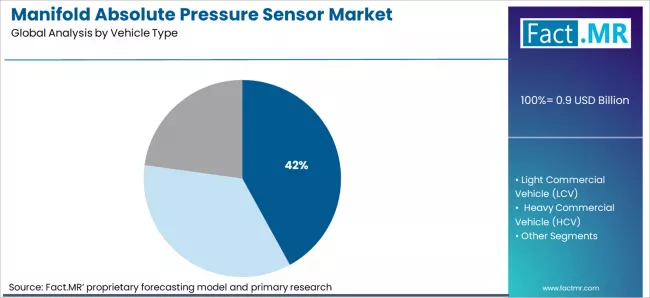
Manifold Absolute Pressure Sensor Market Analysis By Vehicle Type | Source: Fact.MR
Based on FACT.MR's manifold absolute pressure sensor market report, Passenger Cars are estimated to hold 42% share in 2026. Passenger cars lead due to the highest global production volumes, broad emission compliance mandates, and strong aftermarket replacement frequency driven by higher mileage cycles.
- Denso MAP Sensor Production Expansion: In its FY2024 Annual Report, Denso Corporation confirmed continued MAP sensor supply for Toyota and Honda hybrid platforms including Corolla Hybrid and CR V Hybrid, supporting its Sensing and Semiconductor division revenue growth. [1]
- Bosch MAP Sensor for Euro 7 Compliance: In January 2025, Robert Bosch GmbH disclosed next generation MAP sensors with enhanced temperature compensation for Euro 7 engine systems and confirmed OEM qualification testing for 2025 approvals. [2]
- LCV Turbocharged Engine Fitment Trend: In 2024, ACEA reported turbocharged engine fitment in European LCVs exceeded 95%, sustaining 2 Bar and 3 Bar MAP sensor demand with premium pricing versus 1 Bar units. [3]
Manifold Absolute Pressure Sensor Market Analysis by Product Type
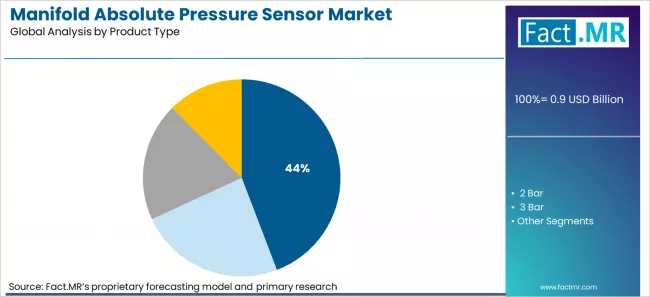
Manifold Absolute Pressure Sensor Market Analysis By Product Type | Source: Fact.MR
Based on FACT.MR's manifold absolute pressure sensor market report, 1 Bar sensors are estimated to hold 44.2% share in 2026. They dominate as standard specification for naturally aspirated engines, widely used in high volume economy segment vehicles across Asia and Latin America.
- NXP MPXH6115A MAP Sensor Design Win: In 2024, NXP Semiconductors confirmed continued production of its MPXH6115A 1 Bar MAP sensor for Asian Tier 1 suppliers serving BS VI compliant passenger car programmes. [4]
- Sensata 3 Bar Turbocharged Sensor Launch: In early 2025, Sensata Technologies launched its PT200 3 Bar MAP sensor for high boost gasoline engines, targeting compact TMAP integration for European and Chinese OEMs. [5]
- 4 Bar HCV Diesel Engine Adoption: In 2024, Continental AG confirmed supply of 4 Bar MAP sensors to HCV OEMs for Euro VI and EPA compliant diesel engines with higher turbo pressure requirements. [6]
Drivers, Restraints, and Opportunities
FACT.MR analysts observe that the MAP sensor market remains tied to global ICE and hybrid production, with demand driven by vehicle output, turbo adoption, and aftermarket cycles rather than disruptive innovation.
- BS VI Phase 2 and China 6b Mandating Precision Engine Management: India’s BS VI Phase 2 and China 6b standards require tighter real driving emission control, increasing MAP sensor performance specifications across new vehicles. [7]
- Turbocharger Penetration Driving Bar Rating Upgrade: In 2024, ACEA reported European turbo penetration above 85%, while India approached 60%, lifting demand for higher bar MAP sensors.
- Large Aftermarket Fleet Sustaining Replacement Demand: The global ICE and hybrid fleet exceeded 1.4 billion units in 2024 per IEA data, sustaining organised aftermarket MAP sensor demand in Asia and Latin America.
Regional Analysis
The manifold absolute pressure sensor market is analysed across Asia Pacific, Europe, North America, Latin America, and Middle East and Africa, spanning over 40 countries with distinct vehicle production, emission regulation, and aftermarket fleet profiles. The full report offers market attractiveness analysis based on regulatory mandate timelines, turbocharger adoption rates, and aftermarket fleet size by region.
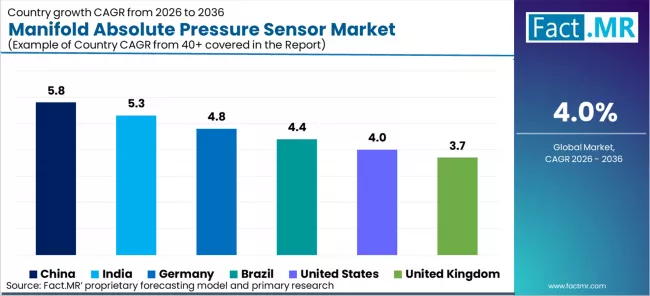
Manifold Absolute Pressure Sensor Market Cagr Analysis By Country | Source: Fact.MR
| Country | CAGR (2026-2036) |
|---|---|
| China | 5.8% |
| India | 5.3% |
| Germany | 4.8% |
| Brazil | 4.4% |
| United States | 4.0% |
| United Kingdom | 3.7% |
Source: Fact.MR analysis. Updated Mar 3, 2026
Source: Fact.MR (FACT.MR) analysis, based on proprietary forecasting model and primary research
Asia Pacific Manifold Absolute Pressure Sensor Market Analysis
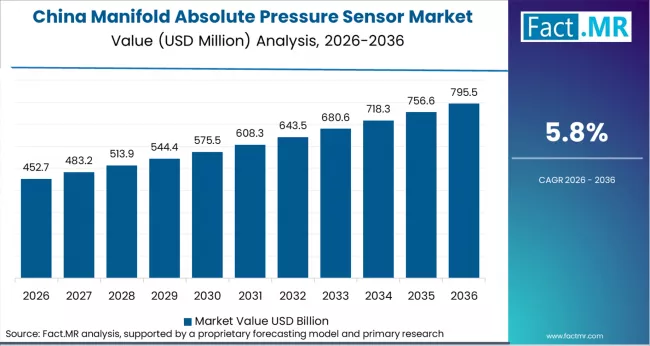
Manifold Absolute Pressure Sensor Market Country Value Analysis | Source: Fact.MR
Asia Pacific is the volume production epicenter for MAP sensors, led by China's scale and India's rapidly accelerating emission-driven upgrade cycle. The region hosts the world's largest automotive OEM production base alongside the fastest-growing aftermarket fleet. Denso Corporation, NXP Semiconductors, and domestic Chinese sensor suppliers compete for design wins across OEM programmes ranging from economy naturally aspirated to turbocharged mid-sized platforms.
- China: China’s MAP sensor market is expected to expand at a steady 5.8% annual rate through 2036. China 6b standards, enforced since July 2023, require precise real driving emission control across ICE and hybrid vehicles, sustaining OEM procurement. In January 2025, SAIC Motor confirmed expanded domestic sensor sourcing for turbocharged platforms. Calterah and Hebei Sinostar Electronics reported 2024 MEMS pressure sensor capacity expansion targeting 2 Bar and 3 Bar segments.
- India: India is forecast to witness 5.3% yearly growth in MAP sensor demand through 2036. BS VI Phase 2 norms from April 2024 mandate calibrated MAP sensor fitment across all vehicle categories. Maruti Suzuki upgraded engine management systems on Swift and Baleno in October 2024. Continental AG confirmed multi year supply contracts with four Indian OEMs.
FACT.MR's Asia Pacific analysis covers China, Japan, South Korea, India, Australia and New Zealand, ASEAN, and Rest of Asia Pacific. Readers can find emission regulation adoption timelines, turbocharger penetration by vehicle segment, OEM sensor procurement trends, and country-level CAGR projections by product type.
Europe Manifold Absolute Pressure Sensor Market Analysis
Europe remains a regulatory led market where Euro 7 preparation and hybrid platforms sustain MAP sensor demand despite BEV growth. Germany anchors OEM and Tier 1 supply.
- Germany: Germany’s MAP sensor demand is projected to record a 4.8% compound annual increase through 2036. Euro 7 enforcement from 2025 requires upgraded temperature compensation and accuracy. Volkswagen updated TMAP specifications for MEB+ hybrid platforms in March 2025. Bosch confirmed continued hybrid programme sensor revenue in FY2024.
- United Kingdom: The UK market is anticipated to grow at an average pace of 3.7% per year through 2036. Post Brexit alignment with Euro 6d sustains OEM and aftermarket demand. Jaguar Land Rover upgraded Defender PHEV sensor specifications in 2025. A fleet exceeding 39 million vehicles supports strong replacement demand.
FACT.MR's European analysis covers Germany, France, the United Kingdom, Italy, Spain, the Netherlands, the Nordics, and Rest of Europe. Readers can find Euro 7 compliance impact on sensor specifications, hybrid OEM platform adoption, aftermarket fleet size benchmarks, and country-level CAGR projections by vehicle type.
North America Manifold Absolute Pressure Sensor Market Analysis
North America is a large, mature MAP sensor market anchored by a substantial active ICE and light truck fleet and sustained turbocharged engine fitment across Ford, GM, and Stellantis light truck and SUV programmes.
- United States: U.S. MAP sensor demand is set to rise at 4.0% annually through 2036. Revised 2024 CAFE standards sustain turbocharged ICE and hybrid investment. TE Connectivity confirmed multiyear supply contracts for 2025 to 2027 platforms. An active fleet above 280 million vehicles underpins aftermarket growth.
FACT.MR's North American analysis covers the United States, Canada, and Mexico. Readers can find CAFE standard impacts on engine management sensor demand, turbocharged engine fitment rates by vehicle segment, aftermarket fleet replacement benchmarks, and country-level CAGR projections.
Latin America Manifold Absolute Pressure Sensor Market Analysis
Latin America is an emerging growth region for MAP sensors led by Brazil's PROCONVE Phase 8 emission programme and sustained ICE vehicle production across major OEM assembly plants.
- Brazil: Brazil is poised to expand at a 4.4% CAGR through 2036 in MAP sensor demand. PROCONVE Phase 8 mandates higher fuel injection precision across new approvals. Volkswagen do Brasil upgraded 1.0 TSI platforms in 2024 with 2 Bar sensors. ANFAVEA reported over 2.4 million vehicles produced with turbo fitment nearing 70%.
FACT.MR's Latin American analysis covers Brazil, Chile, Ecuador, and Rest of Latin America. Readers can find PROCONVE Phase 8 enforcement timelines, turbocharged engine adoption rates, OEM compliance investment profiles, and country-level CAGR projections by product type.
Competitive Aligners for Market Players
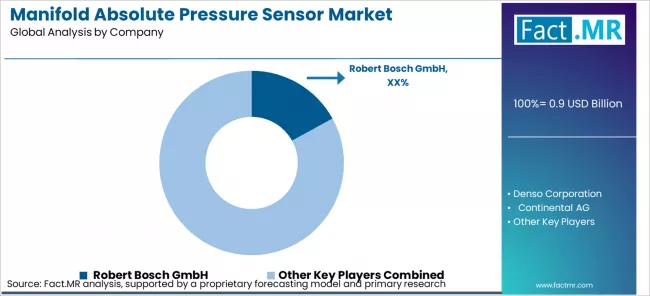
Manifold Absolute Pressure Sensor Market Analysis By Company | Source: Fact.MR
The global manifold absolute pressure sensor market is moderately concentrated at the Tier 1 level, led by Robert Bosch GmbH, Continental AG, Denso Corporation, and Sensata Technologies, which together account for most OEM revenue. Competition centres on technical certification depth, including compliance with engine management calibration, emission accuracy standards, and thermal compensation capability. These factors create OEM specification lock in and pricing stability. Margin pressure in 1 Bar standard sensors is balanced by stronger profitability in 3 Bar and 4 Bar turbocharged variants where performance requirements are higher.
Structural advantages favour suppliers with in house MEMS chip design, early stage OEM co development partnerships, and proven regulatory compliance history. Bosch benefits from vertically integrated MEMS to module production. NXP Semiconductors and Infineon Technologies compete at the chipset layer, supplying pressure ICs to Tier 1 integrators. Hitachi Automotive Systems and TE Connectivity maintain regional OEM strength through long term platform contracts.
OEM procurement is tied to four to six-year platform cycles, with specifications fixed at design freeze. Dual sourcing reduces dependency, but long qualification timelines limit supplier switching. Aftermarket pricing remains more competitive, particularly in standard sensor categories.
Recent Developments
- In January 2025, Robert Bosch GmbH disclosed availability of its next-generation TMAP sensor module combining temperature and manifold absolute pressure measurement for Euro 7-compliant passenger car engine management systems, with OEM qualification testing confirmed at European passenger car customers.
- In September 2024, Sensata Technologies announced commercial launch of its PT200 series 3 Bar MAP sensor for high-boost turbocharged GDI engine applications, confirming initial design wins at European and Chinese OEM Tier 1 customers.
Key Players
- Robert Bosch GmbH
- Denso Corporation
- Continental AG
- BorgWarner Inc.
- NXP Semiconductors N.V.
- TE Connectivity
- Hitachi Automotive Systems, Ltd.
- Sensata Technologies
- Infineon Technologies AG
Bibliography
- [1] Denso Corporation. (2024). FY2024 Annual Report: Sensing and Semiconductor Division Engine Management Sensor Revenue and MAP Sensor Supply Overview. Denso Investor Relations. June 2024.
- [2] Robert Bosch GmbH. (2025). Press Release: Next-Generation TMAP Sensor Module for Euro 7 Engine Management Systems OEM Qualification Announcement. Bosch Media. January 2025.
- [3] European Automobile Manufacturers' Association (ACEA). (2024). European Vehicle Market Statistics Pocketbook 2024: Turbocharged Engine Fitment Rates in Passenger Cars and LCVs. ACEA Publications. October 2024.
- [4] NXP Semiconductors N.V. (2024). MPXH6115A MAP Sensor Product Page and Design Win Announcement: Asia Pacific Economy-Segment OEM Applications. NXP Automotive Sensor Division. August 2024.
- [5] Sensata Technologies. (2025). Press Release: PT200 Series 3 Bar MAP Sensor Commercial Launch for Turbocharged GDI Engine Applications. Sensata Investor Relations. January 2025.
- [6] Continental AG. (2024). FY2024 Investor Update: 4 Bar MAP Sensor Volume Supply Ramp for Euro VI HCV OEM Programmes. Continental Investor Relations. November 2024.
- [7] Ministry of Ecology and Environment, People's Republic of China. (2023). GB18352.6 China 6b Emission Standard Enforcement Guidance. July 2023.
- [8] Automotive Research Association of India / Ministry of Road Transport and Highways. (2024). BS VI Phase 2 OBD Implementation Compliance Circular. April 2024.
- [9] International Energy Agency. (2024). Global EV Outlook 2024: Global Vehicle Fleet Stock and ICE Vehicle Registration Statistics. IEA Publications. April 2024.
This Report Addresses
- Strategic intelligence on BS VI Phase 2 OBD enforcement, China 6b MAP sensor specification upgrades, Euro 7 TMAP integration requirements, NHTSA CAFE standard impacts, and PROCONVE Phase 8 emission compliance sensor procurement.
- Market forecast from USD 0.9 billion in 2026 to USD 1.3 billion by 2036 at a 4.0% CAGR, segmented by vehicle type, product type, and region.
- Growth opportunity mapping across 2 Bar and 3 Bar turbocharged engine adoption in Asia Pacific, hybrid platform MAP sensor specification upgrades, and aftermarket replacement demand from large ICE fleet markets.
- Country CAGR outlook: China (5.8%), India (5.3%), Germany (4.8%), Brazil (4.4%), United States (4.0%), and United Kingdom (3.7%) with detailed segment splits by vehicle type and bar rating.
- Competitive analysis of Bosch, Denso, Continental, NXP, Sensata, TE Connectivity, and Hitachi covering OEM specification positioning, turbocharger segment strategies, MEMS chipset integration capability, and aftermarket channel depth.
- Product and technology tracking including 3 Bar and 4 Bar turbocharged sensor lines, TMAP combined temperature-pressure modules, MEMS pressure chipset advances, and Euro 7 temperature compensation upgrades.
- Regulatory impact analysis covering China 6b, Euro 7, BS VI Phase 2 OBD, NHTSA CAFE standards (2024 revision), and PROCONVE Phase 8 and their direct implications for OEM and aftermarket MAP sensor procurement.
- Report delivered in Excel datasets, PowerPoint summary, and detailed PDF supported by verified regulatory records, OEM disclosures, and Tier 1 supplier filings.
Segmentation
Scope of Report
| Items | Values |
|---|---|
| Quantitative Units | USD 0.9 billion (2026) to USD 1.3 billion (2036), at a CAGR of 4.0% |
| Market Definition | Manifold absolute pressure sensors are electronic devices that measure intake manifold air pressure to support ECU fuel injection and ignition timing control in naturally aspirated and turbocharged ICE and hybrid vehicles, across 1 Bar to 4 Bar ratings. |
| Vehicle Type Segmentation | Passenger Car, Light Commercial Vehicle (LCV), Heavy Commercial Vehicle (HCV) |
| Product Type Segmentation | 1 Bar, 2 Bar, 3 Bar, 4 Bar |
| Application Coverage | OEM passenger car engine management, turbocharged LCV emission compliance, HCV high-boost diesel engine management, hybrid vehicle fuel injection precision, aftermarket ICE fleet replacement. |
| Regions Covered | Asia Pacific, Europe, North America, Latin America, Middle East and Africa |
| Countries Covered | China, Japan, South Korea, India, Australia and New Zealand, ASEAN, Rest of Asia Pacific, Germany, United Kingdom, France, Italy, Spain, Netherlands, Nordics, Rest of Europe, United States, Canada, Mexico, Brazil, Chile, Ecuador, Rest of Latin America, Kingdom of Saudi Arabia, United Arab Emirates, South Africa, Turkey, Rest of Middle East and Africa |
| Key Companies Profiled | Robert Bosch GmbH, Denso Corporation, Continental AG, BorgWarner Inc., NXP Semiconductors N.V., TE Connectivity, Hitachi Automotive Systems Ltd., Sensata Technologies, Infineon Technologies AG |
| Forecast Period | 2026 to 2036 |
| Approach | A hybrid top down and bottom up model was used, combining vehicle production forecasts, emission timelines, and turbo adoption rates with MAP sensor pricing by bar rating, OEM fitment levels, aftermarket cycles, and supplier interviews. |
Source: Fact.MR analysis. Updated Mar 3, 2026
Manifold Absolute Pressure Sensor Market by Segment
-
By Vehicle Type
- Passenger Car
- Light Commercial Vehicle (LCV)
- Heavy Commercial Vehicle (HCV)
-
By Product Type
- 1 Bar
- 2 Bar
- 3 Bar
- 4 Bar
-
By Region
- North America
- United States
- Canada
- Mexico
- Europe
- Germany
- United Kingdom
- France
- Italy
- Spain
- Netherlands
- Nordics
- Rest of Europe
- Asia Pacific
- China
- Japan
- South Korea
- India
- Australia and New Zealand
- ASEAN
- Rest of Asia Pacific
- Latin America
- Brazil
- Chile
- Ecuador
- Rest of Latin America
- Middle East and Africa
- Kingdom of Saudi Arabia
- United Arab Emirates
- South Africa
- Turkey
- Rest of Middle East and Africa
- North America
Frequently Asked Questions
How large is the manifold absolute pressure sensor market in 2025?
What will the market size be in 2026?
What is the projected market size by 2036?
What is the expected CAGR for the forecast period 2026 to 2036?
Which vehicle type segment holds the leading share?
Which product type segment commands the largest share?
Which country is projected to grow the fastest?
What is the expected growth rate for India?
What is the forecast CAGR for Germany's manifold absolute pressure sensor market?
How is the manifold absolute pressure sensor market in the United States expected to grow?
Who worked on this report


Preview the report firsthand - request a free sample
Free SampleGet the brochure for pricing and purchase details
Download PDF