- Market Value (2025): USD 294.9 Mn
- Estimated Value (2026): USD 345.0 Mn
- Forecast Value (2036): USD 1658.0 Mn
- CAGR (2026-2036): 17.0%
What is the Marine Biodegradable Films Market forecast to be worth by 2036?
USD 345.0 million in 2026 to USD 1658.0 million by 2036, at 17.0% CAGR.
- The marine biodegradable films market crossed a valuation of USD 294.9 million in 2025.
- Demand is projected to increase from USD 345.0 million in 2026 to USD 1658.0 million by 2036.
- The market is forecast to record a 17.0% CAGR from 2026 to 2036 as shipyards, harbor fleets and vessel owners test films for anti-fouling and marine-waste reduction.
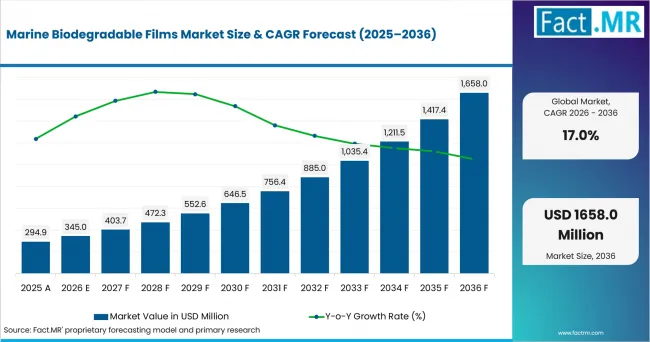
Marine Biodegradable Films Market Value Analysis | Source: Fact.MR
What are the defining numbers behind Marine Biodegradable Films Market growth?
USD 1313.0 million absolute opportunity by 2036, led by bio-polyesters, hull applications and commercial vessels.
- Demand Drivers in the Market
- Vessel owners need removable surface films that protect coated areas while reducing persistent plastic fragments during cleaning and refit work.
- Port-service teams are giving closer attention to residue capture. In April 2025, the International Maritime Organization approved guidance on in-water cleaning of ship biofouling.
- Marine debris programs keep plastic leakage visible near ports. On September 17, 2025, the NOAA Marine Debris Program announced 13 fiscal-year 2025 projects representing over USD 26.4 million in federal funding for marine debris removal.
- Polymer converters need film grades that process cleanly across extrusion, lamination and coating lines used for flexible protective materials.
- Key Segments Analyzed
- By Material: Bio-polyesters are expected to hold 36.0% share in 2026, supported by established conversion knowledge and a wider film-grade material base.
- By Vessel Area: Hull is projected to account for 41.0% share in 2026 because underwater surfaces face regular cleaning and biofouling exposure.
- By Function: Anti-fouling is anticipated to capture 44.0% share in 2026, driven by vessel-surface cleaning and drag-control needs.
- By Vessel Type: Commercial vessels are estimated to represent 38.0% share in 2026 owing to recurring maintenance schedules and clearer procurement documentation.
- Analyst Opinion at Fact.MR
- Shambhu Nath Jha, Principal Consultant at Fact.MR, states, "Marine biodegradable films are moving through a proof stage, where simple substitution claims carry little weight. The market is expected to widen as film makers connect seawater behavior with adhesion, abrasion and anti-fouling performance. Suppliers that combine test documentation with installer-friendly formats are expected to gain preference with shipyards and fleet maintenance teams."
- Strategic Implications
- Film converters should document seawater behavior, peel quality and residue control in one technical pack for shipyard review.
- Polymer producers should align PLA, PHA and bio-polyester grades with saltwater exposure tests before broad vessel promotion.
- Shipyards should trial films during scheduled dry-dock work so operators can compare installation time with coating alternatives.
- Testing partners should reference ISO 20679:2025 when assessing ship biofouling in-water cleaning systems because the standard specifies procedures for independent performance testing, including cleaning efficacy, safety, and debris capture and disposal.
South Korea is projected to record 18.2% CAGR through 2036, supported by port throughput and local PHA production. Germany is expected to post 17.6% CAGR as seaport cargo and European validation needs support substitution trials. The UK is anticipated to reach 15.3% CAGR through maritime decarbonisation policy and port maintenance needs. The USA is estimated to advance at 13.5% CAGR as marine economy activity sustains retrofit demand. Japan is forecast to reach 12.4% CAGR through container-port throughput and local seawater-biodegradable polymer expertise.
How does the Marine Biodegradable Films Market break down by segment?
Bio-polyesters lead Material at 36.0%; Hull leads Vessel Area at 41.0%.
Which Material dominates?
Bio-polyesters are expected to hold 36.0% share in 2026.
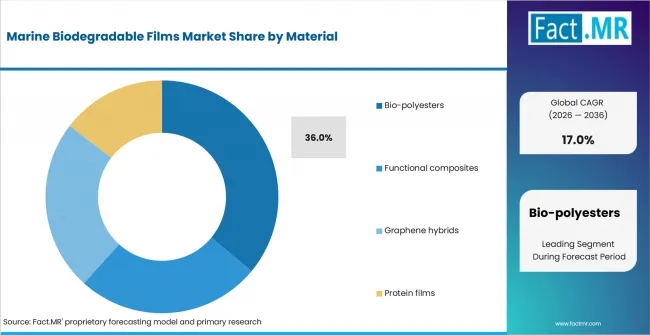
Marine Biodegradable Films Market Analysis By Material | Source: Fact.MR
Bio-polyesters lead because film makers can process them into flexible sheets with familiar gauges and sealing behavior. Their position is reinforced by adjacent biopolymer films supply chains that already serve flexible and specialty film applications.
Conversion skill is central to this segment. Film suppliers need to balance stiffness, clarity and degradation behavior so the protective layer handles marine use without becoming brittle.
What leads the Vessel Area segment?
Hull is projected to account for 41.0% share in 2026.
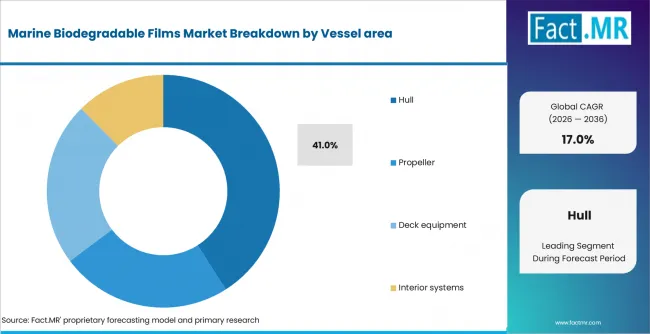
Marine Biodegradable Films Market Analysis By Vessel Area | Source: Fact.MR
Hull applications lead because the hull carries direct seawater exposure and cleaning pressure. Bio anti-fouling polymers demand shows why operators already compare surface systems through fuel use, cleaning time and residue behavior.
How does Function shape demand?
Anti-fouling is anticipated to capture 44.0% share in 2026.
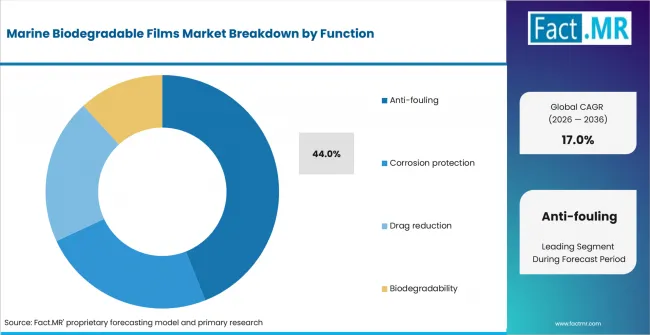
Marine Biodegradable Films Market Analysis By Function | Source: Fact.MR
Anti-fouling applications lead because clean surfaces affect drag, route reliability and maintenance timing. This performance angle links the market with marine biodegradable polymers where end-of-life proof carries weight in coastal environments.
Film makers are expected to compete on adhesion, release behavior and removal quality. Claims in this segment need marine exposure data and cleaning-cycle records that purchasing teams can review.
What supports Vessel Type demand?
Commercial vessels are estimated to represent 38.0% share in 2026.
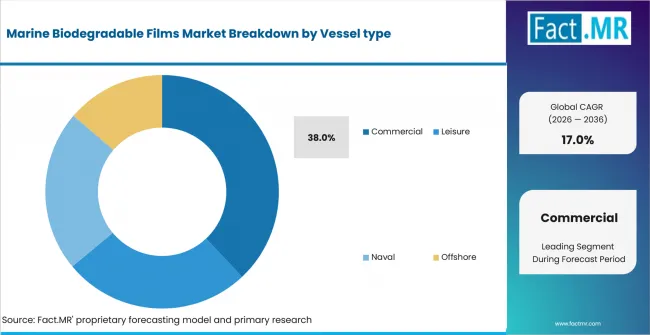
Marine Biodegradable Films Market Analysis By Vessel Type | Source: Fact.MR
Commercial vessels lead because fleet managers schedule recurring maintenance and measure downtime closely. Films that reduce cleaning residue can be compared against dry-dock time, coating compatibility and operating routes.
UNCTAD reported on September 24, 2025 that maritime trade grew 2.2% in 2024 and was expected to slow to 0.5% in 2025 before averaging 2% annually over 2026-2030.
What is accelerating Marine Biodegradable Films Market adoption, and what is holding it back?
Demand is expected to rise through hull protection, biofouling management and port waste pressure. Growth is constrained by testing burden, cost and installer caution.
Drivers Impact Analysis
| DRIVER | (~) % IMPACT ON CAGR | GEOGRAPHIC RELEVANCE | IMPACT TIMELINE |
|---|---|---|---|
| Biofouling and hull-cleaning pressure | +2.8% | Global commercial fleets | Short term (<= 2 years) |
| Marine debris reduction and port waste pressure | +2.1% | North America, Europe, East Asia | Medium term (2-4 years) |
| Biopolyester film conversion capability | +1.6% | Europe, Japan, South Korea | Medium term (2-4 years) |
| Port throughput and dry-dock maintenance cycles | +1.3% | USA, UK, Germany, South Korea | Short term (<= 2 years) |
Source: Fact.MR analysis. Updated Aug 27, 2026
- Biofouling and hull-cleaning pressure: Vessel operators are expected to compare biodegradable films with coatings where surface cleaning creates residue and coating-damage concerns.
- Marine debris reduction and port waste pressure: Port authorities and coastal operators are expected to favor materials that reduce persistent fragments during vessel maintenance.
- Biopolyester film conversion capability: Converters with extrusion and lamination know-how can tailor gauges for hull, propeller and deck-equipment use.
Opportunity Impact Analysis
| OPPORTUNITY | (~) % IMPACT ON CAGR | GEOGRAPHIC RELEVANCE | IMPACT TIMELINE |
|---|---|---|---|
| Anti-fouling sacrificial films for hulls | +1.9% | Global | Medium term (2-4 years) |
| PHA and PLA blends for marine-safe films | +1.2% | Japan, South Korea, Europe | Long term (>= 4 years) |
| Barrier films for offshore and deck equipment | +0.9% | North America, Europe | Short term (<= 2 years) |
Source: Fact.MR analysis. Updated Aug 27, 2026
- Anti-fouling sacrificial films: Shipyards can use controlled trials to compare surface cleanliness and removal waste against standard coating routines.
- PHA and PLA blends: Compounders are expected to gain interest where marine-film developers need both handling strength and credible degradation records.
- Barrier films for offshore equipment: Compostable laminate packaging know-how can help developers build multilayer structures for temporary marine protection.
Restraints Impact Analysis
| RESTRAINT | (~) % IMPACT ON CAGR | GEOGRAPHIC RELEVANCE | IMPACT TIMELINE |
|---|---|---|---|
| Certification and seawater testing burden | -0.9% | Global | Medium term (2-4 years) |
| Higher cost than conventional films | -0.7% | Global | Short term (<= 2 years) |
| Installer caution during hull maintenance | -0.5% | Commercial fleets | Medium term (2-4 years) |
Source: Fact.MR analysis. Updated Aug 27, 2026
- Certification and seawater testing burden: Shipyards require records that separate compostability claims from marine exposure behavior.
- Higher cost than conventional films: Procurement teams need clear maintenance savings before approving premium biodegradable materials for wider fleet use.
- Installer caution during hull maintenance: Approval is expected to move gradually until application time and removal quality match existing dry-dock routines.
Which countries are scaling the Marine Biodegradable Films Market through 2036?
- The country comparison spans 5.8 percentage points between South Korea and Japan across the forecast period.
- South Korea remains 0.6 percentage point above Germany through container-port scale and local PHA development.
- Germany remains 2.3 percentage points above the UK through seaport cargo recovery and strict European validation needs.
- The UK remains 1.8 percentage points above the USA through port freight activity and maritime decarburization programs.
- The USA remains 1.1 percentage points above Japan through a large marine economy and active vessel-maintenance base.
- Japan closes the displayed range through container throughput and seawater-biodegradable polymer know-how.
Comparable CAGRs create different entry conditions due to port mix, shipyard access, polymer supply and regulatory pressure. Full report coverage includes North America, Latin America, Western Europe, Eastern Europe, East Asia, South Asia & Pacific, Middle East & Africa.
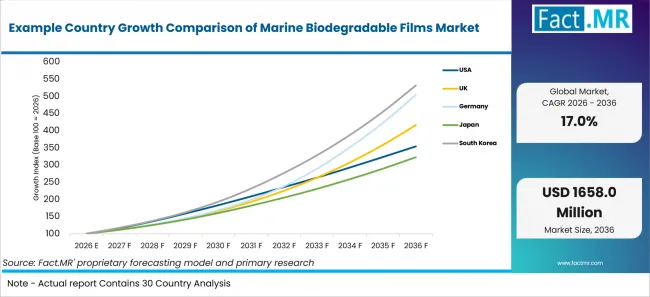
Example Country Growth Comparison Of Marine Biodegradable Films Market | Source: Fact.MR
| Country | CAGR (2026-2036) |
|---|---|
| South Korea | 18.2% |
| Germany | 17.6% |
| UK | 15.3% |
| USA | 13.5% |
| Japan | 12.4% |
Source: Fact.MR analysis. Updated Aug 27, 2026
What supports South Korea adoption?
18.2% CAGR, supported by port scale and domestic PHA capability.
South Korea is expected to benefit from a concentrated port base where film trials can reach ship-service contractors and container fleets. On January 29, 2026, the Ministry of Oceans and Fisheries reported that South Korean ports handled 32.11 million TEU of containers in 2025, up 1.2% year on year. CJ Biomaterials introduced its PHA extrusion-coating platform on October 1, 2025 for food-service and packaging applications.
What supports Germany adoption?
17.6% CAGR, led by seaport recovery and European validation needs.
Germany is anticipated to scale through seaports that combine freight activity with strict documentation habits. On March 10, 2026, Destatis reported that German seaports handled 284.4 million tonnes of goods in 2025, up 3.8% from 2024.
What supports the UK's growth?
15.3% CAGR, backed by port freight activity and maritime decarburization policy.
The UK is forecast to advance through freight ports, ferry links and cleaner maritime programs. On July 29, 2026, the Department for Transport reported that UK ports handled 428.3 million tonnes of freight in 2025.
What supports USA adoption?
13.5% CAGR, driven by marine economy scale and retrofit activity.
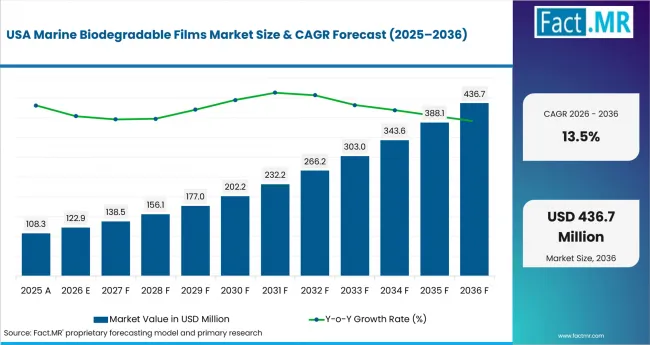
Marine Biodegradable Films Market Country Value Analysis | Source: Fact.MR
The USA is expected to gain from a broad marine economy that supports port services, ship repair and recreational vessel maintenance. On June 5, 2025, the Bureau of Economic Analysis reported that the U.S. marine economy accounted for USD 511.0 billion, or 1.8% of current-dollar U.S. GDP, in 2023.
How does Japan perform?
12.4% CAGR, led by container throughput and seawater-biodegradable polymer expertise.
Japan is estimated to grow through port activity and local polymer development that already addresses seawater behavior. On August 21, 2026, MLIT reported that Japanese ports handled a preliminary 22.36 million TEU of container cargo in 2025, up 1.8% year over year. Kaneka announced on May 20, 2025, that Green Planet™ had been adopted for pharmaceutical-packaging banding films and described the polymer as biodegradable in both soil and seawater, providing an adjacent example of seawater-biodegradable film material technology.
Who leads the Marine Biodegradable Films Market?
Aquapak Polymers reports independent Daphnia testing of Hydropol™ by OWS using the ASTM D6691 and OK Marine test protocol, providing a relevant marine-safety data point for water-soluble PVOH-based polymer technology. Kaneka’s Green Planet™ provides a biodegradable polymer platform with documented biodegradability in soil and seawater.
Competitive strength is expected to rest on proof of degradation behavior, film handling and surface-protection value. Bio marine composites and compostable PHA film activity show that marine users compare new materials through qualification steps before vessel-scale approval.
Which companies are the key providers?
Key companies include RWDC INDUSTRIES; Aquapak Polymers; Kaneka Corporation; CJ Biomaterials; and BLUEPHA.
- RWDC INDUSTRIES
- Aquapak Polymers
- Kaneka Corporation
- CJ Biomaterials
- BLUEPHA
Bibliography
- NOAA Marine Debris Program. (2025, September 17). The NOAA Marine Debris Program awards 13 new projects for funding to remove marine debris.
- International Organization for Standardization. (2025, January 10). ISO 20679:2025 ships and marine technology—Marine environment protection—Testing of ship biofouling in-water cleaning systems.
- UN Trade and Development. (2025, September 24). Review of Maritime Transport 2025: Staying the course in turbulent waters.
- Federal Statistical Office (Destatis). (2026, March 10). Seeverkehr 2025: Güterumschlag steigt um 3,8 % gegenüber dem Vorjahr [Sea transport 2025: Goods handling rises by 3.8% year on year].
- Department for Transport. (2026, July 29). Port freight annual statistics: 2025. GOV.UK.
- U.S. Bureau of Economic Analysis. (2025, June 5). Marine Economy Satellite Account, 2023.
- Kaneka Corporation. (2025, May 20). KANEKA Biodegradable Polymer Green Planet™ adopted in an industry first by Shionogi Pharma for pharmaceutical packaging banding films.
This Report Answers
- The report explains where marine biodegradable films are used across material, vessel area, function and vessel type.
- Segment analysis identifies the leading subsegments and the operating reasons vessel owners compare them with conventional film or coating systems.
- Country analysis examines the listed markets and the port, fleet and policy mechanisms supporting marine film adoption.
- Competitive analysis reviews current providers across compostable films, marine-safe polymers, PHA materials, PLA grades and biodegradable polymer portfolios.
- Application analysis assesses how anti-fouling performance, degradation proof and installation behavior influence supplier selection.
What does the Marine Biodegradable Films Market cover?
The Marine Biodegradable Films Market covers film materials used to protect, wrap or modify vessel surfaces while reducing persistent plastic residue. It includes bio-polyester, functional composite, graphene hybrid and protein film formats used on hulls, propellers, deck equipment and interior systems.
The assessment links marine film use with adjacent bioplastics, bioplastics for packaging and specialty surface-protection categories. Demand is assessed across anti-fouling, corrosion protection, drag reduction and biodegradability functions.
What is included in the scope?
The scope includes films sold for marine surface protection, temporary hull films, removable anti-fouling films, biodegradable wrapping for vessel areas and film structures validated for marine exposure. Related biodegradable sheets technologies are referenced where they inform material capability.
It includes material families such as PLA, PHA, bio-polyesters and composite film systems when the intended use is tied to vessel environments. Adjacent biodegradable packaging material knowledge is used only where film conversion or degradation testing has a clear link to marine use.
What is excluded from the scope?
The scope excludes conventional plastic wrapping, standard paints and coatings sold without a biodegradable film function. It also excludes packaging-only films where vessel, port or marine-equipment use is absent.
Raw polymer resin is excluded when it is sold without film conversion or without a marine-film use case. Anti-fouling coatings without a film layer are treated as adjacent competition outside the market boundary.
How Was the Analysis Built?
The analysis draws on 120+ sources, 35+ company portfolios, 25+ countries, and more than 20 industry interviews.
- Primary Research: Primary research includes discussions with manufacturers, service providers, technology developers, distributors, end users, procurement teams, and subject-matter experts. These conversations examine purchasing priorities, product adoption, operational challenges, approval requirements, competitive positioning, and the factors that influence wider market acceptance.
- Desk Research: Desk research covers government statistics, regulatory publications, company filings, trade data, technical studies, industry associations, standards, public policy, and other authoritative sources. Every source used in the analysis is documented in the bibliography.
- Market Sizing and Forecasting: Market estimates combine historical performance, demand indicators, pricing and volume trends, segment shares, company participation, country-level growth, adoption patterns, investment activity, and barriers to market expansion.
- Data Validation and Update Cycle: Findings are validated by comparing primary interviews with public data, company activity, regulatory changes, trade patterns, and industry developments. Regular updates review new product launches, capacity changes, partnerships, approvals, procurement trends, and shifts in commercial adoption.
Segmentation
What is the report's scope and coverage?
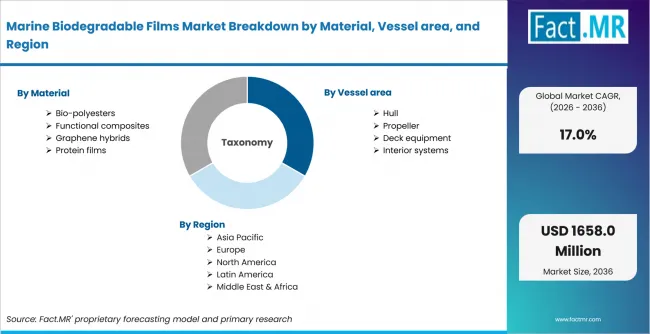
Marine Biodegradable Films Market Breakdown By Material, Vessel Area, And Region | Source: Fact.MR
| Attribute | Details |
|---|---|
| Quantitative Units | USD million |
| Market Definition | Films designed for marine use that provide protective, anti-fouling, corrosion-control or biodegradability functions while reducing persistent plastic residue in vessel environments. |
| Material | Bio-polyesters; Functional composites; Graphene hybrids; Protein films |
| Vessel Area | Hull; Propeller; Deck equipment; Interior systems |
| Function | Anti-fouling; Corrosion protection; Drag reduction; Biodegradability |
| Vessel Type | Commercial; Leisure; Naval; Offshore |
| Regions Covered | North America; Latin America; Western Europe; Eastern Europe; East Asia; South Asia & Pacific; Middle East & Africa |
| Countries Covered | United States; United Kingdom; Germany; Japan; South Korea |
| Key Companies Profiled | RWDC INDUSTRIES; Aquapak Polymers; Kaneka Corporation; CJ Biomaterials; BLUEPHA |
| Forecast Period | 2026 to 2036 |
| Approach | Hybrid top-down and bottom-up approach using marine film applications; vessel-area mix; function demand; country adoption; and provider portfolio review. |
Source: Fact.MR analysis. Updated Aug 27, 2026
How is the market segmented?
-
By Material:
- Bio-polyesters
- Functional composites
- Graphene hybrids
- Protein films
-
By Vessel Area:
- Hull
- Propeller
- Deck equipment
- Interior systems
-
By Function:
- Anti-fouling
- Corrosion protection
- Drag reduction
- Biodegradability
-
By Vessel Type:
- Commercial
- Leisure
- Naval
- Offshore
-
By Region:
- North America
- Latin America
- Western Europe
- Eastern Europe
- East Asia
- South Asia & Pacific
- Middle East & Africa
Frequently Asked Questions
How big is the marine biodegradable films market in 2026?
What is the CAGR of the marine biodegradable films market from 2026 to 2036?
Which material leads the marine biodegradable films market?
Which vessel area leads the marine biodegradable films market?
Who are the leading companies in the marine biodegradable films market?
Who worked on this report


Preview the report firsthand - request a free sample
Free SampleGet the brochure for pricing and purchase details
Download PDF