- Market Value (2025): USD 374.0 Mn
- Estimated Value (2026): USD 460 Mn
- Forecast Value (2036): USD 3646 Mn
- CAGR (2026-2036): 23.0%
What is the Marine Digital Twins Market forecast to be worth by 2036?
USD 460 million in 2026 to USD 3,646 million by 2036 at a 23.0% CAGR.
- The marine digital twins market reached USD 374.0 million in 2025.
- Demand is projected to increase from USD 460 million in 2026 to USD 3,646 million by 2036.
- The market is forecast to record 23.0% CAGR from 2026 to 2036 as fleet operators, shipyards and port authorities use live asset models for performance and risk control.
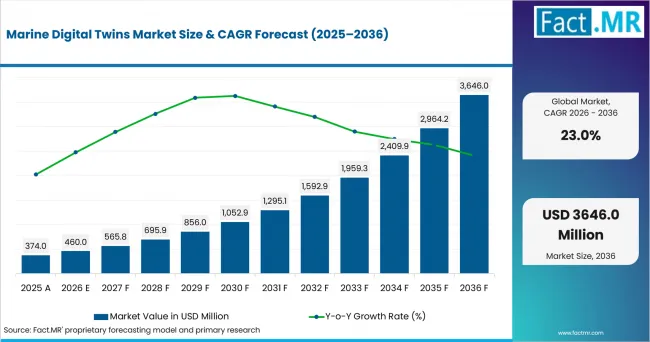
Marine Digital Twins Market Value Analysis | Source: Fact.MR
What are the defining numbers behind Marine Digital Twins Market growth?
An absolute opportunity of USD 3,186 million is expected between 2026 and 2036.
- Demand Drivers in the Market
- Vessel owners need operating twins that compare engine behavior with route plans because fuel use and maintenance windows are measured voyage by voyage.
- Port authorities need shared digital views of ships and terminals. Since 1 January 2024, IMO's FAL Convention has required public authorities to establish, maintain and use Maritime Single Window systems for the electronic exchange of information required on ships' arrival, stay and departure.
- Offshore operators need equipment twins for rotating machinery, weather exposure and inspection planning where crew visits are costly and uptime has direct revenue value.
- Key Segments Analyzed
- By Asset: Commercial vessels are projected to hold 26.0% share in 2026 owing to repeated voyages, large machinery datasets and clearer operating-cost payback.
- By Function: Performance optimization is anticipated to account for 51.0% share in 2026 because operators can link hull, engine and route behavior to voyage economics.
- By Deployment: Cloud is estimated to capture 42.0% share in 2026 as fleet teams need shared access across shore offices, vessels and service partners.
- By Data Source: Machinery IoT is forecast to represent 50.0% share in 2026 due to direct links between sensor streams, equipment condition and maintenance decisions.
- Analyst Opinion at Fact.MR
- Shambhu Nath Jha, Principal Consultant at Fact.MR, states, "Marine digital twins are drawing attention because the buyer is not purchasing a dashboard. The buyer is paying for a trusted vessel memory that links design intent with live equipment behavior. Suppliers are expected to win when they combine clean data models, class-aware workflows and proof that the twin improves decisions at sea."
- Strategic Implications
- Platform vendors should show how the twin carries data from design files into fleet operations without breaking the audit trail.
- Shipowners should begin with fuel, engine and maintenance use cases where savings are visible after each voyage cycle.
- Ports should connect berth, vessel-call and equipment data carefully because shared port twins depend on consistent event definitions.
- Classification partners should document model assumptions and update rules so operators know when a twin still reflects the physical asset.
The UK is projected to record 27.2% CAGR through smart-shipping funding and port modernization. The USA is expected to hold 24.0% CAGR as port data systems and commercial fleets generate large asset records. South Korea is anticipated to post 23.0% CAGR due to shipbuilding integration and record container throughput. Germany is estimated at 22.2% CAGR as sea and inland logistics support vessel-condition analytics. Japan is forecast to reach 16.8% CAGR as carbon-neutral port certification and Cyber Port digitization shape deployment.
How does the Marine Digital Twins Market break down by segment?
Performance optimization leads at 51.0%; machinery IoT leads at 50.0%.
Which Asset dominates?
Commercial vessels are expected to hold 26.0% share in 2026.
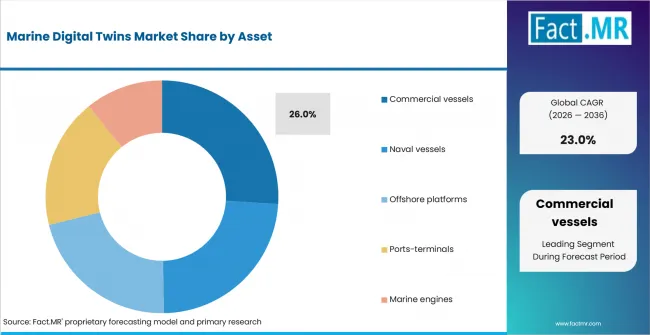
Marine Digital Twins Market Analysis By Asset | Source: Fact.MR
Commercial vessels lead the asset view because they create repeatable records across engines, routes and port calls. UNCTAD reported that by January 2025 the world fleet comprised about 112,500 vessels with 2.44 billion deadweight tons.
What leads the Function segment?
Performance optimization is projected to account for 51.0% share in 2026.
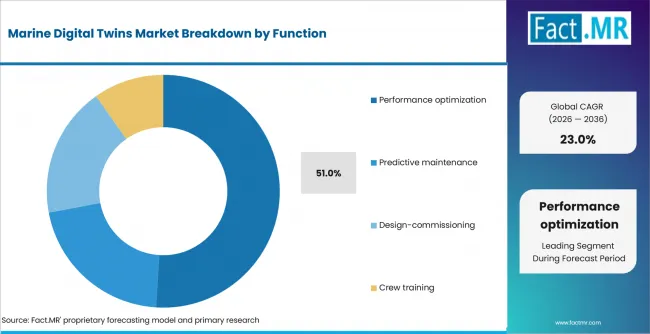
Marine Digital Twins Market Analysis By Function | Source: Fact.MR
Performance optimization leads because it turns live vessel data into decisions that operators can price. A twin can compare expected propulsion power with actual weather and machinery behavior. In a 25 February 2025 webinar, Wärtsilä described advanced digital twins and AI for vessel-performance analysis, including propulsion-power, fuel-consumption and voyage-efficiency applications.
How does Deployment shape demand?
Cloud is anticipated to capture 42.0% share in 2026.
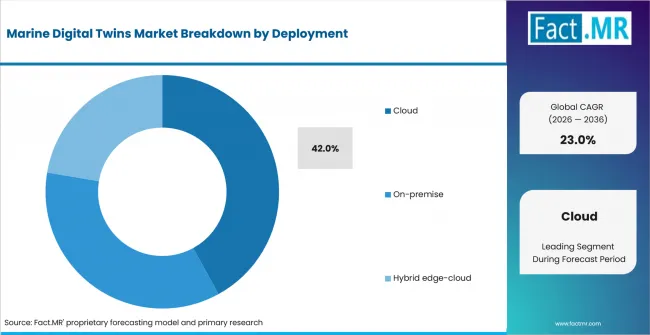
Marine Digital Twins Market Analysis By Deployment | Source: Fact.MR
Cloud deployment leads because vessels, shore offices and service partners rarely work inside the same network. Cloud environments let operators update models centrally and compare vessel groups without copying files between local systems. The format also suits ship managers that outsource technical management across several fleets.
What supports Machinery IoT within Data Source?
Machinery IoT is estimated to represent 50.0% share in 2026.
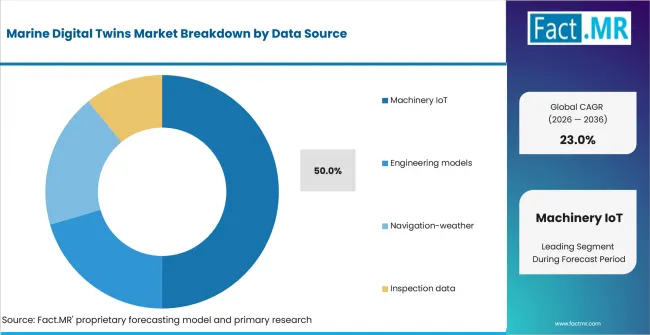
Marine Digital Twins Market Analysis By Data Source | Source: Fact.MR
Machinery IoT leads because engines, pumps and propulsion systems generate the highest-value stream of operating signals. Sensor data gives the twin a live connection to heat, vibration, load and fuel behavior. DNV, Wärtsilä and Kongsberg use vessel data as a foundation for condition monitoring, performance analysis and related maintenance and operational workflows.
What is accelerating Marine Digital Twins Market adoption, and what is holding it back?
Demand is expected to rise through fleet performance, port digitization and shipyard data continuity.
Drivers Impact Analysis
| DRIVER | (~) % IMPACT ON CAGR | GEOGRAPHIC RELEVANCE | IMPACT TIMELINE |
|---|---|---|---|
| Voyage performance and fuel-efficiency pressure | +2.5% | Global | Short term (<= 2 years) |
| Port and ship data-exchange digitization | +1.8% | North America, Europe, East Asia | Medium term (2-4 years) |
| Shipyard digital-thread integration | +1.4% | South Korea, Europe, Japan | Medium term (2-4 years) |
| Autonomous and remote-operation preparation | +0.9% | USA, UK, Japan | Long term (>= 4 years) |
- Voyage performance and fuel-efficiency pressure is expected to raise demand for twins that compare planned and actual vessel behavior during real operations.
- Port and ship data-exchange digitization gives twin platforms cleaner event data. At FAL 50 in March 2026, IMO's Facilitation Committee approved draft FAL Convention amendments requiring Contracting Governments to implement cybersecurity measures for Maritime Single Windows.
- Shipyard digital-thread integration supports twins before vessels enter service. Siemens AG reported in February 2026 that HD Korea Shipbuilding & Offshore Engineering had selected it as a preferred partner to establish an integrated digital shipbuilding platform that will form the core foundation of HD Hyundai’s Future of Shipyard project.
Opportunity Impact Analysis
| OPPORTUNITY | (~) % IMPACT ON CAGR | GEOGRAPHIC RELEVANCE | IMPACT TIMELINE |
|---|---|---|---|
| Cloud fleet-twin subscriptions for commercial vessels | +1.5% | Global | Medium term (2-4 years) |
| Port-to-vessel twins for berth and call planning | +1.1% | USA, UK, South Korea, Japan | Long term (>= 4 years) |
| Offshore asset twins for inspection planning | +0.8% | North Sea, East Asia, USA | Medium term (2-4 years) |
- Cloud fleet-twin subscriptions give ship managers a way to test a twin on a narrow use case before expanding across the fleet.
- Port-to-vessel twins are expected to benefit from digital reporting rules as arrival, cargo and departure data move into common systems.
- Offshore asset twins can improve inspection planning where weather windows are limited and equipment downtime is expensive.
Restraints Impact Analysis
| RESTRAINT | (~) % IMPACT ON CAGR | GEOGRAPHIC RELEVANCE | IMPACT TIMELINE |
|---|---|---|---|
| Legacy vessel data quality and sensor gaps | -0.8% | Global | Short term (<= 2 years) |
| Cybersecurity and data-sharing concerns | -0.6% | Global ports and fleets | Medium term (2-4 years) |
| Integration cost across shipyard and class workflows | -0.4% | Europe, South Korea, Japan | Long term (>= 4 years) |
- Legacy vessel data quality slows direct twin deployment when older machinery records are incomplete or stored in incompatible maintenance systems.
- Cybersecurity concerns are rising as port and vessel systems share more data. IMO FAL 50 approved draft amendments in March 2026 that would require Contracting Governments to implement cybersecurity measures for Maritime Single Windows; adoption is planned for FAL 51 in 2027, with expected entry into force on 1 January 2029.
- Integration cost remains a restraint where shipyards, class societies and owners use separate naming conventions for the same asset.
Which countries are scaling the Marine Digital Twins Market through 2036?
- The country comparison spans 10.4 percentage points and forms three practical growth bands across the forecast period.
- The UK remains 3.2 percentage points above the USA as smart-shipping funding and port freight growth support earlier testing.
- The USA remains 1.0 percentage point above South Korea through port-trade scale and commercial fleet analytics.
- South Korea remains 0.8 percentage point above Germany as shipbuilding data programs connect twins to newbuild workflows.
- Germany remains 5.4 percentage points above Japan through sea transport volume and industrial logistics depth.
- Japan closes the displayed range as Cyber Port and Carbon Neutral Port certification build a more structured deployment route.
Comparable CAGRs can create different entry conditions due to vessel data readiness, port digitalization, shipyard software depth and class acceptance. Full report coverage includes North America, Latin America, Western Europe, Eastern Europe, East Asia, South Asia & Pacific, Middle East & Africa.
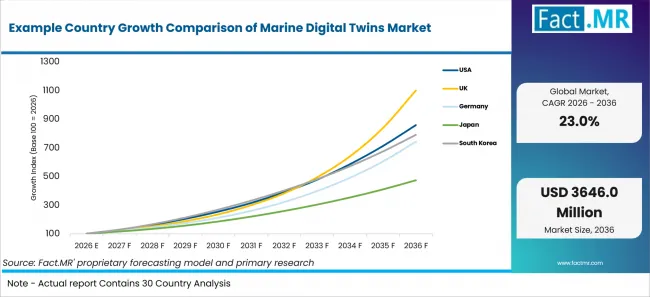
Example Country Growth Comparison Of Marine Digital Twins Market | Source: Fact.MR
| Country | CAGR (2026-2036) |
|---|---|
| UK | 27.2% |
| USA | 24.0% |
| South Korea | 23.0% |
| Germany | 22.2% |
| Japan | 16.8% |
What supports UK adoption?
27.2% CAGR, supported by smart-shipping funding and port digitization.
UK port operators have a measurable base for digital vessel and berth planning. The Department for Transport reported on 29 July 2026 that all UK ports handled 428.3 million tonnes of freight in 2025; Lo-Lo container tonnage at major ports reached 66.9 million tonnes, 10% above 2024.
What supports USA adoption?
24.0% CAGR, led by port-trade scale and commercial fleet analytics.
The USA has a large port network and a high-value maritime trade base. MARAD states that the United States has more than 300 ports. BTS reported that ports accounted for 41% of U.S. imports and exports in 2024, totaling more than USD 2.1 trillion.
How is South Korea scaling demand?
23.0% CAGR, shaped by shipbuilding integration and port throughput.
South Korea links marine digital-twin demand to shipbuilding depth and port activity. The Ministry of Oceans and Fisheries reported on 29 January 2026 that Korean trade ports handled 1.57101 billion tonnes of cargo in 2025, while container throughput reached a record 32.11 million TEU, up 1.2% from 2024.
What supports Germany adoption?
22.2% CAGR, supported by sea transport volume and industrial logistics.
Germany brings marine digital twins into a mixed sea and inland logistics base. Destatis data updated in April 2026 showed that Germany’s maritime freight transport reached 279.595 million tonnes in 2025, while inland-waterway freight transport totaled 171.594 million tonnes. These maritime and inland-waterway freight flows as contextual evidence for port-asset, river-logistics and vessel-maintenance digital-twin use cases; deployment still depends on data and system integration.
How does Japan perform?
16.8% CAGR, led by Cyber Port and carbon-neutral port certification.
Japan is building demand through structured port digitization rather than a fast retrofit cycle. MLIT reported in October 2025 that it had awarded the first Carbon Neutral Port certifications to five container terminals, with the certifications dated September 25, 2025. Its Cyber Port platform digitizes port logistics procedures between private operators and port infrastructure information covering planning, maintenance, management and use. This digitization and decarbonization programs to create relevant data foundations for port-energy and asset-information digital-twin applications.
Who leads the Marine Digital Twins Market?
DNV, HD Hyundai Mipo and HD Korea Shipbuilding & Offshore Engineering signed a January 2025 MoU to develop standards and procedures for digital-twin-based testing of electric propulsion systems. The project includes verification of digital assets and aims to support earlier and more comprehensive hardware-in-the-loop testing using class-verified digital assets.
Kongsberg Maritime and Kongsberg Maritime connect simulation, vessel automation and operational software. Siemens AG supports shipyard and engineering data threads, while Wärtsilä links vessel performance data with operational decision tools.
Dassault Systèmes SE supports ship virtual twins through the 3DEXPERIENCE platform, with marine and offshore use cases across design, manufacturing and operations. Competition centers on data continuity, class acceptance, model governance and proof that the twin changes operating decisions.
Which companies are the key providers?
Key companies include DNV, Kongsberg Maritime, Siemens AG, Wärtsilä, NAPA Ltd. and Dassault Systèmes SE.
- DNV
- Kongsberg Maritime
- Siemens AG
- Wärtsilä
- NAPA Ltd.
- Dassault Systèmes SE
Bibliography
- U.S. Department of Transportation, Bureau of Transportation Statistics. (2026, January 1). Port performance freight statistics: 2026 annual report.
- Department for Transport. (2026, July 29). Port freight annual statistics 2025: Overview of port freight statistics and useful information. GOV.UK.
- DNV. (2025, January 23). DNV, HD Hyundai Mipo and KSOE sign MoU on new standards for using digital twins to test electric propulsion systems.
- International Maritime Organization. (2026, March 31). Facilitation Committee approves digitalization strategy and cyber security measures.
- International Maritime Organization. (2026, May 22). IMO adopts first global Code for autonomous ships.
- Kongsberg Maritime. (2025, January 9). Relocating maritime operations to Kongsberg Maritime from Kongsberg Digital.
- U.S. Department of Transportation, Maritime Administration. (2025, June 16). Ports.
- Ministry of Land, Infrastructure, Transport and Tourism. (2025, October 10). First CNP (Carbon Neutral Port) Certification Awarded to Five Terminals.
- Siemens AG. (2026, February 16). HD Hyundai selects Siemens Xcelerator for integrated digital shipbuilding platform.
- United Nations Conference on Trade and Development. (2025, September 24). Review of maritime transport 2025: Staying the course in turbulent waters.
- Wärtsilä. (2025, February 25). How advanced digital twins and AI help optimise vessel performance [Webinar].
This Report Answers
- The report explains where marine digital twins are used across asset type, function, deployment and data source.
- Segment analysis identifies the subsegments that carry the clearest operational reason for buyer spending.
- Country analysis examines the listed markets and the port, shipyard or policy mechanisms supporting digital-twin deployment.
- Competitive analysis reviews active providers across vessel performance, shipyard data threads, fleet management and virtual engineering.
- Application analysis assesses how machinery data, engineering models and port information influence purchase decisions.
What does the Marine Digital Twins Market cover?
The Marine Digital Twins Market covers software and services that create virtual operating models of marine assets. The model can represent a whole vessel, a port asset, an offshore structure or a marine engine. It links the digital model to live data or engineering records so operators can compare expected and actual behavior.
The assessment covers connected ship systems, digital twin platforms, marine engine monitoring systems and adjacent port-data tools when they support a twin rather than a standalone monitoring dashboard.
What is included in the scope?
The scope includes cloud fleet twins, on-premise shipyard twins and hybrid edge-cloud twins. It also covers model-linking software, sensor-data integration and digital services used to build or maintain the twin. It includes mooring load sensor outputs when the sensor data feeds berth or vessel-response models.
The scope also includes port and vessel data integration where the system models the behavior or condition of the asset. Relevant adjacent areas include port equipment telemetry units, digital twin composer tools and berth load monitoring systems when they feed a marine twin.
What is excluded from the scope?
The scope excludes general shipbuilding services, raw marine sensors, standalone navigation equipment and fleet-management tools that do not create or update an asset model. It also excludes autonomous vessel hardware when sold without twin software or operational modeling services.
General port operating systems are excluded when they only record events. The scope also excludes automatic identification systems, marine sensors and broad port equipment categories unless they form part of a digital twin deployment.
How Was the Analysis Built?
The analysis draws on 120+ sources, 35+ company portfolios, 25+ countries, and more than 20 industry interviews.
- Primary Research: Primary research includes discussions with manufacturers, service providers, technology developers, distributors, end users, procurement teams, and subject-matter experts. These conversations examine purchasing priorities, product adoption, operational challenges, approval requirements, competitive positioning, and the factors that influence wider market acceptance.
- Desk Research: Desk research covers government statistics, regulatory publications, company filings, trade data, technical studies, industry associations, standards, public policy, and other authoritative sources. Every source used in the analysis is documented in the bibliography.
- Market Sizing and Forecasting: Market estimates combine historical performance, demand indicators, pricing and volume trends, segment shares, company participation, country-level growth, adoption patterns, investment activity, and barriers to market expansion.
- Data Validation and Update Cycle: Findings are validated by comparing primary interviews with public data, company activity, regulatory changes, trade patterns, and industry developments. Regular updates review new product launches, capacity changes, partnerships, approvals, procurement trends, and shifts in commercial adoption.
What is the report’s scope and coverage?
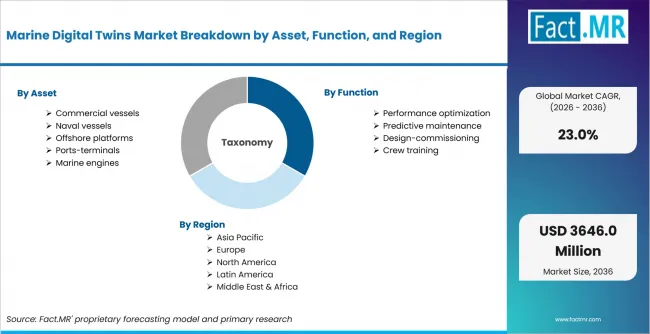
Marine Digital Twins Market Breakdown By Asset, Function, And Region | Source: Fact.MR
| Attribute | Details |
|---|---|
| Quantitative Units | USD million |
| Market Definition | Software and data platforms that create virtual operating models of marine assets, including vessels, ports, offshore assets and marine engines. |
| Asset | Commercial vessels; Naval vessels; Offshore platforms; Ports-terminals; Marine engines |
| Function | Performance optimization; Predictive maintenance; Design-commissioning; Crew training |
| Deployment | Cloud; On-premise; Hybrid edge-cloud |
| Data Source | Machinery IoT; Engineering models; Navigation-weather; Inspection data |
| Regions Covered | North America; Latin America; Western Europe; Eastern Europe; East Asia; South Asia & Pacific; Middle East & Africa |
| Countries Covered | USA; UK; Germany; Japan; South Korea |
| Companies Profiled | DNV; Kongsberg Maritime; Siemens AG; Wärtsilä; NAPA Ltd.; Dassault Systèmes SE |
| Forecast Period | 2026 to 2036 |
| Approach | Hybrid top-down and bottom-up approach using fleet activity, port digitalization, shipyard software adoption, asset mix, sensor readiness and provider portfolio review. |
How is the market segmented?
-
By Asset:
- Commercial vessels
- Naval vessels
- Offshore platforms
- Ports-terminals
- Marine engines
-
By Function:
- Performance optimization
- Predictive maintenance
- Design-commissioning
- Crew training
-
By Deployment:
- Cloud
- On-premise
- Hybrid edge-cloud
-
By Data Source:
- Machinery IoT
- Engineering models
- Navigation-weather
- Inspection data
-
By Region:
- North America
- Latin America
- Western Europe
- Eastern Europe
- East Asia
- South Asia & Pacific
- Middle East & Africa