Mercury Capture Sorbents for Flue Gas Market
Mercury Capture Sorbents for Flue Gas Market Size and Share Forecast Outlook 2026 to 2036
Mercury capture sorbents for flue gas market is projected to grow from USD 0.5 billion in 2026 to USD 1.2 billion by 2036, at a CAGR of 8.4%. Activated Carbon-Based Sorbents will dominate with a 42.0% market share, while coal-fired power plants will lead the end-use industry segment with a 44.0% share.
Mercury Capture Sorbents for Flue Gas Market Forecast and Outlook 2026 to 2036
The global market for mercury capture sorbents used in flue gas treatment is projected to reach USD 1.16 billion by 2036. The market is valued at USD 0.52 billion in 2026 and is set to rise at a CAGR of 8.4% throughout the forecast period.
Coal-fired power plants constitute the leading end-use industry segment, holding a 44% share. Among application methods, dry sorbent injection (DSI) dominates with a 48% share.
Key Takeaways from the Mercury Capture Sorbents for Flue Gas Market
- Market Value for 2026: USD 0.52 Billion
- Market Value for 2036: USD 1.16 Billion
- Forecast CAGR (2026-2036): 8.4%
- Leading Sorbent Type Share (2026): Activated Carbon-Based Sorbents (42%)
- Leading End-Use Industry Share (2026): Coal-Fired Power Plants (44%)
- Leading Application Method Share (2026): Dry Sorbent Injection (DSI) (48%)
- Key Players in the Market: ADA Carbon Solutions, Cabot Corporation, Calgon Carbon (Kurita Group), Chemviron, Albemarle Corporation, Veolia Environnement S.A.
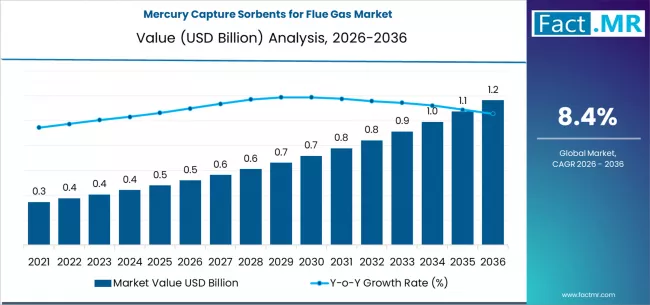
This growth is driven by the global implementation of stringent mercury emission regulations, such as the Minamata Convention, and regional air quality directives. These policies mandate the control of mercury releases from major industrial point sources, creating a definitive and expanding market for effective capture technologies.
Mercury capture sorbents are specialized materials designed to adsorb elemental and oxidized mercury from hot, complex flue gas streams. Their performance is critical for industries to achieve regulatory compliance, protect public health, and mitigate the environmental impact of toxic metal emissions.
Mercury Capture Sorbents for Flue Gas Market
| Metric | Value |
|---|---|
| Market Value (2026) | USD 0.52 Billion |
| Market Forecast Value (2036) | USD 1.16 Billion |
| Forecast CAGR (2026-2036) | 8.4% |
Category
| Category | Segments |
|---|---|
| Sorbent Type | Activated Carbon-Based Sorbents, Brominated/Halogenated Sorbents, Metal Oxide Sorbents (Cu, Mn, Fe, Ti), Zeolite/Mineral-Based Sorbents, Other Advanced Sorbents (Nano, Hybrid) |
| End-Use Industry | Coal-Fired Power Plants, Cement & Lime Kilns, Waste Incineration Facilities, Industrial Boilers & Refineries, Other Emission-Control Applications |
| Application Method | Dry Sorbent Injection (DSI), Fixed-Bed Sorbent Systems, Wet Scrubber Additives, Hybrid Sorbent + Catalyst Systems, Other Advanced Delivery Methods |
| Region | North America, Latin America, Western Europe, Eastern Europe, East Asia, South Asia & Pacific, MEA |
Segmental Analysis
Which Sorbent Technology is leading the Capture Race?
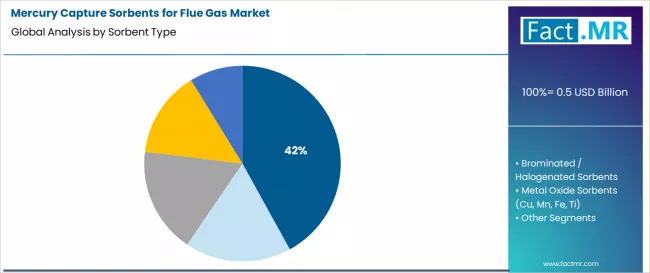
Activated carbon-based sorbents command a dominant 42% market share. This leadership is rooted in their high surface area, tunable pore structure, and ability to be chemically impregnated with halogens like bromine to enhance oxidation and capture of elemental mercury. Their versatility and proven effectiveness across diverse flue gas conditions and plant configurations make them the most widely deployed and trusted solution for meeting initial compliance deadlines.
Which Industry Sector is the Primary Driver of Sorbent Demand?
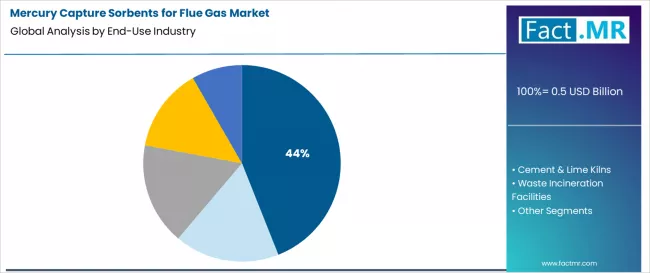
Coal-fired power plants represent the largest end-use industry with a 44% share. As the single largest anthropogenic source of mercury emissions globally, this sector faces the most direct and impactful regulation.
The sheer volume of flue gas generated and the capital investment in existing infrastructure make retrofit solutions like sorbent injection the preferred compliance pathway, driving massive and consistent demand for bulk sorbent materials.
What is the Preferred Method for Integrating Sorbents into Existing Plants?
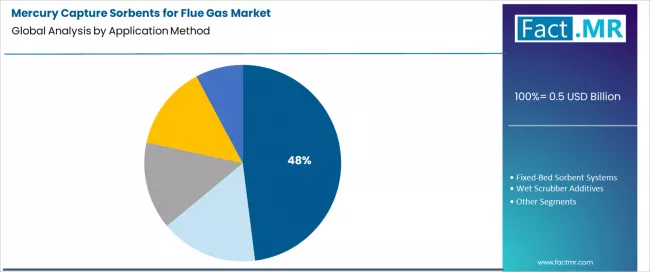
Dry sorbent injection (DSI) is the leading application method with a 48% share. Its dominance is due to its relatively low capital cost and ease of retrofitting into existing plants without major downtime.
Powdered sorbent is injected directly into the flue gas duct upstream of particulate control devices, offering operational flexibility and avoiding the complexity of fixed-bed systems. This practicality makes DSI the default choice for a majority of power generators and industrial facilities.
What are the Drivers, Restraints, and Key Trends of the Mercury Capture Sorbents for Flue Gas Market?
The primary market driver is the global ratification and enforcement of the Minamata Convention on Mercury, which legally binds signatory countries to control and reduce mercury emissions from key industrial categories. National regulations like the Mercury and Air Toxics Standards (MATS) in the USA create enforceable compliance deadlines, translating directly into procurement demand for capture technologies.
A significant market restraint is the potential negative impact of sorbent injection on the saleability of byproducts like fly ash. Carbon content can disqualify ash for use in concrete, creating a financial disincentive for plant operators. The ongoing operational cost of continuous sorbent purchase and the need for precise injection control to balance performance with cost also present economic and technical challenges.
Key trends include the development of non-carbon, mineral-based sorbents to preserve fly ash quality. There is strong innovation in multifunctional sorbents that capture mercury alongside other pollutants like SOx or dioxins. The market is moving toward smarter injection control systems using real-time mercury monitors to optimize sorbent feed rates. Research is also focused on regenerable sorbents to reduce waste volume and long-term operating expenses.
Analysis of the Mercury Capture Sorbents for Flue Gas Market by Key Countries
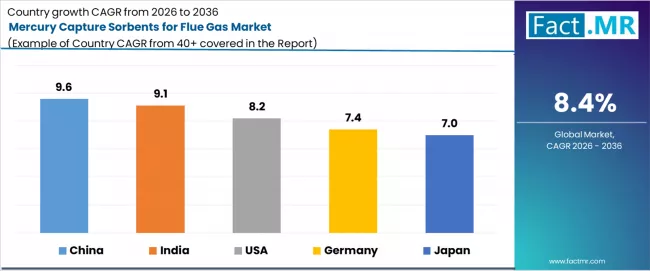
| Country | CAGR (2026-2036) |
|---|---|
| China | 9.60% |
| India | 9.10% |
| USA | 8.20% |
| Germany | 7.40% |
| Japan | 7.00% |
How are China's Ultra-Low Emission Standards Shaping Market Growth?
A comprehensive ultra-low emission retrofit program for coal-fired power plants and growing pressure on industrial sources fuels China’s leading CAGR of 9.60%. As the world's largest coal consumer, China's national policy mandates the installation of advanced air pollution control equipment, creating an immense, centrally driven market for mercury sorbents, often integrated with existing SCR and FGD systems.
What Role does India's Expanding Coal Fleet and Regulatory Evolution Play?
Growing base of coal-fired power capacity underpins India’s 9.10% growth and the gradual implementation of stricter emission limits by the Central Pollution Control Board (CPCB). While compliance is in earlier stages compared to China and the USA, the scale of the existing and planned coal fleet positions India as a high-growth future market, with demand driven by new regulations and international financing for clean technology.
How does the USA's Mature Regulatory Environment Sustain Demand?
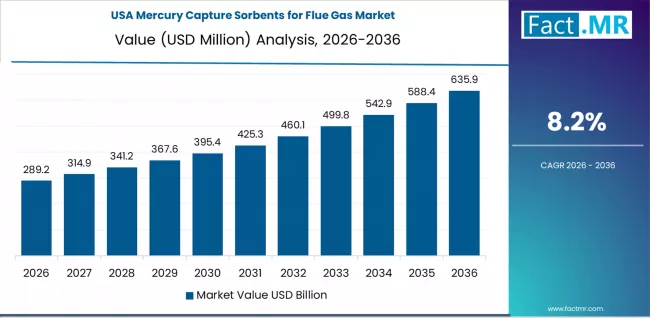
The USA's 8.20% growth is supported by the well-established MATS rule and ongoing compliance requirements for the existing coal fleet, as well as regulations affecting waste incineration and industrial boilers. This mature market focuses on operational optimization, sorbent performance enhancement, and cost reduction, driving demand for advanced and efficient sorbent products and delivery systems.
Why is Germany a Market for Advanced and Integrated Solutions?
Germany's 7.40% CAGR reflects its stringent EU Industrial Emissions Directive compliance and leadership in waste-to-energy incineration. The German market prioritizes high-efficiency, integrated solutions that achieve ultra-low emission levels. This creates demand for specialized sorbents and hybrid systems, particularly in the waste incineration sector where mercury speciation is complex.
What is the Impact of Japan's Stringent Incineration and Industrial Policies?
Japan's 7.00% growth is anchored in its world-leading standards for waste incineration emissions and a strong policy focus on hazardous air pollutant control. The high density of waste-to-energy plants and advanced industrial infrastructure drives demand for premium, high-performance sorbents capable of achieving exceptionally low outlet concentrations in challenging flue gas environments.
Competitive Landscape of the Mercury Capture Sorbents for Flue Gas Market
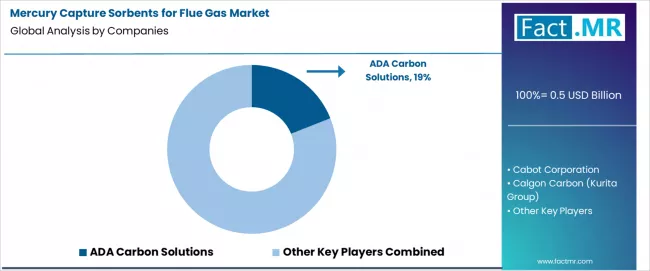
Specialized activated carbon producers and global environmental technology firms define the competitive landscape. Companies like ADA Carbon Solutions and Cabot Corporation compete on sorbent performance, cost-per-ton of mercury removed, and reliable bulk supply logistics.
Larger players like Calgon Carbon (Kurita) and Veolia leverage their broader water and air treatment portfolios to offer integrated service contracts. Competition centers on proprietary chemical impregnations that improve sorbent capacity and oxidation kinetics, alongside providing comprehensive technical support for system design and optimization.
Key Players in the Mercury Capture Sorbents for Flue Gas Market
- ADA Carbon Solutions
- Cabot Corporation
- Calgon Carbon (Kurita Group)
- Chemviron
- Albemarle Corporation
- Veolia Environnement S.A.
Scope of Report
| Items | Values |
|---|---|
| Quantitative Units | USD Billion |
| Sorbent Type | Activated Carbon, Brominated, Metal Oxides, Zeolite/Mineral, Advanced Hybrids |
| End-Use Industry | Coal Power, Cement & Lime, Waste Incineration, Industrial Boilers, Other |
| Application Method | Dry Injection (DSI), Fixed-Bed, Wet Scrubber Additives, Hybrid Systems, Other |
| Key Countries | China, India, USA, Germany, Japan |
| Key Companies | ADA Carbon Solutions, Cabot Corp., Calgon Carbon, Chemviron, Albemarle, Veolia |
| Additional Analysis | Analysis of sorbent performance under different flue gas chemistries (Cl, SO2); impact on fly ash quality and disposal; mercury monitoring (CEMS) and injection control strategies; spent sorbent management and disposal; regulatory frameworks and testing protocols (e.g., EPA Method 30B). |
Market by Segments
-
Sorbent Type :
- Activated Carbon-Based Sorbents
- Brominated/Halogenated Sorbents
- Metal Oxide Sorbents (Cu, Mn, Fe, Ti)
- Zeolite/Mineral-Based Sorbents
- Other Advanced Sorbents (Nano, Hybrid)
-
End-Use Industry :
- Coal-Fired Power Plants
- Cement & Lime Kilns
- Waste Incineration Facilities
- Industrial Boilers & Refineries
- Other Emission-Control Applications
-
Application Method :
- Dry Sorbent Injection (DSI)
- Fixed-Bed Sorbent Systems
- Wet Scrubber Additives
- Hybrid Sorbent + Catalyst Systems
- Other Advanced Delivery Methods
-
Region :
-
North America
- USA
- Canada
-
Latin America
- Brazil
- Mexico
- Argentina
- Rest of Latin America
-
Western Europe
- Germany
- UK
- France
- Spain
- Italy
- BENELUX
- Rest of Western Europe
-
Eastern Europe
- Russia
- Poland
- Czech Republic
- Rest of Eastern Europe
-
East Asia
- China
- Japan
- South Korea
- Rest of East Asia
-
South Asia & Pacific
- India
- ASEAN
- Australia
- Rest of South Asia & Pacific
-
MEA
- Saudi Arabia
- UAE
- Turkiye
- Rest of MEA
-
Table of Content
- Executive Summary
- Global Market Outlook
- Demand to side Trends
- Supply to side Trends
- Technology Roadmap Analysis
- Analysis and Recommendations
- Market Overview
- Market Coverage / Taxonomy
- Market Definition / Scope / Limitations
- Market Background
- Market Dynamics
- Drivers
- Restraints
- Opportunity
- Trends
- Scenario Forecast
- Demand in Optimistic Scenario
- Demand in Likely Scenario
- Demand in Conservative Scenario
- Opportunity Map Analysis
- Product Life Cycle Analysis
- Supply Chain Analysis
- Investment Feasibility Matrix
- Value Chain Analysis
- PESTLE and Porter’s Analysis
- Regulatory Landscape
- Regional Parent Market Outlook
- Production and Consumption Statistics
- Import and Export Statistics
- Market Dynamics
- Global Market Analysis 2021 to 2025 and Forecast, 2026 to 2036
- Historical Market Size Value (USD Million) Analysis, 2021 to 2025
- Current and Future Market Size Value (USD Million) Projections, 2026 to 2036
- Y to o to Y Growth Trend Analysis
- Absolute $ Opportunity Analysis
- Global Market Pricing Analysis 2021 to 2025 and Forecast 2026 to 2036
- Global Market Analysis 2021 to 2025 and Forecast 2026 to 2036, By Sorbent Type
- Introduction / Key Findings
- Historical Market Size Value (USD Million) Analysis By Sorbent Type, 2021 to 2025
- Current and Future Market Size Value (USD Million) Analysis and Forecast By Sorbent Type, 2026 to 2036
- Activated Carbon-Based Sorbents
- Brominated / Halogenated Sorbents
- Metal Oxide Sorbents (Cu, Mn, Fe, Ti)
- Zeolite / Mineral-Based Sorbents
- Other Advanced Sorbents (Nano, Hybrid)
- Activated Carbon-Based Sorbents
- Y to o to Y Growth Trend Analysis By Sorbent Type, 2021 to 2025
- Absolute $ Opportunity Analysis By Sorbent Type, 2026 to 2036
- Global Market Analysis 2021 to 2025 and Forecast 2026 to 2036, By End-Use Industry
- Introduction / Key Findings
- Historical Market Size Value (USD Million) Analysis By End-Use Industry, 2021 to 2025
- Current and Future Market Size Value (USD Million) Analysis and Forecast By End-Use Industry, 2026 to 2036
- Coal-Fired Power Plants
- Cement & Lime Kilns
- Waste Incineration Facilities
- Industrial Boilers & Refineries
- Other Emission-Control Applications
- Coal-Fired Power Plants
- Y to o to Y Growth Trend Analysis By End-Use Industry, 2021 to 2025
- Absolute $ Opportunity Analysis By End-Use Industry, 2026 to 2036
- Global Market Analysis 2021 to 2025 and Forecast 2026 to 2036, By Application Method
- Introduction / Key Findings
- Historical Market Size Value (USD Million) Analysis By Application Method, 2021 to 2025
- Current and Future Market Size Value (USD Million) Analysis and Forecast By Application Method, 2026 to 2036
- Dry Sorbent Injection (DSI)
- Fixed-Bed Sorbent Systems
- Wet Scrubber Additives
- Hybrid Sorbent + Catalyst Systems
- Other Advanced Delivery Methods
- Dry Sorbent Injection (DSI)
- Y to o to Y Growth Trend Analysis By Application Method, 2021 to 2025
- Absolute $ Opportunity Analysis By Application Method, 2026 to 2036
- Global Market Analysis 2021 to 2025 and Forecast 2026 to 2036, By Region
- Introduction
- Historical Market Size Value (USD Million) Analysis By Region, 2021 to 2025
- Current Market Size Value (USD Million) Analysis and Forecast By Region, 2026 to 2036
- North America
- Latin America
- Western Europe
- Eastern Europe
- East Asia
- South Asia and Pacific
- Middle East & Africa
- Market Attractiveness Analysis By Region
- North America Market Analysis 2021 to 2025 and Forecast 2026 to 2036, By Country
- Historical Market Size Value (USD Million) Trend Analysis By Market Taxonomy, 2021 to 2025
- Market Size Value (USD Million) Forecast By Market Taxonomy, 2026 to 2036
- By Country
- USA
- Canada
- Mexico
- By Sorbent Type
- By End-Use Industry
- By Application Method
- By Country
- Market Attractiveness Analysis
- By Country
- By Sorbent Type
- By End-Use Industry
- By Application Method
- Key Takeaways
- Latin America Market Analysis 2021 to 2025 and Forecast 2026 to 2036, By Country
- Historical Market Size Value (USD Million) Trend Analysis By Market Taxonomy, 2021 to 2025
- Market Size Value (USD Million) Forecast By Market Taxonomy, 2026 to 2036
- By Country
- Brazil
- Chile
- Rest of Latin America
- By Sorbent Type
- By End-Use Industry
- By Application Method
- By Country
- Market Attractiveness Analysis
- By Country
- By Sorbent Type
- By End-Use Industry
- By Application Method
- Key Takeaways
- Western Europe Market Analysis 2021 to 2025 and Forecast 2026 to 2036, By Country
- Historical Market Size Value (USD Million) Trend Analysis By Market Taxonomy, 2021 to 2025
- Market Size Value (USD Million) Forecast By Market Taxonomy, 2026 to 2036
- By Country
- Germany
- UK
- Italy
- Spain
- France
- Nordic
- BENELUX
- Rest of Western Europe
- By Sorbent Type
- By End-Use Industry
- By Application Method
- By Country
- Market Attractiveness Analysis
- By Country
- By Sorbent Type
- By End-Use Industry
- By Application Method
- Key Takeaways
- Eastern Europe Market Analysis 2021 to 2025 and Forecast 2026 to 2036, By Country
- Historical Market Size Value (USD Million) Trend Analysis By Market Taxonomy, 2021 to 2025
- Market Size Value (USD Million) Forecast By Market Taxonomy, 2026 to 2036
- By Country
- Russia
- Poland
- Hungary
- Balkan & Baltic
- Rest of Eastern Europe
- By Sorbent Type
- By End-Use Industry
- By Application Method
- By Country
- Market Attractiveness Analysis
- By Country
- By Sorbent Type
- By End-Use Industry
- By Application Method
- Key Takeaways
- East Asia Market Analysis 2021 to 2025 and Forecast 2026 to 2036, By Country
- Historical Market Size Value (USD Million) Trend Analysis By Market Taxonomy, 2021 to 2025
- Market Size Value (USD Million) Forecast By Market Taxonomy, 2026 to 2036
- By Country
- China
- Japan
- South Korea
- By Sorbent Type
- By End-Use Industry
- By Application Method
- By Country
- Market Attractiveness Analysis
- By Country
- By Sorbent Type
- By End-Use Industry
- By Application Method
- Key Takeaways
- South Asia and Pacific Market Analysis 2021 to 2025 and Forecast 2026 to 2036, By Country
- Historical Market Size Value (USD Million) Trend Analysis By Market Taxonomy, 2021 to 2025
- Market Size Value (USD Million) Forecast By Market Taxonomy, 2026 to 2036
- By Country
- India
- ASEAN
- Australia & New Zealand
- Rest of South Asia and Pacific
- By Sorbent Type
- By End-Use Industry
- By Application Method
- By Country
- Market Attractiveness Analysis
- By Country
- By Sorbent Type
- By End-Use Industry
- By Application Method
- Key Takeaways
- Middle East & Africa Market Analysis 2021 to 2025 and Forecast 2026 to 2036, By Country
- Historical Market Size Value (USD Million) Trend Analysis By Market Taxonomy, 2021 to 2025
- Market Size Value (USD Million) Forecast By Market Taxonomy, 2026 to 2036
- By Country
- Kingdom of Saudi Arabia
- Other GCC Countries
- Turkiye
- South Africa
- Other African Union
- Rest of Middle East & Africa
- By Sorbent Type
- By End-Use Industry
- By Application Method
- By Country
- Market Attractiveness Analysis
- By Country
- By Sorbent Type
- By End-Use Industry
- By Application Method
- Key Takeaways
- Key Countries Market Analysis
- USA
- Pricing Analysis
- Market Share Analysis, 2025
- By Sorbent Type
- By End-Use Industry
- By Application Method
- Canada
- Pricing Analysis
- Market Share Analysis, 2025
- By Sorbent Type
- By End-Use Industry
- By Application Method
- Mexico
- Pricing Analysis
- Market Share Analysis, 2025
- By Sorbent Type
- By End-Use Industry
- By Application Method
- Brazil
- Pricing Analysis
- Market Share Analysis, 2025
- By Sorbent Type
- By End-Use Industry
- By Application Method
- Chile
- Pricing Analysis
- Market Share Analysis, 2025
- By Sorbent Type
- By End-Use Industry
- By Application Method
- Germany
- Pricing Analysis
- Market Share Analysis, 2025
- By Sorbent Type
- By End-Use Industry
- By Application Method
- UK
- Pricing Analysis
- Market Share Analysis, 2025
- By Sorbent Type
- By End-Use Industry
- By Application Method
- Italy
- Pricing Analysis
- Market Share Analysis, 2025
- By Sorbent Type
- By End-Use Industry
- By Application Method
- Spain
- Pricing Analysis
- Market Share Analysis, 2025
- By Sorbent Type
- By End-Use Industry
- By Application Method
- France
- Pricing Analysis
- Market Share Analysis, 2025
- By Sorbent Type
- By End-Use Industry
- By Application Method
- India
- Pricing Analysis
- Market Share Analysis, 2025
- By Sorbent Type
- By End-Use Industry
- By Application Method
- ASEAN
- Pricing Analysis
- Market Share Analysis, 2025
- By Sorbent Type
- By End-Use Industry
- By Application Method
- Australia & New Zealand
- Pricing Analysis
- Market Share Analysis, 2025
- By Sorbent Type
- By End-Use Industry
- By Application Method
- China
- Pricing Analysis
- Market Share Analysis, 2025
- By Sorbent Type
- By End-Use Industry
- By Application Method
- Japan
- Pricing Analysis
- Market Share Analysis, 2025
- By Sorbent Type
- By End-Use Industry
- By Application Method
- South Korea
- Pricing Analysis
- Market Share Analysis, 2025
- By Sorbent Type
- By End-Use Industry
- By Application Method
- Russia
- Pricing Analysis
- Market Share Analysis, 2025
- By Sorbent Type
- By End-Use Industry
- By Application Method
- Poland
- Pricing Analysis
- Market Share Analysis, 2025
- By Sorbent Type
- By End-Use Industry
- By Application Method
- Hungary
- Pricing Analysis
- Market Share Analysis, 2025
- By Sorbent Type
- By End-Use Industry
- By Application Method
- Kingdom of Saudi Arabia
- Pricing Analysis
- Market Share Analysis, 2025
- By Sorbent Type
- By End-Use Industry
- By Application Method
- Turkiye
- Pricing Analysis
- Market Share Analysis, 2025
- By Sorbent Type
- By End-Use Industry
- By Application Method
- South Africa
- Pricing Analysis
- Market Share Analysis, 2025
- By Sorbent Type
- By End-Use Industry
- By Application Method
- USA
- Market Structure Analysis
- Competition Dashboard
- Competition Benchmarking
- Market Share Analysis of Top Players
- By Regional
- By Sorbent Type
- By End-Use Industry
- By Application Method
- Competition Analysis
- Competition Deep Dive
- ADA Carbon Solutions
- Overview
- Product Portfolio
- Profitability by Market Segments (Product/Age /Sales Channel/Region)
- Sales Footprint
- Strategy Overview
- Marketing Strategy
- Product Strategy
- Channel Strategy
- Cabot Corporation
- Calgon Carbon (Kurita Group)
- Chemviron
- Albemarle Corporation
- Veolia Environnement S.A.
- ADA Carbon Solutions
- Competition Deep Dive
- Assumptions & Acronyms Used
- Research Methodology
List Of Table
- Table 1: Global Market Value (USD Million) Forecast by Region, 2021 to 2036
- Table 2: Global Market Value (USD Million) Forecast by Sorbent Type, 2021 to 2036
- Table 3: Global Market Value (USD Million) Forecast by End-Use Industry, 2021 to 2036
- Table 4: Global Market Value (USD Million) Forecast by Application Method, 2021 to 2036
- Table 5: North America Market Value (USD Million) Forecast by Country, 2021 to 2036
- Table 6: North America Market Value (USD Million) Forecast by Sorbent Type, 2021 to 2036
- Table 7: North America Market Value (USD Million) Forecast by End-Use Industry, 2021 to 2036
- Table 8: North America Market Value (USD Million) Forecast by Application Method, 2021 to 2036
- Table 9: Latin America Market Value (USD Million) Forecast by Country, 2021 to 2036
- Table 10: Latin America Market Value (USD Million) Forecast by Sorbent Type, 2021 to 2036
- Table 11: Latin America Market Value (USD Million) Forecast by End-Use Industry, 2021 to 2036
- Table 12: Latin America Market Value (USD Million) Forecast by Application Method, 2021 to 2036
- Table 13: Western Europe Market Value (USD Million) Forecast by Country, 2021 to 2036
- Table 14: Western Europe Market Value (USD Million) Forecast by Sorbent Type, 2021 to 2036
- Table 15: Western Europe Market Value (USD Million) Forecast by End-Use Industry, 2021 to 2036
- Table 16: Western Europe Market Value (USD Million) Forecast by Application Method, 2021 to 2036
- Table 17: Eastern Europe Market Value (USD Million) Forecast by Country, 2021 to 2036
- Table 18: Eastern Europe Market Value (USD Million) Forecast by Sorbent Type, 2021 to 2036
- Table 19: Eastern Europe Market Value (USD Million) Forecast by End-Use Industry, 2021 to 2036
- Table 20: Eastern Europe Market Value (USD Million) Forecast by Application Method, 2021 to 2036
- Table 21: East Asia Market Value (USD Million) Forecast by Country, 2021 to 2036
- Table 22: East Asia Market Value (USD Million) Forecast by Sorbent Type, 2021 to 2036
- Table 23: East Asia Market Value (USD Million) Forecast by End-Use Industry, 2021 to 2036
- Table 24: East Asia Market Value (USD Million) Forecast by Application Method, 2021 to 2036
- Table 25: South Asia and Pacific Market Value (USD Million) Forecast by Country, 2021 to 2036
- Table 26: South Asia and Pacific Market Value (USD Million) Forecast by Sorbent Type, 2021 to 2036
- Table 27: South Asia and Pacific Market Value (USD Million) Forecast by End-Use Industry, 2021 to 2036
- Table 28: South Asia and Pacific Market Value (USD Million) Forecast by Application Method, 2021 to 2036
- Table 29: Middle East & Africa Market Value (USD Million) Forecast by Country, 2021 to 2036
- Table 30: Middle East & Africa Market Value (USD Million) Forecast by Sorbent Type, 2021 to 2036
- Table 31: Middle East & Africa Market Value (USD Million) Forecast by End-Use Industry, 2021 to 2036
- Table 32: Middle East & Africa Market Value (USD Million) Forecast by Application Method, 2021 to 2036
List Of Figures
- Figure 1: Global Market Pricing Analysis
- Figure 2: Global Market Value (USD Million) Forecast 2021 to 2036
- Figure 3: Global Market Value Share and BPS Analysis by Sorbent Type, 2026 and 2036
- Figure 4: Global Market Y to o to Y Growth Comparison by Sorbent Type, 2026 to 2036
- Figure 5: Global Market Attractiveness Analysis by Sorbent Type
- Figure 6: Global Market Value Share and BPS Analysis by End-Use Industry, 2026 and 2036
- Figure 7: Global Market Y to o to Y Growth Comparison by End-Use Industry, 2026 to 2036
- Figure 8: Global Market Attractiveness Analysis by End-Use Industry
- Figure 9: Global Market Value Share and BPS Analysis by Application Method, 2026 and 2036
- Figure 10: Global Market Y to o to Y Growth Comparison by Application Method, 2026 to 2036
- Figure 11: Global Market Attractiveness Analysis by Application Method
- Figure 12: Global Market Value (USD Million) Share and BPS Analysis by Region, 2026 and 2036
- Figure 13: Global Market Y to o to Y Growth Comparison by Region, 2026 to 2036
- Figure 14: Global Market Attractiveness Analysis by Region
- Figure 15: North America Market Incremental Dollar Opportunity, 2026 to 2036
- Figure 16: Latin America Market Incremental Dollar Opportunity, 2026 to 2036
- Figure 17: Western Europe Market Incremental Dollar Opportunity, 2026 to 2036
- Figure 18: Eastern Europe Market Incremental Dollar Opportunity, 2026 to 2036
- Figure 19: East Asia Market Incremental Dollar Opportunity, 2026 to 2036
- Figure 20: South Asia and Pacific Market Incremental Dollar Opportunity, 2026 to 2036
- Figure 21: Middle East & Africa Market Incremental Dollar Opportunity, 2026 to 2036
- Figure 22: North America Market Value Share and BPS Analysis by Country, 2026 and 2036
- Figure 23: North America Market Value Share and BPS Analysis by Sorbent Type, 2026 and 2036
- Figure 24: North America Market Y to o to Y Growth Comparison by Sorbent Type, 2026 to 2036
- Figure 25: North America Market Attractiveness Analysis by Sorbent Type
- Figure 26: North America Market Value Share and BPS Analysis by End-Use Industry, 2026 and 2036
- Figure 27: North America Market Y to o to Y Growth Comparison by End-Use Industry, 2026 to 2036
- Figure 28: North America Market Attractiveness Analysis by End-Use Industry
- Figure 29: North America Market Value Share and BPS Analysis by Application Method, 2026 and 2036
- Figure 30: North America Market Y to o to Y Growth Comparison by Application Method, 2026 to 2036
- Figure 31: North America Market Attractiveness Analysis by Application Method
- Figure 32: Latin America Market Value Share and BPS Analysis by Country, 2026 and 2036
- Figure 33: Latin America Market Value Share and BPS Analysis by Sorbent Type, 2026 and 2036
- Figure 34: Latin America Market Y to o to Y Growth Comparison by Sorbent Type, 2026 to 2036
- Figure 35: Latin America Market Attractiveness Analysis by Sorbent Type
- Figure 36: Latin America Market Value Share and BPS Analysis by End-Use Industry, 2026 and 2036
- Figure 37: Latin America Market Y to o to Y Growth Comparison by End-Use Industry, 2026 to 2036
- Figure 38: Latin America Market Attractiveness Analysis by End-Use Industry
- Figure 39: Latin America Market Value Share and BPS Analysis by Application Method, 2026 and 2036
- Figure 40: Latin America Market Y to o to Y Growth Comparison by Application Method, 2026 to 2036
- Figure 41: Latin America Market Attractiveness Analysis by Application Method
- Figure 42: Western Europe Market Value Share and BPS Analysis by Country, 2026 and 2036
- Figure 43: Western Europe Market Value Share and BPS Analysis by Sorbent Type, 2026 and 2036
- Figure 44: Western Europe Market Y to o to Y Growth Comparison by Sorbent Type, 2026 to 2036
- Figure 45: Western Europe Market Attractiveness Analysis by Sorbent Type
- Figure 46: Western Europe Market Value Share and BPS Analysis by End-Use Industry, 2026 and 2036
- Figure 47: Western Europe Market Y to o to Y Growth Comparison by End-Use Industry, 2026 to 2036
- Figure 48: Western Europe Market Attractiveness Analysis by End-Use Industry
- Figure 49: Western Europe Market Value Share and BPS Analysis by Application Method, 2026 and 2036
- Figure 50: Western Europe Market Y to o to Y Growth Comparison by Application Method, 2026 to 2036
- Figure 51: Western Europe Market Attractiveness Analysis by Application Method
- Figure 52: Eastern Europe Market Value Share and BPS Analysis by Country, 2026 and 2036
- Figure 53: Eastern Europe Market Value Share and BPS Analysis by Sorbent Type, 2026 and 2036
- Figure 54: Eastern Europe Market Y to o to Y Growth Comparison by Sorbent Type, 2026 to 2036
- Figure 55: Eastern Europe Market Attractiveness Analysis by Sorbent Type
- Figure 56: Eastern Europe Market Value Share and BPS Analysis by End-Use Industry, 2026 and 2036
- Figure 57: Eastern Europe Market Y to o to Y Growth Comparison by End-Use Industry, 2026 to 2036
- Figure 58: Eastern Europe Market Attractiveness Analysis by End-Use Industry
- Figure 59: Eastern Europe Market Value Share and BPS Analysis by Application Method, 2026 and 2036
- Figure 60: Eastern Europe Market Y to o to Y Growth Comparison by Application Method, 2026 to 2036
- Figure 61: Eastern Europe Market Attractiveness Analysis by Application Method
- Figure 62: East Asia Market Value Share and BPS Analysis by Country, 2026 and 2036
- Figure 63: East Asia Market Value Share and BPS Analysis by Sorbent Type, 2026 and 2036
- Figure 64: East Asia Market Y to o to Y Growth Comparison by Sorbent Type, 2026 to 2036
- Figure 65: East Asia Market Attractiveness Analysis by Sorbent Type
- Figure 66: East Asia Market Value Share and BPS Analysis by End-Use Industry, 2026 and 2036
- Figure 67: East Asia Market Y to o to Y Growth Comparison by End-Use Industry, 2026 to 2036
- Figure 68: East Asia Market Attractiveness Analysis by End-Use Industry
- Figure 69: East Asia Market Value Share and BPS Analysis by Application Method, 2026 and 2036
- Figure 70: East Asia Market Y to o to Y Growth Comparison by Application Method, 2026 to 2036
- Figure 71: East Asia Market Attractiveness Analysis by Application Method
- Figure 72: South Asia and Pacific Market Value Share and BPS Analysis by Country, 2026 and 2036
- Figure 73: South Asia and Pacific Market Value Share and BPS Analysis by Sorbent Type, 2026 and 2036
- Figure 74: South Asia and Pacific Market Y to o to Y Growth Comparison by Sorbent Type, 2026 to 2036
- Figure 75: South Asia and Pacific Market Attractiveness Analysis by Sorbent Type
- Figure 76: South Asia and Pacific Market Value Share and BPS Analysis by End-Use Industry, 2026 and 2036
- Figure 77: South Asia and Pacific Market Y to o to Y Growth Comparison by End-Use Industry, 2026 to 2036
- Figure 78: South Asia and Pacific Market Attractiveness Analysis by End-Use Industry
- Figure 79: South Asia and Pacific Market Value Share and BPS Analysis by Application Method, 2026 and 2036
- Figure 80: South Asia and Pacific Market Y to o to Y Growth Comparison by Application Method, 2026 to 2036
- Figure 81: South Asia and Pacific Market Attractiveness Analysis by Application Method
- Figure 82: Middle East & Africa Market Value Share and BPS Analysis by Country, 2026 and 2036
- Figure 83: Middle East & Africa Market Value Share and BPS Analysis by Sorbent Type, 2026 and 2036
- Figure 84: Middle East & Africa Market Y to o to Y Growth Comparison by Sorbent Type, 2026 to 2036
- Figure 85: Middle East & Africa Market Attractiveness Analysis by Sorbent Type
- Figure 86: Middle East & Africa Market Value Share and BPS Analysis by End-Use Industry, 2026 and 2036
- Figure 87: Middle East & Africa Market Y to o to Y Growth Comparison by End-Use Industry, 2026 to 2036
- Figure 88: Middle East & Africa Market Attractiveness Analysis by End-Use Industry
- Figure 89: Middle East & Africa Market Value Share and BPS Analysis by Application Method, 2026 and 2036
- Figure 90: Middle East & Africa Market Y to o to Y Growth Comparison by Application Method, 2026 to 2036
- Figure 91: Middle East & Africa Market Attractiveness Analysis by Application Method
- Figure 92: Global Market - Tier Structure Analysis
- Figure 93: Global Market - Company Share Analysis
- FAQs -
How big is the mercury capture sorbents for flue gas market in 2026?
The global mercury capture sorbents for flue gas market is estimated to be valued at USD 0.5 billion in 2026.
What will be the size of mercury capture sorbents for flue gas market in 2036?
The market size for the mercury capture sorbents for flue gas market is projected to reach USD 1.2 billion by 2036.
How much will be the mercury capture sorbents for flue gas market growth between 2026 and 2036?
The mercury capture sorbents for flue gas market is expected to grow at a 8.4% CAGR between 2026 and 2036.
What are the key product types in the mercury capture sorbents for flue gas market?
The key product types in mercury capture sorbents for flue gas market are activated carbon-based sorbents, brominated / halogenated sorbents, metal oxide sorbents (cu, mn, fe, ti), zeolite / mineral-based sorbents and other advanced sorbents (nano, hybrid).
Which end-use industry segment to contribute significant share in the mercury capture sorbents for flue gas market in 2026?
In terms of end-use industry, coal-fired power plants segment to command 44.0% share in the mercury capture sorbents for flue gas market in 2026.