VOC Capture and Scrubbing Chemicals Market
VOC Capture and Scrubbing Chemicals Market Size and Share Forecast Outlook 2026 to 2036
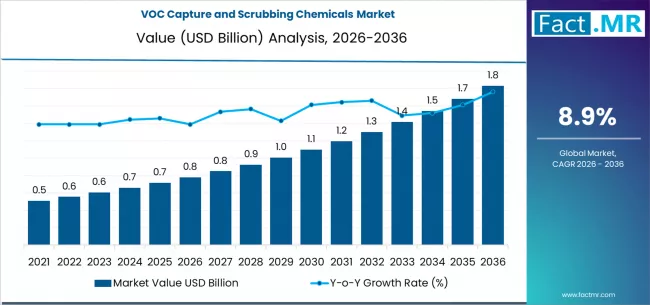
VOC capture and scrubbing chemicals market is projected to grow from USD 0.8 billion in 2026 to USD 1.8 billion by 2036, at a CAGR of 8.9%. Activated Carbon & Adsorbent Chemicals will dominate with a 30.0% market share, while petrochemical & refining will lead the end-use industry segment with a 28.0% share.
VOC Capture and Scrubbing Chemicals Market Forecast and Outlook 2026 to 2036
The global market for VOC capture and scrubbing chemicals is projected to reach USD 1.83 billion by 2036. The market is valued at USD 0.78 billion in 2026 and is set to rise at a CAGR of 8.9% during the assessment period. By chemical type, activated carbon and adsorbent chemicals hold a leading 30% share. The end-use industry for petrochemical and refining represents the dominant application at 28%.
Key Takeaways from the VOC Capture and Scrubbing Chemicals Market
- Market Value for 2026: USD 0.78 Billion
- Market Value for 2036: USD 1.83 Billion
- Forecast CAGR (2026-2036): 8.9%
- Leading Chemical Type Share (2026): Activated Carbon & Adsorbent Chemicals (30%)
- Leading End-Use Industry Share (2026): Petrochemical & Refining (28%)
- Leading Treatment Method Share (2026): Adsorption (Carbon, Zeolites) (36%)
- Key Players in the Market: Ecolab Inc., BASF SE, Solvay S.A., Kurita Water Industries, Cabot Corporation
Adsorption using carbon and zeolites is the foremost treatment method, accounting for a 36% share. This growth is propelled by tightening global air quality regulations aimed at reducing VOC emissions, which contribute to smog formation and pose health risks. Industries are compelled to invest in effective abatement technologies to ensure compliance and meet corporate sustainability targets.
VOC capture and scrubbing chemicals are essential for removing organic solvents, hydrocarbons, and other volatile pollutants from industrial exhaust streams. Their application ranges from simple adsorption to complex oxidation processes, enabling facilities to control emissions, recover valuable solvents, and minimize their environmental footprint.
VOC Capture and Scrubbing Chemicals Market
| Metric | Value |
|---|---|
| Market Value (2026) | USD 0.78 Billion |
| Market Forecast Value (2036) | USD 1.83 Billion |
| Forecast CAGR (2026-2036) | 8.9% |
Category
| Category | Segments |
|---|---|
| Chemical Type | Activated Carbon & Adsorbent Chemicals, Alkaline & Acidic Scrubbing Chemicals, Oxidizing Agents (Ozone, Permanganate, Peroxide), Bio-Based & Enzymatic VOC Treatment Chemicals, Other Specialty VOC Capture Chemicals |
| End-Use Industry | Petrochemical & Refining, Chemical Manufacturing, Paints, Coatings & Printing, Electronics & Semiconductor, Food, Pharma & Others |
| Treatment Method | Adsorption (Carbon, Zeolites), Wet Scrubbing, Thermal/Catalytic Oxidation, Bio-Scrubbing & Biofiltration, Hybrid/Advanced Oxidation |
| Region | North America, Latin America, Western Europe, Eastern Europe, East Asia, South Asia & Pacific, MEA |
Segmental Analysis
By Chemical Type, Which Segment Represents the Most Versatile Solution?
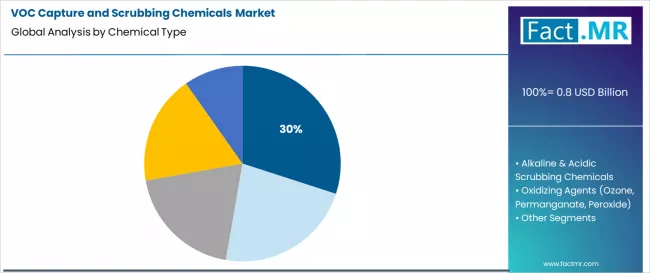
Activated carbon and related adsorbent chemicals lead the segment with a 30% share. Their prominence stems from their exceptional versatility and capacity to adsorb a wide spectrum of organic vapors.
Activated carbon's high surface area and pore structure make it effective for intermittent and variable emission streams, solvent recovery, and polishing applications. Its ability to be regenerated in some cases also offers economic advantages for handling high-volume or valuable VOC streams.
By End-Use Industry, Which Sector Has the Most Concentrated Emission Points?
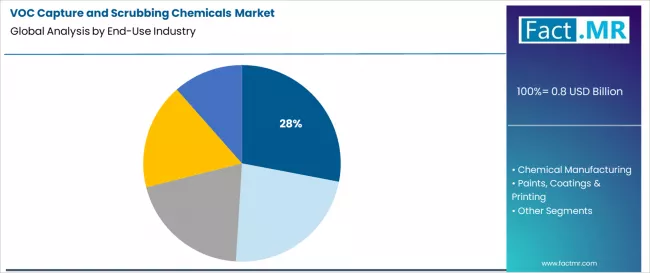
The petrochemical and refining industry commands the largest end-use share at 28%. This sector features numerous fugitive and point-source emissions from tanks, vents, and process units containing hydrocarbons and aromatic compounds.
The scale of operations and the high regulatory scrutiny on these emissions create consistent, large-scale demand for reliable capture and scrubbing solutions, including both adsorption for recovery and oxidation for destruction.
By Treatment Method, Which Approach is Considered a Workhorse for VOC Control?
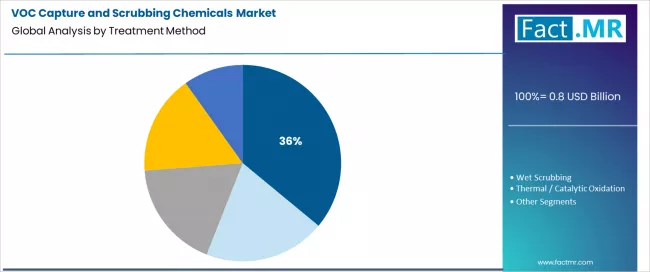
Adsorption using carbon and zeolites is the leading treatment method with a 36% share. It is often the first considered technology due to its relative simplicity, lower capital cost for moderate flow rates, and high removal efficiency for a broad range of VOCs.
The method is particularly suited for applications where solvent recovery is desired or where VOC concentrations are moderate, making it a foundational technology across diverse industries from printing to chemical synthesis.
What are the Drivers, Restraints, and Key Trends of the VOC Capture and Scrubbing Chemicals Market?
The fundamental market driver is the global proliferation of stringent air quality regulations, such as the US EPA's National Emission Standards for Hazardous Air Pollutants (NESHAP) and the EU's Industrial Emissions Directive (IED). These rules mandate specific control efficiencies for VOC emissions. Increasing corporate focus on ESG (Environmental, Social, and Governance) reporting and the push for circular economy practices, including solvent recovery, further stimulate investment in advanced capture technologies.
A primary restraint is the high operational cost associated with certain technologies, particularly thermal oxidation and the periodic replacement or regeneration of spent adsorbents. The treatment of complex, mixed VOC streams can also be challenging, as no single chemical or method is universally effective, often requiring customized, multi-stage solutions that increase complexity and cost.
Key trends include the development of next-generation adsorbents with higher capacity and selectivity for specific VOCs. There is growing adoption of AOPs using ozone or peroxide for low-concentration, high-flow air streams. The market is also seeing increased use of biological treatment methods for sustainable, low-energy treatment of certain biodegradable VOCs. Integration of real-time sensors and AI for dynamic control of chemical dosing and system operation is an emerging trend to optimize efficiency.
Analysis of the VOC Capture and Scrubbing Chemicals Market by Key Countries
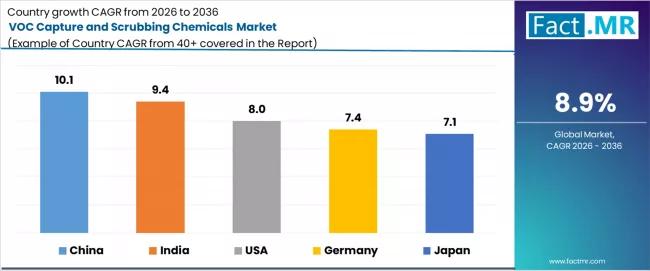
| Country | CAGR (2026-2036) |
|---|---|
| China | 10.10% |
| India | 9.40% |
| USA | 8.00% |
| Germany | 7.40% |
| Japan | 7.10% |
How are China's Air Pollution Action Plans Catalyzing Market Demand?
Ongoing Blue Sky defense campaigns and increasingly strict air pollution control laws fuel China’s leading CAGR of 10.10%. The government mandates VOC emission limits for over 100 key industries, including petrochemicals and coatings. This top-down regulatory push, combined with massive industrial capacity, drives widespread installation and upgrade of VOC control systems, creating the world's fastest-growing market for associated chemicals and adsorbents.
What is the Impact of India's Industrial Growth and Evolving Air Quality Standards?
Rapid industrial expansion and the gradual strengthening of the National Clean Air Programme (NCAP) underpin India’s 9.40% growth. As regulatory frameworks evolve and enforcement increases, especially in industrial clusters and metropolitan areas, industries are compelled to adopt VOC abatement technologies, generating significant and growing demand for capture chemicals and systems.
How does the USA's Mature Regulatory Environment Influence Technological Demand?
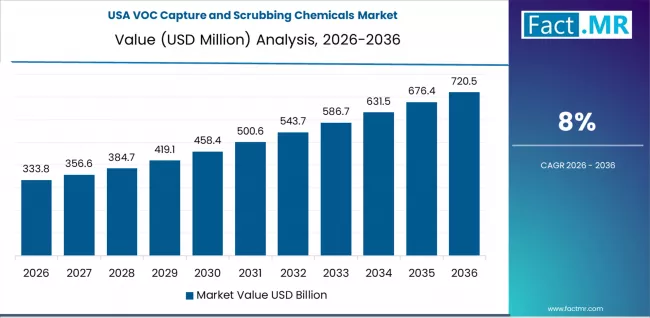
A well-established and stringent regulatory framework under the Clean Air Act supports the USA’s 8.00% growth. Compliance-driven upgrades, leak detection and repair (LDAR) programs, and the need to replace aging control equipment sustain a stable, technology-advanced market. Demand focuses on high-efficiency solutions, next-generation oxidants, and systems that minimize operational costs.
Why is Germany a Hub for Advanced and Integrated Abatement Solutions?
Germany's 7.40% CAGR reflects its leadership in environmental engineering and strict adherence to EU directives. The German market demands highly efficient, reliable, and often customized solutions that integrate seamlessly into sophisticated manufacturing processes. This drives innovation and adoption of advanced chemical scrubbing formulations, precision adsorption systems, and energy-efficient oxidation technologies.
What Role does Japan's High-Tech Industry and Precision Standards Play?
Japan's 7.10% growth is anchored in its advanced electronics, semiconductor, and precision manufacturing sectors, which require ultra-clean processes and stringent control of VOC emissions from solvents and coatings. The need for high-purity, reliable, and compact abatement systems tailored for sensitive manufacturing environments creates a specialized market for premium scrubbing chemicals and advanced capture media.
Competitive Landscape of the VOC Capture and Scrubbing Chemicals Market
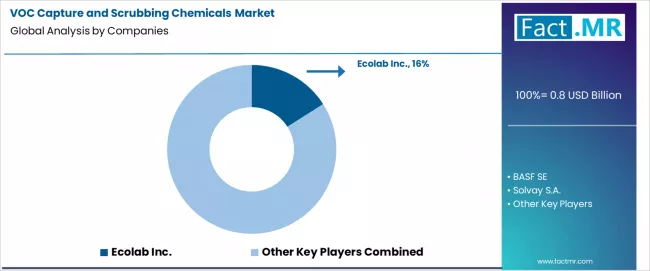
The competitive landscape involves global specialty chemical producers, adsorbent manufacturers, and comprehensive environmental solution providers. Companies like BASF and Solvay compete with advanced oxidizing agent formulations and scrubbing chemistries.
Adsorbent specialists like Cabot Corporation and Kurita Water Industries focus on high-performance carbon and hybrid media. Competition centers on providing proven removal efficiency for specific VOC profiles, offering cost-effective total solutions (including equipment and service), and delivering technical expertise for system design and optimization to meet complex regulatory requirements.
Key Players in the VOC Capture and Scrubbing Chemicals Market
- Ecolab Inc.
- BASF SE
- Solvay S.A.
- Kurita Water Industries
- Cabot Corporation
Scope of Report
| Items | Values |
|---|---|
| Quantitative Units | USD Billion |
| Chemical Type | Adsorbents, Scrubbing Chemicals, Oxidizing Agents, Bio-Based, Other |
| End-Use Industry | Petrochemical/Refining, Chemical Manufacturing, Paints/Coatings, Electronics, Others |
| Treatment Method | Adsorption, Wet Scrubbing, Thermal/Catalytic Oxidation, Bio-Scrubbing, Hybrid/AOP |
| Key Countries | China, India, USA, Germany, Japan |
| Key Companies | Ecolab Inc., BASF SE, Solvay S.A., Kurita Water Industries, Cabot Corporation |
| Additional Analysis | Analysis of adsorbent regeneration techniques and economics; performance of oxidants on different VOC classes; impact of stream humidity and temperature on system selection; regulatory testing methods (e.g., EPA Method 25); life-cycle cost comparison of different abatement technologies. |
Market by Segments
-
Chemical Type :
- Activated Carbon & Adsorbent Chemicals
- Alkaline & Acidic Scrubbing Chemicals
- Oxidizing Agents (Ozone, Permanganate, Peroxide)
- Bio-Based & Enzymatic VOC Treatment Chemicals
- Other Specialty VOC Capture Chemicals
-
End-Use Industry :
- Petrochemical & Refining
- Chemical Manufacturing
- Paints, Coatings & Printing
- Electronics & Semiconductor
- Food, Pharma & Others
-
Treatment Method :
- Adsorption (Carbon, Zeolites)
- Wet Scrubbing
- Thermal/Catalytic Oxidation
- Bio-Scrubbing & Biofiltration
- Hybrid/Advanced Oxidation
-
Region :
- North America
- USA
- Canada
- Latin America
- Brazil
- Mexico
- Argentina
- Rest of Latin America
- Western Europe
- Germany
- UK
- France
- Spain
- Italy
- BENELUX
- Rest of Western Europe
- Eastern Europe
- Russia
- Poland
- Czech Republic
- Rest of Eastern Europe
- East Asia
- China
- Japan
- South Korea
- Rest of East Asia
- South Asia & Pacific
- India
- ASEAN
- Australia
- Rest of South Asia & Pacific
- MEA
- Saudi Arabia
- UAE
- Turkiye
- Rest of MEA
- North America
Table of Content
- Executive Summary
- Global Market Outlook
- Demand to side Trends
- Supply to side Trends
- Technology Roadmap Analysis
- Analysis and Recommendations
- Market Overview
- Market Coverage / Taxonomy
- Market Definition / Scope / Limitations
- Market Background
- Market Dynamics
- Drivers
- Restraints
- Opportunity
- Trends
- Scenario Forecast
- Demand in Optimistic Scenario
- Demand in Likely Scenario
- Demand in Conservative Scenario
- Opportunity Map Analysis
- Product Life Cycle Analysis
- Supply Chain Analysis
- Investment Feasibility Matrix
- Value Chain Analysis
- PESTLE and Porter’s Analysis
- Regulatory Landscape
- Regional Parent Market Outlook
- Production and Consumption Statistics
- Import and Export Statistics
- Market Dynamics
- Global Market Analysis 2021 to 2025 and Forecast, 2026 to 2036
- Historical Market Size Value (USD Million) Analysis, 2021 to 2025
- Current and Future Market Size Value (USD Million) Projections, 2026 to 2036
- Y to o to Y Growth Trend Analysis
- Absolute $ Opportunity Analysis
- Global Market Pricing Analysis 2021 to 2025 and Forecast 2026 to 2036
- Global Market Analysis 2021 to 2025 and Forecast 2026 to 2036, By Chemical Type
- Introduction / Key Findings
- Historical Market Size Value (USD Million) Analysis By Chemical Type, 2021 to 2025
- Current and Future Market Size Value (USD Million) Analysis and Forecast By Chemical Type, 2026 to 2036
- Activated Carbon & Adsorbent Chemicals
- Alkaline & Acidic Scrubbing Chemicals
- Oxidizing Agents (Ozone, Permanganate, Peroxide)
- Bio-Based & Enzymatic VOC Treatment Chemicals
- Other Specialty VOC Capture Chemicals
- Activated Carbon & Adsorbent Chemicals
- Y to o to Y Growth Trend Analysis By Chemical Type, 2021 to 2025
- Absolute $ Opportunity Analysis By Chemical Type, 2026 to 2036
- Global Market Analysis 2021 to 2025 and Forecast 2026 to 2036, By End-Use Industry
- Introduction / Key Findings
- Historical Market Size Value (USD Million) Analysis By End-Use Industry, 2021 to 2025
- Current and Future Market Size Value (USD Million) Analysis and Forecast By End-Use Industry, 2026 to 2036
- Petrochemical & Refining
- Chemical Manufacturing
- Paints, Coatings & Printing
- Electronics & Semiconductor
- Food, Pharma & Others
- Petrochemical & Refining
- Y to o to Y Growth Trend Analysis By End-Use Industry, 2021 to 2025
- Absolute $ Opportunity Analysis By End-Use Industry, 2026 to 2036
- Global Market Analysis 2021 to 2025 and Forecast 2026 to 2036, By Treatment Method
- Introduction / Key Findings
- Historical Market Size Value (USD Million) Analysis By Treatment Method, 2021 to 2025
- Current and Future Market Size Value (USD Million) Analysis and Forecast By Treatment Method, 2026 to 2036
- Adsorption (Carbon, Zeolites)
- Wet Scrubbing
- Thermal / Catalytic Oxidation
- Bio-Scrubbing & Biofiltration
- Hybrid / Advanced Oxidation
- Adsorption (Carbon, Zeolites)
- Y to o to Y Growth Trend Analysis By Treatment Method, 2021 to 2025
- Absolute $ Opportunity Analysis By Treatment Method, 2026 to 2036
- Global Market Analysis 2021 to 2025 and Forecast 2026 to 2036, By Region
- Introduction
- Historical Market Size Value (USD Million) Analysis By Region, 2021 to 2025
- Current Market Size Value (USD Million) Analysis and Forecast By Region, 2026 to 2036
- North America
- Latin America
- Western Europe
- Eastern Europe
- East Asia
- South Asia and Pacific
- Middle East & Africa
- Market Attractiveness Analysis By Region
- North America Market Analysis 2021 to 2025 and Forecast 2026 to 2036, By Country
- Historical Market Size Value (USD Million) Trend Analysis By Market Taxonomy, 2021 to 2025
- Market Size Value (USD Million) Forecast By Market Taxonomy, 2026 to 2036
- By Country
- USA
- Canada
- Mexico
- By Chemical Type
- By End-Use Industry
- By Treatment Method
- By Country
- Market Attractiveness Analysis
- By Country
- By Chemical Type
- By End-Use Industry
- By Treatment Method
- Key Takeaways
- Latin America Market Analysis 2021 to 2025 and Forecast 2026 to 2036, By Country
- Historical Market Size Value (USD Million) Trend Analysis By Market Taxonomy, 2021 to 2025
- Market Size Value (USD Million) Forecast By Market Taxonomy, 2026 to 2036
- By Country
- Brazil
- Chile
- Rest of Latin America
- By Chemical Type
- By End-Use Industry
- By Treatment Method
- By Country
- Market Attractiveness Analysis
- By Country
- By Chemical Type
- By End-Use Industry
- By Treatment Method
- Key Takeaways
- Western Europe Market Analysis 2021 to 2025 and Forecast 2026 to 2036, By Country
- Historical Market Size Value (USD Million) Trend Analysis By Market Taxonomy, 2021 to 2025
- Market Size Value (USD Million) Forecast By Market Taxonomy, 2026 to 2036
- By Country
- Germany
- UK
- Italy
- Spain
- France
- Nordic
- BENELUX
- Rest of Western Europe
- By Chemical Type
- By End-Use Industry
- By Treatment Method
- By Country
- Market Attractiveness Analysis
- By Country
- By Chemical Type
- By End-Use Industry
- By Treatment Method
- Key Takeaways
- Eastern Europe Market Analysis 2021 to 2025 and Forecast 2026 to 2036, By Country
- Historical Market Size Value (USD Million) Trend Analysis By Market Taxonomy, 2021 to 2025
- Market Size Value (USD Million) Forecast By Market Taxonomy, 2026 to 2036
- By Country
- Russia
- Poland
- Hungary
- Balkan & Baltic
- Rest of Eastern Europe
- By Chemical Type
- By End-Use Industry
- By Treatment Method
- By Country
- Market Attractiveness Analysis
- By Country
- By Chemical Type
- By End-Use Industry
- By Treatment Method
- Key Takeaways
- East Asia Market Analysis 2021 to 2025 and Forecast 2026 to 2036, By Country
- Historical Market Size Value (USD Million) Trend Analysis By Market Taxonomy, 2021 to 2025
- Market Size Value (USD Million) Forecast By Market Taxonomy, 2026 to 2036
- By Country
- China
- Japan
- South Korea
- By Chemical Type
- By End-Use Industry
- By Treatment Method
- By Country
- Market Attractiveness Analysis
- By Country
- By Chemical Type
- By End-Use Industry
- By Treatment Method
- Key Takeaways
- South Asia and Pacific Market Analysis 2021 to 2025 and Forecast 2026 to 2036, By Country
- Historical Market Size Value (USD Million) Trend Analysis By Market Taxonomy, 2021 to 2025
- Market Size Value (USD Million) Forecast By Market Taxonomy, 2026 to 2036
- By Country
- India
- ASEAN
- Australia & New Zealand
- Rest of South Asia and Pacific
- By Chemical Type
- By End-Use Industry
- By Treatment Method
- By Country
- Market Attractiveness Analysis
- By Country
- By Chemical Type
- By End-Use Industry
- By Treatment Method
- Key Takeaways
- Middle East & Africa Market Analysis 2021 to 2025 and Forecast 2026 to 2036, By Country
- Historical Market Size Value (USD Million) Trend Analysis By Market Taxonomy, 2021 to 2025
- Market Size Value (USD Million) Forecast By Market Taxonomy, 2026 to 2036
- By Country
- Kingdom of Saudi Arabia
- Other GCC Countries
- Turkiye
- South Africa
- Other African Union
- Rest of Middle East & Africa
- By Chemical Type
- By End-Use Industry
- By Treatment Method
- By Country
- Market Attractiveness Analysis
- By Country
- By Chemical Type
- By End-Use Industry
- By Treatment Method
- Key Takeaways
- Key Countries Market Analysis
- USA
- Pricing Analysis
- Market Share Analysis, 2025
- By Chemical Type
- By End-Use Industry
- By Treatment Method
- Canada
- Pricing Analysis
- Market Share Analysis, 2025
- By Chemical Type
- By End-Use Industry
- By Treatment Method
- Mexico
- Pricing Analysis
- Market Share Analysis, 2025
- By Chemical Type
- By End-Use Industry
- By Treatment Method
- Brazil
- Pricing Analysis
- Market Share Analysis, 2025
- By Chemical Type
- By End-Use Industry
- By Treatment Method
- Chile
- Pricing Analysis
- Market Share Analysis, 2025
- By Chemical Type
- By End-Use Industry
- By Treatment Method
- Germany
- Pricing Analysis
- Market Share Analysis, 2025
- By Chemical Type
- By End-Use Industry
- By Treatment Method
- UK
- Pricing Analysis
- Market Share Analysis, 2025
- By Chemical Type
- By End-Use Industry
- By Treatment Method
- Italy
- Pricing Analysis
- Market Share Analysis, 2025
- By Chemical Type
- By End-Use Industry
- By Treatment Method
- Spain
- Pricing Analysis
- Market Share Analysis, 2025
- By Chemical Type
- By End-Use Industry
- By Treatment Method
- France
- Pricing Analysis
- Market Share Analysis, 2025
- By Chemical Type
- By End-Use Industry
- By Treatment Method
- India
- Pricing Analysis
- Market Share Analysis, 2025
- By Chemical Type
- By End-Use Industry
- By Treatment Method
- ASEAN
- Pricing Analysis
- Market Share Analysis, 2025
- By Chemical Type
- By End-Use Industry
- By Treatment Method
- Australia & New Zealand
- Pricing Analysis
- Market Share Analysis, 2025
- By Chemical Type
- By End-Use Industry
- By Treatment Method
- China
- Pricing Analysis
- Market Share Analysis, 2025
- By Chemical Type
- By End-Use Industry
- By Treatment Method
- Japan
- Pricing Analysis
- Market Share Analysis, 2025
- By Chemical Type
- By End-Use Industry
- By Treatment Method
- South Korea
- Pricing Analysis
- Market Share Analysis, 2025
- By Chemical Type
- By End-Use Industry
- By Treatment Method
- Russia
- Pricing Analysis
- Market Share Analysis, 2025
- By Chemical Type
- By End-Use Industry
- By Treatment Method
- Poland
- Pricing Analysis
- Market Share Analysis, 2025
- By Chemical Type
- By End-Use Industry
- By Treatment Method
- Hungary
- Pricing Analysis
- Market Share Analysis, 2025
- By Chemical Type
- By End-Use Industry
- By Treatment Method
- Kingdom of Saudi Arabia
- Pricing Analysis
- Market Share Analysis, 2025
- By Chemical Type
- By End-Use Industry
- By Treatment Method
- Turkiye
- Pricing Analysis
- Market Share Analysis, 2025
- By Chemical Type
- By End-Use Industry
- By Treatment Method
- South Africa
- Pricing Analysis
- Market Share Analysis, 2025
- By Chemical Type
- By End-Use Industry
- By Treatment Method
- USA
- Market Structure Analysis
- Competition Dashboard
- Competition Benchmarking
- Market Share Analysis of Top Players
- By Regional
- By Chemical Type
- By End-Use Industry
- By Treatment Method
- Competition Analysis
- Competition Deep Dive
- Ecolab Inc.
- Overview
- Product Portfolio
- Profitability by Market Segments (Product/Age /Sales Channel/Region)
- Sales Footprint
- Strategy Overview
- Marketing Strategy
- Product Strategy
- Channel Strategy
- BASF SE
- Solvay S.A.
- Kurita Water Industries
- Cabot Corporation
- Ecolab Inc.
- Competition Deep Dive
- Assumptions & Acronyms Used
- Research Methodology
List Of Table
- Table 1: Global Market Value (USD Million) Forecast by Region, 2021 to 2036
- Table 2: Global Market Value (USD Million) Forecast by Chemical Type , 2021 to 2036
- Table 3: Global Market Value (USD Million) Forecast by End-Use Industry, 2021 to 2036
- Table 4: Global Market Value (USD Million) Forecast by Treatment Method, 2021 to 2036
- Table 5: North America Market Value (USD Million) Forecast by Country, 2021 to 2036
- Table 6: North America Market Value (USD Million) Forecast by Chemical Type , 2021 to 2036
- Table 7: North America Market Value (USD Million) Forecast by End-Use Industry, 2021 to 2036
- Table 8: North America Market Value (USD Million) Forecast by Treatment Method, 2021 to 2036
- Table 9: Latin America Market Value (USD Million) Forecast by Country, 2021 to 2036
- Table 10: Latin America Market Value (USD Million) Forecast by Chemical Type , 2021 to 2036
- Table 11: Latin America Market Value (USD Million) Forecast by End-Use Industry, 2021 to 2036
- Table 12: Latin America Market Value (USD Million) Forecast by Treatment Method, 2021 to 2036
- Table 13: Western Europe Market Value (USD Million) Forecast by Country, 2021 to 2036
- Table 14: Western Europe Market Value (USD Million) Forecast by Chemical Type , 2021 to 2036
- Table 15: Western Europe Market Value (USD Million) Forecast by End-Use Industry, 2021 to 2036
- Table 16: Western Europe Market Value (USD Million) Forecast by Treatment Method, 2021 to 2036
- Table 17: Eastern Europe Market Value (USD Million) Forecast by Country, 2021 to 2036
- Table 18: Eastern Europe Market Value (USD Million) Forecast by Chemical Type , 2021 to 2036
- Table 19: Eastern Europe Market Value (USD Million) Forecast by End-Use Industry, 2021 to 2036
- Table 20: Eastern Europe Market Value (USD Million) Forecast by Treatment Method, 2021 to 2036
- Table 21: East Asia Market Value (USD Million) Forecast by Country, 2021 to 2036
- Table 22: East Asia Market Value (USD Million) Forecast by Chemical Type , 2021 to 2036
- Table 23: East Asia Market Value (USD Million) Forecast by End-Use Industry, 2021 to 2036
- Table 24: East Asia Market Value (USD Million) Forecast by Treatment Method, 2021 to 2036
- Table 25: South Asia and Pacific Market Value (USD Million) Forecast by Country, 2021 to 2036
- Table 26: South Asia and Pacific Market Value (USD Million) Forecast by Chemical Type , 2021 to 2036
- Table 27: South Asia and Pacific Market Value (USD Million) Forecast by End-Use Industry, 2021 to 2036
- Table 28: South Asia and Pacific Market Value (USD Million) Forecast by Treatment Method, 2021 to 2036
- Table 29: Middle East & Africa Market Value (USD Million) Forecast by Country, 2021 to 2036
- Table 30: Middle East & Africa Market Value (USD Million) Forecast by Chemical Type , 2021 to 2036
- Table 31: Middle East & Africa Market Value (USD Million) Forecast by End-Use Industry, 2021 to 2036
- Table 32: Middle East & Africa Market Value (USD Million) Forecast by Treatment Method, 2021 to 2036
List Of Figures
- Figure 1: Global Market Pricing Analysis
- Figure 2: Global Market Value (USD Million) Forecast 2021 to 2036
- Figure 3: Global Market Value Share and BPS Analysis by Chemical Type, 2026 and 2036
- Figure 4: Global Market Y to o to Y Growth Comparison by Chemical Type, 2026 to 2036
- Figure 5: Global Market Attractiveness Analysis by Chemical Type
- Figure 6: Global Market Value Share and BPS Analysis by End-Use Industry, 2026 and 2036
- Figure 7: Global Market Y to o to Y Growth Comparison by End-Use Industry, 2026 to 2036
- Figure 8: Global Market Attractiveness Analysis by End-Use Industry
- Figure 9: Global Market Value Share and BPS Analysis by Treatment Method, 2026 and 2036
- Figure 10: Global Market Y to o to Y Growth Comparison by Treatment Method, 2026 to 2036
- Figure 11: Global Market Attractiveness Analysis by Treatment Method
- Figure 12: Global Market Value (USD Million) Share and BPS Analysis by Region, 2026 and 2036
- Figure 13: Global Market Y to o to Y Growth Comparison by Region, 2026 to 2036
- Figure 14: Global Market Attractiveness Analysis by Region
- Figure 15: North America Market Incremental Dollar Opportunity, 2026 to 2036
- Figure 16: Latin America Market Incremental Dollar Opportunity, 2026 to 2036
- Figure 17: Western Europe Market Incremental Dollar Opportunity, 2026 to 2036
- Figure 18: Eastern Europe Market Incremental Dollar Opportunity, 2026 to 2036
- Figure 19: East Asia Market Incremental Dollar Opportunity, 2026 to 2036
- Figure 20: South Asia and Pacific Market Incremental Dollar Opportunity, 2026 to 2036
- Figure 21: Middle East & Africa Market Incremental Dollar Opportunity, 2026 to 2036
- Figure 22: North America Market Value Share and BPS Analysis by Country, 2026 and 2036
- Figure 23: North America Market Value Share and BPS Analysis by Chemical Type, 2026 and 2036
- Figure 24: North America Market Y to o to Y Growth Comparison by Chemical Type, 2026 to 2036
- Figure 25: North America Market Attractiveness Analysis by Chemical Type
- Figure 26: North America Market Value Share and BPS Analysis by End-Use Industry, 2026 and 2036
- Figure 27: North America Market Y to o to Y Growth Comparison by End-Use Industry, 2026 to 2036
- Figure 28: North America Market Attractiveness Analysis by End-Use Industry
- Figure 29: North America Market Value Share and BPS Analysis by Treatment Method, 2026 and 2036
- Figure 30: North America Market Y to o to Y Growth Comparison by Treatment Method, 2026 to 2036
- Figure 31: North America Market Attractiveness Analysis by Treatment Method
- Figure 32: Latin America Market Value Share and BPS Analysis by Country, 2026 and 2036
- Figure 33: Latin America Market Value Share and BPS Analysis by Chemical Type, 2026 and 2036
- Figure 34: Latin America Market Y to o to Y Growth Comparison by Chemical Type, 2026 to 2036
- Figure 35: Latin America Market Attractiveness Analysis by Chemical Type
- Figure 36: Latin America Market Value Share and BPS Analysis by End-Use Industry, 2026 and 2036
- Figure 37: Latin America Market Y to o to Y Growth Comparison by End-Use Industry, 2026 to 2036
- Figure 38: Latin America Market Attractiveness Analysis by End-Use Industry
- Figure 39: Latin America Market Value Share and BPS Analysis by Treatment Method, 2026 and 2036
- Figure 40: Latin America Market Y to o to Y Growth Comparison by Treatment Method, 2026 to 2036
- Figure 41: Latin America Market Attractiveness Analysis by Treatment Method
- Figure 42: Western Europe Market Value Share and BPS Analysis by Country, 2026 and 2036
- Figure 43: Western Europe Market Value Share and BPS Analysis by Chemical Type, 2026 and 2036
- Figure 44: Western Europe Market Y to o to Y Growth Comparison by Chemical Type, 2026 to 2036
- Figure 45: Western Europe Market Attractiveness Analysis by Chemical Type
- Figure 46: Western Europe Market Value Share and BPS Analysis by End-Use Industry, 2026 and 2036
- Figure 47: Western Europe Market Y to o to Y Growth Comparison by End-Use Industry, 2026 to 2036
- Figure 48: Western Europe Market Attractiveness Analysis by End-Use Industry
- Figure 49: Western Europe Market Value Share and BPS Analysis by Treatment Method, 2026 and 2036
- Figure 50: Western Europe Market Y to o to Y Growth Comparison by Treatment Method, 2026 to 2036
- Figure 51: Western Europe Market Attractiveness Analysis by Treatment Method
- Figure 52: Eastern Europe Market Value Share and BPS Analysis by Country, 2026 and 2036
- Figure 53: Eastern Europe Market Value Share and BPS Analysis by Chemical Type, 2026 and 2036
- Figure 54: Eastern Europe Market Y to o to Y Growth Comparison by Chemical Type, 2026 to 2036
- Figure 55: Eastern Europe Market Attractiveness Analysis by Chemical Type
- Figure 56: Eastern Europe Market Value Share and BPS Analysis by End-Use Industry, 2026 and 2036
- Figure 57: Eastern Europe Market Y to o to Y Growth Comparison by End-Use Industry, 2026 to 2036
- Figure 58: Eastern Europe Market Attractiveness Analysis by End-Use Industry
- Figure 59: Eastern Europe Market Value Share and BPS Analysis by Treatment Method, 2026 and 2036
- Figure 60: Eastern Europe Market Y to o to Y Growth Comparison by Treatment Method, 2026 to 2036
- Figure 61: Eastern Europe Market Attractiveness Analysis by Treatment Method
- Figure 62: East Asia Market Value Share and BPS Analysis by Country, 2026 and 2036
- Figure 63: East Asia Market Value Share and BPS Analysis by Chemical Type, 2026 and 2036
- Figure 64: East Asia Market Y to o to Y Growth Comparison by Chemical Type, 2026 to 2036
- Figure 65: East Asia Market Attractiveness Analysis by Chemical Type
- Figure 66: East Asia Market Value Share and BPS Analysis by End-Use Industry, 2026 and 2036
- Figure 67: East Asia Market Y to o to Y Growth Comparison by End-Use Industry, 2026 to 2036
- Figure 68: East Asia Market Attractiveness Analysis by End-Use Industry
- Figure 69: East Asia Market Value Share and BPS Analysis by Treatment Method, 2026 and 2036
- Figure 70: East Asia Market Y to o to Y Growth Comparison by Treatment Method, 2026 to 2036
- Figure 71: East Asia Market Attractiveness Analysis by Treatment Method
- Figure 72: South Asia and Pacific Market Value Share and BPS Analysis by Country, 2026 and 2036
- Figure 73: South Asia and Pacific Market Value Share and BPS Analysis by Chemical Type, 2026 and 2036
- Figure 74: South Asia and Pacific Market Y to o to Y Growth Comparison by Chemical Type, 2026 to 2036
- Figure 75: South Asia and Pacific Market Attractiveness Analysis by Chemical Type
- Figure 76: South Asia and Pacific Market Value Share and BPS Analysis by End-Use Industry, 2026 and 2036
- Figure 77: South Asia and Pacific Market Y to o to Y Growth Comparison by End-Use Industry, 2026 to 2036
- Figure 78: South Asia and Pacific Market Attractiveness Analysis by End-Use Industry
- Figure 79: South Asia and Pacific Market Value Share and BPS Analysis by Treatment Method, 2026 and 2036
- Figure 80: South Asia and Pacific Market Y to o to Y Growth Comparison by Treatment Method, 2026 to 2036
- Figure 81: South Asia and Pacific Market Attractiveness Analysis by Treatment Method
- Figure 82: Middle East & Africa Market Value Share and BPS Analysis by Country, 2026 and 2036
- Figure 83: Middle East & Africa Market Value Share and BPS Analysis by Chemical Type, 2026 and 2036
- Figure 84: Middle East & Africa Market Y to o to Y Growth Comparison by Chemical Type, 2026 to 2036
- Figure 85: Middle East & Africa Market Attractiveness Analysis by Chemical Type
- Figure 86: Middle East & Africa Market Value Share and BPS Analysis by End-Use Industry, 2026 and 2036
- Figure 87: Middle East & Africa Market Y to o to Y Growth Comparison by End-Use Industry, 2026 to 2036
- Figure 88: Middle East & Africa Market Attractiveness Analysis by End-Use Industry
- Figure 89: Middle East & Africa Market Value Share and BPS Analysis by Treatment Method, 2026 and 2036
- Figure 90: Middle East & Africa Market Y to o to Y Growth Comparison by Treatment Method, 2026 to 2036
- Figure 91: Middle East & Africa Market Attractiveness Analysis by Treatment Method
- Figure 92: Global Market - Tier Structure Analysis
- Figure 93: Global Market - Company Share Analysis
- FAQs -
How big is the voc capture and scrubbing chemicals market in 2026?
The global voc capture and scrubbing chemicals market is estimated to be valued at USD 0.8 billion in 2026.
What will be the size of voc capture and scrubbing chemicals market in 2036?
The market size for the voc capture and scrubbing chemicals market is projected to reach USD 1.8 billion by 2036.
How much will be the voc capture and scrubbing chemicals market growth between 2026 and 2036?
The voc capture and scrubbing chemicals market is expected to grow at a 8.9% CAGR between 2026 and 2036.
What are the key product types in the voc capture and scrubbing chemicals market?
The key product types in voc capture and scrubbing chemicals market are activated carbon & adsorbent chemicals, alkaline & acidic scrubbing chemicals, oxidizing agents (ozone, permanganate, peroxide), bio-based & enzymatic voc treatment chemicals and other specialty voc capture chemicals.
Which end-use industry segment to contribute significant share in the voc capture and scrubbing chemicals market in 2026?
In terms of end-use industry, petrochemical & refining segment to command 28.0% share in the voc capture and scrubbing chemicals market in 2026.