- Base Value(2025): 0.2 Bn
- Estimated Value(2026): 0.2 Bn
- Forecast Value (2036): 0.5 Bn
- CAGR (2026 - 2036): 10.1%
Mobile Slaughterhouses Market Forecast and Outlook By Fact.MR
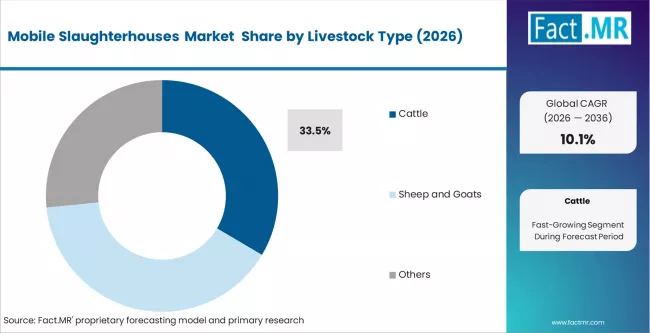
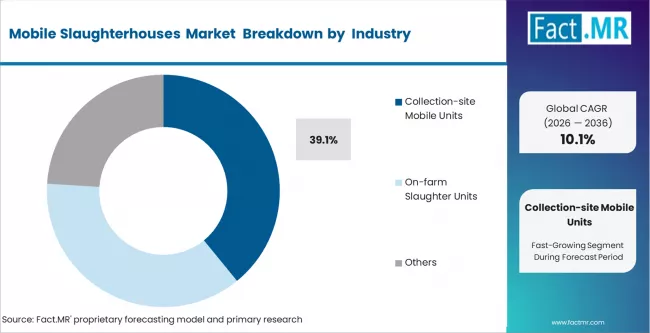
The mobile slaughterhouses market was valued at USD 0.2 billion in 2025 and is projected to reach USD 0.2 billion in 2026 and USD 0.5 billion by 2036, at a CAGR of 10.1%. Cattle leads livestock type at 33.5% share in 2026. Collection-site Mobile Units holds the top operation model position at 39.1%, with Cooperatives commanding end use demand at 30.8% in 2026. The fundamental market driver here is a geography problem. Processing capacity in modern food systems is concentrated, and the cost of transporting livestock from dispersed small-scale producers to those distant processing points can eliminate the economics of local meat production entirely. Mobile slaughter units solve that problem directly, and in doing so they unlock supply chains that the fixed abattoir system structurally cannot serve.
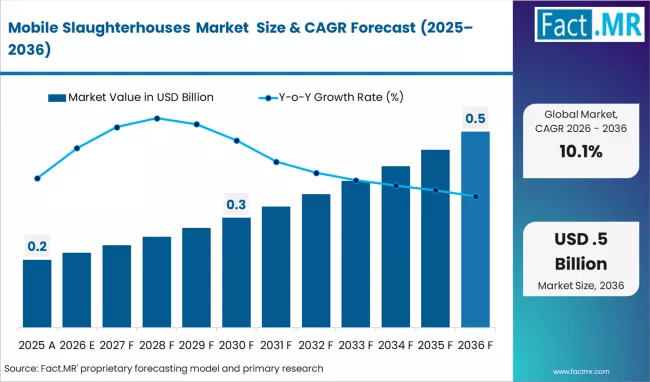
Mobile Slaughterhouses Market Market Value Analysis | Source: Fact.MR
Key Drivers
- Processing Access Gap: Small livestock producers often lack economically viable access to inspected slaughter facilities within practical distance.
- Animal Welfare Case: On-farm or near-farm slaughter can reduce transport stress and logistics burden on livestock.
- Local Food Systems: Regional meat programs and cooperative models continue to support interest in mobile processing units.
Key Segments Analyzed in the Report
- Livestock Type: Cattle, Sheep And Goats, Poultry, Swine, And Others
- Operation Model: On-Farm Slaughter Units, Collection-Site Mobile Units, Mobile Processing Labs, And Others
- End Use: Smallholder Farms, Cooperatives, Tribal And Remote Communities, Specialty Meat Processors, And Others
- Region: North America, Latin America, Europe, Asia Pacific, And Middle East & Africa
Analyst Opinion
Shambhu Nath Jha, Principal Consultant, Fact.MR says mobile slaughterhouses are not a mass industrial throughput story. Their value sits in access, animal welfare, and regional economics where fixed abattoir capacity is missing, distant, or commercially impractical for smaller producers. The market will grow wherever local food policy and regional meat infrastructure investment align, and stall wherever the operating ecosystem around the unit is not designed with the same care as the unit itself.
Mobile Slaughterhouses Market Definition
The mobile slaughterhouses market covers self-contained or transportable slaughter units designed to bring inspected or controlled slaughter capability closer to livestock production sites or regional collection hubs.
Mobile Slaughterhouses Market Inclusions
- Revenue from transportable slaughter units, mobile abattoirs, modular harvest units, and adjacent mobile processing configurations.
- Use across small-scale livestock systems, remote communities, cooperative meat models, and specialty local meat supply chains.
- Demand across North America, Latin America, Europe, Asia Pacific, and the Middle East & Africa.
Mobile Slaughterhouses Market Exclusions
- Conventional fixed abattoirs and permanent slaughterhouse construction revenue.
- Cold-chain or meat transport equipment sold without slaughter functionality.
- Livestock trading revenue unrelated to mobile slaughter infrastructure.
Mobile Slaughterhouses Market Research Methodology
This study evaluates the mobile slaughterhouses market across livestock type, operation model, end use, and region, using 2025 as the base year and 2026 to 2036 as the forecast period. Market value is expressed in USD billion. Evidence inputs include official compliance guidance, agricultural processing studies, local meat infrastructure needs, and first-party information from mobile slaughter unit builders and operators. Triangulation aligns unit build costs, deployment volumes, operating models, livestock mix, and regional infrastructure gaps to derive segment and regional estimates.
Key Drivers, Restraints, and Trends in Mobile Slaughterhouses Market
Drivers
Mobile slaughterhouses are gaining attention where geography and scale break the economics of fixed processing. Small producers often cannot justify long-distance transport to a permanent plant, and in some regions that transport undermines animal-welfare and local-food claims. Mobile units offer a way to bring slaughter capacity closer to production without constructing a full abattoir at every site.
Restraints
The category remains operationally challenging. Inspection compliance, wastewater handling, chilling logistics, utilization rates, and labor availability can all limit commercial viability. A mobile unit only works when the surrounding ecosystem of collection, carcass handling, hygiene, and scheduling is designed around it.
Trends
Viable models are moving away from isolated farm-to-farm operation and toward hub or collection-site systems shared across regional producer groups. That helps improve scheduling, inspection practicality, and equipment utilization. Modular builds are also widening the market beyond one-size-fits-all trailer concepts.
Segmental Analysis
Mobile Slaughterhouses Market Analysis by Livestock Type
Mobile Slaughterhouses Market Analysis By Livestock Type | Source: Fact.MR
The Cattle segment is expected to lead the livestock type category with a 33.5% share in 2026. Cattle lead because beef processing captures higher value per animal and often faces pronounced rural processing bottlenecks in regions with dispersed producers. Even modest cattle throughput can support stronger economics than very small-unit poultry or mixed micro-livestock models.
Mobile Slaughterhouses Market Analysis by Operation Model
Mobile Slaughterhouses Market Analysis By Operation Model | Source: Fact.MR
The Collection-site Mobile Units segment is expected to lead the operation model category with a 39.1% share in 2026. Collection-site models lead because they balance mobility with operational discipline. They reduce the need for every farm to maintain slaughter-ready infrastructure and improve unit utilization by concentrating scheduled throughput at prepared sites.
Competitive Aligners for Market Players
Mobile Slaughterhouses Market Analysis By Company | Source: Fact.MR
The mobile slaughterhouse market is defined by a deceptively simple insight: the equipment is the easy part. The hard part is the operating system around it. Wastewater disposal at every stop, maintaining inspection approval across multiple jurisdictions, coordinating livestock scheduling across dozens of small producers, keeping the chilling chain intact between slaughter and the next cold-storage point, and training and retaining a skilled operator team that does not mind moving locations regularly: these are the operational problems that have caused more mobile slaughter programs to fail than any equipment deficiency. The competitors who understand this build operating system capability as seriously as they build equipment.
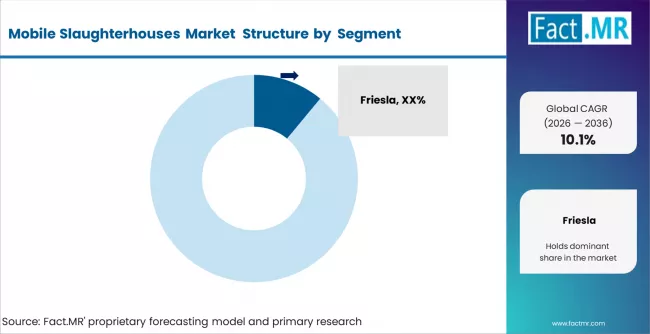
Friesla and Kometos have each developed reputations not just as equipment manufacturers but as organizations that help customers design viable operating models. That advisory capability, understanding what inspection agencies require in different regions, what waste handling infrastructure is typically needed, and how scheduling must be organized to make unit economics work, is a competitive asset that is difficult for a pure equipment manufacturer to replicate. In a market where buyers are often trying something new, the supplier that helps them avoid the known failure modes commands a relationship that extends well beyond the initial sale.
From a geographic competitive standpoint, the markets that will drive the most unit volume growth are not necessarily the most publicized. USDA pilot programs in the United States generate significant policy attention, but the deployment volumes in Scotland, Scandinavia, and New Zealand, where sheep and cattle farming is dispersed across remote landscapes and local meat culture is strong, have in some respects been more commercially consistent. In the medium term, emerging markets in Southeast Asia and East Africa, where smallholder livestock production is enormous and fixed processing infrastructure is thin, represent the largest long-run opportunity for suppliers who can design units and operating models appropriate to those regulatory and infrastructure environments.
Key Players in Mobile Slaughterhouses Market
- Friesla
- TriVan Truck Body
- Kometos
- Mobile Slaughter Technologies
- AES Food Equipment
- Global Food Technology
- The Mobile Abattoir Company
- Fir Farm
- Niche Meat Processor Assistance Network
- Ranch Foods Direct
Strategic Outlook by Fact.MR on Mobile Slaughterhouses Market
Fact.MR expects mobile slaughterhouses to remain a specialized but increasingly relevant market where local meat systems, welfare standards, and regional processing resilience matter. Growth will be most durable in cooperative and hub-based models that solve utilization and compliance challenges. The suppliers who invest in operating model design, regulatory navigation, and regional ecosystem building alongside their equipment offering are the ones who will define what this market looks like at scale.
Bibliography
- Scottish Animal Welfare Commission. (2025). Abattoir provision and opportunities for mobile slaughterhouses in Scotland.
- Scottish Animal Welfare Commission. (2024). Annual report of SAWC activity 2023–2024.
- United States Department of Agriculture, National Agricultural Statistics Service. (2025). Livestock slaughter 2024 summary.
- United States Department of Agriculture, National Agricultural Statistics Service. (2026). Livestock slaughter 2025 annual summary.
- Kometos. (n.d.). Mobile slaughterhouses.
Segmentation
Scope of the Report
| Metric | Value |
|---|---|
| Market Value | USD 0.2 billion in 2025 to USD 0.5 billion by 2036 |
| CAGR | 10.1% from 2026 to 2036 |
| Base Year | 2025 |
| Forecast Period | 2026 to 2036 |
| Livestock Type Segmentation | Cattle, Sheep and Goats, Poultry, Swine, Others |
| Operation Model Segmentation | On-farm Slaughter Units, Collection-site Mobile Units, Mobile Processing Labs, Others |
| End Use Segmentation | Smallholder Farms, Cooperatives, Tribal and Remote Communities, Specialty Meat Processors, Others |
| Regional Coverage | North America, Latin America, Europe, Asia Pacific, and Middle East & Africa |
Source: Fact.MR analysis. Updated Mar 16, 2026
Frequently Asked Questions
What is the projected size of the Mobile Slaughterhouses Market by 2036?
What is the CAGR of the Mobile Slaughterhouses Market from 2026 to 2036?
Which livestock type segment leads the Mobile Slaughterhouses Market?
Which operation model segment dominates the Mobile Slaughterhouses Market?
Which end use segment leads the Mobile Slaughterhouses Market?
Who are the key companies in the Mobile Slaughterhouses Market?
What is driving demand in the Mobile Slaughterhouses Market?
Who worked on this report


Preview the report firsthand - request a free sample
Free SampleGet the brochure for pricing and purchase details
Download PDF