Multi-Omic Fluidic Samplers Market (2026 - 2036)

Multi-Omic Fluidic Samplers Market Analysis, By Product Type, By Sample Type, By Application, By End User and Region - Market Insights 2026 to 2036

Core Findings

    Multi-Omic Fluidic Samplers Market Outlook 2026-2036

    The global multi-omic fluidic samplers market is expected to reach USD 2,757 million by 2036, up from USD 1,197 million in 2026. During the forecast period (2026 to 2036), the industry is projected to expand at a CAGR of 8.7%.

    An increase of USD 1.56 billion over the forecast period signals strong but incremental expansion rather than a structural transformation. Growth is supported by rising multi-omics research funding and precision medicine adoption, but moderated by high capital equipment costs, grant-dependent purchasing cycles in academic labs, regulatory validation requirements for clinical deployment, and substitution pressure from integrated benchtop omics platforms that bundle sampling with analytics.
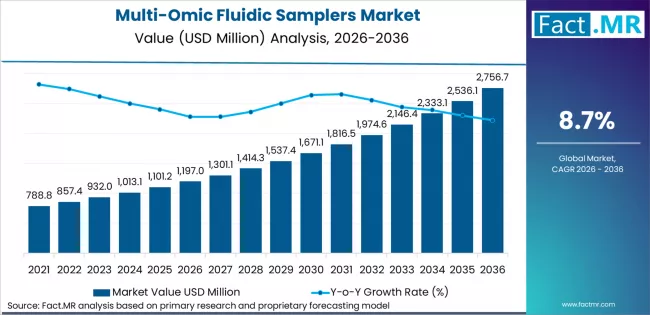
    Multi Omic Fluidic Samplers Market Market Value Analysis

    The multi-omic fluidic samplers market has also recorded stable growth owing to the rising demand of accurate, effective, and scalable sampling technology which enables comprehensive omics analysis. Clinical and research uses have been increased with the adoption of automation, microfluidic engineering and multiplexed sample collection technologies. The development of sustainable and miniaturized sampler designs leads to the improvement of accuracy of the analysis, biocompatibility and cost efficiency, contributing to the growth of business and development of technologies worldwide.

    Quick Stats for Multi-Omic Fluidic Samplers Market

    • Industry Value (2026): USD 1,197 Million
    • Projected Value (2036): USD 2,757 Million
    • Forecast CAGR (2026 to 2036): 8.7%
    • Leading Segment (2026): Automated Samplers (36.5% Market Share)
    • Fastest Growing Country (2026-2036): India (11.3% CAGR)
    • Top Key Players:Illumina, Inc., Thermo Fisher Scientific Inc., and Danaher Corporation

    Market Definition

    The Multi-Omic Fluidic Samplers market refers to specialized laboratory instruments designed to collect, isolate, and prepare biological samples-such as blood, tissue fluids, or cellular extracts-for multi-omics analysis. “Multi-omics” means studying multiple biological layers at once, including genomics (DNA), transcriptomics (RNA), proteomics (proteins), and metabolomics (metabolites). These samplers use controlled microfluidic systems to handle very small volumes of fluids with high precision and minimal contamination. Their primary function is to standardize and automate sample preparation before advanced analytical testing. The key end-uses include biomedical research, precision medicine development, clinical diagnostics, and pharmaceutical drug discovery programs.

    Market Inclusion: The report provides global and regional market size estimates for the Multi-Omic Fluidic Samplers market, covering the base year 2025 and forecasts from 2026 to 2036. It includes detailed segmentation by product type, application, and end user, along with country-level analysis. The study also evaluates pricing trends, competitive landscape, technology adoption, regulatory impact, and trade flow dynamics to deliver a comprehensive industry outlook.

    Market Exclusion: The scope excludes full-scale sequencing instruments, mass spectrometers, standalone PCR systems, and integrated omics analyzers unless directly bundled with fluidic sampling modules. It also omits downstream diagnostic test kits, commercial genomic testing services, and bioinformatics software platforms. The report does not cover general laboratory consumables or standard microfluidic chips used outside multi-omics workflows, focusing strictly on dedicated multi-omic fluidic sampling systems and their immediate operational components.

    Research Methodology

    Primary Research: Interviews were conducted with senior executives from microfluidics equipment manufacturers, multi-omics platform providers, contract research organizations (CROs), academic research labs, and procurement heads in pharmaceutical and biotechnology companies.

    Desk Research: The study draws on annual reports, investor presentations, regulatory filings, grant funding databases, patent publications, and verified company press releases related to multi-omics and microfluidic technologies.

    Market-Sizing and Forecasting: A hybrid approach was used, combining bottom-up revenue analysis of leading manufacturers with top-down validation against regional life sciences research expenditure and capital equipment spending trends.

    Data Validation and Update Cycle: Estimates were triangulated using primary interviews, financial disclosures, and funding data, with periodic updates aligned to major product launches, research funding cycles, and strategic investment announcements.

    What are the drivers of the multi-omic fluidic samplers market?

    It is anticipated that the multi-omic fluidic samplers market will be led by the development of microfluidics, bioengineering and the integration of analytical omics. Their application in diagnostics, precision medicine, and translational research is driven by increasing demand for patient-specific, biocompatible, and high throughput sampling systems.

    The increasing investments in microfabrication and polymer technology are enhancing the design of sampler channels, and the control and accuracy of the analysis. The multi-omic sampling platforms of the next generation are scalable manufacturing and validation, which are being supported by collaborations between medical device companies and research centers.

    Sustainability development is also being influenced by the fact that manufacturers are now using recyclable polymers, low-emission manufacturing, and adhering to global standards like REACH to reduce the impact on the environment. Also, the presence of more regulatory approvals and the use of minimally invasive sample collection techniques are also speeding up the global growth of the market. The EU MDR transition extensions implemented in 2023–2024 have intensified compliance requirements for medical and diagnostic devices, including microfluidic sampling systems. This increases validation costs but improves long-term regulatory credibility for compliant manufacturers. [1]

    • Precision Medicine Funding: Expanding government-backed genomics and precision health programs are structurally driving demand for standardized sample preparation tools. For instance, national initiatives such as the U.S. National Institutes of Health’s All of Us Research Program are increasing multi-omics data generation, directly supporting investment in automated fluidic sampling systems that improve reproducibility and throughput. In 2023, the NIH All of Us Research Program surpassed 400,000 participants with genomic data available to researchers, significantly expanding multi-omic datasets. This scale directly increases demand for standardized, automated fluidic sampling and preparation platforms. [2]
    • Regulatory Validation Standards: Clinical translation of multi-omics workflows is increasingly influenced by laboratory compliance requirements such as the U.S. Clinical Laboratory Improvement Amendments (CLIA) and ISO 15189 accreditation standards. These frameworks push laboratories toward validated, automated fluidic sampling platforms that minimize manual variability and support audit-ready traceability.
    • Asia-Pacific Research Expansion: Countries such as China and South Korea are scaling national genomics and biotech research infrastructure, accelerating procurement of advanced laboratory automation tools. Regional investments in biomedical parks and translational research centers are expanding installed bases of multi-omic fluidic systems, particularly in high-growth Asia-Pacific markets.

    What are the regional trends of the multi-omic fluidic samplers market?

    America is the strongest market of multi-omic fluidic samplers rivaled by robust healthcare systems, well understood regulatory settings, and a significant R&D in omics integration and microfluidic automation. The engagement of research universities and biotech companies helps to further boost the innovation and FDA approvals of more advanced sampling systems.

    Europe is experiencing gradual improvement with tough medical device legislation, sustainability and technological dominance in miniaturized sampling. Countries such as Germany, France, and the U.K. focus on the forces of compliance with REACH, quality of data, and sustainable production making the region a hub of regulation-oriented innovation.

    The Asia Pacific area is rising at an alarming rate, and within it, China, Japan, and India are leading the pack in terms of emerging biomedical technologies, innovative localized production, and digital health programs supported by the government. Increased investment in precision diagnostics and omics technologies is making regional markets accessible and affordable. China continued expanding its national precision medicine program in 2023, supporting multi-omics research infrastructure development and domestic medical device innovation. This directly boosts procurement of advanced sampling and microfluidic automation systems. [3]

    Latin America and Middle East / Africa are on the move with the development of more healthcare facilities, more research partnerships, and the growing interest in precision sampling in diagnosis. The global medtech partners are facilitating access to more sustainable and innovative sampling systems in new economies.

    What are the challenges and restraining factors of the Multi-Omic Fluidic Samplers market?

    The multi-omic fluidic samplers market has a number of threats that restrict the large scale use and commercialize it. Microfabrication, sensor integration and validation at multiple omic platforms are advanced and expensive to produce, especially in price sensitive areas. Unstandardized testing procedures, complicated calibration requirements and time-consuming regulatory approvals in addition to slacking product rollout and reimbursement procedures.

    Rigorous compliance requirements under the FDA, EMA and REACH systems increase the cost of R&D and activities. Analytical accuracy and reproducibility of fluid biological elements are influenced by aspects of design that determine fluidic precision, sample integrity, and biocompatibility. Sterilization sensitivity, temperature fluctuation, and material fatigue in the course of constant use can also affect long-term stability.

    Scalability is inhibited by a disjointed global supply chain, inaccessibility to high-grade polymers, and technical know-how in the new regions. Market penetration is also limited by competition with established analytical tools and traditional sampling methods, but on-going development of R&D and localized production, will overcome these obstacles.

    Country-Wise Insights
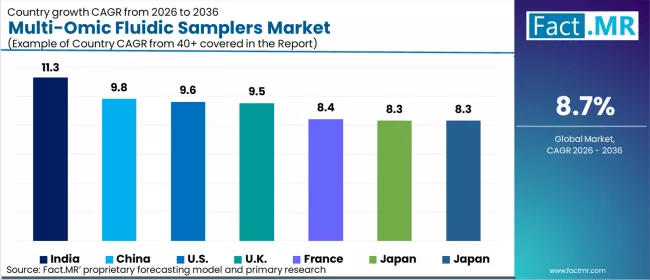
    Multi Omic Fluidic Samplers Market Cagr Analysis By Country

    Country CAGR %
    U.S. 9.6%
    China 9.8%
    India 11.3%
    Japan 8.3%
    Germany 8.3%
    France 8.4%
    U.K. 9.5%
    Indonesia 9.9%
    South Korea 8.4%
    Saudi Arabia 8.7%

    Source: Fact MR (FMR) analysis, based on proprietary forecasting model and primary research.

    Precision Manufacturing and Compliance Strengthen Germany’s Multi-Omic Fluidic Samplers Market

    The multi-omic fluidic samplers have been adopted faster in Germany, owing to its engineering skills and good manufacturing foundation. Reliability and performance are being improved by compliance with the standards of the REACH, advanced automation, and sustainable polymer processing. German manufacturers increase focus in digital validation, high accuracy of molding, and traceable bio-materials, which is guaranteed in the next generation of diagnostic equipment.

    Automation and AI-Driven Fabrication Advance Japan’s Multi-Omic Fluidic Samplers Development

    The combination of robotics and smart automation in Japan has re-determined accuracy in fluidic sampling system. Producers are capitalizing on AI-controlled microfabrication, PFAS-free materials, and closed-loop automation to perform the same tasks to the same samples. Joint development of projects in medical universities and technology centers is making Japan the leader in the industry of high-throughput omics sampling innovation.

    Healthcare Diversification and Technological Localization Boost Middle East’s Multi-Omic Fluidic Samplers Growth

    Saudi Arabia and the UAE are among the countries that are encouraging the local production of multi-omic fluidic samplers in line with the national health resilience objectives. Sustainable production is supported by investment in energy-efficient fabrication, adaptive microfluidic materials and automated reactors. These projects are indicative of the overall approach to the region as to innovation-driven diversification of industries and medical technology independence.

    Fact.MR's analysis of the Multi-Omic Fluidic Samplers market in North America consists of country-wise assessment that includes the United States and Canada. Readers can find detailed insights on technology adoption trends, research funding patterns, regulatory environment, competitive landscape, pricing dynamics, and long-term growth projections through 2036.

    Category-Wise Analysis

    Automated and Integrated Systems Drive Core Market Performance
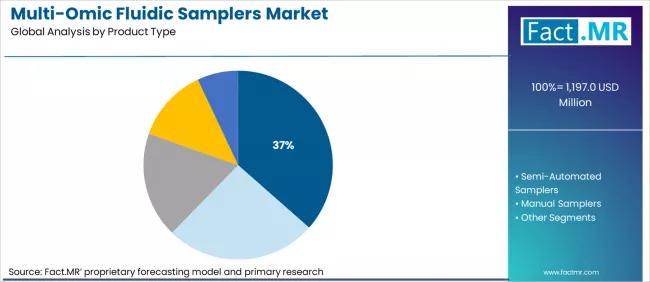
    Multi Omic Fluidic Samplers Market Analysis By Product Type

    Multi-omic fluidic samplers are being automated and integrated with multi-omic samplers characterized as performance standards with accuracy, scalability and minimal contamination potential. Such systems allow processing the samples in parallel, intelligent calibration, and integration with analytical software. They are used in high-throughput labs, which provides reproducible findings, better workflow automation, and efficient generation of multi-omic data.

    Single-Cell and Spatial Applications Anchor Analytical Innovation

    The trend in single-cell and spatial multi-omics is driving the need of micro-precision sampling. The requirements of these applications include controlled flow dynamics and low cross-interference, obtained in adaptive fluidic designs. Highly sophisticated droplet engineering and miniaturized chips enable real-time molecular profiling and will support further biological understanding and enhance the potential of conducting translational research. In 2024, 10x Genomics expanded its Visium spatial biology portfolio, enhancing multi-omic spatial profiling capabilities. These advancements increase the need for ultra-precise fluidic sample handling systems compatible with spatial transcriptomics workflows. [4]

    Blood and Tissue Sampling Establish Foundational Use Cases
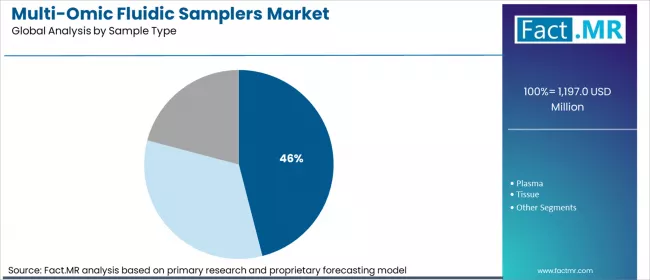
    Multi Omic Fluidic Samplers Market Analysis By Sample Type

    Fluidic sampling is still anchored on blood and tissue samples because they are convenient and diagnostic. Samplers to these media facilitate high fidelity nucleic acid, protein and metabolite extraction. The ever-growing advances in material chemistry and fluid mechanics boost the recovery, purity and preservation of samples in a variety of omic workflows.

    Competitive Analysis

    Multi-omic fluidic samplers are being embraced more rapidly by research institutions, diagnostic developers, and healthcare providers as attention is given toward precision, miniaturization and sustainability in sampling systems. The trend in the world in moving towards contamination-free, high throughput, and environmentally friendly material is forcing the switch of the traditional manual sampling method to automated, polymer-based microfluidic systems. Major manufacturers are developing designs based on sensor integration, microfabrication accuracy and AI-based automation that are compliant with FDA EMA and REACH designs.

    These strategic alliances between microfluidics technology vendors, omics data vendors, and academic research institutions are commercializing. Other companies like Thermo Fisher Scientific, Standard BioTools and QIAGEN are growing their sampler and consumeable lines to enable multi-omic processes. Unremitting innovation in chip design, data connection and low-volume biofluid capture delivers a competitive advantage based on the reproducibility, efficiency and scalable deployment in global research and clinical ecosystems.

    Key players in the multi-omic fluidic samplers market include Illumina, Inc., Thermo Fisher Scientific Inc., Danaher Corporation, Agilent Technologies, Inc., BGI Genomics, QIAGEN N.V., Bruker Corporation, Shimadzu Corporation, Becton, Dickinson and Company, Standard BioTools Inc.

    Recent Development

    • In October 2025, Thermo Fisher Scientific introduced the new Applied Biosystems™ SwiftArrayStudio™ Microarray Analyzer, the Axiom PharmacoPro Array and the Axiom PangenomePro Array. The platform incorporates four genotyping workflows into a single compact system and has the capability of getting results in as little as 30 hours- massively saving hands on time. According to the company, this progress is geared towards speeding up multi-omics research and allowing more studies in the field of pharmacogenomics and pangenome [5].

    Fact.MR has provided detailed information about the price points of key manufacturers of Multi-Omic Fluidic Samplers Market positioned across regions, sales growth, production capacity, and speculative technological expansion, in the recently published report.

    Segmentation of Multi-Omic Fluidic Samplers Market

    By Product Type :

    • Automated Samplers
    • Semi-Automated Samplers
    • Manual Samplers
    • Cartridge Modules
    • Integrated Workflow Systems

    By Sample Type :

    • Blood
    • Plasma
    • Tissue
    • Body Fluids
    • Microbiome Fluids

    By Application :

    • Single-Cell Multi-Omics
    • Bulk Tissue Sampling
    • Longitudinal Microsampling
    • Spatial Multi-Omics
    • Remote/Wearable Sampling

    By End User :

    • Research Institutes
    • Biopharma Companies
    • CROs
    • Diagnostics Labs

    By Region :

    • North America
    • Latin America
    • Western Europe
    • Eastern Europe
    • East Asia
    • South Asia & Pacific
    • Middle East & Africa

    Bibliography

    • [1] European Union – EU MDR Transition Extensions (2023–2024) regulatory update on Medical Device Regulation compliance requirements)
    • [2] National Institutes of Health (NIH) – All of Us Research Program update (2023 milestone exceeding 400,000 participants with genomic data available to researchers)
    • [3] Government of China – National Precision Medicine Program expansion (2023 update supporting multi-omics research infrastructure and domestic medical device innovation)
    • [4] 10x Genomics – 2024 expansion of the Visium spatial biology portfolio (company announcement on enhanced multi-omic spatial profiling capabilities)
    • [5] Thermo Fisher Scientific – October 2025 launch of Applied Biosystems™ SwiftArrayStudio™ Microarray Analyzer, Axiom PharmacoPro Array, and Axiom PangenomePro Array (company product announcement)

    Table of Content

    1. Executive Summary
      • Global Market Outlook
      • Demand-side Trends
      • Supply-side Trends
      • Technology Roadmap Analysis
      • Analysis and Recommendations
    2. Market Overview
      • Market Coverage / Taxonomy
      • Market Definition / Scope / Limitations
    3. Market Background
      • Market Dynamics
        • Drivers
        • Restraints
        • Opportunity
        • Trends
      • Scenario Forecast
        • Demand in Optimistic Scenario
        • Demand in Likely Scenario
        • Demand in Conservative Scenario
      • Opportunity Map Analysis
      • Product Life Cycle Analysis
      • Supply Chain Analysis
      • Investment Feasibility Matrix
      • Value Chain Analysis
      • PESTLE and Porter’s Analysis
      • Regulatory Landscape
      • Regional Parent Market Outlook
      • Production and Consumption Statistics
      • Import and Export Statistics
    4. Global Multi-Omic Fluidic Samplers Market Analysis 2021-2025 and Forecast, 2026-2036
      • Historical Market Size Value (USD Mn) Analysis, 2021-2025
      • Current and Future Market Size Value (USD Mn) Projections, 2026-2036
        • Y-o-Y Growth Trend Analysis
        • Absolute $ Opportunity Analysis
    5. Global Multi-Omic Fluidic Samplers Market Pricing Analysis 2021-2025 and Forecast 2026-2036
    6. Global Multi-Omic Fluidic Samplers Market Analysis 2021-2025 and Forecast 2026-2036, By Product Type
      • Introduction / Key Findings
      • Historical Market Size Value (USD Mn) Analysis By Product Type, 2021-2025
      • Current and Future Market Size Value (USD Mn) Analysis and Forecast By Product Type, 2026-2036
        • Automated Samplers
        • Semi-Automated Samplers
        • Manual Samplers
        • Cartridge Modules
        • Integrated Workflow Systems
      • Y-o-Y Growth Trend Analysis By Product Type, 2021-2025
      • Absolute $ Opportunity Analysis By Product Type, 2026-2036
    7. Global Multi-Omic Fluidic Samplers Market Analysis 2021-2025 and Forecast 2026-2036, By Application
      • Introduction / Key Findings
      • Historical Market Size Value (USD Mn) Analysis By Application, 2021-2025
      • Current and Future Market Size Value (USD Mn) Analysis and Forecast By Application, 2026-2036
        • Single-Cell Multi-Omics
        • Bulk Tissue Sampling
        • Longitudinal Microsampling
        • Spatial Multi-Omics
        • Remote/Wearable Sampling
      • Y-o-Y Growth Trend Analysis By Application, 2021-2025
      • Absolute $ Opportunity Analysis By Application, 2026-2036
    8. Global Multi-Omic Fluidic Samplers Market Analysis 2021-2025 and Forecast 2026-2036, By Sample Type
      • Introduction / Key Findings
      • Historical Market Size Value (USD Mn) Analysis By Sample Type, 2021-2025
      • Current and Future Market Size Value (USD Mn) Analysis and Forecast By Sample Type, 2026-2036
        • Blood
        • Plasma
        • Tissue
        • Body Fluids
        • Microbiome Fluids
      • Y-o-Y Growth Trend Analysis By Sample Type, 2021-2025
      • Absolute $ Opportunity Analysis By Sample Type, 2026-2036
    9. Global Multi-Omic Fluidic Samplers Market Analysis 2021-2025 and Forecast 2026-2036, By End User
      • Introduction / Key Findings
      • Historical Market Size Value (USD Mn) Analysis By End User, 2021-2025
      • Current and Future Market Size Value (USD Mn) Analysis and Forecast By End User, 2026-2036
        • Research Institutes
        • Biopharma Companies
        • CROs
        • Diagnostics Labs
      • Y-o-Y Growth Trend Analysis By End User, 2021-2025
      • Absolute $ Opportunity Analysis By End User, 2026-2036
    10. Global Multi-Omic Fluidic Samplers Market Analysis 2021-2025 and Forecast 2026-2036, By Region
      • Introduction
      • Historical Market Size Value (USD Mn) Analysis By Region, 2021-2025
      • Current Market Size Value (USD Mn) Analysis and Forecast By Region, 2026-2036
        • North America
        • Latin America
        • Western Europe
        • Eastern Europe
        • East Asia
        • South Asia and Pacific
        • Middle East & Africa
      • Market Attractiveness Analysis By Region
    11. North America Multi-Omic Fluidic Samplers Market Analysis 2021-2025 and Forecast 2026-2036, By Country
      • Historical Market Size Value (USD Mn) Trend Analysis By Market Taxonomy, 2021-2025
      • Market Size Value (USD Mn) Forecast By Market Taxonomy, 2026-2036
        • By Country
          • U.S.
          • Canada
          • Mexico
        • By Product Type
        • By Application
        • By Sample Type
        • By End User
      • Market Attractiveness Analysis
        • By Country
        • By Product Type
        • By Application
        • By Sample Type
        • By End User
      • Key Takeaways
    12. Latin America Multi-Omic Fluidic Samplers Market Analysis 2021-2025 and Forecast 2026-2036, By Country
      • Historical Market Size Value (USD Mn) Trend Analysis By Market Taxonomy, 2021-2025
      • Market Size Value (USD Mn) Forecast By Market Taxonomy, 2026-2036
        • By Country
          • Brazil
          • Chile
          • Rest of Latin America
        • By Product Type
        • By Application
        • By Sample Type
        • By End User
      • Market Attractiveness Analysis
        • By Country
        • By Product Type
        • By Application
        • By Sample Type
        • By End User
      • Key Takeaways
    13. Western Europe Multi-Omic Fluidic Samplers Market Analysis 2021-2025 and Forecast 2026-2036, By Country
      • Historical Market Size Value (USD Mn) Trend Analysis By Market Taxonomy, 2021-2025
      • Market Size Value (USD Mn) Forecast By Market Taxonomy, 2026-2036
        • By Country
          • Germany
          • U.K.
          • Italy
          • Spain
          • France
          • Nordic
          • BENELUX
          • Rest of Western Europe
        • By Product Type
        • By Application
        • By Sample Type
        • By End User
      • Market Attractiveness Analysis
        • By Country
        • By Product Type
        • By Application
        • By Sample Type
        • By End User
      • Key Takeaways
    14. Eastern Europe Multi-Omic Fluidic Samplers Market Analysis 2021-2025 and Forecast 2026-2036, By Country
      • Historical Market Size Value (USD Mn) Trend Analysis By Market Taxonomy, 2021-2025
      • Market Size Value (USD Mn) Forecast By Market Taxonomy, 2026-2036
        • By Country
          • Russia
          • Poland
          • Hungary
          • Balkan & Baltic
          • Rest of Eastern Europe
        • By Product Type
        • By Application
        • By Sample Type
        • By End User
      • Market Attractiveness Analysis
        • By Country
        • By Product Type
        • By Application
        • By Sample Type
        • By End User
      • Key Takeaways
    15. East Asia Multi-Omic Fluidic Samplers Market Analysis 2021-2025 and Forecast 2026-2036, By Country
      • Historical Market Size Value (USD Mn) Trend Analysis By Market Taxonomy, 2021-2025
      • Market Size Value (USD Mn) Forecast By Market Taxonomy, 2026-2036
        • By Country
          • China
          • Japan
          • South Korea
        • By Product Type
        • By Application
        • By Sample Type
        • By End User
      • Market Attractiveness Analysis
        • By Country
        • By Product Type
        • By Application
        • By Sample Type
        • By End User
      • Key Takeaways
    16. South Asia and Pacific Multi-Omic Fluidic Samplers Market Analysis 2021-2025 and Forecast 2026-2036, By Country
      • Historical Market Size Value (USD Mn) Trend Analysis By Market Taxonomy, 2021-2025
      • Market Size Value (USD Mn) Forecast By Market Taxonomy, 2026-2036
        • By Country
          • India
          • ASEAN
          • Australia & New Zealand
          • Rest of South Asia and Pacific
        • By Product Type
        • By Application
        • By Sample Type
        • By End User
      • Market Attractiveness Analysis
        • By Country
        • By Product Type
        • By Application
        • By Sample Type
        • By End User
      • Key Takeaways
    17. Middle East & Africa Multi-Omic Fluidic Samplers Market Analysis 2021-2025 and Forecast 2026-2036, By Country
      • Historical Market Size Value (USD Mn) Trend Analysis By Market Taxonomy, 2021-2025
      • Market Size Value (USD Mn) Forecast By Market Taxonomy, 2026-2036
        • By Country
          • Kingdom of Saudi Arabia
          • Other GCC Countries
          • Turkiye
          • South Africa
          • Other African Union
          • Rest of Middle East & Africa
        • By Product Type
        • By Application
        • By Sample Type
        • By End User
      • Market Attractiveness Analysis
        • By Country
        • By Product Type
        • By Application
        • By Sample Type
        • By End User
      • Key Takeaways
    18. Key Countries Multi-Omic Fluidic Samplers Market Analysis
      • U.S.
        • Pricing Analysis
        • Market Share Analysis, 2025
          • By Product Type
          • By Application
          • By Sample Type
          • By End User
      • Canada
        • Pricing Analysis
        • Market Share Analysis, 2025
          • By Product Type
          • By Application
          • By Sample Type
          • By End User
      • Mexico
        • Pricing Analysis
        • Market Share Analysis, 2025
          • By Product Type
          • By Application
          • By Sample Type
          • By End User
      • Brazil
        • Pricing Analysis
        • Market Share Analysis, 2025
          • By Product Type
          • By Application
          • By Sample Type
          • By End User
      • Chile
        • Pricing Analysis
        • Market Share Analysis, 2025
          • By Product Type
          • By Application
          • By Sample Type
          • By End User
      • Germany
        • Pricing Analysis
        • Market Share Analysis, 2025
          • By Product Type
          • By Application
          • By Sample Type
          • By End User
      • U.K.
        • Pricing Analysis
        • Market Share Analysis, 2025
          • By Product Type
          • By Application
          • By Sample Type
          • By End User
      • Italy
        • Pricing Analysis
        • Market Share Analysis, 2025
          • By Product Type
          • By Application
          • By Sample Type
          • By End User
      • Spain
        • Pricing Analysis
        • Market Share Analysis, 2025
          • By Product Type
          • By Application
          • By Sample Type
          • By End User
      • France
        • Pricing Analysis
        • Market Share Analysis, 2025
          • By Product Type
          • By Application
          • By Sample Type
          • By End User
      • India
        • Pricing Analysis
        • Market Share Analysis, 2025
          • By Product Type
          • By Application
          • By Sample Type
          • By End User
      • ASEAN
        • Pricing Analysis
        • Market Share Analysis, 2025
          • By Product Type
          • By Application
          • By Sample Type
          • By End User
      • Australia & New Zealand
        • Pricing Analysis
        • Market Share Analysis, 2025
          • By Product Type
          • By Application
          • By Sample Type
          • By End User
      • China
        • Pricing Analysis
        • Market Share Analysis, 2025
          • By Product Type
          • By Application
          • By Sample Type
          • By End User
      • Japan
        • Pricing Analysis
        • Market Share Analysis, 2025
          • By Product Type
          • By Application
          • By Sample Type
          • By End User
      • South Korea
        • Pricing Analysis
        • Market Share Analysis, 2025
          • By Product Type
          • By Application
          • By Sample Type
          • By End User
      • Russia
        • Pricing Analysis
        • Market Share Analysis, 2025
          • By Product Type
          • By Application
          • By Sample Type
          • By End User
      • Poland
        • Pricing Analysis
        • Market Share Analysis, 2025
          • By Product Type
          • By Application
          • By Sample Type
          • By End User
      • Hungary
        • Pricing Analysis
        • Market Share Analysis, 2025
          • By Product Type
          • By Application
          • By Sample Type
          • By End User
      • Kingdom of Saudi Arabia
        • Pricing Analysis
        • Market Share Analysis, 2025
          • By Product Type
          • By Application
          • By Sample Type
          • By End User
      • Turkiye
        • Pricing Analysis
        • Market Share Analysis, 2025
          • By Product Type
          • By Application
          • By Sample Type
          • By End User
      • South Africa
        • Pricing Analysis
        • Market Share Analysis, 2025
          • By Product Type
          • By Application
          • By Sample Type
          • By End User
    19. Market Structure Analysis
      • Competition Dashboard
      • Competition Benchmarking
      • Market Share Analysis of Top Players
        • By Regional
        • By Product Type
        • By Application
        • By Sample Type
        • By End User
    20. Competition Analysis
      • Competition Deep Dive
        • Illumina, Inc.
          • Overview
          • Product Portfolio
          • Profitability by Market Segments (Product/Age /Sales Channel/Region)
          • Sales Footprint
          • Strategy Overview
        • Thermo Fisher Scientific Inc.
        • Danaher Corporation
        • Agilent Technologies, Inc.
        • BGI Genomics
        • QIAGEN N.V.
        • Bruker Corporation
        • Shimadzu Corporation
        • Becton, Dickinson and Company
        • Standard BioTools Inc.
      • Assumptions & Acronyms Used
      • Research Methodology

    List Of Table

    • Table 1: Global Market Value (USD Million) Forecast by Region, 2021 to 2036
    • Table 2: Global Market Value (USD Million) Forecast by Product Type, 2021 to 2036
    • Table 3: Global Market Value (USD Million) Forecast by Application, 2021 to 2036
    • Table 4: Global Market Value (USD Million) Forecast by Sample Type, 2021 to 2036
    • Table 5: Global Market Value (USD Million) Forecast by End User, 2021 to 2036
    • Table 6: North America Market Value (USD Million) Forecast by Country, 2021 to 2036
    • Table 7: North America Market Value (USD Million) Forecast by Product Type, 2021 to 2036
    • Table 8: North America Market Value (USD Million) Forecast by Application, 2021 to 2036
    • Table 9: North America Market Value (USD Million) Forecast by Sample Type, 2021 to 2036
    • Table 10: North America Market Value (USD Million) Forecast by End User, 2021 to 2036
    • Table 11: Latin America Market Value (USD Million) Forecast by Country, 2021 to 2036
    • Table 12: Latin America Market Value (USD Million) Forecast by Product Type, 2021 to 2036
    • Table 13: Latin America Market Value (USD Million) Forecast by Application, 2021 to 2036
    • Table 14: Latin America Market Value (USD Million) Forecast by Sample Type, 2021 to 2036
    • Table 15: Latin America Market Value (USD Million) Forecast by End User, 2021 to 2036
    • Table 16: Western Europe Market Value (USD Million) Forecast by Country, 2021 to 2036
    • Table 17: Western Europe Market Value (USD Million) Forecast by Product Type, 2021 to 2036
    • Table 18: Western Europe Market Value (USD Million) Forecast by Application, 2021 to 2036
    • Table 19: Western Europe Market Value (USD Million) Forecast by Sample Type, 2021 to 2036
    • Table 20: Western Europe Market Value (USD Million) Forecast by End User, 2021 to 2036
    • Table 21: Eastern Europe Market Value (USD Million) Forecast by Country, 2021 to 2036
    • Table 22: Eastern Europe Market Value (USD Million) Forecast by Product Type, 2021 to 2036
    • Table 23: Eastern Europe Market Value (USD Million) Forecast by Application, 2021 to 2036
    • Table 24: Eastern Europe Market Value (USD Million) Forecast by Sample Type, 2021 to 2036
    • Table 25: Eastern Europe Market Value (USD Million) Forecast by End User, 2021 to 2036
    • Table 26: East Asia Market Value (USD Million) Forecast by Country, 2021 to 2036
    • Table 27: East Asia Market Value (USD Million) Forecast by Product Type, 2021 to 2036
    • Table 28: East Asia Market Value (USD Million) Forecast by Application, 2021 to 2036
    • Table 29: East Asia Market Value (USD Million) Forecast by Sample Type, 2021 to 2036
    • Table 30: East Asia Market Value (USD Million) Forecast by End User, 2021 to 2036
    • Table 31: South Asia and Pacific Market Value (USD Million) Forecast by Country, 2021 to 2036
    • Table 32: South Asia and Pacific Market Value (USD Million) Forecast by Product Type, 2021 to 2036
    • Table 33: South Asia and Pacific Market Value (USD Million) Forecast by Application, 2021 to 2036
    • Table 34: South Asia and Pacific Market Value (USD Million) Forecast by Sample Type, 2021 to 2036
    • Table 35: South Asia and Pacific Market Value (USD Million) Forecast by End User, 2021 to 2036
    • Table 36: Middle East & Africa Market Value (USD Million) Forecast by Country, 2021 to 2036
    • Table 37: Middle East & Africa Market Value (USD Million) Forecast by Product Type, 2021 to 2036
    • Table 38: Middle East & Africa Market Value (USD Million) Forecast by Application, 2021 to 2036
    • Table 39: Middle East & Africa Market Value (USD Million) Forecast by Sample Type, 2021 to 2036
    • Table 40: Middle East & Africa Market Value (USD Million) Forecast by End User, 2021 to 2036

    List Of Figures

    • Figure 1: Global Market Pricing Analysis
    • Figure 2: Global Market Value (USD Mn) Forecast 2021 to 2036
    • Figure 3: Global Market Value Share and BPS Analysis by Product Type, 2026 and 2036
    • Figure 4: Global Market Y-o-Y Growth Comparison by Product Type, 2026 to 2036
    • Figure 5: Global Market Attractiveness Analysis by Product Type
    • Figure 6: Global Market Value Share and BPS Analysis by Application, 2026 and 2036
    • Figure 7: Global Market Y-o-Y Growth Comparison by Application, 2026 to 2036
    • Figure 8: Global Market Attractiveness Analysis by Application
    • Figure 9: Global Market Value Share and BPS Analysis by Sample Type, 2026 and 2036
    • Figure 10: Global Market Y-o-Y Growth Comparison by Sample Type, 2026 to 2036
    • Figure 11: Global Market Attractiveness Analysis by Sample Type
    • Figure 12: Global Market Value Share and BPS Analysis by End User, 2026 and 2036
    • Figure 13: Global Market Y-o-Y Growth Comparison by End User, 2026 to 2036
    • Figure 14: Global Market Attractiveness Analysis by End User
    • Figure 15: Global Market Value (USD Mn) Share and BPS Analysis by Region, 2026 and 2036
    • Figure 16: Global Market Y-o-Y Growth Comparison by Region, 2026 to 2036
    • Figure 17: Global Market Attractiveness Analysis by Region
    • Figure 18: North America Market Incremental $ Opportunity, 2026 to 2036
    • Figure 19: Latin America Market Incremental $ Opportunity, 2026 to 2036
    • Figure 20: Western Europe Market Incremental $ Opportunity, 2026 to 2036
    • Figure 21: Eastern Europe Market Incremental $ Opportunity, 2026 to 2036
    • Figure 22: East Asia Market Incremental $ Opportunity, 2026 to 2036
    • Figure 23: South Asia and Pacific Market Incremental $ Opportunity, 2026 to 2036
    • Figure 24: Middle East & Africa Market Incremental $ Opportunity, 2026 to 2036
    • Figure 25: North America Market Value Share and BPS Analysis by Country, 2026 and 2036
    • Figure 26: North America Market Value Share and BPS Analysis by Product Type, 2026 and 2036
    • Figure 27: North America Market Y-o-Y Growth Comparison by Product Type, 2026 to 2036
    • Figure 28: North America Market Attractiveness Analysis by Product Type
    • Figure 29: North America Market Value Share and BPS Analysis by Application, 2026 and 2036
    • Figure 30: North America Market Y-o-Y Growth Comparison by Application, 2026 to 2036
    • Figure 31: North America Market Attractiveness Analysis by Application
    • Figure 32: North America Market Value Share and BPS Analysis by Sample Type, 2026 and 2036
    • Figure 33: North America Market Y-o-Y Growth Comparison by Sample Type, 2026 to 2036
    • Figure 34: North America Market Attractiveness Analysis by Sample Type
    • Figure 35: North America Market Value Share and BPS Analysis by End User, 2026 and 2036
    • Figure 36: North America Market Y-o-Y Growth Comparison by End User, 2026 to 2036
    • Figure 37: North America Market Attractiveness Analysis by End User
    • Figure 38: Latin America Market Value Share and BPS Analysis by Country, 2026 and 2036
    • Figure 39: Latin America Market Value Share and BPS Analysis by Product Type, 2026 and 2036
    • Figure 40: Latin America Market Y-o-Y Growth Comparison by Product Type, 2026 to 2036
    • Figure 41: Latin America Market Attractiveness Analysis by Product Type
    • Figure 42: Latin America Market Value Share and BPS Analysis by Application, 2026 and 2036
    • Figure 43: Latin America Market Y-o-Y Growth Comparison by Application, 2026 to 2036
    • Figure 44: Latin America Market Attractiveness Analysis by Application
    • Figure 45: Latin America Market Value Share and BPS Analysis by Sample Type, 2026 and 2036
    • Figure 46: Latin America Market Y-o-Y Growth Comparison by Sample Type, 2026 to 2036
    • Figure 47: Latin America Market Attractiveness Analysis by Sample Type
    • Figure 48: Latin America Market Value Share and BPS Analysis by End User, 2026 and 2036
    • Figure 49: Latin America Market Y-o-Y Growth Comparison by End User, 2026 to 2036
    • Figure 50: Latin America Market Attractiveness Analysis by End User
    • Figure 51: Western Europe Market Value Share and BPS Analysis by Country, 2026 and 2036
    • Figure 52: Western Europe Market Value Share and BPS Analysis by Product Type, 2026 and 2036
    • Figure 53: Western Europe Market Y-o-Y Growth Comparison by Product Type, 2026 to 2036
    • Figure 54: Western Europe Market Attractiveness Analysis by Product Type
    • Figure 55: Western Europe Market Value Share and BPS Analysis by Application, 2026 and 2036
    • Figure 56: Western Europe Market Y-o-Y Growth Comparison by Application, 2026 to 2036
    • Figure 57: Western Europe Market Attractiveness Analysis by Application
    • Figure 58: Western Europe Market Value Share and BPS Analysis by Sample Type, 2026 and 2036
    • Figure 59: Western Europe Market Y-o-Y Growth Comparison by Sample Type, 2026 to 2036
    • Figure 60: Western Europe Market Attractiveness Analysis by Sample Type
    • Figure 61: Western Europe Market Value Share and BPS Analysis by End User, 2026 and 2036
    • Figure 62: Western Europe Market Y-o-Y Growth Comparison by End User, 2026 to 2036
    • Figure 63: Western Europe Market Attractiveness Analysis by End User
    • Figure 64: Eastern Europe Market Value Share and BPS Analysis by Country, 2026 and 2036
    • Figure 65: Eastern Europe Market Value Share and BPS Analysis by Product Type, 2026 and 2036
    • Figure 66: Eastern Europe Market Y-o-Y Growth Comparison by Product Type, 2026 to 2036
    • Figure 67: Eastern Europe Market Attractiveness Analysis by Product Type
    • Figure 68: Eastern Europe Market Value Share and BPS Analysis by Application, 2026 and 2036
    • Figure 69: Eastern Europe Market Y-o-Y Growth Comparison by Application, 2026 to 2036
    • Figure 70: Eastern Europe Market Attractiveness Analysis by Application
    • Figure 71: Eastern Europe Market Value Share and BPS Analysis by Sample Type, 2026 and 2036
    • Figure 72: Eastern Europe Market Y-o-Y Growth Comparison by Sample Type, 2026 to 2036
    • Figure 73: Eastern Europe Market Attractiveness Analysis by Sample Type
    • Figure 74: Eastern Europe Market Value Share and BPS Analysis by End User, 2026 and 2036
    • Figure 75: Eastern Europe Market Y-o-Y Growth Comparison by End User, 2026 to 2036
    • Figure 76: Eastern Europe Market Attractiveness Analysis by End User
    • Figure 77: East Asia Market Value Share and BPS Analysis by Country, 2026 and 2036
    • Figure 78: East Asia Market Value Share and BPS Analysis by Product Type, 2026 and 2036
    • Figure 79: East Asia Market Y-o-Y Growth Comparison by Product Type, 2026 to 2036
    • Figure 80: East Asia Market Attractiveness Analysis by Product Type
    • Figure 81: East Asia Market Value Share and BPS Analysis by Application, 2026 and 2036
    • Figure 82: East Asia Market Y-o-Y Growth Comparison by Application, 2026 to 2036
    • Figure 83: East Asia Market Attractiveness Analysis by Application
    • Figure 84: East Asia Market Value Share and BPS Analysis by Sample Type, 2026 and 2036
    • Figure 85: East Asia Market Y-o-Y Growth Comparison by Sample Type, 2026 to 2036
    • Figure 86: East Asia Market Attractiveness Analysis by Sample Type
    • Figure 87: East Asia Market Value Share and BPS Analysis by End User, 2026 and 2036
    • Figure 88: East Asia Market Y-o-Y Growth Comparison by End User, 2026 to 2036
    • Figure 89: East Asia Market Attractiveness Analysis by End User
    • Figure 90: South Asia and Pacific Market Value Share and BPS Analysis by Country, 2026 and 2036
    • Figure 91: South Asia and Pacific Market Value Share and BPS Analysis by Product Type, 2026 and 2036
    • Figure 92: South Asia and Pacific Market Y-o-Y Growth Comparison by Product Type, 2026 to 2036
    • Figure 93: South Asia and Pacific Market Attractiveness Analysis by Product Type
    • Figure 94: South Asia and Pacific Market Value Share and BPS Analysis by Application, 2026 and 2036
    • Figure 95: South Asia and Pacific Market Y-o-Y Growth Comparison by Application, 2026 to 2036
    • Figure 96: South Asia and Pacific Market Attractiveness Analysis by Application
    • Figure 97: South Asia and Pacific Market Value Share and BPS Analysis by Sample Type, 2026 and 2036
    • Figure 98: South Asia and Pacific Market Y-o-Y Growth Comparison by Sample Type, 2026 to 2036
    • Figure 99: South Asia and Pacific Market Attractiveness Analysis by Sample Type
    • Figure 100: South Asia and Pacific Market Value Share and BPS Analysis by End User, 2026 and 2036
    • Figure 101: South Asia and Pacific Market Y-o-Y Growth Comparison by End User, 2026 to 2036
    • Figure 102: South Asia and Pacific Market Attractiveness Analysis by End User
    • Figure 103: Middle East & Africa Market Value Share and BPS Analysis by Country, 2026 and 2036
    • Figure 104: Middle East & Africa Market Value Share and BPS Analysis by Product Type, 2026 and 2036
    • Figure 105: Middle East & Africa Market Y-o-Y Growth Comparison by Product Type, 2026 to 2036
    • Figure 106: Middle East & Africa Market Attractiveness Analysis by Product Type
    • Figure 107: Middle East & Africa Market Value Share and BPS Analysis by Application, 2026 and 2036
    • Figure 108: Middle East & Africa Market Y-o-Y Growth Comparison by Application, 2026 to 2036
    • Figure 109: Middle East & Africa Market Attractiveness Analysis by Application
    • Figure 110: Middle East & Africa Market Value Share and BPS Analysis by Sample Type, 2026 and 2036
    • Figure 111: Middle East & Africa Market Y-o-Y Growth Comparison by Sample Type, 2026 to 2036
    • Figure 112: Middle East & Africa Market Attractiveness Analysis by Sample Type
    • Figure 113: Middle East & Africa Market Value Share and BPS Analysis by End User, 2026 and 2036
    • Figure 114: Middle East & Africa Market Y-o-Y Growth Comparison by End User, 2026 to 2036
    • Figure 115: Middle East & Africa Market Attractiveness Analysis by End User
    • Figure 116: Global Market – Tier Structure Analysis
    • Figure 117: Global Market – Company Share Analysis

    - FAQs -

    How large is the Multi-Omic Fluidic Samplers market in 2026?

    The global market is estimated to be valued at USD 1,197 million in 2026.

    What will be the market size by 2036?

    The market is projected to reach USD 2,757 million by 2036.

    What is the expected growth rate between 2026 and 2036?

    The market is expected to grow at a CAGR of 8.7% during the forecast period, driven by expansion in genomics, proteomics, metabolomics, and integrated multi-omic research platforms.

    Which type segment leads the market?

    Automated Samplers are projected to dominate the market, accounting for 37% of total share in 2026, due to improved reproducibility, high-throughput capabilities, and reduced human error in complex omics workflows.

    Which country shows the highest growth rate?

    India is projected to register the highest CAGR at 11.3%, reflecting rapid biotechnology expansion, increased R&D investment, and growing adoption of precision medicine initiatives.

    How does China perform in this market?

    China is expected to grow at a CAGR of 9.8%, supported by strong government funding in genomics and biomedical research.

    What is the outlook for the United States?

    The United States is projected to grow at a CAGR of 9.6%, driven by advanced life sciences infrastructure and significant investment in translational and multi-omic research.

    What is the growth forecast for the United Kingdom?

    The U.K. is expected to grow at a CAGR of 9.5%, supported by collaborative academic–industry research programs.

    How are Southeast Asian markets positioned?

    Indonesia is projected to grow at a CAGR of 9.9%, reflecting increasing laboratory modernization and biotechnology investment.

    What is the expected growth in Saudi Arabia?

    Saudi Arabia is projected to grow at a CAGR of 8.7%, reflecting increasing healthcare R&D investments and biotechnology infrastructure development.

    Which company is identified as a leading player?

    Thermo Fisher Scientific Inc. is identified as a leading player, offering advanced automated sampling and fluidic handling systems for multi-omic applications.

    What are Multi-Omic Fluidic Samplers used for?

    Multi-Omic Fluidic Samplers are laboratory instruments designed to automate and optimize sample handling in genomics, transcriptomics, proteomics, and metabolomics workflows, ensuring high precision, contamination control, and reproducibility.

    What does the market scope include?

    The market scope includes automated and semi-automated fluidic sampling systems used in research laboratories, clinical diagnostics, pharmaceutical R&D, and biotechnology applications.

    Multi-Omic Fluidic Samplers Market