Acute Myeloid Leukemia Therapeutics Market Size, Share, Growth and Forecast (2026 - 2036)

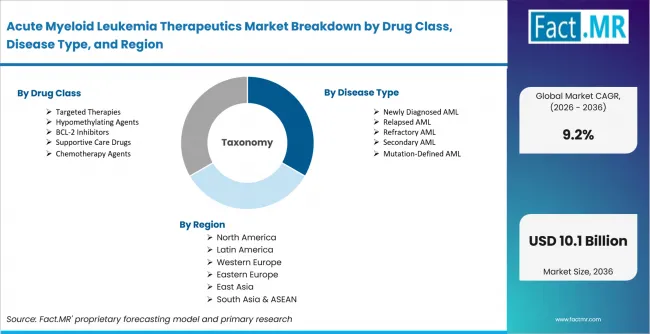
The Acute Myeloid Leukemia Therapeutics Market is segmented by Drug Class (Chemotherapy Agents, Targeted Therapies, Hypomethylating Agents, BCL-2 Inhibitors, Supportive Care Drugs), by Disease Type (Newly Diagnosed AML, Relapsed AML, Refractory AML, Secondary AML, Mutation-Defined AML), by Route of Administration, by End User, and by Sales Channel, and by Region. Forecast for 2026 to 2036.

Acute Myeloid Leukemia Therapeutics Market Size, Market Forecast and Outlook by Fact.MR

  • The acute myeloid leukemia therapeutics market was valued at USD 3.8 billion in 2025.
  • Demand is expected to increase from USD 4.2 billion in 2026 to USD 10.1 billion by 2036.
  • The market is forecast to record 9.2% CAGR during 2026 to 2036 as targeted therapies and relapse-focused treatments gain wider clinical use.
  • Acute myeloid leukemia therapeutics demand is becoming more genomics-led.
  • NCI’s AML treatment PDQ states that treatment options include chemotherapy, stem cell transplant, maintenance therapy, and other drug therapy.
  • This supports a treatment landscape that combines older cytotoxic therapy with newer targeted approaches.
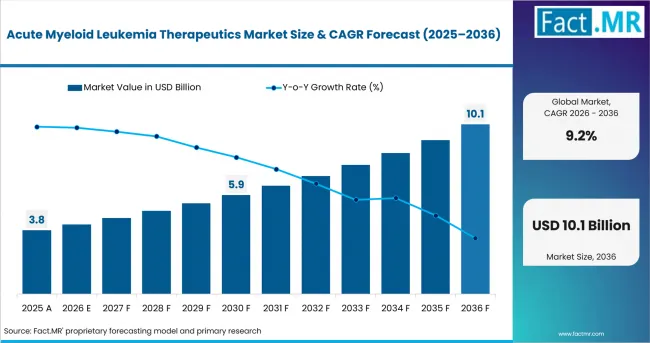
Acute Myeloid Leukemia Therapeutics Market Value Analysis

Summary of the Acute Myeloid Leukemia Therapeutics Market

  • Demand Drivers in the Market
    • Mutation-Led Therapy: Hematologists use molecular results to select targeted AML drugs.
    • Older Patient Need: Lower-intensity regimens support patients who cannot tolerate intensive induction.
    • Relapse Treatment: New oral targeted drugs are expanding options for refractory and recurrent AML.
  • Key Segments Analyzed
    • By Drug Class: Targeted therapies are expected to hold 36.0% share in 2026 because mutation-defined AML is reshaping treatment choice.
    • By Disease Type: Newly diagnosed AML leads because first-line treatment creates the main therapy volume. The segment is likely to account for 48.0% share in 2026.
    • By Route of Administration: Intravenous therapy is projected to hold 52.0% share in 2026 because induction and hospital-based regimens need IV delivery.
    • By End User: Hospitals lead as AML diagnosis and induction therapy usually begin in inpatient oncology units. The segment is anticipated to capture 55.0% share in 2026.
    • By Sales Channel: Hospital pharmacies are expected to hold 49.0% share in 2026 because most acute AML regimens begin under hospital supervision.
    • By Geography: India is projected to record 11.8% CAGR through 2036 as cancer center access and molecular testing expand.
  • Analyst Opinion at Fact.MR
    • Shambhu Nath Jha, Principal Consultant at Fact.MR, states, “Acute myeloid leukemia therapeutics are becoming more mutation-specific and patient-risk driven. We see demand rising for oral targeted drugs and lower-intensity combinations.”
  • Strategic Implications
    • Molecular Access: Cancer centers should expand mutation testing before final therapy selection so clinicians can match AML patients with targeted treatment options.
    • Therapy Sequencing: Hematologists need clear pathways for induction and maintenance treatment to guide therapy decisions across changing AML disease stages safely.
    • Pharmacy Readiness: Hospitals need safe handling and monitoring protocols for high-risk AML drugs so pharmacy staff can manage toxicity and dosing risks.
Metric Value
Industry Size 2026 USD 4.2 billion
Industry Value 2036 USD 10.1 billion
CAGR 2026 to 2036 9.2%

The market is moving from broad chemotherapy-only treatment toward patient-specific therapy selection. Older patients often need lower-intensity treatment. Relapsed and refractory patients need new oral options and targeted therapies. Mutation testing is becoming more important because drug selection can depend on FLT3 or NPM1 status.

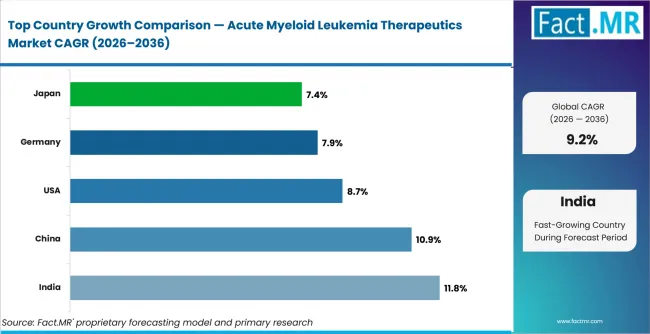
India is projected to record 11.8% CAGR by 2036 as cancer center access and molecular testing expand. China is likely to post 10.9% CAGR through 2036 as hematology capacity and targeted therapy access improve. The United States is expected to register 8.7% CAGR from 2026 to 2036 as approved targeted drugs and specialty pharmacy access sustain demand. Germany is forecast to advance at 7.9% CAGR by 2036 because advanced hematology care supports protocol-led therapy use. Japan is set to record 7.4% CAGR through 2036 as aging patients and hospital-based hematology care sustain treatment demand.

Segmental Analysis

Acute Myeloid Leukemia Therapeutics Market Analysis by Drug Class
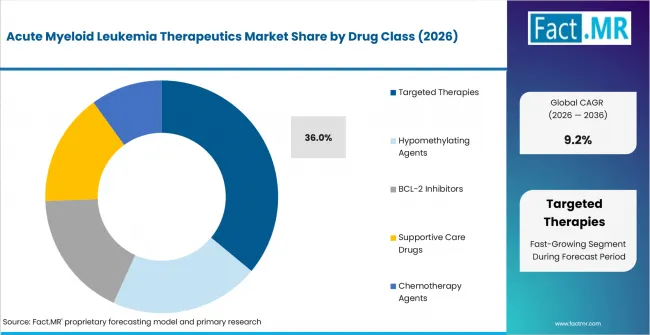
Acute Myeloid Leukemia Therapeutics Market Analysis By Drug Class

Targeted therapies are expected to hold 36.0% share in 2026 because mutation-defined AML is reshaping treatment choice. FLT3 and NPM1-directed drugs are expanding the precision treatment base. Chemotherapy agents still support induction and consolidation in eligible patients. Hypomethylating agents remain important for older patients and lower-intensity regimens. BCL-2 inhibitors support combination treatment in newly diagnosed AML patients who cannot tolerate intensive induction.

  • Targeted Therapy: Mutation-directed agents help clinicians treat AML groups with clearer genetic treatment markers.
  • Lower-Intensity Use: Hypomethylating combinations support older patients who cannot tolerate aggressive induction therapy.
  • Chemotherapy Base: Cytotoxic regimens remain important for eligible patients pursuing curative-intent treatment.

Acute Myeloid Leukemia Therapeutics Market Analysis by Disease Type
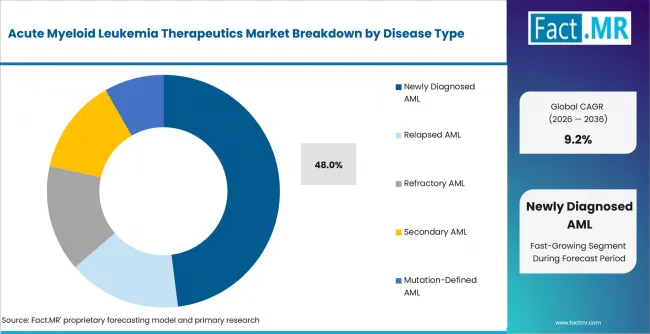
Acute Myeloid Leukemia Therapeutics Market Analysis By Disease Type

Newly diagnosed AML leads because first-line treatment creates the main therapy volume. Patients often start therapy quickly after diagnosis and risk assessment. The segment is likely to account for 48.0% share in 2026 as induction and lower-intensity regimens drive initial drug demand. Relapsed AML needs targeted options and salvage therapy. Refractory AML creates demand for newer drug classes and clinical review. Secondary AML is harder to treat and often needs adjusted regimens. Mutation-defined AML is gaining value because molecular status guides drug selection.

  • First-Line Demand: Newly diagnosed patients create early treatment volume through induction and lower-intensity regimens.
  • Relapse Need: Recurrent AML requires targeted drugs and careful reassessment of prior therapy response.
  • Mutation Groups: Genetic subtypes help clinicians match patients with newer precision treatment options.

Acute Myeloid Leukemia Therapeutics Market Analysis by Route of Administration
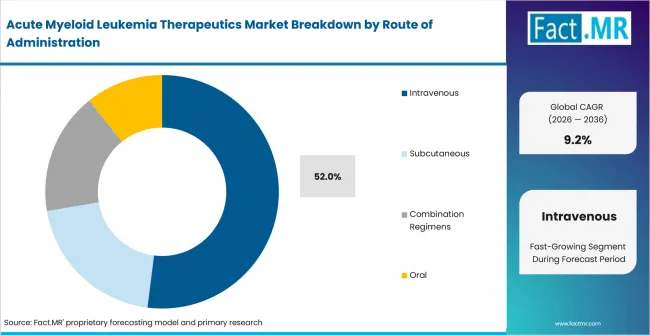
Acute Myeloid Leukemia Therapeutics Market Analysis By Route Of Administration

Intravenous therapy is likely to hold 52.0% share in 2026 because induction and hospital-based regimens need IV delivery. Oxford Haematology’s 2025 AML induction protocol lists daunorubicin by IV route on days 1 to 3 and cytarabine by continuous IV infusion on days 1 to 7 [2]. Cytarabine and several supportive medicines are commonly used under hospital monitoring. Oral therapy is rising as targeted drugs and maintenance approaches expand. Subcutaneous therapy supports selected hypomethylating treatment schedules. 

  • IV Treatment: Hospital-based regimens use intravenous drugs for induction and high-intensity therapy cycles.
  • Oral Expansion: Targeted tablets improve outpatient flexibility for selected relapsed and mutation-defined AML patients.
  • Combination Use: Multi-drug regimens help clinicians match intensity with patient risk and treatment goals.

Acute Myeloid Leukemia Therapeutics Market Analysis by End User
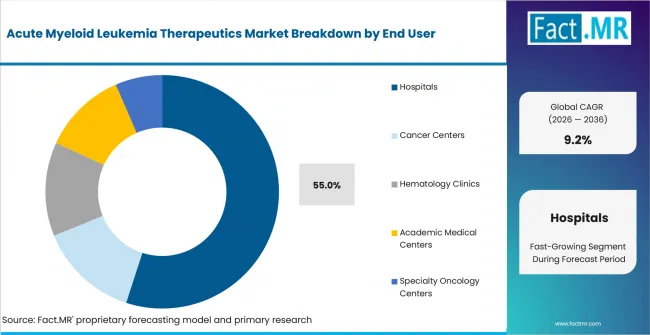
Acute Myeloid Leukemia Therapeutics Market Analysis By End User

Hospitals lead as AML diagnosis and induction therapy usually begin in inpatient oncology units. Patients often need transfusion support and intensive clinical supervision. The segment is anticipated to capture 55.0% share in 2026 because early AML therapy is medically complex. Cancer centers manage targeted therapy selection and relapse treatment. Hematology clinics support follow-up and oral therapy management. Academic medical centers manage complex trials and transplant-linked care.

  • Hospital Start: Inpatient oncology units manage induction therapy and transfusion support.
  • Cancer Centers: Specialist sites provide molecular treatment selection and relapse-focused care planning.
  • Hematology Clinics: Outpatient teams monitor oral therapy response and adverse effects after discharge.

Acute Myeloid Leukemia Therapeutics Market Analysis by Sales Channel
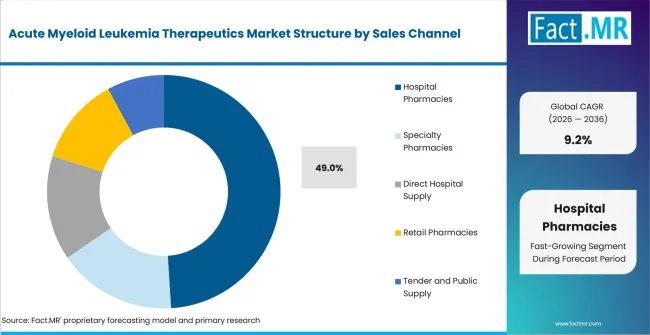
Acute Myeloid Leukemia Therapeutics Market Analysis By Sales Channel

Hospital pharmacies are expected to hold 49.0% share in 2026 because most acute AML regimens begin under hospital supervision. Oncology pharmacists manage cytotoxic drugs and supportive medicines during treatment cycles. Specialty pharmacies support oral targeted drugs and adherence follow-up. Direct hospital supply serves formulary-controlled oncology products. Retail pharmacies support selected supportive care and oral medicine refills. Tender and public supply channels influence access in government hospitals.

  • Hospital Control: Oncology pharmacies manage high-risk AML medicines across inpatient treatment and safety monitoring.
  • Specialty Access: Specialty pharmacies support oral targeted therapy delivery and patient adherence services.
  • Public Supply: Tender channels influence access to generic chemotherapy and supportive medicines in public hospitals.

Acute Myeloid Leukemia Therapeutics Market Drivers, Restraints, and Opportunities
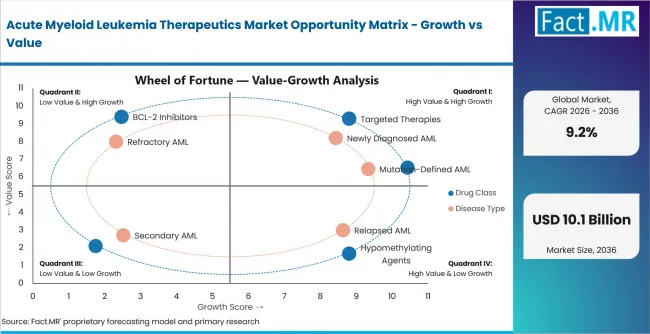
Acute Myeloid Leukemia Therapeutics Market Opportunity Matrix Growth Vs Value

Targeted drug approvals and molecular treatment selection are the main drivers for AML therapeutics demand. Syndax announced in 2025 that Revuforj received approval for relapsed or refractory acute myeloid leukemia with a susceptible NPM1 mutation in adult and pediatric patients one year and older [3]. This approval expands menin inhibitor use in mutation-defined AML.

Toxicity and treatment cost can restrain adoption. AML drugs can cause severe myelosuppression and tumor lysis concerns. Intensive chemotherapy requires inpatient monitoring and strong supportive care. New targeted therapies can face payer review and restricted access in cost-sensitive systems. Molecular testing gaps can limit use of mutation-directed therapy.

Opportunities in the Acute Myeloid Leukemia Therapeutics Market

  • Menin Inhibitors: Drug makers can target NPM1-mutated and KMT2A-rearranged relapse settings.
  • Oral Targeted Therapy: Specialty pharmacies can support adherence and toxicity monitoring for outpatient treatment.
  • Older Patient Care: Lower-intensity regimens can serve patients who cannot receive intensive induction therapy.

Regional Analysis

Based on regional analysis, the acute myeloid leukemia therapeutics market is segmented into North America, Latin America, Western Europe, Eastern Europe, East Asia, South Asia and Pacific, and Middle East and Africa.

Top Country Growth Comparison Acute Myeloid Leukemia Therapeutics Market Cagr (2026 2036)

Country CAGR (2026 to 2036)
India 11.8%
China 10.9%
United States 8.7%
Germany 7.9%
Japan 7.4%

Source: Fact.MR analysis, based on proprietary forecasting model and primary research. Acute Myeloid Leukemia Therapeutics Market Cagr Analysis By Country

South Asia and East Asia Acute Myeloid Leukemia Therapeutics Market Analysis

South Asia and East Asia demand comes from cancer center expansion and rising access to oncology drugs. India leads the growth outlook because tertiary cancer care and private oncology networks are expanding. China has a large hospital base and improving access to targeted hematology drugs.

  • India: India is projected to record 11.8% CAGR through 2036 as cancer center access and molecular testing expand. Large hospitals are adding hematology services and oncology pharmacy capacity. AML treatment demand is rising through better diagnosis and wider private cancer care. Cost limits access to newer targeted drugs outside major cities. Generic chemotherapy remains important in public hospitals.
  • China: China has broad tertiary hospital capacity and improving hematology care. Cancer hospitals use chemotherapy and targeted therapies across AML pathways. The country is likely to post 10.9% CAGR by 2036 as targeted therapy access and testing improve. Domestic drug makers can serve price-sensitive segments.

North America Acute Myeloid Leukemia Therapeutics Market Analysis
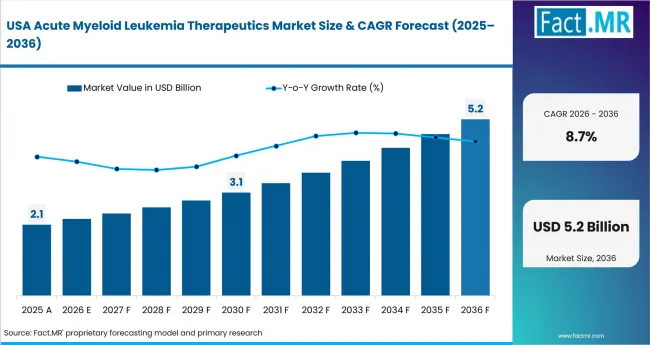
Acute Myeloid Leukemia Therapeutics Market Country Value Analysis

North America demand is led by the United States because targeted therapy access and specialty pharmacy channels are strong. AML treatment is guided by mutation testing and protocol-led hematology care.

  • United States: The United States is expected to register 8.7% CAGR through 2036 as approved targeted drugs and specialty pharmacy access sustain demand. FDA approval of ziftomenib in 2025 added another option for R/R AML with susceptible NPM1 mutation. [4] Payer review and toxicity management will remain important adoption filters.

Western Europe Acute Myeloid Leukemia Therapeutics Market Analysis
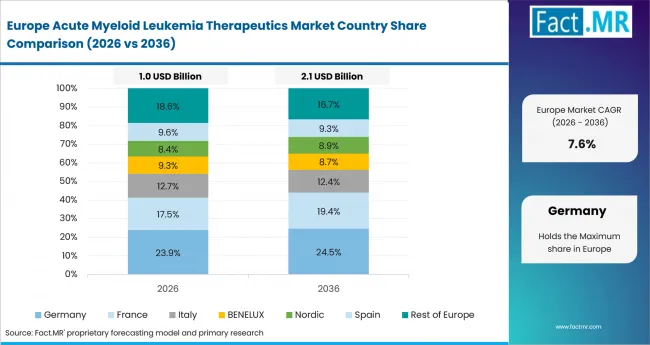
Acute Myeloid Leukemia Therapeutics Market Europe Country Market Share Analysis, 2026 & 2036

Western Europe demand comes from mature hematology care and guideline-led oncology practice. Germany leads the regional view because university hospitals and cancer centers manage complex AML cases.

  • Germany: Germany is forecast to advance at 7.9% CAGR over the forecast period because advanced hematology care supports protocol-led therapy use. University hospitals use molecular testing to guide targeted treatment and relapse planning. Older AML patients drive demand for lower-intensity regimens and supportive care. Reimbursement review can slow uptake of newer premium therapies. Clinical trial activity supports access to new drug classes.

East Asia Mature Market View
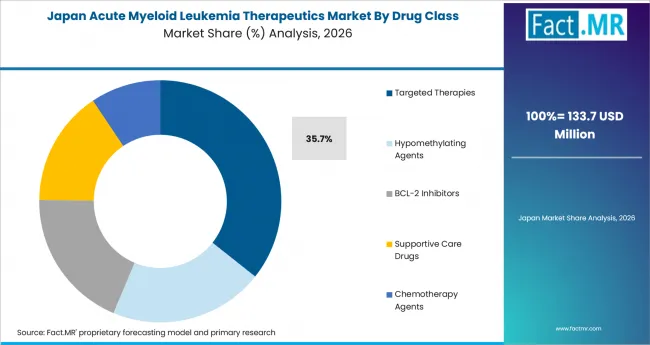
Acute Myeloid Leukemia Therapeutics Market Japan Market Share Analysis By Drug Class

Japan has an aging population and established hospital-based hematology care. AML treatment demand is steady because older patients often need lower-intensity treatment and careful monitoring. Hospital formulary access and safety data affect targeted therapy uptake.

  • Japan: Japan is set to record 7.4% CAGR through 2036 as aging patients and hospital-based hematology care sustain treatment demand. Cancer centers use chemotherapy and targeted drugs across AML pathways. Older patients need therapy choices that balance response and tolerability.

Competitive Aligners for Market Suppliers
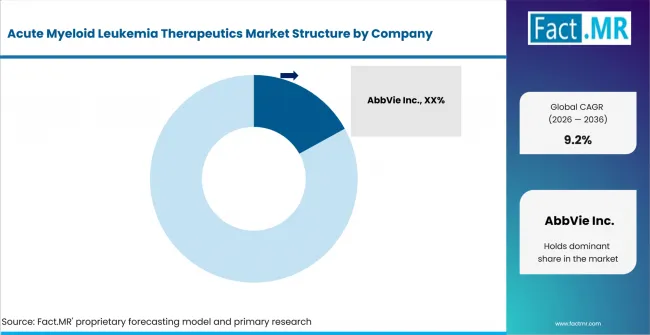
Acute Myeloid Leukemia Therapeutics Market Analysis By Company

The acute myeloid leukemia therapeutics market is served by oncology drug companies with targeted therapy and supportive care portfolios. AbbVie Inc. and Genentech, Roche compete through Venclexta for selected AML treatment needs. Astellas Pharma Inc. supports FLT3 mutated AML care through Xospata. Syndax Pharmaceuticals Inc. competes through Revuforj for specific genetically defined AML cases. Kura Oncology Inc. supports targeted AML treatment development through its menin inhibitor program.

Competitive position depends on mutation coverage and hospital formulary access. Toxicity profile and specialty pharmacy support also influence therapy use. Hematologists need treatment options that match molecular testing results and patient fitness. Drug suppliers must support hospitals with clinical education and patient access programs.

Competition will depend on therapy sequencing and molecular testing access through 2036. AML treatment is becoming more precise. Toxicity management remains central in daily care. Suppliers that connect targeted therapy with testing support and hospital education will gain stronger hematology access.

Key Companies in Acute Myeloid Leukemia Therapeutics Market

  • AbbVie Inc.
  • Genentech, Roche
  • Astellas Pharma Inc.
  • Syndax Pharmaceuticals, Inc.
  • Kura Oncology, Inc.

Bibliography

  • [1] National Cancer Institute. (2025, March 14). Acute myeloid leukemia treatment (PDQ®): Health professional version. National Cancer Institute.
  • [2] Oxford Department of Haematology, Myeloid Group. (2025, June). DA (daunorubicin + cytarabine). Oxford Haematology NSSG.
  • [3] Syndax Pharmaceuticals, Inc. (2025, October 24). Syndax announces FDA approval of Revuforj® (revumenib) in adult and pediatric patients with relapsed or refractory NPM1 mutated acute myeloid leukemia. Syndax Pharmaceuticals.
  • [4] U.S. Food and Drug Administration. (2025, November 13). FDA approves ziftomenib for relapsed or refractory acute myeloid leukemia with a NPM1 mutation. U.S. Food and Drug Administration.

This Report Addresses

  • Strategic intelligence on acute myeloid leukemia therapeutics demand across drug class, disease type, route, end user, and sales channel.
  • Forecast mapping from USD 4.2 billion in 2026 to USD 10.1 billion by 2036.
  • Segment analysis covering targeted therapies, newly diagnosed AML, intravenous therapy, hospitals, and hospital pharmacies.
  • Regional outlook covering India, China, the United States, Germany, and Japan.
  • Competitive analysis of AbbVie Inc., Genentech, Roche, Astellas Pharma Inc., Syndax Pharmaceuticals, Inc., Kura Oncology, Inc.
  • Therapy assessment covering chemotherapy, targeted therapy, hypomethylating agents, BCL-2 inhibitors, and supportive care drugs.
  • Channel assessment covering hospital pharmacies, specialty pharmacies, direct hospital supply, retail pharmacies, and public supply channels.
  • Primary interviews, supplier checks, official source review, and AML treatment workflow validation support the forecast.

Acute Myeloid Leukemia Therapeutics Market Definition

The acute myeloid leukemia therapeutics market covers drugs used to treat AML across newly diagnosed and mutation-defined patient groups. It includes chemotherapy agents and supportive care drugs. The market differs from general leukemia therapy because it focuses on AML-specific treatment pathways.

Acute Myeloid Leukemia Therapeutics Market Inclusions

The scope includes branded and generic AML drugs used in induction and supportive care. It includes venetoclax combinations and cytotoxic chemotherapy. Hospital pharmacy and public supply channels are included.

Acute Myeloid Leukemia Therapeutics Market Exclusions

The scope excludes diagnostics and hospital service fees. It excludes chronic myeloid leukemia drugs unless used in AML pathways. It excludes clinical trial services and companion diagnostic products sold separately from drug therapy.

Acute Myeloid Leukemia Therapeutics Market Research Methodology

  • Primary Research
    • Primary research includes interviews with hematologists and oncology pharmacists. It includes input from cancer center formulary committees and hospital oncology supply managers.
  • Desk Research
    • Desk research reviews AML treatment references and official drug approval records. It covers prescribing information and public cancer statistics.
  • Market-Sizing and Forecasting
    • Forecasting uses drug class demand and disease type mix. Route of administration and channel structure support the market assessment.
  • Data Validation and Update Cycle
    • Forecasts are validated through hospital feedback and supplier checks. AML treatment use and specialty pharmacy movement help confirm market direction.

Scope of the Report

Acute Myeloid Leukemia Therapeutics Market Breakdown By Drug Class, Disease Type, And Region

Attribute Details
Quantitative Units USD 4.2 billion in 2026 to USD 10.1 billion by 2036 at 9.2% CAGR
Market Definition Drugs used to treat newly diagnosed, relapsed, refractory, and mutation-defined acute myeloid leukemia
Drug Class Chemotherapy Agents, Targeted Therapies, Hypomethylating Agents, BCL-2 Inhibitors, Supportive Care Drugs
Disease Type Newly Diagnosed AML, Relapsed AML, Refractory AML, Secondary AML, Mutation-Defined AML
Route of Administration Oral, Intravenous, Subcutaneous,Other Routes
End User Hospitals, Cancer Centers, Hematology Clinics, Academic Medical Centers, Specialty Oncology Centers
Sales Channel Hospital Pharmacies, Specialty Pharmacies, Direct Hospital Supply, Retail Pharmacies, Tender and Public Supply
Regions Covered North America, Latin America, Western Europe, Eastern Europe, East Asia, South Asia and Pacific, Middle East and Africa
Countries Covered India, China, United States, Germany, Japan
Key Companies Profiled AbbVie Inc., Genentech, Roche, Astellas Pharma Inc., Syndax Pharmaceuticals, Inc., Kura Oncology, Inc.
Forecast Period 2026 to 2036
Approach Hybrid top-down and bottom-up approach using drug class demand, disease type mix, route of administration, end-user demand, sales channel structure, and regional validation

Acute Myeloid Leukemia Therapeutics Market Analysis by Segments

  • By Drug Class:

    • Chemotherapy Agents
    • Targeted Therapies
    • Hypomethylating Agents
    • BCL-2 Inhibitors
    • Supportive Care Drugs
  • By Disease Type:

    • Newly Diagnosed AML
    • Relapsed AML
    • Refractory AML
    • Secondary AML
    • Mutation-Defined AML
  • By Route of Administration:

    • Oral
    • Intravenous
    • Subcutaneous
    • Other Routes
  • By End User:

    • Hospitals
    • Cancer Centers
    • Hematology Clinics
    • Academic Medical Centers
    • Specialty Oncology Centers
  • By Sales Channel:

    • Hospital Pharmacies
    • Specialty Pharmacies
    • Direct Hospital Supply
    • Retail Pharmacies
    • Tender and Public Supply
  • By Region:

    • North America
      • United States
      • Canada
    • Europe
      • Germany
      • United Kingdom
      • France
      • Italy
      • Spain
    • Asia Pacific
      • China
      • Japan
      • South Korea
      • Taiwan
      • Singapore
    • Latin America
      • Brazil
      • Mexico
      • Argentina
    • Middle East & Africa
      • GCC Countries
      • South Africa
      • Israel

- Frequently Asked Questions -

What is the Acute Myeloid Leukemia Therapeutics Market size in 2026?

The acute myeloid leukemia therapeutics market is estimated to reach USD 4.2 billion in 2026 as targeted therapy use expands.

What will the Acute Myeloid Leukemia Therapeutics Market be worth by 2036?

The acute myeloid leukemia therapeutics market is projected to reach USD 10.1 billion by 2036.

What CAGR is projected for the Acute Myeloid Leukemia Therapeutics Market?

The acute myeloid leukemia therapeutics market is forecast to record 9.2% CAGR during 2026 to 2036.

Which drug class leads the Acute Myeloid Leukemia Therapeutics Market?

Targeted therapies lead with 36.0% share in 2026 because mutation-defined AML is reshaping treatment choice.

Which country expands faster in the Acute Myeloid Leukemia Therapeutics Market?

India is projected to record 11.8% CAGR through 2036 as cancer center access and molecular testing expand.

How does China perform in the Acute Myeloid Leukemia Therapeutics Market?

China is likely to post 10.9% CAGR through 2036 as hematology capacity and targeted therapy access improve.

How does the United States perform in the Acute Myeloid Leukemia Therapeutics Market?

The United States is forecast to register 8.7% CAGR as approved targeted drugs and specialty pharmacy access sustain demand.

What is the primary driver in the Acute Myeloid Leukemia Therapeutics Market?

The primary driver is mutation-led treatment. Molecular testing helps clinicians match AML patients with targeted drugs.

What is the main restraint in the Acute Myeloid Leukemia Therapeutics Market?

The main restraint is treatment toxicity. AML therapies can cause severe myelosuppression and infection risk.

Why are hospital pharmacies important in this market?

Hospital pharmacies are important because AML treatment requires high-risk drug handling and close inpatient monitoring.

Table of Content

  1. Executive Summary
    • Global Market Outlook
    • Demand to side Trends
    • Supply to side Trends
    • Technology Roadmap Analysis
    • Analysis and Recommendations
  2. Market Overview
    • Market Coverage / Taxonomy
    • Market Definition / Scope / Limitations
  3. Research Methodology
    • Chapter Orientation
    • Analytical Lens and Working Hypotheses
      • Market Structure, Signals, and Trend Drivers
      • Benchmarking and Cross-market Comparability
      • Market Sizing, Forecasting, and Opportunity Mapping
    • Research Design and Evidence Framework
      • Desk Research Programme (Secondary Evidence)
        • Company Annual and Sustainability Reports
        • Peer-reviewed Journals and Academic Literature
        • Corporate Websites, Product Literature, and Technical Notes
        • Earnings Decks and Investor Briefings
        • Statutory Filings and Regulatory Disclosures
        • Technical White Papers and Standards Notes
        • Trade Journals, Industry Magazines, and Analyst Briefs
        • Conference Proceedings, Webinars, and Seminar Materials
        • Government Statistics Portals and Public Data Releases
        • Press Releases and Reputable Media Coverage
        • Specialist Newsletters and Curated Briefings
        • Sector Databases and Reference Repositories
        • Fact.MR Internal Proprietary Databases and Historical Market Datasets
        • Subscription Datasets and Paid Sources
        • Social Channels, Communities, and Digital Listening Inputs
        • Additional Desk Sources
      • Expert Input and Fieldwork (Primary Evidence)
        • Primary Modes
          • Qualitative Interviews and Expert Elicitation
          • Quantitative Surveys and Structured Data Capture
          • Blended Approach
        • Why Primary Evidence is Used
        • Field Techniques
          • Interviews
          • Surveys
          • Focus Groups
          • Observational and In-context Research
          • Social and Community Interactions
        • Stakeholder Universe Engaged
          • C-suite Leaders
          • Board Members
          • Presidents and Vice Presidents
          • R&D and Innovation Heads
          • Technical Specialists
          • Domain Subject-matter Experts
          • Scientists
          • Physicians and Other Healthcare Professionals
        • Governance, Ethics, and Data Stewardship
          • Research Ethics
          • Data Integrity and Handling
      • Tooling, Models, and Reference Databases
    • Data Engineering and Model Build
      • Data Acquisition and Ingestion
      • Cleaning, Normalisation, and Verification
      • Synthesis, Triangulation, and Analysis
    • Quality Assurance and Audit Trail
  4. Market Background
    • Market Dynamics
      • Drivers
      • Restraints
      • Opportunity
      • Trends
    • Scenario Forecast
      • Demand in Optimistic Scenario
      • Demand in Likely Scenario
      • Demand in Conservative Scenario
    • Opportunity Map Analysis
    • Product Life Cycle Analysis
    • Supply Chain Analysis
    • Investment Feasibility Matrix
    • Value Chain Analysis
    • PESTLE and Porter’s Analysis
    • Regulatory Landscape
    • Regional Parent Market Outlook
    • Production and Consumption Statistics
    • Import and Export Statistics
  5. Global Market Analysis 2021 to 2025 and Forecast, 2026 to 2036
    • Historical Market Size Value (USD Million) Analysis, 2021 to 2025
    • Current and Future Market Size Value (USD Million) Projections, 2026 to 2036
      • Y to o to Y Growth Trend Analysis
      • Absolute $ Opportunity Analysis
  6. Global Market Pricing Analysis 2021 to 2025 and Forecast 2026 to 2036
  7. Global Market Analysis 2021 to 2025 and Forecast 2026 to 2036, By Drug Class
    • Introduction / Key Findings
    • Historical Market Size Value (USD Million) Analysis By Drug Class , 2021 to 2025
    • Current and Future Market Size Value (USD Million) Analysis and Forecast By Drug Class , 2026 to 2036
      • Antiplatelet Agents
      • Anticoagulants
      • Thrombolytics
      • Beta Blockers
      • Lipid-Lowering Therapies
    • Y to o to Y Growth Trend Analysis By Drug Class , 2021 to 2025
    • Absolute $ Opportunity Analysis By Drug Class , 2026 to 2036
  8. Global Market Analysis 2021 to 2025 and Forecast 2026 to 2036, By Disease Type
    • Introduction / Key Findings
    • Historical Market Size Value (USD Million) Analysis By Disease Type, 2021 to 2025
    • Current and Future Market Size Value (USD Million) Analysis and Forecast By Disease Type, 2026 to 2036
      • Non-ST-Elevation Myocardial Infarction
      • Unstable Angina
      • Recurrent ACS
      • ST-Elevation Myocardial Infarction
    • Y to o to Y Growth Trend Analysis By Disease Type, 2021 to 2025
    • Absolute $ Opportunity Analysis By Disease Type, 2026 to 2036
  9. Global Market Analysis 2021 to 2025 and Forecast 2026 to 2036, By Route of Administration
    • Introduction / Key Findings
    • Historical Market Size Value (USD Million) Analysis By Route of Administration, 2021 to 2025
    • Current and Future Market Size Value (USD Million) Analysis and Forecast By Route of Administration, 2026 to 2036
      • Oral
      • Intravenous
      • Subcutaneous
      • Intracoronary
    • Y to o to Y Growth Trend Analysis By Route of Administration, 2021 to 2025
    • Absolute $ Opportunity Analysis By Route of Administration, 2026 to 2036
  10. Global Market Analysis 2021 to 2025 and Forecast 2026 to 2036, By End User
    • Introduction / Key Findings
    • Historical Market Size Value (USD Million) Analysis By End User, 2021 to 2025
    • Current and Future Market Size Value (USD Million) Analysis and Forecast By End User, 2026 to 2036
      • Hospitals
      • Cardiac Centers
      • Emergency Departments
      • Ambulatory Care Centers
      • Homecare Follow-up Programs
    • Y to o to Y Growth Trend Analysis By End User, 2021 to 2025
    • Absolute $ Opportunity Analysis By End User, 2026 to 2036
  11. Global Market Analysis 2021 to 2025 and Forecast 2026 to 2036, By Sales Channel
    • Introduction / Key Findings
    • Historical Market Size Value (USD Million) Analysis By Sales Channel, 2021 to 2025
    • Current and Future Market Size Value (USD Million) Analysis and Forecast By Sales Channel, 2026 to 2036
      • Hospital Pharmacies
      • Retail Pharmacies
      • Direct Hospital Procurement
      • Tender and Public Procurement
      • Online Pharmacy Channels
    • Y to o to Y Growth Trend Analysis By Sales Channel, 2021 to 2025
    • Absolute $ Opportunity Analysis By Sales Channel, 2026 to 2036
  12. Global Market Analysis 2021 to 2025 and Forecast 2026 to 2036, By Region
    • Introduction
    • Historical Market Size Value (USD Million) Analysis By Region, 2021 to 2025
    • Current Market Size Value (USD Million) Analysis and Forecast By Region, 2026 to 2036
      • North America
      • Latin America
      • Western Europe
      • Eastern Europe
      • East Asia
      • South Asia and Pacific
      • Middle East & Africa
    • Market Attractiveness Analysis By Region
  13. North America Market Analysis 2021 to 2025 and Forecast 2026 to 2036, By Country
    • Historical Market Size Value (USD Million) Trend Analysis By Market Taxonomy, 2021 to 2025
    • Market Size Value (USD Million) Forecast By Market Taxonomy, 2026 to 2036
      • By Country
        • USA
        • Canada
        • Mexico
      • By Drug Class
      • By Disease Type
      • By Route of Administration
      • By End User
      • By Sales Channel
    • Market Attractiveness Analysis
      • By Country
      • By Drug Class
      • By Disease Type
      • By Route of Administration
      • By End User
      • By Sales Channel
    • Key Takeaways
  14. Latin America Market Analysis 2021 to 2025 and Forecast 2026 to 2036, By Country
    • Historical Market Size Value (USD Million) Trend Analysis By Market Taxonomy, 2021 to 2025
    • Market Size Value (USD Million) Forecast By Market Taxonomy, 2026 to 2036
      • By Country
        • Brazil
        • Chile
        • Rest of Latin America
      • By Drug Class
      • By Disease Type
      • By Route of Administration
      • By End User
      • By Sales Channel
    • Market Attractiveness Analysis
      • By Country
      • By Drug Class
      • By Disease Type
      • By Route of Administration
      • By End User
      • By Sales Channel
    • Key Takeaways
  15. Western Europe Market Analysis 2021 to 2025 and Forecast 2026 to 2036, By Country
    • Historical Market Size Value (USD Million) Trend Analysis By Market Taxonomy, 2021 to 2025
    • Market Size Value (USD Million) Forecast By Market Taxonomy, 2026 to 2036
      • By Country
        • Germany
        • UK
        • Italy
        • Spain
        • France
        • Nordic
        • BENELUX
        • Rest of Western Europe
      • By Drug Class
      • By Disease Type
      • By Route of Administration
      • By End User
      • By Sales Channel
    • Market Attractiveness Analysis
      • By Country
      • By Drug Class
      • By Disease Type
      • By Route of Administration
      • By End User
      • By Sales Channel
    • Key Takeaways
  16. Eastern Europe Market Analysis 2021 to 2025 and Forecast 2026 to 2036, By Country
    • Historical Market Size Value (USD Million) Trend Analysis By Market Taxonomy, 2021 to 2025
    • Market Size Value (USD Million) Forecast By Market Taxonomy, 2026 to 2036
      • By Country
        • Russia
        • Poland
        • Hungary
        • Balkan & Baltic
        • Rest of Eastern Europe
      • By Drug Class
      • By Disease Type
      • By Route of Administration
      • By End User
      • By Sales Channel
    • Market Attractiveness Analysis
      • By Country
      • By Drug Class
      • By Disease Type
      • By Route of Administration
      • By End User
      • By Sales Channel
    • Key Takeaways
  17. East Asia Market Analysis 2021 to 2025 and Forecast 2026 to 2036, By Country
    • Historical Market Size Value (USD Million) Trend Analysis By Market Taxonomy, 2021 to 2025
    • Market Size Value (USD Million) Forecast By Market Taxonomy, 2026 to 2036
      • By Country
        • China
        • Japan
        • South Korea
      • By Drug Class
      • By Disease Type
      • By Route of Administration
      • By End User
      • By Sales Channel
    • Market Attractiveness Analysis
      • By Country
      • By Drug Class
      • By Disease Type
      • By Route of Administration
      • By End User
      • By Sales Channel
    • Key Takeaways
  18. South Asia and Pacific Market Analysis 2021 to 2025 and Forecast 2026 to 2036, By Country
    • Historical Market Size Value (USD Million) Trend Analysis By Market Taxonomy, 2021 to 2025
    • Market Size Value (USD Million) Forecast By Market Taxonomy, 2026 to 2036
      • By Country
        • India
        • ASEAN
        • Australia & New Zealand
        • Rest of South Asia and Pacific
      • By Drug Class
      • By Disease Type
      • By Route of Administration
      • By End User
      • By Sales Channel
    • Market Attractiveness Analysis
      • By Country
      • By Drug Class
      • By Disease Type
      • By Route of Administration
      • By End User
      • By Sales Channel
    • Key Takeaways
  19. Middle East & Africa Market Analysis 2021 to 2025 and Forecast 2026 to 2036, By Country
    • Historical Market Size Value (USD Million) Trend Analysis By Market Taxonomy, 2021 to 2025
    • Market Size Value (USD Million) Forecast By Market Taxonomy, 2026 to 2036
      • By Country
        • Kingdom of Saudi Arabia
        • Other GCC Countries
        • Turkiye
        • South Africa
        • Other African Union
        • Rest of Middle East & Africa
      • By Drug Class
      • By Disease Type
      • By Route of Administration
      • By End User
      • By Sales Channel
    • Market Attractiveness Analysis
      • By Country
      • By Drug Class
      • By Disease Type
      • By Route of Administration
      • By End User
      • By Sales Channel
    • Key Takeaways
  20. Key Countries Market Analysis
    • USA
      • Pricing Analysis
      • Market Share Analysis, 2025
        • By Drug Class
        • By Disease Type
        • By Route of Administration
        • By End User
        • By Sales Channel
    • Canada
      • Pricing Analysis
      • Market Share Analysis, 2025
        • By Drug Class
        • By Disease Type
        • By Route of Administration
        • By End User
        • By Sales Channel
    • Mexico
      • Pricing Analysis
      • Market Share Analysis, 2025
        • By Drug Class
        • By Disease Type
        • By Route of Administration
        • By End User
        • By Sales Channel
    • Brazil
      • Pricing Analysis
      • Market Share Analysis, 2025
        • By Drug Class
        • By Disease Type
        • By Route of Administration
        • By End User
        • By Sales Channel
    • Chile
      • Pricing Analysis
      • Market Share Analysis, 2025
        • By Drug Class
        • By Disease Type
        • By Route of Administration
        • By End User
        • By Sales Channel
    • Germany
      • Pricing Analysis
      • Market Share Analysis, 2025
        • By Drug Class
        • By Disease Type
        • By Route of Administration
        • By End User
        • By Sales Channel
    • UK
      • Pricing Analysis
      • Market Share Analysis, 2025
        • By Drug Class
        • By Disease Type
        • By Route of Administration
        • By End User
        • By Sales Channel
    • Italy
      • Pricing Analysis
      • Market Share Analysis, 2025
        • By Drug Class
        • By Disease Type
        • By Route of Administration
        • By End User
        • By Sales Channel
    • Spain
      • Pricing Analysis
      • Market Share Analysis, 2025
        • By Drug Class
        • By Disease Type
        • By Route of Administration
        • By End User
        • By Sales Channel
    • France
      • Pricing Analysis
      • Market Share Analysis, 2025
        • By Drug Class
        • By Disease Type
        • By Route of Administration
        • By End User
        • By Sales Channel
    • India
      • Pricing Analysis
      • Market Share Analysis, 2025
        • By Drug Class
        • By Disease Type
        • By Route of Administration
        • By End User
        • By Sales Channel
    • ASEAN
      • Pricing Analysis
      • Market Share Analysis, 2025
        • By Drug Class
        • By Disease Type
        • By Route of Administration
        • By End User
        • By Sales Channel
    • Australia & New Zealand
      • Pricing Analysis
      • Market Share Analysis, 2025
        • By Drug Class
        • By Disease Type
        • By Route of Administration
        • By End User
        • By Sales Channel
    • China
      • Pricing Analysis
      • Market Share Analysis, 2025
        • By Drug Class
        • By Disease Type
        • By Route of Administration
        • By End User
        • By Sales Channel
    • Japan
      • Pricing Analysis
      • Market Share Analysis, 2025
        • By Drug Class
        • By Disease Type
        • By Route of Administration
        • By End User
        • By Sales Channel
    • South Korea
      • Pricing Analysis
      • Market Share Analysis, 2025
        • By Drug Class
        • By Disease Type
        • By Route of Administration
        • By End User
        • By Sales Channel
    • Russia
      • Pricing Analysis
      • Market Share Analysis, 2025
        • By Drug Class
        • By Disease Type
        • By Route of Administration
        • By End User
        • By Sales Channel
    • Poland
      • Pricing Analysis
      • Market Share Analysis, 2025
        • By Drug Class
        • By Disease Type
        • By Route of Administration
        • By End User
        • By Sales Channel
    • Hungary
      • Pricing Analysis
      • Market Share Analysis, 2025
        • By Drug Class
        • By Disease Type
        • By Route of Administration
        • By End User
        • By Sales Channel
    • Kingdom of Saudi Arabia
      • Pricing Analysis
      • Market Share Analysis, 2025
        • By Drug Class
        • By Disease Type
        • By Route of Administration
        • By End User
        • By Sales Channel
    • Turkiye
      • Pricing Analysis
      • Market Share Analysis, 2025
        • By Drug Class
        • By Disease Type
        • By Route of Administration
        • By End User
        • By Sales Channel
    • South Africa
      • Pricing Analysis
      • Market Share Analysis, 2025
        • By Drug Class
        • By Disease Type
        • By Route of Administration
        • By End User
        • By Sales Channel
  21. Market Structure Analysis
    • Competition Dashboard
    • Competition Benchmarking
    • Market Share Analysis of Top Players
      • By Regional
      • By Drug Class
      • By Disease Type
      • By Route of Administration
      • By End User
      • By Sales Channel
  22. Competition Analysis
    • Competition Deep Dive
      • AstraZeneca plc
        • Overview
        • Product Portfolio
        • Profitability by Market Segments (Product/Age /Sales Channel/Region)
        • Sales Footprint
        • Strategy Overview
          • Marketing Strategy
          • Product Strategy
          • Channel Strategy
      • Bayer AG
      • Sanofi S.A.
      • Daiichi Sankyo Company, Limited
      • Viatris Inc.
  23. Assumptions & Acronyms Used

List Of Table

  • Table 1: Global Market Value (USD Million) Forecast by Region, 2021 to 2036
  • Table 2: Global Market Value (USD Million) Forecast by Drug Class , 2021 to 2036
  • Table 3: Global Market Value (USD Million) Forecast by Disease Type, 2021 to 2036
  • Table 4: Global Market Value (USD Million) Forecast by Route of Administration, 2021 to 2036
  • Table 5: Global Market Value (USD Million) Forecast by End User, 2021 to 2036
  • Table 6: Global Market Value (USD Million) Forecast by Sales Channel, 2021 to 2036
  • Table 7: North America Market Value (USD Million) Forecast by Country, 2021 to 2036
  • Table 8: North America Market Value (USD Million) Forecast by Drug Class , 2021 to 2036
  • Table 9: North America Market Value (USD Million) Forecast by Disease Type, 2021 to 2036
  • Table 10: North America Market Value (USD Million) Forecast by Route of Administration, 2021 to 2036
  • Table 11: North America Market Value (USD Million) Forecast by End User, 2021 to 2036
  • Table 12: North America Market Value (USD Million) Forecast by Sales Channel, 2021 to 2036
  • Table 13: Latin America Market Value (USD Million) Forecast by Country, 2021 to 2036
  • Table 14: Latin America Market Value (USD Million) Forecast by Drug Class , 2021 to 2036
  • Table 15: Latin America Market Value (USD Million) Forecast by Disease Type, 2021 to 2036
  • Table 16: Latin America Market Value (USD Million) Forecast by Route of Administration, 2021 to 2036
  • Table 17: Latin America Market Value (USD Million) Forecast by End User, 2021 to 2036
  • Table 18: Latin America Market Value (USD Million) Forecast by Sales Channel, 2021 to 2036
  • Table 19: Western Europe Market Value (USD Million) Forecast by Country, 2021 to 2036
  • Table 20: Western Europe Market Value (USD Million) Forecast by Drug Class , 2021 to 2036
  • Table 21: Western Europe Market Value (USD Million) Forecast by Disease Type, 2021 to 2036
  • Table 22: Western Europe Market Value (USD Million) Forecast by Route of Administration, 2021 to 2036
  • Table 23: Western Europe Market Value (USD Million) Forecast by End User, 2021 to 2036
  • Table 24: Western Europe Market Value (USD Million) Forecast by Sales Channel, 2021 to 2036
  • Table 25: Eastern Europe Market Value (USD Million) Forecast by Country, 2021 to 2036
  • Table 26: Eastern Europe Market Value (USD Million) Forecast by Drug Class , 2021 to 2036
  • Table 27: Eastern Europe Market Value (USD Million) Forecast by Disease Type, 2021 to 2036
  • Table 28: Eastern Europe Market Value (USD Million) Forecast by Route of Administration, 2021 to 2036
  • Table 29: Eastern Europe Market Value (USD Million) Forecast by End User, 2021 to 2036
  • Table 30: Eastern Europe Market Value (USD Million) Forecast by Sales Channel, 2021 to 2036
  • Table 31: East Asia Market Value (USD Million) Forecast by Country, 2021 to 2036
  • Table 32: East Asia Market Value (USD Million) Forecast by Drug Class , 2021 to 2036
  • Table 33: East Asia Market Value (USD Million) Forecast by Disease Type, 2021 to 2036
  • Table 34: East Asia Market Value (USD Million) Forecast by Route of Administration, 2021 to 2036
  • Table 35: East Asia Market Value (USD Million) Forecast by End User, 2021 to 2036
  • Table 36: East Asia Market Value (USD Million) Forecast by Sales Channel, 2021 to 2036
  • Table 37: South Asia and Pacific Market Value (USD Million) Forecast by Country, 2021 to 2036
  • Table 38: South Asia and Pacific Market Value (USD Million) Forecast by Drug Class , 2021 to 2036
  • Table 39: South Asia and Pacific Market Value (USD Million) Forecast by Disease Type, 2021 to 2036
  • Table 40: South Asia and Pacific Market Value (USD Million) Forecast by Route of Administration, 2021 to 2036
  • Table 41: South Asia and Pacific Market Value (USD Million) Forecast by End User, 2021 to 2036
  • Table 42: South Asia and Pacific Market Value (USD Million) Forecast by Sales Channel, 2021 to 2036
  • Table 43: Middle East & Africa Market Value (USD Million) Forecast by Country, 2021 to 2036
  • Table 44: Middle East & Africa Market Value (USD Million) Forecast by Drug Class , 2021 to 2036
  • Table 45: Middle East & Africa Market Value (USD Million) Forecast by Disease Type, 2021 to 2036
  • Table 46: Middle East & Africa Market Value (USD Million) Forecast by Route of Administration, 2021 to 2036
  • Table 47: Middle East & Africa Market Value (USD Million) Forecast by End User, 2021 to 2036
  • Table 48: Middle East & Africa Market Value (USD Million) Forecast by Sales Channel, 2021 to 2036

List Of Figures

  • Figure 1: Global Market Pricing Analysis
  • Figure 2: Global Market Value (USD Million) Forecast 2021-2036
  • Figure 3: Global Market Value Share and BPS Analysis by Drug Class , 2026 and 2036
  • Figure 4: Global Market Y-o-Y Growth Comparison by Drug Class , 2026-2036
  • Figure 5: Global Market Attractiveness Analysis by Drug Class
  • Figure 6: Global Market Value Share and BPS Analysis by Disease Type, 2026 and 2036
  • Figure 7: Global Market Y-o-Y Growth Comparison by Disease Type, 2026-2036
  • Figure 8: Global Market Attractiveness Analysis by Disease Type
  • Figure 9: Global Market Value Share and BPS Analysis by Route of Administration, 2026 and 2036
  • Figure 10: Global Market Y-o-Y Growth Comparison by Route of Administration, 2026-2036
  • Figure 11: Global Market Attractiveness Analysis by Route of Administration
  • Figure 12: Global Market Value Share and BPS Analysis by End User, 2026 and 2036
  • Figure 13: Global Market Y-o-Y Growth Comparison by End User, 2026-2036
  • Figure 14: Global Market Attractiveness Analysis by End User
  • Figure 15: Global Market Value Share and BPS Analysis by Sales Channel, 2026 and 2036
  • Figure 16: Global Market Y-o-Y Growth Comparison by Sales Channel, 2026-2036
  • Figure 17: Global Market Attractiveness Analysis by Sales Channel
  • Figure 18: Global Market Value (USD Million) Share and BPS Analysis by Region, 2026 and 2036
  • Figure 19: Global Market Y-o-Y Growth Comparison by Region, 2026-2036
  • Figure 20: Global Market Attractiveness Analysis by Region
  • Figure 21: North America Market Incremental Dollar Opportunity, 2026-2036
  • Figure 22: Latin America Market Incremental Dollar Opportunity, 2026-2036
  • Figure 23: Western Europe Market Incremental Dollar Opportunity, 2026-2036
  • Figure 24: Eastern Europe Market Incremental Dollar Opportunity, 2026-2036
  • Figure 25: East Asia Market Incremental Dollar Opportunity, 2026-2036
  • Figure 26: South Asia and Pacific Market Incremental Dollar Opportunity, 2026-2036
  • Figure 27: Middle East & Africa Market Incremental Dollar Opportunity, 2026-2036
  • Figure 28: North America Market Value Share and BPS Analysis by Country, 2026 and 2036
  • Figure 29: North America Market Value Share and BPS Analysis by Drug Class , 2026 and 2036
  • Figure 30: North America Market Y-o-Y Growth Comparison by Drug Class , 2026-2036
  • Figure 31: North America Market Attractiveness Analysis by Drug Class
  • Figure 32: North America Market Value Share and BPS Analysis by Disease Type, 2026 and 2036
  • Figure 33: North America Market Y-o-Y Growth Comparison by Disease Type, 2026-2036
  • Figure 34: North America Market Attractiveness Analysis by Disease Type
  • Figure 35: North America Market Value Share and BPS Analysis by Route of Administration, 2026 and 2036
  • Figure 36: North America Market Y-o-Y Growth Comparison by Route of Administration, 2026-2036
  • Figure 37: North America Market Attractiveness Analysis by Route of Administration
  • Figure 38: North America Market Value Share and BPS Analysis by End User, 2026 and 2036
  • Figure 39: North America Market Y-o-Y Growth Comparison by End User, 2026-2036
  • Figure 40: North America Market Attractiveness Analysis by End User
  • Figure 41: North America Market Value Share and BPS Analysis by Sales Channel, 2026 and 2036
  • Figure 42: North America Market Y-o-Y Growth Comparison by Sales Channel, 2026-2036
  • Figure 43: North America Market Attractiveness Analysis by Sales Channel
  • Figure 44: Latin America Market Value Share and BPS Analysis by Country, 2026 and 2036
  • Figure 45: Latin America Market Value Share and BPS Analysis by Drug Class , 2026 and 2036
  • Figure 46: Latin America Market Y-o-Y Growth Comparison by Drug Class , 2026-2036
  • Figure 47: Latin America Market Attractiveness Analysis by Drug Class
  • Figure 48: Latin America Market Value Share and BPS Analysis by Disease Type, 2026 and 2036
  • Figure 49: Latin America Market Y-o-Y Growth Comparison by Disease Type, 2026-2036
  • Figure 50: Latin America Market Attractiveness Analysis by Disease Type
  • Figure 51: Latin America Market Value Share and BPS Analysis by Route of Administration, 2026 and 2036
  • Figure 52: Latin America Market Y-o-Y Growth Comparison by Route of Administration, 2026-2036
  • Figure 53: Latin America Market Attractiveness Analysis by Route of Administration
  • Figure 54: Latin America Market Value Share and BPS Analysis by End User, 2026 and 2036
  • Figure 55: Latin America Market Y-o-Y Growth Comparison by End User, 2026-2036
  • Figure 56: Latin America Market Attractiveness Analysis by End User
  • Figure 57: Latin America Market Value Share and BPS Analysis by Sales Channel, 2026 and 2036
  • Figure 58: Latin America Market Y-o-Y Growth Comparison by Sales Channel, 2026-2036
  • Figure 59: Latin America Market Attractiveness Analysis by Sales Channel
  • Figure 60: Western Europe Market Value Share and BPS Analysis by Country, 2026 and 2036
  • Figure 61: Western Europe Market Value Share and BPS Analysis by Drug Class , 2026 and 2036
  • Figure 62: Western Europe Market Y-o-Y Growth Comparison by Drug Class , 2026-2036
  • Figure 63: Western Europe Market Attractiveness Analysis by Drug Class
  • Figure 64: Western Europe Market Value Share and BPS Analysis by Disease Type, 2026 and 2036
  • Figure 65: Western Europe Market Y-o-Y Growth Comparison by Disease Type, 2026-2036
  • Figure 66: Western Europe Market Attractiveness Analysis by Disease Type
  • Figure 67: Western Europe Market Value Share and BPS Analysis by Route of Administration, 2026 and 2036
  • Figure 68: Western Europe Market Y-o-Y Growth Comparison by Route of Administration, 2026-2036
  • Figure 69: Western Europe Market Attractiveness Analysis by Route of Administration
  • Figure 70: Western Europe Market Value Share and BPS Analysis by End User, 2026 and 2036
  • Figure 71: Western Europe Market Y-o-Y Growth Comparison by End User, 2026-2036
  • Figure 72: Western Europe Market Attractiveness Analysis by End User
  • Figure 73: Western Europe Market Value Share and BPS Analysis by Sales Channel, 2026 and 2036
  • Figure 74: Western Europe Market Y-o-Y Growth Comparison by Sales Channel, 2026-2036
  • Figure 75: Western Europe Market Attractiveness Analysis by Sales Channel
  • Figure 76: Eastern Europe Market Value Share and BPS Analysis by Country, 2026 and 2036
  • Figure 77: Eastern Europe Market Value Share and BPS Analysis by Drug Class , 2026 and 2036
  • Figure 78: Eastern Europe Market Y-o-Y Growth Comparison by Drug Class , 2026-2036
  • Figure 79: Eastern Europe Market Attractiveness Analysis by Drug Class
  • Figure 80: Eastern Europe Market Value Share and BPS Analysis by Disease Type, 2026 and 2036
  • Figure 81: Eastern Europe Market Y-o-Y Growth Comparison by Disease Type, 2026-2036
  • Figure 82: Eastern Europe Market Attractiveness Analysis by Disease Type
  • Figure 83: Eastern Europe Market Value Share and BPS Analysis by Route of Administration, 2026 and 2036
  • Figure 84: Eastern Europe Market Y-o-Y Growth Comparison by Route of Administration, 2026-2036
  • Figure 85: Eastern Europe Market Attractiveness Analysis by Route of Administration
  • Figure 86: Eastern Europe Market Value Share and BPS Analysis by End User, 2026 and 2036
  • Figure 87: Eastern Europe Market Y-o-Y Growth Comparison by End User, 2026-2036
  • Figure 88: Eastern Europe Market Attractiveness Analysis by End User
  • Figure 89: Eastern Europe Market Value Share and BPS Analysis by Sales Channel, 2026 and 2036
  • Figure 90: Eastern Europe Market Y-o-Y Growth Comparison by Sales Channel, 2026-2036
  • Figure 91: Eastern Europe Market Attractiveness Analysis by Sales Channel
  • Figure 92: East Asia Market Value Share and BPS Analysis by Country, 2026 and 2036
  • Figure 93: East Asia Market Value Share and BPS Analysis by Drug Class , 2026 and 2036
  • Figure 94: East Asia Market Y-o-Y Growth Comparison by Drug Class , 2026-2036
  • Figure 95: East Asia Market Attractiveness Analysis by Drug Class
  • Figure 96: East Asia Market Value Share and BPS Analysis by Disease Type, 2026 and 2036
  • Figure 97: East Asia Market Y-o-Y Growth Comparison by Disease Type, 2026-2036
  • Figure 98: East Asia Market Attractiveness Analysis by Disease Type
  • Figure 99: East Asia Market Value Share and BPS Analysis by Route of Administration, 2026 and 2036
  • Figure 100: East Asia Market Y-o-Y Growth Comparison by Route of Administration, 2026-2036
  • Figure 101: East Asia Market Attractiveness Analysis by Route of Administration
  • Figure 102: East Asia Market Value Share and BPS Analysis by End User, 2026 and 2036
  • Figure 103: East Asia Market Y-o-Y Growth Comparison by End User, 2026-2036
  • Figure 104: East Asia Market Attractiveness Analysis by End User
  • Figure 105: East Asia Market Value Share and BPS Analysis by Sales Channel, 2026 and 2036
  • Figure 106: East Asia Market Y-o-Y Growth Comparison by Sales Channel, 2026-2036
  • Figure 107: East Asia Market Attractiveness Analysis by Sales Channel
  • Figure 108: South Asia and Pacific Market Value Share and BPS Analysis by Country, 2026 and 2036
  • Figure 109: South Asia and Pacific Market Value Share and BPS Analysis by Drug Class , 2026 and 2036
  • Figure 110: South Asia and Pacific Market Y-o-Y Growth Comparison by Drug Class , 2026-2036
  • Figure 111: South Asia and Pacific Market Attractiveness Analysis by Drug Class
  • Figure 112: South Asia and Pacific Market Value Share and BPS Analysis by Disease Type, 2026 and 2036
  • Figure 113: South Asia and Pacific Market Y-o-Y Growth Comparison by Disease Type, 2026-2036
  • Figure 114: South Asia and Pacific Market Attractiveness Analysis by Disease Type
  • Figure 115: South Asia and Pacific Market Value Share and BPS Analysis by Route of Administration, 2026 and 2036
  • Figure 116: South Asia and Pacific Market Y-o-Y Growth Comparison by Route of Administration, 2026-2036
  • Figure 117: South Asia and Pacific Market Attractiveness Analysis by Route of Administration
  • Figure 118: South Asia and Pacific Market Value Share and BPS Analysis by End User, 2026 and 2036
  • Figure 119: South Asia and Pacific Market Y-o-Y Growth Comparison by End User, 2026-2036
  • Figure 120: South Asia and Pacific Market Attractiveness Analysis by End User
  • Figure 121: South Asia and Pacific Market Value Share and BPS Analysis by Sales Channel, 2026 and 2036
  • Figure 122: South Asia and Pacific Market Y-o-Y Growth Comparison by Sales Channel, 2026-2036
  • Figure 123: South Asia and Pacific Market Attractiveness Analysis by Sales Channel
  • Figure 124: Middle East & Africa Market Value Share and BPS Analysis by Country, 2026 and 2036
  • Figure 125: Middle East & Africa Market Value Share and BPS Analysis by Drug Class , 2026 and 2036
  • Figure 126: Middle East & Africa Market Y-o-Y Growth Comparison by Drug Class , 2026-2036
  • Figure 127: Middle East & Africa Market Attractiveness Analysis by Drug Class
  • Figure 128: Middle East & Africa Market Value Share and BPS Analysis by Disease Type, 2026 and 2036
  • Figure 129: Middle East & Africa Market Y-o-Y Growth Comparison by Disease Type, 2026-2036
  • Figure 130: Middle East & Africa Market Attractiveness Analysis by Disease Type
  • Figure 131: Middle East & Africa Market Value Share and BPS Analysis by Route of Administration, 2026 and 2036
  • Figure 132: Middle East & Africa Market Y-o-Y Growth Comparison by Route of Administration, 2026-2036
  • Figure 133: Middle East & Africa Market Attractiveness Analysis by Route of Administration
  • Figure 134: Middle East & Africa Market Value Share and BPS Analysis by End User, 2026 and 2036
  • Figure 135: Middle East & Africa Market Y-o-Y Growth Comparison by End User, 2026-2036
  • Figure 136: Middle East & Africa Market Attractiveness Analysis by End User
  • Figure 137: Middle East & Africa Market Value Share and BPS Analysis by Sales Channel, 2026 and 2036
  • Figure 138: Middle East & Africa Market Y-o-Y Growth Comparison by Sales Channel, 2026-2036
  • Figure 139: Middle East & Africa Market Attractiveness Analysis by Sales Channel
  • Figure 140: Global Market - Tier Structure Analysis
  • Figure 141: Global Market - Company Share Analysis

Acute Myeloid Leukemia Therapeutics Market