- Base Value(2025): 7.1 Bn
- Estimated Value(2025): 7.1 Bn
- Forecast Value (2035): 12.9 Bn
- CAGR (2025 - 2035): 6.2%
Mustard Market Forecast and Outlook 2025 to 2035
The global mustard market is projected to reach USD 12.9 billion by 2035, recording an absolute increase of USD 5.8 billion over the forecast period. The market is valued at USD 7.1 billion in 2025 and is set to rise at a CAGR of 6.2% during the assessment period.
The overall market size is expected to grow by approximately 1.8 times during the same period, supported by increasing consumer demand for natural condiments and plant-based cooking oils worldwide, driving demand for versatile mustard products and increasing investments in sustainable agriculture practices with organic cultivation systems across culinary applications and health-conscious food formulations globally.
Quick Stats for Mustard Market
- Mustard Market Value (2025): USD 7.1 billion
- Mustard Market Forecast Value (2035): USD 12.9 billion
- Mustard Market Forecast CAGR: 6.2%
- Leading Product Type in Mustard Market: Seed (39.0%)
- Key Growth Regions in Mustard Market: Asia Pacific, North America, and Europe
- Top Players in Mustard Market: McCormick & Company, Inc., Unilever, Conagra Brands Inc., Backwoods Mustard Company, Woeber Mustard Manufacturing Company, French's, H.J. Heinz Company, Cargill, Mustard and Co., Sun Impex
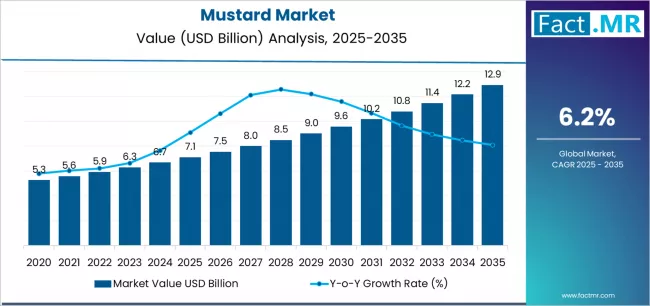
Mustard Market Market Value Analysis | Source: Fact.MR
Food manufacturers and consumers face mounting pressure to access authentic flavors and nutritional ingredients while addressing clean-label preferences and functional food requirements, with modern mustard products providing documented benefits including natural antimicrobial properties, omega-3 fatty acid content in mustard oil, and glucosinolate compounds offering potential health benefits compared to synthetic condiments and refined oils alone.
Rising awareness about traditional cooking methods and expanding specialty food segments enabling artisanal product positioning create substantial opportunities for producers and food brands. However, climate variability affecting crop yields and regulatory restrictions on mustard oil in certain markets may pose obstacles to consistent supply availability across price-sensitive consumer segments.
The seed segment dominates market activity, driven by extensive culinary versatility supporting pickling, spice blending, and whole-seed condiment applications across diverse food cultures worldwide. Food processors increasingly recognize the essential functionality of mustard seeds, with typical product offerings providing pungent flavor development and natural preservation properties at competitive pricing through established agricultural commodity networks.
The oil segment demonstrates robust growth potential, supported by rising health-conscious cooking preferences and evidence-based nutritional benefits integrating heart-healthy fatty acids in modern dietary approaches. Online sales emerge as the dominant distribution channel, reflecting e-commerce expansion and consumer preference for convenient home delivery enabling access to specialty mustard varieties. Seed products represent the leading form, driven by traditional culinary applications and food processing industry demand.
Regional dynamics show Asia Pacific maintaining market leadership, supported by high mustard oil consumption in Indian subcontinent and expanding mustard green cultivation across East Asian markets. North America demonstrates steady growth trajectory driven by condiment innovation and gourmet mustard adoption accepting premium flavor profiles, while Europe emphasizes traditional mustard manufacturing and artisanal product heritage for authentic culinary experiences. India leads country-level growth through extensive mustard oil cooking traditions and agricultural production dominance, followed by China supported by growing interest in mustard greens and expanding seasoning applications.
The competitive landscape features moderate concentration with McCormick & Company maintaining market leadership position at a 14.2% share, while specialized players including Unilever, Conagra Brands, French's, and Heinz compete through branded condiment portfolios and comprehensive distribution partnerships across diverse culinary markets.
Mustard Market Year-over-Year Forecast 2025 to 2035
Between 2025 and 2029, the mustard market is projected to expand from USD 7.1 billion to USD 9.0 billion, resulting in a value increase of USD 1.9 billion, which represents 32.8% of the total forecast growth for the period. This phase of development will be shaped by rising demand for organic and non-GMO mustard products addressing clean-label preferences, product innovation in flavored mustard varieties with ethnic fusion profiles and artisanal formulations, as well as expanding integration with plant-based food trends and functional ingredient applications. Companies are establishing competitive positions through investment in sustainable sourcing programs, flavor development capabilities, and strategic market expansion across specialty retail channels, e-commerce platforms, and foodservice distribution partnerships.
From 2029 to 2035, the market is forecast to grow from USD 9.0 billion to USD 12.9 billion, adding another USD 3.9 billion, which constitutes 67.2% of the overall expansion. This period is expected to be characterized by the expansion of specialized product applications, including premium gourmet mustards for culinary enthusiasts and health-focused mustard oil formulations tailored for specific dietary preferences, strategic collaborations between mustard producers and food manufacturers, and an enhanced focus on traceability systems and regenerative agriculture initiatives. The growing emphasis on authentic ethnic flavors and rising consumer preference for minimally processed condiments addressing taste sophistication and nutritional transparency will drive demand for comprehensive mustard product portfolios across diverse culinary traditions and health-conscious consumer segments.
Mustard Market Key Takeaways
| Metric | Value |
|---|---|
| Market Value (2025) | USD 7.1 billion |
| Market Forecast Value (2035) | USD 12.9 billion |
| Forecast CAGR (2025-2035) | 6.2% |
Source: Fact.MR analysis. Updated Dec 12, 2025
Why is the Mustard Market Growing?
The mustard market grows by enabling consumers and food manufacturers to access versatile flavor ingredients and functional cooking oils while addressing clean-label expectations and nutritional enhancement without exclusive reliance on synthetic condiments and heavily processed oils.
Consumers face mounting pressure to choose authentic ingredients and healthier cooking options while managing flavor preferences, dietary requirements, and budget considerations, with mustard products typically providing natural pungency and complex flavor profiles including sinigrin compounds responsible for characteristic bite, essential fatty acids in mustard oil supporting cardiovascular health, and antimicrobial properties enabling natural food preservation compared to artificial flavoring agents and refined vegetable oils alone, making mustard essential for authentic culinary experiences and health-conscious cooking.
The food industry's need for versatile ingredients supporting diverse applications from condiments to cooking oils creates demand for specialized mustard solutions that can provide flavor intensity, enhance food safety, and support clean-label formulations without compromising taste quality or nutritional value.
Culinary tradition validation and nutritional research supporting mustard benefits drive adoption in home cooking, restaurant kitchens, and food processing facilities, where ingredient authenticity has direct impact on product differentiation and consumer satisfaction.
The expanding global condiment market valued at over USD 180 billion annually with natural ingredient segments growing faster than synthetic alternatives creates substantial opportunities for traditional mustard products. Rising consumer awareness about seed-to-table sourcing and cultural food heritage enables informed purchasing decisions and adherence to authentic cooking practices. However, price volatility from agricultural commodity markets and taste preference variations across cultural contexts may limit adoption rates and optimal market penetration across diverse consumer populations with different culinary traditions and flavor expectations.
Segmental Analysis
The market is segmented by product, distribution channel, and region. By product, the market is divided into seed, powder, oil, and paste. Based on distribution channel, the market is categorized into supermarket & hypermarket, convenience stores, specialty stores, and online sales. Regionally, the market is divided into Asia Pacific, Europe, North America, Latin America, and Middle East & Africa.
By Product, Which Segment Accounts for the Dominant Market Share?
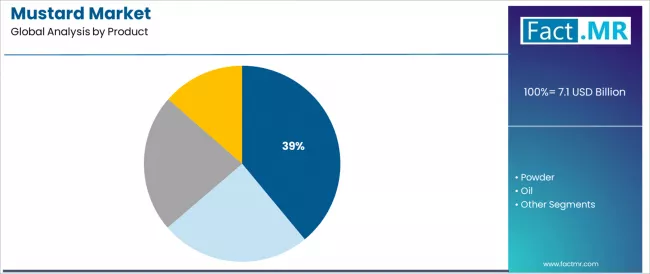
Mustard Market Analysis By Product | Source: Fact.MR
The seed segment represents the dominant force in the mustard market, capturing approximately 39.0% of total market share in 2025. This established product category encompasses solutions featuring whole mustard seeds and minimally processed seed products, including yellow mustard seeds for American-style condiments, brown mustard seeds for Indian cooking applications, and black mustard seeds for traditional spice blends that enable authentic flavor development and natural food preservation across pickling operations, spice manufacturing, and culinary preparations worldwide.
The seed segment's market leadership stems from its fundamental culinary versatility, with solutions capable of providing base ingredients for condiment manufacturing, essential components for spice blends and curry powders, and whole-seed applications for pickles and preserves while maintaining natural nutrient profiles including protein content averaging 25-28% and dietary fiber supporting digestive health across various cultural cooking traditions.
The oil segment maintains a substantial market share at 28.0%, serving health-conscious consumers and traditional cooking communities that require pungent cooking oils addressing high-temperature applications and nutritional requirements including heart-healthy omega-3 fatty acids, monounsaturated fats supporting cardiovascular wellness, and natural vitamin E providing antioxidant benefits.
These solutions offer essential cooking functionality for consumers enabling traditional frying and seasoning while providing sufficient heat stability to support diverse culinary techniques. The oil segment demonstrates strong growth potential at 6.9% CAGR, driven by expanding awareness of mustard oil nutritional benefits and increasing adoption beyond traditional South Asian markets.
Within the product category, powder represents 22.0% share serving convenience-oriented applications and industrial food processing where standardized flavor delivery and extended shelf stability support mass production requirements, while paste accounts for 11.0% addressing prepared condiment preferences and immediate-use applications.
Key functional advantages driving the seed segment include:
- Advanced culinary versatility mechanisms with demonstrated application breadth across condiment manufacturing, spice blending, pickling preservation, and whole-seed preparations without processing limitations
- Established flavor development characteristics allowing enzymatic reactions upon grinding and moisture exposure creating characteristic pungency without artificial flavor enhancement complexity
- Enhanced nutritional integrity features enabling complete nutrient retention including protein, fiber, minerals, and beneficial glucosinolate compounds while maintaining natural product authenticity
- Superior shelf stability profile providing optimal storage longevity and quality retention across various climatic conditions and distribution channels
By Distribution Channel, Which Segment Accounts for the Largest Market Share?
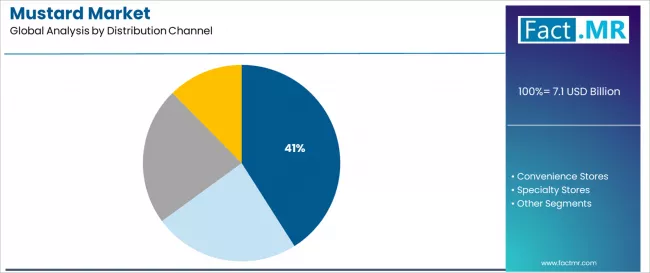
Mustard Market Analysis By Distribution Channel | Source: Fact.MR
Online sales dominate the mustard distribution landscape with approximately 41.0% market share in 2025, reflecting the critical role of e-commerce platforms in supporting specialty product access, variety selection, and convenient home delivery across consumer purchasing behavior worldwide. The online sales segment's market leadership is reinforced by digital commerce advantages enabling extensive product range availability, direct-to-consumer brand relationships, and subscription-based replenishment models that characterize modern grocery shopping patterns and specialty food procurement.
Within this segment, dedicated food e-commerce platforms represent substantial transaction volumes, driven by curated mustard product selections including artisanal varieties, international imports, and bulk purchasing options. This sub-segment benefits from targeted marketing capabilities and consumer review systems supporting informed purchasing decisions.
The supermarket & hypermarket segment represents an important distribution category at 29.0% share, demonstrating steady presence through mainstream retail accessibility, physical product inspection opportunities, and integrated shopping convenience where mustard products serve everyday condiment and cooking oil needs alongside comprehensive grocery assortments. This segment benefits from established consumer shopping habits and promotional merchandising supporting impulse purchases.
The convenience stores segment maintains presence at 19.0% through immediate availability and neighborhood accessibility, while specialty stores at 11.0% serve gourmet enthusiasts and ethnic food shoppers seeking authentic mustard varieties and premium product positioning.
Key market dynamics supporting distribution channel growth include:
- Online channel expansion driven by e-commerce penetration and specialty food seeking behavior, requiring efficient logistics and product differentiation
- Supermarket modernization trends require ethnic food aisle expansion and premium condiment category development
- Integration of omnichannel strategies enabling click-and-collect services and seamless shopping experiences across physical and digital touchpoints
- Growing emphasis on direct-to-consumer models supporting artisanal producers and regional specialty brands without traditional retail intermediaries
What are the Drivers, Restraints, and Key Trends of the Mustard Market?
The market is driven by three concrete demand factors tied to culinary evolution. First, increasing consumer preference for natural and clean-label ingredients creates expanding requirements for authentic condiments and cooking oils, with mustard representing traditional alternative to synthetic flavorings in comprehensive food authenticity strategies, requiring sustainable sourcing. Second, growing awareness of mustard oil nutritional benefits drives health-conscious cooking adoption and dietary diversification, with mustard oil demonstrating favorable fatty acid profiles including omega-3 content, vitamin E antioxidants, and potential cardiovascular benefits through regular consumption by 2030. Third, expanding ethnic food popularity and culinary experimentation enable flavor discovery that increases mustard product trial while meeting consumer expectations for authentic global cuisine experiences.
Market restraints include agricultural yield variability and climate change impacts that can challenge production consistency and price stability across major mustard-growing regions including India, Canada, and European Union, particularly when drought conditions or excessive rainfall affect crop quality and harvest volumes. Regulatory restrictions on mustard oil consumption and erucic acid content concerns pose another significant obstacle, as certain markets including United States maintain limitations on mustard oil food use due to historical safety considerations regarding high erucic acid varieties, potentially affecting market access and consumer awareness. Competition from alternative condiments and cooking oils creates additional market pressure, demanding continuous innovation and value demonstration initiatives.
Key trends indicate accelerated organic and non-GMO certification adoption in developed markets, particularly North America and Europe, where consumers demonstrate willingness to pay premiums for verified sustainable mustard products aligned with environmental values. Artisanal and craft mustard proliferation trends toward small-batch production with unique flavor combinations including honey mustard, spicy brown, and regional specialty formulations combine traditional techniques with innovative ingredients that optimize taste differentiation and premium positioning. However, the market thesis could face disruption if significant shifts in dietary preferences or breakthrough alternative condiment technologies reduce dependence on traditional mustard-based flavor systems.
Analysis of the Mustard Market by Key Countries
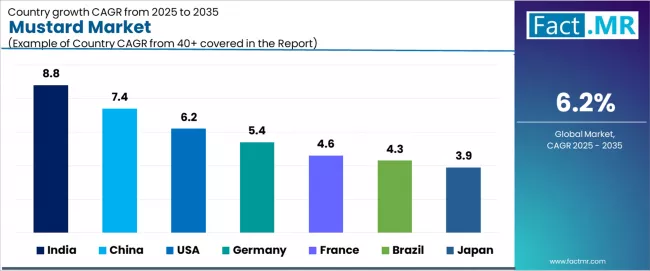
Mustard Market Cagr Analysis By Country | Source: Fact.MR
| Country | CAGR (2025-2035) |
|---|---|
| India | 8.8% |
| China | 7.4% |
| USA | 6.2% |
| Germany | 5.4% |
| France | 4.6% |
| Brazil | 4.3% |
| Japan | 3.9% |
Source: Fact.MR analysis. Updated Dec 12, 2025
The global mustard market is expanding steadily, with India leading at an 8.8% CAGR through 2035, driven by high reliance on mustard oil in cooking traditions, extensive agricultural production, and deep cultural integration in daily cuisine. China follows at 7.4%, supported by growing interest in mustard greens cultivation, expanding seasoning applications, and diversifying vegetable consumption patterns. USA records 6.2%, reflecting strong condiment demand, mustard oil adoption in health-conscious segments, and gourmet mustard innovation.
Germany advances at 5.4%, leveraging high gourmet mustard consumption, traditional manufacturing expertise, and premium product positioning. France posts 4.6%, focusing on mature mustard processing industry, Dijon mustard heritage, and artisanal production excellence, while Brazil grows steadily at 4.3%, emphasizing expanding food processing sector and condiment market development. Japan demonstrates 3.9% growth, anchored by stable demand for powdered mustard and traditional Japanese cuisine applications.
How is India Leading Global Market Expansion?
India demonstrates the strongest growth potential in the mustard market with a CAGR of 8.8% through 2035. The country's leadership position stems from dominant mustard oil consumption as primary cooking medium across North and East Indian states, substantial agricultural production accounting for approximately 8-10 million metric tons annually, and deep cultural integration where mustard oil represents essential ingredient in traditional cooking and food preparation rituals.
Growth is concentrated in major consuming states and agricultural regions, including Punjab, Rajasthan, Haryana, and West Bengal, where households rely on mustard oil for daily cooking while farmers cultivate mustard as major rabi season crop supporting rural livelihoods. Distribution channels through traditional kiranas, modern retail chains, and bulk oil distributors expand product accessibility across urban and rural populations. The country's traditional oil extraction infrastructure combined with modern processing facilities provides strong momentum for domestic consumption and limited export activities, including comprehensive usage across income segments from economy-grade filtered oils to premium cold-pressed organic varieties.
Key market factors:
- Cooking tradition dominance concentrated in northern and eastern regions with multigenerational mustard oil preference and cultural significance
- Agricultural production leadership through extensive rabi crop cultivation and government support for oilseed farming
- Comprehensive value chain integration ecosystem, including traditional ghani extraction and modern solvent processing facilities
- Price sensitivity dynamics featuring mustard oil as affordable cooking medium competing with refined vegetable oils across middle-income households
Why is China Emerging as a High-Growth Market?
In major vegetable-growing provinces including Sichuan, Hubei, Anhui, and Jiangsu, the adoption of mustard cultivation and consumption is accelerating across agricultural communities and urban consumers, driven by increasing interest in mustard greens as popular leafy vegetable and expanding use of mustard seeds in regional cuisine seasoning. The market demonstrates strong growth momentum with a CAGR of 7.4% through 2035, linked to diversifying vegetable consumption patterns and increasing integration of mustard products in Chinese culinary traditions.
Chinese consumers are implementing mustard greens in stir-fries, pickles, and preserved vegetable preparations while exploring mustard-based seasonings for flavor enhancement. The country's substantial population creates ongoing demand for diverse vegetable options, while increasing culinary experimentation drives adoption of mustard seeds and prepared mustard products beyond traditional applications.
Key development areas:
- Mustard greens cultivation expansion leading vegetable consumption with emphasis on fresh produce and preserved preparations
- Regional cuisine integration through Sichuan pickled vegetables and traditional fermented mustard green dishes
- Seasoning application growth enabling mustard-based spice blends and condiment innovation
- Agricultural modernization supporting increased yield productivity and quality improvement in mustard crop cultivation
What drives USA’s Market Resilience?
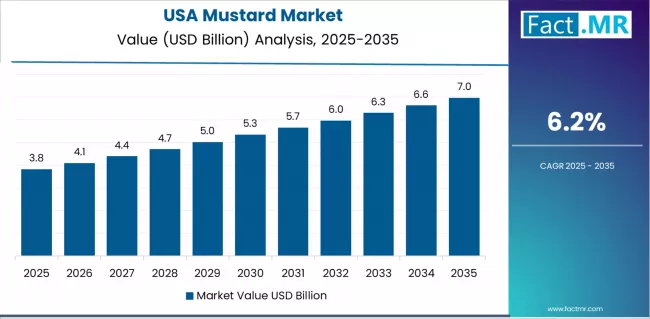
Mustard Market Country Value Analysis | Source: Fact.MR
USA’s market expansion is driven by diverse condiment preferences, including classic yellow mustard in fast-food applications and artisanal gourmet mustards in specialty food segments. The country demonstrates steady growth potential with a CAGR of 6.2% through 2035, supported by continuous innovation from established condiment manufacturers and emerging craft mustard producers emphasizing unique flavor profiles and local ingredient sourcing.
American consumers face abundant choices related to mustard varieties ranging from ballpark yellow to Dijon-style and spicy brown formulations, requiring brand differentiation and taste preference alignment. However, established mustard consumption habits averaging 0.8-1.0 pounds per capita annually and strong presence in foodservice channels including restaurants and fast-food chains create stable baseline demand for mustard products, particularly among condiment manufacturers and specialty food retailers where flavor innovation drives consumer trial and repeat purchases.
Market characteristics:
- Condiment category maturity and flavor innovation showing robust demand with substantial per-capita consumption
- Gourmet mustard proliferation varying between small-batch artisanal producers and established brand line extensions
- Future projections indicate continued growth with emphasis on organic certification and clean-label formulations
- Growing emphasis on health-conscious alternatives supporting mustard oil adoption among plant-based cooking enthusiasts despite regulatory considerations
How does Germany Demonstrate Gourmet Excellence Leadership?
The market in Germany leads in premium mustard product development based on extensive manufacturing heritage and consumer appreciation for quality condiment craftsmanship for enhanced culinary experiences. The country shows strong potential with a CAGR of 5.4% through 2035, driven by high per-capita gourmet mustard consumption and established manufacturing expertise in major production regions, including Bavaria and Baden-Württemberg.
German consumers are adopting premium mustard varieties through traditional shopping channels and emphasis on authentic flavor profiles for comprehensive meal enhancement, particularly in sausage accompaniment and traditional cuisine applications demanding proven quality credentials. Distribution channels through supermarkets, specialty delicatessens, and direct manufacturer sales expand coverage across urban centers and regional markets.
Leading market segments:
- Gourmet mustard consumption in traditional cuisine contexts implementing comprehensive flavor pairing with sausages and meat dishes
- Manufacturing heritage preservation with established producers maintaining traditional recipes and production methods
- Strategic emphasis on regional specialties including Bavarian sweet mustard and various grain mustard styles
- Focus on quality certifications and protected geographical indications addressing authenticity standards
What positions France for Heritage Manufacturing Leadership?
In major mustard-producing regions including Burgundy and surrounding areas, manufacturers are maintaining traditional Dijon mustard production through established recipes and quality standards, with documented heritage supporting global recognition through geographical indication and historical reputation. The market shows steady potential with a CAGR of 4.6% through 2035, linked to mature industry structure, established export markets, and ongoing tradition preservation in major production zones.
French mustard producers are sustaining classic formulations with manufacturing excellence to preserve culinary heritage while serving domestic and international markets. The country's established mustard identity creates ongoing opportunities for premium positioning that differentiates through authentic production methods and historical authenticity.
Market development factors:
- Dijon mustard heritage leading global recognition with emphasis on traditional production methods and quality standards
- Mature industry structure providing established manufacturing base and export capabilities
- Geographic indication protection supporting authenticity claims and premium market positioning
- Cultural culinary integration emphasizing mustard's essential role in French gastronomy and sauce preparations
How does Brazil Show Processing Sector Growth?
Brazil's mustard market demonstrates developing characteristics focused on expanding food processing industry and growing condiment consumption aligned with urbanization and changing dietary patterns. The country maintains moderate growth momentum with a CAGR of 4.3% through 2035, driven by food industry modernization and increasing consumer exposure to international condiment varieties through globalization influences.
Major urban centers, including São Paulo, Rio de Janeiro, and Brasília, showcase growing adoption of mustard products where condiment usage integrates with hamburger restaurants, hot dog vendors, and home cooking experimentation.
Key market characteristics:
- Food processing expansion driving mustard ingredient demand with emphasis on condiment manufacturing and prepared food applications
- Urbanization patterns supporting changing dietary habits and international food influence adoption
- Condiment category development pioneering mustard awareness and usage frequency improvement
- Distribution infrastructure growth enabling imported and domestic mustard product availability across retail channels
What Characterizes Japan's Market Development?
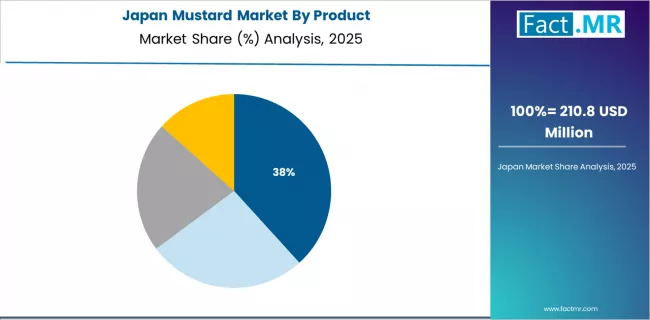
Mustard Market Japan Market Share Analysis By Product | Source: Fact.MR
In major metropolitan centers including Tokyo, Osaka, and Nagoya, the adoption of powdered mustard products is maintaining steady presence across traditional Japanese cuisine and Western-influenced food applications, driven by karashi (Japanese hot mustard) cultural integration and oden hot pot accompaniment traditions. The market demonstrates stable growth potential with a CAGR of 3.9% through 2035, linked to mature consumption patterns and established product applications in traditional and contemporary cuisine.
Japanese consumers are maintaining consistent mustard powder usage with traditional food pairing customs while exploring prepared mustard products in Western-style sandwiches and dressings. The country's sophisticated food culture creates ongoing demand for quality mustard products, while stable consumption patterns support predictable market development without dramatic expansion or contraction.
Key development areas:
- Traditional karashi mustard maintaining steady consumption with emphasis on hot pot accompaniment and traditional pairings
- Powdered mustard dominance through consumer preference for freshly prepared condiments and portion control
- Western cuisine influence enabling prepared mustard adoption in sandwiches, dressings, and fusion applications
- Quality consciousness supporting premium product positioning and authentic flavor expectations
Europe Market Split by Country
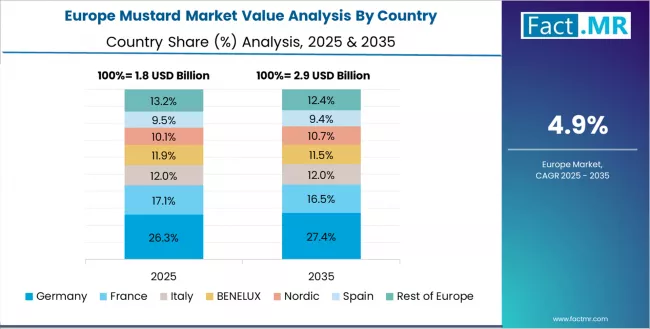
Mustard Market Europe Country Market Share Analysis, 2025 & 2035 | Source: Fact.MR
The mustard market in Europe is projected to grow from USD 2.3 billion in 2025 to USD 3.8 billion by 2035, registering a CAGR of 5.2% over the forecast period. Germany is expected to maintain its leadership position with a 27.0% market share in 2025, adjusting to 27.5% by 2035, supported by its dominant gourmet mustard consumption, established manufacturing infrastructure, and strong culinary tradition integration serving major European markets.
France follows with a 24.5% share in 2025, projected to reach 24.0% by 2035, driven by Dijon mustard heritage and traditional production excellence in Burgundy region implementing authentic manufacturing standards. UK holds a 18.0% share in 2025, expected to maintain 18.5% by 2035 through ongoing condiment innovation and imported specialty mustard appreciation.
Italy commands a 14.0% share, while Spain accounts for 11.0% in 2025. The rest of Europe region is anticipated to gain momentum, expanding its collective share from 5.5% to 6.0% by 2035, attributed to increasing gourmet food appreciation in Nordic countries and emerging Eastern European markets implementing Western condiment consumption patterns.
Competitive Landscape of the Mustard Market
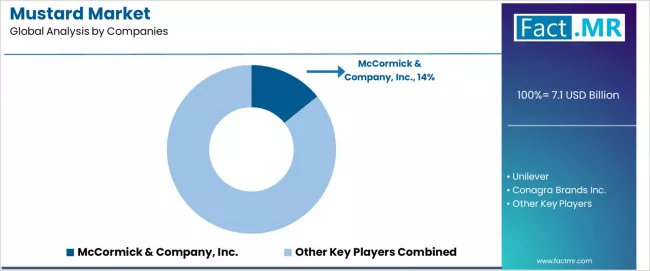
Mustard Market Analysis By Company | Source: Fact.MR
The mustard market features approximately 20-30 meaningful players with moderate concentration, where the top three companies control roughly 30-35% of global market share through established brand recognition, comprehensive distribution networks, and diverse product portfolios. Competition centers on flavor innovation, quality differentiation, and regional authenticity rather than price competition alone.
Market leaders include McCormick & Company with a 14.2% market share, along with Unilever and Conagra Brands, which maintain competitive advantages through extensive condiment brand portfolios spanning mustard varieties and related products, global distribution capabilities reaching diverse retail channels, and deep relationships with foodservice operators and retail buyers, creating high credibility among consumers seeking reliable condiment brands. These companies leverage substantial marketing investments and product development capabilities to defend market positions while expanding into adjacent categories including flavored mustards and organic product lines.
Challengers encompass established condiment brands including French's and Heinz competing through iconic yellow mustard positioning and comprehensive grocery distribution, specialized mustard producers including Woeber Mustard Manufacturing and Backwoods Mustard Company focusing on artisanal formulations and regional authenticity, and ingredient suppliers including Cargill and Sun Impex serving food processing customers. Emerging craft producers including Mustard and Co. create competitive pressure through innovative flavor combinations and local market differentiation.
Regional mustard producers and traditional oil extraction facilities create competitive pressure through authentic production methods and local market knowledge, particularly in high-consumption markets including India where traditional ghani-pressed mustard oil and regional seed varieties provide advantages in cultural authenticity and traditional consumer preferences. Market dynamics favor companies that combine quality consistency with flavor innovation addressing complete consumer journeys from everyday condiment usage through gourmet culinary experimentation and health-conscious cooking applications. Strategic emphasis on clean-label formulations, sustainable sourcing, and authentic production methods enables differentiation in increasingly competitive condiment segments across developed and emerging markets.
Global Mustard Market — Stakeholder Contribution Framework
Mustard products represent a critical culinary ingredient category that enables consumers and food manufacturers to access versatile flavor ingredients and functional cooking oils while addressing clean-label expectations and nutritional enhancement without exclusive synthetic condiment dependency, typically providing natural pungency and complex flavor profiles including characteristic bite compounds, essential fatty acids in oils supporting cardiovascular health, and antimicrobial properties enabling natural food preservation compared to artificial flavoring agents and refined vegetable oils alone while ensuring improved culinary authenticity and comprehensive nutritional value outcomes.
With the market projected to grow from USD 7.1 billion in 2025 to USD 12.9 billion by 2035 at a 6.2% CAGR, these solutions offer compelling advantages for condiment applications, cooking oil uses, and diverse culinary traditions seeking authentic flavor profiles. Scaling market adoption and sustainable production requires coordinated action across agricultural policy, quality standards, mustard producers, food manufacturers, and consumer education initiatives.
How Could Governments Spur Local Development and Adoption?
- Agricultural Support Programs: Include mustard cultivation in crop diversification initiatives, providing targeted support for oilseed farming and supporting research institutions through breeding program development and agronomic research funding.
- Trade Policy Development: Implement balanced import-export regulations for mustard products, provide agricultural subsidies supporting domestic cultivation, and establish quality standards that encourage authentic production over adulterated alternatives.
- Food Safety Standards: Create clear regulations for mustard oil composition and erucic acid content, establish labeling requirements and quality specifications, and develop harmonized international standards facilitating cross-border mustard trade.
- Market Development Support: Fund mustard product promotion programs, invest in processing infrastructure and cold storage facilities, and support value addition initiatives enabling farmers to capture greater value chain shares.
- Research & Innovation Funding: Establish programs for mustard variety improvement, support sustainable cultivation research and pest management studies, and create demonstration farms validating best agricultural practices.
How Could Industry Bodies Support Market Development?
- Quality Standards Development: Define standardized quality parameters for mustard products across purity, moisture content, and chemical composition, establish universal testing protocols and certification methodologies, and create authenticity verification systems supporting consumer confidence.
- Market Education & Awareness: Lead consumer education about mustard nutritional benefits, emphasizing cooking applications, health advantages, and proper storage practices supporting product value recognition.
- Sustainability Guidelines: Develop recommendations for sustainable mustard cultivation, processing efficiency, and environmental stewardship, ensuring long-term industry viability across production regions.
- Professional Development: Run training programs for farmers, processors, and quality assessors on optimizing mustard cultivation, post-harvest handling, and quality management in diverse production environments.
How Could Producers and Manufacturers Strengthen the Ecosystem?
- Quality Excellence Programs: Develop comprehensive quality assurance systems ensuring consistent product specifications, implement traceability from field to consumer, and maintain rigorous testing protocols supporting food safety standards.
- Product Innovation: Create next-generation mustard products with enhanced flavor profiles, convenient packaging formats, and application-specific characteristics that address evolving consumer preferences while respecting traditional authenticity.
- Sustainability Integration: Implement sustainable sourcing practices, support farmer cooperatives and fair pricing models, and invest in environmental stewardship programs ensuring long-term raw material availability.
- Consumer Education: Provide comprehensive product information including usage suggestions, nutritional data, and authenticity verification that help consumers make informed purchasing decisions aligned with culinary goals.
How Could Food Manufacturers and Retailers Navigate the Market?
- Product Portfolio Development: Incorporate authentic mustard products addressing diverse consumer segments, implement quality verification for sourcing, and develop innovative applications showcasing mustard versatility across food categories.
- Sourcing Excellence: Establish direct relationships with quality mustard producers, implement transparent supply chain practices, and ensure consistent availability through strategic inventory management.
- Consumer Engagement: Develop educational marketing about mustard usage, provide recipe inspiration and cooking demonstrations, and create experiential opportunities supporting product trial and repeat purchase.
- Quality Assurance: Maintain rigorous supplier qualification protocols, implement regular quality testing, and ensure proper storage conditions preserving product freshness and flavor integrity throughout distribution.
How Could Investors and Financial Enablers Unlock Value?
- Production Infrastructure Financing: Provide capital for processing facility modernization, quality testing equipment investments, and storage infrastructure supporting quality preservation and market access expansion.
- Innovation Investment: Back companies developing value-added mustard products, sustainable cultivation technologies, and novel application formulations enhancing market competitiveness and consumer appeal.
- Supply Chain Development: Finance farmer cooperative formation, contract farming programs, and aggregation infrastructure supporting smallholder farmer participation and income improvement.
- Market Expansion Support: Support brands entering new geographic markets, e-commerce platform development, and marketing programs building consumer awareness and trial supporting category growth.
Key Players in the Mustard Market
- McCormick & Company, Inc.
- Unilever
- Conagra Brands Inc.
- Backwoods Mustard Company
- Woeber Mustard Manufacturing Company
- French's
- H.J. Heinz Company
- Cargill
- Mustard and Co.
- Sun Impex
Segmentation
Scope of the Report
| Items | Values |
|---|---|
| Quantitative Units | USD 7.1 Billion |
| Product | Seed, Powder, Oil, Paste |
| Distribution Channel | Supermarket & Hypermarket, Convenience Stores, Specialty Stores, Online Sales |
| Regions Covered | Asia Pacific, Europe, North America, Latin America, Middle East & Africa |
| Country Covered | India, China, USA, Germany, France, Brazil, Japan, and 40+ countries |
| Key Companies Profiled | McCormick & Company, Inc., Unilever, Conagra Brands Inc., Backwoods Mustard Company, Woeber Mustard Manufacturing Company, French's, H.J. Heinz Company, Cargill, Mustard and Co., Sun Impex |
| Additional Attributes | Dollar sales by product and distribution channel categories, regional adoption trends across Asia Pacific, Europe, and North America, competitive landscape with food manufacturers and condiment producers, product specifications and quality requirements, integration with clean-label trends and organic certification programs, innovations in flavor development and sustainable sourcing practices, and development of specialized applications with artisanal production methods and authentic culinary heritage. |
Source: Fact.MR analysis. Updated Dec 12, 2025
Mustard Market by Segments
-
Product :
- Seed
- Powder
- Oil
- Paste
-
Distribution Channel :
- Supermarkets & Hypermarkets
- Convenience Stores
- Specialty Stores
- Online Sales
-
Region :
- Asia Pacific
- China
- Japan
- South Korea
- India
- Australia
- Thailand
- Rest of Asia Pacific
- Europe
- Germany
- UK
- France
- Italy
- Spain
- Denmark
- Sweden
- Norway
- Rest of Europe
- North America
- USA
- Canada
- Mexico
- Latin America
- Brazil
- Argentina
- Rest of Latin America
- Middle East & Africa
- South Africa
- Saudi Arabia
- UAE
- Kuwait
- Rest of Middle East & Africa
- Asia Pacific
Frequently Asked Questions
How big is the mustard market in 2025?
What will be the size of mustard market in 2035?
How much will be the mustard market growth between 2025 and 2035?
What are the key product types in the mustard market?
Which distribution channel segment to contribute significant share in the mustard market in 2025?
Who worked on this report


Preview the report firsthand - request a free sample
Free SampleGet the brochure for pricing and purchase details
Download PDF