- Market Value (2025): USD 1.0 Bn
- Estimated Value (2026): USD 1.2 Bn
- Forecast Value (2036): USD 3.8 Bn
- CAGR (2026-2036): 12.2%
What is the pulmonary mesh nebulizers market forecast to be worth by 2036?
USD 1.2 billion in 2026 to USD 3.8 billion by 2036, at 12.2% CAGR.
- The pulmonary mesh nebulizers market crossed a valuation of USD 1.0 billion in 2025.
- Demand is expected to increase from USD 1.2 billion in 2026 to USD 3.8 billion by 2036.
- The market is forecast to record 12.2% CAGR from 2026 to 2036 as asthma, COPD, cystic fibrosis and home respiratory therapy programs adopt portable mesh-based aerosol delivery.
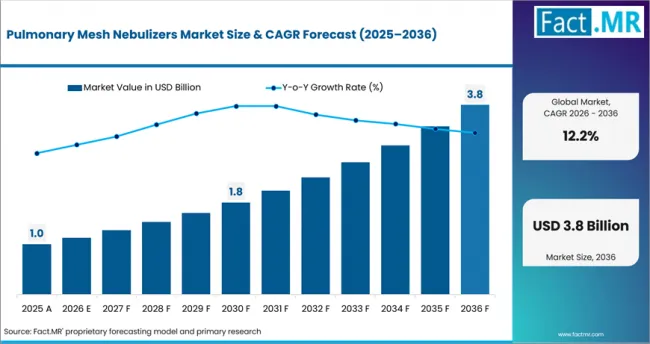
Pulmonary Mesh Nebulizers Market Value Analysis | Source: Fact.MR
What are the defining numbers behind pulmonary mesh nebulizer market growth?
USD 2.6 billion absolute opportunity by 2036, led by the United States and Germany.
- Demand Drivers in the Market
- Home respiratory patients need compact nebulizers that support daily therapy.
- Hospitals need inline mesh devices that reduce workflow disruption.
- Pediatric care teams need quieter devices that improve treatment acceptance.
- Device suppliers need replaceable mesh caps and medication cups for recurring use.
- Key Segments Analyzed
- By Device Format: Portable Handheld Mesh Nebulizers are expected to hold 47.0% share in 2026 because home and travel therapy drive compact-device demand.
- By Technology Type: Active Vibrating Mesh Systems lead because the vibrating membrane creates controlled aerosol output. The share is projected at 63.0% in 2026.
- By Patient Group: Adult Asthma and COPD Patients are likely to account for 49.0% share in 2026 because chronic respiratory therapy drives repeated use.
- By Care Setting: Home Care Settings lead with 44.0% share in 2026 because portable therapy reduces dependence on clinic visits.
- By Sales Channel: Medical Equipment Retail and Online Supply are expected to hold 36.0% share in 2026 because patients often buy replacement devices and accessories outside hospitals.
- By Geography: The United States is projected to record 14.8% CAGR through 2036 as home respiratory care adoption expands.
- Analyst Opinion at Fact.MR
- Shambhu Nath Jha, Senior Analyst at Fact.MR, states, “Pulmonary mesh nebulizers are gaining attention because patients want quiet and portable inhalation therapy. We see home-care providers and hospitals selecting mesh systems where treatment time and device handling matter. Suppliers that combine stable aerosol output with easy cleaning and accessory availability will gain stronger access to respiratory care channels.”
- Strategic Implications
- Device suppliers should improve mesh cap durability and cleaning guidance.
- Home-care providers should pair device supply with patient training.
- Hospitals should validate drug compatibility before broad inline use.
- Manufacturers should support pediatric and elderly users with simple device design.
Pulmonary mesh nebulizers use a vibrating membrane or mesh plate to convert liquid medicine into an inhalable aerosol. The category connects with drug delivery systems because aerosol quality and dose delivery shape therapy performance. The strongest adoption case comes from patients who need quiet and travel-friendly nebulization.
PARI describes eFlow Technology nebuliser handsets as vibrating membrane systems used for diseases of the lower airways. The company also notes high efficiency and short nebulisation times depending on the drug. This supports use in advanced pulmonary therapy programs.
HCmed’s 2025 FDA 510(k) summary for AdheResp states that the smart breath-actuated mesh nebulizer is used for aerosolizing liquid medications for inhalation in home care, hospital and long-term care settings. This shows how mesh systems are moving toward connected and breath-guided therapy.
The United States is projected to record 14.8% CAGR through 2036 as home respiratory care and hospital aerosol therapy programs expand. Germany is expected to post 13.8% CAGR through 2036 as pulmonary specialty care supports efficient nebulization. Japan is likely to record 13.1% CAGR as aging patients adopt portable devices for home therapy. China is forecast to advance at 12.4% CAGR as local manufacturers scale low-noise mesh devices. India is set to record 11.8% CAGR as asthma and COPD care shifts toward affordable portable nebulizers.
How does the pulmonary mesh nebulizers market break down by segment?
Portable Handheld Mesh Nebulizers lead at 47.0%; Home Care Settings lead at 44.0%.
Which device format dominates?
Portable Handheld Mesh Nebulizers hold 47.0% share in 2026.
Portable Handheld Mesh Nebulizers are expected to hold 47.0% share in 2026 because patients need compact therapy devices for home and travel use. These devices reduce noise and remove compressor dependence. Philips states that InnoSpire Go uses vibrating mesh technology and is designed for portable asthma therapy. The segment is tied to home respiratory care because inhalation therapy is moving into home-based routines.
Which technology type dominates?
Active Vibrating Mesh Systems account for 63.0% share in 2026.
Active Vibrating Mesh Systems lead because they push liquid medication through small mesh openings to form aerosol. The technology type is projected to capture 63.0% share in 2026. Aerogen and PARI both use vibrating mesh or vibrating membrane platforms. These systems support efficient nebulization and lower operating noise. Mesh precision and electronics shape device performance.
Which patient group dominates?
Adult Asthma and COPD Patients hold 49.0% share in 2026.
Adult Asthma and COPD Patients lead because chronic respiratory therapy creates repeated device use. The patient group is likely to account for 49.0% share in 2026. Portable mesh nebulizers help users receive prescribed aerosol therapy at home or outside the clinic. Pediatric use is also rising because quiet operation can reduce distress during treatment. The segment connects with asthma treatment because nebulizers remain important for some patients who struggle with inhaler coordination.
Which care setting dominates?
Home Care Settings lead with 44.0% share in 2026.
Home Care Settings lead because many respiratory patients need convenient therapy outside hospitals. The care setting is expected to hold 44.0% share in 2026. OMRON describes MicroAir U100 as a compact portable mesh nebulizer for lower-airway conditions. Home care adoption is strongest where devices are quiet, easy to clean and battery powered. Home healthcare channels support this shift.
Which sales channel dominates?
Medical Equipment Retail and Online Supply hold 36.0% share in 2026.
Medical Equipment Retail and Online Supply lead because patients and caregivers buy portable nebulizers through pharmacy and DME channels. The sales channel is expected to hold 36.0% share in 2026. Replacement mesh caps and medication cups add recurring accessory demand. MicroBase Technology states that Pocket Air is a series of vibrating mesh nebulizers using polyimide mesh technology. This supports a broad retail and OEM supply base.
What is accelerating pulmonary mesh nebulizer demand, and what is holding it back?
Portable respiratory therapy drives demand, while cleaning and clogging risk restrains adoption.
Portable respiratory therapy is the main driver. Patients need devices that are quiet and easy to carry. Mesh nebulizers fit this need because they are compact and can deliver therapy without a compressor.
Hospital adoption adds a second driver. Aerogen Solo is used across hospital aerosol delivery workflows and is built around vibrating mesh technology. This supports clinical use where efficient drug delivery and inline compatibility matter.
The main restraint is cleaning and clogging risk. Mesh openings can be affected by residue if users do not clean devices correctly. Suppliers need better instructions and durable mesh caps before adoption scales further.
Where do the biggest pulmonary mesh nebulizer opportunities sit?
Home COPD therapy, pediatric care and connected nebulization.
- Home COPD Therapy: Patients can use compact mesh devices for regular aerosol treatment outside clinics.
- Pediatric Care: Quiet devices can improve acceptance during asthma or respiratory infection treatment.
- Connected Nebulization: Smart devices can track sessions and support remote respiratory care.
Which countries are scaling pulmonary mesh nebulizers fastest?
United States 14.8%, Germany 13.8%, Japan 13.1%, China 12.4%, India 11.8%.
Based on regional analysis, the pulmonary mesh nebulizers market covers North America and Western Europe. Asia Pacific is also included. Latin America and Middle East and Africa complete the regional scope.
| Country | CAGR |
|---|---|
| United States | 14.8% |
| Germany | 13.8% |
| Japan | 13.1% |
| China | 12.4% |
| India | 11.8% |
Source: Fact.MR analysis. Updated Jun 29, 2026
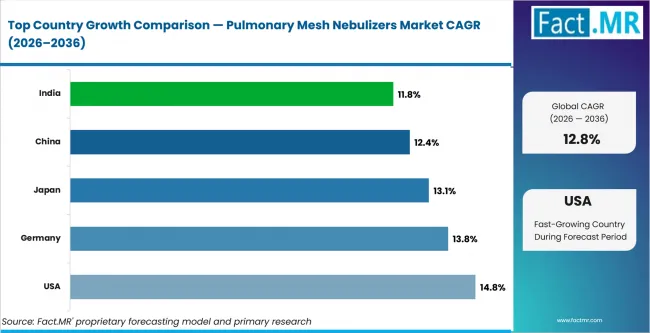
Pulmonary Mesh Nebulizers Market Cagr Analysis By Country | Source: Fact.MR
What is powering the United States lead?
14.8% CAGR, driven by Aerogen and home respiratory care adoption.
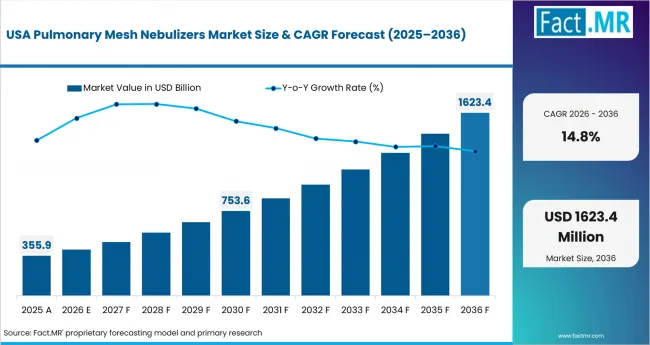
Pulmonary Mesh Nebulizers Market Country Value Analysis | Source: Fact.MR
The United States is projected to record 14.8% CAGR by 2036 as hospitals and home-care providers adopt portable mesh nebulizers. Aerogen supports hospital aerosol delivery with vibrating mesh systems. OMRON and Philips support consumer-facing portable mesh devices. Growth will favor suppliers with strong DME access and clear patient instructions.
How is Germany scaling pulmonary mesh nebulizer demand?
13.8% CAGR, supported by PARI and pulmonary specialty care.
Germany is expected to post 13.8% CAGR through 2036 as pulmonary therapy programs use efficient mesh nebulization. PARI supports lower-airway treatment through eFlow Technology handsets. Specialist respiratory clinics need devices that shorten therapy time. Growth will favor validated nebulizer platforms with drug-specific development support.
What supports Japan’s outlook?
13.1% CAGR, driven by OMRON Healthcare and aging respiratory patients.
Japan is likely to record 13.1% CAGR by 2036 as older patients use compact home respiratory devices. OMRON MicroAir supports portable mesh nebulization and lower-airway therapy. Home treatment convenience is important for chronic respiratory care. Growth will favor silent and easy-to-handle devices.
What underpins China’s growth?
12.4% CAGR, backed by local device manufacturing and retail mesh nebulizer supply.
China is forecast to advance at 12.4% CAGR through 2036 as domestic manufacturers scale portable mesh nebulizers. Feellife and other local suppliers support low-noise consumer models. Retail availability increases access for families managing asthma and bronchitis care. Growth will favor affordable devices with clear quality documentation.
How is India scaling pulmonary mesh nebulizer adoption?
11.8% CAGR, led by pharmacy channels and portable respiratory therapy.
India is set to record 11.8% CAGR by 2036 as pharmacy and online channels improve access to portable mesh nebulizers. Patients value devices that are light and quiet. Asthma and COPD care in urban households supports adoption. Growth will favor durable devices with affordable replacement parts.
Who leads the pulmonary mesh nebulizers market?
Aerogen and PARI lead through hospital-grade and drug-specific mesh nebulizer platforms.
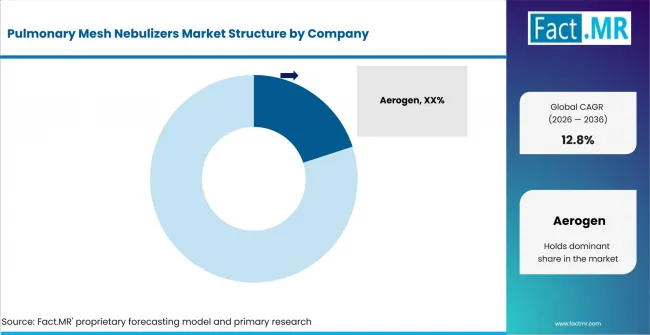
Pulmonary Mesh Nebulizers Market Analysis By Company | Source: Fact.MR
Pulmonary mesh nebulizers are supplied by respiratory device companies and portable medical equipment manufacturers. Aerogen leads through vibrating mesh technology used in hospital aerosol therapy. PARI supports advanced lower-airway treatment through eFlow Technology.
OMRON Healthcare supports home therapy through MicroAir U100. HCmed Innovations supports smart and breath-actuated vibrating mesh nebulizers. MicroBase Technology supports Pocket Air vibrating mesh nebulizer platforms for respiratory therapy.
Competition through 2036 will depend on aerosol consistency and device usability. Suppliers need strong cleaning guidance and reliable accessory supply. The medical polymers layer matters because medication cups and housings need biocompatible materials. Respiratory disposables are relevant because masks, mouthpieces, and medication cups support recurring use.
Which companies are the key providers?
Aerogen and PARI are key providers. Philips Respironics and OMRON Healthcare are also profiled. HCmed Innovations and MicroBase Technology complete the company set.
- Aerogen
- PARI
- Philips Respironics
- OMRON Healthcare
- HCmed Innovations
- MicroBase Technology
Bibliography
- Aerogen. (2026). Discover Aerogen Solo: Vibrating mesh nebuliser. Aerogen.
- PARI. (2026). eFlow® Technology nebuliser handsets. PARI.
- U.S. Food and Drug Administration. (2025, June 20). AdheResp Smart Breath-actuated Mesh Nebulizer: 510(k) summary. FDA.
- HCmed Innovations. (2025, July 18). HCmed AdheResp® receives U.S. FDA 510(k) clearance. HCmed Innovations.
- Philips Respironics. (2026). InnoSpire Go portable mesh nebulizer. Philips.
- OMRON Healthcare. (2026). MicroAir U100 mesh nebulizer. OMRON Healthcare.
- MicroBase Technology. (2026). Aerosol drug delivery solution: Pocket Air vibrating mesh nebulizers. MicroBase Technology.
This Report Addresses
- Strategic intelligence on pulmonary mesh nebulizers across device format and technology type.
- Segment analysis covering Portable Handheld Mesh Nebulizers and Active Vibrating Mesh Systems.
- Regional outlook covering the United States, Germany, Japan, China, and India.
- Competitive analysis of Aerogen, PARI, Philips Respironics, OMRON Healthcare, HCmed Innovations, and MicroBase Technology.
- Technology assessment covering vibrating mesh membranes, breath actuation, connected tracking, and accessory replacement.
- Use case assessment covering home COPD therapy, pediatric care and connected nebulization.
- Primary interviews, supplier checks and official source review support the forecast.
What does the pulmonary mesh nebulizers market cover?
Portable and clinical mesh devices used to aerosolize pulmonary medicines.
The pulmonary mesh nebulizers market covers vibrating mesh nebulizers used for lower-airway drug delivery. It includes portable handheld devices, hospital inline mesh systems, breath-actuated mesh nebulizers, and connected nebulizer platforms. The scope connects with inhalation therapy because pulmonary mesh nebulizers support aerosol treatment for respiratory diseases.
The market differs from jet nebulizers because mesh systems do not rely on compressor airflow to generate aerosol. Mesh devices are quieter and smaller. They also fit home and travel use where conventional compressor systems can be inconvenient.
What is included in the scope?
Handheld, breath-actuated and inline vibrating mesh nebulizers.
The scope includes reusable and single-patient mesh nebulizers used in home care and hospitals. It covers devices for asthma, COPD, cystic fibrosis and other pulmonary conditions. The scope includes respiratory care devices when mesh nebulization is the delivery mechanism.
The scope includes medication cups, mesh caps and device accessories when sold with mesh nebulizer platforms. It also includes smart nebulizers with adherence tracking or breath-actuation features. Clinical trial devices are included when they are intended for pulmonary aerosol delivery.
What is excluded from the scope?
Jet nebulizers, ultrasonic humidifiers and non-pulmonary aerosol devices.
The scope excludes compressor jet nebulizers and ultrasonic nebulizers without mesh technology. It excludes humidifiers and aroma diffusers. It excludes nasal sprays and dry powder inhalers. It also excludes ventilators unless the mesh nebulizer is sold as a separate aerosol delivery component.
How was the analysis built?
100+ sources, 40+ company portfolios, 25+ countries, 20+ interviews.
- Primary Research:
- Primary research includes interviews with respiratory therapists and home-care equipment suppliers. It includes input from pulmonary device manufacturers and hospital procurement teams.
- Desk Research:
- Desk research reviews official product pages and regulatory summaries. It covers vibrating mesh technology, breath-actuated devices and point-of-care respiratory testing workflows that connect with respiratory care programs.
- Market-Sizing and Forecasting:
- Forecasting uses installed device base and replacement accessory demand. Home-care adoption and hospital aerosol therapy demand support the market assessment.
- Data Validation and Update Cycle:
- Forecasts are validated through supplier checks and respiratory care references. FDA summaries and official product updates help confirm market direction.
Segmentation
What is the report’s scope and coverage?
| Attribute | Details |
|---|---|
| Quantitative Units | USD Billion in 2026 to USD Billion by 2036 at CAGR |
| Market Definition | Portable and clinical vibrating mesh nebulizers used to deliver pulmonary aerosol medicines |
| Device Format | Portable Handheld Mesh Nebulizers; Hospital Inline Mesh Nebulizers; Breath-Actuated Mesh Nebulizers; Connected Mesh Nebulizers; Pediatric Mesh Nebulizers |
| Technology Type | Active Vibrating Mesh Systems; Passive Mesh Aerosol Systems; Breath-Actuated Mesh Systems; Smart Connected Mesh Platforms; Drug-Specific Mesh Platforms |
| Patient Group | Adult Asthma and COPD Patients; Pediatric Respiratory Patients; Cystic Fibrosis Patients; Elderly Home-Care Patients; Acute Hospital Respiratory Patients |
| Care Setting | Home Care Settings; Hospitals and ICUs; Pulmonary Clinics; Pediatric Care Centers; Long-Term Care Facilities |
| Sales Channel | Medical Equipment Retail and Online Supply; DME Suppliers; Hospital Procurement; Pharmacy Channels; OEM and Drug-Device Partnerships |
| Regions Covered | North America; Western Europe; Asia Pacific; Latin America; Middle East and Africa |
| Countries Covered | United States; Germany; Japan; China; India |
| Key Companies Profiled | Aerogen; PARI; Philips Respironics; OMRON Healthcare; HCmed Innovations; MicroBase Technology |
| Forecast Period | 2026 to 2036 |
| Approach | Hybrid top-down and bottom-up approach using device sales, accessory replacement, hospital adoption, home-care demand and provider validation |
Source: Fact.MR analysis. Updated Jun 29, 2026
How is the market segmented?
-
By Device Format:
- Portable Handheld Mesh Nebulizers
- Hospital Inline Mesh Nebulizers
- Breath-Actuated Mesh Nebulizers
- Connected Mesh Nebulizers
- Pediatric Mesh Nebulizers
-
By Technology Type:
- Active Vibrating Mesh Systems
- Passive Mesh Aerosol Systems
- Breath-Actuated Mesh Systems
- Smart Connected Mesh Platforms
- Drug-Specific Mesh Platforms
-
By Patient Group:
- Adult Asthma and COPD Patients
- Pediatric Respiratory Patients
- Cystic Fibrosis Patients
- Elderly Home-Care Patients
- Acute Hospital Respiratory Patients
-
By Care Setting:
- Home Care Settings
- Hospitals and ICUs
- Pulmonary Clinics
- Pediatric Care Centers
- Long-Term Care Facilities
-
By Sales Channel:
- Medical Equipment Retail and Online Supply
- DME Suppliers
- Hospital Procurement
- Pharmacy Channels
- OEM and Drug-Device Partnerships
-
Region:
- North America
- United States
- Canada
- Europe
- Germany
- United Kingdom
- France
- Italy
- Netherlands
- Asia Pacific
- Japan
- China
- India
- South Korea
- Singapore
- Latin America
- Brazil
- Mexico
- Argentina
- Middle East & Africa
- UAE
- Saudi Arabia
- South Africa
- Israel
- North America
Frequently Asked Questions
Which device format leads the Pulmonary Mesh Nebulizers Market?
Which technology type leads the Pulmonary Mesh Nebulizers Market?
Which patient group leads the Pulmonary Mesh Nebulizers Market?
Which care setting leads the Pulmonary Mesh Nebulizers Market?
Which sales channel leads the Pulmonary Mesh Nebulizers Market?
Which country expands fastest in the Pulmonary Mesh Nebulizers Market?
How does Germany perform in the Pulmonary Mesh Nebulizers Market?
How does Japan perform in the Pulmonary Mesh Nebulizers Market?
How does China perform in the Pulmonary Mesh Nebulizers Market?
How does India perform in the Pulmonary Mesh Nebulizers Market?
What is the primary driver in the Pulmonary Mesh Nebulizers Market?
What is the main restraint in the Pulmonary Mesh Nebulizers Market?
Why are portable handheld mesh nebulizers important?
Why are breath-actuated mesh systems gaining adoption?
Who worked on this report


Preview the report firsthand - request a free sample
Free SampleGet the brochure for pricing and purchase details
Download PDF