- Market Value (2025): USD 3.3 Bn
- Estimated Value (2026): USD 3.5 Bn
- Forecast Value (2036): USD 6.8 Bn
- CAGR (2026-2036): 6.8%
What is the Rat Mouse Model Market forecast to be worth by 2036?
USD 3.5 billion in 2026 to USD 6.8 billion by 2036 at 6.8% CAGR.
- The rat mouse model market reached USD 3.3 billion in 2025 as preclinical programs kept using standardized animals with documented strain histories.
- Market value is projected to increase from USD 3.5 billion in 2026 to USD 6.8 billion by 2036.
- The market is forecast to record 6.8% CAGR from 2026 to 2036 as model choice becomes part of study quality review.
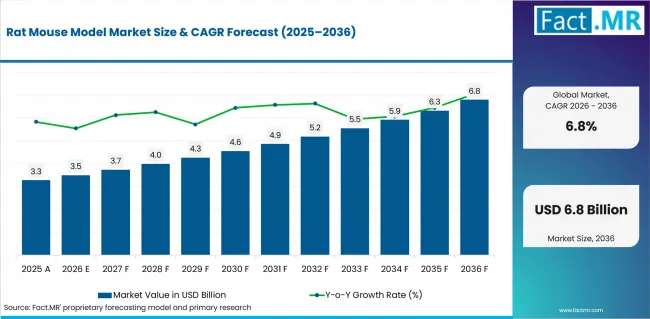
Rat Mouse Model Market Value Analysis | Source: Fact.MR
What are the defining numbers behind Rat Mouse Model Market growth?
USD 3.3 billion absolute opportunity by 2036, led by Inbred Models and Drug Discovery & Development. Pharmaceutical Companies and Direct Sales shape the main commercial route.
- Demand Drivers in the Market
- Inbred Models require stable genetic backgrounds. This helps research groups compare disease responses across repeated studies without changing the baseline animal strain.
- Drug Discovery & Development work depends on rat and mouse models that show measurable efficacy and toxicity signals. These results help teams decide whether a program is ready for the next stage.
- Pharmaceutical Companies require documented sourcing and animal health records. Rederivation support matters when approval groups review each model before study release.
- Direct Sales channels remain important when customers need model guidance and predictable delivery. They give customers a clear contact point from strain selection through colony support.
- Key Segments Analyzed
- By Product Type: Inbred Models are projected to hold 37.1% share in 2026 as stable genetic backgrounds reduce variation across repeat studies.
- By Application: Drug Discovery & Development is expected to account for 30.2% share in 2026 because preclinical programs need animal evidence before clinical spending expands.
- By End User: Pharmaceutical Companies are anticipated to capture 29.9% share in 2026 since recurring discovery and toxicology programs require steady model access.
- By Distribution Channel: Direct Sales is estimated to represent 31.3% share in 2026 due to the need for model selection support and supply coordination.
- By Model Type: Mouse Models are forecast to hold 37.5% share in 2026 as mice offer broad strain availability and established disease-model evidence.
- Analyst Opinion at Fact.MR
- Shambhu Nath Jha, Sr. Consultant at Fact.MR, opines, “Rat and mouse model demand depends less on broad research spending and more on whether a model reduces experimental uncertainty. Providers that show strain provenance and health status are expected to hold stronger positions with pharmaceutical and academic customers.”
- Strategic Implications
- Laboratory managers can define strain-selection and validation criteria before procurement begins. This helps animal model programs compare inbred and humanized options against the study endpoint.
- Providers need to connect product choice with application evidence. A proposal using drug discovery technologies is stronger when it explains how the model supports disease relevance and repeatable preclinical readouts.
- Investors need to separate routine animal supply from specialized model services. Preclinical CRO services become more valuable when model creation and breeding support are tied to recurring research workflows.
The USA is expected to record an 8.8% CAGR from 2026 to 2036, supported by pharmaceutical research depth and model documentation requirements. Japan is projected to record an 8.1% CAGR as drug discovery programs place more weight on reliable supply and quality-controlled strains. Germany is anticipated to grow at 7.5% through institutional research activity and service-led purchasing. The UK is estimated to post a 6.8% CAGR through translational research and outsourced preclinical services. Canada is forecast at 6.1% through academic research networks and manageable service access. Australia is projected to reach 5.4% through specialty research demand. Brazil is expected to record a 4.7% CAGR as regional distributors support model availability and study continuity.
How does the Rat Mouse Model Market break down by segment?
Inbred Models are expected to lead Product Type at 37.1% share in 2026. Drug Discovery & Development is projected to lead Application at 30.2% share in 2026.
What supports Inbred Models within Product Type?
Inbred Models are projected to account for 37.1% share in 2026.
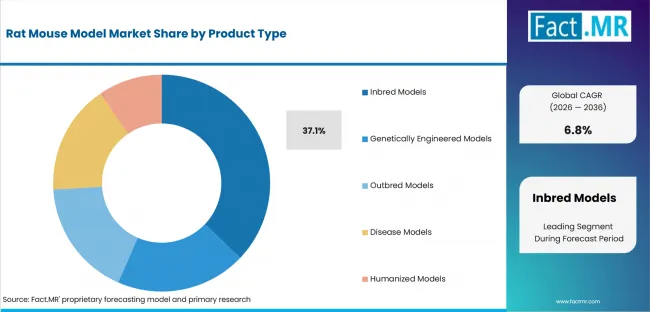
Rat Mouse Model Market Analysis By Product Type | Source: Fact.MR
Inbred Models provide a consistent genetic background, helping researchers reduce variation across repeated studies. Strains such as C57BL/6 Mice are widely used in metabolic, neurological and immunology research, while BALB/c Mice support antibody and oncology studies. Genetically Engineered Models serve more targeted programs where researchers need specific gene deletions, mutations or disease traits.
What supports Drug Discovery & Development within Application?
Drug Discovery & Development is expected to hold 30.2% share in 2026.
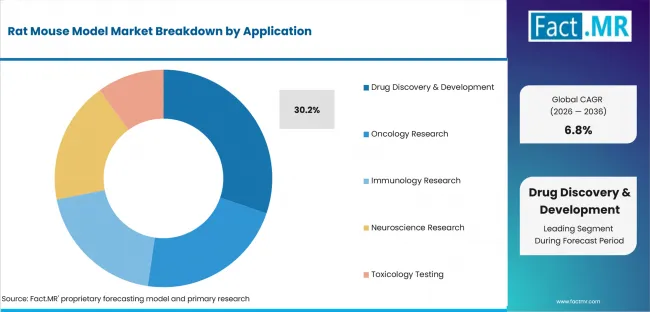
Rat Mouse Model Market Analysis By Application | Source: Fact.MR
A large share of demand comes from the need to assess drug safety, dosage response and biological activity before human trials. Rat and mouse models support early compound screening as well as later toxicology studies. In addition, Oncology Research and Tumor Xenograft Studies increase model use because researchers need measurable tumor growth, treatment response and survival data.
What supports Pharmaceutical Companies within End User?
Pharmaceutical Companies are anticipated to lead with 29.9% share in 2026.
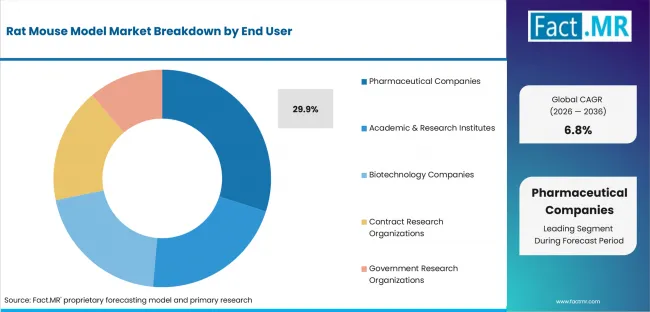
Rat Mouse Model Market Analysis By End User | Source: Fact.MR
For pharmaceutical developers, animal models remain important across target identification, candidate selection and regulatory testing. Innovator Pharmaceutical Companies often purchase specialized models for oncology, rare disease and immune-response programs. Generic Pharmaceutical Companies usually depend on established strains for bioequivalence support, toxicity assessment and repeatable preclinical testing before submitting product documentation.
What supports Direct Sales within Distribution Channel?
Direct Sales are estimated to represent 31.3% share in 2026.
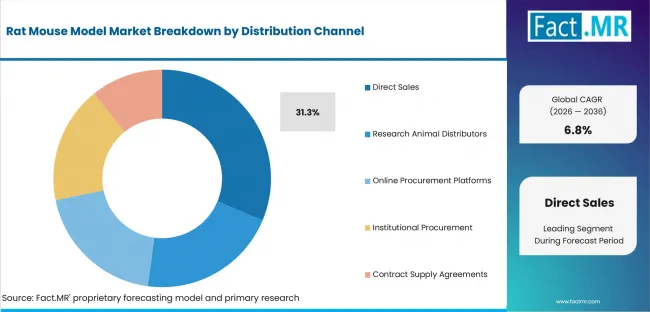
Rat Mouse Model Market Analysis By Distribution Channel | Source: Fact.MR
Direct purchasing gives laboratories better access to strain history, health records, breeding schedules and technical support. This route is especially useful for large studies that require animals of a specific age, sex or genetic background. Long-Term Supply Agreements improve availability for recurring programs, whereas Research Animal Distributors mainly support smaller laboratories and locations without direct breeder coverage.
What supports Mouse Models within Model Type?
Mouse Models are forecast to hold 37.5% share in 2026.
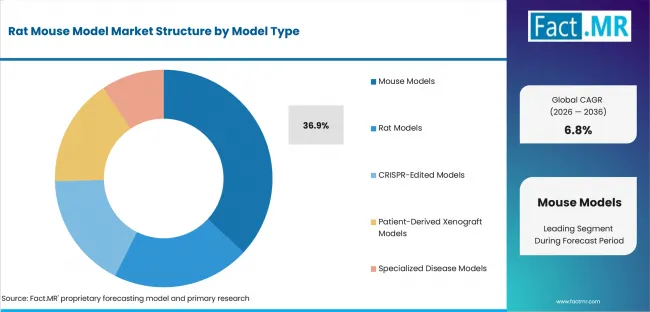
Rat Mouse Model Market Analysis By Model Type | Source: Fact.MR
Mouse Models remain widely preferred because they have short breeding cycles, well-documented genetics and broad availability across research areas. Immunodeficient Mice support xenograft and humanized-model studies, while Wild-Type Mice provide a standard reference for treatment comparison. By contrast, Rat Models are selected more often for cardiovascular, behavioral and toxicology studies that require larger tissue samples or easier surgical procedures.
Mouse Models also benefit from extensive historical datasets and established laboratory protocols. Demand for Humanized Mice is expected to rise in immuno-oncology, infectious disease and antibody research because these models can reproduce selected parts of the human immune system. Their higher cost and more complex handling may limit routine use, but they remain valuable for advanced therapies requiring stronger human biological relevance.
What is accelerating Rat Mouse Model Market adoption, and what is holding it back?
Demand is expected to grow due to reliable inbred models and their use in drug discovery. High prices and weak documentation may limit adoption.
Drivers Impact Analysis
| DRIVER | QUALITATIVE RELEVANCE | GEOGRAPHIC RELEVANCE | IMPACT TIMELINE |
|---|---|---|---|
| Inbred model reproducibility | High | USA | Short term (<= 2 years) |
| Drug discovery and development demand | High | Japan | Short term (<= 2 years) |
| Pharmaceutical company validation needs | Moderate | Germany | Medium term (2-4 years) |
| Direct sales and service support | Selective | UK | Medium term (2-4 years) |
Source: Fact.MR analysis. Updated Jul 29, 2026
- Inbred model reproducibility: Customers select Inbred Models when genetic consistency lowers experimental variation. Clear health monitoring helps facilities approve repeat use.
- Drug discovery and development demand: Early-stage programs need models that connect disease biology with measurable response. This creates recurring orders when protocols depend on stable cohorts.
- Pharmaceutical company validation needs: Pharmaceutical Companies require provider qualification before model use. Documentation and service response are expected to reduce review friction.
- Direct sales and service support: Direct Sales work best where model choice affects study setup and timing. A direct contact helps customers compare health status and delivery plans.
Opportunity Impact Analysis
| OPPORTUNITY | QUALITATIVE RELEVANCE | GEOGRAPHIC RELEVANCE | IMPACT TIMELINE |
|---|---|---|---|
| Specialized inbred model grades | High | USA | Medium term (2-4 years) |
| Humanized and immunodeficient models | Moderate | Japan | Medium term (2-4 years) |
| Custom breeding and colony services | Selective | Germany | Medium term (2-4 years) |
Source: Fact.MR analysis. Updated Jul 29, 2026
- Specialized inbred model grades: Premium demand is concentrated where customers need strain histories and repeatable disease-response data. Providers are expected to improve acceptance by tying each model to a clear study function and preclinical antibody development needs.
- Humanized and immunodeficient models: These models are expected to gain attention in immuno-oncology and infectious disease research. Growth depends on graft behavior and clear model performance.
- Custom breeding and colony services: Research groups need support when a study requires timed animals or strain maintenance. Service-led programs are expected to turn one-time model selection into recurring contracts.
Restraints Impact Analysis
| RESTRAINT | QUALITATIVE RELEVANCE | GEOGRAPHIC RELEVANCE | IMPACT TIMELINE |
|---|---|---|---|
| Validation and documentation burden | High | USA | Short term (<= 2 years) |
| Price sensitivity in discovery programs | Moderate | Japan | Medium term (2-4 years) |
| Slow conversion without local support | Selective | Germany | Medium term (2-4 years) |
Source: Fact.MR analysis. Updated Jul 29, 2026
- Validation and documentation burden: Customers delay orders when they cannot verify strain provenance or health status. This restraint is sharper for specialized models used in high-cost studies.
- Price sensitivity in discovery programs: Model cost becomes harder to defend when early-stage programs face uncertain decisions. Providers need evidence that the model reduces repeat work.
- Slow conversion without local support: Conversion slows when customers lack help for breeding and shipment timing. Local service access matters where facilities cannot absorb failed cohorts.
Which countries are scaling Rat Mouse Model Market fastest?
The country comparison is defined by the narrow spread between the USA and Brazil. The total spread between the highest and lowest listed CAGR is 4.1 percentage points. The USA and Japan form the upper cluster. Germany and the UK remain close to the global 6.8% CAGR.
- The USA leads the listed countries as pharmaceutical research groups place heavy weight on strain records and direct service. Predictable model supply strengthens the country position.
- Japan remains close to the USA in CAGR terms but follows a different route through quality-controlled procurement. Careful channel selection is expected to shape customer approval.
- Germany holds a measured position through institutional research demand. Documentation and service proof influence provider selection before customers change established model sources.
- The UK stays near the global rate as translational research activity supports model use. Price review is expected to slow some upgrades to specialized strains.
- Canada and Australia form the lower cluster where geography and service coverage affect adoption timing. Brazil records the lowest listed CAGR as distribution depth remains less even.
Comparable CAGRs can therefore produce different market entry conditions across these countries. Deployment timing depends on model documentation and service access. Commercial readiness reflects the fit between study purpose and strain availability.
The full report provides country-level CAGR analysis across North America; Latin America; Europe; East Asia; South Asia and Oceania; and the Middle East and Africa.
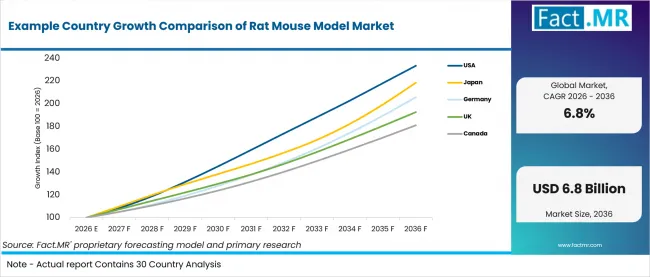
Example Country Growth Comparison Of Rat Mouse Model Market | Source: Fact.MR
| Country | CAGR (2026-2036) |
|---|---|
| USA | 8.8% |
| Japan | 8.1% |
| Germany | 7.5% |
| UK | 6.8% |
| Canada | 6.1% |
| Australia | 5.4% |
| Brazil | 4.7% |
Source: Fact.MR analysis. Updated Jul 29, 2026
What strengthens USA adoption?
8.8% CAGR, supported by pharmaceutical research depth and direct model support.
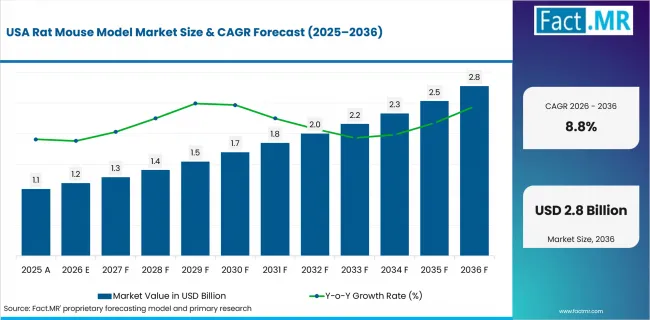
Rat Mouse Model Market Country Value Analysis | Source: Fact.MR
USA demand benefits from a large pharmaceutical and biotechnology research base. Buyers often review strain history, model availability and technical response before approving a supplier. Direct supply relationships also matter because model selection can affect study design, protocol approval and repeat purchasing.
Why is Japan gaining demand?
8.1% CAGR, led by quality-focused research programs and controlled procurement.
In Japan, growth is linked to drug discovery programs that place strong importance on model consistency. Health records, genetic quality and study repeatability influence purchasing decisions. Providers that offer complete documentation and timely technical support are more likely to secure specialized research orders.
What drives Germany’s growth through 2036?
7.5% CAGR, backed by institutional research activity and validation-led purchasing.
Germany’s pharmaceutical companies and public research institutes usually assess model performance before changing suppliers. Ethical sourcing, validation records and breeding quality play a major role in approval. Demand remains stronger for providers that can support repeated use of inbred and genetically engineered models.
How is demand expanding in the UK?
6.8% CAGR, driven by translational research and outsourced preclinical services.
Translational research and contract preclinical work create steady demand across the UK. Research groups look for disease-relevant models, dependable delivery and consistent study support. Established mouse and rat strains remain widely used, although price pressure can delay adoption of more specialized models.
Why does Canada maintain steady growth?
6.1% CAGR, led by academic research networks and service coverage needs.
Canada’s broad research network creates demand for suppliers with reliable delivery and strong regional support. Academic institutions and biopharma companies continue to use standard mouse models for repeatable disease studies. More specialized models gain traction only when providers can manage long-distance shipment and technical assistance.
What shapes Australia’s market development?
5.4% CAGR, backed by specialty research demand and controlled supply planning.
Distance and import requirements strongly influence purchasing in Australia. Research facilities often prefer suppliers that can reduce shipment risk and provide complete health documentation. Specialized models are adopted more selectively because many programs operate at a smaller scale and require careful supply planning.
How is Brazil building research demand?
4.7% CAGR, supported by distributor access and gradual preclinical research expansion.
Brazil’s market depends heavily on distributor reach and technical support during model selection. Pharmaceutical and academic users value partners that can maintain availability across ongoing studies. Growth is slower where limited service coverage, delivery delays and restricted access to specialized models interrupt purchasing decisions.
Who leads the Rat Mouse Model Market?
The Jackson Laboratory and Charles River Laboratories show the direct relevance. Taconic Biosciences strengthen the specialized rodent model base.
The Jackson Laboratory offers a wide range of mouse strains and research support. Charles River Laboratories provides standard and specialized models. Taconic Biosciences supplies genetically defined mouse and rat models. Janvier Labs and Orient Bio strengthen regional supply. Cyagen Biosciences adds custom model services.
From 2026 to 2036, competition will depend on model availability, consistent results and clear health records. Customers will also compare rederivation support and supply reliability. Providers that reduce study delays and model-related risks may gain stronger demand from pharmaceutical companies and CROs.
Which companies are the key providers?
Key companies include The Jackson Laboratory; Charles River Laboratories; Taconic Biosciences; Janvier Labs; Orient Bio; Inotiv; and Cyagen Biosciences.
- The Jackson Laboratory
- Charles River Laboratories
- Taconic Biosciences
- Janvier Labs
- Orient Bio
- Inotiv
- Cyagen Biosciences
Bibliography
- U.S. Food and Drug Administration. (2025, April 10). FDA announces plan to phase out animal testing requirement for monoclonal antibodies and other drugs.
- National Institutes of Health. (2025, March 31). Development of animal models and related biological materials for research (R21 clinical trial not allowed): PAR-25-273. U.S. Department of Health and Human Services.
- The Jackson Laboratory. (2025, February 13). What is a JAX humanized mouse?
- Taconic Biosciences. (2025, June 19). Taconic Biosciences launches huSelect custom immune-system humanization to improve the reliability of immuno-oncology, autoimmune and infectious-disease research.
This Report Answers
- The report provides strategic intelligence on the Rat Mouse Model Market across Product Type and Application choices that shape preclinical model purchasing.
- Segment analysis covers Inbred Models and Drug Discovery & Development as the share leaders within the 2026 market.
- Country outlook evaluates the USA and Japan alongside Germany and the UK. Canada, Australia and Brazil complete the growth comparison across profiled markets.
- Competitive analysis profiles The Jackson Laboratory and Charles River Laboratories alongside Taconic Biosciences. Janvier Labs; Orient Bio; Inotiv and Cyagen Biosciences complete the provider set.
- Service assessment covers Direct Sales and custom breeding. Research animal distributors and long-term supply agreements complete the channel view alongside model support requirements.
What does the Rat Mouse Model Market cover?
The Rat Mouse Model Market covers commercial activity tied to standardized and specialized rat and mouse models used for preclinical research.
The market includes Inbred Models and C57BL/6 Mice. BALB/c Mice and Genetically Engineered Models are included when they serve disease-focused research. Coverage extends to Drug Discovery & Development and Preclinical Drug Screening. Oncology Research and toxicology use are included when animals are purchased for study evidence.
The market differs from general laboratory products because value comes from model fitness and strain documentation. Basic consumables remain outside the boundary. Unrelated infrastructure is excluded. Data-only tools and in-vitro human models are excluded unless procurement depends on rat or mouse model selection.
What is included in the scope?
Rat and mouse model supply is used by pharmaceutical companies and biotechnology firms. CROs and academic research organizations remain within scope.
The scope includes Product Type and Application alongside End User, Distribution Channel and Model Type. Coverage spans inbred and outbred models. Humanized, disease and genetically engineered models are included when they support drug discovery or toxicology studies. Preclinical brain imaging becomes adjacent only when model use requires imaging endpoints.
What is excluded from the scope?
General laboratory consumables and infrastructure outside rat or mouse model procurement remain outside this market.
The scope excludes unrelated animal health products and companion-animal services. Veterinary care and non-research animals are excluded. Standalone software is excluded unless it is tied to model selection or preclinical study procurement. General CRO revenue without clear animal model use is excluded.
How Was the Analysis Built?
The analysis draws on 120+ sources, 35+ company portfolios, 25+ countries, and more than 20 industry interviews.
- Primary Research: Primary research includes discussions with manufacturers, service providers, technology developers, distributors, end users, procurement teams, and subject-matter experts. These conversations examine purchasing priorities, product adoption, operational challenges, approval requirements, competitive positioning, and the factors that influence wider market acceptance.
- Desk Research: Desk research covers government statistics, regulatory publications, company filings, trade data, technical studies, industry associations, standards, public policy, and other authoritative sources. Every source used in the analysis is documented in the bibliography.
- Market Sizing and Forecasting: Market estimates combine historical performance, demand indicators, pricing and volume trends, segment shares, company participation, country-level growth, adoption patterns, investment activity, and barriers to market expansion.
- Data Validation and Update Cycle: Findings are validated by comparing primary interviews with public data, company activity, regulatory changes, trade patterns, and industry developments. Regular updates review new product launches, capacity changes, partnerships, approvals, procurement trends, and shifts in commercial adoption.
Segmentation
What is the report’s scope and coverage?
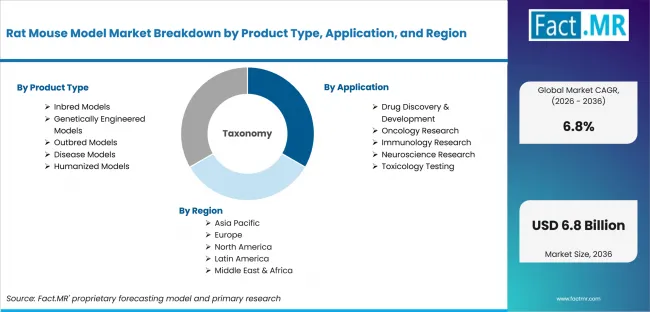
Rat Mouse Model Market Breakdown By Product Type, Application, And Region | Source: Fact.MR
| Attribute | Details |
|---|---|
| Quantitative Units | USD billion in 2026 to USD billion by 2036 at CAGR |
| Market Definition | Commercial supply of rat and mouse models used in preclinical research; custom breeding; genetically engineered strains; humanized models; related model support for toxicology testing; disease biology and translational research. |
| Product Type | Inbred Models; C57BL/6 Mice; BALB/c Mice; Genetically Engineered Models; Knockout Models; Transgenic Models; Outbred Models; CD-1 Mice; Sprague Dawley Rats; Disease Models; Oncology Models; Neurology Models; Humanized Models; Humanized Mice; Humanized Rats |
| Application | Drug Discovery & Development; Preclinical Drug Screening; Efficacy Studies; Oncology Research; Tumor Xenograft Studies; Cancer Biomarker Research; Immunology Research; Autoimmune Disease Studies; Vaccine Development; Neuroscience Research; Neurodegenerative Disease Models; Behavioral Studies; Toxicology Testing; Safety Assessment; Regulatory Toxicology |
| End User | Pharmaceutical Companies; Innovator Pharmaceutical Companies; Generic Pharmaceutical Companies; Academic & Research Institutes; Universities; Public Research Institutes; Biotechnology Companies; Emerging Biotech Companies; Established Biotech Companies; Contract Research Organizations; Preclinical CROs; Full-Service CROs; Government Research Organizations; Public Health Laboratories; Regulatory Research Institutes |
| Distribution Channel | Direct Sales; Long-Term Supply Agreements; Custom Breeding Contracts; Research Animal Distributors; Regional Distributors; Global Distributors; Online Procurement Platforms; E-Procurement Portals; Digital Research Marketplaces; Institutional Procurement; Public Research Tenders; University Procurement; Contract Supply Agreements; CRO Partnerships; Biopharma Supply Contracts |
| Model Type | Mouse Models; Immunodeficient Mice; Wild-Type Mice; Rat Models; Wistar Rats; Sprague Dawley Rats; CRISPR-Edited Models; CRISPR Knockout Models; CRISPR Knock-In Models; Patient-Derived Xenograft Models; Human Tumor Xenografts; Orthotopic Xenografts; Specialized Disease Models; Metabolic Disease Models; Cardiovascular Disease Models |
| Regions Covered | North America; Latin America; Europe; East Asia; South Asia and Oceania; Middle East and Africa |
| Countries Covered | USA; Japan; Germany; UK; Canada; Australia; Brazil |
| Key Companies Profiled | The Jackson Laboratory; Charles River Laboratories; Taconic Biosciences; Janvier Labs; Orient Bio; Inotiv; Cyagen Biosciences |
| Forecast Period | 2026 to 2036 |
| Approach | Hybrid top-down and bottom-up approach using preclinical model demand; model procurement criteria; segment mix; country growth; company participation; strain documentation; service access; custom breeding; humanized model availability and public information relevant to the category. |
Source: Fact.MR analysis. Updated Jul 29, 2026
How is the market segmented?
-
By Product Type
- Inbred Models
- C57BL/6 Mice
- BALB/c Mice
- Genetically Engineered Models
- Knockout Models
- Transgenic Models
- Outbred Models
- CD-1 Mice
- Sprague Dawley Rats
- Disease Models
- Oncology Models
- Neurology Models
- Humanized Models
- Humanized Mice
- Humanized Rats
-
By Application
- Drug Discovery & Development
- Preclinical Drug Screening
- Efficacy Studies
- Oncology Research
- Tumor Xenograft Studies
- Cancer Biomarker Research
- Immunology Research
- Autoimmune Disease Studies
- Vaccine Development
- Neuroscience Research
- Neurodegenerative Disease Models
- Behavioral Studies
- Toxicology Testing
- Safety Assessment
- Regulatory Toxicology
-
By End User
- Pharmaceutical Companies
- Innovator Pharmaceutical Companies
- Generic Pharmaceutical Companies
- Academic & Research Institutes
- Universities
- Public Research Institutes
- Biotechnology Companies
- Emerging Biotech Companies
- Established Biotech Companies
- Contract Research Organizations
- Preclinical CROs
- Full-Service CROs
- Government Research Organizations
- Public Health Laboratories
- Regulatory Research Institutes
-
By Distribution Channel
- Direct Sales
- Long-Term Supply Agreements
- Custom Breeding Contracts
- Research Animal Distributors
- Regional Distributors
- Global Distributors
- Online Procurement Platforms
- E-Procurement Portals
- Digital Research Marketplaces
- Institutional Procurement
- Public Research Tenders
- University Procurement
- Contract Supply Agreements
- CRO Partnerships
- Biopharma Supply Contracts
-
By Model Type
- Mouse Models
- Immunodeficient Mice
- Wild-Type Mice
- Rat Models
- Wistar Rats
- Sprague Dawley Rats
- CRISPR-Edited Models
- CRISPR Knockout Models
- CRISPR Knock-In Models
- Patient-Derived Xenograft Models
- Human Tumor Xenografts
- Orthotopic Xenografts
- Specialized Disease Models
- Metabolic Disease Models
- Cardiovascular Disease Models
-
By Region
- North America
- Latin America
- Europe
- East Asia
- South Asia and Oceania
- Middle East and Africa
Frequently Asked Questions
Which Product Type leads the Rat Mouse Model Market?
Which Application leads the Rat Mouse Model Market?
Which End User leads the Rat Mouse Model Market?
Which Distribution Channel leads the Rat Mouse Model Market?
Which Model Type leads the Rat Mouse Model Market?
Which country records the highest listed CAGR?
What is the primary driver in this market?
What is the main restraint?
Why do Mouse Models lead demand?
Who worked on this report


Preview the report firsthand - request a free sample
Free SampleGet the brochure for pricing and purchase details
Download PDF