- Market Value (2025): USD 43.9 Mn
- Estimated Value (2026): USD 55 Mn
- Forecast Value (2036): USD 520 Mn
- CAGR (2026-2036): 25.2%
What is the Recipe Copilot Software Market forecast to be worth by 2036?
USD 55 million in 2026 to USD 520 million by 2036 at a 25.2% CAGR.
- The recipe copilot software market reached USD 43.9 million in 2025.
- Demand is projected to increase from USD 55 million in 2026 to USD 520 million by 2036.
- The market is forecast to record 25.2% CAGR from 2026 to 2036 as process engineers and fab IT teams seek shorter DOE cycles under stronger data controls.
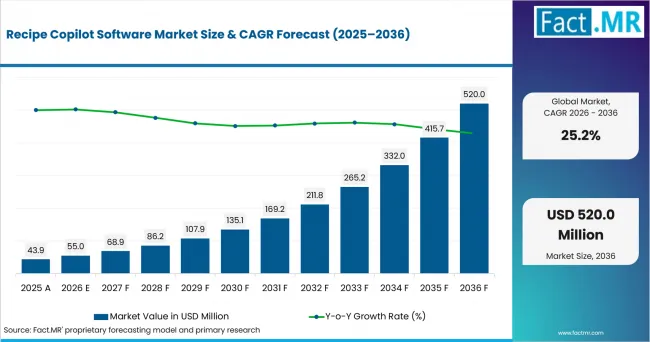
Recipe Copilot Software Market Value Analysis | Source: Fact.MR
What are the defining numbers behind Recipe Copilot Software Market growth?
An absolute opportunity of USD 465 million is expected by 2036.
- Demand Drivers in the Market
- Process engineers need faster split-lot learning because failed wafer passes consume metrology time and delay release.
- SEMI projected in April 2026 that worldwide 300 mm fab equipment spending would reach USD 133 billion in 2026.
- Semiconductor process-model validation is becoming more visible: TOKYO ELECTRON LIMITED (TEL) said in August 2025 that digital twins can explore different process conditions before actual wafers are processed.
- Key Segments Analyzed
- By Optimization Engine: Bayesian optimization is expected to hold 38.0% share in 2026 because it works well with limited experiments and noisy fab data.
- By Process Step: Litho is projected to account for 27.0% share in 2026 owing to tight overlay, dose and focus windows.
- By Deployment: On-prem is anticipated to capture 51.0% share in 2026 since fabs protect process IP and tool trace data.
- By End User: Foundries are estimated to represent 41.0% share in 2026 due to multi-customer learning cycles and node transfer work.
- By Maturity: Advisory-only is forecast to hold 48.0% share in 2026 because most fabs keep final recipe approval with engineers.
- Analyst Opinion at Fact.MR
- Shambhu Nath Jha, Principal Consultant at Fact.MR, states, “Recipe copilots are drawing attention because they turn process learning into a governed workflow. Adoption is expected to rise where fabs connect recommendations to wafer evidence. Qualified platforms combine model transparency, secure deployment and engineer approval.”
- Strategic Implications
- Software vendors should show how each recommendation changes wafer results and which tool signals shaped the suggestion.
- Fab engineering teams should keep human approval checkpoints until advisory models demonstrate stable results across product families.
- Equipment suppliers should connect virtual models with chamber data so recipes reflect tool drift.
- Data-governance teams should separate recipe IP by account and process module before wider training begins.
The USA is expected to record 27.04% CAGR through 2036 because domestic memory investment and digital-twin funding increase local recipe-optimization activity. Taiwan is projected to post 26.75% CAGR as foundry learning cycles keep advanced process data active. South Korea is anticipated to advance at 26.70% CAGR due to memory exports. China is forecast to reach 26.69% CAGR owing to electronics output and software scale. Japan is estimated to hold 26.59% CAGR linked to 2 nm pilot work. Israel is expected to record 26.55% CAGR because deep-tech software teams serve fab-adjacent analytics accounts.
How does the Recipe Copilot Software Market break down by segment?
Bayesian optimization leads at 38.0%; on-prem deployment leads at 51.0% share.
Which Optimization Engine dominates?
Bayesian optimization is expected to hold 38.0% share in 2026.
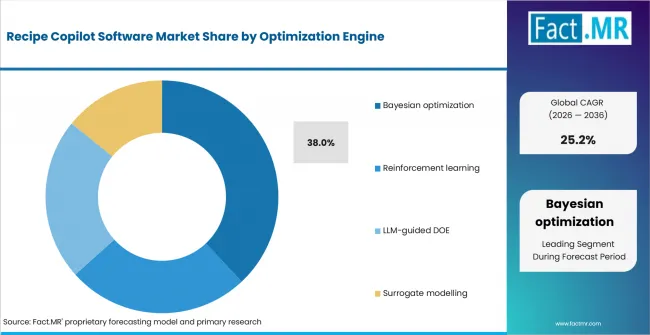
Recipe Copilot Software Market Analysis By Optimization Engine | Source: Fact.MR
Bayesian optimization is expected to lead because fabs need to learn efficiently from limited split lots and noisy process outputs. It supports structured experimentation where each additional wafer run carries cost, helping engineers narrow promising recipe settings while maintaining control over qualification decisions.
What leads the Process Step segment?
Litho is projected to account for 27.0% share in 2026.
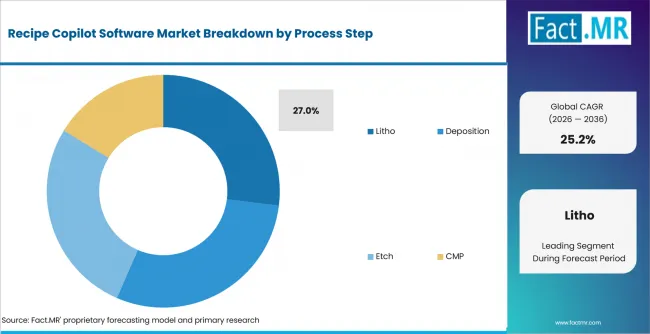
Recipe Copilot Software Market Analysis By Process Step | Source: Fact.MR
Litho is projected to lead because overlay, focus and exposure windows directly influence downstream yield and process stability. Optimization tools can help engineers compare recipe changes across tightly controlled experiments, reducing unnecessary iterations while preserving the qualification discipline required before new lithography settings move into production.
How does Deployment shape demand?
On-prem deployment is anticipated to capture 51.0% share in 2026.
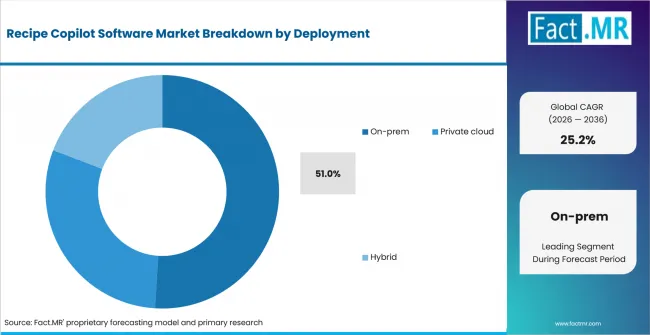
Recipe Copilot Software Market Analysis By Deployment | Source: Fact.MR
On-prem deployment is anticipated to lead because fabs prefer recipe histories, equipment traces and process data to remain inside controlled plant networks. Local deployment also fits cybersecurity and access-control requirements, allowing optimization tools to operate closer to sensitive manufacturing systems without relying heavily on external cloud environments.
What supports Foundries within End User?
Foundries are estimated to represent 41.0% share in 2026.
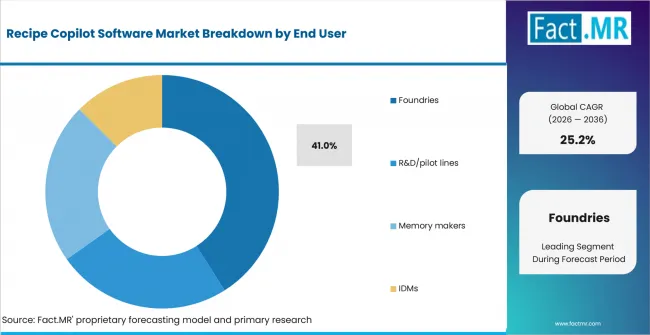
Recipe Copilot Software Market Analysis By End User | Source: Fact.MR
Foundries are estimated to lead because they manage many product families, customer-specific process flows and frequent qualification cycles. Optimization tools help engineering teams compare recipe performance across varied wafers and modules while maintaining traceability, making them particularly useful where fabs must balance throughput, yield and process-window stability.
What leads the Maturity segment?
Advisory-only is forecast to hold 48.0% share in 2026.
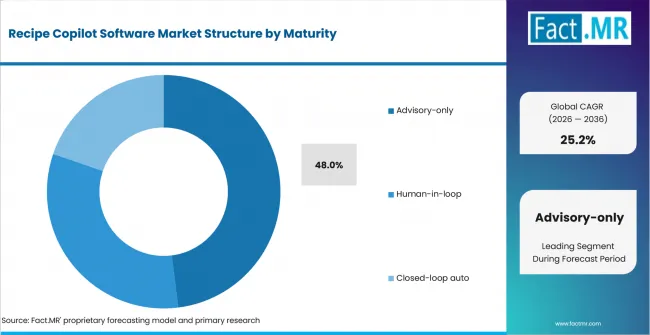
Recipe Copilot Software Market Analysis By Maturity | Source: Fact.MR
Advisory-only maturity is forecast to lead because engineers typically retain final authority over semiconductor recipe changes. Optimization systems can rank options, suggest experiments and highlight promising parameter ranges while leaving approval with process teams, which helps fabs gain decision support without giving automated systems direct control over production recipes.
What is accelerating Recipe Copilot Software Market adoption, and what is holding it back?
DOE compression drives it; model trust restrains it.
Drivers Impact Analysis
| DRIVER | (~) % IMPACT ON CAGR | GEOGRAPHIC RELEVANCE | IMPACT TIMELINE |
|---|---|---|---|
| Bayesian DOE compression | +2.8% | Global | Short term (<= 2 years) |
| Digital-twin links | +2.1% | USA, Japan, Taiwan | Medium term (2-4 years) |
| On-prem process data governance | +1.6% | USA, Taiwan, South Korea | Short term (<= 2 years) |
| AI-memory and fab investment | +1.5% | USA, East Asia | Medium term (2-4 years) |
Source: Fact.MR analysis. Updated Aug 21, 2026
- Bayesian DOE compression: Bayesian engines are expected to reduce wafer experiments needed to test a process window. Fabs favor systems that explain confidence behind each recipe move.
- Digital-twin links: Digital-twin workflows are anticipated to connect simulated chamber behavior with wafer results. The U.S. Department of Commerce announced in January 2025 that CHIPS for America awarded USD 285 million to Semiconductor Research Corporation Manufacturing Consortium Corporation to establish and operate SMART USA, an institute focused on semiconductor digital twins.
- On-prem process data governance: On-prem deployment is projected to gain acceptance where customer recipes and metrology data remain restricted. Providers need data isolation by module and customer account.
- AI-memory and fab investment: AI-linked memory demand is expected to expand recipe-optimization use cases. Applied Materials, Inc. introduced DRAM and advanced-packaging systems in June 2026 for next-generation AI chip architectures.
Opportunity Impact Analysis
| OPPORTUNITY | (~) % IMPACT ON CAGR | GEOGRAPHIC RELEVANCE | IMPACT TIMELINE |
|---|---|---|---|
| Private-cloud recipe collaboration | +1.2% | Taiwan, South Korea, USA | Medium term (2-4 years) |
| Human-in-loop escalation | +1.0% | Global | Short term (<= 2 years) |
| Pilot-line recipe libraries | +0.8% | Japan, USA, Israel | Medium term (2-4 years) |
Source: Fact.MR analysis. Updated Aug 21, 2026
- Private-cloud collaboration: Private cloud is expected to support recipe sharing between sites without exposing account-level IP. Vendors should map permissions to product family and process module.
- Human-in-loop escalation: Human-in-loop workflows are likely to grow where engineers require a review trail before tool changes. Advisory outputs can feed DOE setup without bypassing sign-off.
- Pilot-line libraries: Pilot-line recipe libraries are projected to help teams reuse learning across tool generations. Rapidus’ April 2025 plan called for an April pilot-line start, prototype 2 nm GAA transistors on 300 mm wafers, and PDK release to early customers.
Restraints Impact Analysis
| RESTRAINT | (~) % IMPACT ON CAGR | GEOGRAPHIC RELEVANCE | IMPACT TIMELINE |
|---|---|---|---|
| Process IP and tool data access | -0.8% | Global | Short term (<= 2 years) |
| Wafer validation before release | -0.7% | Global | Medium term (2-4 years) |
| Compute cost and power scrutiny | -0.3% | USA, Europe, Japan | Long term (>= 4 years) |
Source: Fact.MR analysis. Updated Aug 21, 2026
- Process IP limits: Data access remains constrained because recipe histories contain customer know-how. Software suppliers must prove that training does not mix restricted information.
- Wafer validation needs: Fabs are expected to delay deeper automation until model suggestions hold up on production wafers. Qualification teams need repeatable metrology evidence before release.
- Compute scrutiny: Recipe models are expected to face review when training and simulation workloads grow.
Which countries are scaling the Recipe Copilot Software Market through 2036?
- The country comparison spans 0.49 percentage point and forms a narrow high-growth band across the forecast period.
- The USA remains 0.29 percentage point above Taiwan because domestic memory investment and digital-twin funding increase recipe-optimization work.
- Taiwan remains 0.05 percentage point above South Korea due to foundry learning cycles and AI-server supply-chain depth.
- South Korea remains 0.01 percentage point above China as memory exports and ICT manufacturing keep process learning active.
- Japan remains 0.04 percentage point above Israel because 2 nm pilot-line activity and equipment digital twins support recipe modelling.
Comparable CAGRs create different entry conditions due to fab data access and local semiconductor policy. Full coverage includes North America, Latin America, Western Europe, Eastern Europe, East Asia, South Asia & Pacific, Middle East & Africa.
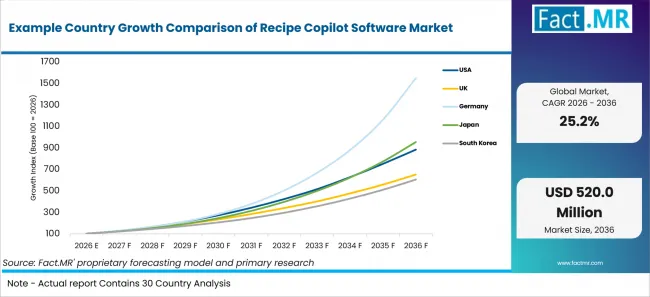
Example Country Growth Comparison Of Recipe Copilot Software Market | Source: Fact.MR
| Country | CAGR (2026-2036) |
|---|---|
| USA | 27.04% |
| Taiwan | 26.75% |
| South Korea | 26.70% |
| China | 26.69% |
| Japan | 26.59% |
| Israel | 26.55% |
Source: Fact.MR analysis. Updated Aug 21, 2026
What supports USA adoption?
27.04% CAGR, supported by digital-twin funding and memory-fab investment.
The USA’s growth reflects major semiconductor investment, digital-twin development and demand for recipe optimization across advanced fabs. In January 2025, Commerce announced SMART USA with more than USD 1 billion in combined total investment, while Micron announced in June 2025 plans to invest approximaTokyo Electron Limited (TEL)y USD 200 billion in U.S. semiconductor manufacturing and R&D. Recipe copilots can connect chamber traces, metrology and split-lot results, although electricity demand, tool-data restrictions and production validation may slow deployment.
How is Taiwan scaling demand?
26.75% CAGR, driven by foundry learning cycles and AI-server supply chains.
Taiwan’s growth is supported by strong exports, advanced foundry activity and the need to shorten recipe-learning cycles. Taiwan’s exports reached USD 640.75 billion in 2025, up 34.9% year over year, while TSMC continued advancing leading-edge process technology, with its 2 nm N2 process entering volume production in Q4 2025. Recipe copilots can reduce split-lot iterations and support multi-site learning, although confidentiality requirements, weaker fixed-asset purchases and chamber-level audit needs may constrain adoption.
How does South Korea build momentum?
26.70% CAGR, supported by memory exports and ICT manufacturing depth.
South Korea’s growth reflects its large memory manufacturing base and strong semiconductor export performance. South Korea’s semiconductor exports reached USD 173.4 billion in 2025, while total ICT exports reached USD 264.3 billion. Recipe copilots can support stack, etch and deposition optimization in controlled production environments, although equipment-investment softness, lengthy closed-loop validation and integration with existing fab control systems may slow rollout.
What supports China adoption?
26.69% CAGR, backed by electronics manufacturing output and software scale.
China’s growth reflects substantial electronics manufacturing, rising integrated-circuit output and a large domestic software sector. China’s integrated-circuit output reached 484.3 billion units in 2025, while revenue of the software and information technology services industry reached RMB 15,483.1 billion. Localized recipe copilots can integrate with domestic MES and equipment interfaces, although export controls, uneven fab maturity and weaker foreign investment may complicate wider deployment.
What is supporting Japan’s outlook?
26.59% CAGR, linked to 2 nm pilot activity and equipment digital twins.
Japan’s growth reflects advanced 2 nm development, pilot-line activity and strong equipment expertise. Rapidus began operating its IIM-1 pilot line in April 2025, while Tokyo Electron highlighted digital twins for exploring process conditions before wafers are processed. Recipe copilots can reduce experimental load, although production-wafer validation, hardware-specific documentation and cautious movement toward closed-loop control may extend commercialization.
How is Israel developing demand?
26.55% CAGR, supported by deep-tech software and fab-adjacent analytics.
Israel’s growth reflects a strong high-tech software base and expanding AI activity. Israeli high-tech output reached about NIS 317 billion in 2024, while AI startups accounted for 40% of funding rounds and 47% of total funding, according to Startup Nation Central. Fab-adjacent analytics vendors can support global semiconductor customers, although specialized hiring constraints, overseas qualification cycles and advisory-focused deployment may delay closed-loop recipe control.
Who leads the Recipe Copilot Software Market?
Lam Research and Tignis/Cohu for direct semiconductor optimization and process-control software; TOKYO ELECTRON LIMITED (TEL) for semiconductor digital twins; and Applied Materials, Inc. and Synopsys, Inc. for adjacent process, simulation and modelling capability.
Applied Materials, Inc. is profiled for process-control and materials engineering depth. Lam Research is profiled through Semiverse and Fabtex Yield Optimizer. Tignis, now part of Cohu, adds AI process-control and analytics-based monitoring software for semiconductor manufacturing teams.
Synopsys, Inc. is included for its expanded simulation and system-design capabilities following completion of the Ansys acquisition in July 2025. TOKYO ELECTRON LIMITED (TEL) is profiled for equipment digital twins and process informatics.
Which companies are the key providers?
Key companies include Applied Materials, Inc., Lam Research Corporation (Semiverse Solutions), Cohu, Inc. (Tignis PAICe), Synopsys, Inc., TOKYO ELECTRON LIMITED (TEL).
- Applied Materials, Inc.
- Lam Research Corporation (Semiverse Solutions)
- Cohu, Inc. (Tignis PAICe)
- Synopsys, Inc.
- TOKYO ELECTRON LIMITED (TEL)
Bibliography
- National Institute of Standards and Technology. (2025, January 3). Biden-Harris administration awards Semiconductor Research Corporation Manufacturing Consortium Corporation $285M for new CHIPS Manufacturing USA Institute for digital twins, headquartered in North Carolina.
- Micron Technology, Inc. (2025, June 12). Micron and Trump Administration announce expanded U.S. investments in leading-edge DRAM manufacturing and R&D.
- SEMI. (2026, April 1). SEMI projects double-digit growth in global 300mm fab equipment spending for 2026 and 2027.
- Lam Research Corporation. (2025, October 7). Driving yield at scale: Fabtex Yield Optimizer improves processes for high-volume manufacturing.
- Applied Materials, Inc. (2026, June 25). Applied Materials introduces new systems to accelerate DRAM and advanced packaging for AI chips.
- Cohu, Inc. (2025, January 7). Cohu completes acquisition of Tignis.
- International Energy Agency. (2025, April 10). Energy and AI.
- Directorate General of Budget, Accounting and Statistics. (2025, August 15). GDP: Preliminary estimate for 2025Q2 and outlook for 2025-26.
- Ministry of Finance, R.O.C. (2026, January 9). Summary of exports and imports for December 2025.
- Ministry of Trade, Industry and Resources. (2026, January 2). Korea’s annual exports reach new highs in 2025.
- Ministry of Trade, Industry and Resources, & Ministry of Science and ICT. (2026, January 15). ICT exports post record annual performance in 2025.
- Ministry of Data and Statistics. (2026, January 30). Monthly industrial statistics, December 2025. First-hand Ministry of Data and Statistics source.
- National Bureau of Statistics of China. (2026, February 28). Statistical communiqué of the People's Republic of China on the 2025 national economic and social development.
This Report Answers
- The report explains where recipe copilot software is used across optimization engine and process step.
- Segment analysis identifies Bayesian optimization and on-prem deployment as the leading subsegments in 2026.
- Country analysis examines six markets across fab-specific adoption conditions.
- Competitive analysis reviews Applied Materials, Inc., Lam Research, Tignis, Synopsys, Inc. and TOKYO ELECTRON LIMITED (TEL).
- Evidence review uses official statistics, company announcements and provider checks to support the forecast narrative.
What does the Recipe Copilot Software Market cover?
The Recipe Copilot Software Market covers software that helps fab engineers choose, test and approve semiconductor process recipes. It includes Bayesian optimization, reinforcement learning, LLM-guided DOE and surrogate modelling tools used with wafer metrology and tool traces.
The assessment differs from broader fab automation because it focuses on recipe recommendation and decision support. General MES, APC, yield-management and simulation tools are included only when recipe-copilot functionality is a defined commercial feature.
What is included in the scope?
The scope includes recipe systems linked to digital twin platforms when twin outputs guide recipe decisions.
Fab teams apply model-based manufacturing where simulated process behavior informs suggested recipe windows. The scope covers virtual commissioning software when virtual equipment validation feeds production recipes. Metrology-linked copilots use industrial metrology software when measurement signals become recipe inputs.
What is excluded from the scope?
General SoC test platforms are excluded unless test feedback is packaged into recipe recommendations.
AI EDA tools are outside scope when they support chip design without fab recipe learning. Enterprise ModelOps workflows are excluded when they govern generic AI models. Device-level edge AI tuning is excluded unless it is sold for fab recipe optimization.
How Was the Analysis Built?
The analysis draws on 120+ sources, 35+ company portfolios, 25+ countries, and more than 20 industry interviews.
- Primary Research: Interviews include fab process engineers, yield teams, equipment software teams, fab IT leaders and procurement teams.
- Desk Research: Reviews cover government statistics, regulator publications, company filings, product pages, standards and technical studies.
- Market Sizing and Forecasting: Estimates combine software spend, process-control adoption, segment shares, country activity and provider participation.
- Data Validation and Update Cycle: Findings are checked against public data, company activity, technology launches and semiconductor manufacturing trends.
Segmentation
What is the report’s scope and coverage?
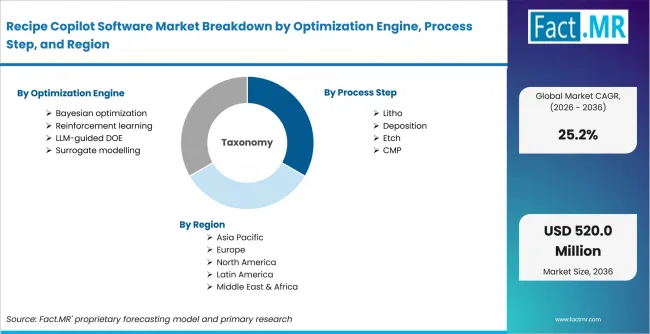
Recipe Copilot Software Market Breakdown By Optimization Engine, Process Step, And Region | Source: Fact.MR
| Attribute | Details |
|---|---|
| Quantitative Units | USD million |
| Market Definition | Software that recommends or ranks semiconductor process recipes using wafer data, chamber traces, metrology results, DOE records and model-based optimization. |
| Optimization Engine | Bayesian optimization; Reinforcement learning; LLM-guided DOE; Surrogate modelling |
| Process Step | Litho; Etch; Deposition; CMP |
| Deployment | On-prem; Private cloud; Hybrid |
| End User | Foundries; R&D/pilot lines; Memory makers; IDMs |
| Maturity | Advisory-only; Human-in-loop; Closed-loop auto |
| Regions Covered | North America; Latin America; Western Europe; Eastern Europe; East Asia; South Asia & Pacific; Middle East & Africa |
| Countries Covered | USA; Taiwan; South Korea; China; Japan; Israel |
| Key Companies Profiled | Applied Materials, Inc., Lam Research Corporation (Semiverse Solutions), Cohu, Inc. (Tignis PAICe), Synopsys, Inc., TOKYO ELECTRON LIMITED (TEL). |
| Forecast Period | 2026 to 2036 |
| Approach | Hybrid top-down and bottom-up approach using fab software spend, process-control adoption, deployment mix, country activity, segment shares and provider portfolio review. |
Source: Fact.MR analysis. Updated Aug 21, 2026
How is the market segmented?
-
By Optimization Engine:
- Bayesian optimization
- Reinforcement learning
- LLM-guided DOE
- Surrogate modelling
-
By Process Step:
- Litho
- Etch
- Deposition
- CMP
-
By Deployment:
- On-prem
- Private cloud
- Hybrid
-
By End User:
- Foundries
- R&D/pilot lines
- Memory makers
- IDMs
-
By Maturity:
- Advisory-only
- Human-in-loop
- Closed-loop auto
-
By Region:
- North America
- Latin America
- Western Europe
- Eastern Europe
- East Asia
- South Asia & Pacific
- Middle East & Africa
Frequently Asked Questions
How big is the recipe copilot software market in 2026?
What is the CAGR of the recipe copilot software market from 2026 to 2036?
Which optimization engine leads the recipe copilot software market?
Which process step leads the recipe copilot software market?
Who are the leading companies in the recipe copilot software market?
Who worked on this report


Preview the report firsthand - request a free sample
Free SampleGet the brochure for pricing and purchase details
Download PDF