- Market Value (2025): USD 508.3 Mn
- Estimated Value (2026): USD 610.0 Mn
- Forecast Value (2036): USD 3777.0 Mn
- CAGR (2026-2036): 20.0%
What is the Self-Healing Elastomers Market forecast to be worth by 2036?
USD 610.0 million in 2026 to USD 3777.0 million by 2036 at a 20.0% CAGR.
- The self-healing elastomers market reached USD 508.3 million in 2025.
- Demand is projected to increase from USD 610.0 million in 2026 to USD 3777.0 million by 2036.
- The market is forecast to record a 20.0% CAGR from 2026 to 2036 as automotive refinishers, infrastructure owners and industrial maintenance teams test longer-life elastomer systems.
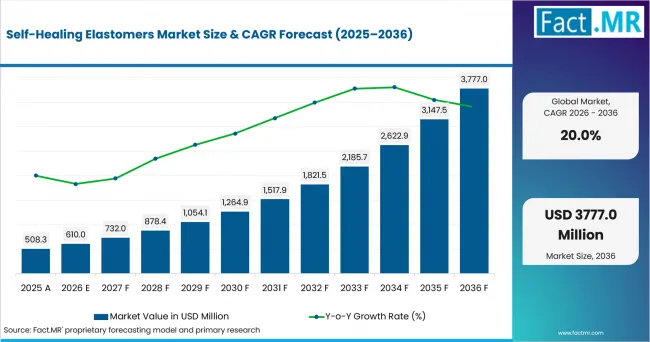
Self Healing Elastomers Market Value Analysis | Source: Fact.MR
What are the defining numbers behind Self-Healing Elastomers Market growth?
An absolute opportunity of USD 3167.0 million is expected between 2026 and 2036.
- Demand Drivers in the Market
- Automotive coating teams need elastomers that reduce visible scratch damage on exterior films, bumper surfaces and trim parts exposed to repeated abrasion.
- Infrastructure owners need liquid coatings and sealants that delay crack widening where water ingress raises maintenance cost.
- Aerospace maintenance teams need fatigue-resistant elastomers that support protective layers on high-value parts with strict inspection cycles.
- Industrial plant operators need compounds and films that tolerate heat, vibration and chemical contact while limiting unscheduled surface repair.
- Marine asset owners need barrier protection because saltwater, sunlight and mechanical wear shorten coating life on exposed equipment.
- Key Segments Analyzed
- By Chemistry: Polyurethane is expected to hold 44.0% share in 2026 due to its balance of abrasion resistance, flexibility and coating compatibility.
- By Form: Liquid coating is projected to account for 38.0% share in 2026 because repair programs apply it to irregular surfaces and existing substrates.
- By Performance: Self-repair is anticipated to capture 41.0% share in 2026 since visible healing is the main value proposition for premium elastomer systems.
- By Application: Automotive is estimated to represent 38.0% share in 2026 owing to paint protection, refinish coatings and exterior polymer parts.
- Analyst Opinion at Fact.MR
- Shambhu Nath Jha, Principal Consultant at Fact.MR, states, “Self-healing elastomers are judged on proof, not novelty. Buyers want healing chemistry to keep adhesion and strength after abrasion. Suppliers need polymer design, application support and validation data before these systems move into service environments.”
- Strategic Implications
- Material developers should publish healing-cycle data by substrate and coating thickness so engineers compare performance across use cases.
- Coating formulators should link self-repair behavior with adhesion, weathering and chemical-resistance results before presenting premium claims to OEMs.
- Automotive suppliers should target refinish and protection-film channels where scratch recovery is shown quickly through visible surface tests.
- Construction and marine suppliers should document water-barrier performance after controlled cracking because buyers need proof beyond surface closure.
Japan is forecast to post 25.8% CAGR through 2036 on vehicle material transitions and infrastructure maintenance. South Korea is projected at 24.7% as auto exports and factory output support qualification. Germany is anticipated to reach 23.3% through chemicals and industrial coatings. The United Kingdom is estimated at 21.0%, while the United States is forecast at 20.5%.
How does the Self-Healing Elastomers Market break down by segment?
Polyurethane leads Chemistry at 44.0%; Automotive leads Application at 38.0%.
Which Chemistry dominates?
Polyurethane holds 44.0% share in 2026.
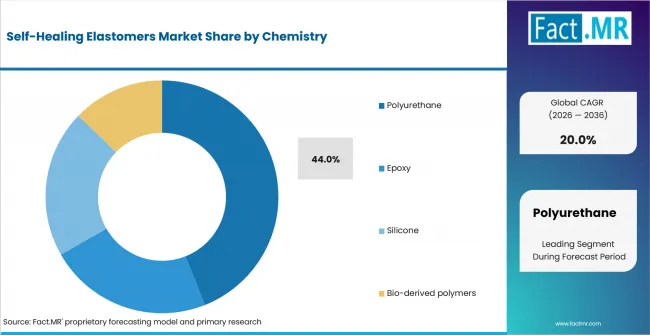
Self Healing Elastomers Market Analysis By Chemistry | Source: Fact.MR
Polyurethane leads chemistry because it combines elasticity, toughness and process flexibility. Epoxy systems remain relevant for barrier protection and adhesion. Silicone serves high-temperature applications. Bio-derived polymers are assessed where customers want lower fossil feedstock exposure without losing fatigue resistance.
What leads the Form segment?
Liquid coating accounts for 38.0% share in 2026.
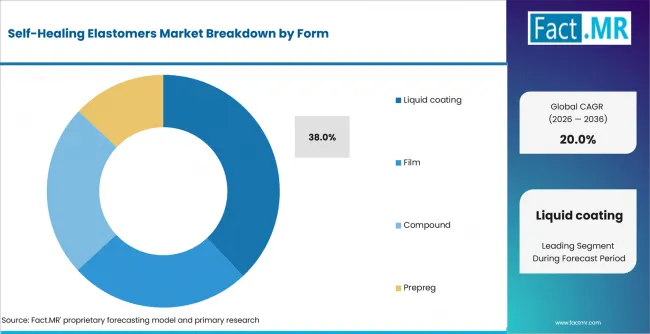
Self Healing Elastomers Market Analysis By Form | Source: Fact.MR
Liquid coating leads the form segment because it is applied to complex surfaces without replacing the whole part. Film formats suit automotive exterior protection after scratching. Compounds are used in molded or bonded components. Prepreg formats support composite structures with embedded damage control.
How does Performance shape demand?
Self-repair leads with 41.0% share in 2026.
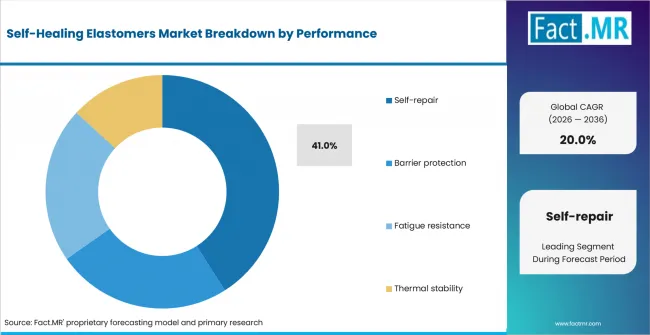
Self Healing Elastomers Market Analysis By Performance | Source: Fact.MR
Self-repair leads performance because users see the benefit after scratching or surface cracking. Barrier protection matters where moisture enters tiny defects. Fatigue resistance supports moving parts and flexible films. Thermal stability helps electronics, vehicles and industrial equipment that face heat.
What supports Automotive within Application?
Automotive represents 38.0% share in 2026.
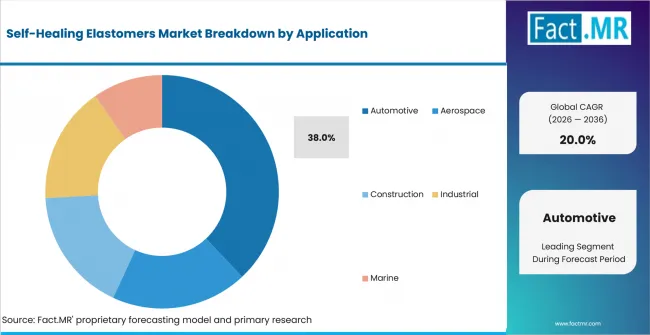
Self Healing Elastomers Market Analysis By Application | Source: Fact.MR
Automotive leads application because vehicles combine visible surfaces, polymer parts and a steady repair channel. Paint protection films, bumper skins and refinish coatings face small scratches before parts fail. Aerospace follows where inspection costs raise interest in surface protection. Construction, industrial and marine uses are tied to water and abrasion exposure.
What is accelerating Self-Healing Elastomers Market adoption, and what is holding it back?
Automotive surface repair drives it; qualification cost restrains it.
Drivers Impact Analysis
| DRIVER | (~) % IMPACT ON CAGR | GEOGRAPHIC RELEVANCE | IMPACT TIMELINE |
|---|---|---|---|
| Long-life automotive surface materials | +2.2% | Global | Short term (<= 2 years) |
| Infrastructure coating and sealant maintenance | +1.6% | North America, Europe, East Asia | Medium term (2-4 years) |
| Aerospace and industrial downtime reduction | +1.2% | North America, Western Europe, East Asia | Medium term (2-4 years) |
| Polyurethane compatibility with existing coating processes | +0.9% | Global | Long term (>= 4 years) |
Source: Fact.MR analysis. Updated Aug 25, 2026
- Long-life automotive surface materials: Automakers and refinish shops face repeated abrasion on visible surfaces. Self-healing elastomers reduce cosmetic repair frequency when films and coatings prove gloss retention after scratch cycles.
- Infrastructure coating and sealant maintenance: Bridges and building envelopes face water ingress after microcracks form. The U.S. Census Bureau estimated June 2026 construction spending at a seasonally adjusted annual rate of USD 2,166.5 billion, providing scale context for coating and sealant maintenance.
- Polyurethane compatibility with existing coating processes: Polyurethane gives formulators a familiar base for films, cast elastomers and liquid coatings. Self-healing additives are tested without a full processing reset.
Opportunity Impact Analysis
| OPPORTUNITY | (~) % IMPACT ON CAGR | GEOGRAPHIC RELEVANCE | IMPACT TIMELINE |
|---|---|---|---|
| Liquid coatings for refinish and fleet repair | +1.3% | United States, Germany, South Korea | Short term (<= 2 years) |
| Bio-derived polymer programs | +1.0% | Europe, Japan | Medium term (2-4 years) |
| Microcrack repair in industrial barriers | +0.8% | Global | Medium term (2-4 years) |
Source: Fact.MR analysis. Updated Aug 25, 2026
- Bio-derived polymer programs: Bio-derived polymers create a development lane for lower feedstock exposure. They are useful only when they match petrochemical elastomers on adhesion and fatigue.
- Microcrack repair in industrial barriers: Industrial coatings face small defects before major failure. Self-healing systems slow water or chemical ingress when damage stays within the healing window.
Restraints Impact Analysis
| RESTRAINT | (~) % IMPACT ON CAGR | GEOGRAPHIC RELEVANCE | IMPACT TIMELINE |
|---|---|---|---|
| Higher validation and qualification cost | -0.7% | Global | Short term (<= 2 years) |
| Mechanical property loss after repeated healing | -0.5% | Automotive, aerospace | Medium term (2-4 years) |
| Specialty raw material and processing limits | -0.4% | Europe, East Asia | Long term (>= 4 years) |
Source: Fact.MR analysis. Updated Aug 25, 2026
- Higher validation and qualification cost: Self-healing claims require proof under abrasion, weathering and repeated cycling. Buyers delay adoption when visible repair is not backed by lifecycle data.
- Mechanical property loss after repeated healing: Healing chemistry closes scratches while changing hardness or adhesion. Automotive and aerospace programs need proof after multiple damage events.
- Specialty raw material and processing limits: Microcapsules and reversible bonds may require careful storage or mixing. These needs slow scale-up in plants built around standard coatings or molded elastomers.
Which countries are scaling Self-Healing Elastomers Market fastest?
- The country comparison spans 5.3 percentage points across the five profiled markets through 2036.
- Japan remains 1.1 percentage points above South Korea through vehicle material transitions, infrastructure renewal and demand for scratch-recovery coatings.
- South Korea remains 1.4 percentage points above Germany as automotive exports, electronics production and factory activity support faster material qualification.
- Germany remains 2.3 percentage points above the United Kingdom through specialty chemicals, automotive manufacturing and industrial coating demand.
- The United Kingdom remains 0.5 percentage point above the United States as aerospace repair, construction maintenance and liquid-coating applications support adoption.
Comparable CAGRs can create different entry conditions due to automotive production, industrial activity, coating qualification requirements, infrastructure maintenance and local material-development capability. Full report coverage includes North America, Latin America, Western Europe, Eastern Europe, East Asia, South Asia & Pacific, and Middle East & Africa.
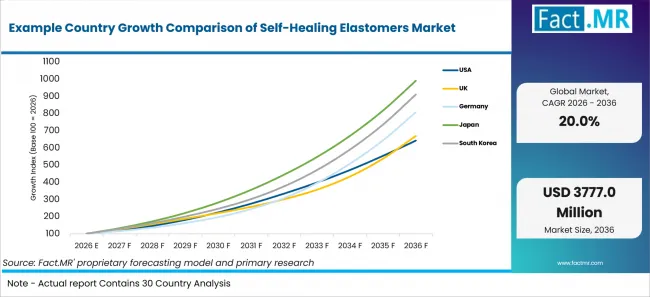
Example Country Growth Comparison Of Self Healing Elastomers Market | Source: Fact.MR
| Country | CAGR (2026-2036) |
|---|---|
| Japan | 25.8% |
| South Korea | 24.7% |
| Germany | 23.3% |
| United Kingdom | 21.0% |
| United States | 20.5% |
Source: Fact.MR analysis. Updated Aug 25, 2026
What is powering Japan’s lead?
25.8% CAGR, driven by vehicle material transitions and infrastructure renewal.
Japan’s growth is supported by automotive material changes and continued infrastructure maintenance. Alternative-fuel vehicles accounted for 60.4% of new passenger-car registrations in Japan in 2024, while METI forecast manufacturing production to increase 3.7% month over month in June 2026. These conditions support self-healing films and liquid coatings for automotive protection and infrastructure applications where scratch recovery, durability and microcrack control are important.
How is South Korea scaling demand?
24.7% CAGR, supported by automotive exports and factory activity.
South Korea’s growth reflects strong automotive exports, manufacturing activity and electronics-related material requirements. MOTIR reported that Korea’s automobile exports increased 7.0% year over year to USD 6.24 billion in July 2026, while the Ministry of Data and Statistics reported that manufacturing production increased 6.8% month over month in June 2026. These conditions create opportunities for self-healing elastomers that combine scratch recovery, thermal stability and barrier protection across vehicles, electronics and battery applications.
What supports Germany’s outlook?
23.3% CAGR, driven by specialty chemicals, vehicles and industrial maintenance.
Germany’s growth is supported by its manufacturing, automotive and specialty-chemical base. Destatis reported manufacturing gross value added increased 0.7% in the first quarter of 2026, while exports rose 3.3% from the previous quarter. This industrial environment supports polyurethane, epoxy and silicone-based self-healing systems where abrasion resistance, surface protection and longer maintenance intervals influence material selection.
What underpins the United Kingdom’s growth?
21.0% CAGR, supported by aerospace repair and construction maintenance.
The United Kingdom’s growth is supported by aerospace maintenance, construction repair and automotive refinishing. ONS reported civil aircraft repair and maintenance increased 14.1% to GBP 3.7 billion in 2025, while construction repair and maintenance rose 2.1% in the three months to May 2026. These activities create practical applications for liquid self-healing coatings used to control scratches, microcracks and surface deterioration.
What supports United States adoption?
20.5% CAGR, driven by vehicle use, infrastructure maintenance and aerospace activity.
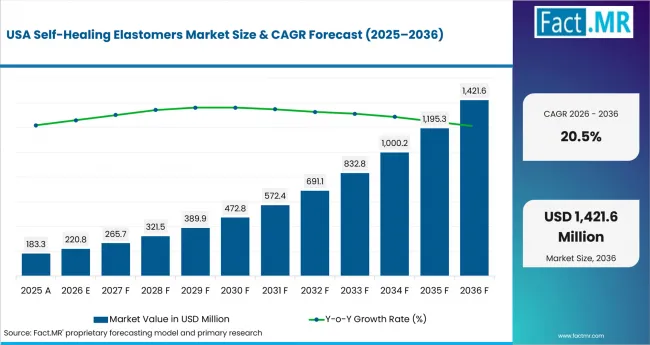
Self Healing Elastomers Market Country Value Analysis | Source: Fact.MR
The United States benefits from large transportation and infrastructure systems that expose coatings and elastomeric surfaces to repeated wear. The U.S. Census Bureau estimated total U.S. construction spending at a seasonally adjusted annual rate of USD 2,166.5 billion in June 2026, while BTS produced a preliminary estimate of 97.1 million passenger enplanements for May 2026 across all carriers and unscheduled service. These conditions support self-healing materials in automotive refinishing, infrastructure protection and aerospace maintenance where reducing repair frequency can improve lifecycle performance.
Who leads the Self-Healing Elastomers Market?
Companies profiled in this report include GELEST, INC., Arkema S.A., Dow Inc. and Autonomic Materials, Inc. across self-healing, elastomer, coating and adjacent polymer technologies.
Competition is shaped by proof of healing. Suppliers need to show visible repair while retaining adhesion, barrier protection and fatigue resistance. Credible commercialization links chemistry selection with application support and end-use testing.
Which companies are the active providers?
Key companies include GELEST, INC., Arkema S.A., Dow Inc., Autonomic Materials, Inc.
- GELEST, INC.
- Arkema S.A.
- Dow Inc.
- Autonomic Materials, Inc.
Bibliography
- Bureau of Transportation Statistics. (2026, August 13). May 2026 U.S. airline traffic data down 0.7% from the same month last year.
- Department for Business and Trade. (2026, June 3). Construction building materials: Commentary May 2026. GOV.UK.
- Federal Highway Administration. (2025, September). 2025 FHWA forecasts of vehicle miles traveled (VMT).
- Federal Statistical Office. (2026, May 22). Gross domestic product: Detailed results on economic performance in the 1st quarter of 2026.
- Japan Automobile Manufacturers Association, Inc. (2025, October 16). The motor industry of Japan 2025.
- Statistics Bureau of Japan. (2026, July 24). Consumer Price Index (2020-base): June 2026, Japan.
- Ministry of Economy, Trade and Industry. (2026, July 31). Indices of industrial production: Preliminary report for June 2026.
- Ministry of Land, Infrastructure, Transport and Tourism. (2026). Roads in Japan 2026.
- Ministry of Data and Statistics. (2026, July 2). Consumer Price Index in June 2026.
- Ministry of Data and Statistics. (2026, July 31). Monthly Industrial Statistics, June 2026.
- Ministry of Trade, Industry and Resources. (2026, August 14). Automobile exports hit record high for July; government and industry join forces on future-vehicle transition and mutual growth.
- Office for National Statistics. (2026, July 16). Construction output in Great Britain: May 2026.
- Office for National Statistics. (2026, July 24). UK manufacturers' sales by product: 2025.
- U.S. Census Bureau. (2026, August 3). Monthly construction spending, June 2026.
This Report Answers
- The report explains where self-healing elastomers are used across chemistry, form and performance. It also covers automotive, aerospace, construction, industrial and marine applications.
- Segment analysis identifies the leading subsegments and explains why polyurethane, liquid coatings and self-repair performance attract stronger demand across repair-sensitive applications.
- Country analysis examines the United States, United Kingdom, Germany, Japan and South Korea, together with the automotive, industrial, infrastructure and material-development conditions supporting adoption.
- Competitive analysis reviews BASF, Covestro, Arkema, Evonik, Dow and Autonomic Materials across self-healing, elastomer, coating and adjacent polymer technologies.
- Application analysis assesses how scratch recovery, microcrack repair, barrier protection and fatigue resistance influence material selection. It also considers adhesion, weathering, chemical resistance and qualification requirements across end-use environments.
What does the Self-Healing Elastomers Market cover?
The Self-Healing Elastomers Market covers polyurethane, epoxy, silicone and bio-derived elastomer systems that recover from surface damage or microcracking.
The assessment includes liquid coatings, films, compounds and prepregs used in automotive, aerospace, construction, industrial and marine applications. Circular elastomers, thermoplastic elastomers and thermoplastic polyurethane helps frame the wider flexible-polymer landscape.
What is included in the scope?
The scope includes commercial or near-commercial elastomer materials where self-repair, barrier restoration or fatigue recovery is part of the value proposition. It also includes elastomer coatings and additives evaluated against self-healing microcapsule systems when capsule delivery is part of the design.
It covers products positioned for automotive surface protection, construction waterproofing, industrial barriers and marine maintenance. Automotive UV-stabilized thermoplastic elastomers, recycled silicones and thermoplastic copolyester elastomers supports adjacent material mapping.
What is excluded from the scope?
The scope excludes ordinary elastomers without self-repair behavior. It also excludes paints, sealants, adhesives and composites where self-healing is not part of the commercial claim.
Raw monomers, base resins, commodity rubber and ordinary polyurethane systems are excluded unless sold as part of a self-healing elastomer formulation.
How Was the Analysis Built?
The analysis draws on 120+ sources, 35+ company portfolios, 25+ countries, and more than 20 industry interviews.
- Primary Research: Primary research includes discussions with manufacturers, service providers, technology developers, distributors, end users, procurement teams, and subject-matter experts. These conversations examine purchasing priorities, product adoption, operational challenges, approval requirements, competitive positioning, and the factors that influence wider market acceptance.
- Desk Research: Desk research covers government statistics, regulatory publications, company filings, trade data, technical studies, industry associations, standards, public policy, and other authoritative sources. Every source used in the analysis is documented in the bibliography.
- Market Sizing and Forecasting: Market estimates combine historical performance, demand indicators, pricing and volume trends, segment shares, company participation, country-level growth, adoption patterns, investment activity, and barriers to market expansion.
- Data Validation and Update Cycle: Findings are validated by comparing primary interviews with public data, company activity, regulatory changes, trade patterns, and industry developments. Regular updates review new product launches, capacity changes, partnerships, approvals, procurement trends, and shifts in commercial adoption.
Segmentation
What is the report’s scope and coverage?
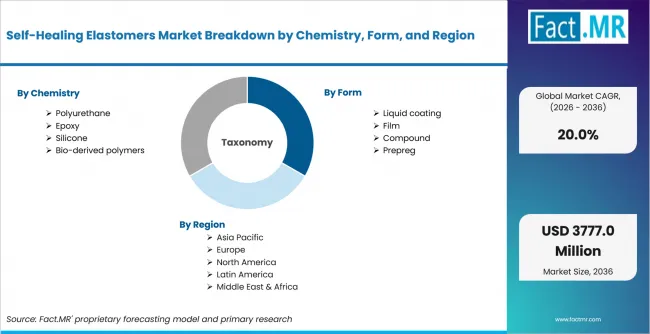
Self Healing Elastomers Market Breakdown By Chemistry, Form, And Region | Source: Fact.MR
| Attribute | Details |
|---|---|
| Quantitative Units | USD million |
| Market Definition | Elastomeric materials designed to recover from scratches, microcracks or fatigue damage through reversible bonds, healing additives, capsules or polymer-network recovery mechanisms. |
| Chemistry | Polyurethane; Epoxy; Silicone; Bio-derived polymers |
| Form | Liquid coating; Film; Compound; Prepreg |
| Performance | Self-repair; Barrier protection; Fatigue resistance; Thermal stability |
| Application | Automotive; Aerospace; Construction; Industrial; Marine |
| Regions Covered | North America; Latin America; Western Europe; Eastern Europe; East Asia; South Asia & Pacific; Middle East & Africa |
| Countries Covered | United States; United Kingdom; Germany; Japan; South Korea |
| Companies Profiled | GELEST, INC.; Arkema S.A.; Dow Inc.; Autonomic Materials, Inc. |
| Forecast Period | 2026 to 2036 |
| Approach | Hybrid top-down and bottom-up approach using application demand, chemistry fit, country adoption signals, supplier portfolio review and verified official evidence. |
Source: Fact.MR analysis. Updated Aug 25, 2026
How is the market segmented?
-
By Chemistry:
- Polyurethane
- Epoxy
- Silicone
- Bio-derived polymers
-
By Form:
- Liquid coating
- Film
- Compound
- Prepreg
-
By Performance:
- Self-repair
- Barrier protection
- Fatigue resistance
- Thermal stability
-
By Application:
- Automotive
- Aerospace
- Construction
- Industrial
- Marine
-
By Region:
- North America
- Latin America
- Western Europe
- Eastern Europe
- East Asia
- South Asia & Pacific
- Middle East & Africa
Frequently Asked Questions
How big is the self-healing elastomers market in 2026?
What is the CAGR of the self-healing elastomers market from 2026 to 2036?
Which chemistry leads the self-healing elastomers market?
Which form leads the self-healing elastomers market?
Who are the leading companies in the self-healing elastomers market?
Who worked on this report


Preview the report firsthand - request a free sample
Free SampleGet the brochure for pricing and purchase details
Download PDF