What is the wearable infusion adhesives market forecast to be worth by 2036?
USD 0.4 billion in 2026 to USD 1.4 billion by 2036 at 13.3% CAGR.
- The Wearable Infusion Adhesives Market was valued at USD 0.3 billion in 2025.
- The market is estimated at USD 0.4 billion in 2026. It is projected to reach USD 1.4 billion by 2036.
- The market is forecast to expand at 13.3% CAGR during the forecast period as wearable infusion devices, patch pumps and continuous glucose monitoring systems continue gaining wider acceptance.
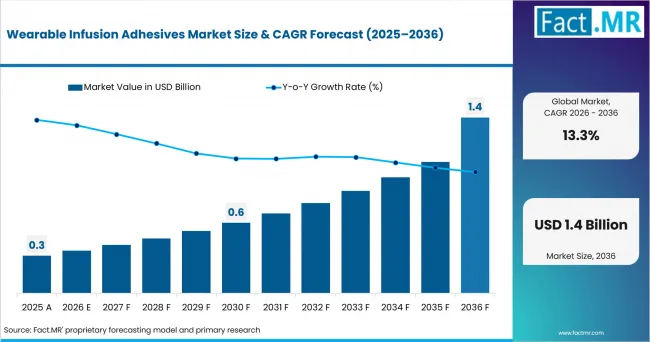
Wearable Infusion Adhesives Market Market Value Analysis | Source: Fact.MR
What are the defining numbers behind wearable infusion adhesives growth?
USD 1.0 billion absolute opportunity by 2036 led by the United States and Germany.
- Demand Drivers in the Market
- Wearable drug delivery devices continue expanding.
- Continuous glucose monitoring adoption continues increasing.
- Home healthcare continues supporting wearable treatment.
- Skin friendly adhesive innovation improves device performance.
- Key Segments Analyzed
- By Adhesive Type: Acrylic is expected to hold 37.0% share in 2026 because it provides dependable adhesion across extended wear periods.
- By Device Type: CGM Devices are projected to account for 33.0% share in 2026 because continuous glucose monitoring adoption continues increasing worldwide.
- By Wear Duration: 3-7 Days is expected to hold 35.0% share in 2026 because it matches the replacement cycle of many wearable medical devices.
- By Property: Breathable is projected to account for 31.0% share in 2026 because it improves skin comfort during prolonged wear.
- By Geography: The United States is projected to record 13.8% CAGR through 2036.
- Analyst Opinion at Fact.MR
- Shambhu Nath Jha, Senior Analyst at Fact.MR, states, "Wearable infusion adhesives are becoming an essential component of connected drug delivery systems. Manufacturers continue improving adhesive performance to support longer wear times and greater patient comfort. Growth in wearable healthcare devices will continue creating strong demand for advanced medical adhesives."
- Strategic Implications
- Expand production of medical grade adhesive materials.
- Improve compatibility across wearable device platforms.
- Strengthen partnerships with wearable device manufacturers.
- Invest in advanced skin friendly adhesive technologies.
Wearable infusion adhesives are specialized medical adhesive materials used to secure wearable drug delivery and monitoring devices to the skin. They provide reliable attachment while maintaining patient comfort during extended wear.
The United States is projected to record 13.8% CAGR through 2036 because wearable drug delivery devices continue gaining widespread adoption. Germany is expected to grow at 13.5% CAGR due to increasing use of advanced medical wearables. Japan is forecast to expand at 13.2% CAGR because the aging population continues supporting demand for home healthcare technologies. China is projected to register 13.0% CAGR through 2036 as healthcare technology adoption continues increasing. South Korea is expected to grow at 12.7% CAGR due to rising demand for connected healthcare devices.
How is the wearable infusion adhesives market segmented?
Acrylic leads at 37.0%. CGM Devices lead at 33.0%.
Which adhesive type holds the largest market share?
Acrylic holds 37.0% share in 2026.
Acrylic adhesives lead because they provide dependable skin adhesion across different environmental conditions. They maintain device attachment during daily activities while supporting comfortable wear. The platform provides guidance on selecting pressure-sensitive adhesives based on skin type, intended wear time, device design, and application requirements.
Why do CGM devices account for the highest demand?
CGM Devices account for 33.0% share in 2026.
CGM devices represent the largest application because continuous glucose monitoring adoption continues increasing worldwide. These devices require dependable skin adhesion throughout the wear period. Medical adhesive suppliers continue developing products that improve device retention while reducing skin irritation. This supports wider adoption across diabetes management. The FDA cleared the Dexcom Stelo as the first over-the-counter (OTC) wearable device for continuous glucose monitoring (CGM). The Stelo is a wearable adhesive patch sensor designed for adults 18 and older who do not use insulin. The device consists of a sensor applied to the back of the upper arm with an adhesive patch, paired with a smartphone application.
Which wear duration generates the strongest demand?
3-7 Days hold 35.0% share in 2026.
The 3-7-day segment leads because it matches the replacement schedule of many wearable infusion and monitoring devices. This wear period provides a balance between patient convenience and reliable device performance. Healthcare providers continue recommending adhesives that maintain secure attachment without causing skin damage during removal.
Which adhesive property is preferred the most?
Breathable leads with 31.0% share in 2026.
Breathable adhesives generate the highest demand because they improve skin comfort during prolonged device wear. Better moisture management also helps reduce irritation and improves patient experience. Manufacturers continue introducing breathable adhesive materials to support longer wear times. Product innovation remains focused on improving both comfort and adhesion.
What factors are accelerating market growth?
Wearable healthcare adoption supports expansion while skin sensitivity remains a challenge.
Demand continues increasing because wearable drug delivery and monitoring devices are becoming more common. Home healthcare and remote patient monitoring also support greater use of advanced medical adhesives.
Longer device wear periods continue encouraging development of skin friendly adhesive materials. Greater investment in connected healthcare technologies also supports market growth. Skin irritation remains a challenge for some patients. Manufacturers continue developing low-trauma formulations to improve long-term wear comfort.
Where are future opportunities emerging?
- Diabetes Management: Continuous glucose monitoring continues expanding worldwide. Advanced adhesives improve device stability throughout the wear cycle.
- Wearable Drug Delivery: On-body injectors continue gaining acceptance for biologic therapies. Reliable adhesion remains essential for treatment success.
- Home Healthcare: More patients are receiving treatment outside hospitals. Comfortable adhesives improve long-term device use.
- Remote Patient Monitoring: Connected healthcare devices continue expanding. Longer wear duration increases demand for advanced adhesive technologies.
Which countries are driving demand for wearable infusion adhesives?
United States 13.8%, Germany 13.5%, Japan 13.2%, China 13.0%, South Korea 12.7%.
Regional demand continues increasing as wearable drug delivery devices become more common across chronic disease management. Greater adoption of continuous glucose monitoring systems and on-body injectors is supporting demand for advanced medical adhesives. North America remains the leading market while Asia Pacific continues recording rapid growth.
| Country | CAGR (2026-2036) |
|---|---|
| United States | 13.8% |
| Germany | 13.5% |
| Japan | 13.2% |
| China | 13.0% |
| South Korea | 12.7% |
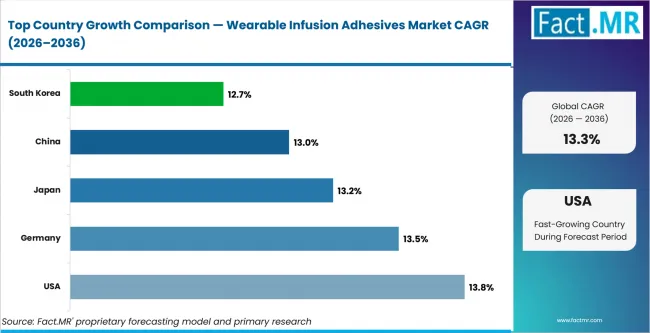
Wearable Infusion Adhesives Market Cagr Analysis By Country | Source: Fact.MR
What supports the United States lead?
13.8% CAGR, supported by wearable healthcare adoption
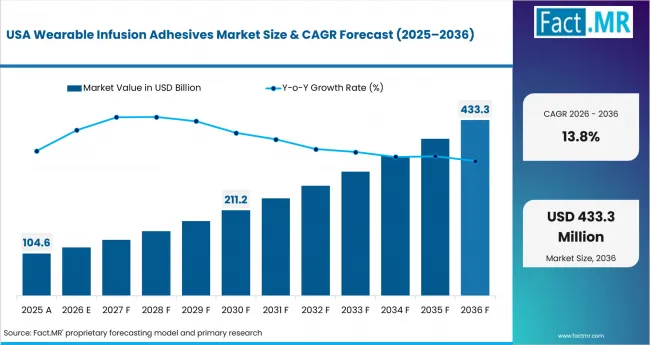
Wearable Infusion Adhesives Market Country Value Analysis | Source: Fact.MR
The United States is projected to expand at a 13.8% CAGR because wearable drug delivery devices and continuous glucose monitoring systems continue gaining wider acceptance. Medical device manufacturers are increasing the use of advanced adhesives to improve device stability and patient comfort. Home healthcare services continue expanding which supports greater demand for long-wear adhesive materials. The country leads global market revenue contribution.
What is supporting market growth in Germany?
13.5% CAGR, backed by medical device innovation
Germany is expected to grow at a 13.5% CAGR because manufacturers continue developing advanced wearable medical devices. Healthcare providers are increasing adoption of skin friendly adhesives that improve device performance during extended wear. Greater investment in digital healthcare also supports market demand. Germany remains one of the key markets across Europe.
How is Japan expanding wearable healthcare applications?
13.2% CAGR, driven by an aging population
Japan is forecast to register a 13.2% CAGR by 2036 because demand for wearable healthcare technologies continues increasing among older patients. Healthcare providers continue adopting wearable infusion and monitoring devices that require dependable skin adhesion. Greater focus on patient comfort also supports continued adhesive innovation. The market is expected to expand steadily during the forecast period.
Why is China becoming a major growth market?
13.0% CAGR, supported by healthcare modernization
China is projected to expand at a 13.0% CAGR because healthcare providers continue adopting advanced wearable medical technologies. Production of wearable medical devices is also increasing across the country. Rising demand for diabetes management and remote patient monitoring continues supporting adhesive consumption. China remains one of Asia’s higher-growth markets.
How is South Korea strengthening market demand?
12.7% CAGR, backed by connected healthcare
South Korea is expected to record a 12.7% CAGR through 2036 because connected healthcare technologies continue expanding across hospitals and home care settings. Manufacturers are increasing the use of high-performance medical adhesives for wearable devices. Greater adoption of digital health solutions also supports product demand. Continued healthcare investment is expected to sustain long-term market growth.
How are manufacturers strengthening their competitive position?
Solventum / 3M Medical Materials, Lohmann, Nitto Denko Corporation, Amcor / Berry Global healthcare, Henkel Adhesive Technologies compete among each other
Manufacturers are investing in advanced adhesive materials that provide stronger skin adhesion while improving patient comfort during extended wear. Product development is focused on breathable formulations, moisture resistance and low-trauma removal that support long-term device performance.
Continuous glucose monitoring devices remain the largest source of demand because global diabetes management continues shifting toward wearable monitoring systems. Wearable injectors and patch pumps are also creating new opportunities as biologic therapies and home-based treatment become more common.
Solventum / 3M Medical Materials continue strengthening their positions through broad medical adhesive portfolios and close partnerships with wearable device manufacturers. Lohmann continue expanding skin friendly adhesive technologies for extended wear applications. Nitto Denko Corporation continue investing in material innovation, manufacturing expansion and application-specific adhesive solutions. Manufacturers that deliver dependable adhesion and consistent product quality are expected to strengthen their competitive position.
Who are the leading companies in the Wearable Infusion Adhesives Market?
Solventum / 3M Medical Materials, Lohmann, Nitto Denko Corporation
- Solventum / 3M Medical Materials
- Lohmann
- Nitto Denko Corporation
- Amcor / Berry Global healthcare
- Henkel Adhesive Technologies
Bibliography
- U.S. Food and Drug Administration. (2024, March 5). FDA clears first over-the-counter continuous glucose monitor. U.S. Food and Drug Administration.
- Solventum. (2026). Medical wearables. Solventum.
- Lohmann. (2026). Skinsafe solutions for medical wearables. Lohmann.
- Mativ / Scapa Healthcare. (2026). Medical device contract development and manufacturing. Scapa Healthcare.
- Nitto Denko Corporation. (2026). Medical adhesive tapes for wearable devices/body sensors. Nitto Denko Corporation.
- Henkel Adhesive Technologies. (2026). Medical wearables. Henkel Adhesive Technologies.
- Amcor. (2025, April 30). Amcor completes combination with Berry Global. Amcor.
- Avery Dennison Medical. (2026). Wearable adhesive tapes for medical device attachment. Avery Dennison Medical.
This Report Addresses
- Strategic assessment of wearable infusion adhesive technologies.
- Analysis of adhesive type and wearable device trends.
- Evaluation of wear duration and adhesive property demand.
- Regional outlook covering the United States, Germany, Japan, China, and South Korea.
- Competitive assessment of leading medical adhesive manufacturers.
- Analysis of wearable healthcare and home monitoring trends.
- Evaluation of medical device partnerships and adhesive material demand.
- Primary interviews and supplier benchmarking supporting market estimates.
- Assessment of innovation in breathable and skin friendly adhesive materials.
- Analysis of future opportunities across wearable drug delivery and patient monitoring.
How is the market defined?
Medical adhesives designed for wearable infusion and monitoring devices.
The market covers skin contact adhesive materials used to secure wearable injectors, infusion devices and monitoring systems during treatment.
Which products are included?
Medical grade wearable adhesives.
The scope includes acrylic, silicone, hydrocolloid, hydrogel and hybrid adhesive materials designed for wearable medical devices.
What falls outside the scope?
General medical tapes and non-medical adhesive products.
The scope excludes conventional wound dressings, consumer adhesive tapes, and industrial adhesive materials.
What methodology supports this study?
100+ sources, 30+ company assessments, 25+ countries, and industry interviews.
- Primary Research: Interviews with wearable device manufacturers, adhesive suppliers, healthcare professionals and material science specialists.
- Desk Research: Analysis of wearable medical device adoption, adhesive technology developments and healthcare investment.
- Market Sizing and Forecasting: Estimates based on wearable device production, adhesive consumption and supplier revenue analysis.
- Data Validation and Update Cycle: Forecasts validated through supplier benchmarking and expert interviews.
What is the report's scope and coverage?
| Attribute | Details |
|---|---|
| Quantitative Units | USD Billion in 2026 to USD Billion by 2036 |
| Market Definition | Medical adhesive materials designed to secure wearable infusion and monitoring devices during treatment |
| Adhesive Types Covered | Acrylic, Silicone, Hydrocolloid, Hydrogel, Hybrid Adhesives |
| Device Types Covered | Wearable Injectors, Patch Pumps, CGM Devices, Ambulatory Infusion Sets, On-Body Sensors |
| Wear Duration Covered | Below 24 Hours, 1-3 Days, 3-7 Days, 7-14 Days, Above 14 Days |
| Properties Covered | Breathable, Sweat-Resistant, Low-Trauma, Hypoallergenic, Waterproof |
| Regions Covered | North America, Western Europe, Asia Pacific, Latin America, Middle East & Africa |
| Key Countries Covered | United States, Germany, Japan, China, South Korea |
| Companies Covered | Solventum / 3M Medical Materials, Lohmann, Nitto Denko Corporation, Amcor / Berry Global healthcare, Henkel Adhesive Technologies |
| Forecast Period | 2026 to 2036 |
| Research Approach | Hybrid top-down and bottom-up methodology using wearable medical device production, adhesive material demand and supplier revenue analysis. |
How is the market segmented?
-
By Adhesive Type
- Acrylic
- Silicone
- Hydrocolloid
- Hydrogel
- Hybrid Adhesives
-
By Device Type
- Wearable Injectors
- Patch Pumps
- CGM Devices
- Ambulatory Infusion Sets
- On-Body Sensors
-
By Wear Duration
- Below 24 Hours
- 1-3 Days
- 3-7 Days
- 7-14 Days
- Above 14 Days
-
By Property
- Breathable
- Sweat-Resistant
- Low-Trauma
- Hypoallergenic
- Waterproof
-
Region:
- North America
- United States
- Canada
- Europe
- Germany
- United Kingdom
- France
- Italy
- Spain
- Asia Pacific
- China
- Japan
- South Korea
- India
- Singapore
- Latin America
- Brazil
- Mexico
- Argentina
- Middle East & Africa
- GCC Countries
- South Africa
- Israel
- North America