- Market Value (2025): USD 589.4 Mn
- Estimated Value (2026): USD 624.8 Mn
- Forecast Value (2036): USD 1,118.9 Mn
- CAGR (2026-2036): 6.0%
What is the Wood Repair Epoxy Market forecast to be worth by 2036?
USD 624.8 million in 2026 to USD 1,118.9 million by 2036 at 6.0% CAGR.
- The wood repair epoxy market reached USD 589.4 million in 2025.
- Demand is projected to increase from USD 624.8 million in 2026 to USD 1,118.9 million by 2036.
- The market is forecast to record 6.0% CAGR from 2026 to 2036 due to renovation work and stronger repair-grade product selection.
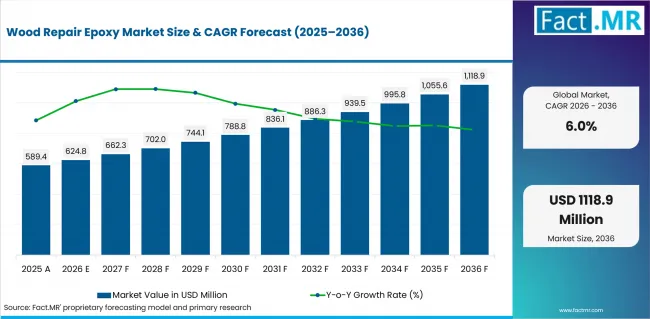
Wood Repair Epoxy Market Value Analysis | Source: Fact.MR
What are the defining numbers behind Wood Repair Epoxy Market growth?
USD 494.1 million absolute opportunity by 2036.
- Demand Drivers in the Market
- Two-part epoxy wood repair gains preference where contractors need stronger filling than standard putty provides.
- Residential repair demand is expected to remain important because doors and windows often need localized repair before replacement.
- Offline retail supports category visibility when store staff help users compare cure time and finish behavior.
- Room-temperature cure products are anticipated to suit field repair without heat equipment or shop-based setups.
- Key Segments Analyzed
- By Product: Two-part Epoxy Wood Repair is projected to hold 39.2% share in 2026 because it rebuilds rot and missing sections with a stronger cured mass.
- By Application: Residential Repair is expected to hold 32.4% share in 2026 since household wood damage creates repeat work across doors and trim.
- By End User: Professional Contractors are anticipated to hold 41.0% share in 2026 as repeat users place more weight on cure reliability.
- By Distribution Channel: Offline Retail is estimated to hold 40.8% share in 2026 because many users still need shelf-level product guidance.
- By Curing Type: Room-temperature Cure is forecast to hold 45.7% share in 2026 as field repairs need simple handling without heated fixtures.
- Analyst Opinion at Fact.MR
- Shambhu Nath Jha, Sr. Consultant at Fact.MR, opines, “Wood repair epoxy demand is expected to depend on proof that a repair compound rebuilds damaged wood without extra finishing work. Contractors are expected to reward products that explain adhesion and cure time in clear jobsite terms. Sanding behavior and moisture resistance need to support a repeatable finish.”
- Strategic Implications
- Manufacturers should build product claims around repair situations that contractors recognize quickly.
- Distributors should place repair epoxy near adhesives and sealants and construction adhesive ranges.
- Investors should separate wood repair epoxy from broad epoxy resins exposure.
USA is expected to record 7.8% CAGR from 2026 to 2036 on the back of contractor scale and retail depth. Germany is anticipated to reach 7.0% through careful product selection and trade-led repair. UK is forecast at 6.4% as older housing keeps repair work active. France is estimated at 5.6% with restoration and outdoor maintenance support. Japan is projected to reach 4.9% through precise small-area repair needs, while Canada is projected at 4.2% through exterior repair needs and contractor use.
How does the Wood Repair Epoxy Market break down by segment?
Two-part Epoxy Wood Repair is expected to lead Product at 39.2% share in 2026. Residential Repair is projected to lead Application at 32.4% share in 2026.
Which product type dominates?
Two-part Epoxy Wood Repair is projected to account for 39.2% share in 2026.
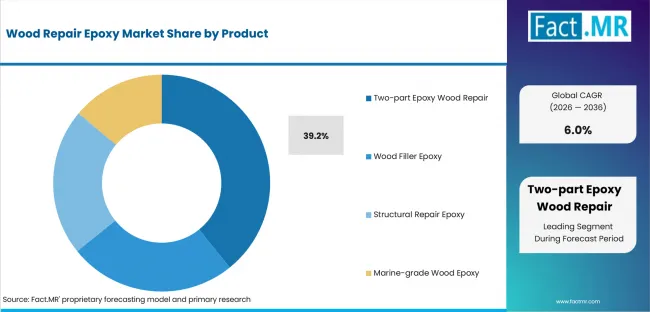
Wood Repair Epoxy Market Analysis By Product | Source: Fact.MR
Two-part systems lead because users mix resin and hardener at the point of repair. The cured mass suits rot pockets and missing corners. Liquid Epoxy serves penetration needs. Paste Epoxy and Wood Filler Epoxy support shaped repairs where sanding controls acceptance.
Why does Residential Repair lead Application?
Residential Repair is expected to hold 32.4% share in 2026.
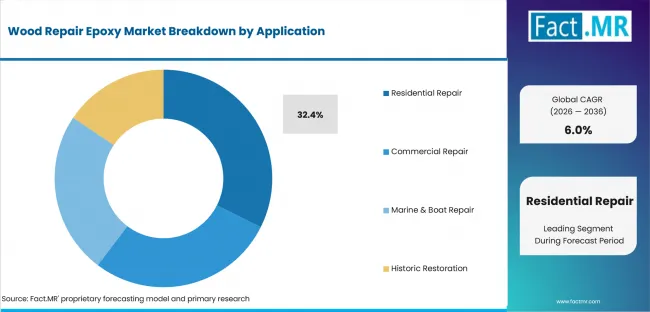
Wood Repair Epoxy Market Analysis By Application | Source: Fact.MR
Homes create steady repair work across frames and trim. Doors and windows stay important because rot often appears before full replacement is justified. Furniture Repair and Flooring Repair support demand when users need a finishable surface after patching.
Why do Professional Contractors lead End User?
Professional Contractors are anticipated to represent 41.0% share in 2026.
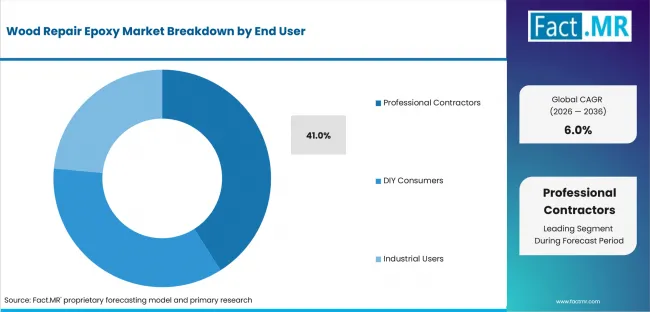
Wood Repair Epoxy Market Analysis By End User | Source: Fact.MR
Contractors lead because repeat work rewards predictable cure and lower rework risk. Building Contractors use repair epoxy where damaged wood slows project completion. Restoration Specialists value products that preserve old wood. Carpentry Professionals add demand when visible joinery must be shaped cleanly.
Why does Offline Retail lead Distribution Channel?
Offline Retail is estimated to hold 40.8% share in 2026.
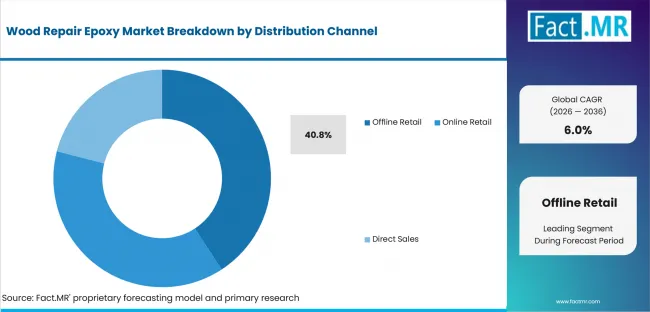
Wood Repair Epoxy Market Analysis By Distribution Channel | Source: Fact.MR
Hardware stores and building material dealers give users immediate access to repair packs. Store advice matters when buyers compare liquid and paste formats. Home Improvement Centers support larger packs. Online Retail expands after repeat users know the product grade.
What supports Room-temperature Cure within Curing Type?
Room-temperature Cure is forecast to account for 45.7% share in 2026.
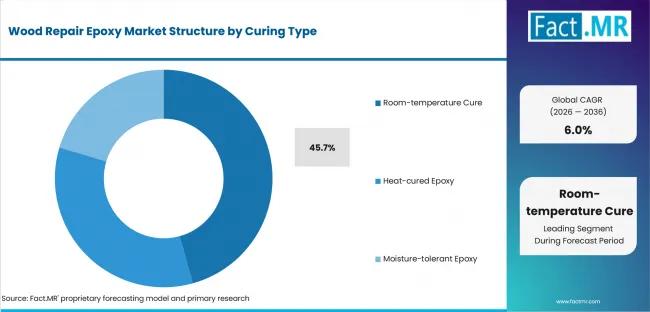
Wood Repair Epoxy Market Analysis By Curing Type | Source: Fact.MR
Room-temperature products fit field repairs because users work on doors and decks without heated equipment. Fast Cure supports urgent jobs. Slow Cure remains relevant when shaping time matters. Heat-cured Epoxy is limited because most repair sites lack controlled curing conditions.
What is accelerating Wood Repair Epoxy Market adoption, and what is holding it back?
Demand is expected to rise because of strong repair performance and repeat contractor use. Growth may be limited by changing material costs and curing challenges.
Drivers Impact Analysis
| DRIVER | (~) % IMPACT ON CAGR | GEOGRAPHIC RELEVANCE | IMPACT TIMELINE |
|---|---|---|---|
| Two-part epoxy repair specification | +1.6% | Canada and USA | Short term (<= 2 years) |
| Residential repair activity | +1.4% | North America and Europe | Short term (<= 2 years) |
| Offline retail guidance | +1.1% | Hardware and home improvement channels | Medium term (2-4 years) |
| Contractor repeat purchasing | +0.9% | Professional repair markets | Medium term (2-4 years) |
| Room-temperature cure convenience | +0.7% | Field repair applications | Long term (>= 4 years) |
Source: Fact.MR analysis. Updated Jul 30, 2026
- Two-part epoxy repair specification: Repair depth is expected to increase the value of strong adhesion and low-shrink filling.
- Residential repair activity: Localized repair is anticipated to gain use when homeowners delay full replacement of damaged wooden parts.
- Offline retail guidance: Store advice is expected to reduce product selection errors for liquid and paste formats.
Opportunity Impact Analysis
| OPPORTUNITY | (~) % IMPACT ON CAGR | GEOGRAPHIC RELEVANCE | IMPACT TIMELINE |
|---|---|---|---|
| Moisture-tolerant repair grades | +0.9% | Canada and coastal markets | Medium term (2-4 years) |
| Contractor training and demos | +0.8% | USA and UK | Medium term (2-4 years) |
| Marine and exterior repair packs | +0.6% | France and Japan | Long term (>= 4 years) |
| Online replenishment for known grades | +0.5% | Mature DIY markets | Long term (>= 4 years) |
Source: Fact.MR analysis. Updated Jul 30, 2026
- Moisture-tolerant repair grades: Outdoor wood repair is expected to create room for products that tolerate damp surfaces after preparation.
- Contractor training and demos: Practical demonstrations are anticipated to reduce mixing errors and show correct shaping steps.
- Marine and exterior repair packs: Boat and dock repair is projected to support demand for waterproof formats.
Restraints Impact Analysis
| RESTRAINT | (~) % IMPACT ON CAGR | GEOGRAPHIC RELEVANCE | IMPACT TIMELINE |
|---|---|---|---|
| Raw-material cost movement | -1.0% | Global | Short term (<= 2 years) |
| Cure and mixing errors | -0.8% | DIY-heavy channels | Short term (<= 2 years) |
| Price sensitivity in small repairs | -0.6% | USA and Europe | Medium term (2-4 years) |
| Limited validation for structural work | -0.5% | Contractor and restoration projects | Long term (>= 4 years) |
Source: Fact.MR analysis. Updated Jul 30, 2026
- Raw-material cost movement: Epoxy resin and hardener cost swings are expected to affect pack pricing and stocking decisions.
- Cure and mixing errors: Two-part systems fail when ratios are wrong or the substrate is not ready.
- Price sensitivity in small repairs: Some users are expected to choose lower-cost fillers when the repair is cosmetic.
Which countries are scaling Wood Repair Epoxy Market fastest?
The country comparison is led by the USA at 7.8% CAGR, followed by Germany at 7.0% and the UK at 6.4%. France, Japan and Canada grow at lower listed rates.
- The USA leads through strong contractor networks and home-improvement retail depth.
- Germany and the UK show steady demand from older buildings and quality-focused trades.
- France benefits from restoration and exterior maintenance.
- Japan grows through compact renovation projects that favor precise localized repair, while Canada remains tied to exterior repair needs and contractor use.
The full report provides country-level CAGR analysis across North America; Latin America; Europe; East Asia; South Asia and Pacific; and the Middle East and Africa.
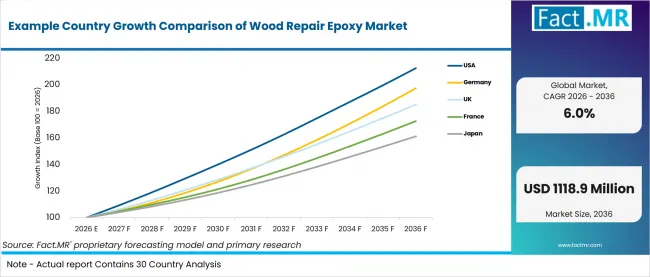
Example Country Growth Comparison Of Wood Repair Epoxy Market | Source: Fact.MR
| Country | CAGR (2026-2036) |
|---|---|
| Canada | 4.2% |
| USA | 7.8% |
| UK | 6.4% |
| Germany | 7.0% |
| France | 5.6% |
| Japan | 4.9% |
Source: Fact.MR analysis. Updated Jul 30, 2026
What supports Canada adoption?
4.2% CAGR, supported by residential maintenance and exterior wood repair needs.
Canada demand reflects outdoor wood exposure to moisture and seasonal temperature swings. Contractors are expected to use two-part epoxy where rot repair must survive repeated weather exposure. Offline retail remains important because users need guidance on mixing and cure timing.
How is USA scaling demand?
7.8% CAGR, driven by contractor scale and home improvement retail depth.
The USA has a large repair base where professional and DIY users compare epoxy with standard fillers. Home improvement centers are expected to support shelf visibility. Contractors value lower callback risk when a repaired part must be sanded and coated.
How does the UK perform?
6.4% CAGR, backed by renovation activity and older housing repair needs.
UK demand is shaped by older homes that create work for frames and stair parts. Decorators are expected to choose epoxy when finish quality matters. Retail advice remains useful because buyers must match repair depth with working time.
What supports Germany’s growth?
7.0% CAGR, led by careful product selection and contractor-led repair standards.
Germany develops through trade users who evaluate repair epoxy through durability and finish compatibility. Furniture and joinery repair create demand where clean sanding is required. Wider uptake depends on clear instructions and proof that the repair meets workmanship expectations.
How does France develop demand?
5.6% CAGR, supported by restoration work and exterior wood maintenance.
France benefits from residential renovation and repair of shutters and frames. Restoration work is expected to favor compounds that preserve existing wood features. Adoption is expected to move more slowly when tradespeople stay with familiar fillers for routine patching.
What supports Japan’s growth?
4.9% CAGR, supported by precision repair needs and compact renovation projects.
Japan’s growth comes from localized repair where full replacement disrupts the project. Furniture and interior wood repair favor clean shaping. Professional users are expected to value predictable cure on visible surfaces.
Who leads the Wood Repair Epoxy Market?
J-B Weld Company and Protective Coating Company are directly relevant through epoxy repair products for damaged wood and household applications. 3M Company, Henkel AG & Co. KGaA and The Sherwin-Williams Company strengthen the wider adhesive, repair-material and finishing landscape.
3M Company contributes adhesive and bonding expertise for professional repair work. Henkel AG & Co. KGaA adds broad adhesive technology and retail reach. The Sherwin-Williams Company strengthens the field through coatings and finishing expertise. J-B Weld Company and Protective Coating Company extend the competitive set through epoxy repair products for damaged wood and household applications.
Which companies are the key providers?
Key companies include 3M Company; Henkel AG & Co. KGaA; The Sherwin-Williams Company; J-B Weld Company; and Protective Coating Company.
- 3M Company
- Henkel AG & Co. KGaA
- The Sherwin-Williams Company
- J-B Weld Company
- Protective Coating Company
Bibliography
- Office for National Statistics. (2024, March 13). Construction output in Great Britain: January 2024.
- U.S. Census Bureau. (2024, December 2). Monthly construction spending, October 2024.
- Office for National Statistics. (2025, February 13). Construction output in Great Britain: December 2024, new orders and construction output price indices, October to December 2024.
This Report Answers
- The report provides strategic intelligence on Product and Application choices that shape repair-grade purchasing.
- Segment analysis covers Two-part Epoxy Wood Repair and Residential Repair as the 2026 share leaders.
- Country outlook evaluates the USA and Germany alongside the UK and France. Japan and Canada complete the comparison.
- Competitive analysis profiles 3M Company; and Henkel AG & Co. KGaA. The Sherwin-Williams Company; J-B Weld Company; and Protective Coating Company complete the provider set.
- Channel assessment covers Offline Retail and Online Retail alongside Hardware Stores and Building Material Dealers.
What does the Wood Repair Epoxy Market cover?
Epoxy wood repair systems are used to rebuild damaged wood where strength and finish quality determine product acceptance.
The Wood Repair Epoxy Market covers two-part products and liquid formats. Paste systems and putty formats are included when sold for repair-grade wood filling.
What is included in the scope?
Wood repair epoxy systems are used across professional contractor and DIY repair settings. Restoration users and industrial users are also included.
The scope includes Product and Application alongside End User and Distribution Channel. Curing Type is included because field users compare room-temperature and fast-cure formats. Two component adhesives and reactive adhesives remain adjacent when repair use overlaps with two-part chemistry.
What is excluded from the scope?
General adhesives and unrelated repair materials remain outside the scope of this market.
The scope excludes products not sold or used for repairing wood. General sealants and cementitious repair materials are excluded. Epoxy grouts are outside the boundary unless the product is used for wood repair. Company revenue without a clear wood repair epoxy connection is also excluded.
How Was the Analysis Built?
The analysis draws on 120+ sources, 35+ company portfolios, 25+ countries, and more than 20 industry interviews.
- Primary Research: Primary research includes discussions with manufacturers, service providers, technology developers, distributors, end users, procurement teams, and subject-matter experts. These conversations examine purchasing priorities, product adoption, operational challenges, approval requirements, competitive positioning, and the factors that influence wider market acceptance.
- Desk Research: Desk research covers government statistics, regulatory publications, company filings, trade data, technical studies, industry associations, standards, public policy, and other authoritative sources. Every source used in the analysis is documented in the bibliography.
- Market Sizing and Forecasting: Market estimates combine historical performance, demand indicators, pricing and volume trends, segment shares, company participation, country-level growth, adoption patterns, investment activity, and barriers to market expansion.
- Data Validation and Update Cycle: Findings are validated by comparing primary interviews with public data, company activity, regulatory changes, trade patterns, and industry developments. Regular updates review new product launches, capacity changes, partnerships, approvals, procurement trends, and shifts in commercial adoption.
Segmentation
What is the report’s scope and coverage?
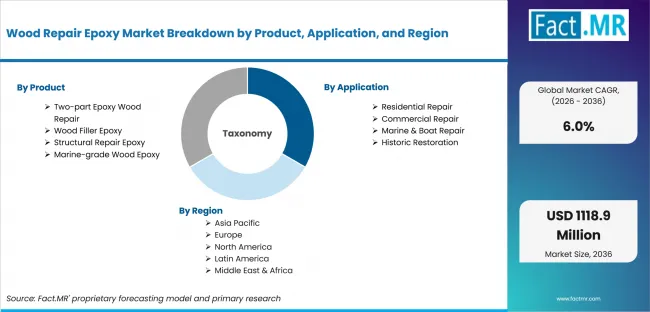
Wood Repair Epoxy Market Breakdown By Product, Application, And Region | Source: Fact.MR
| Attribute | Details |
|---|---|
| Quantitative Units | USD 624.8 million in 2026 to USD 1,118.9 million by 2036, at a 6.0% CAGR. |
| Market Definition | Epoxy-based materials used to fill and rebuild damaged wood where cure behavior, adhesion, moisture tolerance and finish quality determine repair acceptance |
| Product | Two-part Epoxy Wood Repair; Liquid Epoxy; Paste Epoxy; Putty Epoxy; Wood Filler Epoxy |
| Application | Residential Repair; Doors & Windows; Furniture Repair; Flooring Repair; Commercial Repair |
| End User | Professional Contractors; Building Contractors; Restoration Specialists; Carpentry Professionals; DIY Consumers |
| Distribution Channel | Offline Retail; Hardware Stores; Building Material Dealers; Home Improvement Centers; Online Retail |
| Curing Type | Room-temperature Cure; Standard Cure; Fast Cure; Slow Cure; Heat-cured Epoxy |
| Regions Covered | North America; Latin America; Europe; East Asia; South Asia and Pacific; Middle East and Africa |
| Countries Covered | Canada; USA; UK; Germany; France; Japan |
| Key Companies Profiled | 3M Company; Henkel AG & Co. KGaA; The Sherwin-Williams Company; J-B Weld Company; Protective Coating Company |
| Forecast Period | 2026 to 2036 |
| Approach | Hybrid top-down and bottom-up approach using repair indicators; segment share checks; country adoption patterns; channel access and company portfolio review |
Source: Fact.MR analysis. Updated Jul 30, 2026
How is the market segmented?
-
By Product:
- Two-part Epoxy Wood Repair
- Wood Filler Epoxy
- Structural Repair Epoxy
- Marine-grade Wood Epoxy
-
By Application
- Residential Repair
- Commercial Repair
- Marine & Boat Repair
- Historic Restoration
-
By End User
- Professional Contractors
- DIY Consumers
- Industrial Users
-
By Distribution Channel
- Offline Retail
- Online Retail
- Direct Sales
-
By Curing Type
- Room-temperature Cure
- Heat-cured Epoxy
- Moisture-tolerant Epoxy
-
By Region
- North America
- Latin America
- Europe
- East Asia
- South Asia and Oceania
- Middle East and Africa
Frequently Asked Questions
Which Product leads the market?
Which Application leads the market?
Which End User leads the market?
Which Distribution Channel leads the market?
Which Curing Type leads the market?
Which country records the highest listed CAGR?
What is the primary driver in this market?
What is the main restraint?
Why do Professional Contractors lead demand?
Who worked on this report


Preview the report firsthand - request a free sample
Free SampleGet the brochure for pricing and purchase details
Download PDF