- Market Value (2025): USD 168.9 Mn
- Estimated Value (2026): USD 205.0 Mn
- Forecast Value (2036): USD 1420.0 Mn
- CAGR (2026-2036): 21.4%
What is the AI Fertility Planning Platforms Market forecast to be worth by 2036?
USD 205.0 million in 2026 to USD 1,420.0 million by 2036 at 21.4% CAGR.
- The AI fertility planning platforms market reached USD 168.9 million in 2025.
- Demand is projected to increase from USD 205.0 million in 2026 to USD 1,420.0 million by 2036.
- The market is forecast to record 21.4% CAGR from 2026 to 2036 as clinics test validated fertility-planning software.
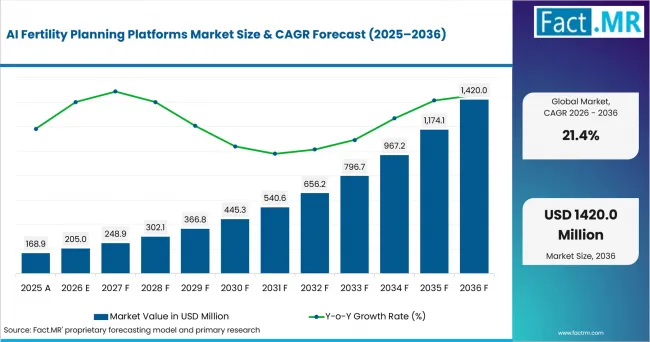
Ai Fertility Planning Platforms Market Value Analysis | Source: Fact.MR
What are the defining numbers behind AI Fertility Planning Platforms Market growth?
USD 1,215.0 million absolute opportunity by 2036 is led by Ovulation & fertile-window prediction and Wearable & sensor data. Consumer app deployment and Fertility clinics complete the leading demand points.
- Demand Drivers in the Market
- Fertility-care workflows produce repeated hormone and embryo records that are expected to support structured review before a clinician makes a decision.
- Use of smart fertility tracker tools is expected to support cycle interpretation when sensor data reduces manual entry.
- Clinics are expected to use AI outputs only when the recommendation is easy to review and easy to challenge.
- Enterprise demand is expected to favor tools that show consent steps and decision limits clearly within digital transformation in healthcare programs.
- Key Segments Analyzed
- By AI Application: Ovulation & fertile-window prediction is expected to hold 33.8% share in 2026 because users already understand cycle tracking.
- By Data Input: Wearable & sensor data is projected to account for 30.5% share in 2026 as passive signals reduce manual entry.
- By Deployment: Consumer app is anticipated to capture 51.5% share in 2026 due to fast user access and low setup friction.
- By End User: Fertility clinics are forecast to hold 39.0% share in 2026 since clinical context decides whether AI output is usable.
- Analyst Opinion at Fact.MR
- Shambhu Nath Jha, Senior Analyst at Fact.MR, states, “AI fertility planning platforms are expected to gain use only when the recommendation is clear enough for clinical review. Purchase decisions are expected to depend on validation, workflow fit and accountability instead of engagement volume alone.”
- Strategic Implications
- Platform providers need a validation plan before software reaches clinic contracts. That plan is expected to show how outputs perform across patients and care protocols.
- Sponsors need clear consent and escalation rules before deployment. The document is read beside healthcare business intelligence tools where reproductive data requires careful access control.
- Implementation teams need routine bias checks after launch. The comparison with AI in diagnostics is useful because both areas require explainable output for qualified clinicians.
France is projected to record a 26.5% CAGR from 2026 to 2036, supported by reimbursement alignment and digital-care governance. The USA is expected to record 19.9% CAGR as fertility clinic networks and health-plan purchasing expand demand for validated software. The UK is forecast to reach 18.9% through evidence-led procurement and care-pathway integration. Japan is anticipated to post 18.2%, backed by clinician oversight and localized workflows, while Germany is estimated at 17.8% through interoperability, disciplined procurement and strict data-handling requirements across fertility care settings.
How does the AI Fertility Planning Platforms Market break down by segment?
Ovulation & fertile-window prediction is expected to lead AI Application at 33.8% share in 2026. Wearable & sensor data is projected to lead Data Input at 30.5% share in 2026.
Which AI Application dominates?
Ovulation & fertile-window prediction is projected to account for 33.8% share in 2026.
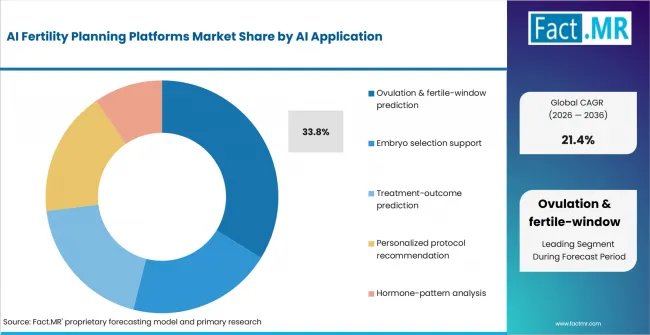
Ai Fertility Planning Platforms Market Analysis By Ai Application | Source: Fact.MR
Fertile-window tools hold the widest starting base because users already understand cycle tracking. Embryo selection support and treatment-outcome prediction remain important for clinic use. Clinic tools are expected to intersect with preimplantation genetic testing when embryo evidence must remain easy to review. Personalized protocol recommendation and hormone-pattern analysis are expected to gain value when physicians can see the basis for each recommendation.
What leads the Data Input segment?
Wearable & sensor data is expected to hold 30.5% share in 2026.
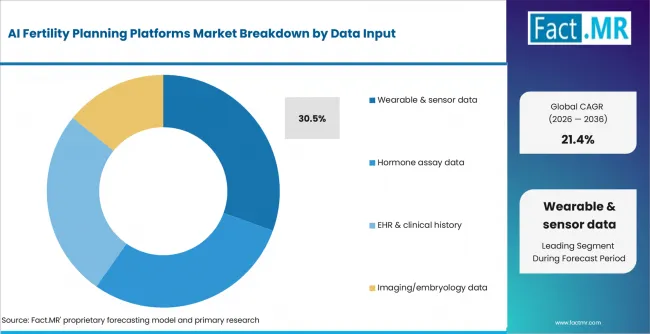
Ai Fertility Planning Platforms Market Analysis By Data Input | Source: Fact.MR
Wearable signals give platforms repeated inputs without asking users to enter every observation. Hormone assay data and EHR history remain important for higher-acuity fertility decisions. IVF devices and embryology records are expected to matter more when tools move from consumer planning into clinic support.
How does Deployment shape demand?
Consumer app is anticipated to lead with 51.5% share in 2026.
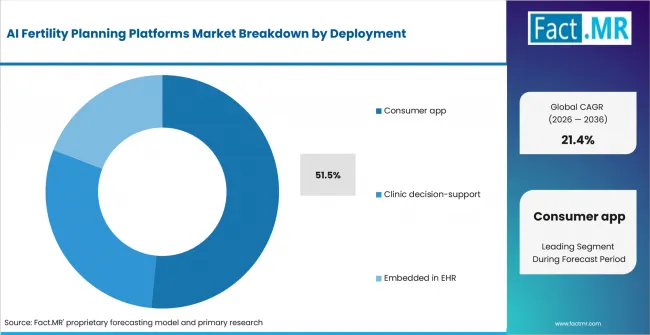
Ai Fertility Planning Platforms Market Analysis By Deployment | Source: Fact.MR
Consumer apps provide the fastest access route for planning tools and cycle interpretation. Clinic decision-support software is expected to grow when fertility centers require evidence and human review. Embedded EHR deployment remains smaller because integration work and data review take longer than app distribution.
What supports Fertility clinics within End User?
Fertility clinics are forecast to hold 39.0% share in 2026.
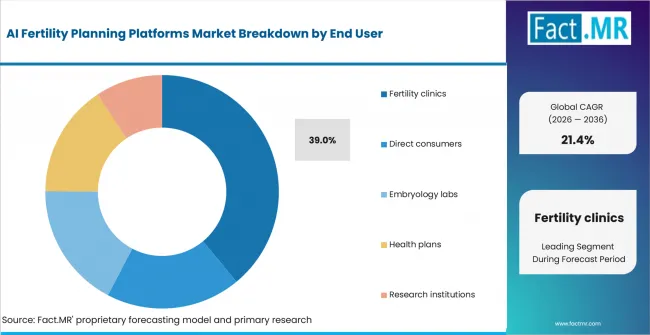
Ai Fertility Planning Platforms Market Analysis By End User | Source: Fact.MR
Clinics hold hormone and laboratory context that makes AI outputs easier to judge. Direct consumers remain important for planning and early education. Embryology labs are expected to connect planning tools with embryo review and sperm processing media when records support a clinician decision.
What is accelerating AI Fertility Planning Platforms Market adoption, and what is holding it back?
Demand is expected to be driven by data-rich fertility workflows and pressure to improve treatment decisions. Adoption is expected to be held back by bias, unclear software classification and consent requirements.
Drivers Impact Analysis
| DRIVER | (~) % IMPACT ON CAGR |
GEOGRAPHIC RELEVANCE | IMPACT TIMELINE |
|---|---|---|---|
| Data-rich fertility workflows | +5.4% | Global | Short term (<= 2 years) |
| Treatment-efficiency pressure | +4.7% | USA; France; UK | Short term (<= 2 years) |
| Consumer prediction use | +3.8% | Global | Medium term (2-4 years) |
| AI investment in fertility tools | +3.0% | France and enterprise markets | Medium term (2-4 years) |
| Clinical validation evidence | +2.2% | Regulated fertility markets | Long term (>= 4 years) |
Source: Fact.MR analysis. Updated Jul 25, 2026
- Data-rich fertility workflows: Repeated hormone and embryo records are expected to increase the value of structured prediction tools.
- Treatment-efficiency pressure: Clinics are expected to favor tools that support scheduling and review consistency during fertility treatment.
- Consumer prediction use: Cycle tracking and home-test routines are expected to create wider interest in personalized fertility planning.
- AI investment in fertility tools: Specialist companies are expected to pursue clinic partnerships when validated outputs support care workflows.
- Clinical validation evidence: Multicenter proof is expected to improve confidence where a recommendation affects treatment timing or embryo review.
Opportunity Impact Analysis
| OPPORTUNITY | (~) % IMPACT ON CAGR |
GEOGRAPHIC RELEVANCE | IMPACT TIMELINE |
|---|---|---|---|
| Multicenter validation | +2.8% | Global | Short term (<= 2 years) |
| Human-readable decision support | +2.0% | France and USA | Medium term (2-4 years) |
| Post-market monitoring | +1.5% | Global | Medium term (2-4 years) |
| Clinic integration partnerships | +1.1% | USA; UK; Germany | Long term (>= 4 years) |
Source: Fact.MR analysis. Updated Jul 25, 2026
- Multicenter validation: Testing across clinics and patient groups is expected to make performance claims easier to review.
- Human-readable decision support: Clear explanations and uncertainty ranges are expected to help clinicians question a score before acting on it.
- Post-market monitoring: Ongoing performance checks are expected to identify drift when lab practice or patient mix changes.
- Clinic integration partnerships: Partnerships tied to predictive telehealth platforms are expected to support patient follow-up and care coordination.
Restraints Impact Analysis
| RESTRAINT | (~) % IMPACT ON CAGR |
GEOGRAPHIC RELEVANCE | IMPACT TIMELINE |
|---|---|---|---|
| Bias and limited generalizability | -2.3% | Global | Short term (<= 2 years) |
| Regulatory classification uncertainty | -1.8% | Regulated and payer-funded markets | Medium term (2-4 years) |
| High-stakes consent concerns | -1.2% | Global | Medium term (2-4 years) |
| Data-quality gaps | -0.9% | Clinics and app-led channels | Long term (>= 4 years) |
Source: Fact.MR analysis. Updated Jul 25, 2026
- Bias and limited generalizability: Training evidence from one clinic or population does not always transfer cleanly to another setting.
- Regulatory classification uncertainty: The clinical decision support role and user type are expected to shape whether software enters medical-device review.
- High-stakes consent concerns: Patients require clear information about how reproductive and embryo data are stored and used.
- Data-quality gaps: Missing inputs or inconsistent lab records are expected to reduce confidence in automated recommendations.
Which countries are scaling AI Fertility Planning Platforms Market fastest?
The country comparison is defined less by the overall CAGR range and more by the spacing between the markets. France occupies a separate position above the remaining countries. The USA sits between France and a closely aligned group formed by the UK, Japan and Germany. The total range between France and Germany is 8.68 percentage points. This pattern reflects differences in reimbursement alignment, clinical validation and fertility-care integration rather than a simple divide between mature and developing markets.
- France shows a notable position because reimbursement alignment can support fertility software with visible clinical governance. Providers must still demonstrate consent controls and preserve medical judgement before wider clinic deployment.
- The USA is separated from France by a considerable gap but remains positioned above the compact lower group. Its commercial route depends on fertility clinic networks, health-plan purchasing and evidence that software can support treatment planning without increasing review burden.
- The UK remains relatively close to Japan in CAGR terms but follows a different adoption model. Progress depends on evidence-led procurement and the ability to place digital fertility tools within established care pathways.
- Japan forms part of the closely aligned lower cluster. Its market development depends on localized interfaces, physician oversight and consent language suited to fertility clinic practice.
- Germany sits near Japan within the comparison yet follows a more measured commercial route. Interoperability requirements, disciplined procurement and strict data handling can extend deployment timelines even when demand remains comparable.
Comparable CAGRs can therefore produce different market entry conditions across these countries. Deployment timing depends on reimbursement design, institutional readiness and the evidence required before AI recommendations enter fertility-care workflows.
The full report provides country-level CAGR analysis across North America, Latin America, Europe, East Asia, South Asia, Oceania and the Middle East and Africa.
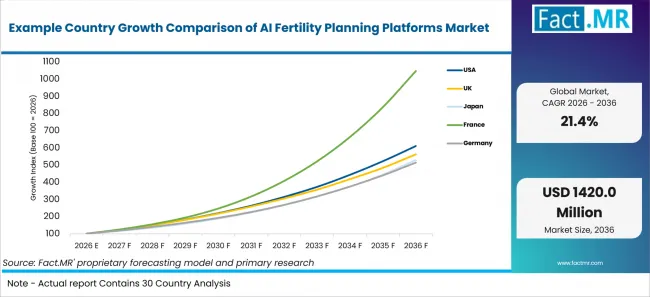
Example Country Growth Comparison Of Ai Fertility Planning Platforms Market | Source: Fact.MR
| Country | CAGR (2026-2036) |
|---|---|
| France | 26.5% |
| USA | 19.9% |
| UK | 18.9% |
| Japan | 18.2% |
| Germany | 17.8% |
Source: Fact.MR analysis. Updated Jul 25, 2026
What supports France adoption?
26.5% CAGR, supported by reimbursement alignment and digital-care governance.
France records the highest workbook growth rate because fertility support fits broader digital-health pathways. Platform providers are expected to show evidence and consent controls before clinic use expands. Local success is expected to depend on tools that support care teams without replacing medical judgment.
What is driving USA growth from 2026 to 2036?
19.9% CAGR, driven by clinic networks and employer or health-plan purchasing.
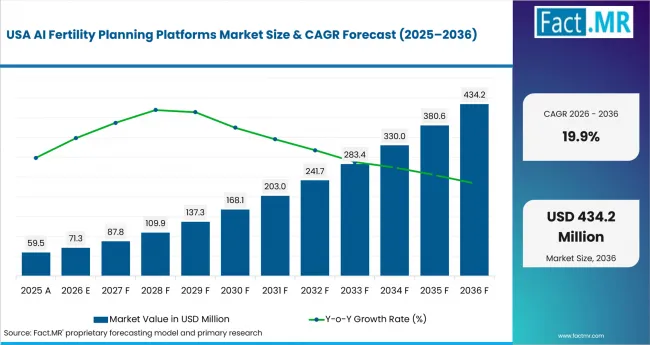
Ai Fertility Planning Platforms Market Country Value Analysis | Source: Fact.MR
USA growth is shaped by fertility networks that evaluate software through clinical evidence and workflow fit. Providers are expected to explain intended use and keep clinicians accountable for high-stakes decisions. Commercial demand is expected to favor platforms that help clinics manage treatment planning without adding review burden.
How is the UK developing demand?
18.9% CAGR, supported by pathway fit and evidence-led procurement.
The UK market is expected to move through careful service review where digital fertility tools fit established care pathways. Clinics and payers are expected to examine whether software improves decision clarity and patient communication. Adoption is therefore more measured than France but remains tied to validated clinician-facing use.
How does Japan perform?
18.2% CAGR, backed by clinician oversight and localized fertility workflows.
Japan growth reflects demand for tools that respect physician review and local patient communication norms. Developers are expected to adapt interfaces and consent language for clinic practice. Fertility planning platforms that show reliable cycle or embryo support are expected to move faster than broad wellness tools.
What supports Germany’s growth?
17.8% CAGR, led by interoperability and disciplined procurement.
Germany growth is expected to be shaped by careful data handling and evidence review. Clinic purchasing is expected to favor tools that document security and clinical limits. This slower route can still support durable demand when providers prove that AI outputs are transparent and reviewable.
Who leads the AI Fertility Planning Platforms Market?
Alife Health holds the largest workbook share. Fairtility and AIVF form the next comparison group. Life Whisperer follows in the same provider set. Conceivable Life Sciences completes the named provider set.
Alife Health is relevant through clinic software and embryo-assessment workflows. Fairtility is tied to embryo-image decision support through CHLOE BLAST. AIVF add adjacent clinic tools for embryo or sperm assessment. Conceivable Life Sciences adds lab automation and AI workflow exposure.
From 2026 to 2036, competition is expected to depend on evidence quality and workflow fit. Providers are expected to compare validation depth and consent design before wider deployment. Integration with healthcare automation programs is expected to matter when fertility clinics connect planning tools with scheduling and follow-up.
Which companies are the key providers?
Key companies include Alife Health; Fairtility; AIVF; Life Whisperer; and Conceivable Life Sciences.
- Alife Health
- Fairtility
- AIVF
- Life Whisperer
- Conceivable Life Sciences
Bibliography
- Centers for Disease Control and Prevention. (2025, February 7). ART success rates.
- Human Fertilisation and Embryology Authority. (2025, June). Fertility treatment 2023: Trends and figures.
- U.S. Food and Drug Administration. (2026, January). Clinical decision support software: Guidance for industry and Food and Drug Administration staff.
- World Health Organization. (2025, November 28). Infertility.
This Report Answers
- The report provides strategic intelligence on the AI Fertility Planning Platforms Market across AI Application and Data Input choices that shape fertility-planning workflows.
- Segment analysis covers Ovulation & fertile-window prediction and Wearable & sensor data as the share leaders within the 2026 market.
- Country outlook evaluates France and the USA alongside the UK. Japan and Germany complete the growth comparison across the profiled markets.
- Competitive analysis profiles Alife Health and Fairtility alongside AIVF. Life Whisperer and Conceivable Life Sciences complete the provider set.
- Deployment assessment covers Consumer app and Clinic decision-support. Embedded in EHR completes the deployment view alongside fertility clinic use.
What does the AI Fertility Planning Platforms Market cover?
Software platforms are used to support fertility planning and embryo review when the output remains open to clinician review.
The AI Fertility Planning Platforms Market covers consumer tools and clinician-facing decision support used in fertility care. Coverage extends to fertile-window prediction and embryo selection support. Treatment-outcome prediction and hormone-pattern analysis are included when they support a care decision. The market includes wearable inputs and clinical records. It also covers consumer app deployment and clinic decision-support use.
The market differs from general women’s health apps because commercial value comes from validated fertility-planning support and clear human review. General wellness tracking remains outside the boundary. Unrelated telehealth software and lab automation are excluded unless their use directly supports AI-based fertility planning or treatment decision support.
What is included in the scope?
AI fertility planning platforms are used by fertility clinics and direct consumers. Embryology labs and health plans are included when they use software for planning or decision support.
The scope includes AI Application and Data Input alongside Deployment and End User. Coverage spans ovulation and fertile-window prediction as well as embryo selection support. Treatment-outcome prediction and personalized protocol recommendation complete the application scope. Wearable signals and hormone assay data are included when they support fertility planning. EHR history and imaging records follow the same use rule.
What is excluded from the scope?
General wellness apps and unrelated healthcare software remain outside the scope of this market.
The scope excludes tools that do not support fertility planning or treatment-outcome estimation. Standalone calendar apps and generic telehealth platforms are excluded. General EHR software is excluded when it does not provide fertility-planning decision support. Fertility treatments and lab procedures are outside the boundary unless revenue is tied to AI-based planning software.
How Was the Analysis Built?
The analysis draws on 120+ sources and 35+ company portfolios. It also covers 25+ countries and more than 20 industry interviews.
- Primary Research: Primary research includes discussions with manufacturers and service providers. It also includes technology developers; distributors; end users; procurement teams; and subject-matter experts. These conversations examine purchasing priorities and product adoption. They also examine operational barriers; approval requirements; competitive positioning; and the factors that influence wider market acceptance.
- Desk Research: Desk research covers government statistics and regulatory publications. It also reviews company filings; trade data; technical studies; industry associations; standards; public policy; and other authoritative sources. Every source used in the analysis is documented in the bibliography.
- Market Sizing and Forecasting: Market estimates combine historical performance and demand indicators. They also review pricing and volume trends; segment shares; company participation; country-level growth; adoption patterns; investment activity; and barriers to market expansion.
- Data Validation and Update Cycle: Findings are validated by comparing primary interviews with public data and company activity. The process also checks regulatory changes; trade patterns; and industry developments. Regular updates review new product launches and capacity changes. They also review partnerships; approvals; procurement trends; and shifts in commercial adoption.
Segmentation
What is the report’s scope and coverage?
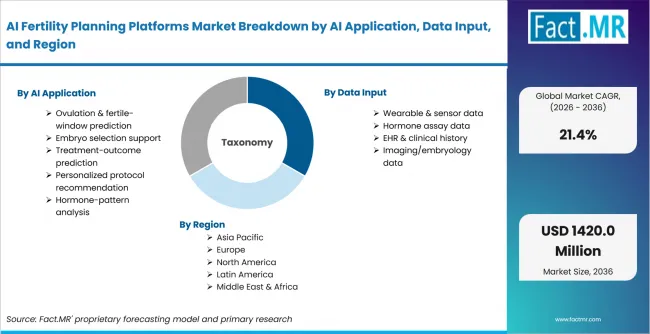
Ai Fertility Planning Platforms Market Breakdown By Ai Application, Data Input, And Region | Source: Fact.MR
| Attribute | Details |
|---|---|
| Quantitative Units |
USD million in 2026 to USD million by 2036 at CAGR |
| Market Definition |
Software platforms that use machine learning or other AI methods to support fertility planning, fertile-window prediction, treatment-outcome estimation, embryo assessment or personalized protocol decisions |
| AI Application | Ovulation & fertile-window prediction; Embryo selection support; Treatment-outcome prediction; Personalized protocol recommendation; Hormone-pattern analysis |
| Data Input | Wearable & sensor data; Hormone assay data; EHR & clinical history; Imaging/embryology data |
| Deployment | Consumer app; Clinic decision-support; Embedded in EHR |
| End User | Fertility clinics; Direct consumers; Embryology labs; Health plans; Research institutions |
| Regions Covered |
North America; Latin America; Europe; East Asia; South Asia and Pacific; Middle East and Africa |
| Countries Covered |
France; USA; UK; Japan; Germany |
| Key Companies Profiled |
Alife Health; Fairtility; AIVF; Life Whisperer; Conceivable Life Sciences |
| Forecast Period | 2026 to 2036 |
| Approach | Hybrid top-down and bottom-up approach using fertility planning software demand; AI embryo-assessment records; cycle-tracking adoption patterns; clinic decision-support workflows; wearable and sensor data use; fertility clinic purchasing behavior; country adoption patterns and company portfolio review |
Source: Fact.MR analysis. Updated Jul 25, 2026
How is the market segmented?
-
By AI Application:
- Ovulation & fertile-window prediction
- Embryo selection support
- Treatment-outcome prediction
- Personalized protocol recommendation
- Hormone-pattern analysis
-
By Data Input:
- Wearable & sensor data
- Hormone assay data
- EHR & clinical history
- Imaging/embryology data
-
By Deployment:
- Consumer app
- Clinic decision-support
- Embedded in EHR
-
By End User:
- Fertility clinics
- Direct consumers
- Embryology labs
- Health plans
- Research institutions
-
By Region:
- North America
- Western Europe
- East Asia
- Latin America
- South Asia and Pacific
- Middle East and Africa
Frequently Asked Questions
Which AI Application leads the market?
Which Data Input leads the market?
Which Deployment category leads the market?
Which End User leads the market?
Which country records the highest listed CAGR?
What is the primary driver in this market?
What is the main restraint?
Why do fertility clinics lead demand?
Who worked on this report


Preview the report firsthand - request a free sample
Free SampleGet the brochure for pricing and purchase details
Download PDF