- Forecast Value (2036): 5.8 Bn
- CAGR (2036): 13.8%
Antibacterial Film Market Forecast and Outlook 2026 to 2036
Global demand for antibacterial film market is projected to rise sharply from USD 1.6 billion in 2026 to approximately USD 5.8 billion by 2036, advancing at a CAGR of 13.8%. This expansion is closely tied to rising food safety standards, healthcare-associated infection control protocols, and normalization of antimicrobial protection across diverse industrial applications. Antibacterial film formulations are closing a long-standing gap in packaging materials. They provide continuous microbial protection while maintaining barrier performance, transparency, and compatibility with existing packaging systems. This makes them especially valuable for perishable food packaging, sterile medical environments, and high-touch surface protection.
Key Takeaways from the Antibacterial Film Market
- Antibacterial Film Market Value (2026): USD 1.6 billion
- Antibacterial Film Market Forecast Value (2036): USD 5.8 billion
- Antibacterial Film Market Forecast CAGR (2026-2036): 13.8%
- Leading End-Use Sector: Food Packaging (44%)
- Key Market Participants: Berry Global, Amcor, Mondi, Wipak, Kuraray, Toray
- Key Growth Regions: Asia Pacific, North America, Europe, Latin America, Middle East& Africa
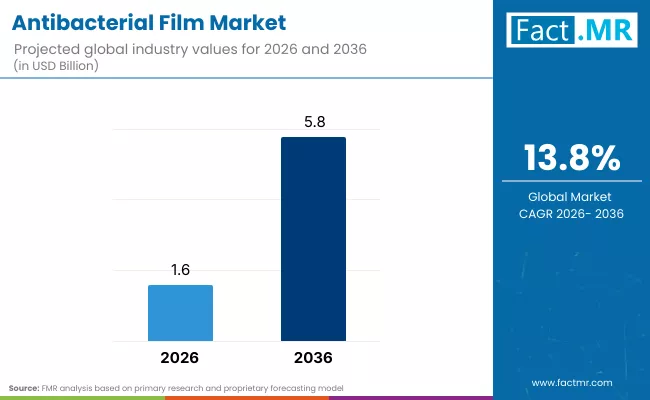
Antibacterial Film Market By Industry | Source: Fact.MR
The importance of this category is often described by industry leaders as the “active preservation revolution.” Speaking at the 2025 Pack Expo International symposium, Dr. Maria Chen, Chief Technology Officer at Berry Global, explained that ‘Modern antibacterial films now combine multiple antimicrobial mechanisms. These include silver nanoparticles, zinc-based additives, and organic compounds. This approach reflects how the market is adapting to rising pathogen resistance and the limits of traditional surface disinfection”.
Manufacturers that apply advanced material science to address specific contamination risks are well positioned to gain market share. By integrating nanotechnology, bio-based antimicrobials, and controlled-release systems, antibacterial film producers are aligning closely with today’s food safety and infection prevention demands.
Antibacterial Film Market
| Metric | Value |
|---|---|
| Estimated Value in (2026E) | USD 1.6 billion |
| Forecast Value in (2036F) | USD 5.8 billion |
| Forecast CAGR (2026 to 2036) | 13.8 % |
Source: Fact.MR analysis. Updated Feb 5, 2026
Category
| Category | Segments |
|---|---|
| End-Use Sector | Food Packaging, Medical Packaging, Consumer Goods, Electronics Protection |
| Active Technology | Silver-Ion Coatings, Zinc-Based Additives, Organic Antimicrobials, Plasma-Treated Films |
| Base Polymer | PE / PET, PP, PLA / Bio-PE, PET |
| Region | United States; Germany; China; India; Japan |
Source: Fact.MR analysis. Updated Feb 5, 2026
Segmental Analysis
How is rising food safety awareness positioning food packaging as the leading sector in the antibacterial film market?
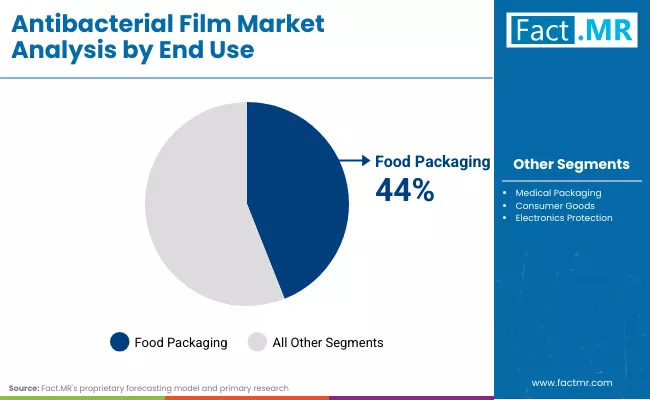
Antibacterial Film Market By End Use | Source: Fact.MR
Food packaging accounts for 44% of the antibacterial film market because it directly supports shelf-life extension and pathogen control. Manufacturers face growing pressure to reduce foodborne illness risks across fresh produce, meat, seafood, and ready-to-eat foods. Consumers are more aware of spoilage and contamination than ever before. This has increased demand for active packaging solutions that go beyond basic barrier protection. Antibacterial films using silver nanoparticles, natural antimicrobials, and controlled-release systems provide continuous protection against bacteria such as E. coli, Salmonella, and Listeria. These films maintain required gas exchange and moisture control while delivering targeted antimicrobial action. They also reduce reliance on chemical preservatives, helping brands meet clean-label expectations without changing cold-chain logistics.
Why does silver-ion technology dominance reshape antimicrobial preferences in packaging films?
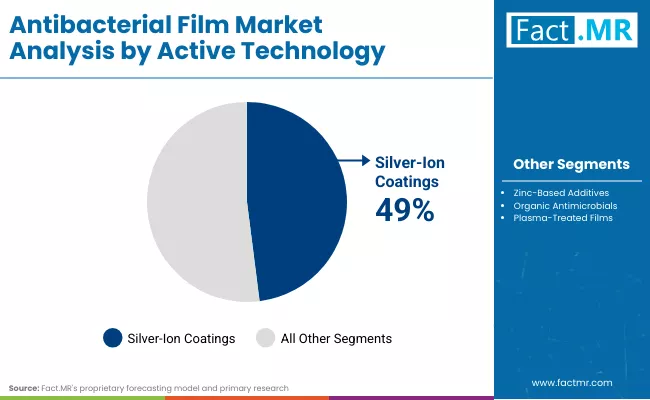
Antibacterial Film Market By Active Technology | Source: Fact.MR
Silver-ion coatings hold 48% market share because they are scientifically proven and highly reliable. Extensive research has validated their broad-spectrum antimicrobial performance and long-term stability within polymer films. Regulators and industry groups increasingly favor antimicrobial technologies with clear scientific backing. Silver-based systems meet these expectations through well-understood mechanisms. They disrupt bacterial cell membranes, prevent biofilm formation, and remain effective throughout the product lifecycle.
Importantly, modern silver-ion technologies maintain antimicrobial activity without significant migration into food. This balance of efficacy and safety reduces risk for manufacturers, making silver-based films the preferred choice for food packaging applications.
Antibacterial Film Market-Drivers, Restraints & Trends
- Drivers: The strongest driver of the antibacterial film market is the growing global focus on food safety. Governments, brands, and consumers are demanding better protection against contamination. Active packaging is becoming essential across both developed and emerging food supply chains. Regulations such as the FDA Food Safety Modernization Act and the EU Framework Regulation 1935/2004 require validated antimicrobial solutions. This is creating large new demand for antibacterial films, especially in high-risk food categories. Advances in nanotechnology are also accelerating adoption. Controlled-release systems now make antimicrobial films viable in applications that were previously too expensive. Breakthroughs in silver nanoparticles, plant-based antimicrobials, and surface treatments are expanding performance while lowering entry barriers.
- Restraints:Despite strong demand, market growth faces regulatory and technical challenges. Approval processes for food-contact materials are complex and vary widely by region. Migration testing and antimicrobial validation requirements can delay product launches. Concerns remain around long-term stability and nanoparticle release. These issues increase scrutiny, especially for new formulations. Manufacturers must also invest in extensive testing against multiple bacteria and conduct long shelf-life studies. In addition, supply constraints for silver compounds and bio-based ingredients have limited portfolio expansion for some producers, slowing growth in premium segments.
- Trend: Bio-Based Antimicrobial IntegrationNatural antimicrobials are no longer niche solutions. They are becoming a mainstream requirement. Converters are actively adopting plant-based compounds, essential oil nano-emulsions, and polysaccharide systems. These materials offer strong antimicrobial performance with improved sustainability profiles. Companies investing in botanical extraction and fermentation technologies gain an advantage, especially with brands focused on biodegradable and non-toxic packaging solutions.
- Trend: Smart Antimicrobial Systems with Visual IndicatorsSmart antibacterial films are emerging as a key differentiator. These films combine microbial protection with real-time quality monitoring. Technologies such as pH-sensitive dyes, oxygen indicators, and color-changing bacterial sensors are being embedded into antimicrobial films. This allows both protection and contamination detection. Such systems are especially valuable in premium food and pharmaceutical packaging, where visible alerts improve safety and consumer confidence.
Antibacterial Film Market Analysis by Key Country
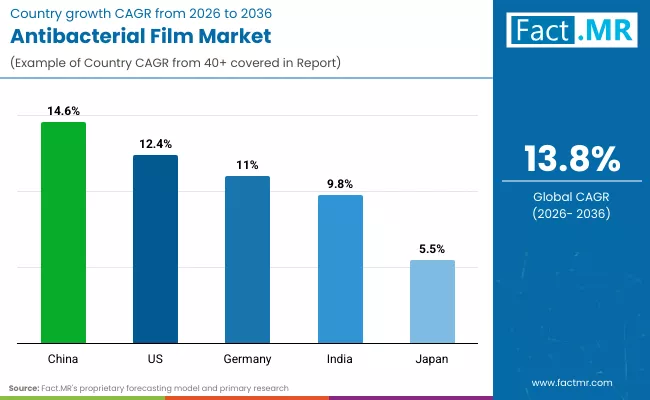
Antibacterial Film Market By Country | Source: Fact.MR
| Country | CAGR (2026-2036) |
|---|---|
| China | 14.6% |
| US | 12.4% |
| Germany | 11.0% |
| India | 9.8% |
| Japan | 5.5% |
Source: Fact.MR analysis. Updated Feb 5, 2026
How is food safety regulation transforming antibacterial film adoption in China?
China is expanding at 14.6% CAGR, driven by enforcement of GB 4806.7-2023, which sets strict migration limits for antimicrobial agents in food-contact plastics. Compliance requirements are accelerating adoption of safer, bio-based antimicrobial films. Manufacturers are turning to polysaccharide-based materials derived from traditional medicinal plants. These solutions align with both regulatory demands and consumer preference for natural preservation. In January 2026, South China University of Technology introduced Alpinia oxyphylla-based films for surimi packaging. The development demonstrated shelf-life extension without synthetic additives. China’s market shows how regulation is converting traditional botanical knowledge into scalable commercial packaging solutions.
How is regulatory policy influencing antibacterial film growth in the United States?
The United States market is growing at 12.4% CAGR, driven by tighter healthcare infection-control rules. The Joint Commission’s 2026 Standards require stronger environmental hygiene in outpatient clinics and ambulatory surgery centers. These rules are pushing demand for continuous disinfection surfaces. Hospitals increasingly use adhesive antibacterial films on touchscreens and high-contact medical equipment. Silver-ion technologies are favored because they offer proven, long-lasting protection. This regulatory shift is also influencing pharmaceuticals. Aquestive Therapeutics resubmitted its Anaphylm sublingual film in 2026 using antimicrobial sterile-barrier packaging. The market reflects a clear link between regulation and innovation, where compliance-ready materials gain rapid adoption
How is biocidal regulation reshaping antibacterial film development in Germany?
Germany’s antibacterial film market grows at 11.0% CAGR, shaped by the EU Biocidal Products Regulation. The final 2026 phase-out of high-toxicity additives has forced manufacturers to rethink antimicrobial strategies. Film producers are shifting toward green-label alternatives. Bio-based agents such as sodium benzoate and mushroom-derived antimicrobials are gaining traction. In January 2026, Lanxess AG launched Scopeblue antibacterial additives for food packaging films. Early compliance is becoming a competitive advantage. German suppliers are well positioned in sustainability-focused European supply chains that demand both efficacy and environmental safety.
How is e-commerce expansion driving antibacterial film demand in India?
India is growing at 9.8% CAGR, supported by stricter enforcement of FSSAI Food Safety Audit 2.0. The regulation requires stronger shelf-life validation for e-commerce and cold-chain distributors. Infrastructure gaps have accelerated innovation. Antibacterial films help compensate for inconsistent refrigeration in last-mile logistics. Nano-active films using silver nanoparticles and bacterial cellulose are doubling shelf life for fresh produce. Research institutions are also contributing. IIT Hyderabad developed graphene oxide composites to salvage overripe fruit. In India, antibacterial films are enabling direct-to-consumer food delivery despite cold-chain limitations.
How is hybrid functionality certification influencing antibacterial film standardization in Japan?
Japan’s market grows at 5.5% CAGR, shaped by the SIAA Kohkin Registration 2026. The certification requires validated antiviral and antibacterial performance in plastic materials. This has pushed manufacturers toward standardized, dual-function films. Virusweeper™ Films embed antimicrobial agents directly into scratch-resistant coatings for touchscreens. Toppan Inc. expanded these films for payment terminals and kiosks serving Japan’s large contactless retail sector. Certification is no longer optional. Dual-function performance has become a baseline requirement, raising quality standards across public touchpoints and consumer electronics.
Competitive Landscape
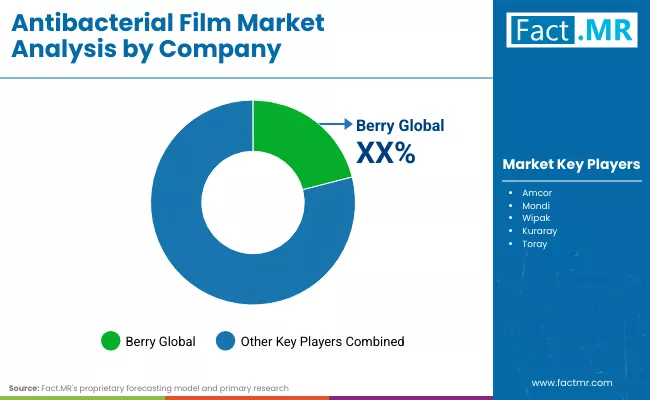
Antibacterial Film Market Company | Source: Fact.MR
Competition in the antibacterial film market is relatively concentrated. It is led by vertically integrated packaging companies and specialized antimicrobial technology providers. These players compete on material science expertise, regulatory approvals, and application-specific validation.
Berry Global holds a strong leadership position through proprietary silver-ion dispersion technologies. The company also benefits from extensive food-contact approvals across North America and Europe, supporting large-scale adoption. Amcor leverages its global manufacturing footprint and deep pharmaceutical relationships. This positions it well in medical-grade antimicrobial films used in sterile barrier systems. Mondi differentiates through sustainability. It combines bio-based polymers with natural antimicrobial extracts, targeting clean-label food packaging applications. Wipak focuses on high-barrier medical films. Its zinc-based antimicrobial solutions are validated for sterilization compatibility and serve implantable devices and surgical instruments. Kuraray advances plasma treatment technologies that deliver antimicrobial performance without chemical additives. This approach addresses regulatory challenges in sensitive applications.
Toray develops nano-silver polyester films for electronics and automotive interiors. This expands antibacterial film use beyond traditional food and healthcare markets. Overall, competitive advantage increasingly depends on proven antimicrobial efficacy, broad regulatory approvals, and sustainability-focused innovation. Companies that combine proprietary technologies with strong regulatory expertise are best positioned to succeed across global markets.
Recent Developments
- In May 2025, Freshr completed an oversubscribed seed funding round to advance its proprietary antimicrobial coating technology for recycled, recyclable, and compostable fresh-fish packaging films, enhancing food safety and sustainability across cold-chain operations.
- In August 2025, Argotec announced it will present its advanced antimicrobial film portfolio at Medica 2025 in Düsseldorf, showcasing engineered films designed for medical and surface protection applications, including antimicrobial constructions targeting healthcare and industrial use cases.
Key Players in Antibacterial Film Market
- Berry Global
- Amcor
- Mondi
- Wipak
- Kuraray
- Toray
Bibliography
- Joint Commission. 2026. Environmental infection control standards for outpatient settings. Joint Commission Perspectives 26(1): 12-18.
- European Union. 2023. Framework Regulation EC 1935/2004 on materials and articles intended to come into contact with food. Official Journal of the European Union. Brussels: EU.
- U.S. Food and Drug Administration. 2025. Guidance for industry: Antimicrobial food packaging materials. FDA Food Contact Substances. Washington: FDA.
- China National Standards. 2023. GB 4806.7-2023 National food safety standard for plastic materials and articles for food contact use. Beijing: Standardization Administration of China.
- International Organization for Standardization. 2024. ISO 22196:2024 Measurement of antibacterial activity on plastics and other non-porous surfaces. Geneva: ISO.
- MDPI Foods. 2026. Polysaccharide-based antibacterial films for food preservation: Recent advances and applications. Foods 15(3): 412-429.
Segmentation
Scope of Report
| Items | Values |
|---|---|
| Quantitative Units (2026) | USD 1.6 Billion |
| End-Use Sector | Food Packaging, Medical Packaging, Consumer Goods, Electronics Protection |
| Active Technology | Silver-Ion Coatings, Zinc-Based Additives, Organic Antimicrobials, Plasma-Treated Films |
| Base Polymer | PE / PET, PP, PLA / Bio-PE, PET |
| Regions Covered | North America, Europe, Asia Pacific, Latin America, Middle East & Africa |
| Countries Covered | U.S., Canada, Germany, Italy, UK, France, Japan, Australia, and other countries |
| Key Companies Profiled | Berry Global, Amcor, Mondi, Wipak, Kuraray, Toray |
| Additional Attributes | Dollar revenue in the antibacterial film market is segmented by end-use sector (food packaging, medical packaging, consumer goods, electronics protection), active technology (silver-ion coatings, zinc-based additives, organic antimicrobials, plasma-treated films), base polymer (PE/PET, PP, PLA/Bio-PE, PET), and region. Regional demand patterns are shaped by rising food safety standards, infection control protocols, antimicrobial technology adoption, and regulatory compliance requirements across packaging applications. |
Source: Fact.MR analysis. Updated Feb 5, 2026
Antibacterial Film Market by Segments
-
End-Use Sector :
- Food Packaging
- Medical Packaging
- Consumer Goods
- Electronics Protection
-
Active Technology :
- Silver-Ion Coatings
- Zinc-Based Additives
- Organic Antimicrobials
- Plasma-Treated Films
-
Base Polymer :
- PE / PET
- PP
- PLA / Bio-PE
- PET
-
Region :
- Asia Pacific
- China
- India
- Japan
- South Korea
- Australia
- Rest of Asia Pacific
- North America
- United States
- Canada
- Mexico
- Europe
- Germany
- France
- UK
- Italy
- Spain
- Rest of Europe
- Latin America
- Brazil
- Mexico
- Argentina
- Rest of Latin America
- Asia Pacific
Frequently Asked Questions
How big is the global antibacterial film market in 2026?
What will be the size of the antibacterial film market in 2036?
How fast will the antibacterial film market grow between 2026 and 2036?
Which end-use sector dominates the antibacterial film market?
Which active technology holds the largest share in antibacterial films?
Who worked on this report


Preview the report firsthand - request a free sample
Free SampleGet the brochure for pricing and purchase details
Download PDF