Belt Edge Protectors Market Size, Share, Growth and Forecast (2026 - 2036)
The Belt Edge Protectors Market is segmented by Product Type, Material Type, Installation Type, Functionality, End-use Industry, Distribution Channel and Region. Forecast for 2026 to 2036.
Belt Edge Protectors Market Overview, Growth Outlook, and Forecast
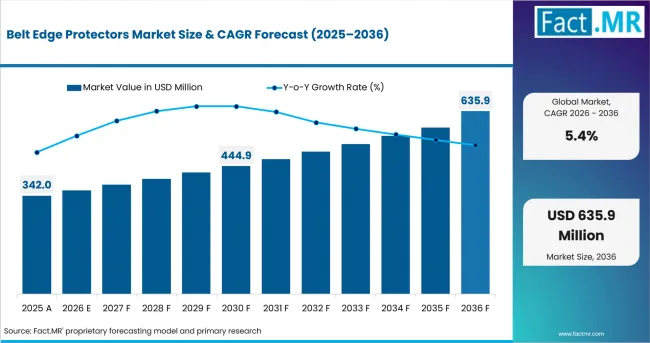
- Global conveyor belt edge protection systems market revenue stood at USD 342 million in 2025 and is forecast to reach USD 635.9 million by 2036.
- At a 5.4% CAGR from 2026 to 2036, this market is set to expand ~1.8x in value, adding USD 260 million in absolute opportunity.

Summary of the Belt Edge Protectors Market
- Market Snapshot
- In 2025, the global Belt Edge Protectors Market was valued at approximately USD 342 million.
- The market is estimated to reach USD 375.5 million in 2026 and is projected to attain USD 635.9 million by 2036
- Belt edge protectors market is likely to expand at a CAGR of 5.4% during the forecast period.
- The market is anticipated to create an absolute dollar opportunity of USD 260 million between 2026 and 2036.
- Clam-on edge protectors account for 24% of market share in 2026.
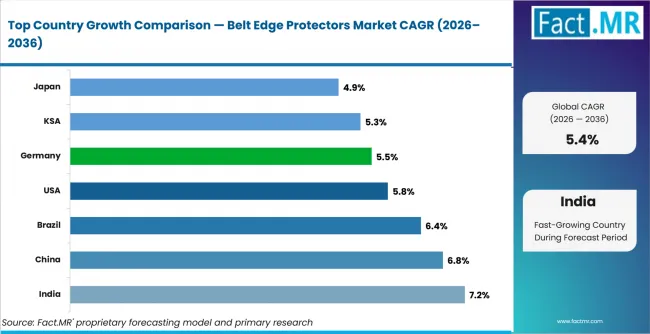
- India (7.2%) and China (6.8%) are the key growth markets during the forecast period
- Demand and Growth Drivers
- Increasing demand for efficient bulk material handling systems in mining, cement, and industrial sectors is driving adoption of conveyor belt protection solutions.
- Growing focus on reducing operational downtime and maintenance costs is encouraging use of reinforced edge protection systems.
- Rising safety regulations across industrial environments are supporting demand for systems that enhance worker safety and prevent belt damage.
- Expansion of logistics, warehousing, and e-commerce infrastructure is increasing demand for reliable conveyor belt performance.
- Increasing adoption of high-capacity conveyor systems in industrial applications is driving demand for durable and impact-resistant edge protection solutions.
- Advancements in materials such as polyurethane and composite polymers are improving product durability and performance.
- Product and Segment View
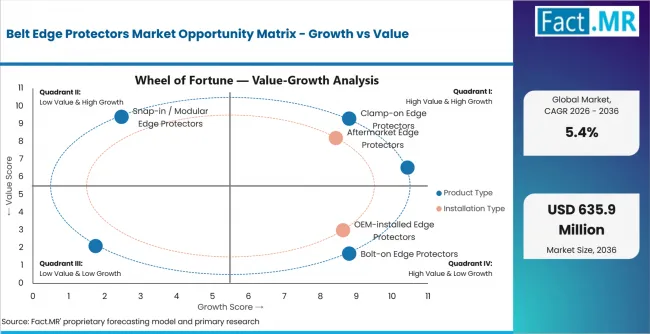
- Clamp-on edge protectors hold 24% share of product type segment, driven by ease of installation and cost-effectiveness in industrial conveyor applications.
- Bolt-on edge protectors account for 22% share, offering high durability and strong mechanical fixation in heavy-duty operations.
- Snap-in/modular edge protectors represent 20% share, supported by flexibility and quick replacement capabilities.
- Integrated belt edge reinforcement systems contribute 18% share, widely used in high-load industrial conveyor environments.
- Adjustable edge guard systems hold 16% share, supporting customized applications across different belt configurations.
- Rubber edge protectors hold 26% share by material type, supported by flexibility and impact resistance.
- Polyurethane (PU) edge protectors account for 22% share, driven by superior wear resistance and durability.
- PVC and metal-reinforced edge protectors collectively contribute 37% share, reflecting adoption in high-strength industrial applications.
- Aftermarket installation accounts for 58% share, driven by replacement demand and retrofit installations in existing conveyor systems.
- OEM-installed edge protection systems represent 42% share, reflecting integration in newly deployed conveyor systems.
- Geography and Competitive Outlook
- Asia Pacific represents a key growth region supported by expansion of mining, construction, and industrial manufacturing sectors.
- China and India are witnessing strong growth due to increasing infrastructure development and bulk material handling operations.
- North America and Europe continue to invest in industrial automation and conveyor system optimization technologies.
- Market growth is influenced by advancements in high-performance materials, automation integration, and predictive maintenance technologies.
- Key companies active in this market include Flexco, Metso Outotec, Fenner Dunlop, Martin Engineering, and ContiTech AG.
- Analyst Opinion
- Shambhu Nath Jha, Principal Consultant at Fact.MR, says, “The belt edge protectors market is no longer defined solely by heavy industrial applications. Growth is increasingly driven by logistics automation, aftermarket replacement demand, and the shift toward modular, high-performance materials that enhance conveyor efficiency, reduce downtime, and optimize lifecycle costs across diverse end-use industries."
Belt Edge Protectors Market - At a Glance
| Attribute | Details |
|---|---|
| Market Value 2025 | USD 342 million |
| Market Value 2036 | USD 635.9 million |
| Absolute Dollar Opportunity | USD 260 million |
| CAGR | 5.4% |
| Growth Multiple | 1.8x |
| Key Demand Theme | Increasing demand for conveyor durability, safety, and reduced maintenance costs |
| Leading Product Type | Clamp-on Edge Protectors |
| Product Share | 24% |
| Leading Material Type | Rubber Edge Protectors |
| Material Share | 26% |
| Leading Installation Type | Aftermarket Edge Protectors |
| Installation Share | 58% |
| Leading Functionality | Wear Protection |
| Functionality Share | 26% |
| Leading End-use Industry | Mining & Minerals |
| Industry Share | 24% |
| Leading Distribution Channel | Direct Sales (OEM partnerships) |
| Channel Share | 32% |
| Key Growth Regions | Asia Pacific, North America, Europe |
| Key Companies | Flexco, Metso Outotec, Fenner Dunlop, Martin Engineering, ContiTech |
| Segmentation by Product Type | Clamp-on, Bolt-on, Snap-in/Modular, Integrated Reinforcement Systems, Adjustable Edge Guards |
| Segmentation by Material Type | Rubber, Polyurethane (PU), PVC, Metal Reinforced, Composite |
| Segmentation by Installation Type | OEM-installed, Aftermarket |
| Segmentation by Functionality | Wear Protection, Impact Protection, Belt Alignment Assistance, Edge Sealing, Safety Enhancement |
| Segmentation by End-use Industry | Mining & Minerals, Manufacturing, Logistics & Warehousing, Food Processing, Construction Materials, Airports & Baggage Handling, Recycling & Waste Management |
| Segmentation by Distribution Channel | Direct Sales, Industrial Distributors, Conveyor System Integrators, Online B2B Platforms |
| Segmentation by Region | North America, Latin America, Europe, East Asia, South Asia & Pacific, Middle East & Africa |
Key Growth Drivers, Constraints, and Opportunities

Key Factors Driving Growth
- The growth in the use of conveyor systems in the mining, logistics, manufacturing, and infrastructure industries is boosting the need of belt protection solutions.
- Rising attention to the life-cycle cost optimization and preventive maintenance is increasing the use of belt edge protectors to lessen downtime and increase the life of belts.
- Increasing trend towards modular, easily installed, high performing materials (PU, composites) is facilitating rapid integration into automated and high-speed conveys.
Key Market Constraints
- Lack of awareness and uptake in cost-sensitive and smaller industries limits the penetration in the market.
- Long replacement times of belt edge protectors decrease frequency of demand.
- Low cost alternatives and bundling conveyor protection systems place pricing pressure on the firm, restricting the adoption of standalone products.
Key Opportunity Areas
- New avenues of demand are being generated through expansion of logistics automation, e-commerce warehousing and high-throughput material handling systems.
- Strong growth potential exists in the aftermarket demand by retrofitting of the current conveyor systems.
- Innovation of modern, durable and intelligent maintenance friendly edge protection products can be used to help position products premiumly and achieve long term growth in the market.
| Growth Driver | Demand Impact | Time Horizon | Key Impact Area | Fact.MR Insight |
|---|---|---|---|---|
| Industrial automation & expansion of conveyor-based industries (mining, logistics, manufacturing) | High | Short-Mid Term | Adoption acceleration | Rising deployment of conveyor systems across industries is directly driving demand for belt protection solutions to ensure operational efficiency |
| High cost of belt replacement & downtime + growth in preventive maintenance practices | High | Short-Mid Term | Aftermarket expansion | Industries are increasingly adopting edge protectors to extend belt life and minimize costly downtime, strengthening aftermarket demand |
| Shift toward modular, adjustable systems & OEM integration | High | Mid Term | Product innovation & OEM adoption | Demand is transitioning toward easy-to-install, replaceable systems, with gradual integration into new conveyor installations |
| Advancements in high-performance materials (PU, composites) | Medium-High | Mid-Long Term | Product enhancement | Material innovation is enabling longer lifecycle and superior wear resistance, supporting premiumization of edge protection solutions |
| Expansion in emerging markets & strengthening distribution networks | Medium | Short-Mid Term | Regional growth & accessibility | Industrial growth in Asia and Latin America, along with stronger distributor ecosystems, is improving market penetration and accessibility |
Segment-wise Analysis of the Belt Edge Protectors Market
- Clamp-on edge protectors have a 24% product type share in 2026 with their ease of installation, cost-effectiveness, and high penetration in retrofit and aftermarket use across mining, manufacturing, and logistics settings.
- Wear protection is a 26% of the functionality category in 2026, with the market focus being to prevent belt edge wear, increase the life of the conveyor belt, and reduce downtimes in industries with high levels of abrasion like mining and bulk material handling.
- Aftermarket edge protectors is 58% of installation segment in 2026, as the demand for replacement solutions and preventive maintenance strategies will increase to enhance operational efficiency and lower the lifecycle costs.
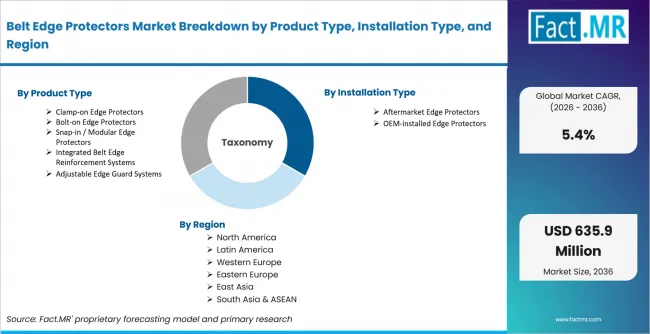
The belt edge protectors market is segmented by product type, material type, installation type, functionality, end-use industry, distribution channel, and region. By product type, the market includes clamp-on, bolt-on, modular, integrated reinforcement, and adjustable systems. By material type, it covers rubber, polyurethane, PVC, metal-reinforced, and composite protectors. Mining & minerals lead the end-use segment with 24% share, while direct sales (OEM partnerships) dominate distribution with 32% share. Clamp-on and rubber-based solutions lead due to their balance of cost and performance, while modular systems and advanced materials are expected to drive future growth as automation and efficiency requirements increase.
Which Product Type Segment Dominates the Belt Edge Protectors Market?
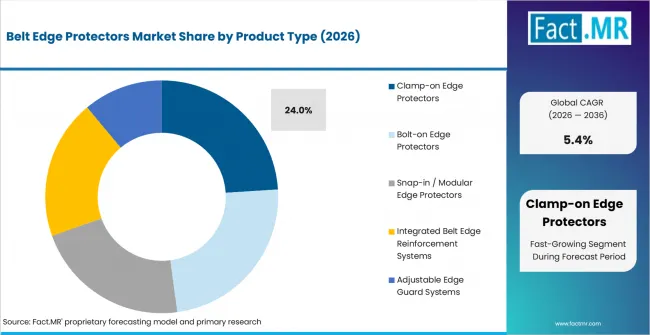
The main product type segment is clamp-on edge protectors, which represent 24% of the overall market value in 2026. Their supremacy is motivated by simple installation, low initial expenditure, and great adaptability to retrofit functions in existing conveyor systems. These systems are very popular in maintenance oriented environments whereby rapid deployment and low downtime are decisive. Clamp-on solutions are particularly favourable in mining, manufacturing and logistics industries where continuity of operations and cost effectiveness are major purchasing considerations.
Which Material Type Segment Dominates the Belt Edge Protectors Market?
In 2026, rubber edge protectors will capture 26% of the material type segment due to their excellent flexibility, impact resistance, and cost-efficiency. They are used in heavy industries like mining and construction making them always in demand. Rubber-based solutions have some advantages to withstand abrasive conditions whilst preserving the performance and hence are a good and cost-effective solution to large-scale industrial applications.
Which Installation Type Segment Dominates the Belt Edge Protectors Market?
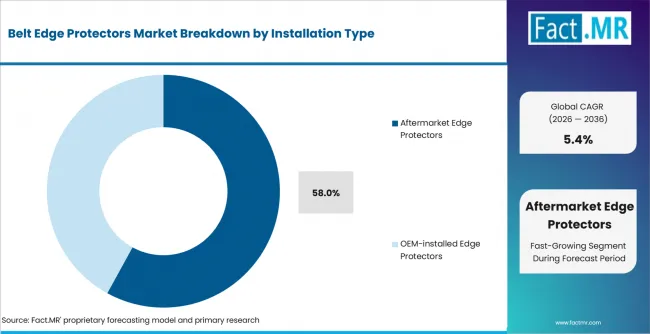
The replacement-driven nature of the market is reflected in the high percentage of aftermarket edge protectors with 58% in the installation segment in 2026. Some of the factors that drive demand include constant maintenance needs, wear and tear on belts and the need to increase the life of equipment. Aftermarket channels are the main source of revenue because industries favor retrofit solutions which can be installed without having to make significant changes to the system.
Which Functionality Segment Dominates the Belt Edge Protectors Market?
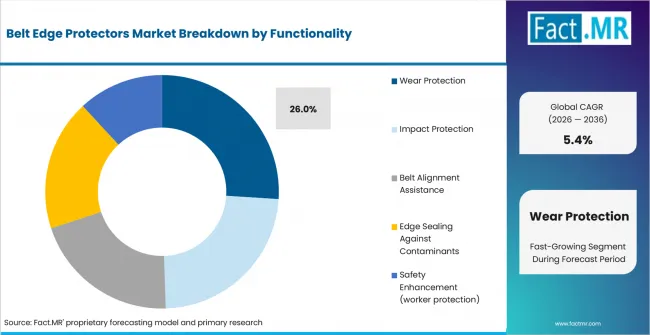
Wear protection takes 26% of functionality category in 2026, due to the necessity to reduce the edge degradation of belts and increase the lifespan of the conveyors. This role is essential in high-abrasion applications like mining and bulk material handling, where wear minimization directly affects the operational performance and maintenance expense.
Which End-use Industry Segment Dominates the Belt Edge Protectors Market?
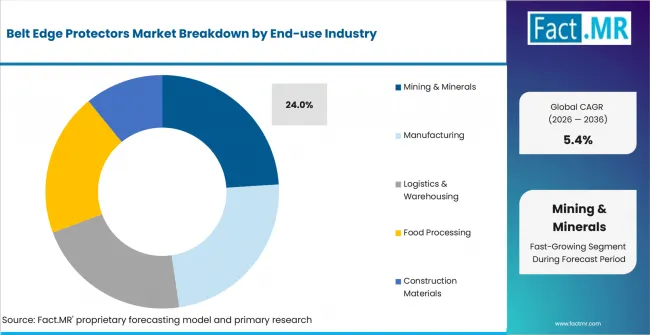
The leading industry is mining & minerals with 24% of the end-use segment in 2026. Durable belt protection solutions are in high demand due to high material loads, abrasive conditions, and continuous operations. The industry emphasis on reducing downtime and increasing equipment life is a great encouragement towards the use of edge protectors.
Which Distribution Channel Dominates the Belt Edge Protectors Market?
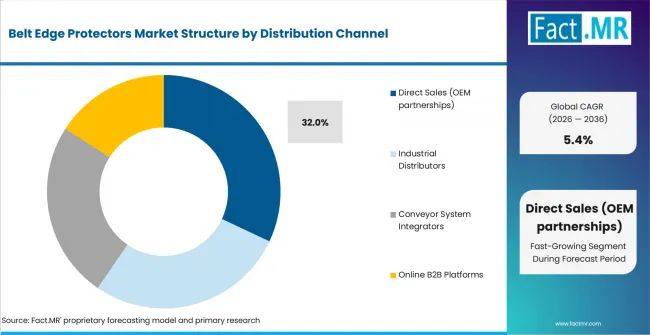
The direct sales (OEM partnerships) has a 32% share of the distribution channel segment in 2026, which is a result of integration of protection solutions as the conveyor systems are installed. OEM alliances guarantee compatibility with products and maximization of performance, so this channel is the leading one when deploying new systems, and the demand is provided by distributors and integrators.
Regional Outlook Across Key Markets
The market analysis covers key global regions, including South Asia and Pacific, Middle East & Africa, North America, Latin America, Western Europe, and Eastern Europe. It is segmented geographically, with specific market dynamics for each region. The full report provides a detailed market attractiveness analysis.
.webp)
CAGR Table
| Country | CAGR (%) |
|---|---|
| Japan | 4.9% |
| KSA | 5.3% |
| Germany | 5.5% |
| U.S. | 5.8% |
| Brazil | 6.4% |
| China | 6.8% |
| India | 7.2% |
Source: Fact.MR analysis, based on proprietary forecasting model and primary research.
North America – The Aftermarket Optimization Hub
North America represents a mature, maintenance-driven market, where demand is anchored in operational efficiency and lifecycle cost optimization. Key players such as Flexco, Martin Engineering, and ASGCO maintain strong positions through advanced belt protection solutions and service networks. The region emphasizes retrofit installations and predictive maintenance adoption.
- U.S.: Demand for belt edge protectors in U.S. is projected to rise at 5.8% CAGR through 2036.
Western Europe – The Efficiency & Compliance Driven Market

Western Europe acts as a technology and compliance-driven market, where stringent safety and efficiency standards shape demand. Companies such as Continental AG, Trelleborg, and Fenner Dunlop lead through advanced material innovation and integrated solutions. The region prioritizes sustainability and operational reliability.
- Germany: Demand for belt edge protectors in Germany is projected to rise at 5.5% CAGR through 2036.
East Asia – The Production & Industrial Expansion Engine
East Asia is the global production epicenter, driven by large-scale manufacturing, mining, and infrastructure development. Key players such as Bridgestone, Yokohama Rubber, and Bando Chemical Industries dominate through strong manufacturing capabilities and regional supply chains.
- China: Demand for belt edge protectors in China is projected to rise at 6.8% CAGR through 2036.
South Asia & Pacific – The High-Growth Industrializing Region

South Asia & Pacific is a high-growth, emerging industrial hub, benefiting from rapid urbanization and expanding manufacturing bases. Regional players and global entrants are strengthening distribution networks to tap into rising demand.
- India: Demand for belt edge protectors in India is projected to rise at 7.2% CAGR through 2036.
Latin America – The Resource-Driven Growth Market
Latin America represents a resource-driven demand market, with mining and bulk material handling industries as key contributors. Companies such as Metso and Continental maintain presence through mining-focused solutions.
- Brazil: Demand for belt edge protectors in Brazil is projected to rise at 6.4% CAGR through 2036.
Middle East & Africa – The Infrastructure & Mining Expansion Zone
The Middle East & Africa region is an emerging infrastructure and mining-driven market, with demand supported by large-scale industrial and construction projects. Companies like Trelleborg and Fenner Dunlop are expanding presence through regional partnerships.
- KSA: Demand for belt edge protectors in KSA is projected to rise at 5.3% CAGR through 2036.
FACT.MR’s analysis of the belt edge protectors market provides a comprehensive regional outlook covering North America, Western Europe, East Asia, South Asia & Pacific, Latin America, and Middle East & Africa. Readers can access country-wise insights, growth trends, industrial demand patterns, and adoption dynamics shaping both mature and emerging markets.
Competitive Benchmarking and Company Positioning

Leading Companies Shaping the Belt Edge Protectors Market
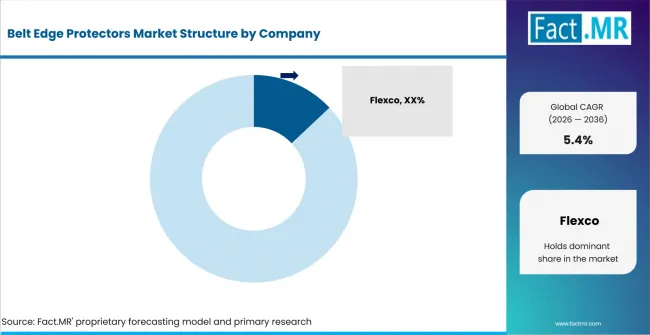
The market industry of belt edge protectors is relatively fragmented with the leading market participants such as Flexco, Martin Engineering and Trelleborg business having a share of about 45-55%. Durability, ease of install, and lifecycle cost are factors that promote competition. These companies enjoy the advantages of good distribution network and integrated services, whereas the local players compete with customization. The multi-sourcing strategies are used by buyers, particularly in mining and logistics, to decrease dependency, which constrains the power of suppliers to set prices. Nevertheless, businesses with high-performance, maintenance-cutting products can be priced at a premium whereas ordinary products experience a pressure in margin because of competitive bids and demand dynamics driven by aftermarket products.
Key Players of the Belt Edge Protectors Market
- Flexco
- ASGCO
- Martin Engineering
- Richwood Industries, Inc.
- Kinder Australia
- ESS Engineering
- REMA TIP TOP
- Trelleborg
Recent Industry Developments
- Flexco - Radial Belt Edge Protector Launch for Curved Conveyor Systems (April 2026)
- In April 2026, Flexco launched the Radial Belt Edge Protector for curved conveyor systems. The product is designed for logistics facilities, airport baggage handling systems, and parcel sortation centers where package jams occur at power turns.
- Flexco - SHG Conveyor Control GmbH Acquisition (November 2025)
- In November 2025, Flexco acquired SHG Conveyor Control GmbH to add Rip Prevent+ to its conveyor intelligence portfolio. The system supports real-time belt rip detection, anomaly detection, and conveyor monitoring without sensors inside the belt.
- REMA TIP TOP - Gomocha Partnership for CCube Service Platform (November 2025)
- In November 2025, REMA TIP TOP partnered with Gomocha to advance its global CCube service platform. The partnership supports predictive maintenance, automated service documentation, and higher service efficiency across conveyor and industrial maintenance operations.
Sources and Research References
- Flexco. (2026, April 29). Flexco introduces the Radial Belt Edge Protector (BEP-R).
- Flexco. (2025, November 3). Flexco acquires SHG Conveyor Control GmbH.
- REMA TIP TOP. (2025, November 5). REMA TIP TOP partners with Gomocha for its global service platform CCube.
- Press Information Bureau. (2025, October 13). Union Minister of Commerce and Industry highlights transformative impact of PM GatiShakti on India’s infrastructure and development vision.
- The State Council of the People’s Republic of China. (2021, August 9). Outline of the 14th Five-Year Plan for national economic and social development and long-range objectives for 2035.
Belt Edge Protectors Market Definition
The Belt Edge Protectors Market are the products that are used to prevent the edges of industrial belts to wear, damage, and misalign. These elements are normally crafted out of rubber, polyurethane or metals composites and are attached at the edges of belts in order to increase longevity and smooth operation. They are used to minimize belt breakdown and unproductivity. They find extensive application in conveyors systems in the mining, manufacturing, logistics, and material handling industries.
Belt Edge Protectors Market Inclusions
This report includes both global and regional market size analysis of belt edge protectors and also the predictions till 2026 to 2036. It has product type, material type, installation type, functionality, end-use industry, and distribution channel segmentation. The pricing analysis and growth trends, and demand outlook across the key regions, as well as the understanding of aftermarket demand and adoption rates across industrial sectors are also included in the study.
Belt Edge Protectors Market Exclusions
The scope does not cover complete conveyor belt systems, belt cleaners, scrapers, and other conveyor accessories not specifically designed to protect the edges. It does not include downstream conveyor installations and system integration services either. Specialized use of protective coatings or wear liners are not considered niche protective coatings or general wear liners unless they specifically serve a purpose as a belt edge protector. The report is confined to individual edge protection products and their direct use in industries.
Belt Edge Protectors Market Research Methodology
- Primary Research
- To capture real-time demand trends and pricing dynamics, interviews were carried out with the manufacturers of conveyor systems, belt protection solutions providers, their distributors, and maintenance heads of the mining, logistics, and manufacturing industries.
- Desk Research
- The market size, industry trends, and competitive landscape were confirmed by examining the public sources such as company annual reports, investor presentations, government industrial data, and trade publications.
- Market-Sizing and Forecasting
- To have the correct estimation and prediction, a hybrid methodology with bottom-up (company revenues, unit consumption) and top-down (industry benchmarks, conveyor system data) was adopted.
- Data Validation and Update Cycle
- The data points were all triangulated with industry experts and updated periodically according to the new developments and macroeconomic indicators.
Scope of Analysis

| Parameter | Details |
|---|---|
| Quantitative Units | USD 342 million in 2025 to USD 635.9 million in 2036, at a CAGR of 5.4% |
| Market Definition | The Belt Edge Protectors Market includes products designed to prevent belt edge wear, damage, and misalignment, improving conveyor performance, reducing downtime, and extending belt lifespan across industrial material handling applications. |
| Regions Covered | North America, Latin America, Europe, East Asia, South Asia and Pacific, MiddleEastand Africa |
| Countries Covered | USA, Canada, UK, Germany, China, India, 30 plus countries |
| Key Companies | Flexco, ASGCO, Martin Engineering, Richwood Industries, Inc., Kinder Australia , ESS Engineering , REMA TIP TOP, Trelleborg |
| Forecast Period | 2026 to 2036 |
| Approach | Hybrid demand-side and top-downmethodologybuilt on country-level application demand, product benchmarking, pricing analysis, shipment validation, and primary interviews across manufacturers, distributors, retailers, and end users |
Analysis by Type, by Grade, by Product Form, by Processing Technology, by Application, by Sales Channel and by Region
-
Belt Edge Protectors Market By Product Type
- Clamp-on Edge Protectors
- Single-Piece Clamp Edge Protectors
- Two-Piece Clamp Edge Protectors
- Hinged Clamp Edge Protectors
- Bolt-on Edge Protectors
- Rigid Bolt-on Edge Protectors
- Segmental Bolt-on Edge Protectors
- Heavy-Duty Bolt-on Edge Protectors
- Snap-in / Modular Edge Protectors
- Interlocking Modular Edge Protectors
- Cartridge-based Edge Protectors
- Strip-type Modular Edge Protectors
- Integrated Belt Edge Reinforcement Systems
- Fabric Reinforced Edge Systems
- Steel Cord Reinforced Edge Systems
- Hybrid Reinforced Edge Systems
- Adjustable Edge Guard Systems
- Screw Adjustable Edge Guards
- Spring Loaded Edge Guards
- Rail-type Adjustable Edge Guards
- Clamp-on Edge Protectors
-
Belt Edge Protectors Market By Material Type
- Rubber Edge Protectors
- Natural Rubber Edge Protectors
- Synthetic Rubber Edge Protectors
- EPDM Rubber Edge Protectors
- Polyurethane (PU) Edge Protectors
- Thermoplastic PU Edge Protectors
- Cast PU Edge Protectors
- Foamed PU Edge Protectors
- PVC Edge Protectors
- Flexible PVC Edge Protectors
- Rigid PVC Edge Protectors
- Modified PVC Edge Protectors
- Metal Reinforced Edge Protectors
- Stainless Steel Reinforced Protectors
- Carbon Steel Reinforced Protectors
- Aluminum Reinforced Protectors
- Composite Edge Protectors
- Fiber Reinforced Composite Protectors
- Polymer Composite Protectors
- Hybrid Composite Protectors
- Rubber Edge Protectors
-
Belt Edge Protectors Market By Installation Type
- OEM-installed Edge Protectors
- Aftermarket Edge Protectors
-
Belt Edge Protectors Market By Functionality
- Wear Protection
- Impact Protection
- Belt Alignment Assistance
- Edge Sealing Against Contaminants
- Safety Enhancement (worker protection)
-
Belt Edge Protectors Market By End-use Industry
- Mining & Minerals
- Manufacturing
- Logistics & Warehousing
- Food Processing
- Construction Materials
- Airports & Baggage Handling
- Recycling & Waste Management
-
Belt Edge Protectors Market By Distribution Channel
- Direct Sales (OEM partnerships)
- Industrial Distributors
- Conveyor System Integrators
- Online B2B Platforms
-
Belt Edge Protectors Market By Region
- North America
- USA
- Canada
- Mexico
- Latin America
- Brazil
- Chile
- Rest of LATAM
- East Asia
- China
- Japan
- South Korea
- Western Europe
- Germany
- Italy
- France
- U.K.
- Spain
- BENELUX
- Nordic
- Rest of W. Europe
- Eastern Europe
- Russia
- Hungary
- Poland
- Balkan & Baltics
- Rest of E. Europe
- Middle East and Africa
- Kingdom of Saudi Arabia
- United Arab Emirates
- South Africa
- Rest of Middle East and Africa
- North America
- Frequently Asked Questions -
How large is the demand for Belt Edge Protectors in the global market in 2025?
Demand for Belt Edge Protectors in the global market is estimated to be valued at USD 342.0 million in 2025.
What will be the market size of Belt Edge Protectors in the global market by 2036?
The market size for Belt Edge Protectors is projected to reach USD 635.9 million by 2036.
What is the expected demand growth for Belt Edge Protectors in the global market between 2026 and 2036?
Demand for Belt Edge Protectors in the global market is expected to grow at a CAGR of 5.8% between 2026 and 2036, supported by increasing industrial material handling and conveyor system usage.
Which product type is expected to dominate the market?
Clamp-on Edge Protectors are expected to dominate the market, accounting for 24% of the market share in 2026, driven by ease of installation, cost efficiency, and suitability for heavy-duty conveyor applications.
How significant is the growth outlook for the United States in this market?
The United States is expected to grow at a CAGR of 5.8%, reflecting strong demand from mining, bulk material handling, and manufacturing sectors.
Which company is identified as a leading player in the Belt Edge Protectors market?
Flexco is recognized as a leading player in this market, offering advanced conveyor belt maintenance solutions including edge protectors and belt accessories.
Table of Content
- Belt Edge Protectors Market – Executive Summary
- Market Overview
- Market Definition & Introduction
- Market Taxonomy & Research Scope
- Global Belt Edge Protectors Market Demand Analysis 2021-2025 and Forecast, 2026–2036
- Historical Market Volume (Units) Analysis, 2021-2025
- Current and Future Market Volume (Units) Projections, 2026–2036
- Y-o-Y Growth Trend Analysis
- Global Belt Edge Protectors Market - Pricing Analysis
- Product Category and Country-Level Pricing Analysis
- Region Average Pricing Analysis Benchmark
- Price Trends and Forecasts
- Historical price trends
- Future price forecasts
- Factors Influencing Pricing
- Competitive Pricing Strategies
- Cost Structure Analysis
- Global Belt Edge Protectors Market Demand (in Value or Size in USD Million) Analysis 2021-2025 and Forecast, 2026–2036
- Historical Market Value (USD Million) Analysis, 2021-2025
- Current and Future Market Value (USD Million) Projections, 2026–2036
- Y-o-Y Growth Trend Analysis
- Absolute $ Opportunity Analysis
- Market Background and Foundational Data Points
- Installed base of belts requiring edge protection
- Edge protector penetration rate (%)
- Average coverage per belt (units/meters)
- Replacement frequency / lifecycle
- OEM vs aftermarket demand split (%)
- Industry-wise wear severity index
- Adoption rate of modular systems (%)
- Operational intensity (usage hours/load)
- Material mix share (rubber, PU, composite, etc.)
- Preventive maintenance adoption level
- Downtime cost sensitivity across industries
- Trade Scenario, 2025
- Imports and Export Analysis
- By Region
- By Country
- Imports and Export Analysis
- Start-up Ecosystem Analysis, 2021-2025
- Belt Edge Protectors Market Opportunity Assessment
- Total Available Market (USD Million)
- Serviceable Addressable Market (USD Million)
- Serviceable Obtainable Market (USD Million)
- Porter’s Five Forces and PESTEL Analysis
- Investment Feasibility Analysis
- Macro-Economic Factors & Forecast Factors - Relevance & Impact
- Industry Value and Supply Chain Analysis
- List of Key Channel Partners
- Profit Margin & Operating Margin at Each Node of Supply Chain.
- Notes on Value Added at Each Node in the Value Chain
- Factors Influencing Value Chain
- Market Dynamics
- Drivers
- Restraints
- Opportunity Analysis
- Key Regulations & Certifications
- Belt Edge Protectors Market Analysis 2021-2025 and Forecast 2026–2036, By Product Type
- Introduction / Key Findings
- Historical Market Size (USD Million) & Volume (Units) Trend Analysis By Product Type, 2021-2025
- Current and Future Market Size (USD Million) & Volume (Units) Analysis and Forecast By Product Type, 2026-2036
- Clamp-on Edge Protectors
- Single-Piece Clamp Edge Protectors
- Two-Piece Clamp Edge Protectors
- Hinged Clamp Edge Protectors
- Bolt-on Edge Protectors
- Rigid Bolt-on Edge Protectors
- Segmental Bolt-on Edge Protectors
- Heavy-Duty Bolt-on Edge Protectors
- Snap-in / Modular Edge Protectors
- Interlocking Modular Edge Protectors
- Cartridge-based Edge Protectors
- Strip-type Modular Edge Protectors
- Integrated Belt Edge Reinforcement Systems
- Fabric Reinforced Edge Systems
- Steel Cord Reinforced Edge Systems
- Hybrid Reinforced Edge Systems
- Adjustable Edge Guard Systems
- Screw Adjustable Edge Guards
- Spring Loaded Edge Guards
- Rail-type Adjustable Edge Guards
- Clamp-on Edge Protectors
- Market Attractiveness Analysis By Product Type
- Belt Edge Protectors Market Analysis 2021-2025 and Forecast 2026–2036, By Material Type
- Introduction / Key Findings
- Historical Market Size (USD Million) & Volume (Units) Trend Analysis By Material Type, 2021-2025
- Current and Future Market Size (USD Million) & Volume (Units) Analysis and Forecast By Material Type, 2026-2036
- Rubber Edge Protectors
- Natural Rubber Edge Protectors
- Synthetic Rubber Edge Protectors
- EPDM Rubber Edge Protectors
- Polyurethane (PU) Edge Protectors
- Thermoplastic PU Edge Protectors
- Cast PU Edge Protectors
- Foamed PU Edge Protectors
- PVC Edge Protectors
- Flexible PVC Edge Protectors
- Rigid PVC Edge Protectors
- Modified PVC Edge Protectors
- Metal Reinforced Edge Protectors
- Stainless Steel Reinforced Protectors
- Carbon Steel Reinforced Protectors
- Aluminum Reinforced Protectors
- Composite Edge Protectors
- Fiber Reinforced Composite Protectors
- Polymer Composite Protectors
- Hybrid Composite Protectors
- Rubber Edge Protectors
- Market Attractiveness Analysis By Material Type
- Belt Edge Protectors Market Analysis 2021-2025 and Forecast 2026–2036, By Installation Type
- Introduction / Key Findings
- Historical Market Size (USD Million) & Volume (Units) Trend Analysis By Installation Type, 2021-2025
- Current and Future Market Size (USD Million) & Volume (Units) Analysis and Forecast By Installation Type, 2026-2036
- OEM-installed Edge Protectors
- Aftermarket Edge Protectors
- Market Attractiveness Analysis By Installation Type
- Belt Edge Protectors Market Analysis 2021-2025 and Forecast 2026–2036, By Functionality
- Introduction / Key Findings
- Historical Market Size (USD Million) & Volume (Units) Trend Analysis By Functionality, 2021-2025
- Current and Future Market Size (USD Million) & Volume (Units) Analysis and Forecast By Functionality, 2026-2036
- Wear Protection
- Impact Protection
- Belt Alignment Assistance
- Edge Sealing Against Contaminants
- Safety Enhancement (worker protection)
- Market Attractiveness Analysis By Functionality
- Belt Edge Protectors Market Analysis 2021-2025 and Forecast 2026–2036, By End-use Industry
- Introduction / Key Findings
- Historical Market Size (USD Million) & Volume (Units) Trend Analysis By End-use Industry, 2021-2025
- Current and Future Market Size (USD Million) & Volume (Units) Analysis and Forecast By End-use Industry, 2026-2036
- Mining & Minerals
- Manufacturing
- Logistics & Warehousing
- Food Processing
- Construction Materials
- Airports & Baggage Handling
- Recycling & Waste Management
- Market Attractiveness Analysis By End-use Industry
- Belt Edge Protectors Market Analysis 2021-2025 and Forecast 2026–2036, By Distribution Channel
- Introduction / Key Findings
- Historical Market Size (USD Million) & Volume (Units) Trend Analysis by Distribution Channel, 2021-2025
- Current and Future Market Size (USD Million) & Volume (Units) Analysis and Forecast by Distribution Channel, 2026-2036
- Direct Sales (OEM partnerships)
- Industrial Distributors
- Conveyor System Integrators
- Online B2B Platforms
- Market Attractiveness Analysis by Distribution Channel
- Belt Edge Protectors Market Analysis 2021-2025 and Forecast 2026–2036, By End-User Type
- Introduction / Key Findings
- Historical Market Size (USD Million) & Volume (Units) Trend Analysis by End-User Type, 2021-2025
- Current and Future Market Size (USD Million) & Volume (Units) Analysis and Forecast by End-User Type, 2026-2036
- Mobile Network Operators (MILLIONOs)
- Telecom Infrastructure OEMs
- Neutral-host / Tower companies
- Hyperscale edge data center operators
- Government & defense telecom networks
- Market Attractiveness Analysis by End-User Type
- Global Belt Edge Protectors Market Analysis and Forecast, by Region
- Introduction / Key Findings
- Historical Market Size (USD Million) & Volume (Units) Trend Analysis by Region, 2021-2025
- Current and Future Market Size (USD Million) & Volume (Units) Analysis and Forecast by Region, 2026-2036
- North America
- Latin America
- Western Europe
- Eastern Europe
- East Asia
- South Asia & Pacific
- Middle East & Africa
- Market Attractiveness Analysis by Region
- North America Belt Edge Protectors Market Analysis and Forecast
- Introduction / Key Findings
- Pricing Analysis
- Historical Market Size (USD Million) & Volume (Units) Trend Analysis by Market Taxonomy, 2021-2025
- Current and Future Market Size (USD Million) and Volume (Units) Analysis & Forecast by Market Taxonomy, 2026-2036
- By Country
- United States
- Canada
- Mexico
- By Taxonomy
- Market Attractiveness Analysis By Country & Taxonomy
- Market Trends
- Key Market Participants – Intensity Mapping
- Drivers and Restraints - Impact Analysis
- Latin America Belt Edge Protectors Market Analysis and Forecast
- Introduction / Key Findings
- Pricing Analysis
- Historical Market Size (USD Million) & Volume (Units) Trend Analysis by Market Taxonomy, 2021-2025
- Current and Future Market Size (USD Million) and Volume (Units) Analysis & Forecast by Market Taxonomy, 2026-2036
- By Country
- Brazil
- Chile
- Rest of LATAM
- By Taxonomy
- Market Attractiveness Analysis By Country & Taxonomy
- Market Trends
- Key Market Participants – Intensity Mapping
- Drivers and Restraints - Impact Analysis
- Western Europe Belt Edge Protectors Market Analysis and Forecast
- Introduction / Key Findings
- Pricing Analysis
- Historical Market Size (USD Million) & Volume (Units) Trend Analysis by Market Taxonomy, 2021-2025
- Current and Future Market Size (USD Million) and Volume (Units) Analysis & Forecast by Market Taxonomy, 2026-2036
- By Country
- Germany
- Italy
- France
- United Kingdom
- Spain
- BENELUX
- Nordics
- Rest of Western Europe
- By Taxonomy
- Market Attractiveness Analysis By Country & Taxonomy
- Market Trends
- Key Market Participants – Intensity Mapping
- Drivers and Restraints - Impact Analysis
- Eastern Europe Belt Edge Protectors Market Analysis and Forecast
- Introduction / Key Findings
- Pricing Analysis
- Historical Market Size (USD Million) & Volume (Units) Trend Analysis by Market Taxonomy, 2021-2025
- Current and Future Market Size (USD Million) and Volume (Units) Analysis & Forecast by Market Taxonomy, 2026-2036
- By Country
- Russia
- Hungary
- Poland
- Balkan & Baltics
- Rest of Eastern Europe
- By Taxonomy
- Market Attractiveness Analysis By Country & Taxonomy
- Market Trends
- Key Market Participants – Intensity Mapping
- Drivers and Restraints - Impact Analysis
- East Asia Belt Edge Protectors Market Analysis and Forecast
- Introduction / Key Findings
- Pricing Analysis
- Historical Market Size (USD Million) & Volume (Units) Trend Analysis by Market Taxonomy, 2021-2025
- Current and Future Market Size (USD Million) and Volume (Units) Analysis & Forecast by Market Taxonomy, 2026-2036
- By Country
- China
- Japan
- South Korea
- By Taxonomy
- Market Attractiveness Analysis By Country & Taxonomy
- Market Trends
- Key Market Participants – Intensity Mapping
- Drivers and Restraints - Impact Analysis
- South Asia & Pacific Belt Edge Protectors Market Analysis and Forecast
- Introduction / Key Findings
- Pricing Analysis
- Historical Market Size (USD Million) & Volume (Units) Trend Analysis by Market Taxonomy, 2021-2025
- Current and Future Market Size (USD Million) and Volume (Units) Analysis & Forecast by Market Taxonomy, 2026-2036
- By Country
- India
- ASEAN
- Australia & New Zealand
- Rest of South Asia & Pacific
- By Taxonomy
- Market Attractiveness Analysis By Country & Taxonomy
- Market Trends
- Key Market Participants – Intensity Mapping
- Drivers and Restraints - Impact Analysis
- Middle East & Africa Belt Edge Protectors Market Analysis and Forecast
- Introduction / Key Findings
- Pricing Analysis
- Historical Market Size (USD Million) & Volume (Units) Trend Analysis by Market Taxonomy, 2021-2025
- Current and Future Market Size (USD Million) and Volume (Units) Analysis & Forecast by Market Taxonomy, 2026-2036
- By Country
- Kingdom of Saudi Arabia
- Other GCC Countries
- Turkiye
- South Africa
- Other African Union
- By Taxonomy
- Market Attractiveness Analysis By Country & Taxonomy
- Market Trends
- Key Market Participants – Intensity Mapping
- Drivers and Restraints - Impact Analysis
- Country-level Belt Edge Protectors Market Analysis and Forecast
- Introduction
- Market Value Proportion Analysis, By Key Countries
- Global Vs. Country Growth Comparison
- United States Belt Edge Protectors Market Analysis
- Market Size (USD Million) & Volume (Units) Analysis by Market Taxonomy, 2021–2036
- By Product Type
- By Material Type
- By Installation Type
- By Functionality
- By End-use Industry
- By Distribution Channel
- United States Belt Edge Protectors Market Analysis
-
-
-
- Canada Belt Edge Protectors Market Analysis
- Mexico Belt Edge Protectors Market Analysis
- Brazil Belt Edge Protectors Market Analysis
- Chile Belt Edge Protectors Market Analysis
- Germany Belt Edge Protectors Market Analysis
- France Belt Edge Protectors Market Analysis
- Italy Belt Edge Protectors Market Analysis
- Spain Belt Edge Protectors Market Analysis
- United Kingdom Belt Edge Protectors Market Analysis
- BENELUX Belt Edge Protectors Market Analysis
- Nordics Belt Edge Protectors Market Analysis
- Poland Belt Edge Protectors Market Analysis
- Russia Belt Edge Protectors Market Analysis
- Hungary Belt Edge Protectors Market Analysis
- Balkan & Baltics Belt Edge Protectors Market Analysis
- China Belt Edge Protectors Market Analysis
- Japan Belt Edge Protectors Market Analysis
- South Korea Belt Edge Protectors Market Analysis
- India Belt Edge Protectors Market Analysis
- ASEAN Belt Edge Protectors Market Analysis
- ANZ Belt Edge Protectors Market Analysis
- KSA Belt Edge Protectors Market Analysis
- Other GCC Countries Belt Edge Protectors Market Analysis
- South Africa Belt Edge Protectors Market Analysis
- Turkiye Belt Edge Protectors Market Analysis
-
-
-
- Belt Edge Protectors Market Structure Analysis
- Market Analysis by Tier of Companies
- Market Concentration
- Market Share Analysis of Top Players
- Market Space for New Brands and Dollar Opportunity
- Market Presence Analysis
- Regional Footprint of Players
- Product Footprint by Players
- Mobile Optical Pluggable Competition Analysis
- Competition Dashboard
- Pricing Analysis by Competition
- Competition Benchmarking
- Competition Deep Dive
- Flexco
- Overview
- Product Portfolio
- Sales Footprint
- Key Developments
- SWOT Analysis
- Strategy Overview
- Key Financials
- ASGCO
- Martin Engineering
- Richwood Industries, Inc.
- Kinder Australia
- ESS Engineering
- REMA TIP TOP
- Trelleborg
- Other Prominent Players
- Flexco
- Primary insights
- Assumptions & Acronyms Used
- Research Methodology & Data Sources
- Belt Edge Protectors Market Structure Analysis
List Of Table
- Table 1: Global Market Value (USD Million) Forecast by Region, 2021 to 2036
- Table 2: Global Market Volume (Units) Forecast by Region, 2021 to 2036
- Table 3: Global Market Value (USD Million) Forecast by Product Type, 2021 to 2036
- Table 4: Global Market Volume (Units) Forecast by Product Type, 2021 to 2036
- Table 5: Global Market Value (USD Million) Forecast by Material Type, 2021 to 2036
- Table 6: Global Market Volume (Units) Forecast by Material Type, 2021 to 2036
- Table 7: Global Market Value (USD Million) Forecast by Installation Type, 2021 to 2036
- Table 8: Global Market Volume (Units) Forecast by Installation Type, 2021 to 2036
- Table 9: Global Market Value (USD Million) Forecast by Functionality, 2021 to 2036
- Table 10: Global Market Volume (Units) Forecast by Functionality, 2021 to 2036
- Table 11: Global Market Value (USD Million) Forecast by End-use Industry, 2021 to 2036
- Table 12: Global Market Volume (Units) Forecast by End-use Industry, 2021 to 2036
- Table 13: Global Market Value (USD Million) Forecast by Distribution Channel, 2021 to 2036
- Table 14: Global Market Volume (Units) Forecast by Distribution Channel, 2021 to 2036
- Table 15: North America Market Value (USD Million) Forecast by Country, 2021 to 2036
- Table 16: North America Market Volume (Units) Forecast by Country, 2021 to 2036
- Table 17: North America Market Value (USD Million) Forecast by Product Type, 2021 to 2036
- Table 18: North America Market Volume (Units) Forecast by Product Type, 2021 to 2036
- Table 19: North America Market Value (USD Million) Forecast by Material Type, 2021 to 2036
- Table 20: North America Market Volume (Units) Forecast by Material Type, 2021 to 2036
- Table 21: North America Market Value (USD Million) Forecast by Installation Type, 2021 to 2036
- Table 22: North America Market Volume (Units) Forecast by Installation Type, 2021 to 2036
- Table 23: North America Market Value (USD Million) Forecast by Functionality, 2021 to 2036
- Table 24: North America Market Volume (Units) Forecast by Functionality, 2021 to 2036
- Table 25: North America Market Value (USD Million) Forecast by End-use Industry, 2021 to 2036
- Table 26: North America Market Volume (Units) Forecast by End-use Industry, 2021 to 2036
- Table 27: North America Market Value (USD Million) Forecast by Distribution Channel, 2021 to 2036
- Table 28: North America Market Volume (Units) Forecast by Distribution Channel, 2021 to 2036
- Table 29: Latin America Market Value (USD Million) Forecast by Country, 2021 to 2036
- Table 30: Latin America Market Volume (Units) Forecast by Country, 2021 to 2036
- Table 31: Latin America Market Value (USD Million) Forecast by Product Type, 2021 to 2036
- Table 32: Latin America Market Volume (Units) Forecast by Product Type, 2021 to 2036
- Table 33: Latin America Market Value (USD Million) Forecast by Material Type, 2021 to 2036
- Table 34: Latin America Market Volume (Units) Forecast by Material Type, 2021 to 2036
- Table 35: Latin America Market Value (USD Million) Forecast by Installation Type, 2021 to 2036
- Table 36: Latin America Market Volume (Units) Forecast by Installation Type, 2021 to 2036
- Table 37: Latin America Market Value (USD Million) Forecast by Functionality, 2021 to 2036
- Table 38: Latin America Market Volume (Units) Forecast by Functionality, 2021 to 2036
- Table 39: Latin America Market Value (USD Million) Forecast by End-use Industry, 2021 to 2036
- Table 40: Latin America Market Volume (Units) Forecast by End-use Industry, 2021 to 2036
- Table 41: Latin America Market Value (USD Million) Forecast by Distribution Channel, 2021 to 2036
- Table 42: Latin America Market Volume (Units) Forecast by Distribution Channel, 2021 to 2036
- Table 43: Western Europe Market Value (USD Million) Forecast by Country, 2021 to 2036
- Table 44: Western Europe Market Volume (Units) Forecast by Country, 2021 to 2036
- Table 45: Western Europe Market Value (USD Million) Forecast by Product Type, 2021 to 2036
- Table 46: Western Europe Market Volume (Units) Forecast by Product Type, 2021 to 2036
- Table 47: Western Europe Market Value (USD Million) Forecast by Material Type, 2021 to 2036
- Table 48: Western Europe Market Volume (Units) Forecast by Material Type, 2021 to 2036
- Table 49: Western Europe Market Value (USD Million) Forecast by Installation Type, 2021 to 2036
- Table 50: Western Europe Market Volume (Units) Forecast by Installation Type, 2021 to 2036
- Table 51: Western Europe Market Value (USD Million) Forecast by Functionality, 2021 to 2036
- Table 52: Western Europe Market Volume (Units) Forecast by Functionality, 2021 to 2036
- Table 53: Western Europe Market Value (USD Million) Forecast by End-use Industry, 2021 to 2036
- Table 54: Western Europe Market Volume (Units) Forecast by End-use Industry, 2021 to 2036
- Table 55: Western Europe Market Value (USD Million) Forecast by Distribution Channel, 2021 to 2036
- Table 56: Western Europe Market Volume (Units) Forecast by Distribution Channel, 2021 to 2036
- Table 57: Eastern Europe Market Value (USD Million) Forecast by Country, 2021 to 2036
- Table 58: Eastern Europe Market Volume (Units) Forecast by Country, 2021 to 2036
- Table 59: Eastern Europe Market Value (USD Million) Forecast by Product Type, 2021 to 2036
- Table 60: Eastern Europe Market Volume (Units) Forecast by Product Type, 2021 to 2036
- Table 61: Eastern Europe Market Value (USD Million) Forecast by Material Type, 2021 to 2036
- Table 62: Eastern Europe Market Volume (Units) Forecast by Material Type, 2021 to 2036
- Table 63: Eastern Europe Market Value (USD Million) Forecast by Installation Type, 2021 to 2036
- Table 64: Eastern Europe Market Volume (Units) Forecast by Installation Type, 2021 to 2036
- Table 65: Eastern Europe Market Value (USD Million) Forecast by Functionality, 2021 to 2036
- Table 66: Eastern Europe Market Volume (Units) Forecast by Functionality, 2021 to 2036
- Table 67: Eastern Europe Market Value (USD Million) Forecast by End-use Industry, 2021 to 2036
- Table 68: Eastern Europe Market Volume (Units) Forecast by End-use Industry, 2021 to 2036
- Table 69: Eastern Europe Market Value (USD Million) Forecast by Distribution Channel, 2021 to 2036
- Table 70: Eastern Europe Market Volume (Units) Forecast by Distribution Channel, 2021 to 2036
- Table 71: East Asia Market Value (USD Million) Forecast by Country, 2021 to 2036
- Table 72: East Asia Market Volume (Units) Forecast by Country, 2021 to 2036
- Table 73: East Asia Market Value (USD Million) Forecast by Product Type, 2021 to 2036
- Table 74: East Asia Market Volume (Units) Forecast by Product Type, 2021 to 2036
- Table 75: East Asia Market Value (USD Million) Forecast by Material Type, 2021 to 2036
- Table 76: East Asia Market Volume (Units) Forecast by Material Type, 2021 to 2036
- Table 77: East Asia Market Value (USD Million) Forecast by Installation Type, 2021 to 2036
- Table 78: East Asia Market Volume (Units) Forecast by Installation Type, 2021 to 2036
- Table 79: East Asia Market Value (USD Million) Forecast by Functionality, 2021 to 2036
- Table 80: East Asia Market Volume (Units) Forecast by Functionality, 2021 to 2036
- Table 81: East Asia Market Value (USD Million) Forecast by End-use Industry, 2021 to 2036
- Table 82: East Asia Market Volume (Units) Forecast by End-use Industry, 2021 to 2036
- Table 83: East Asia Market Value (USD Million) Forecast by Distribution Channel, 2021 to 2036
- Table 84: East Asia Market Volume (Units) Forecast by Distribution Channel, 2021 to 2036
- Table 85: South Asia and Pacific Market Value (USD Million) Forecast by Country, 2021 to 2036
- Table 86: South Asia and Pacific Market Volume (Units) Forecast by Country, 2021 to 2036
- Table 87: South Asia and Pacific Market Value (USD Million) Forecast by Product Type, 2021 to 2036
- Table 88: South Asia and Pacific Market Volume (Units) Forecast by Product Type, 2021 to 2036
- Table 89: South Asia and Pacific Market Value (USD Million) Forecast by Material Type, 2021 to 2036
- Table 90: South Asia and Pacific Market Volume (Units) Forecast by Material Type, 2021 to 2036
- Table 91: South Asia and Pacific Market Value (USD Million) Forecast by Installation Type, 2021 to 2036
- Table 92: South Asia and Pacific Market Volume (Units) Forecast by Installation Type, 2021 to 2036
- Table 93: South Asia and Pacific Market Value (USD Million) Forecast by Functionality, 2021 to 2036
- Table 94: South Asia and Pacific Market Volume (Units) Forecast by Functionality, 2021 to 2036
- Table 95: South Asia and Pacific Market Value (USD Million) Forecast by End-use Industry, 2021 to 2036
- Table 96: South Asia and Pacific Market Volume (Units) Forecast by End-use Industry, 2021 to 2036
- Table 97: South Asia and Pacific Market Value (USD Million) Forecast by Distribution Channel, 2021 to 2036
- Table 98: South Asia and Pacific Market Volume (Units) Forecast by Distribution Channel, 2021 to 2036
- Table 99: Middle East & Africa Market Value (USD Million) Forecast by Country, 2021 to 2036
- Table 100: Middle East & Africa Market Volume (Units) Forecast by Country, 2021 to 2036
- Table 101: Middle East & Africa Market Value (USD Million) Forecast by Product Type, 2021 to 2036
- Table 102: Middle East & Africa Market Volume (Units) Forecast by Product Type, 2021 to 2036
- Table 103: Middle East & Africa Market Value (USD Million) Forecast by Material Type, 2021 to 2036
- Table 104: Middle East & Africa Market Volume (Units) Forecast by Material Type, 2021 to 2036
- Table 105: Middle East & Africa Market Value (USD Million) Forecast by Installation Type, 2021 to 2036
- Table 106: Middle East & Africa Market Volume (Units) Forecast by Installation Type, 2021 to 2036
- Table 107: Middle East & Africa Market Value (USD Million) Forecast by Functionality, 2021 to 2036
- Table 108: Middle East & Africa Market Volume (Units) Forecast by Functionality, 2021 to 2036
- Table 109: Middle East & Africa Market Value (USD Million) Forecast by End-use Industry, 2021 to 2036
- Table 110: Middle East & Africa Market Volume (Units) Forecast by End-use Industry, 2021 to 2036
- Table 111: Middle East & Africa Market Value (USD Million) Forecast by Distribution Channel, 2021 to 2036
- Table 112: Middle East & Africa Market Volume (Units) Forecast by Distribution Channel, 2021 to 2036
List Of Figures
- Figure 1: Global Market Volume (Units) Forecast 2021–2036
- Figure 2: Global Market Pricing Analysis
- Figure 3: Global Market Value (USD Million) Forecast 2021–2036
- Figure 4: Global Market Value Share and BPS Analysis by Product Type, 2026 and 2036
- Figure 5: Global Market Y-o-Y Growth Comparison by Product Type, 2026 to 2036
- Figure 6: Global Market Attractiveness Analysis by Product Type
- Figure 7: Global Market Value Share and BPS Analysis by Material Type, 2026 and 2036
- Figure 8: Global Market Y-o-Y Growth Comparison by Material Type, 2026 to 2036
- Figure 9: Global Market Attractiveness Analysis by Material Type
- Figure 10: Global Market Value Share and BPS Analysis by Installation Type, 2026 and 2036
- Figure 11: Global Market Y-o-Y Growth Comparison by Installation Type, 2026 to 2036
- Figure 12: Global Market Attractiveness Analysis by Installation Type
- Figure 13: Global Market Value Share and BPS Analysis by Functionality, 2026 and 2036
- Figure 14: Global Market Y-o-Y Growth Comparison by Functionality, 2026 to 2036
- Figure 15: Global Market Attractiveness Analysis by Functionality
- Figure 16: Global Market Value Share and BPS Analysis by End-use Industry, 2026 and 2036
- Figure 17: Global Market Y-o-Y Growth Comparison by End-use Industry, 2026 to 2036
- Figure 18: Global Market Attractiveness Analysis by End-use Industry
- Figure 19: Global Market Value Share and BPS Analysis by Distribution Channel, 2026 and 2036
- Figure 20: Global Market Y-o-Y Growth Comparison by Distribution Channel, 2026 to 2036
- Figure 21: Global Market Attractiveness Analysis by Distribution Channel
- Figure 22: Global Market Value (USD Million) Share and BPS Analysis by Region, 2026 and 2036
- Figure 23: Global Market Y-o-Y Growth Comparison by Region, 2026 to 2036
- Figure 24: Global Market Attractiveness Analysis by Region
- Figure 25: North America Market Incremental $ Opportunity, 2026 to 2036
- Figure 26: Latin America Market Incremental $ Opportunity, 2026 to 2036
- Figure 27: Western Europe Market Incremental $ Opportunity, 2026 to 2036
- Figure 28: Eastern Europe Market Incremental $ Opportunity, 2026 to 2036
- Figure 29: East Asia Market Incremental $ Opportunity, 2026 to 2036
- Figure 30: South Asia and Pacific Market Incremental $ Opportunity, 2026 to 2036
- Figure 31: Middle East & Africa Market Incremental $ Opportunity, 2026 to 2036
- Figure 32: North America Market Value Share and BPS Analysis by Country, 2026 and 2036
- Figure 33: North America Market Value Share and BPS Analysis by Product Type, 2026 and 2036
- Figure 34: North America Market Y-o-Y Growth Comparison by Product Type, 2026 to 2036
- Figure 35: North America Market Attractiveness Analysis by Product Type
- Figure 36: North America Market Value Share and BPS Analysis by Material Type, 2026 and 2036
- Figure 37: North America Market Y-o-Y Growth Comparison by Material Type, 2026 to 2036
- Figure 38: North America Market Attractiveness Analysis by Material Type
- Figure 39: North America Market Value Share and BPS Analysis by Installation Type, 2026 and 2036
- Figure 40: North America Market Y-o-Y Growth Comparison by Installation Type, 2026 to 2036
- Figure 41: North America Market Attractiveness Analysis by Installation Type
- Figure 42: North America Market Value Share and BPS Analysis by Functionality, 2026 and 2036
- Figure 43: North America Market Y-o-Y Growth Comparison by Functionality, 2026 to 2036
- Figure 44: North America Market Attractiveness Analysis by Functionality
- Figure 45: North America Market Value Share and BPS Analysis by End-use Industry, 2026 and 2036
- Figure 46: North America Market Y-o-Y Growth Comparison by End-use Industry, 2026 to 2036
- Figure 47: North America Market Attractiveness Analysis by End-use Industry
- Figure 48: North America Market Value Share and BPS Analysis by Distribution Channel, 2026 and 2036
- Figure 49: North America Market Y-o-Y Growth Comparison by Distribution Channel, 2026 to 2036
- Figure 50: North America Market Attractiveness Analysis by Distribution Channel
- Figure 51: Latin America Market Value Share and BPS Analysis by Country, 2026 and 2036
- Figure 52: Latin America Market Value Share and BPS Analysis by Product Type, 2026 and 2036
- Figure 53: Latin America Market Y-o-Y Growth Comparison by Product Type, 2026 to 2036
- Figure 54: Latin America Market Attractiveness Analysis by Product Type
- Figure 55: Latin America Market Value Share and BPS Analysis by Material Type, 2026 and 2036
- Figure 56: Latin America Market Y-o-Y Growth Comparison by Material Type, 2026 to 2036
- Figure 57: Latin America Market Attractiveness Analysis by Material Type
- Figure 58: Latin America Market Value Share and BPS Analysis by Installation Type, 2026 and 2036
- Figure 59: Latin America Market Y-o-Y Growth Comparison by Installation Type, 2026 to 2036
- Figure 60: Latin America Market Attractiveness Analysis by Installation Type
- Figure 61: Latin America Market Value Share and BPS Analysis by Functionality, 2026 and 2036
- Figure 62: Latin America Market Y-o-Y Growth Comparison by Functionality, 2026 to 2036
- Figure 63: Latin America Market Attractiveness Analysis by Functionality
- Figure 64: Latin America Market Value Share and BPS Analysis by End-use Industry, 2026 and 2036
- Figure 65: Latin America Market Y-o-Y Growth Comparison by End-use Industry, 2026 to 2036
- Figure 66: Latin America Market Attractiveness Analysis by End-use Industry
- Figure 67: Latin America Market Value Share and BPS Analysis by Distribution Channel, 2026 and 2036
- Figure 68: Latin America Market Y-o-Y Growth Comparison by Distribution Channel, 2026 to 2036
- Figure 69: Latin America Market Attractiveness Analysis by Distribution Channel
- Figure 70: Western Europe Market Value Share and BPS Analysis by Country, 2026 and 2036
- Figure 71: Western Europe Market Value Share and BPS Analysis by Product Type, 2026 and 2036
- Figure 72: Western Europe Market Y-o-Y Growth Comparison by Product Type, 2026 to 2036
- Figure 73: Western Europe Market Attractiveness Analysis by Product Type
- Figure 74: Western Europe Market Value Share and BPS Analysis by Material Type, 2026 and 2036
- Figure 75: Western Europe Market Y-o-Y Growth Comparison by Material Type, 2026 to 2036
- Figure 76: Western Europe Market Attractiveness Analysis by Material Type
- Figure 77: Western Europe Market Value Share and BPS Analysis by Installation Type, 2026 and 2036
- Figure 78: Western Europe Market Y-o-Y Growth Comparison by Installation Type, 2026 to 2036
- Figure 79: Western Europe Market Attractiveness Analysis by Installation Type
- Figure 80: Western Europe Market Value Share and BPS Analysis by Functionality, 2026 and 2036
- Figure 81: Western Europe Market Y-o-Y Growth Comparison by Functionality, 2026 to 2036
- Figure 82: Western Europe Market Attractiveness Analysis by Functionality
- Figure 83: Western Europe Market Value Share and BPS Analysis by End-use Industry, 2026 and 2036
- Figure 84: Western Europe Market Y-o-Y Growth Comparison by End-use Industry, 2026 to 2036
- Figure 85: Western Europe Market Attractiveness Analysis by End-use Industry
- Figure 86: Western Europe Market Value Share and BPS Analysis by Distribution Channel, 2026 and 2036
- Figure 87: Western Europe Market Y-o-Y Growth Comparison by Distribution Channel, 2026 to 2036
- Figure 88: Western Europe Market Attractiveness Analysis by Distribution Channel
- Figure 89: Eastern Europe Market Value Share and BPS Analysis by Country, 2026 and 2036
- Figure 90: Eastern Europe Market Value Share and BPS Analysis by Product Type, 2026 and 2036
- Figure 91: Eastern Europe Market Y-o-Y Growth Comparison by Product Type, 2026 to 2036
- Figure 92: Eastern Europe Market Attractiveness Analysis by Product Type
- Figure 93: Eastern Europe Market Value Share and BPS Analysis by Material Type, 2026 and 2036
- Figure 94: Eastern Europe Market Y-o-Y Growth Comparison by Material Type, 2026 to 2036
- Figure 95: Eastern Europe Market Attractiveness Analysis by Material Type
- Figure 96: Eastern Europe Market Value Share and BPS Analysis by Installation Type, 2026 and 2036
- Figure 97: Eastern Europe Market Y-o-Y Growth Comparison by Installation Type, 2026 to 2036
- Figure 98: Eastern Europe Market Attractiveness Analysis by Installation Type
- Figure 99: Eastern Europe Market Value Share and BPS Analysis by Functionality, 2026 and 2036
- Figure 100: Eastern Europe Market Y-o-Y Growth Comparison by Functionality, 2026 to 2036
- Figure 101: Eastern Europe Market Attractiveness Analysis by Functionality
- Figure 102: Eastern Europe Market Value Share and BPS Analysis by End-use Industry, 2026 and 2036
- Figure 103: Eastern Europe Market Y-o-Y Growth Comparison by End-use Industry, 2026 to 2036
- Figure 104: Eastern Europe Market Attractiveness Analysis by End-use Industry
- Figure 105: Eastern Europe Market Value Share and BPS Analysis by Distribution Channel, 2026 and 2036
- Figure 106: Eastern Europe Market Y-o-Y Growth Comparison by Distribution Channel, 2026 to 2036
- Figure 107: Eastern Europe Market Attractiveness Analysis by Distribution Channel
- Figure 108: East Asia Market Value Share and BPS Analysis by Country, 2026 and 2036
- Figure 109: East Asia Market Value Share and BPS Analysis by Product Type, 2026 and 2036
- Figure 110: East Asia Market Y-o-Y Growth Comparison by Product Type, 2026 to 2036
- Figure 111: East Asia Market Attractiveness Analysis by Product Type
- Figure 112: East Asia Market Value Share and BPS Analysis by Material Type, 2026 and 2036
- Figure 113: East Asia Market Y-o-Y Growth Comparison by Material Type, 2026 to 2036
- Figure 114: East Asia Market Attractiveness Analysis by Material Type
- Figure 115: East Asia Market Value Share and BPS Analysis by Installation Type, 2026 and 2036
- Figure 116: East Asia Market Y-o-Y Growth Comparison by Installation Type, 2026 to 2036
- Figure 117: East Asia Market Attractiveness Analysis by Installation Type
- Figure 118: East Asia Market Value Share and BPS Analysis by Functionality, 2026 and 2036
- Figure 119: East Asia Market Y-o-Y Growth Comparison by Functionality, 2026 to 2036
- Figure 120: East Asia Market Attractiveness Analysis by Functionality
- Figure 121: East Asia Market Value Share and BPS Analysis by End-use Industry, 2026 and 2036
- Figure 122: East Asia Market Y-o-Y Growth Comparison by End-use Industry, 2026 to 2036
- Figure 123: East Asia Market Attractiveness Analysis by End-use Industry
- Figure 124: East Asia Market Value Share and BPS Analysis by Distribution Channel, 2026 and 2036
- Figure 125: East Asia Market Y-o-Y Growth Comparison by Distribution Channel, 2026 to 2036
- Figure 126: East Asia Market Attractiveness Analysis by Distribution Channel
- Figure 127: South Asia and Pacific Market Value Share and BPS Analysis by Country, 2026 and 2036
- Figure 128: South Asia and Pacific Market Value Share and BPS Analysis by Product Type, 2026 and 2036
- Figure 129: South Asia and Pacific Market Y-o-Y Growth Comparison by Product Type, 2026 to 2036
- Figure 130: South Asia and Pacific Market Attractiveness Analysis by Product Type
- Figure 131: South Asia and Pacific Market Value Share and BPS Analysis by Material Type, 2026 and 2036
- Figure 132: South Asia and Pacific Market Y-o-Y Growth Comparison by Material Type, 2026 to 2036
- Figure 133: South Asia and Pacific Market Attractiveness Analysis by Material Type
- Figure 134: South Asia and Pacific Market Value Share and BPS Analysis by Installation Type, 2026 and 2036
- Figure 135: South Asia and Pacific Market Y-o-Y Growth Comparison by Installation Type, 2026 to 2036
- Figure 136: South Asia and Pacific Market Attractiveness Analysis by Installation Type
- Figure 137: South Asia and Pacific Market Value Share and BPS Analysis by Functionality, 2026 and 2036
- Figure 138: South Asia and Pacific Market Y-o-Y Growth Comparison by Functionality, 2026 to 2036
- Figure 139: South Asia and Pacific Market Attractiveness Analysis by Functionality
- Figure 140: South Asia and Pacific Market Value Share and BPS Analysis by End-use Industry, 2026 and 2036
- Figure 141: South Asia and Pacific Market Y-o-Y Growth Comparison by End-use Industry, 2026 to 2036
- Figure 142: South Asia and Pacific Market Attractiveness Analysis by End-use Industry
- Figure 143: South Asia and Pacific Market Value Share and BPS Analysis by Distribution Channel, 2026 and 2036
- Figure 144: South Asia and Pacific Market Y-o-Y Growth Comparison by Distribution Channel, 2026 to 2036
- Figure 145: South Asia and Pacific Market Attractiveness Analysis by Distribution Channel
- Figure 146: Middle East & Africa Market Value Share and BPS Analysis by Country, 2026 and 2036
- Figure 147: Middle East & Africa Market Value Share and BPS Analysis by Product Type, 2026 and 2036
- Figure 148: Middle East & Africa Market Y-o-Y Growth Comparison by Product Type, 2026 to 2036
- Figure 149: Middle East & Africa Market Attractiveness Analysis by Product Type
- Figure 150: Middle East & Africa Market Value Share and BPS Analysis by Material Type, 2026 and 2036
- Figure 151: Middle East & Africa Market Y-o-Y Growth Comparison by Material Type, 2026 to 2036
- Figure 152: Middle East & Africa Market Attractiveness Analysis by Material Type
- Figure 153: Middle East & Africa Market Value Share and BPS Analysis by Installation Type, 2026 and 2036
- Figure 154: Middle East & Africa Market Y-o-Y Growth Comparison by Installation Type, 2026 to 2036
- Figure 155: Middle East & Africa Market Attractiveness Analysis by Installation Type
- Figure 156: Middle East & Africa Market Value Share and BPS Analysis by Functionality, 2026 and 2036
- Figure 157: Middle East & Africa Market Y-o-Y Growth Comparison by Functionality, 2026 to 2036
- Figure 158: Middle East & Africa Market Attractiveness Analysis by Functionality
- Figure 159: Middle East & Africa Market Value Share and BPS Analysis by End-use Industry, 2026 and 2036
- Figure 160: Middle East & Africa Market Y-o-Y Growth Comparison by End-use Industry, 2026 to 2036
- Figure 161: Middle East & Africa Market Attractiveness Analysis by End-use Industry
- Figure 162: Middle East & Africa Market Value Share and BPS Analysis by Distribution Channel, 2026 and 2036
- Figure 163: Middle East & Africa Market Y-o-Y Growth Comparison by Distribution Channel, 2026 to 2036
- Figure 164: Middle East & Africa Market Attractiveness Analysis by Distribution Channel
- Figure 165: Global Market – Tier Structure Analysis
- Figure 166: Global Market – Company Share Analysis