Bioactive Sphingolipid Market (2026 - 2036)

The Bioactive Sphingolipid Market is segmented by Product Type (Ceramides, Sphingomyelin, and Glycosphingolipids), Source (Synthetic and Natural), Application (Therapeutics, Cosmetics & Personal Care, and Nutraceuticals), and Region. Forecast for 2026 to 2036.

FACT.MR analysis indicates the market is experiencing a sourcing bifurcation. Demand is splitting between synthetic and natural sphingolipids. Pharmaceutical and premium cosmetic buyers are shifting toward high-purity, synthetically verified ceramides. These require strict quality and documentation standards. Nutraceutical and personal care formulators prefer natural-source sphingolipids. This is driven by clean-label and consumer preference trends.

Bioactive Sphingolipid Market Forecast and Outlook By Fact.MR

In 2025, the bioactive sphingolipid market was valued at USD 0.7 billion. Based on Fact.MR analysis, demand for bioactive sphingolipids is estimated to grow to USD 0.8 billion in 2026 and USD 1.2 billion by 2036. FACT.MR projects a CAGR of 5.1% during the forecast period.
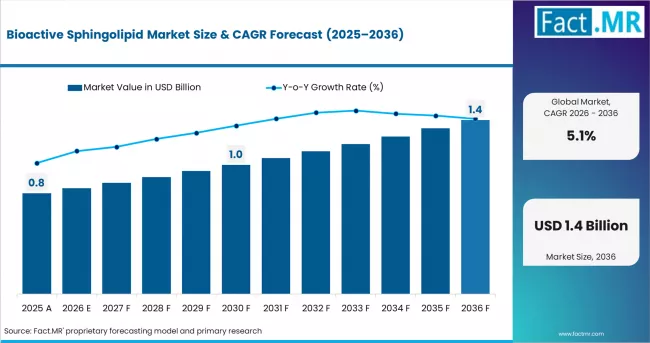
Bioactive Sphingolipid Market Market Value Analysis

Metric Value
Estimated Value in 2026 USD 0.8 billion
Forecast Value in 2036 USD 1.2 billion
Forecast CAGR (2026 to 2036) 5.1%

Summary of Bioactive Sphingolipid Market

  • Market Definition
    • The market includes synthetic and natural ceramides, sphingomyelin, and glycosphingolipids in pharmaceutical, cosmetic, and nutraceutical grade forms. These compounds function as membrane bioregulators and drug delivery matrices applied in therapeutic formulations, premium skin care actives, and dietary supplement ingredients across global specialty lipid supply chains.
  • Demand Drivers
    • U.S. pharmaceutical companies are adopting sphingolipid-based lipid nanoparticle carriers. Used in oncology and genetic medicine drug formulation programmes.
    • South Korea's ceramide-centric cosmetic industry is scaling demand. Premium skincare brands are requiring identity-tested, high-purity sphingolipid actives.
    • EU pharmaceutical regulations support GMP-grade sphingolipid adoption. Driving demand for documented synthetic sources in Germany and France.
  • Key Segments Analyzed
    • By Product Type: Ceramides lead with 40% share in 2026. Driven by dual-application demand in skin barrier therapeutics and premium cosmetic formulation.
    • By Source: Synthetic leads with 50% share in 2026. Preferred for pharmaceutical applications requiring purity documentation and batch-to-batch consistency.
    • By Application: Therapeutics leads with 74% share in 2026. Driven by sphingolipid use in lipid nanoparticle drug delivery and oncology active ingredient supply.
    • By Geography: India leads 8.2% CAGR. Driven by pharmaceutical API manufacturing expansion and nutraceutical ingredient sourcing growth.
  • Analyst Opinion at FACT.MR
    • Shambhu Nath Jha, Principal Consultant at Fact.MR, opines, CXOs will find the divide between synthetic pharmaceutical-grade ceramides and natural cosmetic-grade sphingolipids is structural. It is not a formulation preference. It represents a clear separation in supply chains. Each segment requires distinct quality and production systems.
  • Strategic Implications
    • Invest in GMP-certified synthetic ceramide and sphingomyelin production with validated purity and identity documentation to qualify for pharmaceutical procurement in the U.S. and EU.
    • Develop natural sphingolipid grades with standardised bioactive content and source traceability to access premium cosmetic and nutraceutical markets.
    • Establish dual supply infrastructure separating synthetic and natural production to meet distinct regulatory and quality requirements.
  • Methodology
    • Market sizing based on shipment volumes by purity grade and application, validated with 2024–2025 producer and procurement data.
    • Supported by FDA filings, EMA guidelines, and REACH safety data for demand analysis.
    • Forecasts include pharmaceutical growth trends, cosmetic bioactive demand, and nutraceutical adoption insights.

The market is expected to generate USD 0.4 billion in incremental revenue during the forecast period, reflecting steady but measured growth. Expansion is underpinned by rising therapeutic adoption of ceramide-based drug carriers and growing cosmetic demand for barrier-function actives. However, growth is constrained by high synthesis costs for pharmaceutical-grade sphingolipids and limited scalable natural extraction from plant and animal sources.

Simultaneously, the shift toward precision dermatology and lipid-based drug delivery is elevating demand for characterised sphingolipid fractions. Formulators in premium skin care and oncology drug development increasingly require identity-tested, purity-documented ingredients. Suppliers without GMP-compliant synthesis or validated natural extraction processes are being excluded from high-value procurement channels.

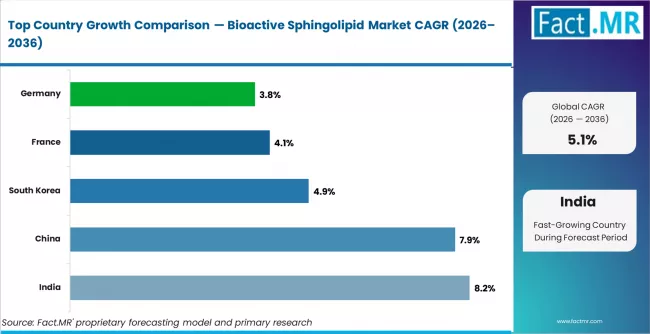
At the country level, India leads growth with a projected CAGR of 8.2% through 2036, supported by expanding pharmaceutical API manufacturing and active nutraceutical ingredient sourcing. China follows with 7.9% CAGR, driven by rapid scaling of synthetic lipid chemistry production in its biopharma supply chain. South Korea records 4.9% CAGR, anchored by its advanced cosmetic ingredient development industry and ceramide-centric skincare formulation. France is projected at 4.1% CAGR, reflecting the country's established luxury cosmetic ingredient procurement infrastructure. Germany grows at 3.8% CAGR, sustained by pharmaceutical GMP-grade sphingolipid demand from its biotech and specialty chemical sector. Mature European markets face constraints from complex regulatory documentation and long qualification timelines for novel lipid ingredients.

Segmental Analysis

Bioactive Sphingolipid Market Analysis by Product Type
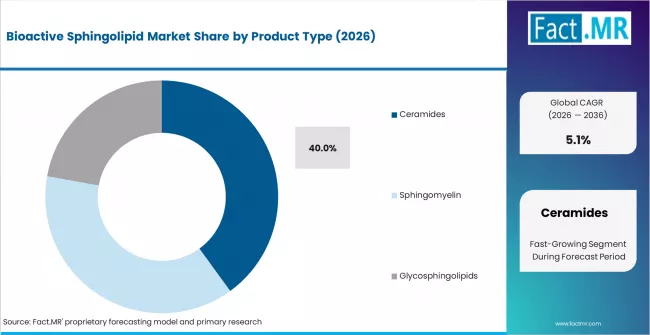
Bioactive Sphingolipid Market Analysis By Product Type

Based on FACT.MR's bioactive sphingolipid market report, consumption of ceramides is estimated to hold 40% share in 2026. Ceramides dominate due to their established role in skin barrier restoration therapeutics and their growing adoption as a key functional active in prestige skin care formulations requiring clinical-grade ingredient documentation.

  • Evonik Industries Expansion: The company expanded ISOCELL ceramide production in 2024. Focus is on pharma and cosmetic-grade supply. This supports dermatology and clinical skincare demand. [1]
  • Avanti Polar Lipids Development: The company launched an extended ceramide and sphingomyelin range in 2025. Products include enhanced GMP certification. This supports pharmaceutical applications. [2]
  • Ceramide Demand Trend: Ceramide-based skincare launches increased in 2024. Clinical skin barrier products dominate new launches. Demand is strong in premium and therapeutic segments. [3]

Bioactive Sphingolipid Market Analysis by Source
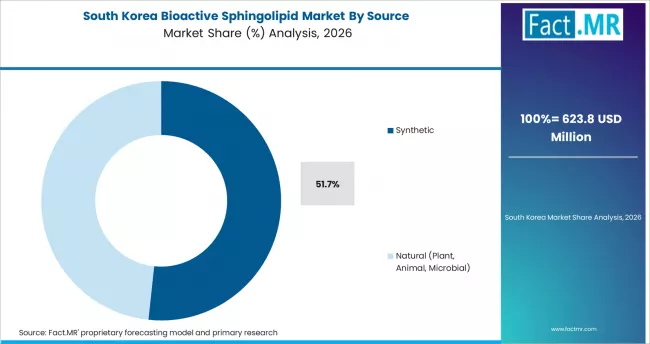
Bioactive Sphingolipid Market South Korea Market Share Analysis By Source

Based on FACT.MR, synthetic sphingolipids hold around 50% share in 2026. They dominate due to consistent molecular purity and defined structural identity. They also ensure batch-to-batch reproducibility required in pharmaceutical applications. These properties make them critical for lipid nanoparticle manufacturing. They are widely used in drug delivery and clinical supply chains.

  • Merck KGaA Investment: The company invested in synthetic lipid chemistry scale-up in 2024. Focus is on GMP-grade sphingolipid production. This supports drug delivery and oncology applications. [4]
  • Tokyo Chemical Industry Development: The company launched high-purity synthetic ceramides in 2024. Products include full analytical and GMP documentation. This supports pharmaceutical formulation approval. [5]
  • Synthetic Demand Trend: Synthetic sphingolipids are the fastest-growing in lipid nanoparticles. Pharmaceutical demand is increasing rapidly. Around 78% of buyers require GMP-grade documentation. [6]

Drivers, Restraints, and Opportunities
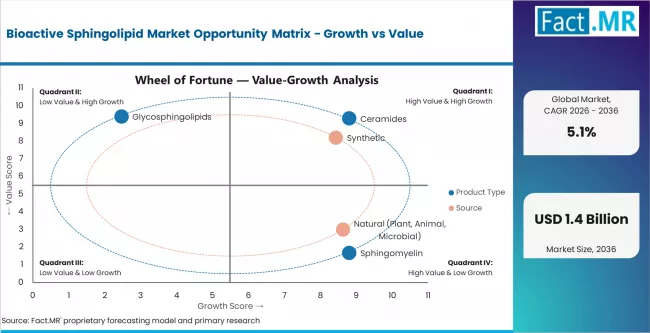
Bioactive Sphingolipid Market Opportunity Matrix Growth Vs Value

FACT.MR analysts observe the market is a specialized, high-value segment at an early commercial stage. Demand is concentrated in pharmaceutical therapeutics. This accounts for the majority of current market value. Cosmetic and nutraceutical applications remain secondary but are expanding.

Commodity lipid supply is not a key competitive factor. Pharmaceutical buyers require GMP-documented and characterized ingredients. These command significant price premiums. Natural extraction at scale remains limited, supporting synthetic dominance in therapeutics. However, cosmetic and nutraceutical buyers are increasing demand for natural-origin sphingolipids. This creates a parallel, lower-priced demand segment driven by label claims.

  • Pharmaceutical LNP Demand: Lipid nanoparticle filings increased by 28% in 2024. Sphingolipids are key formulation components. Demand is shifting toward GMP-grade synthetic supply.
  • EU Cosmetic Bioactive Regulation: EU updated cosmetic regulation guidance in 2024. Safety documentation for ceramides is now stricter. This supports demand for characterised sphingolipid ingredients.
  • India API Manufacturing Growth: India expanded PLI funding for pharma in FY2024–25. Focus includes bioactive lipid production. This supports domestic sphingolipid manufacturing growth.

Regional Analysis

The bioactive sphingolipid market is assessed across Asia Pacific, North America, Europe, Latin America, and Middle East and Africa, covering key countries with demand shaped by pharmaceutical industry maturity, cosmetic ingredient development infrastructure, and specialty lipid regulatory frameworks. The full report provides market attractiveness analysis by region and country.

Top Country Growth Comparison Bioactive Sphingolipid Market Cagr (2026 2036)

Country CAGR (2026 to 2036)
India 8.2%
China 7.9%
South Korea 4.9%
France 4.1%
Germany 3.8%

Source: Fact.MR (FACT.MR) analysis, based on proprietary forecasting model and primary research
Bioactive Sphingolipid Market Cagr Analysis By Country

Asia Pacific Bioactive Sphingolipid Market Analysis
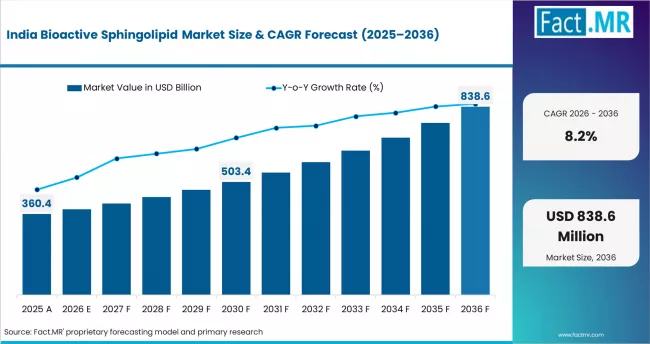
Bioactive Sphingolipid Market Country Value Analysis

Asia Pacific is the fastest-growing region. Growth is supported by pharmaceutical manufacturing expansion and increasing lipid chemistry capability. India and China dominate volume demand, while South Korea leads in cosmetic innovation. Doosan Corporation and regional producers are strengthening supply networks across pharma and cosmetic segments.

  • India: Policy-driven manufacturing expansion and domestic formulation demand are accelerating growth. Demand is projected at 8.2% CAGR through 2036. PLI funding is supporting investment in specialty bioactive lipid production. CDSCO updated GMP compliance guidelines in 2024, improving quality assurance and supplier qualification. Growth is anchored in pharmaceutical APIs and expanding nutraceutical manufacturing.
  • China: Large-scale industrial production and regulatory structuring define market dynamics. Demand is projected at 7.9% CAGR through 2036. NMPA updated lipid-based drug ingredient requirements in 2024, enabling clearer qualification pathways. Domestic producers are scaling GMP-grade sphingolipid output across key industrial zones. Growth is supply-driven with strong integration into export markets.
  • South Korea: Innovation-led cosmetic demand and cross-sector applications shape the market. Demand is projected at 4.9% CAGR through 2036. Research-led validation of ceramide efficacy is supporting premium skincare adoption. Doosan Corporation is expanding into pharmaceutical-grade supply. Demand spans both dermatology and biopharma segments with high-value positioning.

Fact.MR covers India, China, South Korea, Japan, ASEAN, and ANZ. Includes regulatory frameworks, ingredient trends, and country-level forecasts.

Europe Bioactive Sphingolipid Market Analysis
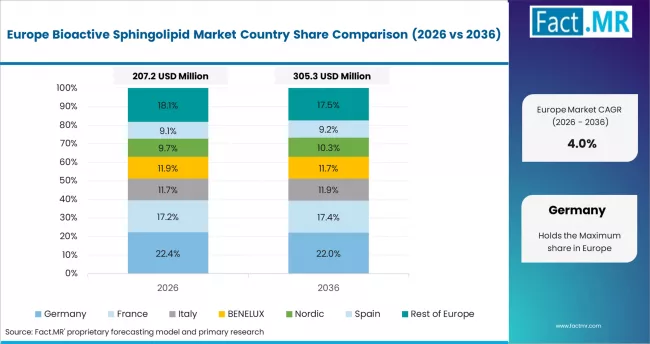
Bioactive Sphingolipid Market Europe Country Market Share Analysis, 2026 & 2036

Europe is a premium and compliance-intensive market. Demand is shaped by EMA pharmaceutical standards and EU cosmetic regulations. Merck KGaA, Evonik Industries, and Beckmann-Kenko maintain strong supply positions through certified production systems.

  • France: Premium cosmetic demand and clean-label positioning are driving adoption. Demand is projected at 4.1% CAGR through 2036. Companies such as L'Oréal and LVMH are expanding bioactive lipid sourcing. Updated EU cosmetic guidelines in 2024 are reinforcing documentation and safety requirements. Growth remains driven by high-value skincare innovation.
  • Germany: Pharmaceutical manufacturing and regulatory stringency define the market. Demand is projected at 3.8% CAGR through 2036. Merck KGaA expanded synthetic lipid production capacity in 2024 to support drug delivery applications. Regulatory authorities strengthened documentation standards for therapeutic lipid ingredients. Growth is stable and centred on GMP-grade pharmaceutical supply.

Fact.MR covers Germany, France, the UK, Italy, Spain, and Rest of Europe. Includes EMA compliance data, cosmetic bioactive trends, and demand forecasts.

Competitive Aligners for Market Players
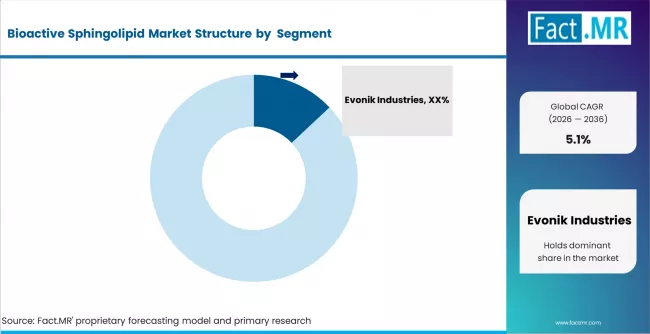
Bioactive Sphingolipid Market Analysis By Company

The bioactive sphingolipid market exhibits a concentrated and specification-driven competitive structure. A limited group of established suppliers including Merck KGaA, Evonik Industries, Avanti Polar Lipids, Tokyo Chemical Industry, and Doosan Corporation dominate supply across pharmaceutical, cosmetic, and research-grade sphingolipid categories. Competition is defined by purity validation, GMP compliance, and application-specific formulation support rather than price, particularly in pharmaceutical and premium cosmetic segments.

Leading players differentiate through advanced synthetic lipid chemistry and controlled production systems. Merck KGaA and Evonik Industries maintain strong positions in GMP-grade ceramide and sphingomyelin supply for drug delivery and dermatology applications. Avanti Polar Lipids and Tokyo Chemical Industry focus on high-purity analytical and pharmaceutical-grade sphingolipids with detailed characterisation data supporting research and clinical formulation. Doosan Corporation integrates cosmetic and pharmaceutical supply, reflecting Asia’s dual demand structure.

Procurement behaviour among pharmaceutical manufacturers is highly stringent and documentation-driven. Buyers require validated molecular identity, batch consistency, and regulatory compliance aligned with FDA and EMA standards before supplier approval. Once a sphingolipid grade is validated within a drug formulation or lipid nanoparticle system, switching suppliers becomes complex due to revalidation requirements, creating long-term supply relationships. Cosmetic and nutraceutical buyers prioritise natural sourcing and traceability alongside functional efficacy. This creates parallel demand streams with differing pricing structures. As a result, market leaders are increasingly adopting dual production strategies, separating synthetic pharmaceutical-grade supply from natural extraction platforms to address both high-margin therapeutic applications and growing clean-label cosmetic demand.

Key Players

  • Evonik Industries
  • Avanti Polar Lipids
  • Merck KGaA
  • Cayman Chemical
  • Tokyo Chemical Industry
  • Doosan Corporation
  • Beckmann-Kenko

Bibliography

  • [1] Evonik Industries. (Q3 2024). Operations Update: ISOCELL Ceramide Production Line Expansion at Essen Specialty Lipid Facility Targeting Increased Supply of Pharmaceutical and Cosmetic-Grade Ceramide Fractions to European Dermatology Formulators and Clinical Skin Care Brands. 2024. evonik.com/investor-relations
  • [2] Avanti Polar Lipids. (January 2025). Product Launch: Extended GMP-Certified Ceramide and Sphingomyelin Catalogue with Standardised Purity Specifications Targeting Pharmaceutical Lipid Nanoparticle Manufacturers in the United States and Europe. January 2025. avantilipids.com
  • [3] Mintel. (2024). Global Skin Care Ingredient Trends 2024: Ceramide-Containing Product Launch Growth of 19% Globally with Clinical Skin Barrier Claim Products Representing 61% of New Introductions in Prestige and Therapeutic Skin Care Segments. 2024. mintel.com
  • [4] Merck KGaA. (2024). Operations Update: Synthetic Lipid Chemistry Scale-Up Investment at Darmstadt Life Science Facility Targeting Expanded GMP-Grade Synthetic Sphingolipid Production for Lipid-Based Drug Delivery and Oncology Therapeutic Ingredient Supply. 2024. merckgroup.com/investor-relations
  • [5] Tokyo Chemical Industry. (Late 2024). Product Development: High-Purity Synthetic Ceramide and Glycosphingolipid Range with Analytical Characterisation Certificates and GMP Documentation Supporting Pharmaceutical Formulation Qualification in Japan and North American Drug Development Markets. 2024. tcichemicals.com
  • [6] Drug Delivery Technology. (2024). Lipid Nanoparticle Formulation Component Report 2024: Synthetic Sphingolipids as Fastest-Growing Component in LNP Formulation Briefs with GMP-Grade Documentation Required by 78% of Pharmaceutical Buyers in North America and Europe. 2024. drugdeliverytechnology.com

This Report Addresses

  • Strategic insights on demand across India, China, South Korea, France, and Germany markets. Covers pharmaceutical lipid nanoparticle adoption, ceramide-led cosmetic reformulation, and nutraceutical bioactive sourcing trends.
  • Market forecast from USD 0.8 billion in 2026 to USD 1.2 billion by 2036 at a CAGR of 5.1%.
  • Growth opportunities across U.S. pharmaceutical LNP formulation, India API manufacturing expansion, China synthetic lipid chemistry scale-up, South Korea premium cosmetic ingredient development, and France luxury cosmetic bioactive procurement.
  • Segment analysis by product type (ceramides, sphingomyelin, glycosphingolipids), source (synthetic, natural), and application (therapeutics, cosmetics, nutraceuticals).
  • Regional outlook covering Asia Pacific pharmaceutical and cosmetic sphingolipid demand, North America LNP therapeutic ingredient growth, and Europe EU regulation-guided GMP-certified supply procurement.
  • Competitive analysis of Evonik Industries, Avanti Polar Lipids, Merck KGaA, Cayman Chemical, Tokyo Chemical Industry, Doosan Corporation, and Beckmann-Kenko. Focus on GMP certification, purity documentation, and application-specific positioning.
  • Technology tracking on synthetic ceramide synthesis optimisation, GMP-grade lipid nanoparticle component development, natural sphingolipid extraction advances, and pharmaceutical regulatory compliance documentation.
  • Report delivered in PDF, Excel datasets, and presentation formats. Supported by primary interviews, producer disclosures, FDA drug master file data, EMA guidance, and cosmetic and pharmaceutical industry procurement statistics.

Scope of Report

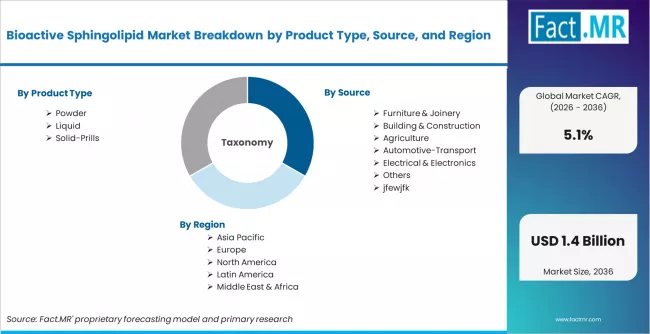
Bioactive Sphingolipid Market Breakdown By Product Type, Source, And Region

Attribute Details
Quantitative Units USD 0.8 billion (2026) to USD 1.2 billion (2036), at a CAGR of 5.1%
Market Definition Synthetic and natural ceramides, sphingomyelin, and glycosphingolipids sold as pharmaceutical, cosmetic, and nutraceutical grade bioactive lipid ingredients globally.
Product Type Segmentation Ceramides, Sphingomyelin, Glycosphingolipids
Source Segmentation Synthetic, Natural (Plant, Animal, Microbial)
Application Segmentation Therapeutics, Cosmetics & Personal Care, Nutraceuticals
Application Coverage Pharmaceutical lipid nanoparticle formulation, oncology therapeutic ingredient supply, skin barrier cosmetic active sourcing, nutraceutical bioactive lipid procurement, and GMP-grade sphingolipid clinical supply.
Regions Covered North America, Europe, Asia Pacific, Latin America, Middle East and Africa
Countries Covered USA, Canada, Mexico, Germany, UK, France, Italy, Spain, Nordic, BENELUX, China, Japan, South Korea, India, ASEAN, Australia and New Zealand, Brazil, Argentina, Chile, Saudi Arabia, GCC, Turkey, South Africa, Rest of MEA
Key Companies Profiled Evonik Industries, Avanti Polar Lipids, Merck KGaA, Cayman Chemical, Tokyo Chemical Industry, Doosan Corporation, Beckmann-Kenko
Forecast Period 2026 to 2036
Approach Hybrid top-down and bottom-up model using sphingolipid compound shipment volumes by purity grade and application, average selling prices by source and channel, pharmaceutical lipid ingredient market benchmarks, cosmetic bioactive procurement data, and primary interviews with drug formulators and cosmetic ingredient buyers.

Bioactive Sphingolipid Market by Segments

  • By Product Type:

    • Ceramides
    • Sphingomyelin
    • Glycosphingolipids
  • By Source:

    • Synthetic
    • Natural (Plant, Animal, Microbial)
  • By Application:

    • Therapeutics
    • Cosmetics & Personal Care
    • Nutraceuticals
  • By Region:

  • North America
    • United States
    • Canada
    • Mexico
  • Latin America
    • Brazil
    • Mexico
    • Argentina
    • Chile
    • Rest of Latin America
  • Western Europe
    • Germany
    • United Kingdom
    • France
    • Italy
    • Spain
    • Nordic Countries
    • BENELUX
  • Rest of Western Europe
    • Eastern Europe
    • Russia
    • Poland
    • Hungary
    • Balkan and Baltic
  • Rest of Eastern Europe
    • East Asia
    • China
    • Japan
  • South Korea
    • South Asia and Pacific
    • India
    • ASEAN
    • Australia and New Zealand
  • Rest of South Asia and Pacific
    • Middle East and Africa
    • Kingdom of Saudi Arabia
    • Other GCC Countries
    • Turkey
    • South Africa
    • Rest of Middle East and Africa

Table of Content

  1. Executive Summary
    • Global Market Outlook
    • Demand to side Trends
    • Supply to side Trends
    • Technology Roadmap Analysis
    • Analysis and Recommendations
  2. Market Overview
    • Market Coverage / Taxonomy
    • Market Definition / Scope / Limitations
  3. Research Methodology
    • Chapter Orientation
    • Analytical Lens and Working Hypotheses
      • Market Structure, Signals, and Trend Drivers
      • Benchmarking and Cross-market Comparability
      • Market Sizing, Forecasting, and Opportunity Mapping
    • Research Design and Evidence Framework
      • Desk Research Programme (Secondary Evidence)
        • Company Annual and Sustainability Reports
        • Peer-reviewed Journals and Academic Literature
        • Corporate Websites, Product Literature, and Technical Notes
        • Earnings Decks and Investor Briefings
        • Statutory Filings and Regulatory Disclosures
        • Technical White Papers and Standards Notes
        • Trade Journals, Industry Magazines, and Analyst Briefs
        • Conference Proceedings, Webinars, and Seminar Materials
        • Government Statistics Portals and Public Data Releases
        • Press Releases and Reputable Media Coverage
        • Specialist Newsletters and Curated Briefings
        • Sector Databases and Reference Repositories
        • Fact.MR Internal Proprietary Databases and Historical Market Datasets
        • Subscription Datasets and Paid Sources
        • Social Channels, Communities, and Digital Listening Inputs
        • Additional Desk Sources
      • Expert Input and Fieldwork (Primary Evidence)
        • Primary Modes
          • Qualitative Interviews and Expert Elicitation
          • Quantitative Surveys and Structured Data Capture
          • Blended Approach
        • Why Primary Evidence is Used
        • Field Techniques
          • Interviews
          • Surveys
          • Focus Groups
          • Observational and In-context Research
          • Social and Community Interactions
        • Stakeholder Universe Engaged
          • C-suite Leaders
          • Board Members
          • Presidents and Vice Presidents
          • R&D and Innovation Heads
          • Technical Specialists
          • Domain Subject-matter Experts
          • Scientists
          • Physicians and Other Healthcare Professionals
        • Governance, Ethics, and Data Stewardship
          • Research Ethics
          • Data Integrity and Handling
      • Tooling, Models, and Reference Databases
    • Data Engineering and Model Build
      • Data Acquisition and Ingestion
      • Cleaning, Normalisation, and Verification
      • Synthesis, Triangulation, and Analysis
    • Quality Assurance and Audit Trail
  4. Market Background
    • Market Dynamics
      • Drivers
      • Restraints
      • Opportunity
      • Trends
    • Scenario Forecast
      • Demand in Optimistic Scenario
      • Demand in Likely Scenario
      • Demand in Conservative Scenario
    • Opportunity Map Analysis
    • Product Life Cycle Analysis
    • Supply Chain Analysis
    • Investment Feasibility Matrix
    • Value Chain Analysis
    • PESTLE and Porter’s Analysis
    • Regulatory Landscape
    • Regional Parent Market Outlook
    • Production and Consumption Statistics
    • Import and Export Statistics
  5. Global Market Analysis 2021 to 2025 and Forecast, 2026 to 2036
    • Historical Market Size Value (USD Million) Analysis, 2021 to 2025
    • Current and Future Market Size Value (USD Million) Projections, 2026 to 2036
      • Y to o to Y Growth Trend Analysis
      • Absolute $ Opportunity Analysis
  6. Global Market Pricing Analysis 2021 to 2025 and Forecast 2026 to 2036
  7. Global Market Analysis 2021 to 2025 and Forecast 2026 to 2036, By Distribution Channel
    • Introduction / Key Findings
    • Historical Market Size Value (USD Million) Analysis By Distribution Channel , 2021 to 2025
    • Current and Future Market Size Value (USD Million) Analysis and Forecast By Distribution Channel , 2026 to 2036
      • Supermarkets and Hypermarkets
      • Online Retail
      • Specialty Health Stores
      • Convenience Stores
    • Y to o to Y Growth Trend Analysis By Distribution Channel , 2021 to 2025
    • Absolute $ Opportunity Analysis By Distribution Channel , 2026 to 2036
  8. Global Market Analysis 2021 to 2025 and Forecast 2026 to 2036, By Protein Source
    • Introduction / Key Findings
    • Historical Market Size Value (USD Million) Analysis By Protein Source, 2021 to 2025
    • Current and Future Market Size Value (USD Million) Analysis and Forecast By Protein Source, 2026 to 2036
      • Beef
      • Poultry
      • Pork
      • Fish and Seafood
      • Eggs
      • Dairy
    • Y to o to Y Growth Trend Analysis By Protein Source, 2021 to 2025
    • Absolute $ Opportunity Analysis By Protein Source, 2026 to 2036
  9. Global Market Analysis 2021 to 2025 and Forecast 2026 to 2036, By Region
    • Introduction
    • Historical Market Size Value (USD Million) Analysis By Region, 2021 to 2025
    • Current Market Size Value (USD Million) Analysis and Forecast By Region, 2026 to 2036
      • North America
      • Latin America
      • Western Europe
      • Eastern Europe
      • East Asia
      • South Asia and Pacific
      • Middle East & Africa
    • Market Attractiveness Analysis By Region
  10. North America Market Analysis 2021 to 2025 and Forecast 2026 to 2036, By Country
    • Historical Market Size Value (USD Million) Trend Analysis By Market Taxonomy, 2021 to 2025
    • Market Size Value (USD Million) Forecast By Market Taxonomy, 2026 to 2036
      • By Country
        • USA
        • Canada
        • Mexico
      • By Distribution Channel
      • By Protein Source
    • Market Attractiveness Analysis
      • By Country
      • By Distribution Channel
      • By Protein Source
    • Key Takeaways
  11. Latin America Market Analysis 2021 to 2025 and Forecast 2026 to 2036, By Country
    • Historical Market Size Value (USD Million) Trend Analysis By Market Taxonomy, 2021 to 2025
    • Market Size Value (USD Million) Forecast By Market Taxonomy, 2026 to 2036
      • By Country
        • Brazil
        • Chile
        • Rest of Latin America
      • By Distribution Channel
      • By Protein Source
    • Market Attractiveness Analysis
      • By Country
      • By Distribution Channel
      • By Protein Source
    • Key Takeaways
  12. Western Europe Market Analysis 2021 to 2025 and Forecast 2026 to 2036, By Country
    • Historical Market Size Value (USD Million) Trend Analysis By Market Taxonomy, 2021 to 2025
    • Market Size Value (USD Million) Forecast By Market Taxonomy, 2026 to 2036
      • By Country
        • Germany
        • UK
        • Italy
        • Spain
        • France
        • Nordic
        • BENELUX
        • Rest of Western Europe
      • By Distribution Channel
      • By Protein Source
    • Market Attractiveness Analysis
      • By Country
      • By Distribution Channel
      • By Protein Source
    • Key Takeaways
  13. Eastern Europe Market Analysis 2021 to 2025 and Forecast 2026 to 2036, By Country
    • Historical Market Size Value (USD Million) Trend Analysis By Market Taxonomy, 2021 to 2025
    • Market Size Value (USD Million) Forecast By Market Taxonomy, 2026 to 2036
      • By Country
        • Russia
        • Poland
        • Hungary
        • Balkan & Baltic
        • Rest of Eastern Europe
      • By Distribution Channel
      • By Protein Source
    • Market Attractiveness Analysis
      • By Country
      • By Distribution Channel
      • By Protein Source
    • Key Takeaways
  14. East Asia Market Analysis 2021 to 2025 and Forecast 2026 to 2036, By Country
    • Historical Market Size Value (USD Million) Trend Analysis By Market Taxonomy, 2021 to 2025
    • Market Size Value (USD Million) Forecast By Market Taxonomy, 2026 to 2036
      • By Country
        • China
        • Japan
        • South Korea
      • By Distribution Channel
      • By Protein Source
    • Market Attractiveness Analysis
      • By Country
      • By Distribution Channel
      • By Protein Source
    • Key Takeaways
  15. South Asia and Pacific Market Analysis 2021 to 2025 and Forecast 2026 to 2036, By Country
    • Historical Market Size Value (USD Million) Trend Analysis By Market Taxonomy, 2021 to 2025
    • Market Size Value (USD Million) Forecast By Market Taxonomy, 2026 to 2036
      • By Country
        • India
        • ASEAN
        • Australia & New Zealand
        • Rest of South Asia and Pacific
      • By Distribution Channel
      • By Protein Source
    • Market Attractiveness Analysis
      • By Country
      • By Distribution Channel
      • By Protein Source
    • Key Takeaways
  16. Middle East & Africa Market Analysis 2021 to 2025 and Forecast 2026 to 2036, By Country
    • Historical Market Size Value (USD Million) Trend Analysis By Market Taxonomy, 2021 to 2025
    • Market Size Value (USD Million) Forecast By Market Taxonomy, 2026 to 2036
      • By Country
        • Kingdom of Saudi Arabia
        • Other GCC Countries
        • Turkiye
        • South Africa
        • Other African Union
        • Rest of Middle East & Africa
      • By Distribution Channel
      • By Protein Source
    • Market Attractiveness Analysis
      • By Country
      • By Distribution Channel
      • By Protein Source
    • Key Takeaways
  17. Key Countries Market Analysis
    • USA
      • Pricing Analysis
      • Market Share Analysis, 2025
        • By Distribution Channel
        • By Protein Source
    • Canada
      • Pricing Analysis
      • Market Share Analysis, 2025
        • By Distribution Channel
        • By Protein Source
    • Mexico
      • Pricing Analysis
      • Market Share Analysis, 2025
        • By Distribution Channel
        • By Protein Source
    • Brazil
      • Pricing Analysis
      • Market Share Analysis, 2025
        • By Distribution Channel
        • By Protein Source
    • Chile
      • Pricing Analysis
      • Market Share Analysis, 2025
        • By Distribution Channel
        • By Protein Source
    • Germany
      • Pricing Analysis
      • Market Share Analysis, 2025
        • By Distribution Channel
        • By Protein Source
    • UK
      • Pricing Analysis
      • Market Share Analysis, 2025
        • By Distribution Channel
        • By Protein Source
    • Italy
      • Pricing Analysis
      • Market Share Analysis, 2025
        • By Distribution Channel
        • By Protein Source
    • Spain
      • Pricing Analysis
      • Market Share Analysis, 2025
        • By Distribution Channel
        • By Protein Source
    • France
      • Pricing Analysis
      • Market Share Analysis, 2025
        • By Distribution Channel
        • By Protein Source
    • India
      • Pricing Analysis
      • Market Share Analysis, 2025
        • By Distribution Channel
        • By Protein Source
    • ASEAN
      • Pricing Analysis
      • Market Share Analysis, 2025
        • By Distribution Channel
        • By Protein Source
    • Australia & New Zealand
      • Pricing Analysis
      • Market Share Analysis, 2025
        • By Distribution Channel
        • By Protein Source
    • China
      • Pricing Analysis
      • Market Share Analysis, 2025
        • By Distribution Channel
        • By Protein Source
    • Japan
      • Pricing Analysis
      • Market Share Analysis, 2025
        • By Distribution Channel
        • By Protein Source
    • South Korea
      • Pricing Analysis
      • Market Share Analysis, 2025
        • By Distribution Channel
        • By Protein Source
    • Russia
      • Pricing Analysis
      • Market Share Analysis, 2025
        • By Distribution Channel
        • By Protein Source
    • Poland
      • Pricing Analysis
      • Market Share Analysis, 2025
        • By Distribution Channel
        • By Protein Source
    • Hungary
      • Pricing Analysis
      • Market Share Analysis, 2025
        • By Distribution Channel
        • By Protein Source
    • Kingdom of Saudi Arabia
      • Pricing Analysis
      • Market Share Analysis, 2025
        • By Distribution Channel
        • By Protein Source
    • Turkiye
      • Pricing Analysis
      • Market Share Analysis, 2025
        • By Distribution Channel
        • By Protein Source
    • South Africa
      • Pricing Analysis
      • Market Share Analysis, 2025
        • By Distribution Channel
        • By Protein Source
  18. Market Structure Analysis
    • Competition Dashboard
    • Competition Benchmarking
    • Market Share Analysis of Top Players
      • By Regional
      • By Distribution Channel
      • By Protein Source
  19. Competition Analysis
    • Competition Deep Dive
      • Epic Provisions
        • Overview
        • Product Portfolio
        • Profitability by Market Segments (Product/Age /Sales Channel/Region)
        • Sales Footprint
        • Strategy Overview
          • Marketing Strategy
          • Product Strategy
          • Channel Strategy
      • Country Archer
      • Chomps
      • Applegate Farms
      • Tyson Foods
      • Hormel Foods
      • Perdue Farms
      • Tillamook
      • Kettle & Fire
      • Carnivore Aurelius
      • The New Primal
      • Paleovalley
  20. Assumptions & Acronyms Used

List Of Table

  • Table 1: Global Market Value (USD Million) Forecast by Region, 2021 to 2036
  • Table 2: Global Market Value (USD Million) Forecast by Distribution Channel , 2021 to 2036
  • Table 3: Global Market Value (USD Million) Forecast by Protein Source, 2021 to 2036
  • Table 4: North America Market Value (USD Million) Forecast by Country, 2021 to 2036
  • Table 5: North America Market Value (USD Million) Forecast by Distribution Channel , 2021 to 2036
  • Table 6: North America Market Value (USD Million) Forecast by Protein Source, 2021 to 2036
  • Table 7: Latin America Market Value (USD Million) Forecast by Country, 2021 to 2036
  • Table 8: Latin America Market Value (USD Million) Forecast by Distribution Channel , 2021 to 2036
  • Table 9: Latin America Market Value (USD Million) Forecast by Protein Source, 2021 to 2036
  • Table 10: Western Europe Market Value (USD Million) Forecast by Country, 2021 to 2036
  • Table 11: Western Europe Market Value (USD Million) Forecast by Distribution Channel , 2021 to 2036
  • Table 12: Western Europe Market Value (USD Million) Forecast by Protein Source, 2021 to 2036
  • Table 13: Eastern Europe Market Value (USD Million) Forecast by Country, 2021 to 2036
  • Table 14: Eastern Europe Market Value (USD Million) Forecast by Distribution Channel , 2021 to 2036
  • Table 15: Eastern Europe Market Value (USD Million) Forecast by Protein Source, 2021 to 2036
  • Table 16: East Asia Market Value (USD Million) Forecast by Country, 2021 to 2036
  • Table 17: East Asia Market Value (USD Million) Forecast by Distribution Channel , 2021 to 2036
  • Table 18: East Asia Market Value (USD Million) Forecast by Protein Source, 2021 to 2036
  • Table 19: South Asia and Pacific Market Value (USD Million) Forecast by Country, 2021 to 2036
  • Table 20: South Asia and Pacific Market Value (USD Million) Forecast by Distribution Channel , 2021 to 2036
  • Table 21: South Asia and Pacific Market Value (USD Million) Forecast by Protein Source, 2021 to 2036
  • Table 22: Middle East & Africa Market Value (USD Million) Forecast by Country, 2021 to 2036
  • Table 23: Middle East & Africa Market Value (USD Million) Forecast by Distribution Channel , 2021 to 2036
  • Table 24: Middle East & Africa Market Value (USD Million) Forecast by Protein Source, 2021 to 2036

List Of Figures

  • Figure 1: Global Market Pricing Analysis
  • Figure 2: Global Market Value (USD Million) Forecast 2021-2036
  • Figure 3: Global Market Value Share and BPS Analysis by Distribution Channel , 2026 and 2036
  • Figure 4: Global Market Y-o-Y Growth Comparison by Distribution Channel , 2026 to 2036
  • Figure 5: Global Market Attractiveness Analysis by Distribution Channel
  • Figure 6: Global Market Value Share and BPS Analysis by Protein Source, 2026 and 2036
  • Figure 7: Global Market Y-o-Y Growth Comparison by Protein Source, 2026 to 2036
  • Figure 8: Global Market Attractiveness Analysis by Protein Source
  • Figure 9: Global Market Value (USD Million) Share and BPS Analysis by Region, 2026 and 2036
  • Figure 10: Global Market Y-o-Y Growth Comparison by Region, 2026 to 2036
  • Figure 11: Global Market Attractiveness Analysis by Region
  • Figure 12: North America Market Incremental Dollar Opportunity, 2026 to 2036
  • Figure 13: Latin America Market Incremental Dollar Opportunity, 2026 to 2036
  • Figure 14: Western Europe Market Incremental Dollar Opportunity, 2026 to 2036
  • Figure 15: Eastern Europe Market Incremental Dollar Opportunity, 2026 to 2036
  • Figure 16: East Asia Market Incremental Dollar Opportunity, 2026 to 2036
  • Figure 17: South Asia and Pacific Market Incremental Dollar Opportunity, 2026 to 2036
  • Figure 18: Middle East & Africa Market Incremental Dollar Opportunity, 2026 to 2036
  • Figure 19: North America Market Value Share and BPS Analysis by Country, 2026 and 2036
  • Figure 20: North America Market Value Share and BPS Analysis by Distribution Channel , 2026 and 2036
  • Figure 21: North America Market Y-o-Y Growth Comparison by Distribution Channel , 2026 to 2036
  • Figure 22: North America Market Attractiveness Analysis by Distribution Channel
  • Figure 23: North America Market Value Share and BPS Analysis by Protein Source, 2026 and 2036
  • Figure 24: North America Market Y-o-Y Growth Comparison by Protein Source, 2026 to 2036
  • Figure 25: North America Market Attractiveness Analysis by Protein Source
  • Figure 26: Latin America Market Value Share and BPS Analysis by Country, 2026 and 2036
  • Figure 27: Latin America Market Value Share and BPS Analysis by Distribution Channel , 2026 and 2036
  • Figure 28: Latin America Market Y-o-Y Growth Comparison by Distribution Channel , 2026 to 2036
  • Figure 29: Latin America Market Attractiveness Analysis by Distribution Channel
  • Figure 30: Latin America Market Value Share and BPS Analysis by Protein Source, 2026 and 2036
  • Figure 31: Latin America Market Y-o-Y Growth Comparison by Protein Source, 2026 to 2036
  • Figure 32: Latin America Market Attractiveness Analysis by Protein Source
  • Figure 33: Western Europe Market Value Share and BPS Analysis by Country, 2026 and 2036
  • Figure 34: Western Europe Market Value Share and BPS Analysis by Distribution Channel , 2026 and 2036
  • Figure 35: Western Europe Market Y-o-Y Growth Comparison by Distribution Channel , 2026 to 2036
  • Figure 36: Western Europe Market Attractiveness Analysis by Distribution Channel
  • Figure 37: Western Europe Market Value Share and BPS Analysis by Protein Source, 2026 and 2036
  • Figure 38: Western Europe Market Y-o-Y Growth Comparison by Protein Source, 2026 to 2036
  • Figure 39: Western Europe Market Attractiveness Analysis by Protein Source
  • Figure 40: Eastern Europe Market Value Share and BPS Analysis by Country, 2026 and 2036
  • Figure 41: Eastern Europe Market Value Share and BPS Analysis by Distribution Channel , 2026 and 2036
  • Figure 42: Eastern Europe Market Y-o-Y Growth Comparison by Distribution Channel , 2026 to 2036
  • Figure 43: Eastern Europe Market Attractiveness Analysis by Distribution Channel
  • Figure 44: Eastern Europe Market Value Share and BPS Analysis by Protein Source, 2026 and 2036
  • Figure 45: Eastern Europe Market Y-o-Y Growth Comparison by Protein Source, 2026 to 2036
  • Figure 46: Eastern Europe Market Attractiveness Analysis by Protein Source
  • Figure 47: East Asia Market Value Share and BPS Analysis by Country, 2026 and 2036
  • Figure 48: East Asia Market Value Share and BPS Analysis by Distribution Channel , 2026 and 2036
  • Figure 49: East Asia Market Y-o-Y Growth Comparison by Distribution Channel , 2026 to 2036
  • Figure 50: East Asia Market Attractiveness Analysis by Distribution Channel
  • Figure 51: East Asia Market Value Share and BPS Analysis by Protein Source, 2026 and 2036
  • Figure 52: East Asia Market Y-o-Y Growth Comparison by Protein Source, 2026 to 2036
  • Figure 53: East Asia Market Attractiveness Analysis by Protein Source
  • Figure 54: South Asia and Pacific Market Value Share and BPS Analysis by Country, 2026 and 2036
  • Figure 55: South Asia and Pacific Market Value Share and BPS Analysis by Distribution Channel , 2026 and 2036
  • Figure 56: South Asia and Pacific Market Y-o-Y Growth Comparison by Distribution Channel , 2026 to 2036
  • Figure 57: South Asia and Pacific Market Attractiveness Analysis by Distribution Channel
  • Figure 58: South Asia and Pacific Market Value Share and BPS Analysis by Protein Source, 2026 and 2036
  • Figure 59: South Asia and Pacific Market Y-o-Y Growth Comparison by Protein Source, 2026 to 2036
  • Figure 60: South Asia and Pacific Market Attractiveness Analysis by Protein Source
  • Figure 61: Middle East & Africa Market Value Share and BPS Analysis by Country, 2026 and 2036
  • Figure 62: Middle East & Africa Market Value Share and BPS Analysis by Distribution Channel , 2026 and 2036
  • Figure 63: Middle East & Africa Market Y-o-Y Growth Comparison by Distribution Channel , 2026 to 2036
  • Figure 64: Middle East & Africa Market Attractiveness Analysis by Distribution Channel
  • Figure 65: Middle East & Africa Market Value Share and BPS Analysis by Protein Source, 2026 and 2036
  • Figure 66: Middle East & Africa Market Y-o-Y Growth Comparison by Protein Source, 2026 to 2036
  • Figure 67: Middle East & Africa Market Attractiveness Analysis by Protein Source
  • Figure 68: Global Market - Tier Structure Analysis
  • Figure 69: Global Market - Company Share Analysis

- Frequently Asked Questions -

How large is the bioactive sphingolipid market in 2025?

The market was valued at USD 0.7 billion in 2025.

What will the market size be in 2026?

The market is estimated to reach USD 0.8 billion in 2026.

What is the projected market size by 2036?

The market is projected to reach USD 1.2 billion by 2036.

What is the expected CAGR of the bioactive sphingolipid market?

The market is expected to grow at a CAGR of 5.1% from 2026 to 2036.

What is the absolute dollar opportunity in this market?

The market is expected to create an absolute dollar opportunity of USD 0.4 billion between 2026 and 2036.

Which product type segment leads the market?

Ceramides lead with approximately 40% share in 2026, driven by demand in skin barrier therapeutics and premium cosmetic formulation.

Which source segment holds the largest share?

Synthetic sources lead with approximately 50% share in 2026, reflecting pharmaceutical preference for purity-documented, batch-consistent sphingolipid ingredients.

Which application segment is poised to lead?

Therapeutics leads with approximately 74% share in 2026, driven by sphingolipid use in lipid nanoparticle drug delivery and oncology formulation programmes.

Which country shows the fastest growth?

India leads with a CAGR of 8.2% through 2036, supported by pharmaceutical API manufacturing expansion and nutraceutical ingredient sourcing under the PLI scheme.

What factors are driving market growth?

Growth is driven by pharmaceutical LNP programme expansion in the U.S., India PLI-supported API manufacturing, China biopharma supply chain scale-up, South Korea ceramide cosmetic demand, and EU cosmetics and pharma documentation requirements.

What are the major restraints?

Key restraints include high synthesis costs for pharmaceutical-grade sphingolipids, limited scalable natural extraction infrastructure, and lengthy regulatory qualification timelines for novel lipid ingredients in EU and U.S. pharmaceutical procurement.

Bioactive Sphingolipid Market