- Base Value(2025): 4.2 Bn
- Estimated Value(2026): 5.0 Bn
- Forecast Value (2036): 27.3 Bn
- CAGR (2026 - 2036): 18.5%
Biometric-as-a-Service Market Forecast and Outlook 2026 to 2036
In 2025, the biometric-as-a-service market was valued at USD 4.2 billion. Based on FACT.MR analysis, demand for biometric-as-a-service solutions is estimated to grow to USD 5.0 billion in 2026 and USD 27.3 billion by 2036. FACT.MR projects a CAGR of 18.5% during the forecast period.
FACT.MR analysis indicates the biometric-as-a-service market is expected to generate an absolute dollar opportunity of USD 22.3 billion between 2026 and 2036. This transformational expansion reflects accelerating digital identity mandate rollouts across government e-services, financial sector KYC compliance, and enterprise zero trust security architecture adoption. Growth is moderated by biometric data privacy regulation complexity under GDPR, India’s DPDPA, and U.S. state-level biometric privacy laws such as BIPA in Illinois, which impose data minimization, consent, and retention constraints that increase compliance architecture cost for cloud biometric service deployment.
Country growth reflects government digital identity programme investment and financial sector biometric KYC mandates. India leads at 22.5% CAGR, driven by Aadhaar biometric platform expansion, DigiYatra aviation identity rollout, and UIDAI cloud API adoption by financial and telecom sector KYC applications. China follows at 19.3%, supported by national public security biometric database expansion and financial services facial recognition payment mandate. Germany posts 18.4% through eIDAS 2.0 digital identity wallet implementation requiring cloud biometric verification for qualified electronic signatures. The United States records 18.0%, driven by TSA biometric airport deployment expansion and federal agency zero trust architecture biometric authentication mandates. Saudi Arabia grows at 17.8%, the most active Gulf market, through Absher digital government services biometric integration and Vision 2030 smart city biometric infrastructure investment.
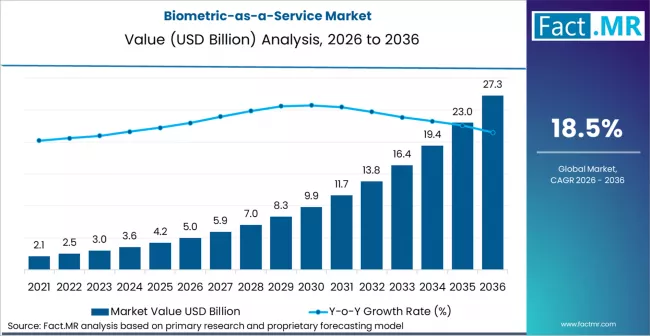
Biometric As A Service Market Market Value Analysis | Source: Fact.MR
| Metric | Value |
|---|---|
| Estimated Value in 2026 | USD 5.0 billion |
| Forecast Value in 2036 | USD 27.3 billion |
| Forecast CAGR (2026 to 2036) | 18.5% |
Source: Fact.MR analysis. Updated Mar 11, 2026
Market Definition
The biometric-as-a-service market provides cloud-based identity verification using fingerprints, facial recognition, iris, voice, and palm patterns. These services are delivered through APIs and SaaS platforms, allowing organisations to authenticate users without maintaining on-premises biometric infrastructure.
Market Inclusions
Includes global forecasts from 2026 to 2036 by biometric modality, deployment model, and scanner type. Covers unimodal and multimodal biometric authentication across public, private, and hybrid cloud for government, financial services, enterprise, and healthcare users worldwide.
Market Exclusions
Excludes standalone biometric hardware devices, physical access readers without cloud connectivity, behavioural biometric analytics, and biometric chip or sensor manufacturing markets.
Research Methodology
- Primary Research: Interviews with biometric system architects, government identity programme managers, financial sector CISOs, enterprise IAM leaders, border control technology buyers, and biometric API developers.
- Desk Research: Sources include digital identity programme tenders, NIST biometric standards, eIDAS 2.0 regulation documents, UIDAI Aadhaar reports, TSA biometric programme updates, financial KYC regulation changes, and vendor earnings reports.
- Market Sizing and Forecasting: Hybrid model using government biometric contract values, enterprise IAM spending, API verification transaction volumes, and average revenue per authentication call.
- Data Validation and Update Cycle: Data validated using vendor revenue disclosures, government procurement records, NIST evaluation participation, and financial sector KYC technology surveys.
Biometric-as-a-Service Market Summary
- Market Definition
- Biometric-as-a-service provides cloud-hosted fingerprint, facial, iris, voice, and palm identity verification through API and SaaS platforms for governments, banks, enterprises, and healthcare organisations.
- Demand Drivers
- India’s Aadhaar biometric API and DigiYatra facial recognition airport system are expanding large-scale biometric identity verification adoption.
- eIDAS 2.0 Digital Identity Wallet regulation is creating demand for certified biometric verification services across EU countries.
- U.S. zero-trust cybersecurity mandates are accelerating biometric authentication adoption for secure federal access systems.
- Key Segments Analyzed
- By Modality: Multimodal biometrics is the fastest-growing segment due to higher accuracy and fraud resistance.
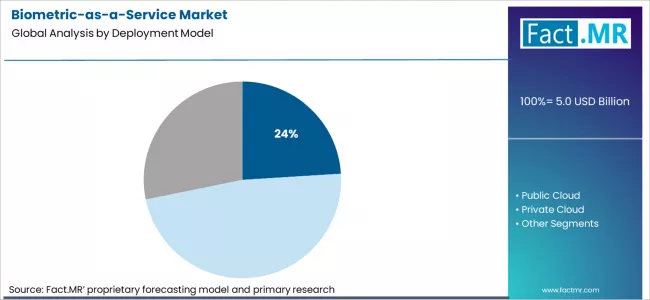
- By Deployment Model: Hybrid cloud holds about 24% share in 2026 due to data sovereignty and scalable API verification needs.
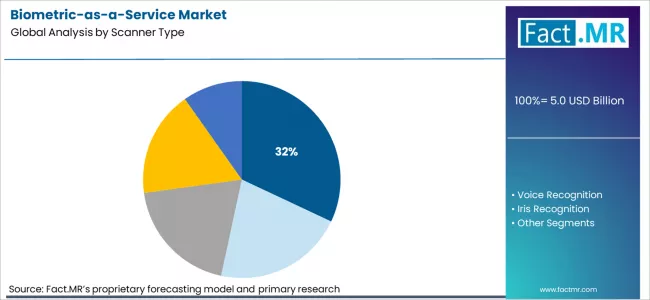
- By Scanner Type: Fingerprint recognition leads with about 32% share because of lower cost and strong accuracy.
- Analyst Opinion at FACT.MR
- Shambhu Nath Jha, Principal Consultant at Fact.MR, opines that CXOs will find this report helpful for understanding how government digital identity programmes, AI-driven fraud detection, multimodal biometric authentication adoption, and financial sector KYC compliance requirements are shaping long-term growth.
- Strategic Implications
- Vendors should obtain ISO biometric security certification and high NIST accuracy rankings to qualify for government identity projects.
- Companies should develop eIDAS 2.0-compliant biometric verification systems for European digital identity wallets.
- Vendors should build financial KYC-ready biometric modules aligned with FATF and regional compliance rules.
- Methodology
- Market sizing used government biometric programme values and enterprise IAM biometric spending data.
- Aadhaar authentication volumes, TSA biometric initiatives, and eIDAS 2.0 policy timelines supported demand analysis.
- Forecasts used API transaction growth trends, NIST evaluation results, and interviews with biometric technology experts.
Segmental Analysis
Biometric-as-a-Service Market Analysis by Deployment Model
Biometric As A Service Market Analysis By Deployment Model | Source: Fact.MR
Based on FACT.MR’s biometric-as-a-service market report, hybrid cloud deployment is projected to hold around 24% share in 2026. Hybrid models allow organisations to retain biometric data locally while using cloud-based verification engines for scalable identity authentication.
- Thales Cloud Identity Investment: In 2025, Thales expanded its SafeNet Trusted Access platform with hybrid cloud biometric verification, allowing governments to store biometric templates locally while using cloud matching APIs. [5]
- Microsoft Azure AD Biometric Technology: Microsoft expanded Azure Active Directory External Identities with biometric verification integration through its partnership with Onfido, enabling hybrid cloud biometric onboarding solutions. [6]
- Private Cloud Government Trend: ENISA reported that 67% of EU government biometric deployments used hybrid or private cloud systems in 2024 due to strict biometric data protection requirements under GDPR. [7]
Biometric-as-a-Service Market Analysis by Scanner Type
Biometric As A Service Market Analysis By Scanner Type | Source: Fact.MR
Based on FACT.MR’s biometric-as-a-service market report, fingerprint recognition is estimated to hold about 32% share in 2026. Fingerprint technology remains the most widely deployed biometric verification method due to its cost efficiency and mature verification ecosystem.
- SUPREMA Cloud Platform Investment: In 2025, SUPREMA expanded its BioStar 2 platform with fingerprint and facial recognition cloud APIs to support migration from on-premises biometric systems to cloud identity platforms. [8]
- Iris Recognition Technology Development: In 2024, IriTech launched its updated IriShield iris recognition cloud API with improved accuracy and extended capture distance for border security and airport identity verification. [9]
- Facial Recognition Adoption Trend: NIST reported significant improvements in facial recognition accuracy in 2024, with financial institutions increasingly adopting facial biometric verification for digital onboarding and KYC processes. [10]
Drivers, Restraints, and Opportunities
FACT.MR analysts observe that the biometric-as-a-service market, valued at USD 4.2 billion in 2025, is expanding due to government digital identity programmes, financial sector fraud prevention needs, and enterprise zero trust security adoption. Cloud biometric APIs are increasingly replacing legacy on-premises biometric systems as organisations seek faster and scalable identity verification.
The market is shifting from hardware-based biometric databases toward hybrid and public cloud authentication platforms. Multimodal biometric verification and hybrid cloud deployment models are generating higher per-transaction value while verification volumes continue to expand.
- eIDAS 2.0 Digital Identity Mandate: The EU eIDAS 2.0 regulation requires member states to deploy Digital Identity Wallets and support biometric verification for digital identity services by 2026. This policy creates large-scale demand for certified cloud biometric verification platforms across Europe. [2]
- India Aadhaar API Expansion: Aadhaar biometric authentications exceeded 2.4 billion transactions in FY2024-25. Updated RBI Video-KYC guidelines now allow Aadhaar fingerprint and face authentication for remote bank onboarding, increasing biometric API usage across financial institutions. [3]
- U.S. Zero Trust Biometric Mandate: U.S. federal zero trust strategy requires phishing-resistant multi-factor authentication for government systems. Federal agencies are adopting biometric authentication integrated with FIDO2 identity platforms to strengthen cybersecurity. [4]
Regional Analysis
The biometric-as-a-service market is analysed across Asia Pacific, Europe, North America, Latin America, and Middle East and Africa, covering 40+ countries with demand profiles shaped by government digital identity programme investment, financial sector KYC regulation, data sovereignty legislation, and national security biometric deployment scale. The full report offers market attractiveness analysis based on government programme timelines, regulatory certification pathways, and cloud biometric API adoption trajectories.
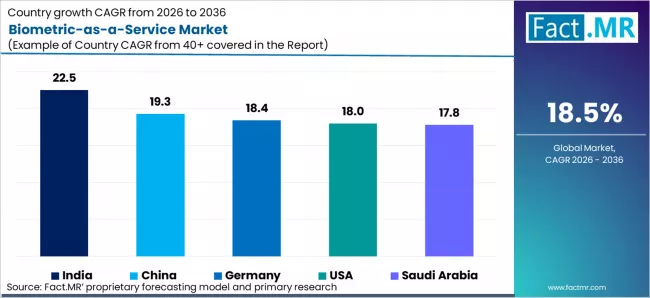
Biometric As A Service Market Cagr Analysis By Country | Source: Fact.MR
| Country | CAGR (2026-2036) |
|---|---|
| India | 22.5% |
| China | 19.3% |
| United States | 18.0% |
| Germany | 18.4% |
| Saudi Arabia | 17.8% |
Source: Fact.MR analysis. Updated Mar 11, 2026
Source: Fact.MR (FACT.MR) analysis, based on proprietary forecasting model and primary research
Asia Pacific Biometric-as-a-Service Market Analysis
Asia Pacific is the largest volume market for biometric-as-a-service due to large national digital identity systems in India and China. Government identity programmes, financial KYC requirements, and strict data localisation rules are accelerating cloud biometric adoption across the region.
- India: Rapid expansion of digital identity infrastructure is driving strong BaaS growth in India, projected at 22.5% CAGR through 2036. Aadhaar processed over 2.4 billion biometric authentications in FY2024-25. RBI’s updated Video-KYC rules now allow Aadhaar-based fingerprint and facial authentication for remote banking. DigiYatra facial recognition boarding expanded to 24 airports in 2024 with a target of 50 airports by 2025. India’s Digital Personal Data Protection Act rules also increased compliance investment for biometric service providers.
- China: Government-backed biometric verification infrastructure is accelerating BaaS demand in China, expected to grow at 19.3% CAGR through 2036. The Ministry of Public Security expanded its national biometric identity platform in 2024 requiring banks and payment providers to integrate facial recognition verification APIs. Alipay and WeChat Pay process over 100 million daily biometric authentications. China’s PIPL enforcement also introduced stricter biometric data storage and processing requirements.
FACT.MR’s Asia Pacific analysis of the biometric-as-a-service market covers China, Japan, South Korea, India, Australia and New Zealand, ASEAN, and Rest of South Asia and Pacific. Readers can find country CAGR forecasts, Aadhaar and MPS biometric API adoption data, digital identity programme timelines, and regulatory compliance benchmarks by deployment model.
Europe Biometric-as-a-Service Market Analysis
Europe represents the regulatory centre for cloud biometric verification due to strict digital identity and data protection frameworks. eIDAS 2.0 implementation is creating large-scale demand for certified biometric verification platforms across EU national identity systems.
- Germany: National digital identity wallet deployment is strengthening BaaS demand in Germany, forecast to grow at 18.4% CAGR through 2036. BSI TR-03159 guidelines define biometric liveness detection and identity verification standards for eIDAS-compliant systems. Germany’s SPRIND programme funded domestic biometric verification platform development projects in 2024. Bundesdruckerei expanded its ID Wallet biometric API services for financial institutions implementing remote digital onboarding.
FACT.MR’s European analysis of the biometric-as-a-service market covers Germany, France, the United Kingdom, Italy, Spain, Nordic countries, BENELUX, and Rest of Western Europe. Readers can find eIDAS 2.0 implementation data, national biometric certification frameworks, digital identity wallet deployment timelines, and country-level forecasts.
North America Biometric-as-a-Service Market Analysis
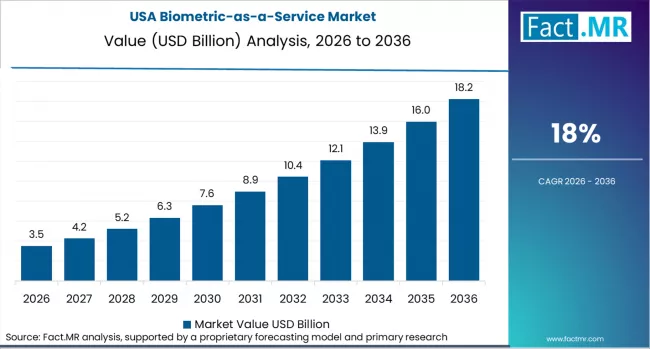
Biometric As A Service Market Country Value Analysis | Source: Fact.MR
North America generates the highest revenue in the biometric-as-a-service market due to strong government adoption, cybersecurity initiatives, and airport biometric screening programmes. Federal security policies and enterprise zero trust frameworks continue to expand biometric verification demand.
- United States: Federal biometric security programmes are driving BaaS growth in the United States, projected to expand at 18.0% CAGR through 2036. TSA expanded biometric identity verification to more than 60 airports through its CAT-2 automated screening system. Federal zero trust policies recommend biometric authentication for phishing-resistant access systems. Illinois BIPA regulation is also increasing enterprise investment in compliant biometric data governance platforms.
FACT.MR’s North American analysis of the biometric-as-a-service market covers the United States, Canada, and Mexico. Readers can find TSA biometric deployment statistics, FedRAMP biometric platform certifications, BIPA compliance requirements, and market forecasts by scanner type and deployment model.
Middle East and Africa Biometric-as-a-Service Market Analysis
Middle East and Africa is emerging as a fast-growing biometric-as-a-service market supported by smart city development, national digital identity programmes, and government e-services expansion across Gulf countries and parts of Africa.
- Saudi Arabia: Government digital identity transformation is accelerating biometric cloud adoption in Saudi Arabia, expected to grow at 17.8% CAGR through 2036. The Absher e-government platform added facial recognition verification for services such as residency permits and driving licence renewals. Vision 2030’s Government Cloud First policy requires new digital identity services to use SDAIA-certified cloud biometric platforms.
FACT.MR’s Middle East and Africa analysis of the biometric-as-a-service market covers Saudi Arabia, other GCC countries, Turkey, South Africa, and Rest of MEA. Readers can find Vision 2030 identity programme investments, SDAIA biometric certification rules, and country-level forecasts by deployment model.
Competitive Aligners for Market Players
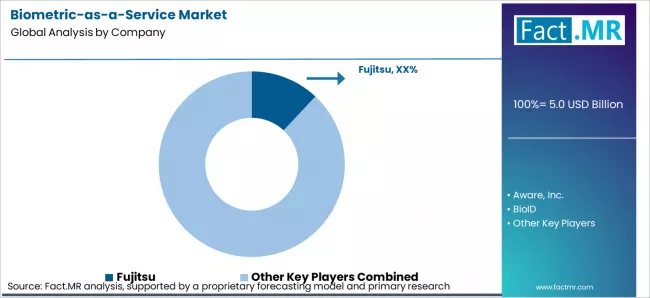
Biometric As A Service Market Analysis By Company | Source: Fact.MR
The biometric-as-a-service market is moderately concentrated in government identity programmes while remaining highly competitive in enterprise and financial sector deployments. Major providers such as Thales, IDEMIA, NEC Corporation, and Leidos hold strong positions because of their long-term contracts with governments for border management, civil identity systems, and national biometric databases. In this market, vendors compete on algorithm accuracy, security certifications, and their ability to meet strict government procurement standards. Performance in global evaluation programmes, compliance with biometric security standards, and recognised cloud security authorisations often determine which companies qualify for large public-sector contracts.
Companies that already operate national identity systems benefit from significant structural advantages. For example, IDEMIA’s strong facial recognition performance in global testing programmes and its established enrolment infrastructure across airports and government service points create long-term dependency for existing customers. Thales also holds a competitive advantage through its secure identity and credential solutions, which are often bundled with biometric verification platforms in national identity tenders.
Government buyers typically maintain multiple qualified vendors to avoid dependency on a single provider. However, switching biometric platforms is complex because it may require re-enrolling millions of citizens. This high switching cost gives established providers strong pricing power during contract renewals, while enterprise clients maintain flexibility by using standardised biometric authentication interfaces.
Key Players
- Fujitsu
- Aware, Inc.
- BioID
- OT-Morpho
- SUPREMA
- Leidos
- ImageWare Systems
- Polygon Innovation
- IriTech
- Sky Biometry
- Fulcrum Biometrics
Bibliography
- [1] European Parliament and Council. (2024). Regulation (EU) 2024/1183 Amending Regulation (EU) No 910/2014 as Regards Establishing the European Digital Identity Framework (eIDAS 2.0): Biometric Verification Requirements for Qualified Electronic Attestations. May 2024. eur-lex.europa.eu
- [2] Unique Identification Authority of India (UIDAI). (2025). Annual Report 2024-25: Aadhaar Biometric Authentication Transaction Volume, RBI Video-KYC Master Direction Biometric Method Expansion, and DigiYatra Airport Coverage Milestone. March 2025. uidai.gov.in
- [3] Cybersecurity and Infrastructure Security Agency (CISA). (2024). Zero Trust Maturity Model Version 2.0: Phishing-Resistant Multi-Factor Authentication Requirements Including Biometric Authentication Recommendations for Federal Agencies. April 2024. cisa.gov
- [4] Thales Group. (2025). Product Launch: SafeNet Trusted Access Hybrid Cloud Biometric Verification for Government Customers with Private Infrastructure Template Storage and Cloud Matching API Access. January 2025. thalesgroup.com
- [5] Microsoft Corporation. (2024). Azure Active Directory External Identities Update: Onfido Biometric Document Verification Integration and Hybrid Cloud Biometric Onboarding with GDPR Data Minimisation Compliance Architecture. September 2024. microsoft.com/azure
- [6] European Union Agency for Cybersecurity (ENISA). (2024). Cloud Security for Government 2024: EU Government Biometric System Deployment Configuration Survey and GDPR Article 9 Compliance Constraint Analysis. November 2024. enisa.europa.eu
- [7] SUPREMA Inc. (2025). Product Update: BioStar 2 Cloud Access Control Platform Fingerprint and Facial Recognition Cloud API Expansion for Hybrid Cloud Enterprise and Government Deployments in Asia Pacific and Europe. January 2025. supremainc.com
- [8] IriTech Inc. (2024). Product Launch: IriShield Cloud Iris Recognition API with Extended Capture Distance and NIST IREX 10 Top-Tier Accuracy Rating for Border Control and Airport Security Applications. August 2024. iritech.com
- [9] National Institute of Standards and Technology (NIST). (2024). Face Recognition Vendor Test Programme 2024: Algorithm Accuracy Results, False Match Rate Benchmarks, and Financial Services Digital Onboarding Adoption Data. December 2024. nist.gov/programs-projects/face-recognition-vendor-test-frvt
This Report Addresses
- Strategic insights on eIDAS 2.0 digital identity wallet rollout, India DPDPA biometric consent rules, U.S. zero trust authentication mandates, China MPS financial biometric APIs, and Saudi Arabia SDAIA certification frameworks.
- Market forecast from USD 5.0 billion in 2026 to USD 27.3 billion by 2036 at an 18.5% CAGR, segmented by modality, deployment model, scanner type, and region.
- Growth opportunities across India Aadhaar KYC expansion, China financial facial recognition integration, Germany eIDAS 2.0 identity wallet deployment, U.S. TSA airport biometrics, and Saudi Arabia Vision 2030 digital identity programmes.
- Country CAGR outlook: India 22.5%, China 19.3%, Germany 18.4%, United States 18.0%, and Saudi Arabia 17.8%.
- Competitive analysis of Thales, IDEMIA, NEC, Fujitsu, SUPREMA, Aware, Leidos, and IriTech focusing on algorithm accuracy, security certifications, government contracts, and cloud API capabilities.
- Technology coverage including multimodal biometrics, presentation attack detection, FIDO2 passkey authentication, edge biometric processing, and AI-based fraud detection.
- Regulatory analysis covering eIDAS 2.0 biometric verification rules, GDPR biometric data protection, India DPDPA consent requirements, U.S. BIPA compliance, China PIPL standards, and Saudi SDAIA certification.
Report delivered in PDF, Excel datasets, PowerPoint summary, and dashboard formats supported by government tenders, NIST evaluation data, vendor earnings disclosures, and primary research interviews.
Segmentation
Scope of Report
| Metric | Value |
|---|---|
| Quantitative Units | USD 5.0 billion (2026) to USD 27.3 billion (2036), at a CAGR of 18.5% |
| Market Definition | Cloud-delivered biometric identity verification services using fingerprint, facial, iris, voice, and palm recognition for enterprise, government, and financial sector authentication. |
| Modality Segmentation | Unimodal, Multimodal |
| Deployment Segmentation | Public Cloud, Private Cloud, Hybrid Cloud (24%) |
| Scanner Type Segmentation | Fingerprint Recognition (32%), Voice Recognition, Iris Recognition, Palm Recognition, Facial Recognition |
| Application Coverage | Border control identity verification, financial KYC onboarding, enterprise workforce authentication, healthcare patient identity, government e-services access, and law enforcement identification. |
| Regions Covered | Asia Pacific, Europe, North America, Latin America, Middle East and Africa |
| Countries Covered | China, Japan, South Korea, India, Australia and New Zealand, ASEAN, Rest of South Asia and Pacific, Germany, UK, France, Italy, Spain, Nordic, BENELUX, Rest of Western Europe, Russia, Poland, Hungary, Balkan and Baltic, USA, Canada, Mexico, Brazil, Chile, Ecuador, Rest of Latin America, Saudi Arabia, GCC, Turkey, South Africa, Rest of MEA |
| Key Companies Profiled | Fujitsu, Aware Inc., BioID, OT-Morpho, SUPREMA, Leidos, ImageWare Systems, Polygon Innovation, IriTech, Sky Biometry, Fulcrum Biometrics |
| Forecast Period | 2026 to 2036 |
| Approach | Hybrid top-down and bottom-up model using government biometric programme procurement values, enterprise IAM contract volumes, scanner shipment data, and primary interviews with biometric platform architects. |
Source: Fact.MR analysis. Updated Mar 11, 2026
Biometric-as-a-Service Market by Segments
-
By Modality:
- Unimodal
- Multimodal
-
By Deployment Model:
- Public Cloud
- Private Cloud
- Hybrid Cloud
-
By Scanner Type:
- Fingerprint Recognition
- Voice Recognition
- Iris Recognition
- Palm Recognition
- Facial Recognition
-
By Region:
- North America
- United States
- Canada
- Mexico
- Latin America
- Brazil
- Chile
- Ecuador
- Rest of Latin America
- Western Europe
- Germany
- United Kingdom
- France
- Italy
- Spain
- Nordic
- BENELUX
- Rest of Western Europe
- Eastern Europe
- Russia
- Poland
- Hungary
- Balkan and Baltic
- Rest of Eastern Europe
- East Asia
- China
- Japan
- South Korea
- South Asia and Pacific
- India
- ASEAN
- Australia and New Zealand
- Rest of South Asia and Pacific
- Middle East and Africa
- Kingdom of Saudi Arabia
- Other GCC Countries
- Turkey
- South Africa
- Other African Union
- Rest of Middle East and Africa
- North America
Frequently Asked Questions
How large is the biometric-as-a-service market in 2025?
What will the market size be in 2026?
What is the projected market size by 2036?
What is the expected CAGR?
Which deployment model holds the notable share?
Which scanner type leads the market?
Which country shows the fastest growth?
Who worked on this report


Preview the report firsthand - request a free sample
Free SampleGet the brochure for pricing and purchase details
Download PDF