- Base Value(2025): 5.7 Bn
- Estimated Value(2026): 6.8 Bn
- Forecast Value (2036): 23.7 Bn
- CAGR (2026 - 2036): 13.3%
CO2-Derived Chemicals Market Size, Market Forecast and Outlook By Fact.MR
In 2025, the CO2-derived chemicals market was valued at USD 5.7 billion. Based on Fact.MR analysis, demand for CO2-derived chemicals is estimated to grow to USD 6.8 billion in 2026 and USD 23.7 billion by 2036. FACT.MR projects a CAGR of 13.3% during the forecast period.
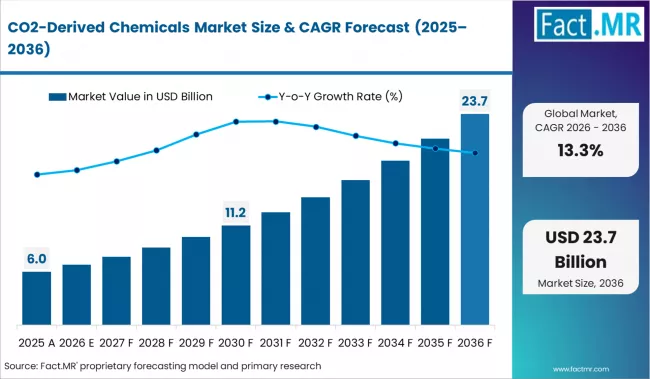
Co2 Derived Chemicals Market Market Value Analysis | Source: Fact.MR
Summary of CO2-Derived Chemicals Market
- Market Definition
- The market covers CO₂-based chemical production using catalytic, electrochemical, biological, and mineralisation technologies across key industries.
- Demand Drivers
- India’s CO₂-to-chemicals mandates and Hydrogen Mission are accelerating projects.
- U.S. IRA tax credits are supporting ExxonMobil and Linde investments.
- South Korea’s K-CCUS programme is driving industrial cluster deployment.
- Key Segments Analyzed
- By Product Type: Alcohols and Platform Chemicals lead with 31% share in 2026, driven by CO₂-to-methanol adoption.
- By End Use: Chemicals and Petrochemicals lead with 26% share in 2026 due to decarbonisation mandates.
- By Technology: Catalytic Hydrogenation leads with 33% share in 2026 due to commercial maturity and cost advantage.
- Analyst Opinion at FACT.MR
- Shambhu Nath Jha states CXOs should prioritise long-term offtake agreements aligned with policy incentives. Catalytic hydrogenation offers near-term viability, while electrochemical routes scale post-2030.
- Strategic Implications
- Secure CO₂ supply from cement, steel, and fertiliser sectors early.
- Leverage grants and tax credits in India, South Korea, and the USA.
- Expand into polymers and building materials for construction and packaging demand.
- Methodology
- Market sizing based on project pipeline and output, validated with grants and disclosures (2024-2025).
- IEA, DOE, and EU data support demand and regional analysis.
- Forecasts include carbon pricing, hydrogen costs, CO₂ availability, and expert inputs.
| Metric | Value |
|---|---|
| Estimated Value in 2026 | USD 6.8 billion |
| Forecast Value in 2036 | USD 23.7 billion |
| Forecast CAGR (2026 to 2036) | 13.3% |
Source: Fact.MR analysis. Updated Mar 27, 2026
The market is projected to generate approximately USD 16.9 billion in incremental revenue over the forecast period, reflecting a phase of accelerated structural expansion. Growth is being underpinned by regulatory support for carbon utilisation across key regions including the EU, South Korea, and India. Concurrently, declining electrolyser and green hydrogen costs are improving economic viability. Increasing corporate net-zero procurement commitments, particularly within the chemicals and packaging sectors, are further reinforcing demand momentum.
Despite these tailwinds, the market continues to face structural constraints. High capital intensity associated with catalytic and electrochemical conversion facilities remains a key barrier to scale. In addition, challenges related to CO₂ feedstock purity, transportation logistics, and infrastructure availability persist. Lengthy customer qualification cycles in end-use industries such as petrochemicals and automotive also contribute to slower commercialization timelines.
Leading industry participants, including Linde, ExxonMobil, and TotalEnergies, are actively advancing market maturity through long-term offtake agreements with chemical producers and cement manufacturers. These developments validate emerging commercial demand beyond demonstration-scale projects. Among technology pathways, catalytic hydrogenation of CO₂ to methanol continues to attract the largest share of investment, supported by its compatibility with existing methanol infrastructure and established downstream integration within the chemical value chain.
Country growth is shaped by carbon policy strength, hydrogen infrastructure, CO₂ availability, and funding. India leads at 15.1% CAGR, driven by CO₂-to-chemicals pilots and the National Hydrogen Mission. China follows at 14.5% with state-backed hydrogenation capacity. South Korea reaches 13.8% through K-CCUS programs. The USA grows at 11.5% supported by IRA incentives and major investments. The UK records 10.0%, driven by CCUS clusters, though progress is moderated by evolving carbon pricing mechanisms.
Segmental Analysis
CO₂-Derived Chemicals Market Analysis by Product Type
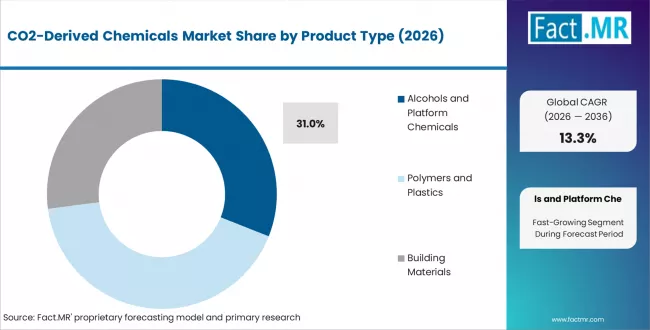
Co2 Derived Chemicals Market Analysis By Product Type | Source: Fact.MR
Alcohols and Platform Chemicals hold 31% share in 2026, driven by the strong commercial position of CO₂-to-methanol. This segment benefits from compatibility with existing methanol infrastructure, established global demand, and easier integration into downstream chemical value chains. In addition, it has the largest active project pipeline, supported by government funding and long-term offtake agreements, making it the most scalable near-term product category.
- Linde Project Investment: Linde advanced its Leuna methanol project with secured offtake and EU funding, supporting commercial-scale deployment. [4]
- Honeywell Technology Launch: Honeywell introduced a CO₂ hydrogenation catalyst in 2025 with improved energy efficiency, targeting large-scale methanol production. [5]
- Methanol Platform Trend: Around 45 global projects (~8 Mt capacity) are under development, with Europe and Asia accounting for the majority of capacity additions. [6]
CO₂-Derived Chemicals Market Analysis by End Use
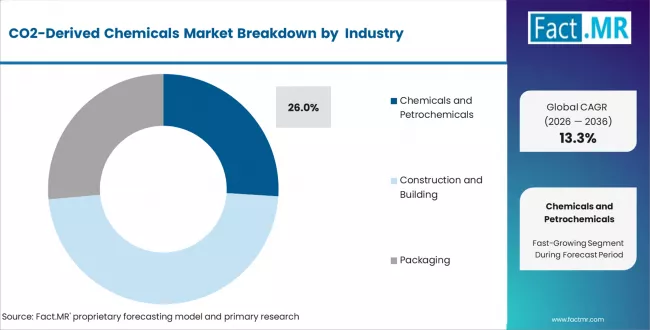
Co2 Derived Chemicals Market Analysis By End Use | Source: Fact.MR
Chemicals and Petrochemicals hold 26% share in 2026, as this sector faces the most immediate regulatory and commercial pressure to decarbonize feedstock’s. Large chemical producers are integrating CO₂-derived inputs through long-term procurement agreements to meet scope 1 and scope 3 emission targets. The sector also benefits from existing infrastructure and the ability to absorb higher-cost sustainable inputs compared to other industries.
- ExxonMobil Offtake Agreement: ExxonMobil secured multi-year CO₂-derived feedstock supply for a U.S. polyol manufacturer, signaling early commercial demand. [7]
- Construction Segment Development: Mitsubishi Heavy Industries is advancing CO₂-cured concrete solutions in Japan, expanding utilization beyond chemicals. [8]
- Packaging End Use Trend: Total Energies is progressing CO₂-derived polymers for packaging, driven by regulatory pressure on sustainable materials. [9]
Drivers, Restraints, and Opportunities
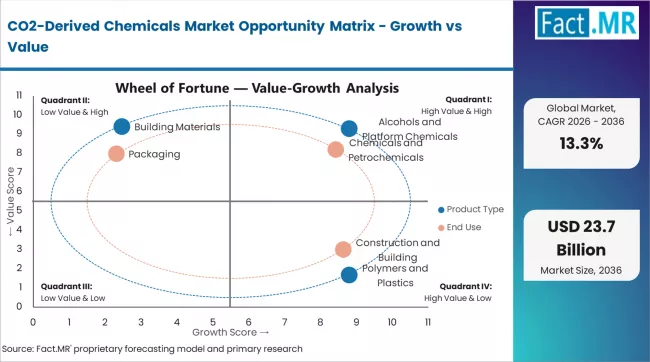
Co2 Derived Chemicals Market Opportunity Matrix Growth Vs Value | Source: Fact.MR
FACT.MR identifies strong decarbonisation-driven demand across chemicals and materials industries. Regulatory mandates and corporate net-zero targets are accelerating adoption of CO₂-derived feedstocks, particularly in regions with established carbon pricing mechanisms. Government subsidies, tax credits, and grant programmes are playing a critical role in bridging early-stage cost gaps, enabling demonstration projects to transition into initial commercial-scale deployment despite high capital intensity and technology risks.
Demonstration-scale projects are gaining momentum, especially in methanol and polycarbonate production pathways where technology readiness is higher. However, unsubsidised routes remain 20-50% more expensive than conventional fossil-based processes, limiting adoption in cost-sensitive markets.
- EU Carbon Utilisation Policy: The EU Innovation Fund allocated EUR 4.8 billion in 2024 for CCU projects across Germany, Netherlands, and Norway, accelerating commercial-scale catalytic and electrochemical facilities. [1]
- U.S. IRA Carbon Utilisation Credits: Enhanced 45Q credits in 2024 are enabling Linde and ExxonMobil to advance CO₂-to-methanol projects in Texas and Louisiana with improved investment returns. [2]
- India National Hydrogen Mission: INR 1,200 crore allocated in 2024 is supporting CO₂ hydrogenation pilot projects at ONGC and IOCL, strengthening domestic project pipelines. [3]
Regional Analysis
The CO2-derived chemicals market is assessed across North America, Asia Pacific, Europe, Latin America, and Middle East and Africa, covering 40+ key countries with distinct demand profiles shaped by carbon policy stringency, green hydrogen infrastructure investment, industrial CO2 source availability, and national carbon utilisation programme funding intensity. The full report provides market attractiveness analysis by region and country.
.webp "Top Country Growth Comparison Co2 Derived Chemicals Market Cagr (2026 2036)")
Top Country Growth Comparison Co2 Derived Chemicals Market Cagr (2026 2036) | Source: Fact.MR
| Country | CAGR (2026 to 2036) |
|---|---|
| India | 15.1% |
| China | 14.5% |
| South Korea | 13.8% |
| USA | 11.5% |
| UK | 10.0% |
Source: Fact.MR analysis. Updated Mar 27, 2026
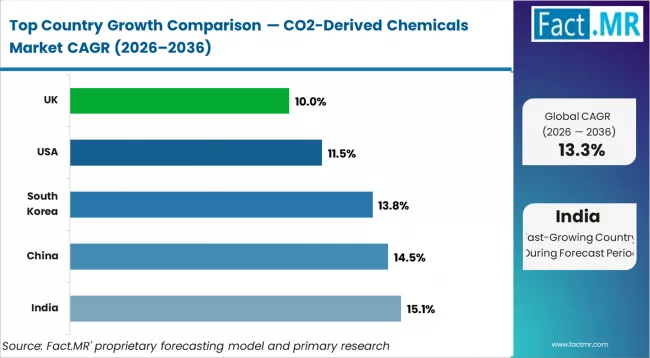
Co2 Derived Chemicals Market Cagr Analysis By Country | Source: Fact.MR
Source: Fact.MR (FACT.MR) analysis, based on proprietary forecasting model and primary research
Asia Pacific CO₂-Derived Chemicals Market Analysis
Asia Pacific is the fastest-growing region, supported by strong policy intervention, expanding industrial CO₂ sources, and growing investment in hydrogen infrastructure. Growth is anchored by India’s mandate-driven deployment and China’s state-led industrial scale-up. Regional competition includes Mitsubishi Heavy Industries, Honeywell, and domestic Chinese technology providers focusing on catalytic hydrogenation and emerging electrochemical conversion technologies.
- India: India is projected to grow at 15.1% CAGR through 2036, the highest globally. Growth is driven by Ministry of Petroleum mandates requiring CO₂ utilisation at refinery sites such as ONGC and IOCL, combined with National Hydrogen Mission expansion into CO₂ hydrogenation. In 2024, INR 1,200 crore was allocated to pilot projects for CO₂-to-methanol and CO₂-to-ammonia, targeting fertiliser and polymer demand. Engineering participation from firms like Fluor highlights increasing private sector involvement. Growth is characterised by government mandates with execution led by industrial and engineering players.
- China: China is projected to grow at 14.5% CAGR through 2036. Growth is underpinned by national carbon intensity reduction targets and strong state enterprise participation. The 2024 green chemistry guidelines prioritise CO₂ hydrogenation to methanol as a key decarbonisation pathway. Companies such as Sinopec and CNOOC are expanding CO₂-to-methanol capacity at major refinery clusters. International technology providers like Honeywell are also entering through licensing agreements. Growth is driven by policy compliance and large-scale industrial deployment.
FACT.MR’s regional analysis covers India, China, South Korea, Japan, ASEAN, and ANZ, including funding pipelines, project capacity benchmarks, CO₂ source availability, and technology adoption trends.
North America CO₂-Derived Chemicals Market Analysis
North America represents a commercially advanced market driven by policy incentives rather than direct mandates. The U.S. Inflation Reduction Act (IRA) has significantly improved project economics through 45Q tax credits, enabling private investment without full reliance on grants. Key players such as Linde, ExxonMobil, Fluor, and Honeywell are leading technology deployment and project execution across Gulf Coast industrial clusters.
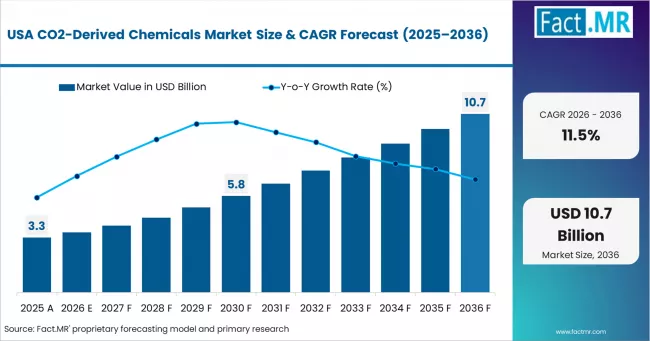
Co2 Derived Chemicals Market Country Value Analysis | Source: Fact.MR
- USA: The USA is projected to grow at 11.5% CAGR through 2036. Growth is driven by a combination of IRA tax credits and Department of Energy funding programmes that support early-stage commercialization. ExxonMobil is advancing CO₂-derived chemical production linked to its carbon capture infrastructure at Baytown, while Linde is progressing methanol projects along the Gulf Coast. The market is characterized by strong private sector participation supported by stable policy incentives and existing industrial CO₂ infrastructure.
FACT.MR covers the United States, Canada, and Mexico, analysing tax credit-driven project pipelines, CO₂ infrastructure availability, and commercialization pathways across product types.
Europe CO₂-Derived Chemicals Market Analysis
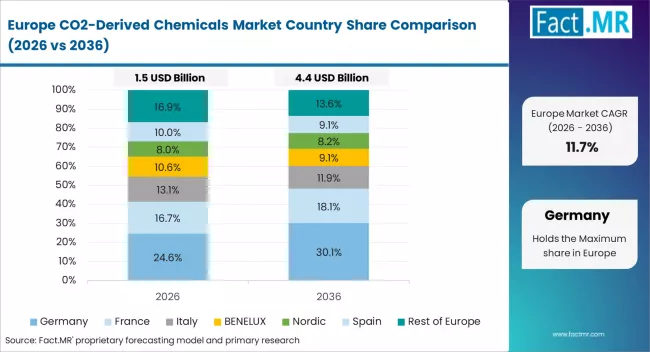
Co2 Derived Chemicals Market Europe Country Market Share Analysis, 2026 & 2036 | Source: Fact.MR
Europe is a regulation-driven market where carbon pricing, emissions targets, and Innovation Fund grants are accelerating adoption of CO₂-derived chemicals. The EU Green Deal framework is compelling industries to integrate low-carbon feedstock’s, particularly in chemicals and construction. Major players such as Total Energies, Linde, and Equinor are leading project development across key industrial clusters in Germany, Norway, and the Netherlands.
- UK: The UK is projected to grow at 10.0% CAGR through 2036. Growth is supported by CCUS Industrial Cluster programmes at Humber and Teesside, which provide CO₂ feedstock for downstream utilisation. The Net Zero Innovation Portfolio (NZIP) is funding pilot-scale projects, including CO₂-to-polymers and fuels, with GBP 22 million allocated in 2024. However, commercialisation remains relatively slower due to evolving carbon pricing mechanisms and reliance on grant-based funding.
FACT.MR’s Europe analysis includes the UK, Germany, France, Norway, the Netherlands, and Western Europe, covering Innovation Fund allocations, CO₂ cluster infrastructure, regulatory timelines, and technology deployment trends.
Competitive Aligners for Market Players
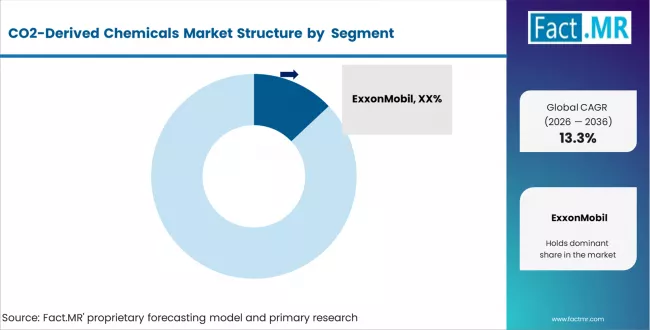
Co2 Derived Chemicals Market Analysis By Company | Source: Fact.MR
The CO₂-derived chemicals market is still in an early stage and is not yet driven by large-scale production. Instead, success depends heavily on access to advanced technologies and strong relationships with government programmes. Companies that were early to develop reliable catalytic hydrogenation or electrochemical conversion technologies have a clear advantage. Players such as Honeywell, Linde, and Mitsubishi Heavy Industries stand out because they combine proprietary technology with engineering expertise. This allows them to deliver complete, integrated CO₂-to-chemical projects, something smaller or newer firms often struggle to match.
At the same time, large energy companies like ExxonMobil, TotalEnergies, and Equinor benefit from their direct access to industrial CO₂ sources through refineries and LNG operations. This gives them a major cost advantage, as CO₂ feedstock is one of the most expensive components in these projects. Engineering and construction firms such as Fluor and Schlumberger further strengthen the ecosystem by enabling full turnkey project delivery, helping connect technology providers with governments and industrial buyers.
On the demand side, chemical producers and construction companies tend to follow a cautious approach. They rely on proven technology providers as primary partners while also testing smaller innovators as secondary options. Long qualification timelines, especially in industries like automotive and packaging, make it difficult to switch suppliers quickly. This helps early commercial players maintain pricing power. In government-funded projects, structured tender systems may limit pricing flexibility, but they ensure stable demand over the duration of programme commitments.
Key Players of CO2-Derived Chemicals Market
- ExxonMobil
- Linde plc
- Honeywell International
- Mitsubishi Heavy Industries
- Schlumberger
- TotalEnergies
- Equinor ASA
- Fluor Corporation
Bibliography
- [1] European Commission. (2024). EU Innovation Fund Large-Scale Projects Round 3 Results: EUR 4.8 Billion Allocated Across Carbon Capture and Utilisation Projects Including CO2-to-Chemicals Facilities in Germany, Netherlands, and Norway. November 2024. ec.europa.eu/clima
- [2] Internal Revenue Service. (2024). IRS Notice 2024-60: Final Guidance on 45Q Carbon Utilisation Tax Credit Rates and Qualification Requirements for CO2-to-Methanol and CO2-to-Polymer Commercial Projects Under the Inflation Reduction Act. June 2024. irs.gov
- [3] Ministry of New and Renewable Energy, Government of India. (2024). National Hydrogen Mission Phase 2 Project Approvals: INR 1,200 Crore Allocated to CO2 Hydrogenation to Methanol and Ammonia Pilot Projects at ONGC and IOCL Refinery Sites. September 2024. mnre.gov.in
- [4] Linde plc. (2024). CO2-to-Methanol Commercial Facility Development: Long-Term Offtake Agreement and FEED Completion at Leuna Germany Site Under EU Innovation Fund Grant Financing. Q4 2024. linde.com/investor-relations
- [5] Honeywell International Inc. (2025). eFining CO2 Hydrogenation Catalyst Platform Commercial Launch: 15% Lower Energy Consumption Specification and India and South Korea Technology Licensing Programme. January 2025. honeywell.com/newsroom
- [6] Methanol Institute. (2024). Green Methanol Project Tracker 2024: 45 CO2-to-Methanol Projects in Active Development Globally Representing 8 Million Tonnes Annual Capacity with Regional Pipeline Distribution. December 2024. methanol.org
- [7] ExxonMobil Corporation. (2024). 2024 Sustainability Report: CO2-Derived Chemical Offtake Agreement with U.S. Gulf Coast Polyol Manufacturer Using Carbon Capture Infrastructure at Baytown Complex. November 2024. exxonmobil.com/sustainability
- [8] Mitsubishi Heavy Industries Ltd. (2024). CO2-Cured Concrete Commercialisation Programme: Partnership with Three Japanese Construction Companies for JIS A 5371 Compliant CO2-Mineralised Building Materials Trial. October 2024. mhi.com/news
- [9] TotalEnergies SE. (2024). Investor Day Presentation: CO2-Derived Polyols Pilot Batch Supply to European Packaging Film Manufacturers for EU Packaging Sustainability Regulation Customer Approval Testing. September 2024. totalenergies.com/investors
This Report Addresses
- Strategic insights on CO2-derived chemical demand across India, China, South Korea, USA, and UK markets. Covers catalytic hydrogenation, electrochemical conversion, and government programme investment trends.
- Market forecast from USD 6.8 billion in 2026 to USD 23.7 billion by 2036. CAGR of 13.3%.
- Growth opportunities across CO2-to-methanol platform chemicals, polymer and building material routes, and government grant-funded electrochemical conversion projects. Includes key country programme pipeline.
- Segment analysis by product type (alcohols, polymers, building materials, fuels), end use (chemicals, construction, packaging, automotive), and technology (catalytic, electrochemical, biological, mineralisation).
- Regional outlook covering Asia Pacific government mandate-led growth, North America IRA tax credit project deployment, and European EU Innovation Fund-driven commercial scale-up.
- Competitive analysis of ExxonMobil, Linde, Honeywell, Mitsubishi Heavy Industries, TotalEnergies, Equinor, Schlumberger, and Fluor. Focus on technology licensing, feedstock access, and government programme positioning.
- Regulatory impact analysis covering EU Innovation Fund large-scale project criteria, U.S. IRA 45Q carbon utilisation tax credit guidance, India National Hydrogen Mission CO2 hydrogenation mandates, and South Korea K-CCUS programme requirements.
- Report available in PDF, Excel, and presentation formats. Supported by primary research, government programme records, project pipeline data, and company investor disclosures.
CO2-Derived Chemicals Market Definition
The CO₂-derived chemicals market includes products made using captured CO₂ as a feedstock. Conversion occurs via catalytic, electrochemical, biological, and mineralization routes. Outputs include alcohols, polymers, fuels, and building materials. Applications span chemicals, construction, packaging, and automotive.
CO2-Derived Chemicals Market Inclusions
Includes forecasts from 2026 to 2036 by product type and end use. Covers alcohols, polymers, fuels, and building materials. Includes catalytic, electrochemical, biological, and mineralization technologies. Covers global and key country markets.
CO2-Derived Chemicals Market Exclusions
Excludes CO₂ used for sequestration, EOR, refrigerants, or food-grade gas. Focus is only on CO₂ converted into saleable chemical products.
CO2-Derived Chemicals Market Research Methodology
- Primary Research: Interviews with technology providers, plant operators, policymakers, and CO₂ offtake buyers.
- Desk Research: Uses IEA, EU Innovation Fund, U.S. DOE data, and company reports (2024-2025).
- Market Sizing and Forecasting: Based on project capacity, output, and pricing by technology route. Supported by funding and offtake data.
- Data Validation and Update Cycle: Validated using project data, grants, company revenues, and expert inputs. Regularly updated.
Segmentation
Scope of Report
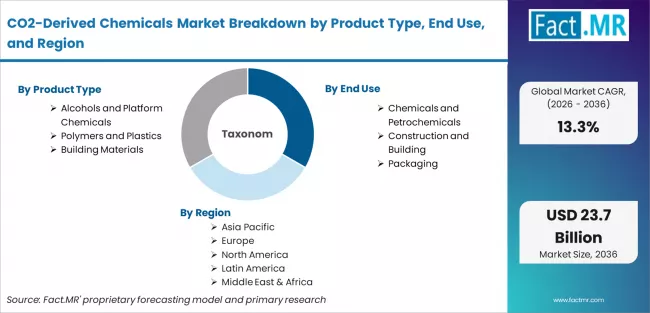
Co2 Derived Chemicals Market Breakdown By Product Type, End Use, And Region | Source: Fact.MR
| Attribute | Details |
|---|---|
| Quantitative Units | USD 6.8 billion (2026) to USD 23.7 billion (2036), at a CAGR of 13.3% |
| Market Definition | Chemicals synthesised using captured CO2 as a primary feedstock through catalytic, electrochemical, biological, and mineralisation conversion processes, serving chemicals, construction, packaging, and automotive industries globally. |
| Product Type Segmentation | Alcohols and Platform Chemicals, Polymers and Plastics, Building Materials, Fuels and Intermediates, Others |
| End Use Segmentation | Chemicals and Petrochemicals, Construction and Building, Packaging, Automotive and Fuels, Others |
| Technology Segmentation | Catalytic Hydrogenation, Mineralization and Carbonation, Electrochemical Conversion, Biological Conversion, Others |
| Application Coverage | Chemical industry decarbonisation feedstock, CO2-cured construction materials, sustainable packaging polymers, automotive fuel intermediates, and biological conversion protein and ethanol production. |
| Regions Covered | North America, Europe, Asia Pacific, Latin America, Middle East and Africa |
| Countries Covered | USA, Canada, Mexico, UK, Germany, France, Italy, Spain, Nordic, BENELUX, China, Japan, South Korea, India, ASEAN, Australia and New Zealand, Brazil, Argentina, Chile, Saudi Arabia, GCC, Turkey, South Africa, Rest of MEA |
| Key Companies Profiled | ExxonMobil, Linde plc, Honeywell International, Mitsubishi Heavy Industries, Schlumberger, TotalEnergies, Equinor ASA, Fluor Corporation |
| Forecast Period | 2026 to 2036 |
| Approach | Hybrid top-down and bottom-up model using CO2 conversion project pipeline capacity data, government programme grant records, technology licensing revenues, offtake contract volumes, and primary interviews with carbon capture project developers and chemical industry procurement managers. |
Source: Fact.MR analysis. Updated Mar 27, 2026
CO2-Derived Chemicals Market by Segments
-
By Product Type:
- Alcohols and Platform Chemicals
- Polymers and Plastics
- Building Materials
- Fuels and Intermediates
- Others
-
By End Use:
- Chemicals and Petrochemicals
- Construction and Building
- Packaging
- Automotive and Fuels
- Others
-
By Technology:
- Catalytic Hydrogenation
- Mineralization and Carbonation
- Electrochemical Conversion
- Biological Conversion
- Others
-
By Region:
- North America
- United States
- Canada
- Mexico
- Latin America
- Brazil
- Mexico
- Argentina
- Chile
- Rest of Latin America
- Western Europe
- Germany
- United Kingdom
- France
- Italy
- Spain
- Nordic Countries
- BENELUX
- Rest of Western Europe
- Eastern Europe
- Russia
- Poland
- Hungary
- Balkan and Baltic
- Rest of Eastern Europe
- East Asia
- China
- Japan
- South Korea
- South Asia and Pacific
- India
- ASEAN
- Australia and New Zealand
- Rest of South Asia and Pacific
- Middle East and Africa
- Kingdom of Saudi Arabia
- Other GCC Countries
- Turkey
- South Africa
- Rest of Middle East and Africa
- North America
Frequently Asked Questions
How large is the CO2-derived chemicals market in 2025?
What will the market size be in 2026?
What is the projected market size by 2036?
What is the expected CAGR of the CO2-derived chemicals market?
What is the absolute dollar opportunity in this market?
Which product type segment leads the CO2-derived chemicals market?
Which end use segment holds the largest share?
Which technology segment dominates the market?
Which country shows the fastest growth?
What are CO₂-derived chemicals?
What is driving market growth?
Why is the market not yet fully commercial?
Which technology leads the market?
Which product segment dominates?
Who are the key players?
Why do large energy companies have an advantage?
Who worked on this report


Preview the report firsthand - request a free sample
Free SampleGet the brochure for pricing and purchase details
Download PDF