- Market Value (2025): USD 995.4 Mn
- Estimated Value (2026): USD 1030.0 Mn
- Forecast Value (2036): USD 1450.0 Mn
- CAGR (2026-2036): 3.5%
What is the Exhibition Truss Systems Market forecast to be worth by 2036?
USD 1030.0 million in 2026 to USD 1450.0 million by 2036 at a 3.5% CAGR.
- The exhibition truss systems market surpassed a value of USD 995.4 million in 2025 as event customers spent more on booth frames and lighting support.
- Demand is projected to rise from USD 1030.0 million in 2026 to USD 1450.0 million by 2036.
- The market is forecast to record a 3.5% CAGR from 2026 to 2036 due to rental-fleet planning and tighter venue checks.
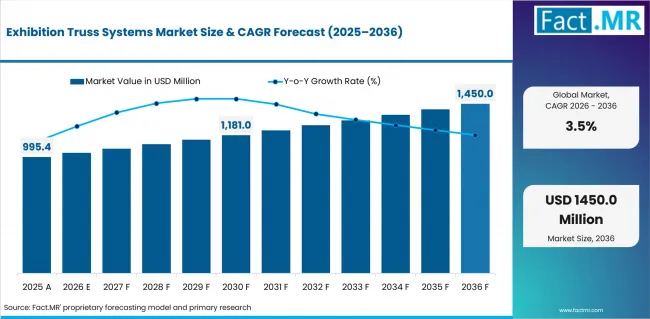
Exhibition Truss Systems Market Value Analysis | Source: Fact.MR
What are the defining numbers behind Exhibition Truss Systems Market growth?
USD 420.0 million absolute opportunity is expected by 2036, led by Box truss and Booth structures alongside AV rental firms and Aluminum mill finish.
- Demand Drivers in the Market
- Large-format booth architecture is expected to raise demand for wider truss spans. Providers gain preference when the load path is checked before booth fabrication begins.
- Higher lighting and display loads are anticipated to increase the value of tested connectors. Event customers need records that show every suspended element stays within approved limits.
- Rental-fleet standardization is projected to support replacement spending across repeat shows. Standard modules help providers inspect, repair and store truss after each event.
- Key Segments Analyzed
- By Truss Type: Box truss is forecast to represent 42.0% share in 2026 because it suits rectangular booth frames and predictable load transfer.
- By Application: Booth structures are estimated to command 28.0% share in 2026 since exhibitors need reusable frames for branded event spaces.
- By Load Class: Light-duty is projected to hold 22.0% share in 2026 due to its fit with common booths and modest hanging loads.
- By Buyer Type: AV rental firms are expected to account for 29.0% share in 2026 as rental fleets need repeatable equipment across many venues.
- By Material / Finish: Aluminum mill finish is anticipated to capture 44.0% share in 2026 because it offers standard availability and broad rental compatibility.
- Analyst Opinion at Fact.MR
- Shambhu Nath Jha, Senior Analyst at Fact.MR, states, “Exhibition truss systems are approved on evidence instead of visual design alone. Providers need to show that load ratings and connector condition remain consistent across repeated event use.”
- Strategic Implications
- Event customers need approval for load paths before booth drawings enter fabrication. This keeps trade show display planning within the structural capacity required for repeat events.
- Lighting loads require review before fixture packages are booked. Early checks help lighting fixture choices remain within safe connection limits.
- Truss providers must assign responsibility for connectors, inspection records and damaged-module replacement before equipment ships. Clear ownership keeps generator rental and temporary power work separate from truss approval.
- Rental partners can link inventory records with tool rental handoff documents. This reduces disputes after teardown and protects truss reuse across recurring exhibition programs.
UAE is expected to record a 4.2% CAGR from 2026 to 2036 with fast venue turnaround supporting pre-approved booth packages. USA is forecast to record a 3.5% CAGR from 2026 to 2036 supported by mature rental procurement and service depth. Japan is anticipated to record a 3.4% CAGR from 2026 to 2036 as compact booth formats favor lighter truss systems. UK is estimated to record a 3.2% CAGR from 2026 to 2036 where recurring exhibitor programs support reusable structures. Germany is projected to record a 2.9% CAGR from 2026 to 2036 because technical review keeps documentation standards high.
How does the Exhibition Truss Systems Market break down by segment?
Box truss is expected to lead Truss Type at 42.0% share. Booth structures are projected to lead Application at 28.0% share in 2026.
Which truss type dominates?
Box truss account for 42.0% share in 2026.
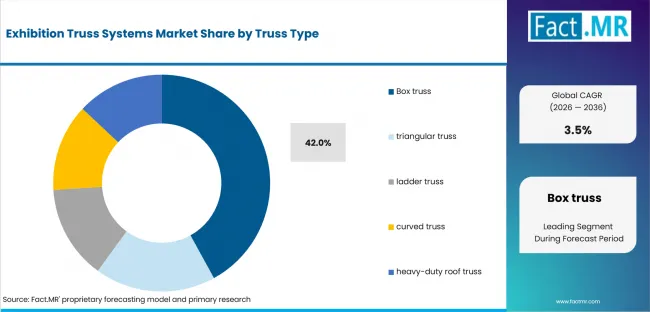
Exhibition Truss Systems Market Analysis By Truss Type | Source: Fact.MR
Box truss holds the top position as its rectangular profile works well with standard booth grids, corner blocks and overhead display layouts. Crews can assemble the format across different stand sizes without redesigning the full support system. Triangular truss suits lighter decorative work, while ladder truss fits simple spans. Curved and roof truss systems are selected for complex shapes or higher structural demands.
Why do Booth structures lead Application?
Booth structures hold 28.0% share in 2026.
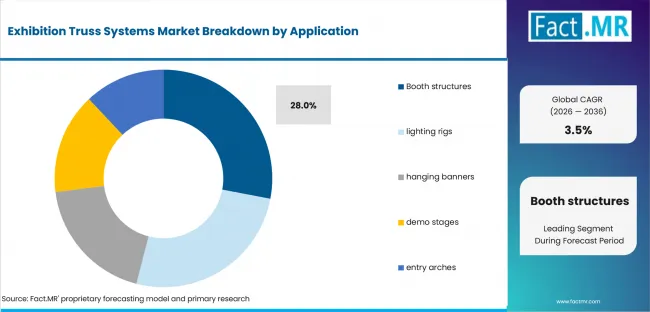
Exhibition Truss Systems Market Analysis By Application | Source: Fact.MR
Booth structures take the largest application share through their direct role in exhibitor stand design. The system supports walls, signs and overhead branding within one layout. Lighting rigs and hanging banners add demand where equipment must remain above visitors. Demo stages and entrance arches stay more specialized due to separate load checks, wider clearances and venue approval requirements before installation.
Why does Light-duty lead Load Class?
Light-duty lead with 22.0% share in 2026.
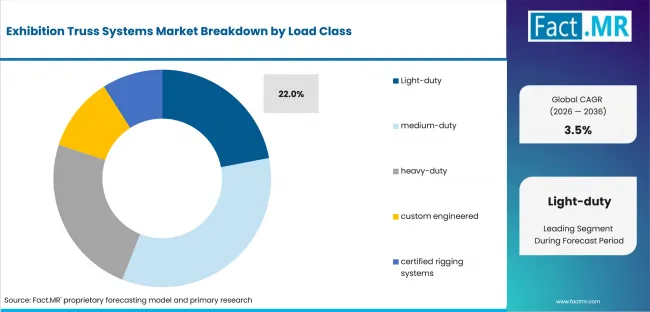
Exhibition Truss Systems Market Analysis By Load Class | Source: Fact.MR
Light-duty truss captures the largest share as most exhibition stands carry branding panels, small lights and lightweight displays rather than major production equipment. Its lower weight simplifies transport, handling and short setup schedules. Medium-duty systems become relevant when larger screens or suspended fixtures are added. Heavy-duty and custom-engineered formats serve taller builds, complex spans and projects requiring detailed structural calculations.
Why do AV rental firms lead Buyer Type?
AV rental firms hold 29.0% share in 2026.
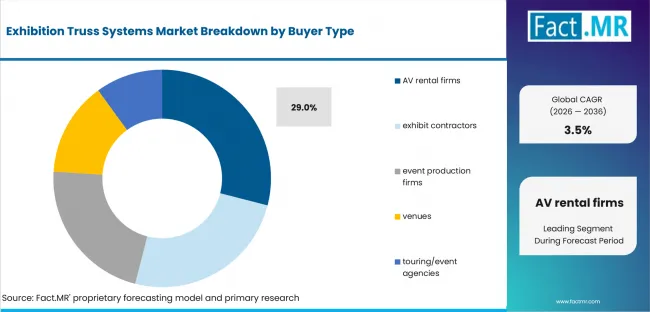
Exhibition Truss Systems Market Analysis By Buyer Type | Source: Fact.MR
AV rental firms represent the leading buyer group since the same truss stock can serve conferences, exhibitions and corporate events. Frequent reuse spreads costs across bookings and keeps compatible parts available. Exhibit contractors purchase truss when structural work is included in booth delivery. Event producers, venues and touring agencies invest selectively when recurring schedules justify dedicated inventory and repair support.
What supports Aluminum mill finish within Material / Finish?
Aluminum mill finish account for 44.0% share in 2026.
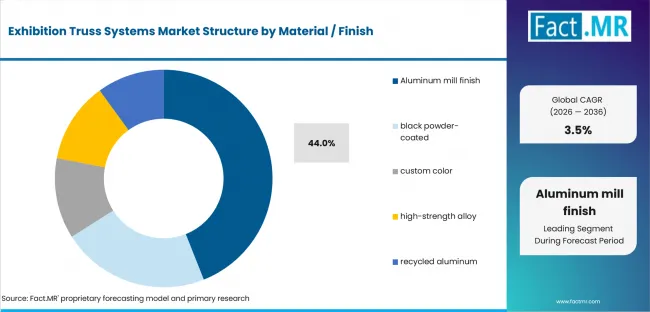
Exhibition Truss Systems Market Analysis By Material Finish | Source: Fact.MR
Aluminum mill finish remains preferred due to easy sourcing and compatibility across rental fleets. Matching sections can be combined or replaced with limited variation. The untreated surface also avoids extra production time. Black powder-coated truss suits darker event spaces, while custom colors support branded installations. Recycled aluminum gains attention where sustainability targets matter, although buyers still expect consistent strength and certification.
What is accelerating Exhibition Truss Systems Market adoption, and what is holding it back?
Demand will rise as booths become larger and use heavier fixtures. Growth may slow due to engineering checks, high transport needs and incompatible connectors.
Drivers Impact Analysis
| DRIVER | (~) % IMPACT ON CAGR | GEOGRAPHIC RELEVANCE | IMPACT TIMELINE |
|---|---|---|---|
| Large-format booth architecture | +0.9% | North America and Europe | Short term (<=2 years) |
| Higher lighting and display loads | +0.7% | China and UAE | Short term (<=2 years) |
| Rental-fleet standardization | +0.6% | Mature exhibition markets | Medium term (2-4 years) |
| Venue safety documentation | +0.4% | Global | Medium term (2-4 years) |
Source: Fact.MR analysis. Updated Jul 28, 2026
- Large-format booth architecture: Wider frames are expected to increase demand for truss systems that can be specified before fabrication. The purchase case improves when customers review load ratings before move-in.
- Higher lighting and display loads: Heavier fixtures are expected to raise the value of tested connection points. Providers need inspection records that remain usable after each event cycle.
- Rental-fleet standardization: Standard truss ranges are expected to support better use across recurring shows. The same inventory base helps companies schedule repair and replacement without redesigning every booth.
- Venue safety documentation: Formal venue review is expected to make load records part of the sales process. Clear documents help organizers approve overhead elements before installation crews reach the hall.
Opportunity Impact Analysis
| OPPORTUNITY | (~) % IMPACT ON CAGR | GEOGRAPHIC RELEVANCE | IMPACT TIMELINE |
|---|---|---|---|
| Digital load-calculation workflows | +0.6% | USA and UK | Short term (<=2 years) |
| Recycled high-strength alloys | +0.5% | Germany and Japan | Medium term (2-4 years) |
| Pre-certified booth packages | +0.3% | China and UAE | Medium term (2-4 years) |
Source: Fact.MR analysis. Updated Jul 28, 2026
- Digital load-calculation workflows: Software checks are expected to help providers explain how loads move through each truss section. The same discipline can support interactive projector installations when screens depend on overhead structure.
- Recycled high-strength alloys: Material upgrades are expected to create value when providers prove that recycled inputs do not weaken rated performance. Customers need records they can reuse across repeated deployments.
- Pre-certified booth packages: Pre-approved layouts are expected to reduce review time for common booth formats. Providers can package truss, connectors and load notes so installers follow the same setup process.
Restraints Impact Analysis
| RESTRAINT | (~) % IMPACT ON CAGR | GEOGRAPHIC RELEVANCE | IMPACT TIMELINE |
|---|---|---|---|
| Engineering and inspection requirements | -0.7% | Cost-sensitive regional markets | Short term (<=2 years) |
| Freight volume for heavy systems | -0.5% | Highly regulated venues | Medium term (2-4 years) |
| Incompatible connector standards | -0.3% | Global | Short term (<=2 years) |
Source: Fact.MR analysis. Updated Jul 28, 2026
- Engineering and inspection requirements: Review costs can slow adoption when customers treat truss as simple commodity equipment. Providers reduce this restraint by making engineering evidence part of the standard offer.
- Freight volume for heavy systems: Large truss packages add handling cost and dock-time pressure. Venue plans should include scissor lift rental when overhead installation requires safe access during setup.
- Incompatible connector standards: Mixed inventories can create approval risk when modules from different systems are combined. Material handling plans should include forklift rental when heavy sections move through venue docks.
Which countries are scaling Exhibition Truss Systems Market fastest?
The country comparison is shaped by event-market structure and venue approval practice. China and UAE form the upper pair because multi-city exhibition activity and fast venue turnover make repeatable truss packages more valuable. USA and Japan occupy the middle through mature procurement and compact system needs. UK and Germany grow more slowly, but both markets still reward careful documentation.
- UAE remains above the global rate because short setup windows reward systems that are easy to inspect. International events raise expectations for quick support and consistent load records.
- USA matches the global CAGR because customers already compare booth systems on repeatability and service depth. Demand depends on whether providers combine structure, lighting and teardown records into one workflow.
- Japan stays close to the USA because compact booth formats still require dependable load control. Space-efficient designs are expected to favor lighter systems with predictable installation.
- UK demand stays active through recurring exhibitions and rental programs. Providers gain preference when they reduce setup friction for customers attending several shows.
- Germany remains documentation-heavy because technical review shapes booth approval. Growth is slower than China and UAE, but customers still value certified components and clear inspection records.
Comparable CAGRs can therefore produce different entry conditions across these countries. Deployment timing depends on venue review, rental-fleet depth and provider readiness instead of the headline rate alone.
The full report provides country-level CAGR analysis across North America, Europe, East Asia, South Asia, Oceania, and the Middle East and Africa.
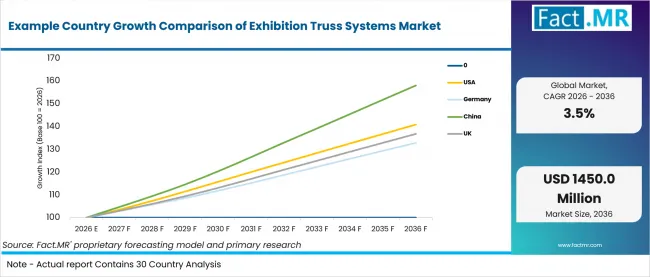
Example Country Growth Comparison Of Exhibition Truss Systems Market | Source: Fact.MR
| Country | CAGR (2026-2036) |
|---|---|
| UAE | 4.2% |
| USA | 3.5% |
| Japan | 3.4% |
| UK | 3.2% |
| Germany | 2.9% |
Source: Fact.MR analysis. Updated Jul 28, 2026
Why is high event activity strengthening demand in the UAE?
4.2% CAGR, driven by high event throughput and international participation.
The UAE forecast reflects short venue windows and high expectations for fast setup. Customers value truss systems that can be checked quickly before lighting and display elements are installed. Providers with local support and clear load records are expected to gain preference in major exhibition venues.
What supports steady expansion across the USA market?
3.5% CAGR, supported by measurement-led exhibitor procurement.
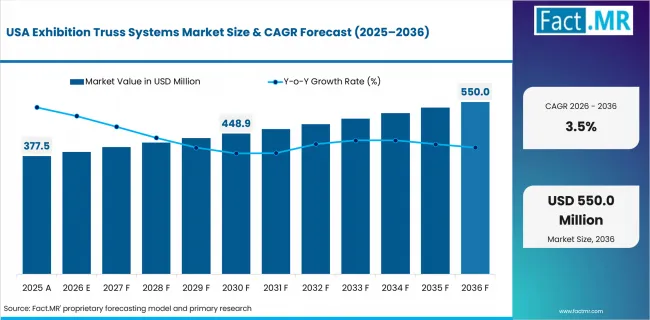
Exhibition Truss Systems Market Country Value Analysis | Source: Fact.MR
The USA is projected to grow at the global rate as exhibitors connect booth spending with repeat show performance. Large-format booth architecture strengthens demand when it can be reused across regional and national events. Providers can improve adoption by approving loads and connection details before fabrication begins.
How are compact systems shaping Japan’s growth outlook?
3.4% CAGR, led by compact systems and reliable operation.
Japan demand reflects a preference for space-efficient booth systems with dependable installation quality. Aluminum mill finish remains useful where rental providers need durable and easily matched inventory. Recycled high-strength alloy can add value when it does not increase documentation burden.
What keeps the UK market moving through 2036?
3.2% CAGR, backed by recurring exhibitions and rental use.
UK demand is forecast to expand as recurring shows support rental and hybrid ownership programs. Exhibition truss systems compete on quick setup, clean finishing and predictable load records. Providers strengthen the offer when structure planning and installation checks are completed before venue move-in.
Why does Germany maintain a slower but stable growth path?
2.9% CAGR, driven by an international and technically demanding trade-fair base.
Germany grows more slowly because technical review and documentation expectations are already high. Customers still need truss packages that prove certified performance across repeated installations. Venue safety documentation is expected to remain the main route for providers to protect share.
Who leads the Exhibition Truss Systems Market?
Global Truss and Eurotruss are key companies, while DuraTruss, Tyler Truss Systems and XSF Truss also support the market.
Global Truss provides modular aluminum truss for booth frames, lighting rigs and temporary event structures. Eurotruss offers certified systems for exhibitions and live events. DuraTruss focuses on reusable products for rental fleets. Tyler Truss Systems provides reliable components for different load needs. XSF Truss supplies custom systems for exhibitions, stages and overhead displays.
Through 2036, competition will depend on load safety, connector compatibility and clear inspection records. Buyers will also compare setup time, transport costs and replacement support. Companies with standard products, proper documents and strong local service are likely to attract more AV rental firms, exhibit contractors, event producers and exhibition venues.
Which companies are the key providers?
Key companies include Global Truss, DuraTruss, Eurotruss, Tyler Truss Systems, XSF Truss.
- Global Truss
- Eurotruss
- DuraTruss
- Tyler Truss Systems
- XSF Truss
Bibliography
- National Bureau of Statistics of China. (2026, February 28). Statistical communiqué of the People’s Republic of China on the 2025 national economic and social development.
- European Commission, Directorate-General for Internal Market, Industry, Entrepreneurship and SMEs. (2025, January 7). New EU rules on the safety and sustainability of construction products mark a new step for the sector’s competitiveness.
- Health and Safety Executive. (2026, July 1). Latest annual work-related fatalities published.
- Events Industry Alliance. (2026, April 15). UK exhibitions reach highest level in a decade according to EIA 2025 SASIE report. Events Industry Alliance.
This Report Answers
- The report provides strategic intelligence on the Exhibition Truss Systems Market across Truss Type and Application choices. These choices shape how event customers approve temporary booth structures.
- Segment analysis covers Box truss and Booth structures as the share leaders within the 2026 market. The review explains why standard form and repeat use matter.
- Country outlook evaluates China and UAE alongside USA and Japan. UK and Germany complete the growth comparison across the profiled markets.
- Competitive analysis profiles Global Truss and DuraTruss alongside Eurotruss and Tyler Truss Systems. XSF Truss completes the provider set.
Use-case assessment covers booth structures and jewelry display stands when display hardware needs rated support points. This keeps the scope focused on direct exhibition use.
What does the Exhibition Truss Systems Market cover?
Engineered aluminum structures support booth elements and temporary event architecture.
The Exhibition Truss Systems Market includes box truss and triangular truss. Coverage extends to ladder truss, curved truss and heavy-duty roof truss modules with connectors used in exhibition and event structures. Revenue is tied to the configured truss product and its direct event function.
The market differs from broader event equipment because the boundary is defined by structural support for temporary exhibition use. Standalone programmable stage lighting is excluded unless it is sold as part of a covered truss package.
What is included in the scope?
The scope includes truss systems used by AV rental firms and exhibit contractors. Event production firms and venues are included when they use truss for covered exhibition structures.
Coverage spans Truss Type and Application alongside Load Class, Buyer Type and Material / Finish. It includes booth structures and lighting rigs. Hanging banners, demo stages and entry arches remain in scope when they use covered exhibition truss systems.
Components remain in scope when they are provided as part of the complete exhibition truss systems offer. Architectural membranes remain outside the scope unless the membrane and support structure are sold as a covered booth system.
What is excluded from the scope?
Building structural steel and venue roof systems remain outside the scope. Permanent stage construction and rigging labor sold separately remain outside the scope.
The scope excludes unrelated venue construction and general event management. Floor-space rental remains outside the scope when it does not deliver the defined product function. It excludes the value of the event or venue in which the system is used.
How Was the Analysis Built?
The analysis draws on 120+ sources, 35+ company portfolios, 25+ countries, and more than 20 industry interviews.
- Primary Research: Primary research includes discussions with manufacturers, service providers, technology developers, distributors, end users, procurement teams, and subject-matter experts. These conversations examine purchasing priorities, product adoption, operational challenges, approval requirements, competitive positioning, and the factors that influence wider market acceptance.
- Desk Research: Desk research covers government statistics, regulatory publications, company filings, trade data, technical studies, industry associations, standards, public policy, and other authoritative sources. Every source used in the analysis is documented in the bibliography.
- Market Sizing and Forecasting: Market estimates combine historical performance, demand indicators, pricing and volume trends, segment shares, company participation, country-level growth, adoption patterns, investment activity, and barriers to market expansion.
- Data Validation and Update Cycle: Findings are validated by comparing primary interviews with public data, company activity, regulatory changes, trade patterns, and industry developments. Regular updates review new product launches, capacity changes, partnerships, approvals, procurement trends, and shifts in commercial adoption.
Segmentation
What is the report’s scope and coverage?
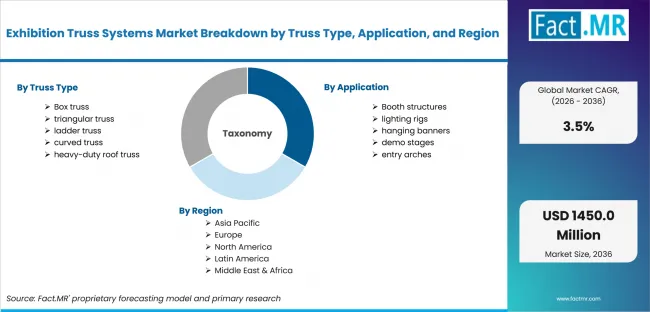
Exhibition Truss Systems Market Breakdown By Truss Type, Application, And Region | Source: Fact.MR
| Attribute | Details |
|---|---|
| Quantitative Units | USD million in 2026 to USD million by 2036 at CAGR |
| Market Definition | Engineered aluminum truss structures used to support booth elements, lighting points, banners and temporary event architecture when sold as exhibition support systems |
| Truss Type | Box truss, triangular truss, ladder truss, curved truss, heavy-duty roof truss |
| Application | Booth structures, lighting rigs, hanging banners, demo stages, entry arches |
| Load Class | Light-duty, medium-duty, heavy-duty, custom engineered, certified rigging systems |
| Buyer Type | AV rental firms, exhibit contractors, event production firms, venues, touring/event agencies |
| Material / Finish | Aluminum mill finish, black powder-coated, custom color, high-strength alloy, recycled aluminum |
| Regions Covered | North America, Europe, East Asia, Middle East and Africa |
| Countries Covered | UAE, USA, Japan, UK, Germany |
| Key Companies Profiled | Global Truss, DuraTruss, Eurotruss, Tyler Truss Systems, XSF Truss |
| Forecast Period | 2026 to 2036 |
| Approach | Hybrid top-down and bottom-up analysis using truss type demand, application requirements, load class, buyer type, material finish, country growth, company participation and adoption barriers |
Source: Fact.MR analysis. Updated Jul 28, 2026
How is the market segmented?
-
By Truss Type:
- Box truss
- Triangular truss
- Ladder truss
- Curved truss
- Heavy-duty roof truss
-
By Application:
- Booth structures
- Lighting rigs
- Hanging banners
- Demo stages
- Entry arches
-
By Load Class:
- Light-duty
- Medium-duty
- Heavy-duty
- Custom engineered
- Certified rigging systems
-
By Buyer Type
- AV rental firms
- Exhibit contractors
- Event production firms
- Venues
- Touring/event agencies
-
By Material / Finish:
- Aluminum mill finish
- Black powder-coated
- Custom color
- High-strength alloy
- Recycled aluminum
-
By Region:
- North America
- USA
- Canada
- Latin America
- Brazil
- Mexico
- Rest of Latin America
- Europe
- Germany
- U.K.
- France
- Italy
- Spain
- Rest of Europe
- East Asia
- South Korea
- Japan
- China
- South Asia & Oceania
- India
- Australia & New Zealand
- Rest of South Asia & Oceania
- Middle East & Africa
- GCC Countries
- South Africa
- UAE
- Rest of Middle East & Africa
- North America
Frequently Asked Questions
Which Truss Type leads the market?
Which Application leads the market?
Which Load Class leads the market?
Which Buyer Type leads the market?
Which Material / Finish leads the market?
Which country records the highest listed CAGR?
What is the primary driver in this market?
What is the main restraint?
Why do AV rental firms lead demand?
Who worked on this report


Preview the report firsthand - request a free sample
Free SampleGet the brochure for pricing and purchase details
Download PDF